
Opening: Why Are Newcomers Searching for BLUR?
If you're new to crypto, you've probably heard of BTC, ETH, and BNB, and maybe even NFTs. But when you first see BLUR, you usually have three questions:
First, is BLUR the token of an NFT platform?
Second, what's the difference between Blur, OpenSea, and Magic Eden?
Third, if I don't trade NFTs and I'm only buying BLUR/USDT on Hibt, does it still have investment value?
Here's a clear upfront conclusion:
BLUR is the governance token of the Blur NFT marketplace ecosystem. It is not equity in Blur, nor does it represent platform ownership; it functions more like a governance credential for Blur DAO, allowing holders to participate in protocol parameters and ecosystem governance. Blur Foundation's official documentation explicitly states that the BLUR token enables the community to engage in DAO governance across Blur marketplace, aggregator, and Blend lending protocol components.
But this doesn't mean BLUR is automatically worth a heavy position. BLUR's value is highly dependent on whether the NFT market recovers, whether Blur can continue attracting professional NFT traders, whether Blend lending has real demand, and whether token unlock pressure is absorbed by the market.
This article addresses the three questions newcomers care about most:
What is BLUR? Can you buy it now? If you choose to buy on Hibt, how can you complete the process as safely as possible?
I. What Exactly Is BLUR? Let's First Solve the "Does This Token Have Real Business Behind It?" Question
The relationship between BLUR and Blur can be understood as:
Blur is the product; BLUR is the governance token of this product's ecosystem.
Blur itself is an NFT marketplace designed for professional NFT traders. Unlike OpenSea, which is more mass-market oriented, Blur emphasizes speed, batch sweeping, listings, bids, real-time data, portfolio management, and trading efficiency. The Blur website directly positions itself as "The fastest NFT marketplace," highlighting 0% marketplace fees, 10x faster sweeping, cumulative GMV, and user metrics.
For newcomers, an NFT marketplace can be simply understood as "a trading market for buying and selling digital collectibles, on-chain profile pictures, game items, and art NFTs." OpenSea is more like the early NFT world's general e-commerce platform, while Blur is more like an NFT trading terminal built for professional traders.
1.1 Does Holding BLUR Equal Owning Shares in Blur Platform?
No.
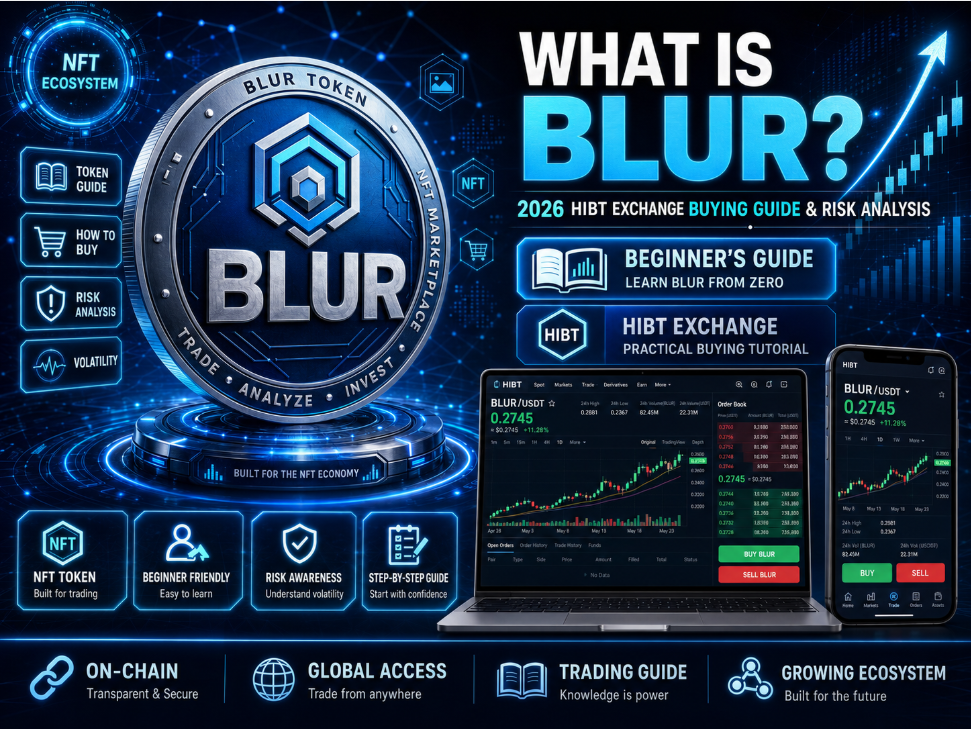
This is the most common misconception among newcomers. BLUR is not a stock; it does not represent equity in Blur Inc., nor does it guarantee dividends. Holding BLUR primarily means you have the right to participate in Blur DAO governance. Blur Foundation documentation clarifies that BLUR is a token for community governance, not a traditional equity certificate.
So, when you buy BLUR, what you're really betting on is:
- Blur platform will continue to have trading demand in the future;
- Blur DAO governance has value;
- The NFT market may recover in the future;
- The BLUR token continues to play a role in ecosystem incentives, governance, and trader participation;
- The market is willing to re-price NFT infrastructure tokens.
If you simply think "buying BLUR equals buying shares in Blur," that understanding is incorrect.
1.2 How Is Blur Different from OpenSea and Magic Eden?
OpenSea caters more to general users and casual NFT collectors. Magic Eden is stronger in multi-chain ecosystems, especially in Solana and Bitcoin Ordinals, with strong brand recognition. Tensor is the professional platform commonly used by Solana NFT traders.
Blur's core difference is: it is more oriented toward professional traders.
Professional NFT traders don't care about "whether the page looks good"; they care about:
- Can they sweep quickly;
- Can they aggregate liquidity across markets;
- Can they monitor floor price changes in real-time;
- Can they batch list and cancel orders;
- Can they earn trading incentives through bids, listings, points, and rewards;
- Can they treat NFTs as financial assets for lending and borrowing.
Blur's 0% marketplace fee model and trading rewards mechanism helped it rapidly capture market share from OpenSea. The Verge's coverage on OpenSea's competitive pressure noted that Blur, through its strategy targeting NFT flippers and professional traders, quickly impacted OpenSea's trading volume and product direction.
1.3 What Can the BLUR Token Specifically Do?
BLUR's core utilities are mainly three:
First, governance voting.
BLUR holders can participate in Blur DAO governance, voting on protocol parameters, incentive mechanisms, and ecosystem direction. Blur Foundation's official documentation explicitly defines BLUR as a community governance token.
Second, ecosystem incentives.
Blur previously distributed BLUR to users through Season 1, Season 2, and other campaigns. The Blur website shows that Season 1 and Season 2 combined distributed 700M BLUR to the community, and it has entered Season 3 supported by Blast.
Third, connection to Blend lending protocol.
Blend is an NFT lending protocol in the Blur ecosystem. Paradigm's Blend whitepaper defines it as a peer-to-peer, oracle-less, no-fixed-maturity NFT collateral lending protocol that allows users to borrow ETH using NFTs as collateral.
Simply put, if Blur is the NFT trading market, then Blend is the financial tool that turns NFTs into "collateralizable assets." It allows NFTs to be used not just for buying and selling, but also for borrowing, leveraged buying, or liquidity management.
1.4 Who Is the Founder? Are There Notable Institutions Backing It?
Blur's founder is commonly known as Pacman, publicly identified as Tieshun Roquerre. He is also associated with the later Blast L2 project. Public records show Blur completed a $11 million seed funding round in 2022, led by Paradigm. The Block reported that Blur is an NFT marketplace targeting professional traders, and it raised an $11 million seed round led by Paradigm in 2022.
The Blur website also displays Paradigm and other backers in its "Trusted and Backed By" section.
This indicates BLUR is not a completely backgroundless "air token." It has a real product, historical trading volume, institutional backing, on-chain contracts, and a governance framework. But this does not mean it has no risks. Institutional backing only means someone was bullish on the project direction early on; it does not guarantee secondary market price appreciation.
1.5 How to Confirm You Are Looking at the Real BLUR?
BLUR is an ERC-20 token on Ethereum mainnet. Blur Foundation's official contract page shows the BLUR Token Contract as:
0x5283d291dbcf85356a21ba090e6db59121208b44
CoinGecko's BLUR page also shows that users can manually add BLUR to MetaMask using the same contract address.
Newcomers must remember: determining real vs. fake BLUR ultimately comes down to the contract address, not just the name.
If you see a token also called BLUR in your on-chain wallet but the contract address is not:
0x5283d291dbcf85356a21ba090e6db59121208b44
Do not touch it. It could be a copycat, fake token, or phishing token.
II. What Is BLUR's "Balance Sheet"? Understanding Price, Market Cap, Supply, and Unlock Pressure
You cannot evaluate BLUR simply by saying "it fell a lot, so it's cheap." What really matters is market cap, circulating supply, unlocks, trading volume, platform revenue, and the NFT industry cycle.
As of data captured on July 7, 2026, CoinGecko shows BLUR price at approximately 0.01954**, 24-hour trading volume at approximately **113 million, circulating supply at approximately 2.8 billion BLUR, market cap at approximately $55.51 million, and CoinGecko ranking around #376. These figures change in real-time with market conditions and should be verified again at publication time.
CoinMarketCap data for the same period also shows BLUR price around $0.0195, 24-hour trading volume exceeding $150 million, circulating supply at approximately 2.837 billion, market cap at approximately $55.38 million, and ranking around #361.
2.1 Why Has BLUR Fallen So Much from Its All-Time High?
CoinGecko shows BLUR's all-time high was approximately $5.02, and the current price is down approximately 99.6% from that peak.
This is not a small decline; it is close to a "round-trip to zero." But this cannot be simply interpreted as "the project is dead." At least four factors explain BLUR's crash:
First, the NFT market overall retreated from the 2021–2022 bubble period.
Second, BLUR's early valuation was too high, and market expectations for NFT marketplace tokens were overly optimistic.
Third, continuous token unlocks have exerted long-term selling pressure on the secondary market.
Fourth, Blur's trading incentive mechanisms, while generating volume, have also sparked controversy around "wash trading for rewards."
In other words, BLUR didn't fall simply because of one bad piece of news; it is the combined result of industry cycles, valuation bubbles, token releases, and platform competition.
2.2 Of the 3 Billion Total Supply, How Much Is Still Locked?
Blur Foundation's official tokenomics shows BLUR's total genesis supply is 3 billion, to be gradually released over 4–5 years. The initial allocation is:
- 51% allocated to community members, approximately 1.53 billion;
- 29% allocated to past and future core contributors, 4-year vesting, approximately 867.6 million;
- 19% allocated to investors, 4-year vesting, approximately 565.6 million;
- 1% allocated to advisors, 4–5 year vesting, approximately 36.76 million.
Since BLUR launched in February 2023, the core release pressure from 4-year vesting will roughly continue until around February 2027; the advisor portion, due to its 4–5 year cycle, could theoretically extend even longer. CoinGecko's page shows that approximately 2.838 billion BLUR have already been unlocked and entered circulation, while approximately 161 million remain locked.
This means BLUR's maximum dilution pressure is already much smaller than in the early days, but it is not completely over. Newcomers should understand one principle:
Token unlocks do not necessarily cause price drops, but they do increase the supply that the market needs to absorb.
If project activity, trading revenue, user growth, and market sentiment do not improve simultaneously, unlocks can easily form selling pressure.
2.3 How Much TVL Does the Blend Protocol Have? What Does It Indicate?
TVL stands for Total Value Locked. It roughly measures how much capital or assets are actively being used in a protocol.
DefiLlama shows that Blur Lending, i.e., Blend, currently has a TVL of approximately $1.07 million, operating primarily on Ethereum. DefiLlama also notes that Blur Lending allows NFT holders to borrow ETH using NFTs as collateral, and supports Buy Now, Pay Later (BNPL) style NFT purchases.
This data tells us two things:
First, Blend is a real protocol that still exists, not a pure concept.
Second, its current scale is not large, far from comparable to mainstream DeFi lending protocols.
Therefore, BLUR's long-term value cannot be supported by the "Blend concept" alone. What the market cares more about is: whether NFT lending demand can recover, whether Blur can re-attract high-quality NFT trading volume, and whether the protocol can generate sustainable revenue in the future.
2.4 Why Is Daily Trading Volume So High? Real Demand or Wash Trading?
BLUR's daily trading volume can sometimes be very high. CoinGecko on July 7, 2026 showed its 24-hour volume exceeding $112 million, while market cap was only about $55.51 million — a very high turnover rate.
High turnover can indicate market activity, but it can also indicate short-term speculation. For tokens like BLUR with a history of trading incentives, you must scrutinize the volume structure:
- Is it concentrated on a few exchanges;
- Is it from real buying and selling demand;
- Is it driven by short-term capital;
- Is it accompanied by major announcements;
- Is the price rising while on-chain users and protocol data are not improving simultaneously.
The NFT market itself also has wash trading issues. A 2024 study on NFT market wash trading noted that NFT marketplaces with incentive structures are more prone to higher proportions of wash trading.
So, when you see BLUR's trading volume is high, don't simply say "money is coming in." A more professional judgment is: volume must be viewed together with price, order book depth, on-chain activity, protocol revenue, and NFT market heat.
III. Is BLUR Still Worth Looking At? Catching a Falling Knife or Buying the Dip?
Whether BLUR is worth paying attention to is not about "it fell 99% so it's cheap," but whether it has a re-pricing opportunity in the next NFT market cycle.
3.1 What Stage Is the NFT Market in for 2026?
The 2026 NFT market is no longer the 2021 era of "profile picture projects exploding everywhere." Today's NFT market is more mature and also more brutal:
- General PFP project liquidity has significantly declined;
- Professional traders remain active, but they value tools and speed more;
- New directions like Bitcoin Ordinals, gaming assets, membership rights, and RWA credentials are diverting attention;
- Competition among platforms like OpenSea, Magic Eden, Blur, and Tensor is more intense;
- The marginal effect of attracting trading volume through subsidies and airdrops is diminishing.
CoinGecko's NFT marketplace research shows that Magic Eden once became the market share leader in 2024 thanks to multi-chain and Ordinals trading volume, while Blur remains an important platform in Ethereum NFT trading. CoinGecko's statistics also note that Blur holds a significant share in Ethereum NFT trading, while Magic Eden and Tensor are more competitive in the Solana NFT market.
This shows Blur has not disappeared, but it is no longer facing a single OpenSea; it is facing multi-chain, multi-platform, multi-asset-type competition.
3.2 Can Blur's 0% Marketplace Fee Model Sustain Long-Term?
The Blur website still emphasizes 0% marketplace fees, which is one of the key reasons it attracts professional traders.
But from a business model perspective, 0% fees also mean limited direct platform revenue. For Blur to prove itself in the future, it may need to establish value capture in the following areas:
- Blend lending-related fees;
- Premium trading tools or data services;
- Protocol parameter adjustments under DAO governance;
- Ecosystem synergy with Blast and others;
- Maintaining trader retention even after incentive reduction.
If a platform relies on subsidies and airdrops to sustain trading volume long-term without stable revenue, its token value will tend to depend on market sentiment. Conversely, if Blur can build stable demand in NFT lending, professional trading tools, and cross-chain liquidity, BLUR's valuation logic will be more solid.
3.3 Compared to Governance Projects Like Core DAO, How Active Is BLUR's DAO?
Core DAO is more oriented toward public chain ecosystem governance, centered around consensus, security, staking, BTCfi, and EVM ecosystem expansion. BLUR is more oriented toward NFT marketplace and trading protocol governance.
The difference is:
Core DAO's governance and ecosystem value come more from the underlying blockchain and application ecosystem expansion.
BLUR's governance value comes more from Blur marketplace, Blend, trading incentives, and NFT financialization.
If you want to understand the difference between public chain governance projects and application governance projects, you can refer to the in-site Core DAO Deep Dive Guide. BLUR's DAO is more like "trading platform protocol governance," not "underlying blockchain governance."
This means BLUR's governance value is more dependent on whether the specific products are being used. If Blur's trading volume and Blend activity decline, BLUR's governance appeal will also decline.
3.4 How Big Is the Threat from OpenSea, Magic Eden, and Tensor to Blur?
The threat is substantial.
OpenSea still has brand recognition and a mass user base. Magic Eden is very strong in multi-chain, Solana, and Ordinals. Tensor holds a position among Solana NFT professional traders. DappRadar's 2026 NFT marketplace article also mentioned that OpenSea 2.0, Magic Eden, and Blur all attract users through points or incentive mechanisms.
Blur's advantage is Ethereum NFT professional trading experience, but its weaknesses are also clear:
- High dependence on overall NFT market conditions;
- User base is professional, with higher barriers for ordinary users;
- Uncertainty of monetization under the 0% fee model;
- Trading volume may fluctuate after token incentives decrease;
- Multi-chain expansion is not as intuitive as Magic Eden's.
Therefore, BLUR is more suitable as an NFT sector rebound play, not as a mindless long-term hold asset.
3.5 Which Types of Investors Are Suitable for BLUR?
Those more suitable for BLUR include:
- People who are bullish on NFT market recovery;
- People familiar with the Ethereum NFT trading ecosystem;
- People who can accept high volatility and deep drawdowns;
- People willing to track unlocks, governance, and platform data;
- People with clear stop-loss and take-profit discipline.
Those not suitable for BLUR include:
- People who just entered the space and want to buy a token and forget about it long-term;
- People who cannot accept 30%–50% drawdowns;
- People who want to bottom-fish just because "it fell a lot";
- People who completely don't understand the NFT market;
- People who use living expenses, borrowed money, or emergency funds to buy tokens.
IV. Practical Steps to Buy BLUR on Hibt
Hibt already provides a BLUR/USDT market page and a "Go to Trade" entry. Page navigation includes shortcuts for buying crypto, markets, spot trading, futures trading, earn products, help center, ticket submission, official channel verification, and more.
Below is the step-by-step breakdown for newcomers.
4.1 What Do You Need to Prepare to Register a Hibt Account?
You need to prepare:
- A frequently used email address;
- A secure password;
- Mobile or email verification codes;
- Identity documents required for KYC;
- Google Authenticator or other 2FA tools.
After registering, do not deposit immediately; first complete security settings:
First, enable 2FA.
Second, confirm you are on the official Hibt website.
Third, find "Official Channel Verification" at the bottom of the Hibt page, and verify whether customer service emails, social media accounts, and links are genuine. Hibt's page footer provides official channel verification and help center entry, which is very important for anti-phishing.
4.2 How Long Does KYC Identity Verification Generally Take?
Different regions, document types, and system review statuses mean KYC can take anywhere from a few minutes to several hours, and in special cases longer. Newcomers doing KYC should note:
- Document photos must be clear;
- Names and document numbers must not be entered incorrectly;
- Do not use someone else's identity information;
- Do not purchase so-called "already verified accounts";
- Do not send verification codes to any private-message "customer service."
Centralized exchange full functionality usually depends on KYC. Without completing KYC, you may be restricted in deposits, withdrawals, trading limits, or use of certain products.
4.3 How to Deposit USDT to Hibt?
Before buying BLUR/USDT, you usually need to deposit USDT first. You can go to the Hibt assets page, select "Deposit," search for USDT, and then choose the deposit network.
Common networks include:
TRC-20: Usually lower fees and faster arrival, a common choice for newcomers.
BEP-20: BNB Chain network, low fees, but you must ensure the sending platform also selects BEP-20.
ERC-20: Ethereum network, compatible with BLUR's main chain ecosystem, but on-chain fees are usually higher.
The most common mistake newcomers make: selecting TRC-20 for withdrawal on one platform, but choosing the BEP-20 deposit address on Hibt. If the chain is wrong, assets may not arrive automatically and may require complex appeals.
My practical advice is:
- First deposit only 10–20 USDT to test;
- Withdrawal network and deposit network must be exactly the same;
- Do not manually type addresses; copy-paste and check the first and last few digits;
- After funds arrive, proceed with larger deposits;
- Every time you change platform or network, re-verify the address.
4.4 How to Search for the BLUR/USDT Trading Pair?
After USDT arrives, go to the Hibt spot trading page and search for:
Select the BLUR/USDT trading pair. You can also enter the trading page through Hibt's BLUR market page. Hibt's BLUR page shows the trading pair as BLUR/USDT, and provides a "Go to Trade" entry.
After entering the trading page, first check three things:
- Current price;
- Bid-ask spread;
- Order book depth and recent trades.
Do not market buy as soon as you enter the page. Especially for volatile altcoins like BLUR, prices can change quickly in a short time.
4.5 For Your First Order, Should You Choose a Limit Order or a Market Order?
Market Order: Executes immediately at the best available market price. Advantage: fast. Disadvantage: possible slippage.
Slippage means the price you see and the actual average execution price differ. For example, the page shows 0.020 USDT, but after a market buy the average execution price becomes 0.021 USDT — the difference is slippage.
Limit Order: You set the price you want to buy at, and the order only executes when that price is reached. Advantage: controllable. Disadvantage: you might not get filled.
For a newcomer buying BLUR for the first time, I recommend using a limit order. For example, if the current price is 0.020 USDT, you can place an order at 0.0195 or 0.0190, waiting for a pullback to fill, rather than chasing emotionally.
If you're just testing the process, you can use a very small amount for a market order, such as 5–10 USDT, with the goal of familiarizing yourself with execution and asset display, not pursuing profit.
4.6 Where to Check Asset Balance and P&L After Buying?
After buying, go to Hibt's "Assets" page and search for BLUR. You should be able to see:
- Available balance;
- Frozen balance;
- Asset valuation;
- Current orders;
- Order history;
- Trade history;
- Deposit and withdrawal entry.
If assets show as frozen, it's usually because you have an unfilled limit order. Go to "Current Orders," cancel the order, and the frozen assets will generally return to available balance.
4.7 If You Want to Withdraw BLUR to MetaMask, How to Operate?
BLUR is an ERC-20 token on Ethereum. The official contract address is:
0x5283d291dbcf85356a21ba090e6db59121208b44
If you want to withdraw BLUR to MetaMask, note the following:
- Confirm whether Hibt's withdrawal network is ERC-20;
- Confirm that your MetaMask address is an Ethereum mainnet address;
- First test with a small amount;
- After withdrawal, manually add the BLUR contract in MetaMask;
- Do not withdraw BLUR to addresses that do not support ERC-20;
- Do not treat the contract address as a withdrawal address.
If BLUR does not show after withdrawal to your wallet, don't panic. Open MetaMask, click "Import Tokens," paste the BLUR contract address, and you should see the balance.
V. Five Risks You Must Know Before Buying BLUR
BLUR is not a risk-free asset. It is more volatile than BTC and ETH, and more dependent on a single sector cycle than many mainstream altcoins.
Risk 1: Token Unlocks Are Not Yet Fully Over
BLUR's total supply is 3 billion, with most already in circulation, but some locked tokens have not yet been fully released. CoinGecko shows that approximately 2.838 billion have been unlocked and circulated, with approximately 161 million still locked.
Unlocks do not necessarily dump the price, but they create potential selling pressure. If project data does not improve, newly circulating supply may suppress the price.
A simple judgment method for newcomers:
If the price rise is due to NFT market recovery, Blur user growth, and Blend TVL increase, this is a relatively healthy rise.
If the price rise is only short-term pump, exchange campaigns, or news-driven, while unlock pressure remains, be more cautious.
Risk 2: Fake BLUR and Phishing Contracts
The real BLUR contract address is:
0x5283d291dbcf85356a21ba090e6db59121208b44
Etherscan's BLUR token page shows that the token has a maximum supply of 3 billion, and displays holders, price, on-chain transactions, and other information.
Before buying BLUR on-chain, you must verify the contract using Etherscan or CoinGecko. If the contract address differs, even if the name and logo look the same, do not buy it.
Risk 3: NFT Market Continues to Be Weak
BLUR's core business is highly correlated with the NFT market. If NFT trading volume continues to be low, Blur platform activity declines, and BLUR demand will be affected.
NFTs themselves have low liquidity, high volatility, difficult valuation, and wash trading and manipulation risks. Researchers have long paid attention to abnormal trading and wash trading in NFT markets, with related studies noting that NFT markets are relatively under-regulated and prone to wash trading, fraud, and abnormal trading behavior.
This means BLUR's risk does not come from the token itself alone, but also from the underlying NFT industry.
Risk 4: BLUR's Liquidity Risk Is Different from Small-Cap New Tokens, but That Doesn't Mean It's Safe
Compared to small-cap new tokens like MANLET, BLUR's advantages are:
- Listed on more exchanges;
- Higher trading volume;
- Easier to verify contracts and project information;
- More complete historical data;
- Usually better market depth.
But BLUR also has its own problems:
- Longer downward cycles;
- More complex token unlock history;
- Greater impact from NFT industry cycles;
- High trading volume may come from short-term speculation;
- Mid-cap does not mean it cannot continue falling.
You can refer to the in-site MANLET Deep Dive Guide to understand the risks of small-cap tokens in terms of slippage, order book depth, and violent ups and downs. BLUR has better liquidity than small tokens, but it is still not a low-risk asset.
Risk 5: Newcomer Errors in Hibt Operations
The three most common mistakes newcomers make when buying BLUR on Hibt or any exchange are:
First, wrong chain deposit.
For example, selecting ERC-20 on the deposit page but choosing TRC-20 on the withdrawal platform.
Second, treating the contract address as a withdrawal address.
The BLUR contract address is not your wallet receiving address; you cannot withdraw tokens to the contract address.
Third, clicking phishing links.
Do not log into exchanges via Telegram private messages, WeChat group links, or ad pop-ups. Preferably use browser bookmarks or official channels.
Anti-error methods are simple:
- Verify the network before every deposit;
- Test with a small amount before every withdrawal;
- Do not send verification codes to anyone;
- Do not download apps from unknown sources;
- Do not believe in "internal customer service," "quick unblocking," or "high-yield earn" private messages.
VI. Rational Strategies for Newcomers Allocating to BLUR
Buying BLUR is not hard; the hard part is how much to buy, when to buy, and when to sell.
6.1 How Much Position Is Safe for a First-Time Altcoin Allocation?
If you are a newcomer buying BLUR or similar altcoins for the first time, it is recommended to keep the position within 5% of total crypto assets.
Even if you have some experience and can tolerate large volatility, it is not recommended to exceed 10%.
For example:
If your total crypto asset budget is 1,000 USDT, then the initial BLUR allocation can be controlled at 30–50 USDT.
If your total budget is 300 USDT, then the first purchase of 10–20 USDT is enough.
The newcomer's first goal is not to get rich overnight with BLUR, but to learn the complete process: deposit, buy, cancel orders, check assets, set alerts, batch sell, and test withdrawals.
6.2 Dollar-Cost Averaging vs. Lump-Sum Bottom Fishing, Which Is More Suitable for BLUR?
BLUR is highly volatile; it is not recommended for newcomers to go all-in at once.
A more suitable approach is batch buying:
First tranche: 30% of planned funds, to establish an observation position.
Second tranche: Buy another 30% when the price pulls back to key support and there is no obvious bad news.
Third tranche: Buy the remaining 40% after NFT market data, Blur platform data, or price structure improves.
For example, if you plan to buy 100 USDT of BLUR, you can start with 30 USDT. If the price continues to fall after your purchase, do not immediately add more; first observe whether it breaks the previous low, whether trading volume abnormally spikes, whether there are new unlocks or exchange risk warnings.
6.3 How to Use Hibt's Price Alert Feature?
If Hibt supports price alerts, you can set two directions:
Buy alerts:
For example, if current BLUR is 0.020 USDT and you want to wait for a pullback, you can set alerts at 0.018 and 0.016.
Take-profit alerts:
For example, if your entry price is 0.020 USDT, you can set alerts at 0.030 and 0.040.
The purpose of price alerts is not to make you chase rallies and panic sell frequently, but to write your trading plan in advance. Execute when the price reaches your target; do not act impulsively in the moment.
Hibt's BLUR price prediction page also provides modules for current BLUR price, short-term price prediction, long-term price prediction, investment amount, and ROI calculation, but the page explicitly states that price predictions are for reference only and do not constitute investment advice.
6.4 How to Take Profits in Batches After Making Gains?
The most practical take-profit method for newcomers is batch selling:
- Up 50%, sell 1/3;
- Up 100%, sell another 1/3;
- Keep the remaining 1/3 as a profit position to continue observing.
Example:
You buy BLUR with 90 USDT.
If it rises 50%, the position becomes 135 USDT, and you sell approximately 45 USDT.
If it rises 100%, the position becomes 180 USDT, and you sell another approximately 60 USDT.
This way you gradually recover your principal while keeping the opportunity for further upside.
This is not a profit-maximization strategy, but it is suitable for newcomers to control emotions.
6.5 If You're Trapped After Buying, Should You Add or Cut Losses?
Do not add to your position just because the price drops.
You should first ask three questions:
First, is the drop because the entire market is falling, or is BLUR having specific problems?
Second, has Blur's fundamentals deteriorated, such as platform trading volume declining, NFT market remaining weak, exchange risk warnings, or major unlocks?
Third, does your original buying logic still hold?
If it's just broad market volatility and BLUR's fundamentals have not changed significantly, you can consider a small additional position.
If it's project-level problems, such as exchange risk tags, declining liquidity, or significantly deteriorating platform data, do not blindly average down.
Binance added BLUR to its Monitoring Tag on June 18, 2026, indicating that the token is considered to have higher volatility and risk and needs to be continuously monitored. This type of information is very important for risk management and should not be ignored.
VII. FAQ: Frequently Asked Questions from Newcomers
1. I bought BLUR on Hibt, why does my asset show "frozen" or "pending release"?
Common reasons include:
- You have a limit order pending, and assets are occupied by the order;
- Withdrawal is under review;
- Participation in campaign rewards is in a pending release state;
- Platform risk control requires additional verification;
- Trading pair or wallet is temporarily under maintenance.
First check "Current Orders." If there are unfilled orders, canceling them will usually return frozen assets to available balance.
2. Can BLUR be mined like Bitcoin?
No.
BLUR is not a PoW mining coin; it cannot be mined with mining rigs like BTC. BLUR is a fixed-supply ERC-20 token. Blur Foundation documentation shows the genesis total supply is 3 billion.
3. Can BLUR be staked for interest?
This depends on whether Hibt or the Blur ecosystem offers related products at the time. Do not directly participate in "stake BLUR for high yield" just because you see it, especially on third-party websites or community links.
If you want to participate in earn products on Hibt, you must confirm:
- Whether the product is on the official Hibt page;
- Whether BLUR is supported;
- What the source of the annual yield is;
- Whether you can redeem at any time;
- Whether there is principal loss risk.
4. Where Can I See Hibt's New Token Listing Announcements?
Hibt's page footer provides entries for "Platform Announcements," "Help Center," "News Articles," and more. You can also get information through Hibt's official social media. Hibt's BLUR market page also displays platform navigation, help center, ticket submission, and official channel verification entries.
Newcomers are advised to rely only on official website announcements and trading pages, not just community screenshots.
5. How Correlated Is BLUR's Price with ETH Price?
BLUR has some correlation with ETH, but ETH rising does not guarantee BLUR rising.
The reason is that Blur mainly operates in the Ethereum NFT ecosystem, and NFT trading, BLUR contracts, and Blend lending are all closely tied to the ETH ecosystem. But BLUR's price is also influenced by NFT market sentiment, token unlocks, exchange liquidity, platform competition, and DAO governance.
A more accurate understanding is:
ETH is the macro environment, the NFT market is the mid environment, Blur platform data is the micro environment, and BLUR's price is the result of all three interacting.
6. If I Want to Stop, How Do I Quickly Convert BLUR to RMB on Hibt?
The usual process is:
First, sell BLUR for USDT in the Hibt spot market.
Second, withdraw USDT to a platform or compliant OTC channel that supports fiat on/off ramp.
Third, convert to RMB or other fiat currency through local compliant channels.
Note here: whether Hibt supports fiat on/off ramp in your region depends on what you see after logging in. Different countries and regions may have different restrictions, and platform features may also be adjusted due to compliance requirements.
7. Is BLUR Worth Buying Now?
A more accurate way to put it is: BLUR is worth watching, but not suitable for newcomers to go heavy.
Its advantages are:
- Has a real NFT marketplace product;
- Has clear official contracts and governance documentation;
- Has institutional backing from Paradigm and others;
- Once held an important position in Ethereum NFT trading;
- Blend gives NFTs financialization expansion potential.
Its risks are:
- Extreme decline from all-time high;
- NFT industry is still in a recovery phase;
- Token unlocks are not yet fully over;
- Trading volume may be influenced by short-term capital;
- Exchange risk tags need attention;
- Platform revenue model still needs verification.
So, newcomers can observe with a small position, but it is not recommended to start with a heavy bet.
VIII. Conclusion: BLUR Is Not an Air Token, but Neither Is It a Low-Risk Bottom-Fishing Coin
BLUR has a real product behind it — Blur — with official documentation, on-chain contracts, a governance framework, and Blend, an NFT lending protocol. It is not an air token with no business whatsoever.
But from an investment perspective, BLUR's risks are also obvious:
The price has fallen extremely far from its all-time high, the NFT market has not fully recovered, platform competition is fierce, token unlocks still have tail-end pressure, and the long-term value capture of the 0% fee model still needs to be proven.
For newcomers, the correct posture is not to ask "Will BLUR rise back to its all-time high?" but to first ask:
- Do I know BLUR's real contract address?
- Do I understand that BLUR is not Blur equity?
- Do I know that the NFT market still has cyclical risks?
- Can I accept 30%–50% price volatility?
- Do I know how to correctly deposit USDT on Hibt?
- Do I know how to use limit orders to reduce slippage?
- Have I set take-profit and stop-loss plans?
If you don't have answers to these questions yet, don't rush to buy.
If you have completed basic learning and are only participating with a small position of 5% or less of total funds, then BLUR can serve as an observation play for NFT sector recovery.
Finally, remember one sentence:
BLUR's opportunity comes from NFT market recovery and Blur ecosystem re-growth; BLUR's risk also comes from NFT market weakness, token unlocks, and platform competition. Protect your principal first, then consider returns.
Author Bio
HIBT Research focuses on crypto newcomer education, exchange practical tutorials, NFT market observations, on-chain data analysis, and altcoin risk identification. Articles are based on public materials, official documentation, on-chain contracts, market data, and exchange practical processes, helping newcomers build a complete judgment framework from "understanding a project" to "safely buying" to "position management."
Disclaimer
This article does not constitute investment advice, legal advice, or financial advice. Crypto asset prices are highly volatile, and BLUR, as an NFT sector-related token, may be affected by market cycles, token unlocks, platform competition, liquidity changes, and regulatory policies. Before purchasing BLUR or any crypto asset, users should independently verify contract addresses, platform announcements, trading depth, local legal requirements, and personal risk tolerance, and make investment decisions independently.