
Tokens in the Solana ecosystem have a distinct pattern: they explode fast, spread fast, and die fast. A token can be pushed to trending by communities, KOLs, DEX leaderboards, and trading bots within 24 hours, then lose all liquidity as soon as the hype fades.
MANLET is a textbook example of this phenomenon.
It is not a long-term consensus asset like BTC, ETH, or SOL with deep liquidity. It is not a protocol token with a stable revenue model. MANLET is closer to an ultra-early-stage Solana Meme / community token. Its price is primarily driven by community virality, narrative hype, short-term buying pressure, and liquidity fluctuations.
More importantly, there are multiple tokens with the same or similar "MANLET" name. If you search for MANLET on different platforms, you may see completely different contract addresses, market caps, holder counts, and trading volumes. Therefore, the first step in researching MANLET is not to look at the price pump, but to verify the contract address.
This article focuses on the low-market-cap MANLET version mentioned in your request, whose Solana contract address is:
BoFAaiFDdEsB9oFhrbvogNtEyEs2r4i8vXXdE6zSpump
At the time of inquiry, the Bitget Wallet page showed this version of MANLET with a market cap of approximately 2.31K**, a fully diluted valuation (FDV) of approximately **2.31K, roughly 180 holders, a total supply of approximately 999.56M, and a max supply of 1B. This falls into the same ultra-low market cap range as the "market cap of approximately $2.68K" figure, meaning it is a typical micro-cap asset with extremely high risk.
This article does not constitute investment advice. MANLET may experience extreme volatility, lack of liquidity, situations where you can buy but not sell, contract confusion, pump and dump schemes, and other risks. Newcomers should treat it as a "high-risk lottery ticket," not a stable investment target.
Chapter 1: What Exactly Is MANLET? First, Answer the Question: "Does This Coin Have Real Backing, or Is It Pure Air?"
The most direct way to verify whether MANLET is real is to check its on-chain Solana contract.
The contract address for the low-market-cap version of MANLET is:
BoFAaiFDdEsB9oFhrbvogNtEyEs2r4i8vXXdE6zSpump
You can search for this full address in tools like Solscan, Bitget Wallet, GMGN, Dexscreener, and Birdeye. Note: you must copy the full contract address; do not rely solely on the "MANLET" name. Because there are many tokens with the same name, it is very easy to buy the wrong one if you only look at the ticker symbol.
The verification process is as follows:
Step 1: Open Solscan or another Solana explorer.
Step 2: Copy the full contract address:
BoFAaiFDdEsB9oFhrbvogNtEyEs2r4i8vXXdE6zSpump
Step 3: Confirm the mainnet is Solana.
Step 4: Check the token name, total supply, holder count, transfer history, and creation time.
Step 5: Cross-reference with platforms like Hibt, Bitget Wallet, CoinGecko, OpenSea, and DEX aggregators to ensure you are looking at the same MANLET.
From a positioning standpoint, MANLET is closer to a Meme coin or community token, rather than a functional utility token. It does not have clear technical utility like a Layer 1, public chain, oracle, or DeFi protocol, nor does it have stable protocol revenue or governance cash flows. Its value mainly comes from:
Solana Meme season hype;
Community self-deprecating culture and internet subculture;
Short-term trading sentiment;
KOL or community topic virality;
The "lottery ticket" imagination space brought by its low market cap.
The issuance logic of this type of token is not "solving a technical problem," but rather "creating a community symbol that is transmissible, tradable, and hype-able."
From a tokenomics perspective, Bitget Wallet shows the BoFA…pump version of MANLET has a total supply of approximately 999.56M, a max supply of 1B, and a circulating supply of approximately 999.56M. This indicates it is not a low-float, high-FDV structure, but rather close to a fully circulating state.
This structure has two implications:
First, future new unlock pressure may not be as significant as that of "low-float new tokens."
Second, the real risk is not in unlocks, but in liquidity, token concentration, and early-wallet selling pressure.
For an ultra-low market cap token like MANLET, the number of holders and the distribution of the Top 10 wallets are critical. When the market cap is only a few thousand dollars, even if the Top 10 wallet share does not look alarming, the price can be severely impacted due to extremely thin liquidity. A sell order of just tens or hundreds of dollars could noticeably move the price.
On the social media front, the publicly available data more strongly confirms that MANLET primarily relies on Meme virality and Solana community heat, rather than a mature official website, whitepaper, roadmap, or product ecosystem. Another higher-market-cap version of manlet is categorized under the Solana ecosystem on CoinGecko and shows trading availability on PumpSwap, Meteora, LBank, MEXC, and other venues; however, that is a different, more active, higher-market-cap MANLET version and cannot be directly applied to the BoFA…pump low-market-cap version.
Therefore, the conclusion of Chapter 1 is clear:
MANLET is not an empty contract; it has a real on-chain contract. However, it is more like an ultra-early Solana Meme coin, rather than a functional project with clear fundamental backing.
Chapter 2: What Is MANLET's Current Market Performance? Is It Expensive Now, and Can You Sell It?
For a micro-cap token like MANLET, determining whether it is "expensive" cannot be based on price alone. A very low unit price does not mean it is cheap, and a very low market cap does not necessarily mean it has potential.
What really matters are three things:
How small the market cap is;
Whether the trading volume is real;
Whether the liquidity is sufficient for you to exit.
At the time of inquiry, the BoFA…pump version of MANLET on the Bitget Wallet page showed a price of approximately 0.00000232**, a market cap of approximately **2.31K, an FDV of approximately $2.31K, roughly 180 holders, and a total supply of approximately 999.56M.
This market cap level is extremely low. It means:
If you buy $10, you may already be a relatively noticeable small buyer.
If you buy $100, you may have a noticeable impact on the price.
If you buy $500 or $1,000, you may encounter severe slippage.
If you want to sell in the future, there may not be enough buying pressure to absorb your order.
This is the most authentic problem with micro-cap Meme coins: it's not about whether it can pump, but whether you can sell.
Liquidity can be understood as "how much money the market is willing to use to take your order." If the pool is shallow, you will buy at a higher price when entering and sell at a lower price when exiting. Newcomers easily get excited when they see the price rising, but only discover when they actually try to sell that the order book is not as deep as they imagined.
Slippage can be understood this way:
The price you see is only the current best quote.
When your order size exceeds the pool's current capacity, the system will execute along the price curve level by level.
The final average execution price will deviate from the price you saw.
When buying, this manifests as paying more than expected.
When selling, this manifests as receiving less than expected.
For an ultra-low market cap token like MANLET, the first purchase should not be tested with a large amount, and definitely should not be market-ordered in. You should first observe the execution experience with a small order before deciding whether to continue participating.
Here is another important reminder: another more active MANLET has already entered a higher market cap range. The CoinGecko page shows another manlet version with a price of approximately 0.01288**, a 24-hour trading volume of approximately **14 million, a circulating supply of approximately 1 billion tokens, and a market cap of approximately 12.81 million**; this version is available on PumpSwap, Meteora, LBank, MEXC, KCEX, and other trading venues. The OpenSea page also shows another DdPr…pump version of manlet with a market cap of approximately **12.5M and roughly 37.2K holders.
This once again illustrates: the same MANLET name does not mean it is the same token.
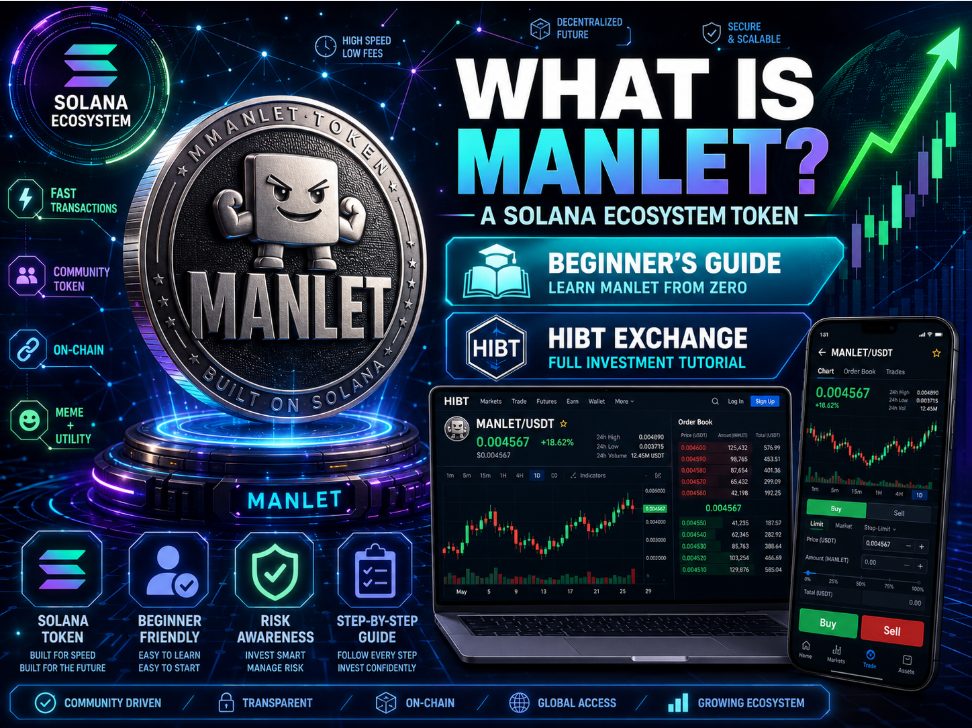
For readers who want to directly view real-time order book and candlestick data, you can first browse the real-time data for the MANLET/USDT trading pair. After entering the Hibt page, the focus should not be on price alone, but on:
Bid-ask spread;
24h trading volume;
Order book depth;
Whether recent trades are continuous;
Whether there are abnormal long wicks on the candles;
Whether limit orders can be placed smoothly;
Whether the sell-side depth is sufficient.
Hibt is relatively beginner-friendly because it is a centralized exchange (CEX); users do not need to connect their own Solana wallet, authorize contracts, set slippage, or handle on-chain transaction failures. CoinGecko shows Hibt is a centralized exchange founded in 2021 and registered in Canada, currently listing 505 coins and 542 trading pairs. The Hibt official help center shows spot trading maker and taker fee example rates of 0.2%, with a minimum order amount of approximately $5; actual rates are subject to the page display.
However, Hibt being more convenient to trade does not mean MANLET itself is less risky. You still need to confirm:
Whether the MANLET on Hibt matches the contract version you are researching;
Whether MANLET/USDT has sufficient trading depth;
Whether deposits and withdrawals are supported;
Whether market orders will generate noticeable slippage;
Whether you can sell smoothly under extreme market conditions.
Chapter 3: Why Are People Paying Attention to MANLET? Is It Investment Value, or Pure Gambling?
MANLET is being watched, not because it has already proven technical value, but because it meets several conditions for Meme coin virality.
First, it is in the Solana ecosystem.
Solana is one of the most active chains for Meme coins. It has fast transaction speeds, low costs, and rapid new token listings, making it suitable for short-term capital and community sentiment to flow quickly. Many Solana Meme coins do not rely on a product, but rather on communities, KOLs, leaderboards, and trading bots to generate short-term heat.
Second, MANLET has internet subculture attributes.
The term "manlet" itself comes from internet culture, carrying self-deprecating, satirical, and community meme properties. For a Meme coin, the most important thing is not how sophisticated the name is, but whether it can be quickly understood, spread, remixed, and discussed.
Third, its low market cap creates a lottery-like imagination space.
For a token with a market cap of only a few thousand dollars, speculators will imagine "how many multiples of upside there would be if it rises to a few hundred thousand or a few million in market cap." But equally, one must understand that a low market cap also means it could go to zero very quickly.
Fourth, the higher-market-cap version of MANLET in the market has brought name recognition heat.
KuCoin's market flash news once mentioned that the Solana ecosystem meme coin Manlet briefly broke through a 17 million market cap**, with a 24-hour trading volume exceeding **9.3 million, and pointed out that its rise was driven by community hype and internet subculture, while also noting that it has no real utility or roadmap, and is highly speculative and volatile.
Such information will drive more search volume for the word "MANLET," but it also brings confusion: the heat of the high-market-cap version does not necessarily transfer to the BoFA…pump low-market-cap version.
Compared to other low-market-cap Solana Meme coins, MANLET's potential advantages are:
Short name, easy to spread;
Solana Meme ecosystem itself is active;
Extremely low market cap, theoretically high elasticity;
If community secondary virality occurs, the price may fluctuate rapidly;
Hibt has a MANLET/USDT page, lowering the barrier for newcomers to view.
Its disadvantages are also obvious:
No clear product functionality;
No stable revenue model;
Social media and community information are not strong enough;
Same-name contract confusion;
Extremely thin liquidity;
Extremely susceptible to being pumped or dumped by small amounts of capital.
As a newcomer, evaluating MANLET should not use "fundamental logic," but rather "lottery ticket logic."
Fundamental logic looks at:
Product;
Users;
Revenue;
Ecosystem partnerships;
Long-term demand;
Protocol value capture.
Lottery ticket logic looks at:
Community heat;
New address growth;
Trading volume;
Liquidity;
Early wallet movements;
KOL promotion;
Exchange listings;
Short-term sentiment.
MANLET is better suited for the latter evaluation. You should not ask "can it change the industry in the future," but rather ask:
How much money am I willing to lose on this high-risk opportunity?
If it drops 80%, can I accept that?
If I can buy but not sell, do I have a contingency plan?
If I find the contract is inconsistent, can I stop trading?
If the community suddenly cools down, will I continue to fantasize about a rebound?
If the answer is no, then you should not buy.
Chapter 4: Complete Practical Guide to Buying MANLET on Hibt
If you decide to research MANLET and wish to operate MANLET/USDT through Hibt, you can follow the process below.
Step 1: Register a Hibt account.
Open the Hibt official website or App, and go to the registration page. It is recommended to use a long-term stable email or phone number when registering; do not use temporary emails. After registration, immediately complete account security settings:
Set a strong password;
Bind email or phone number;
Enable Google Authenticator or other 2FA;
Set a fund password;
Enable anti-phishing code;
Only log in through official links.
If your region requires KYC, follow the page prompts to submit identity information. General KYC may involve ID documents, facial recognition, name, date of birth, and region of residence. Review time varies by region and documentation, ranging from a few minutes to several hours.
Do not submit identity information through Telegram private chats, unfamiliar customer service links, or third-party forms. All account verification should be completed within the official website or official App.
Step 2: Deposit USDT.
Before buying MANLET/USDT, you need to have USDT in your account. There are two common methods.
The first method is on-chain transfer deposit.
If you already hold USDT on another exchange or wallet, you can choose Hibt's USDT deposit address. Before depositing, you must confirm the network is consistent, such as TRC20, ERC20, BEP20, Solana, etc. Selecting the wrong network may result in unrecoverable asset loss.
If you are transferring from a Solana wallet, also confirm whether Hibt supports USDT deposits on the corresponding Solana network. Do not assume that "because MANLET is on Solana, USDT must also go through Solana." The deposit network must be based on what is displayed on Hibt's deposit page.
The second method is third-party or express buy-crypto.
This method is more convenient for newcomers, but pay attention to fees, exchange rate spreads, arrival time, and payment channel restrictions. You should not just look at the payment amount, but at how much USDT actually arrives.
For the first deposit, it is not recommended to directly transfer a large amount. You can first test with $10 or $20 to confirm arrival, and then proceed with the formal deposit.
Step 3: Enter the MANLET/USDT trading page.
After logging into Hibt, search for MANLET in the market or spot trading page, find the MANLET/USDT trading pair, or also view it via https://hibt.com/quotes/MANLET-USDT.
After entering the page, do not place an order immediately; first check:
Current price;
24h price change;
24h trading volume;
Bid-ask spread;
Order book depth;
Recent trade history;
Whether the candlestick is continuous;
Whether there are abnormal pumps or flash crashes.
Step 4: Choose between a limit order or a market order.
The advantage of a market order is fast execution; the disadvantage is that you cannot control the final execution price. For deep assets like BTC and ETH, the impact of a market order may be small; but for a small-cap coin like MANLET, a market order may directly eat through multiple price levels, causing the actual execution price to be much higher than the price you saw.
The advantage of a limit order is that you can control the buy price; the disadvantage is that it may not execute immediately. For a newcomer buying MANLET for the first time, it is more recommended to use a limit order.
For example, if the current ask price is 0.0000025 USDT, you can place a limit order at 0.0000023, 0.0000021, or a price you are willing to accept and wait for execution. Missing one opportunity is not scary; chasing a high and being unable to sell afterward is more dangerous.
Step 5: Control your first position size.
If you only have $100, the general recommendation is to not buy at all, or use at most $1 to $5 for an experience position.
If you have $1,000, you can consider a $10 to $30 observation position; it is not recommended to exceed $50.
If you have $10,000, it is still not recommended to go heavy on MANLET. A more reasonable approach is to first test liquidity and execution experience with $100 or less, unless you are very clear about the order book depth, stop-loss rules, and contract version; otherwise, do not exceed 1%-3% of total assets.
Step 6: Check positions, P&L, and trade history.
After buying, you can view your MANLET position quantity, available balance, frozen balance, and estimated value on Hibt's assets page. In the trade history, you can view the execution price, quantity, fees, and time of each trade.
It is recommended that you additionally record:
Buy time;
Buy price;
Buy amount;
Buy reason;
Stop-loss level;
Take-profit plan;
Sell conditions;
Review results.
This can prevent emotional holding after buying.
Step 7: Set take-profit and stop-loss.
If Hibt supports trigger orders, conditional orders, or take-profit/stop-loss functions, you can set risk controls in advance. MANLET is a micro-cap token with extreme volatility and is not suitable for relying entirely on in-the-moment reactions. When the price drops rapidly, you may encounter a thinning order book, failed execution, or emotional hesitation.
Three strategies can be referenced:
Conservative: Sell the principal portion after a 30%-50% rise, and continue to observe the remaining position.
Swing trading: Take profit in batches at resistance levels, for example, 25%, 25%, 50% in three sell tranches.
Defensive: If the price drops 20%-30% below the buy price and trading volume increases, stop loss decisively without continuously averaging down.
Step 8: Sell MANLET and exchange back to USDT.
If you want to exit in the future, you can select sell on Hibt's MANLET/USDT page to exchange MANLET back to USDT. When selling, it is also recommended to prioritize limit orders, especially when the order book is thin; do not directly dump with a large market order.
After exchanging back to USDT, you can keep it on Hibt, or withdraw to a personal wallet or another platform. Before withdrawing, confirm:
The withdrawal currency is USDT;
The withdrawal network matches the receiving address;
Whether a Memo or Tag is needed;
Whether the fees and minimum withdrawal amount are reasonable;
The address is not copied incorrectly;
Test with a small amount first, then withdraw a large amount.
Chapter 5: MANLET Price Trends and Predictions: When to Buy, When to Sell?
MANLET cannot be predicted using traditional valuation models.
BTC can be analyzed using halving cycles, ETF fund flows, macro liquidity, and long-term holder structures; ETH can be analyzed using on-chain revenue, staking rates, L2 ecosystem, and developer activity; SOL can be analyzed using ecosystem growth, trading volume, and on-chain applications.
But for a Meme coin like MANLET, it depends more on:
Community heat;
Social media virality;
Short-term capital inflows;
DEX rankings;
Exchange listings;
Large wallet behavior;
Solana Meme sector sentiment.
From a historical performance perspective, the data for the BoFA…pump version of MANLET is very thin, with a market cap of only a few thousand dollars; technical analysis has limited significance. What truly needs attention is not a precise support level, but whether liquidity is still there.
For this type of small-cap coin, it is more suitable to look at "zones" and "signals":
First support zone: The recent dense trading area. If the price returns to this area but there is no volume to absorb it, it indicates insufficient buying pressure.
Second support zone: Near the previous low. If it breaks below the previous low with volume, it may enter a state of liquidity exhaustion.
First resistance zone: The position of the previous high-volume dump. There may be trapped holders waiting to break even.
Second resistance zone: Near the historical high. Early buyers may choose to take profits.
To judge accumulation or distribution, four signals can be watched:
When the price is consolidating, is the number of holders increasing;
Is the trading volume expanding moderately;
Are large wallets reducing selling;
Is there real discussion on social media, rather than bot spamming.
If the price rises but the number of holders does not increase, it may just be a small-cap pump.
If trading volume expands but the price does not rise, selling pressure may be heavy.
If early wallets continue to transfer out, it may be a precursor to distribution.
If social media suddenly explodes but there is no new on-chain buying, it may just be noise.
For more detailed technical indicators and algorithmic predictions, you can refer to the MANLET price prediction tool on Hibt at https://hibt.com/symbolPrediction/detail/MANLET, combining signals from multiple time dimensions to make decisions.
But it must be emphasized: prediction tools can only be used as a reference and cannot replace real order books, on-chain data, and risk controls.
The three major variables affecting MANLET's future price are:
First, overall market sentiment.
If BTC, SOL, and the overall Meme sector are strong, small-cap coins are more likely to attract speculative capital. If the market enters a risk-averse phase, small-cap coins usually fall faster.
Second, Solana ecosystem heat.
Capital in Solana Meme coins migrates very quickly. The market may chase MANLET today and another new coin tomorrow. Only sustained community virality and trading volume can maintain price attention.
Third, exchange listing dynamics.
If MANLET gains trading access on more CEXs or DEX aggregators, liquidity may improve; but if trading volume rapidly declines after listing, the price may instead lose support.
Chapter 6: Real Risks of Investing in MANLET and Risk Control Strategies
This chapter is the most important part of the entire article.
MANLET's biggest risk is not "whether it will pump," but "whether you can exit alive."
First, ultra-low market cap risk.
The BoFA…pump version of MANLET had a market cap of approximately $2.31K and roughly 180 holders at the time of inquiry. This market cap level means the price can be moved by very small amounts of capital, and can also be crushed by very small sell orders. It is not an ordinary small-cap coin, but an ultra-low market cap micro-cap.
Second, liquidity risk.
A low market cap does not equal a low-risk opportunity. On the contrary, a low market cap often means insufficient liquidity. You may be able to buy smoothly, but unable to find enough buyers when selling. The so-called "can buy but cannot sell" is very common in micro-cap Meme coins.
Third, contract confusion risk.
There are multiple MANLETs in the market. The high-volume version listed on CoinGecko and OpenSea is not the same as the BoFA…pump low-market-cap version. The manlet shown on the CoinGecko page has a market cap reaching the tens of millions of dollars and is available on PumpSwap, Meteora, LBank, MEXC, and other markets. The DdPr…pump version in the OpenSea page also shows approximately 37.2K holders. If you only look at the name and not the contract, it is very easy to mix data from different tokens together.
Fourth, pump and dump risk.
A common path in small-cap Meme coins is: early addresses acquire chips at low cost, the community manufactures hype, retail chases the rally, and then early addresses sell in batches. For a low-market-cap token like MANLET, even without a complex scam, simply early wallets selling normally can cause violent price drops.
Fifth, Solana network risk.
Solana's advantage is its speed and low fees, but it has also experienced mainnet outages in its history. The Solana official February 6, 2024 mainnet incident report showed that on that day, Solana Mainnet Beta block finalization stopped, and consensus progress resumed after approximately 5 hours. If extreme market conditions cause network congestion or transfer delays, it may affect on-chain deposits, withdrawals, selling, and arbitrage operations.
Sixth, platform trading risk.
Trading MANLET on Hibt can reduce the operational complexity of directly using Solana wallets and DEXs, but platform trading also requires attention to account security and trading depth. Users should enable 2FA, fund passwords, and anti-phishing codes, and take the order book, fees, trading rules, and withdrawal rules displayed on the Hibt page in real time as the standard.
Newcomer position sizing recommendations are as follows:
Conservative users: Do not buy MANLET, only observe the data.
Light participants: Within 1% of total assets.
Moderate risk users: 1%-3% of total assets.
High-risk users: Maximum not exceeding 5% of total assets.
Under any circumstances, it is not recommended to borrow money to buy MANLET, not recommended to use living expenses to buy MANLET, and not recommended to chase highs because someone else showed profits.
If you cannot accept a drawdown of more than 80%, do not touch this level of micro-cap Meme coin.
Chapter 7: Summary and Actionable Recommendations: How Much Should I Invest, and What Should I Do Next?
MANLET is a very suitable case study for learning about Solana Meme coin risks.
It has a real on-chain contract, and it also has community virality potential, but its core risks are equally obvious: ultra-low market cap, thin liquidity, same-name contract confusion, no stable fundamentals, and price highly dependent on sentiment.
If you only have $100, it is recommended to not buy first, or use at most $1 to $5 for an experience position. The focus at this stage is not to make money, but to learn how to verify the contract, check the MANLET/USDT order book, place limit orders, set stop-losses, and sell.
If you have $1,000, you can consider a $10 to $30 observation position; it is not recommended to exceed $50. The purpose of this position is not to go all-in, but to validate your own trading plan.
If you have $10,000, it is still not recommended to go heavy on MANLET. A more reasonable approach is to keep it within 1%-3% of total assets, with a maximum not exceeding 5%. The majority of funds should still be placed in mainstream assets with stronger liquidity and more transparent information.
Short-term swing trading is suitable for people who can watch the screen, read the order book, and strictly enforce stop-losses. The time frame is usually minutes to days, with the goal of capturing sentiment and liquidity swings.
Long-term holding of MANLET is more difficult. Because the life cycle of Meme coins is usually very short, if there is no sustained community, sustained trading volume, and sustained exchange support, long-term holding can easily become passive bag-holding.
After buying MANLET, check at least once a week:
Whether the price has fallen below key zones;
Whether 24h trading volume is continuously shrinking;
Whether the Hibt order book depth is deteriorating;
Whether on-chain holders are increasing;
Whether large wallets are transferring out;
Whether there is still real discussion on social media;
Whether new same-name contract scams have emerged;
Whether there are new exchange listing or delisting risks.
If you find that MANLET does not match your risk appetite, you can research higher-liquidity Solana ecosystem assets on Hibt, such as SOL itself, or other Solana ecosystem assets with stronger trading volume, a clearer community, and more stable trading depth.
Ultimately, the correct way to approach MANLET is not "all-in for a moonshot," but rather:
First, verify the contract;
Then, look at market cap and liquidity;
Then, confirm the Hibt trading pair;
Then, test with a very small position;
Finally, strictly enforce take-profit and stop-loss.
If you have not even verified the contract clearly, do not buy.
If you cannot accept the risk of going to zero, do not buy.
If you are only rushing in because you saw someone else shilling it, that is not investing, but emotional gambling.
For Meme coins, the truly mature trader is not the one who dares to ape in the most, but the one who knows best how to control losses.