
If you are researching BTCfi, Bitcoin Staking, or public chains in the Bitcoin ecosystem, CORE is a name you cannot ignore.
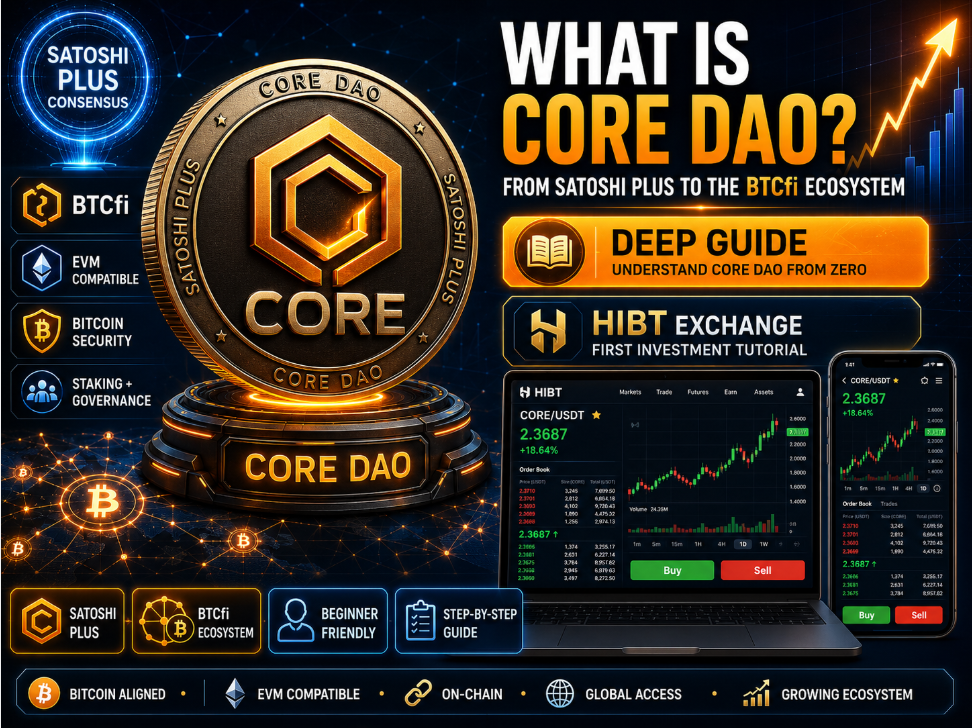
It is not an ordinary meme coin, nor is it a vaporware project simply riding the “Bitcoin” keyword. CORE is the native token of the Core blockchain, and the central narrative behind Core DAO is to connect Bitcoin miners, Bitcoin holders, and CORE stakers through the Satoshi Plus consensus mechanism, building an EVM-compatible, Bitcoin-powered Layer 1 public chain.
But this does not mean CORE is risk-free. CORE has historically been extremely volatile, with its price having retraced sharply from highs; although it has a fixed supply cap of 2.1 billion, it still carries an 81-year emission cycle and validator mining rewards. The BTCfi and Dual Staking narratives look compelling, but whether they can translate into sustained real demand remains to be seen.
This article will help newcomers systematically understand CORE from several angles: Core DAO fundamentals, the Satoshi Plus consensus, CORE tokenomics, market performance, the BTCfi ecosystem, the Hibt purchase process, and risk management.
This article does not constitute investment advice. CORE is a high-volatility crypto asset, and its price may fluctuate dramatically with BTC, the BTCfi narrative, Layer 1 competition, token emissions, and market liquidity. Newcomers should not chase highs with heavy positions; they should first understand the mechanics, then test their trading plans with small positions.
1. What Exactly Is CORE? A Serious Public Chain or a Bitcoin Hype Project?
CORE is the native token of the Core blockchain. Core DAO is the decentralized organization built around the construction, governance, ecosystem development, and community participation of the Core network. To put it simply:
- Core is the chain.
- CORE is the native asset on that chain.
- Core DAO is the community and governance system that runs and develops the chain.
- Core Foundation leans more toward ecosystem support, institutional partnerships, development advancement, and external communications.
Core DAO has no official relationship with Bitcoin’s creator, Satoshi Nakamoto. The project uses the name “Satoshi Plus” to express that its consensus mechanism draws on Bitcoin’s PoW security and further layers on DPoS and BTC Staking — not to imply that it was created by or authorized by Satoshi.
The core technical keyword for Core is Satoshi Plus.
As explained in official Core articles, Satoshi Plus is a hybrid consensus mechanism that combines three layers of security: it introduces Bitcoin miner hash power through DPoW, it introduces Bitcoin holder voting through timelocks, and it introduces CORE token stakers through DPoS. At the same time, Core remains compatible with EVM smart contracts, aiming to strike a balance between Bitcoin security and high-performance smart contracts.
You can break Satoshi Plus down into three parts.
First, Delegated Proof of Work (DPoW)
Bitcoin miners can delegate their hash power signals to Core validators. This does not mean Bitcoin miners are mining a new chain, nor does it require extra energy consumption. Instead, it works through specific metadata in Bitcoin blocks to participate in Core validator selection. As stated in Core’s official documentation, Bitcoin miners can delegate hash power to Core validators via special metadata and earn CORE rewards.
Second, Bitcoin Timelocking
Bitcoin holders can participate in Core validator voting through Bitcoin’s native timelock mechanism. Core documentation explains that self-custodial BTC Staking uses Bitcoin’s CLTV mechanism, allowing users to support Core validators and earn CORE rewards without giving up custody of their BTC.
Third, Delegated Proof of Stake (DPoS)
CORE holders can delegate their CORE to validators to participate in network security and validator elections. Core documentation shows that validator selection takes into account timelocked BTC, delegated CORE, and delegated Bitcoin hash power.
This is what separates CORE from ordinary “Bitcoin hype” projects: it does not just put “Bitcoin” in its marketing, but incorporates Bitcoin miners, Bitcoin holders, and CORE stakers into its consensus design.
CORE plays four primary roles in the ecosystem:
- Gas fees. Core is an EVM-compatible chain; users need CORE as gas for on-chain transfers, contract calls, and DeFi participation.
- Governance. CORE holders can participate in governance decisions and protocol parameter adjustments. Core’s official documentation explicitly lists governance as one of CORE’s core functions.
- Staking and validator security. CORE holders can delegate tokens to validators, and validators also need CORE as slashable collateral to participate in network security.
- Dual Staking yield amplifier. Core officially positions CORE as the key asset for boosting Bitcoin Staking yields. Official documentation states that standalone BTC Staking provides base yields, while BTC + CORE Dual Staking unlocks higher yield tiers; a higher CORE/BTC ratio corresponds to higher reward tiers.
Therefore, CORE’s fundamentals should not be judged by the label “public chain token” alone. What matters is whether it can continue to attract BTC holders, miners, DeFi protocols, and developers into the Core ecosystem. If the BTCfi ecosystem grows, demand for CORE as gas, staking collateral, and Dual Staking asset could strengthen.
2. Why Is CORE’s Tokenomics Worth Studying? Will the 2.1 Billion Supply Cap Get Diluted?
CORE has a maximum supply of 2.1 billion tokens, a design that clearly corresponds to the 100× scale of Bitcoin’s 21 million cap. Core’s official documentation explicitly states that CORE has a fixed supply of 2.1 billion tokens, mimicking the Bitcoin scarcity model at a 100× ratio.
But a “fixed supply cap” does not mean “no sell pressure.”
Because CORE’s emission cycle is very long. Official documentation shows that node mining rewards will be released over 81 years, with block rewards decreasing by 3.61% per year — a smoother emission curve than Bitcoin’s halving.
CORE’s token allocation structure is as follows:
Category
Percentage
Amount (CORE)
Purpose
Node Mining
39.995%
~839,900,000
Validator rewards over 81 years
Users
25.029%
~525,600,000
Community distribution at mainnet genesis
Contributors
15%
~315,000,000
Protocol development and maintenance
Reserve
10%
~210,000,000
Foundation operations and growth
Treasury
9.5%
~199,500,000
Ecosystem development
Relayer Rewards
0.476%
~10,000,000
Cross-chain consensus incentives
This allocation structure can be viewed from two angles.
From the positive side, the near-40% node mining share shows that the project has allocated its long-term security budget to validators and consensus incentives, rather than making a one-time release to the team or investors. The 81-year emission cycle also makes inflation far smoother, unlike some new tokens that concentrate the majority of their supply release within one or two years.
From the risk side, as long as rewards continue to be emitted, the market must continually absorb newly circulating CORE. If on-chain transaction volume, BTC Staking, Dual Staking, and DeFi activity fail to grow in tandem, new issuance could become a long-term source of sell pressure.
Regarding current circulating supply, Binance data shows that CORE’s circulating supply is approximately 1.2B, representing about 59.18% of the maximum supply of 2.1B. This means CORE is no longer a low-float new coin, but a significant portion remains to be released in the future.
The most important demand-side mechanism worth studying in CORE is Dual Staking.
Core’s official documentation calls CORE the key asset for unlocking higher Bitcoin Staking yields. BTC holders who stake only BTC receive base yields; if they simultaneously stake BTC and CORE, they can enter higher yield tiers based on their CORE/BTC ratio. Official documentation mentions that the highest yields can reach roughly 25–50× that of standalone BTC Staking.
This is why Core officially describes CORE as “Bitcoiners’ second asset.”
The logic is:
- BTC holders want higher BTC Staking yields.
- Higher yields require holding and staking CORE simultaneously.
- More BTC entering Core Staking theoretically brings more CORE demand.
- CORE being staked reduces circulating supply.
- If on-chain DeFi is active, CORE will also be used for gas, governance, and ecosystem interactions.
But this logic has prerequisites: BTC Staking yields must remain attractive, the Core ecosystem must have real use cases, and CORE’s price must not be persistently weakened by inflation and sell pressure. Otherwise, the Dual Staking demand loop will be undermined.
Compared with ETH and SOL, CORE’s model has clear differences.
- ETH leans more toward fee burn, staking yield, and network usage drivers. After EIP-1559, ETH supply can become deflationary during periods of high usage.
- SOL leans more toward high throughput, low fees, and application ecosystem drivers. Inflation declines gradually, but still depends on on-chain transaction activity and ecosystem growth.
- CORE emphasizes Bitcoin Staking and BTCfi more heavily. Its core supply-demand logic is not “high-frequency on-chain trading” per se, but rather “whether BTC holders are willing to earn yields through Core and hold CORE for higher yields.”
Therefore, investing in CORE requires looking not just at price, but at whether BTCfi is actually growing.
3. CORE’s Current Market Performance and Ecosystem Data: Is Anyone Trading It? Is Liquidity Sufficient?
As of July 6, 2026, Binance data shows CORE’s price at approximately 0.0255**, market cap at approximately **31.70 million, 24-hour volume at approximately 3.90 million**, circulating supply at approximately **1.2B CORE**, and maximum supply at **2.1B CORE**. CoinCodex shows the same period at approximately **0.0255, market cap at approximately 31.69 million**, and 24-hour volume at approximately **1.53 million.
Different platforms will show different 24-hour volumes due to differences in exchange coverage, update frequency, and anomalous trade filtering. Newcomers should not rely on a single website; it is best to compare Binance, CoinGecko, CoinCodex, CoinMarketCap, Hibt, and exchange order books simultaneously.
There are also differences in historical high data. CoinCodex shows CORE reaching a high of approximately 4.17** on April 1, 2024; CoinGecko and Binance show an earlier all-time high in February 2023 exceeding **6. Therefore, a more rigorous statement would be: If using CoinCodex’s 2024 trading cycle口径, CORE reached approximately $4.17 in April 2024; if using the broader all-history口径 across major platforms, CORE’s all-time high came earlier and was higher.
Regardless of which口径 is used, CORE has experienced a massive drawdown from its highs to the current price. Calculating from $4.17 to $0.0255, the decline exceeds 99%. This shows that although CORE is a legitimate Layer 1 public chain token, it is not a low-risk asset, and its price cycles and volatility are extremely pronounced.
On the ecosystem data side, the Core Foundation website shows that Core’s ecosystem TVL exceeds $850 million, with over 5,400 BTC and 165M CORE staked. At the same time, Core’s historical materials also mention that Core reached millions of active wallets, hundreds of millions of on-chain transactions, and thousands of BTC staked in 2024.
These figures show that Core is not an empty chain with no ecosystem data. But newcomers should note: official ecosystem口径, DeFiLlama statistical口径, and exchange market data口径 are not identical. For example, DeFiLlama’s Core page separately displays on-chain TVL, stablecoin market cap, active addresses, transaction count, and DEX volume — some of which may be far lower than the official promotional口径.
Therefore, when assessing Core ecosystem health, it is recommended to look at three types of data simultaneously:
- Official ecosystem data: TVL, BTC staked, CORE staked, wallet count.
- Third-party DeFi data: DeFiLlama’s TVL, DEX trading volume, active addresses, and transaction count.
- Exchange data: CORE/USDT trading volume, order book depth, bid-ask spread, and order continuity.
In terms of exchange listings, CoinCodex shows CORE trading on Bybit, OKX, Gate, MEXC, Bitget, Coinbase, and other platforms. This means CORE has more trading access than early small-cap coins, and its liquidity risk is lower than micro-cap meme coins, though it is still subject to overall market volume declines.
For readers who want to check real-time K-lines and order book depth directly, you can start by browsing the live data for the CORE/USDT trading pair on Hibt. When you enter the Hibt page, do not just look at the latest price; focus on checking:
- Bid-ask spread;
- 24h trading volume;
- Whether the order book is continuous;
- Whether large orders noticeably move the price;
- Whether recent trades are active;
- Whether the K-line shows abnormal long wicks.
Hibt is relatively newcomer-friendly because it is a centralized exchange; users do not need to configure Core chain wallets, cross-chain bridges, or DeFi contracts themselves. According to Hibt’s official Help Center, the platform’s spot maker and taker fees are both 0.2%, and the minimum order amount is approximately $5 (actual values are subject to the page).
BTCfi sentiment has a direct impact on CORE’s price. If the Bitcoin Staking narrative heats up and more BTC holders seek non-custodial yields, demand for Core’s BTC Staking and Dual Staking could strengthen. If BTCfi sentiment cools, or if competing BTC L2 and BTC staking projects intensify, CORE could also lose its valuation premium.
4. Complete Step-by-Step Guide to Buying CORE on Hibt
If you decide to research CORE and want to purchase CORE/USDT through Hibt, follow the steps below.
Step 1: Register a Hibt Account
Open the Hibt website or app and go to the registration page. It is recommended to use a long-term, stable email or phone number — do not use temporary email addresses. Immediately complete account security settings after registration:
- Set a strong password.
- Bind your email or phone number.
- Enable Google Authenticator or another 2FA method.
- Set a fund password.
- Enable an anti-phishing code.
- Only log in through official links.
If your region requires KYC, follow the Hibt page prompts to submit identity information. KYC typically involves ID documents, facial recognition, name, date of birth, and residential region. Review time depends on document quality, region, and platform review status, and may range from a few minutes to several hours.
Do not submit identity documents through Telegram private chats, unfamiliar customer service links, or third-party pages. All account verification should be completed within the Hibt website or official app.
Step 2: Deposit USDT
Before purchasing CORE/USDT, the most direct way is to deposit USDT into your Hibt account. There are two common deposit methods.
Method 1: On-chain transfer deposit.
If you already hold USDT on another exchange or in a wallet, you can choose Hibt’s USDT deposit address. Before depositing, you must confirm the network is consistent, such as TRC20, ERC20, BEP20, or another network. Choosing the wrong network may result in unrecoverable assets.
Important note here: CORE is a native asset of the Core chain, but your USDT deposit does not necessarily go through the Core chain. Which USDT deposit networks Hibt supports is subject to the Hibt deposit page. Do not transfer USDT to an unsupported Core network address just because you want to buy CORE.
- If you choose BEP20, ensure the withdrawal platform also selects BEP20.
- If you choose ERC20, ensure the withdrawal platform also selects ERC20.
- If you choose TRC20, ensure the withdrawal platform also selects TRC20.
- If the page supports Core chain USDT, you must also confirm that the other wallet or exchange supports the same network.
Method 2: Third-party or quick buy.
This method is simpler for newcomers, but pay attention to payment fees, exchange rate spreads, arrival time, and payment channel restrictions. Do not just look at the payment amount; look at how much USDT actually arrives.
For your first deposit, it is not recommended to transfer a large amount directly. You can first test with $10 or $20, confirm arrival, and then deposit formal funds.
Step 3: Enter the CORE/USDT Trading Page
After logging into Hibt, search for CORE in the Markets or Spot section, find the CORE/USDT trading pair, or access it directly via Hibt CORE/USDT.
After entering the page, first check:
- Whether the current price is close to other major platforms;
- Whether 24h volume is normal;
- Whether the bid-ask spread is too wide;
- Whether order book depth is sufficient;
- Whether recent trades are continuous;
- Whether the K-line shows abnormal long wicks;
- Whether it has just experienced a sharp pump or dump.
Step 4: Choose Limit Order or Market Order
The advantage of a market order is fast execution, but you cannot control the final execution price. If the order book is thin, a market order may sweep through multiple price levels, causing the actual execution price to deviate from what you saw.
The advantage of a limit order is that you can control the buy price, but it may not execute immediately. For a first-time CORE purchase, it is more recommended to use a limit order.
For example, if the current price is 0.0255 USDT, you can place your order at 0.0250, 0.0245, or lower based on your plan and wait for execution. Missing one opportunity is not scary; chasing highs and being unable to execute a stop-loss is more dangerous.
Step 5: Control Your First Position Size
Although CORE has stronger fundamentals than meme coins, it is still a high-volatility public chain token and is not suitable for newcomers to go heavy on from the start.
- If you have 100**, you can start with a **5–$10 learning position.
- If you have 1,000**, consider a **30–80** observation position, with a maximum recommendation of **100.
- If you have 10,000**, you can treat CORE as part of your BTCfi / Layer 1 beta allocation, keeping it in the **300–$800 range, with a maximum of 5–10% of total assets.
Step 6: Check Holdings, P&L, and Trade History
After buying, you can view your CORE holdings, available balance, frozen balance, and estimated value in the Hibt Assets page. Trade history shows every execution price, quantity, fee, and time.
It is recommended to record every trade:
- Buy time;
- Buy price;
- Buy amount;
- Buy rationale;
- Stop-loss level;
- Take-profit target;
- Sell conditions;
- Post-trade review.
This prevents you from shifting from “planned trading” to “emotional holding.”
Step 7: Set Take-Profit and Stop-Loss
If Hibt supports trigger orders, conditional orders, or TP/SL features, set risk controls in advance. CORE has historically seen extreme volatility, so relying solely on in-the-moment judgment is not enough.
Three strategies for reference:
- Conservative: Sell a portion of principal after a 30–50% gain, and continue observing the remaining position.
- Swing trading: Take profit in batches at key resistance levels, for example 25%, 25%, 50% across three sells.
- Defensive: Execute a stop-loss if the price falls 15–25% below your entry with increased volume, without averaging down indefinitely.
Step 8: Sell CORE and Withdraw
If you want to exit in the future, you can sell CORE on the Hibt CORE/USDT page and convert CORE back to USDT. When selling, it is also recommended to prioritize limit orders, especially when the order book thins or volatility increases.
After converting back to USDT, you can keep it on Hibt or withdraw to a personal wallet or another platform. Before withdrawing, confirm:
- Whether the withdrawal asset is USDT or CORE;
- That the withdrawal network matches the receiving address;
- Do not confuse Core chain, BSC, ERC20, and TRC20;
- Whether a Memo or Tag is required;
- Whether the withdrawal fee and minimum amount are reasonable;
- That the address has not been copied incorrectly;
- Conduct a small test first, then withdraw larger amounts.
5. CORE Price Trends and Outlook: When to Buy, When to Sell?
CORE’s price trajectory can be roughly divided into several stages.
Stage 1: Mainnet Launch and Early Airdrop Phase.
After Core’s mainnet went live in 2023, CORE entered the market, with early prices driven by airdrops, exchange listings, community expectations, and liquidity, leading to extreme volatility.
Stage 2: 2024 BTCfi Narrative Explosion Phase.
In 2024, Bitcoin’s halving, BTC L2, Bitcoin Staking, and the BTCfi narrative heated up, and CORE saw a significant rally in April 2024. CoinCodex shows it reached a high of approximately $4.17 on April 1, 2024.
Stage 3: Post-High Correction Phase.
After the highs, CORE entered a prolonged drawdown. CoinCodex data shows CORE fell approximately 89.77% throughout 2025, and Q1 2026 continued to decline approximately 74.07%. This demonstrates that CORE’s price is highly sensitive to market cycles, liquidity, and narrative heat.
From a technical analysis perspective, CORE is currently better suited to “range” and “trend” judgments rather than overly precise price targets.
Short-term support zones to watch:
- Near recent lows;
- Historical low-volume accumulation areas;
- Retracement areas after a volume-backed rebound.
Short-term resistance zones to watch:
- Starting point of the previous volume-backed decline;
- Long-term moving average resistance;
- High-position trapped supply zones;
- Psychological round numbers such as $0.05, $0.10, $0.20.
- If price rebounds but volume does not expand, it indicates insufficient buying.
- If price declines but volume shrinks, it may enter low-range consolidation.
- If price breaks above resistance with expanded volume on Hibt and other major exchanges, short-term sentiment may be warming.
- If large amounts of CORE continue flowing into exchanges and price breaks below key support, be alert for sell pressure.
For more detailed technical indicators and algorithmic predictions, you can refer to the CORE price prediction tool on Hibt, combining signals across multiple timeframes for decision-making.
But it must be emphasized: price prediction tools are for reference only and cannot replace real order book data, on-chain data, and risk control.
Four core variables affect CORE’s medium- to long-term price.
First, BTC halving cycle and overall market risk appetite.
If BTC enters a strong cycle, BTCfi, Layer 1, and public chain beta assets are more likely to attract capital attention. If BTC weakens, high-volatility assets like CORE are typically suppressed.
Second, whether the Bitcoin Staking narrative continues to heat up.
Core’s differentiation comes from self-custodial BTC Staking and Dual Staking. Official documentation states that users can participate in Core consensus through Bitcoin timelocks and earn CORE rewards. If more BTC enters Core Staking, CORE’s narrative will be stronger.
Third, whether Dual Staking creates real CORE demand.
If BTC holders continue to buy and stake CORE for higher yields, CORE will gain a new source of demand. If yields drop or users churn, this demand will weaken.
Fourth, the 81-year emission plan and 3.61% annual decline in inflation.
In the long run, the emission curve will gradually flatten, but in the short to medium term new CORE will still enter the market. Only when ecosystem growth outpaces new emission pressure can CORE form a healthier supply-demand relationship.
6. Real Risks of Investing in CORE and Risk Management Strategies
CORE is a legitimate public chain project, but a legitimate project does not equal a low-risk project.
First, Layer 1 competition risk.
CORE faces competition from established public chains such as ETH, SOL, BNB Chain, and Avalanche, as well as from BTC L2 / BTCfi projects such as Merlin Chain, B² Network, and Bitlayer. Core’s advantages are Satoshi Plus and BTC Staking, but competitors are also fighting for the same pool of Bitcoin liquidity and DeFi users.
Second, long-term emission risk.
CORE’s fixed cap is 2.1 billion, but node rewards will be emitted over 81 years, with block rewards declining 3.61% annually. This means CORE’s long-term supply is not all in circulation at once, but continuously entering the market. If on-chain revenue and demand are insufficient, new issuance will create sell pressure.
Third, historical high-volatility risk.
CORE has experienced a massive drawdown from its highs to the current price. CoinGecko and Binance show an all-time high exceeding 6**, while the current price is around **0.025. This shows CORE can rise rapidly in bull markets and fall deeply in bear markets.
Fourth, Bitcoin Staking mechanism risk.
Core’s BTC Staking emphasizes self-custodial participation, requiring no bridging or giving up BTC custody. Official documentation explains that users lock BTC through Bitcoin timelock transactions and write validator and Core reward addresses into the transaction. But this still involves operational risk, wallet risk, timelock configuration, validator selection, reward rule comprehension, and frontend security. Newcomers should not ignore the actual operational complexity just because they see “non-custodial.”
Fifth, smart contract and ecosystem risk.
Core is an EVM-compatible chain; DeFi applications, cross-chain assets, lending protocols, and liquidity pools all introduce smart contract risk. Even if the Core base layer is sound, an ecosystem protocol could have vulnerabilities, oracle issues, liquidation risks, or pool risks.
Sixth, trading platform risk.
Trading CORE on Hibt reduces the complexity of self-custody wallets, cross-chain bridges, and DeFi operations, but platform account security remains important. Users should enable 2FA, fund passwords, and anti-phishing codes; verify addresses and networks before withdrawal; and avoid clicking unofficial links.
Seventh, liquidity and order book risk.
CORE is listed on multiple major exchanges and has better liquidity than small-cap meme coins, but in a weak market, CORE/USDT order books on some platforms may still thin out. Newcomers should check Hibt’s real-time depth before placing orders, not just look at price.
Tailor your allocation to your risk tolerance:
- Conservative users: Do not buy CORE; only observe BTCfi data and price trends.
- Light participation users: 1–3% of total assets.
- Moderate risk users: 3–5% of total assets.
- High-risk users: Maximum 5–10% of total assets.
If you already hold BTC, ETH, SOL, and other mainstream assets, CORE can serve as a BTCfi / Layer 1 beta allocation supplement, not a replacement for core holdings.
Under no circumstances is it recommended to borrow money to buy CORE, use living expenses to buy CORE, or chase highs with heavy positions because of a short-term rebound.
7. Summary and Action Plan: How Much Should I Invest, and What Should I Do Next?
CORE is a BTCfi ecosystem project worth researching.
Its strengths:
- Clear Layer 1 public chain positioning.
- Satoshi Plus hybrid consensus mechanism.
- EVM support, facilitating developer migration of applications.
- Self-custodial BTC Staking and Dual Staking narrative.
- CORE functions as gas, governance, staking, and yield amplifier.
- The Core ecosystem already has public data on TVL, BTC staked, and active wallets.
Its risks:
- Extremely high historical price volatility.
- Very deep drawdown from highs.
- The 81-year emission cycle still brings long-term new supply.
- BTCfi competition is intensifying.
- Whether Dual Staking demand remains sustained still needs validation.
- Ecosystem TVL and real user quality need continuous tracking.
If you have 100**, consider a **5–$10 learning position, focusing on familiarizing yourself with the CORE/USDT trading process and price volatility rather than pursuing returns.
If you have 1,000**, consider a **30–80** observation position, with a maximum of **100. This size is suitable for tracking the BTCfi narrative while controlling losses.
If you have 10,000**, you can place CORE in a BTCfi / Layer 1 beta allocation at **300–800**, with a maximum of **1,000. The prerequisite is that you already have a base of mainstream assets and can accept CORE’s high volatility.
Short-term swing trading is suitable for those who can monitor the market, read order books, and execute stop-losses. The timeframe is typically days to weeks, focusing on BTC trends, BTCfi sentiment, CORE volume, and key technical levels.
Long-term holding is suitable for users who truly understand Core DAO, Satoshi Plus, BTC Staking, and Dual Staking. The timeframe is typically 6 months to 2+ years, with the core bet being on BTCfi ecosystem growth and CORE demand expansion.
After buying CORE, check at least once per week:
- Whether CORE/USDT price has broken below key support;
- Whether Hibt order book depth has deteriorated;
- Whether 24h volume is continuing to shrink;
- Whether Core chain TVL is growing;
- Whether BTC staked is increasing;
- Whether CORE staked is increasing;
- Whether Dual Staking yields remain attractive;
- Whether active wallets and on-chain transactions are genuinely growing;
- Whether ecosystem protocols have new launches or security incidents;
- Whether large amounts of CORE are flowing into exchanges.
If you find that CORE does not match your risk appetite, you can research other assets in the same track on Hibt, such as BTCfi, Layer 1, public chain infrastructure, or higher-liquidity mainstream coins. Compared with small-cap coins, assets like BTC, ETH, SOL, and BNB may have lower upside elasticity, but their information transparency and liquidity are typically more suitable for newcomers.
Ultimately, the correct way to approach CORE is not “go all-in on BTCfi at first sight,” but rather:
- First understand Satoshi Plus.
- Then see whether Dual Staking is generating real demand.
- Then track TVL and BTC staked.
- Then confirm Hibt order book depth.
- Finally, participate in batches with a position size you can afford to lose.
If you do not understand the 81-year emission cycle, do not go heavy on CORE.
If you cannot accept a drawdown of more than 50%, do not go heavy on CORE.
If you are buying only because of a short-term hot narrative, that is not investing — it is emotional trading.
A truly mature investor is not the one most willing to buy, but the one who best understands position sizing and waiting for confirmation.