
Opening: PHA Is Not Just Another AI Hype Token — It’s a Privacy Computing Infrastructure Asset
If you’ve recently spotted PHA/USDT on a price chart, you probably have a few questions: What is PHA coin? What is Phala Network? Why is PHA linked to AI, privacy computing, TEE, and DePIN? Is it just another AI-concept token?
For crypto newcomers, the key to understanding PHA isn’t about short-term price swings — it’s about grasping the technology behind it. The Phala Network whitepaper defines it as a decentralized cloud computing protocol that uses TEE (Trusted Execution Environment) technology to provide private, verifiable, and decentralized computation for applications. The official docs also mention that Phala Network can support confidential smart contracts, secure off-chain computation, and run AI models in GPU TEE environments.
This means PHA isn’t simply riding the AI hype wave. It’s closer to an intersection of “AI + Privacy Computing + Web3 Infrastructure.” The core question it addresses: in an era where AI and blockchain are increasingly intertwined, how do we protect user data, model inference, on-chain computation, and application privacy?
This article will answer, from a beginner’s perspective: What is PHA? What is PHA coin? What problem does Phala Network solve? How do you buy PHA? How should you interpret PHA price predictions? How does PHA differ from ETH, AI tokens, DePIN, and RWA assets? And is PHA worth investing in?
1. What Is PHA? Why Does a Token Relate to “Privacy Computing”?
When users first search “What is PHA,” the most common question is: which sector does it belong to? AI? Privacy? DePIN? Or just another public chain token?
The answer is that PHA fits under multiple labels, but its core positioning is: the native ecosystem asset of Phala Network, serving a decentralized privacy computing network.
1.1 Basic Definition of PHA (Phala Network)
PHA is the native token within the Phala Network ecosystem. Phala’s core mission is to use Trusted Execution Environments (TEE) to provide privacy computing for Web3 and AI applications. According to the official documentation, Phala Network is a decentralized cloud computing protocol that lets developers build confidential, verifiable, and decentralized applications by executing smart contracts and compute tasks inside secure enclaves.
So, PHA is not a fiat currency, not a central bank digital currency, and not a generic AI chatbot token. It’s better understood as a privacy computing infrastructure token.
From an asset-class perspective, PHA leans toward Web3 infrastructure. Its value proposition isn’t about a single AI app going viral — it’s about whether privacy computing, AI inference, decentralized compute resources, and developer ecosystem can generate real demand.
To check real-time market performance, visit Hibt’s PHA/USDT live price page for the latest price, trading activity, volume, and order book depth. The Hibt page provides today’s price, market trends, and charts.
1.2 What Problem Does Phala Network Solve?
Phala Network tackles a very real issue: data needs to be computed, but it shouldn’t have to be fully exposed.
In traditional cloud computing, user data typically enters centralized servers controlled by platforms, enterprises, or cloud providers. While efficient, this creates risks of data leaks, privacy abuse, opaque permissions, and AI training data security.
In the AI era, this problem intensifies. The more powerful AI models become, the more they need to process personal data, corporate data, financial data, medical records, and confidential business logic. If all that data is fully exposed to centralized systems, privacy and compliance risks skyrocket.
Phala Network uses TEE technology to resolve this tension. TEE is a secure area inside a processor (chip) that protects code and data from being read by the operating system, hypervisor, or other applications.
In short, Phala aims to achieve: data can be computed, but the computation and sensitive content don’t have to be fully exposed. This is critical for AI agents, private LLM inference, on-chain data processing, financial applications, and enterprise Web3 services.
1.3 Is PHA an AI Coin, DePIN, or Privacy Token?
PHA can’t be pinned to a single label.
From the AI angle, PHA relates to private AI inference, AI agent compute environments, GPU TEE, and verifiable AI computation. The Phala website highlights its ability to run agents, private LLM models, and GPU tasks with verifiable execution.
From the DePIN angle, PHA involves a distributed compute resource network. DePIN’s core is connecting real-world hardware resources (compute, storage, network, sensors, GPUs) to blockchains to form decentralized infrastructure. PHA isn’t just about raw compute — it emphasizes “secure compute environments.”
From the Web3 infrastructure angle, PHA provides underlying privacy computing capabilities for on-chain apps, AI applications, and developers.
Therefore, PHA is not a pure AI hype token. It’s more like a privacy infrastructure asset for the AI computing era.
2. How Does Phala Network Work? What Are the Use Cases of the PHA Token?
After understanding “what is PHA,” the next logical question is: why is PHA needed? What does this token actually do in the network?
This is crucial. A project talking about AI, privacy, and TEE doesn’t automatically give its token value. What truly determines PHA’s long-term value is whether Phala Network generates real compute demand and whether PHA captures value within the network.
2.1 Core Technology of Phala Network
Phala’s core technological keyword is TEE — Trusted Execution Environment.
Think of TEE as a hardware-level encrypted secure computing zone. In a normal server environment, the operating system, cloud platform, or administrators could theoretically access your data. But inside a TEE, sensitive code and data are isolated — external systems can’t easily read what’s inside.
The Phala documentation highlights four capabilities: privacy, verifiability, scalability, and decentralization. It executes smart contracts and compute tasks inside secure enclaves, cryptographically verifies results, improves efficiency through off-chain execution with on-chain verification, and is maintained by distributed compute providers.
For newcomers: regular computing is like processing data in a glass room; TEE computing is like processing data inside a cryptographic safe. Outsiders can verify that computation followed the rules, but they can’t necessarily see all the sensitive content.
2.2 How Phala Connects AI and Web3
One of the biggest tensions in the AI era: models are getting stronger, but data privacy is becoming more important.
Many AI applications need to handle private data — personal identities, transaction records, corporate documents, medical data, financial strategies, user behavior. Feeding all that into centralized models creates leakage, misuse, and compliance risks.
Phala’s approach is to run AI inference, agent backends, private data processing, and GPU tasks inside TEE environments. The Phala website emphasizes that its platform supports running agents, private LLM models, and GPU tasks in hardware-backed TEEs, keeping keys and sensitive information confidential while proving exactly what was executed.
This matters for Web3 too. Blockchains are inherently transparent, but many applications don’t want all data public. On-chain financial strategies, AI agent private keys, user identity data, and enterprise business logic all need privacy protection.
Thus, Phala isn’t about “building an AI chatbot” — it’s about providing a privacy compute layer for AI and Web3 applications.
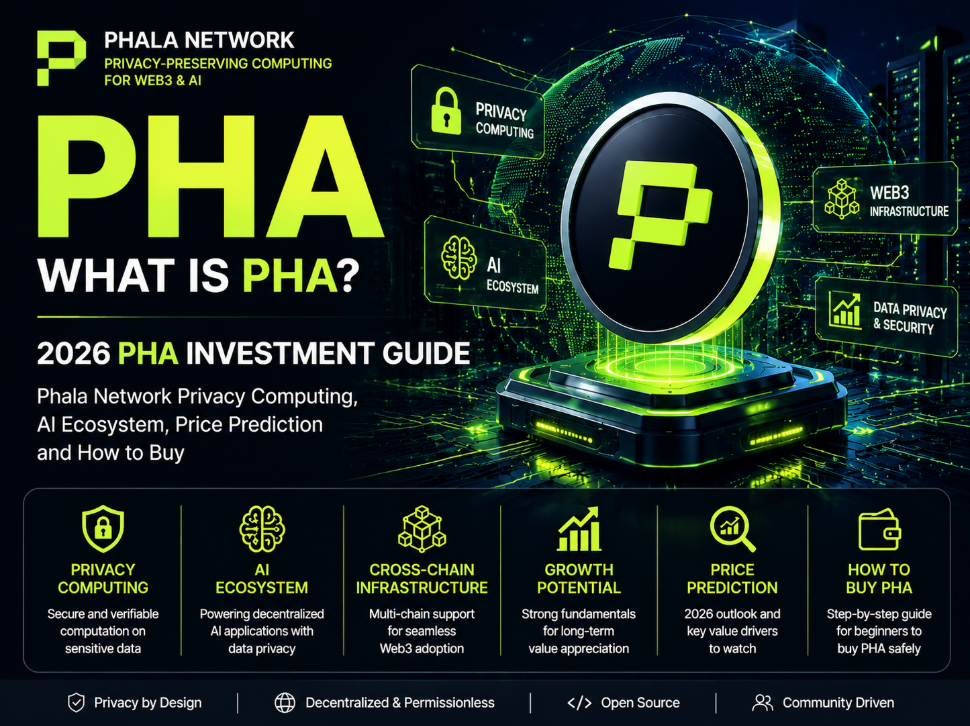
2.3 What Are the Actual Use Cases of the PHA Token?
PHA’s utility can be understood through network payments, node incentives, governance, and security mechanisms.
First, PHA is used for compute resource payments. Users or developers paying for network compute services need a value medium to cover resource costs. In decentralized compute networks, tokens typically serve resource pricing and incentive functions.
Second, PHA is tied to node and compute provider incentives. Phala’s ecosystem needs compute providers to join the network and offer trusted execution environments. Without economic incentives, the network can’t sustain itself.
Third, PHA plays a role in governance and staking. The Phala documentation explains that PHA can be converted to vPHA via a staking contract on Ethereum mainnet, and vPHA is used for community governance, Phala L2 staking, GPU mining collateral, and rewards.
Fourth, PHA contributes to network security and ecosystem participation. The docs also note that PHA is currently an ERC-20 token that can be displayed, transferred, and managed in EVM-compatible wallets, used across the Ethereum ecosystem, and bridged to Phala L2.
So PHA isn’t just a “concept coin.” It’s connected to compute, staking, governance, GPU resources, and L2 applications within the Phala ecosystem.
3. How Does PHA Relate to AI, DePIN, and RWA?
Many newcomers ask: Is PHA the next AI coin? Is it DePIN? How does it relate to the recent RWA (Real-World Assets) trend?
These need to be addressed separately.
3.1 How Does PHA Differ from Other AI Crypto Tokens?
AI Crypto isn’t a single category. Different AI tokens have completely different value drivers.
Some focus on model training, some on AI agents, some on data labeling, some on GPU compute, some on AI applications. PHA leans more toward privacy AI compute infrastructure.
PHA’s value doesn’t come from having “AI” in its name — it comes from the demand for privacy, security, verifiable execution, and decentralized compute environments during AI computation.
If AI agents, private LLM inference, enterprise AI applications, and on-chain AI services continue to grow, projects like Phala that provide privacy compute environments could gain more attention.
But that doesn’t guarantee PHA will rise with every AI narrative. Investors still need to look at real usage, developer adoption, compute task growth, and token value capture.
3.2 How Does PHA Differ from DePIN Projects?
DePIN projects typically emphasize bringing real-world hardware resources onto blockchains — storage, networking, compute, sensors, GPUs, etc.
PHA shares similarities with DePIN because it involves distributed compute resources and decentralized cloud computing. However, PHA’s focus isn’t merely on providing compute power — it’s on providing TEE-protected secure compute environments.
A typical DePIN project might say “we have X amount of compute, Y nodes, Z bandwidth.” PHA emphasizes “is this compute private, verifiable, and suitable for AI and Web3 applications handling sensitive data?”
So PHA can be placed under the DePIN umbrella, but its more precise positioning is privacy-focused DePIN infrastructure.
3.3 How Does PHA Differ from RWA Assets?
PHA is not an RWA asset.
RWA refers to tokenized real-world assets like stocks, bonds, gold, funds, etc. PHA represents Web3 infrastructure and a privacy compute network — not an on-chain representation of real stocks or funds.
For example, Hibt’s TSMB page explains tokenized TSMC stock logic, useful for understanding how traditional stocks enter the on-chain market. NOKB covers Nokia-related tokenized stock assets, which lean more toward RWA financial assets.
PHA is different. PHA depends on technology adoption, compute demand, and AI privacy infrastructure; TSMB and NOKB depend on real stock asset mapping, issuance structures, market prices, and regulatory environments.
Thus, PHA complements the RWA category: PHA represents Web3 tech infrastructure, while RWA assets represent tokenized real-world finance.
4. Why Is the Market Paying Attention to PHA in 2026?
PHA isn’t a brand-new project, but it’s worth revisiting in 2026 because AI, privacy computing, and decentralized infrastructure are once again major market focuses.
4.1 Why Is AI Infrastructure Becoming a New Competitive Battleground?
In the past, the AI market focused most on model capabilities — who had the most parameters, the best inference, the best results.
But as AI applications enter real business scenarios, the competition shifts. Going forward, AI will compete not just on models, but on compute costs, data privacy, inference speed, compliance, and verifiable execution.
Enterprises won’t easily hand over all their private data to opaque models; finance, healthcare, legal, and enterprise services demand higher security standards. This is where privacy AI compute infrastructure becomes vital.
Phala’s opportunity lies here. It’s not directly competing with large AI models — it’s providing a more secure, verifiable runtime environment for AI models, agents, and Web3 applications.
4.2 Why Does Web3 Need Privacy Computing?
Blockchain’s biggest strength is transparency — transactions, contract states, and asset flows are publicly verifiable.
But transparency is also a problem. Not all data should be public. Financial strategies, user identities, business data, AI agent private keys, and enterprise application logic all need privacy.
If blockchain only offers transparency without privacy, many complex applications can’t scale. Privacy computing bridges the gap between transparent verification and data protection.
Phala Network attempts to combine TEE with on-chain verification, allowing applications to get verifiable computation results while protecting sensitive data. This is exactly the foundational capability Web3 needs as it moves into more complex use cases.
4.3 Could PHA Benefit from AI Growth?
PHA could benefit from AI growth — but only if Phala’s ecosystem actually captures AI compute demand, not just because “AI is hot.”
Investors should watch: Are more AI applications integrating with Phala? Is private AI inference generating real usage? Is GPU TEE becoming a commercial requirement? Are developers willing to deploy agents or model services on Phala? Can PHA capture value from these network activities?
If these questions have positive answers, PHA could genuinely benefit from the AI infrastructure trend.
If the market merely treats PHA as an AI concept coin for short-term speculation without real network usage growth, any price surge is likely unsustainable.
5. Why Does PHA’s Price Rise or Fall? How to Interpret Price Predictions?
When users search “PHA price prediction” or “PHA price prediction 2026,” what they really want to know is: what determines PHA’s future price?
For an infrastructure token like PHA, price isn’t driven by a single factor — it’s influenced by the AI sector, DePIN cycles, Phala’s on-chain data, token supply, and the broader crypto market.
5.1 AI Sector Hype
PHA is linked to AI privacy computing, so AI sector sentiment affects market attention.
When the market focuses on AI agents, decentralized AI, GPU compute, private inference, and on-chain AI applications, PHA is more likely to be included in AI crypto watchlists.
But narrative heat doesn’t equal long-term value. What really matters is whether Phala can capture real compute demand from AI applications.
5.2 DePIN Market Cycles
PHA is also influenced by DePIN market cycles.
If the market revisits decentralized compute, distributed GPUs, on-chain cloud computing, and hardware resource networks, PHA as a privacy-focused infrastructure play may attract more capital.
If DePIN热度 cools, PHA may be overlooked.
5.3 Phala Ecosystem Development
The most critical price driver for PHA is still Phala’s own ecosystem growth.
Watch for Phala Cloud usage, AI model invocations, TEE compute tasks, node count, developer growth, partnerships, and Phala L2 activity.
The Phala website shows its product focus on Confidential AI Cloud, Agent sandbox, Confidential GPU, Private LLM models, etc., with verifiable execution and hardware-level security.
If these products consistently attract users, PHA’s fundamentals may improve.
5.4 Token Supply Dynamics
PHA price is also affected by token supply. Watch circulating supply, staking ratio, unlock schedules, exchange balances, and holder distribution.
If demand grows but supply pressure is limited, price finds better support. Conversely, if demand is weak while supply increases, price may face headwinds.
5.5 Overall Crypto Market Sentiment
PHA remains a crypto asset, so it’s influenced by BTC, ETH, and the broader altcoin cycle.
In bull markets, AI, DePIN, and infrastructure tokens tend to attract more capital. In bear markets, money flows back to BTC, ETH, and stablecoins, and smaller tokens see higher volatility.
Therefore, PHA price predictions can’t be separated from the broader market environment.
6. How Should You Read PHA Price Predictions?
You can refer to Hibt’s PHA price prediction page. The page offers a PHA price prediction calculator, short-term and long-term forecasts, and yearly price references — with a clear disclaimer that predictions are user-generated, for reference only, and not investment advice.
These tools are useful for gauging market sentiment, but they should never be treated as buy signals.
6.1 Look at Historical Trends, but Don’t Rely Solely on Them
Historical price data can help you observe PHA’s volatility ranges, support/resistance levels, and sentiment shifts. But an all-time high doesn’t guarantee a return.
For PHA, what matters more than past prices is: does Phala Network now have new products, new users, new developers, and real compute demand?
6.2 Watch Market Sentiment, but Don’t Be Driven by It
AI and DePIN are sectors prone to sentiment amplification. When hype hits, PHA can surge; when it fades, PHA can correct just as fast.
So PHA price predictions shouldn’t be based solely on community chatter. Investors should simultaneously check on-chain data, project progress, token liquidity, and the broader market.
6.3 Consider User-Generated Predictions, but Don’t Treat Them as Financial Advice
Prediction pages often display user inputs, algorithmic estimates, or market expectations — but none are deterministic.
A safer approach is to use PHA price predictions as scenario analysis: if AI compute demand grows, PHA may gain attention; if ecosystem adoption lags, PHA may remain under pressure; if the broader market drops, PHA may follow.
7. Does ETH’s Price Impact PHA?
ETH’s price does impact PHA, but it’s not the sole determinant.
Phala’s docs show that PHA exists as an ERC-20 token that can be displayed, transferred, and managed in EVM-compatible wallets, used across Ethereum, and bridged to Phala L2. This indicates a meaningful relationship with the Ethereum/EVM ecosystem.
When ETH rises, it generally signals stronger risk appetite in the on-chain market, making DeFi, AI, DePIN, and infrastructure tokens more likely to attract capital. When ETH falls, the market becomes more cautious, and smaller tokens tend to be more volatile.
But PHA is not ETH.
ETH is a base-layer asset, with value derived from Ethereum network usage, gas demand, Layer2s, DeFi, and developer ecosystem. PHA is a privacy compute infrastructure token — its value depends more on Phala Network’s compute demand, AI ecosystem adoption, node incentives, and tokenomics.
If you want a major-asset comparison, check Hibt’s ETH price prediction page. The ETH page also provides a prediction calculator and long-term references, with the same disclaimer that predictions are not investment advice.
8. How to Buy PHA? Full Tutorial for Trading PHA/USDT on Hibt
For users searching “how to buy PHA,” the need is for a clear, secure, and actionable process.
8.1 What Do You Need Before Investing in PHA?
Before buying PHA, we recommend four preparatory steps.
First, set up a trading account. Always use the official exchange entry — never click unfamiliar links from社群 (community groups) to avoid phishing.
Second, prepare USDT funds. On Hibt, PHA is traded as PHA/USDT, so you’ll typically need USDT first to trade PHA.
Third, understand the project risks. Though PHA is in AI privacy infrastructure, it’s still a highly volatile crypto asset, not a low-risk investment product.
Fourth, check trading depth. Before buying, review PHA/USDT volume, order book, and spread to avoid chasing during illiquid periods.
8.2 How to Buy PHA on Hibt – Step by Step
Step 1: Go to the PHA/USDT trading page and confirm the pair is PHA/USDT.
Step 2: Check the current price, 24h change, volume, and order book depth. Don’t just look at the percentage change — also see if the order book is active.
Step 3: Choose your order type. Use a limit order if you want to control your entry price; use a market order if you want fast execution, but be mindful of slippage.
Step 4: Enter the quantity of PHA or the amount of USDT you want to spend. For first-time trades, start small to get familiar with the process before adding more.
Step 5: Confirm order details — price, quantity, fee, and estimated total. Double-check before submitting.
Step 6: After execution, check your balance and record your cost basis. Then, manage your position based on project progress, market conditions, and your risk tolerance.
8.3 Who Is PHA Suitable For?
PHA fits three types of users.
First, those bullish on AI infrastructure. If you believe future AI applications will need privacy, security, and verifiable compute environments, PHA is worth watching.
Second, those researching DePIN and decentralized compute. PHA isn’t just a raw compute token — it’s a privacy-focused network asset, suited for those willing to study technical logic.
Third, those comfortable with high volatility. PHA is an altcoin, heavily influenced by AI narratives, market cycles, and project data — unsuitable for those who can’t afford losses.
PHA is not suitable for those who chase hype without understanding TEE technology, don’t research project data, or buy solely based on community calls.
9. PHA Investment Risk Analysis: Must-Know Issues Before Buying
While PHA has narratives around AI, privacy computing, DePIN, and Web3 infrastructure, risks are equally present. Any financial content must address both opportunities and risks — not just the upside.
9.1 Technology Competition Risk
The AI compute and privacy computing space is highly competitive.
Phala faces competition not only from other Web3 projects but also from traditional cloud providers, privacy computing firms, GPU cloud platforms, AI infrastructure protocols, and new DePIN networks.
If alternative solutions offer better cost, performance, developer experience, or security proofs, PHA’s market share could shrink.
9.2 Ecosystem Adoption Risk
Great technology doesn’t guarantee users.
For Phala to gain long-term value, developers must want to use its compute services, AI projects must deploy in TEE environments, and enterprises/Web3 apps must pay for privacy compute.
If real adoption falls short, PHA’s price may rely more on short-term narratives than fundamentals.
9.3 Token Value Capture Risk
Even if Phala Network usage grows, that doesn’t guarantee PHA’s price will rise.
Investors need to study whether network growth translates into PHA demand. For example: are compute resource payments made in PHA? Are node incentives dependent on PHA? Does governance and staking reduce circulating supply? Will ecosystem apps consistently use PHA?
If the link between network growth and token demand is weak, PHA could see “project progress but token doesn’t rise.”
9.4 Market Cycle Risk
PHA is heavily influenced by AI, DePIN, and altcoin market cycles.
When AI narratives heat up, PHA may be bid up; when they cool or the broader market corrects, PHA may face significant downside.
Investors can’t just follow trends — they must consider pullback risks in advance.
9.5 Technical and Contract Risks
PHA involves cross-chain, L2, staking, governance, nodes, and compute services. The official docs also caution users to verify correct contract addresses and note that PHA exists across multiple environments — users must correctly identify and verify the contracts they interact with.
This means beginners must be careful with network and contract addresses when transferring, staking, bridging, or interacting, to avoid asset loss.
10. PHA vs ETH vs AI Token: What’s the Difference in Investment Logic?
10.1 PHA vs ETH
ETH is a base-layer asset, with value from Ethereum network usage, gas demand, developer ecosystem, DeFi, Layer2s, and stablecoins.
PHA is a privacy compute infrastructure token — value depends on whether Phala Network can provide real compute services for AI and Web3.
ETH is more mature, more liquid, and broader in scope; PHA is more niche, potentially more volatile, but with concentrated risk.
If ETH is the highway of the on-chain world, PHA is more like a privacy compute service layer on that highway.
10.2 PHA vs General AI Tokens
Many AI tokens are more application-layer — e.g., AI chat, agent tools, model marketplaces, content generation, or trading bots.
PHA is more infrastructure-layer. It doesn’t sell a chatbot — it provides the private, verifiable, decentralized compute environment needed to run AI apps.
Application-layer AI tokens depend on product user growth; infrastructure tokens like PHA depend more on compute demand, developer adoption, node networks, and security verification.
10.3 PHA vs RWA Tokens
RWA tokens are about tokenizing real-world assets — stocks, bonds, gold, funds. Assets like TSMB and NOKB are closer to tokenized stocks, with investment logic tied to underlying stock prices, issuance structures, custody, and regulatory risks.
PHA is not a real-world asset mapping. It’s a Web3 infrastructure token, with core value from technology adoption and network usage demand.
So, analyze PHA through privacy compute and AI infrastructure; analyze TSMB and NOKB through RWA and stock tokenization mechanisms.
11. What Metrics Should You Watch for PHA Research in 2026?
If you want to assess whether PHA is worth following, don’t just look at price — look at data and ecosystem progress.
11.1 Network Metrics
Track Phala Network’s node count, compute task volume, network usage, TEE resource supply, GPU task demand, and Phala L2 activity.
If compute tasks grow, it suggests real demand. If nodes and resource supply grow, the ecosystem infrastructure may be more robust.
11.2 Ecosystem Metrics
Watch the number of AI applications, developer growth, partnerships, Phala Cloud usage, AI agent deployments, private inference demand, and enterprise client adoption.
Phala’s website has oriented its product focus around Confidential AI Cloud, Agent sandbox, Confidential GPU, and Private LLM models. Whether these products consistently attract users is key to judging PHA.
11.3 Token Metrics
Monitor PHA circulating supply, staking ratio, vPHA size, holder address count, exchange balances, trading depth, and volume.
Higher staking ratios may reduce circulating pressure; rising exchange balances may signal potential sell pressure. Better trading depth improves user experience.
11.4 Market Environment Metrics
Keep an eye on AI Crypto sentiment, DePIN market cycles, ETH price action, BTC trends, and overall altcoin risk appetite.
PHA isn’t an isolated asset — it’s affected by capital flows. Even if Phala’s ecosystem progresses, a weak overall market could still push PHA’s price down.
12. Is PHA Worth Investing In?
PHA is worth watching, but it’s not for everyone.
It suits three types of investors.
First, those bullish on AI infrastructure. If you believe AI will keep growing and that privacy compute, private inference, and verifiable execution will become important, PHA is worth researching.
Second, those who understand DePIN and Web3 infrastructure. PHA isn’t a simple app token — it’s a privacy compute network asset, best analyzed through nodes, compute tasks, developer ecosystem, and token value capture.
Third, those who can handle high volatility. PHA is an altcoin, subject to sharp swings from AI narratives, DePIN cycles, and broader market moves.
It’s not suitable for three types.
First, those who buy solely on “AI concept.” PHA isn’t a simple AI hype coin — you need to understand TEE and privacy compute logic.
Second, those seeking stable returns. PHA is not a stablecoin and offers no yield guarantees.
Third, those who don’t understand the technology and risks. If you can’t assess project adoption, tokenomics, and market cycles, it’s not wise to take a heavy position.
So, whether PHA is worth investing in can’t be answered with a simple “yes” or “no.” A more balanced conclusion: PHA represents a convergence of AI privacy computing and Web3 infrastructure, with long-term observation value — but before investing, you must study real usage data, tokenomics, and your own risk tolerance.
13. Summary: PHA Represents the Convergence of AI + Privacy Computing + Web3 Infrastructure
What is PHA?
PHA is the native token of the Phala Network ecosystem, centered on decentralized privacy computing, TEE-secured execution, AI compute infrastructure, and Web3 application support. It is not a fiat currency, not a central bank digital currency, and not a generic AI chat token.
PHA’s opportunity comes from AI application growth, rising demand for private data processing, DePIN market development, Phala Cloud product adoption, GPU TEE compute demand, and expansion of Web3 privacy infrastructure.
PHA’s risks stem from technology competition, insufficient ecosystem adoption, uncertain token value capture, market cycle volatility, and contract/cross-chain operational risks.
For newcomers, the right order to research PHA is: first understand what Phala Network is, then understand TEE privacy computing, then look at AI and DePIN demand, then observe PHA token utility, and only finally reference price predictions and trading opportunities.
To check the current price, go to the PHA/USDT market page. To see future price scenarios, check the PHA price prediction tool. To compare major-asset risk preferences, combine with ETH price prediction.
If you want to explore more of Hibt’s new financial asset topics, you can read about PONS, ARMB, NOKB, and TSMB. These will help you understand the crypto market from multiple angles — AI infrastructure, Web3 ecosystem, RWA assets, and tokenized stocks.
Ultimately, PHA is worth watching, but don’t blindly chase pumps. A mature investment approach isn’t just asking “will PHA go up?” — it’s asking: Is Phala consistently gaining real users? Is AI compute demand growing? Can PHA capture network value? And can you handle high volatility?
FAQ: Common Questions About PHA
Q1: What is PHA coin?
PHA is the native token of the Phala Network ecosystem, focused on privacy computing, AI infrastructure, and Web3 decentralized compute. It is not a fiat currency or a generic AI chat token.
Q2: What is Phala Network?
Phala Network is a decentralized cloud computing protocol that uses TEE technology to provide private, verifiable, and decentralized compute environments for applications, supporting confidential smart contracts, secure off-chain computation, and AI workloads.
Q3: Is PHA an AI coin?
PHA can be classified under AI infrastructure, but it’s not a typical AI application token. It leans more toward private AI compute, GPU TEE, AI agent runtime, and Web3 infrastructure.
Q4: Is PHA worth investing in?
PHA is worth watching but is a high-risk crypto asset. It suits those who are bullish on AI privacy computing, DePIN, and Web3 infrastructure, not those who chase hype or can’t handle volatility.
Q5: Where can I buy PHA?
You can check the price and trade PHA on Hibt via the PHA/USDT trading page. Before buying, review volume, order book depth, and market volatility.
Q6: Are PHA price predictions reliable?
PHA price predictions are for reference only. You can use the PHA price prediction page, but never treat them as guaranteed returns. What truly matters are Phala ecosystem data, AI compute demand, token liquidity, and overall market cycles.
Q7: What’s the difference between PHA and ETH?
ETH is a base-layer asset — value comes from Ethereum network usage, gas, DeFi, and developer ecosystem. PHA is a privacy compute infrastructure token — value depends more on Phala Network’s compute demand and AI ecosystem adoption.
Q8: What’s the difference between PHA and TSMB?
PHA is a Web3 infrastructure token, focused on privacy compute and AI compute demand. TSMB is closer to a tokenized TSMC stock asset, with logic tied to real-world stock tokenization.
Q9: How does PHA relate to DePIN?
PHA relates to DePIN because it involves distributed compute resources and decentralized cloud computing. But PHA emphasizes TEE privacy compute environments, not just raw compute power.
Q10: Is PHA suitable for long-term holding?
Whether it’s suitable depends on whether Phala Network consistently gains real users, whether AI compute demand grows, whether PHA captures network value, and your personal risk tolerance. Newcomers are better off starting with a small position for observation rather than going all-in long-term.