
1. What Is NOKB? Why Is a Stock Ticker Showing Up in Crypto?
Many newcomers have a very straightforward question when they first encounter NOKB: What exactly is it? Is it a cryptocurrency or a stock?
Simply put, NOKB stands for Nokia Tokenized bStocks – a tokenized representation of Nokia-related stock assets. It falls under the category of Tokenized Stock (tokenized equities) and can also be grouped into the RWA (Real World Assets) sector. Unlike BTC, ETH, or DeFi tokens, NOKB’s core value does not come from a public blockchain, a protocol, or an on-chain application. Instead, it derives from the value of its underlying traditional financial asset.
Users can check NOKB’s real-time price, trading activity, and market movements on Hibt’s NOKB/USDT market page.
Public market data platforms also classify NOKB as a Nokia bStocks Tokenized Stock, making it clear that this is not an ordinary “project coin” but a tokenized asset tied to Nokia stock.
1.1 What Is the Basic Definition of NOKB?
NOKB can be understood as a tokenized expression of Nokia stock-related assets in the crypto market. It allows users to gain price exposure to Nokia stock within a digital asset trading environment.
In traditional stock markets, users need a brokerage account to buy and sell stocks. With tokenized stocks, users can trade NOKB using digital assets like USDT. This model lowers the barrier for some users to access traditional equity assets and bridges the gap between stocks and the crypto trading experience.
However, it must be emphasized: NOKB is not a cryptocurrency issued directly by Nokia, nor does it equate to holding Nokia stock in a traditional securities account. It is better understood as an “on-chain trading instrument for stock-related value.”
1.2 Why Is NOKB Not a Typical Crypto Token?
Ordinary crypto tokens derive value from several sources.
BTC’s value comes from Bitcoin network consensus, scarcity, censorship resistance, and long-term market recognition. ETH’s value stems from the Ethereum ecosystem, gas demand, DeFi, Layer 2, stablecoins, and smart contract applications. DeFi tokens often derive value from protocol usage, fees, governance rights, liquidity incentives, and ecosystem expansion.
NOKB is different.
NOKB’s value primarily comes from three sources: first, the performance of the underlying stock asset; second, trading demand within the crypto market; and third, the growth of the RWA ecosystem.
Therefore, when analyzing NOKB, you cannot rely solely on crypto market sentiment or short-term K-line fluctuations. More importantly, you need to understand that NOKB’s underlying asset logic is closer to traditional stocks than to a new chain, new protocol, or meme asset.
1.3 What Are the Differences Between NOKB and Traditional Stocks?
The biggest differences between NOKB and traditional Nokia stock lie in the trading environment, pricing currency, ownership rights, and regulatory framework.
Traditional stocks are securities market assets. Investors buy them through brokerage accounts, trading hours are typically limited by exchange opening times, pricing is in fiat currencies like USD or EUR, and investor rights are protected by securities market regulations.
NOKB, on the other hand, is a tokenized stock asset. It trades in the crypto market, is usually priced in USDT or other digital assets, and offers a trading experience closer to crypto spot trading. Some xStocks-related materials indicate that tokenized stock products emphasize 1:1 underlying asset backing, on-chain transferability, and more flexible trading, but users’ ultimate rights still depend on the specific issuance mechanism, custody arrangements, and platform rules.
So newcomers must remember: buying NOKB does not make you a traditional Nokia shareholder.
You hold a tokenized stock-related asset, not Nokia stock in a securities account. Whether you have voting rights, shareholder rights, dividend arrangements, or redemption mechanisms depends on the product details and platform policies.
2. What Is the Asset Logic Behind NOKB? Why Is the Market Paying Attention to Tokenized Stocks?
If NOKB isn’t an ordinary cryptocurrency, what drives its price?
The answer: NOKB’s upside logic comes primarily from “underlying asset price + blockchain liquidity + RWA market demand.”
That’s the biggest difference between tokenized stocks and typical crypto tokens. Ordinary project coins may depend on ecosystem growth, community hype, on-chain data, and protocol revenue. NOKB, however, relies more on the corresponding stock’s performance, traditional financial market sentiment, and the adoption of tokenized stock markets.
2.1 What Is RWA?
RWA stands for Real World Assets. In simple terms, it refers to representing existing real-world assets – such as stocks, bonds, gold, real estate, funds, government bonds, and private credit – on the blockchain for representation, circulation, or trading.
In the past, the crypto market mainly revolved around native on-chain assets like BTC, ETH, stablecoins, DeFi tokens, and NFTs. The emergence of RWA allows traditional financial assets to enter the on-chain ecosystem.
NOKB is an example of this trend. It doesn’t create a new narrative out of thin air; it brings traditional stock assets into the crypto trading environment via tokenized stocks.
2.2 Why Is RWA Becoming a Major Web3 Focus in 2026?
Over the past few years, crypto has gone through multiple hype cycles: Bitcoin halvings, DeFi explosions, NFT mania, GameFi, meme coins, Layer 2, AI Crypto, and more.
But as the market matures, more capital is asking a practical question: Can blockchain connect to real-world assets? If stocks, bonds, gold, and funds can circulate on-chain, crypto would no longer be just about “coin-to-coin trading” – it could become a new global infrastructure for asset trading.
xStocks’ official website describes itself as tokenized US stocks and ETFs, emphasizing 1:1 underlying asset backing, 24/7 trading, cross-chain usability, and an on-chain trading experience for global users. The emergence of such products reflects the convergence of traditional finance and crypto.
If you want to explore similar RWA assets, check out Hibt’s guides on what AVGOB is, what AAOIB is, and what ARMB is. These all fall under tokenized stocks or stock-related assets and can help beginners build a comprehensive RWA investment framework.
2.3 How Does NOKB Connect to Traditional Finance?
NOKB’s core logic is not “a project issuing a coin” but “underlying asset price + blockchain trading method.”
In other words, NOKB bridges two markets.
On one side is traditional finance – you need to follow Nokia’s business performance, industry cycles, earnings reports, telecom equipment demand, network infrastructure spending, and more.
On the other side is the crypto market – you need to watch trading depth, USDT liquidity, RWA narrative momentum, platform support, and market sentiment.
So NOKB is not entirely independent of the stock market. It is more like an extension of traditional equity markets into the crypto space.
3. How Does NOKB Work? The Technical Mechanics Behind Tokenized Stocks
Many newcomers ask: How can a token represent stock value?
The answer lies in the “tokenized stock” structure.
Generally, tokenized stocks take traditional equities or related financial assets and digitize them through compliant issuance, custody, and on-chain record-keeping. The token users see – NOKB – is an on-chain or platform-traded token, and behind it lies price exposure to the underlying traditional stock.
3.1 What Is the NOKB Token Issuance Process?
The operational logic of NOKB can be broken down into five steps.
First, the traditional stock asset exists in the real financial market. In NOKB’s case, it corresponds to Nokia-related stock assets.
Second, the issuer or relevant institution uses custody arrangements to bring the underlying asset or its value into a tokenized structure.
Third, the token issuer maps this asset value onto an on-chain token, creating a tokenized stock like NOKB.
Fourth, the blockchain records token ownership and transfers, allowing users to trade on supported platforms.
Fifth, users buy and sell NOKB via trading pairs like NOKB/USDT, gaining price exposure to Nokia-related stock assets.
In a nutshell: traditional stock assets enter a custody and issuance system, and then are brought to the blockchain and crypto trading market in token form.
3.2 Why Does NOKB’s Price Change?
NOKB’s price movements are influenced by three main factors.
The first is the underlying stock price. If Nokia stock rises, NOKB theoretically finds support; if Nokia stock falls, NOKB may come under pressure. Because NOKB’s core logic is not an independent project valuation but a mapped value of the stock asset.
The second factor is market supply and demand. Even if the underlying stock price moves little, the number of buyers and sellers, order book depth, trading volume, short-term sentiment, and capital flows in the crypto market can affect NOKB’s price. If trading depth is thin, price volatility may be more pronounced than in traditional stocks.
The third factor is RWA market heat. If capital starts rotating into tokenized stocks, and more users want to trade equity-like assets with USDT, NOKB could gain extra attention. Conversely, if RWA cools, NOKB’s activity may drop.
So NOKB’s price is not determined by a single factor – it is shaped by the stock market, the crypto market, and RWA sector sentiment together.
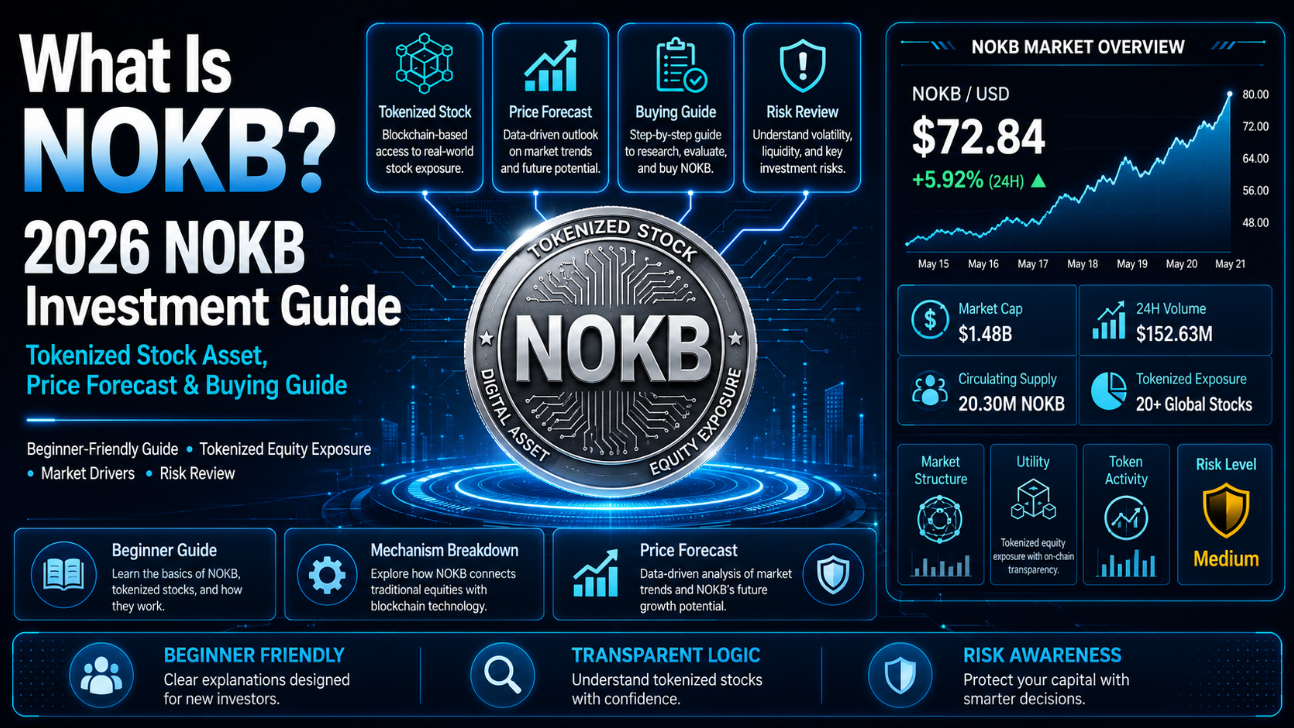
4. NOKB Price Prediction: Where Does Future Upside Come From?
Many users search for “NOKB price prediction” – what they really want to know is whether NOKB will rise in the future and whether it has long-term value from 2026 to 2030.
First, a caveat: NOKB price predictions cannot be reduced to a specific number for a given year. For tokenized stock assets, the more important thing is to build an analytical framework rather than offer unsupported deterministic prices.
Users can check Hibt’s NOKB price prediction page for displayed forecast information, and then combine that with underlying stock performance and their own risk tolerance.
4.1 What Indicators Should You Look at for NOKB Price Predictions?
The first indicator is the underlying asset trend. Since NOKB corresponds to Nokia stock, you need to follow Nokia’s corporate performance, earnings, business growth, industry cycles, and market valuation.
Nokia positions itself as a technology company focused on mobile networks, fixed networks, cloud networks, and network infrastructure, with solutions serving AI, cloud providers, telecom operators, and enterprise networking. Therefore, when analyzing NOKB, you can’t just watch “coin price” – you also need to assess Nokia’s competitiveness in communications infrastructure, 5G, AI networking, cloud connectivity, and enterprise markets.
The second indicator is RWA market growth. If more institutions, exchanges, and users embrace tokenized stocks, NOKB’s visibility and trading demand could rise. xStocks official materials highlight coverage of various stocks and ETFs, with 24/7 trading and 1:1 asset backing. Such infrastructure development is a key backdrop for whether assets like NOKB gain long-term traction.
The third indicator is the broader crypto environment. Bitcoin cycles, Ethereum ecosystem health, stablecoin liquidity, risk appetite, and platform trading activity all influence NOKB’s short-term performance. If crypto enters a risk-on phase, RWA tokens may attract more capital; if risk-off sentiment dominates, NOKB may face selling pressure.
4.2 Potential Catalysts for NOKB’s Future Upside
The first potential catalyst is the growth of the RWA sector. As more traditional assets move on-chain, tokenized stocks could evolve from a niche product into a more common asset class. For users already familiar with USDT and exchange operations, accessing equity assets through a crypto account has a certain appeal.
The second factor is changing investor behavior globally. Traditional stock markets are often constrained by geographic boundaries, account opening requirements, trading hours, and brokerage restrictions. Tokenized stocks emphasize a more global and flexible trading experience. If this model gains wider acceptance, assets like NOKB could benefit.
The third factor is the maturation of crypto infrastructure. Stablecoins, wallets, on-chain trading, cross-chain networks, compliant custody, and RWA protocols all lower the barrier to using tokenized stocks. The more mature the infrastructure, the easier it becomes for ordinary users to understand and trade assets like NOKB.
4.3 What Risks Could NOKB Face?
NOKB’s risks cannot be ignored.
If Nokia’s stock price declines, NOKB may follow suit. If Nokia’s earnings miss expectations, industry demand slows, or competition in telecom equipment intensifies, the underlying asset will suffer.
If NOKB’s trading depth is shallow, users may encounter wide spreads, thin order books, and difficulty executing trades.
If the issuer, custodian, or platform changes its rules, that could affect user holding and trading experience.
If regulatory policies tighten, the admission, trading, issuance, and cross-border流通 of tokenized stocks could be constrained.
So NOKB has RWA narrative value, but it is not a risk-free asset.
5. What Is the Relationship Between NOKB and ETH?
Many newcomers ask: If ETH goes up, will NOKB also rise? And if ETH is the core asset of the on-chain ecosystem, does NOKB depend on ETH?
The answer is: ETH influences RWA market sentiment, but NOKB’s core value still comes from the underlying stock asset.
ETH is a public blockchain asset, representing the Ethereum network ecosystem, smart contract applications, DeFi, Layer 2, stablecoins, and on-chain settlement demand. NOKB is an RWA asset, representing the on-chain expression of Nokia stock-related value.
Users can refer to Hibt’s ETH price prediction to understand ETH’s pricing logic as a public chain asset and then compare it with NOKB.
5.1 Why Does ETH Affect the RWA Market?
ETH affects the RWA market because the Ethereum ecosystem has long hosted a large volume of DeFi, stablecoins, smart contracts, and asset issuance. Many RWA protocols also use Ethereum or EVM-compatible networks as infrastructure.
When ETH prices rise, DeFi activity picks up, and on-chain liquidity is abundant, market attention to RWA, tokenized Treasuries, tokenized stocks, and similar directions tends to increase.
But ETH’s rise does not guarantee NOKB will rise.
If ETH performs strongly but Nokia stock falls, NOKB could still weaken. If ETH is flat but Nokia stock rises and RWA interest grows, NOKB could find support.
5.2 What Are the Investment Logic Differences Between NOKB and ETH?
NOKB’s investment logic is closer to equity investing. You need to focus on Nokia’s corporate value, industry cycles, earnings, market share, communications infrastructure demand, and traditional financial market sentiment.
ETH’s investment logic is closer to public chain ecosystem investing. You need to focus on Ethereum network activity, DeFi total value locked, Layer 2 scaling, staking mechanisms, developer ecosystem, and on-chain application growth.
NOKB’s upside comes from corporate value and RWA adoption; ETH’s upside comes from blockchain network value and ecosystem expansion.
NOKB’s risks primarily stem from company operations, stock market fluctuations, issuance mechanisms, custody rules, and regulatory changes. ETH’s risks come from public chain competition, technical roadmaps, regulatory policies, and crypto cycle volatility.
So NOKB and ETH can both be part of a diversified crypto portfolio, but they are not the same type of asset and should not be analyzed in the same way.
6. How to Invest in NOKB: A Step-by-Step Buying Guide for Beginners
For users searching “how to buy NOKB,” the most important thing is not to place an order immediately, but to first understand what you are buying.
NOKB is not an ordinary project coin or a meme coin. It is a tokenized stock-related asset, and its price logic is tied to the stock market, the RWA market, and the crypto market.
6.1 What Do You Need to Prepare to Invest in NOKB?
Step 1: Register on a trading platform that supports the NOKB/USDT pair. Start by visiting Hibt’s NOKB/USDT market page to check the current price, trading pair information, and market changes.
Step 2: Complete account security settings. Enable two-factor authentication, set a fund password, and confirm that your region supports trading this asset.
Step 3: Prepare USDT. NOKB is typically traded via the NOKB/USDT pair, so you need to hold USDT first.
Step 4: Search for NOKB or NOKB/USDT on the trading page to enter the corresponding market.
Step 5: Set your buy price according to your plan. Beginners should start with a small test amount and avoid heavy positions from the outset.
Step 6: After completing the trade, continuously monitor NOKB’s price, Nokia stock movements, RWA market developments, and platform announcements.
6.2 What Should You Pay Attention to on Your First NOKB Purchase?
For your first NOKB purchase, position sizing is the most critical factor.
Do not assume that because it is a stock-related asset, it is safer than ordinary crypto. NOKB is influenced by both stock and crypto markets, so volatility risk remains real.
Beginners should first understand the underlying asset – what Nokia does, its business lines, and what factors affect its stock price. Second, diversify risk – do not put all your capital into a single RWA token. Finally, set a risk budget – determine the maximum loss you can tolerate and at what price level you would reassess your position.
If you have not yet understood the difference between “tokenized stock” and “buying the stock directly,” you should not rush into a heavy NOKB position.
7. NOKB Investment Risk Analysis: Must-Know Questions Before Buying
A proper NOKB investment guide must address not only upside potential but also risks. RWA and tokenized stocks sit at the intersection of traditional finance and crypto, making their risk structure more complex than that of ordinary spot tokens.
Risk 1: NOKB Is Not a Traditional Stock
NOKB is not equivalent to traditional Nokia stock. Holding NOKB typically does not mean you have direct Nokia shareholder status.
This means it may not include voting rights, corporate governance rights, or full shareholder entitlements. Whether there are dividend arrangements, redemption mechanisms, or rights provisions depends on the issuer and platform rules.
So newcomers should not simplistically view NOKB as “Nokia stock on-chain.” A more accurate understanding is “a tokenized asset tied to Nokia stock value.”
Risk 2: Issuer and Custody Risk
Tokenized stocks are highly dependent on the issuer, custodian, and platform rules.
Investors need to ask: Is the underlying asset fully backed? Is custody transparent? Is there a redemption mechanism? How are user rights handled in extreme scenarios?
If the issuer or custody arrangement encounters problems, NOKB’s price and liquidity could be affected.
Risk 3: Liquidity Risk
NOKB’s trading depth may be far lower than that of mainstream assets like BTC, ETH, and SOL.
This means when buying or selling, you may encounter thin order books, wide slippage, and difficulty executing trades smoothly. During periods of high volatility, insufficient liquidity can amplify losses.
Risk 4: Stock Market Risk
NOKB’s value logic is inseparable from Nokia stock performance.
If Nokia’s business struggles, telecom equipment competition intensifies, earnings disappoint, or the macroeconomic environment deteriorates, NOKB will likely be affected.
These risks cannot be solved by just watching crypto market sentiment. Investing in NOKB requires a certain level of equity market awareness.
Risk 5: Regulatory Risk
Tokenized stocks are still a fast-growing financial innovation. Different jurisdictions have different regulatory attitudes toward tokenized securities, RWA, and stock-mapping assets.
If regulations tighten in the future, NOKB’s trading, issuance, holding, and cross-border流通 could be restricted. For long-term investors, this is a core risk that must be considered in advance.
8. NOKB vs. AVGOB vs. AAOIB vs. ARMB: How to Choose Among RWA Investment Directions?
If you want to invest in RWA tokenized stocks, you should not look only at NOKB – compare it with similar assets.
NOKB leans toward traditional communications and network infrastructure-related stocks, with its investment thesis centered on Nokia’s corporate value, telecom equipment industry demand, and RWA adoption.
AVGOB is more tied to Broadcom-related assets, focusing on AI chips, data center networking, semiconductors, and enterprise software. To learn more, read what AVGOB is.
AAOIB is more oriented toward AI stock tokens, suitable for those interested in AI industry trends and on-chain equity assets. Read what AAOIB is.
ARMB focuses on ARM-related assets, with core attention on chip architecture, mobile computing, edge AI, and the semiconductor ecosystem. Read what ARMB is.
Additionally, what PONS is belongs to a different Web3 project asset category – its logic is more about project ecosystems, tokenomics, and Web3 applications, whereas NOKB is about on-chain traditional equities.
In short: NOKB depends on corporate value and RWA acceptance; AVGOB on Broadcom and AI chips; AAOIB on AI stock trends; and ARMB on chip architecture ecosystems. Different assets have different underlying logics, and investors should not choose based solely on short-term price movements.
9. The Future of NOKB: Will Tokenized Stocks Become the Next-Generation Investment Vehicle?
NOKB’s long-term value is tied to the development of the tokenized stock asset class.
In the coming years, tokenized stocks may see three trends.
First, traditional assets moving on-chain. More stocks, ETFs, bonds, gold, and funds could enter the blockchain market via tokens. Crypto accounts would then no longer be used just for trading BTC, ETH, and altcoins – they could become a new gateway for users to allocate traditional assets.
Second, lower global investment barriers. Traditional stock markets are often constrained by account opening, geography, trading hours, and brokerage limitations. Tokenized stocks emphasize more flexible and global trading experiences. xStocks materials also highlight multi-country and multi-chain coverage with flexible trading options.
Third, deeper convergence of crypto and traditional finance. In the future, users might hold BTC, ETH, stablecoins, tokenized stocks, tokenized bonds, and RWA yield assets in a single account. This mix could change asset allocation habits for many investors.
But it must be emphasized: RWA growth does not mean all RWA tokens will rise.
Whether a tokenized stock has value ultimately depends on underlying asset quality, issuance mechanisms, custody transparency, liquidity, platform support, and the regulatory environment. NOKB has RWA narrative value, but it still faces the dual tests of the stock market and the crypto market.
10. Conclusion: Who Is NOKB Suitable For?
NOKB is better suited for three types of investors.
First, those who are bullish on the tokenization of traditional financial assets. If you believe that stocks, ETFs, bonds, and more will increasingly move on-chain, NOKB can serve as a sample case for tokenized stocks.
Second, those who want to explore the intersection of stocks and crypto. NOKB allows users to gain exposure to Nokia-related stock assets within a USDT trading environment – a model different from buying coins directly or buying stocks through a broker.
Third, those who can accept a long-term value investment approach. NOKB is not a short-term moonshot asset; it is better analyzed through company fundamentals, industry cycles, RWA market trends, and trading liquidity.
But NOKB is not suitable for those chasing short-term spikes, nor for those who have no understanding of stock market risks. If you don’t know what Nokia’s business is or don’t understand the difference between tokenized and traditional stocks, then blindly buying is not advisable.
In one sentence: NOKB is a new investment tool that brings traditional stock assets into the crypto market. Its core logic is not “project issuing a coin” but “stock value on-chain.”
Users can track real-time prices on Hibt’s NOKB/USDT market page and refer to the NOKB price prediction page for additional context. But the final investment decision should always be based on your own risk tolerance, fundamental analysis of the underlying asset, and capital management strategy.
11. FAQ: Common Questions About NOKB
What is NOKB?
NOKB is Nokia Tokenized bStocks – a tokenized stock asset that falls under the RWA sector. It provides price exposure to Nokia-related stock assets within a crypto trading environment via token form.
Is NOKB a cryptocurrency?
NOKB trades as a token in the crypto market, but it is not an ordinary crypto token. Its value primarily comes from the underlying stock’s performance, market supply/demand, and RWA development – not from a public chain ecosystem or protocol revenue.
Is NOKB the same as Nokia stock?
Not exactly. NOKB is a tokenized expression of Nokia stock-related assets, but buying NOKB does not make you a traditional Nokia shareholder. Whether you have voting rights, shareholder benefits, or redemption mechanisms depends on the issuer and platform rules.
How do I buy NOKB?
Start by visiting Hibt’s NOKB/USDT market page to view the trading pair. The general process is: register an account, obtain USDT, search for NOKB/USDT, set a buy price, and complete the trade.
How should I view NOKB price predictions?
NOKB price predictions should not rely solely on short-term K-lines. A more reasonable approach combines underlying stock performance, Nokia’s business, RWA market growth, crypto liquidity, and platform trading depth. You can also refer to Hibt’s NOKB price prediction page.
Is NOKB suitable for long-term holding?
If you are bullish on the trend of traditional assets moving on-chain and are willing to research Nokia’s fundamentals and industry cycles, NOKB can be a watchlist or allocation asset. But if you are only looking for short-term pumps, or don’t understand stock market risks, NOKB is not suitable for a large, long-term position.
What is the biggest risk of NOKB?
NOKB’s main risks include a drop in the underlying stock, insufficient token liquidity, issuer and custody risks, regulatory changes, and crypto market volatility. It is not a risk-free asset – do your risk budgeting before investing.