
Intro: Why Are People Searching for PONS in 2026?
Many users are searching "what is PONS," "PONS coin," "PONS how to buy," "PONS price prediction," "PONS USDT." They typically want to know if it’s a new project and what sector it belongs to.
As of July 16, 2026, publicly available information suggests PONS is best understood as a Robinhood Chain ecosystem Web3 token / Launchpad‑related asset, not an RWA tokenized stock, nor BTC/ETH.
CoinGecko lists PONS under Robinhood Ecosystem, with contract address on Robinhood Chain. The official Pons page states its product is used to "launch and explore fixed‑supply tokens on Robinhood Chain."
Check PONS real‑time quote for current price and volume.
Important: PONS should not be viewed as just a "new coin to pump." Analyze project positioning, token utility, liquidity, ecosystem development, and risks.
1. What Exactly Is PONS?
PONS is a Web3 digital asset, typically appearing as a PONS Token. It is linked to Robinhood Chain ecosystem. The Pons official site says users can launch and explore fixed‑supply tokens, with all transactions submitted via user wallets – non‑custodial.
It is not a centralized exchange points system or a pure memecoin. It’s a project around token issuance, discovery, trading, and on‑chain interaction.
However:
- No clear public info on governance rights.
- No proven fee‑capture model.
- Not clearly a DeFi blue‑chip, AI, or RWA asset.
- CoinGecko notes no clear narrative and circulating supply not reported (market cap unavailable).
So a safer definition: PONS is a Robinhood Chain‑ecosystem Web3 token associated with launching, discovering, and trading fixed‑supply tokens. It is not BTC, ETH, or RWA tokenized stocks like SKHYB.
2. What Type of Digital Asset Is PONS?
Crypto assets broadly:
- BTC – native digital gold.
- ETH – foundational L1.
- Meme – community/sentiment.
- DeFi – protocol revenue, TVL.
- RWA – real‑world assets.
- Application tokens – product/ecosystem utility.
- Launchpad / issuance platform tokens – dependent on new asset issuance and trading activity.
PONS fits the last two categories – Web3 application token / platform token for token issuance and discovery on Robinhood Chain. Do not classify it as a Layer‑1, RWA stock, AI compute, DePIN, or traditional DeFi lending protocol.
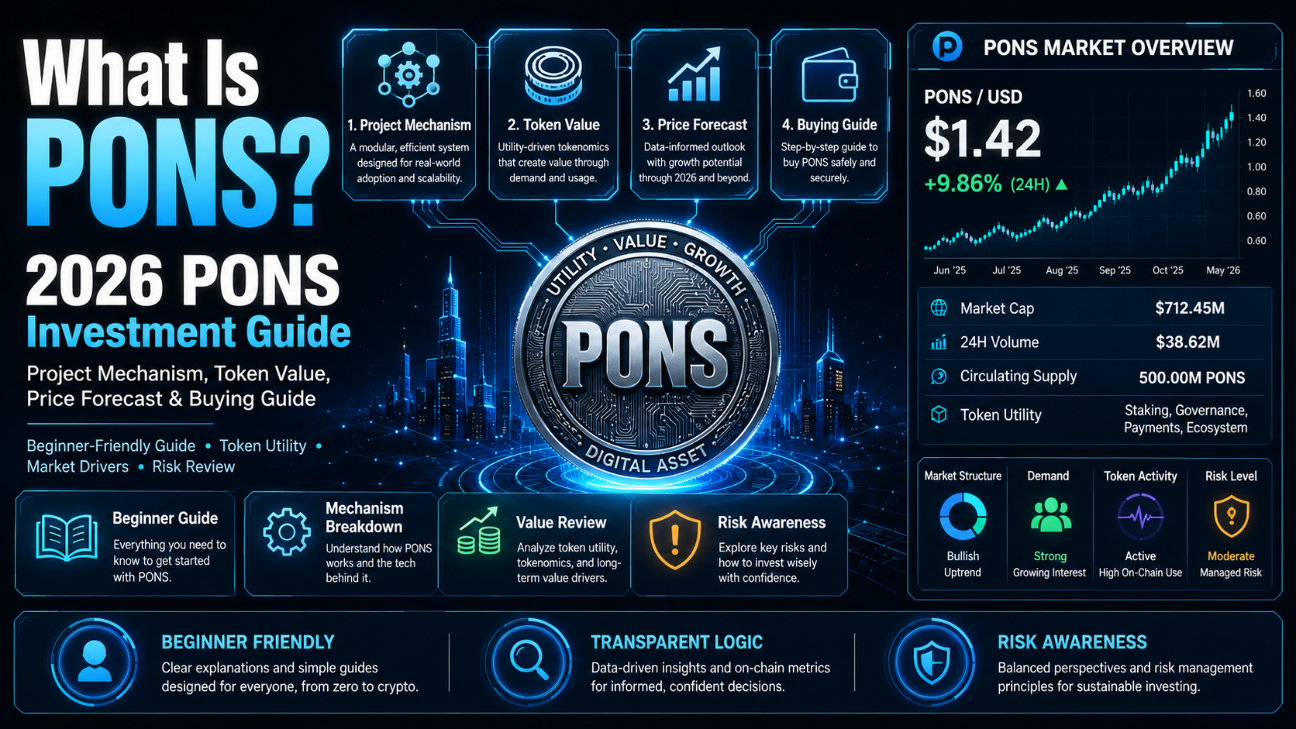
3. Why Is PONS Gaining Attention?
- Robinhood Chain novelty – new chain/ecosystem attract early interest. But early stage brings high risk, low information, and thin liquidity.
- Fixed‑supply token issuance – Pons enables creation and discovery of fixed‑supply tokens. If activity grows, PONS may gain relevance.
- Volume and volatility – CoinGecko shows high 24h volume on PONS/WETH pairs, but supply/circulation data incomplete. High volume doesn’t equal safety.
4. How Does PONS Differ from Memecoins?
Similarities: early stage, high volatility, sentiment‑driven, need to watch contract/liquidity risks.
Differences:
- Memecoins rely purely on culture/community.
- PONS has a clear product interface for launching/exploring tokens.
- Pons emphasizes non‑custodial, wallet‑submitted transactions.
So PONS is not a "standard memecoin." Use a framework: if buying purely on price, it’s a speculative asset; if studying Robinhood Chain and token issuance, it’s an ecosystem observation; if it develops real user demand and fee capture, it may gain long‑term potential.
5. What Problem Does PONS Solve?
Common Web3 issuance pain points: high barriers, difficult discovery, scattered info, fake tokens, low liquidity traps.
Pons aims to be a non‑custodial entry for launching and discovering fixed‑supply tokens on Robinhood Chain. Key terms: launch, explore, fixed‑supply, Robinhood Chain, wallet‑submitted, noncustodial.
But there’s no public proof of large‑scale real users yet. Watch transaction volumes, active wallets, token creations, and retention.
6. Core Functions of PONS
- Token discovery – Explore function to find tokens progressing to "graduation."
- Token creation – Create function; users are responsible for their token’s name, symbol, description, etc. Pons does not endorse or audit.
- Non‑custodial interaction – Pons does not hold assets/keys; users bear wallet security responsibility.
- On‑chain trading/liquidity – Tokens can be highly volatile, illiquid, or malicious; Pons does not guarantee liquidity or exit ability.
7. How Can PONS Generate Real Value?
A Web3 token generates value through:
- Real users and ongoing activity
- Clear product utility
- Ecosystem growth
- Token captures protocol value (fees, governance, staking, etc.)
- Reasonable supply dynamics
- Security and compliance
For PONS, potential value path: Robinhood Chain growth → more token issuance/discovery → more volume and active wallets → PONS gains attention → if token has clear utility, it may capture value.
But the key question: Does PONS token capture any of that value? Currently, no clear documentation on whether PONS is used for fees, governance, token creation, incentives, profit‑sharing, or staking. If not, value relies on sentiment and expectations.
8. Tokenomics – Why Hold PONS?
Token utility: Not clearly defined yet. Potential uses may include ecosystem identity, incentives, community participation, or future governance/fees. But currently, no confirmed mechanism.
Investors should ask:
- Can the platform function without PONS?
- Is PONS essential or just a symbolic token?
- Does it capture growth value?
- Is there an official tokenomics document?
Supply: CoinGecko shows total supply 1 billion, but circulating supply not reported – thus market cap unavailable. FDV is estimated based on total supply, which can be misleading.
Key supply risks: locking, team/investor allocations, future unlocks, inflation. Without transparency, valuation is guesswork.
Inflation risk: If total supply is fixed, inflation may be low; but if there are undisclosed unlocks or minting, supply pressure can appear.
9. Ecosystem Positioning – Which Sector?
PONS fits:
- Robinhood Chain Ecosystem
- Token Launch / Token Discovery
- Fixed‑supply tokens
- DEX trading
- Web3 application asset
- Early‑stage on‑chain ecosystem
It is not RWA stock, AI compute, DePIN, L1, L2, or traditional lending.
Growth depends on Robinhood Chain adoption, Pons platform usage, token creation volume, and whether PONS captures value.
10. PONS and ETH Ecosystem
PONS is not Ethereum‑native, but it trades in PONS/WETH pairs on Uniswap. ETH impacts sentiment and capital rotation. Check ETH price prediction for macro context.
But ETH rising does not guarantee PONS rises – PONS depends on its own ecosystem and liquidity.
11. PONS vs. SKHYB – Key Differences
- PONS – Web3 application token; analysis focuses on Robinhood Chain ecosystem, platform growth, user numbers, on‑chain volume, token utility, liquidity risk.
- SKHYB – RWA tokenized stock; analysis focuses on SK Hynix fundamentals, AI semiconductors, HBM, stock performance, custody/regulatory risks.
They are fundamentally different – don’t compare by price alone.
12. What Moves PONS Price?
Three layers:
1. Fundamentals: Platform updates, token creation count, active users, wallet interactions, community activity, token utility clarity.
2. Liquidity/market: DEX volume, pool depth, spread, price deviation, multiple trading venues.
3. Crypto cycle: BTC/ETH trends affect risk appetite for early‑stage assets.
13. Conditions for PONS to Rise
- Ecosystem growth on Robinhood Chain.
- Increased Pons platform usage (more launches, discoveries, interactions).
- Clearer PONS utility (governance, fees, incentives).
- Improved DEX liquidity.
- Bullish crypto market sentiment.
14. Risks of PONS
- Market risk: Broad crypto downturn hits early assets hardest.
- Project risk: Low user growth, ecosystem failure.
- Liquidity risk: Official Pons terms warn tokens may be illiquid, volatile, worthless; no guarantee of exit.
- Technical risk: Smart contract bugs, wallet/RPC failures, oracles failing.
- Scam/fake token risk: Anyone can create tokens with similar names – always verify contract address.
15. PONS Price Prediction – Framework
Use PONS price prediction as reference.
Assess:
- Fundamentals: roadmap, user growth, token creation.
- Tokenomics: supply, circulation, lockups, utility.
- Market: volume, pool depth, holder distribution, exchange listings.
- Macro: BTC/ETH cycles, risk appetite.
16. Potential Opportunities in a Bull Market
- Early‑ecosystem asset premium.
- Increased token issuance activity.
- Higher DEX trading volume.
- Community spreading.
But these depend on genuine growth and token utility.
17. Biggest Long‑Term Variables
- Real users? Without them, no sustained value.
- Real demand? If users only trade PONS, not use the platform, value is weak.
- Value capture? Even if platform grows, does PONS benefit? Must have clear utility.
18. How to Buy PONS – Beginner’s Guide
Preparation: Choose a platform or DEX supporting PONS/USDT or PONS/WETH; have USDT or WETH; know correct contract address; understand slippage, gas, and wallet security. Check PONS real‑time quote.
Steps (CEX):
- Register/KYC.
- Fund with USDT.
- Search PONS.
- Select PONS/USDT.
- Place market/limit order.
- Confirm.
- Check balance.
DEX steps:
- Connect wallet (correct network).
- Confirm contract address.
- Select pair (e.g., PONS/WETH).
- Set slippage.
- Approve and confirm transaction.
- Check wallet/explorer.
Order types: Market for speed (slippage risk); limit for price control (may not fill). Use small sizes, scale in, avoid chasing.
19. Risk Control for Beginners
Don’t:
- Go all‑in.
- Chase pumps.
- Rely only on community hype.
- Ignore contract address.
- Trade in low liquidity.
- Use leverage.
- Treat as stable income.
- Treat price predictions as guarantees.
Do:
- Start small.
- Scale in.
- Set a loss limit.
- Track project updates.
- Monitor supply/liquidity.
- Compare volume with price moves.
Pons’ own risk disclosure: blockchain transactions are irreversible, tokens may lose all value, Pons is non‑custodial and provides no financial advice.
20. PONS vs. SKHYB – Web3 vs. RWA
PONS – Web3 project token; SKHYB – RWA stock token. Different analysis – don’t compare by price.
21. PONS vs. VEX – Both Web3 Project Tokens
Even within Web3, each project has unique mechanics. PONS focuses on token issuance/discovery; VEX has its own project specifics. Always analyze individually.
22. Who Is PONS For?
Suitable: Those interested in new Web3 projects, early‑stage ecosystems, DEX/wallet operation, comfortable with high volatility, willing to research tokenomics and Robinhood Chain.
Not suitable: Stable‑income seekers, crypto novices, those who can’t verify contract addresses, those unable to lose principal, those who chase hype.
23. PONS FAQ
Q1: What is PONS?
Robinhood Chain‑ecosystem Web3 asset for fixed‑supply token launch/discovery – not BTC/ETH or RWA stock.
Q2: Is PONS a coin?
It’s a project token, but its full utility/value capture is still unclear.
Q3: Can I buy PONS?
Yes, on supporting platforms or DEX – but assess risks first.
Q4: How to buy?
Via PONS/USDT on CEX or PONS/WETH on DEX – verify contract address.
Q5: Will PONS rise?
Depends on platform growth, Robinhood Chain, token utility, volume, liquidity, and crypto cycles.
Q6: Is price prediction reliable?
No – use PONS price prediction as reference only.
Q7: Difference from ETH?
ETH is L1 infrastructure; PONS is a specific project token.
Q8: Difference from SKHYB?
PONS is Web3 project token; SKHYB is RWA stock token.
Q9: Risks? High – early‑stage uncertainty, unclear utility, illiquidity, high volatility, contract/fake risks, market downturns.
24. Summary – Is PONS Worth Watching?
PONS is an interesting 2026 Web3 asset to observe, but not a simple "new coin."
Key points:
- Robinhood Chain ecosystem.
- Focus on fixed‑supply token issuance and discovery.
- Non‑custodial, wallet‑based interactions.
- Primarily DEX trading.
- Total supply 1 billion, but circulating supply data incomplete.
- Early stage – watch real user growth and ecosystem traction.
To evaluate: platform development, Robinhood Chain growth, token utility, liquidity, supply transparency, contract security, and crypto market cycle.
For beginners: understand PONS → check live quote → review price prediction → research official site and contract → then only use small, affordable positions.
Bottom line: PONS’ opportunity lies in Robinhood Chain’s early ecosystem and token issuance/discovery demand; risks stem from project uncertainty, unclear utility, illiquidity, contract risks, and market volatility.