
Introduction: Why Should Crypto Users Care About a "B-Suffixed" QQQ?
In the past, crypto users looking to ride the upside of US tech stocks typically had three paths:
- Open a traditional US brokerage account, such as Futu, Tiger Brokers, or IBKR;
- Buy crypto assets correlated with US tech stocks, such as AI, DePIN, and semiconductor concept tokens;
- Simply hold BTC, ETH, and other major crypto assets as an indirect bet on the global risk-asset cycle.
But all three paths have clear limitations.
Traditional brokerage onboarding involves identity verification, fiat deposits, FX conversion, capital channel restrictions, and trading-hour constraints. Crypto concept tokens may offer higher elasticity, but they are not fully equivalent to the real fundamentals of US tech giants. And while BTC and ETH are core crypto assets, they do not directly represent the likes of NVIDIA, Apple, Microsoft, and Amazon that make up the Nasdaq-100 Index.
The emergence of QQQB is designed to fill this gap: Can crypto users gain price exposure to the Nasdaq-100 ETF directly with USDT?
In short, QQQB can be understood as a tokenized representation of the Invesco QQQ Trust (ticker: QQQ). QQQ itself is an ETF that tracks the Nasdaq-100 Index. According to Invesco's official materials, QQQ is a passively managed ETF tracking the Nasdaq-100 Index with an expense ratio of 0.18%; its holdings cover many of the world's leading innovative companies.
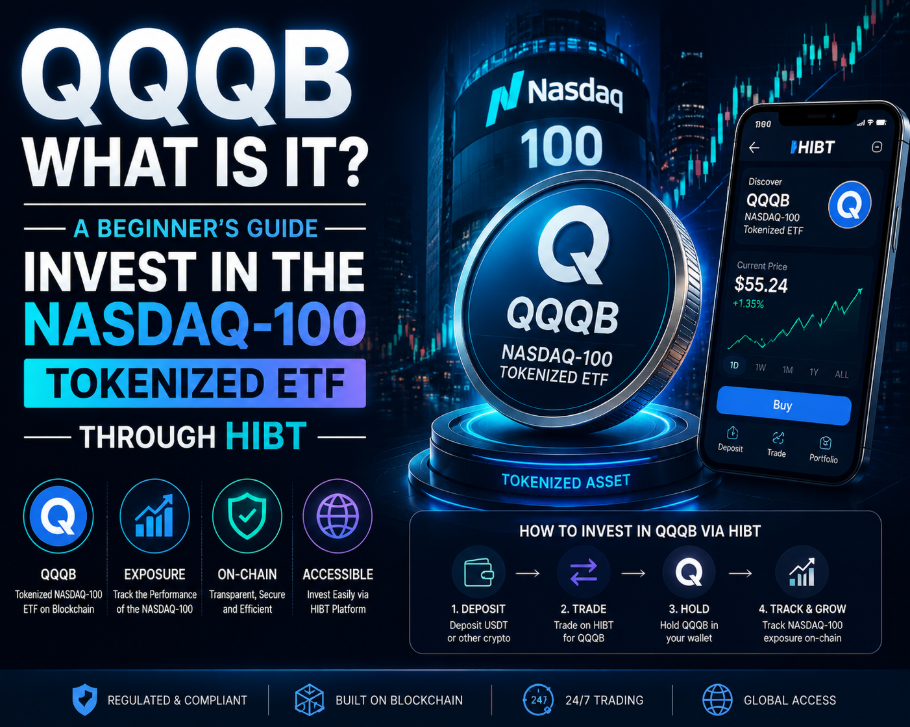
QQQB, in turn, is a tokenized security product that "moves" this traditional ETF asset into a crypto trading environment. According to publicly available information, HIBT has listed the QQQB/USDT spot trading pair, where users can check QQQB prices, candlestick charts, and trading data on the HIBT spot market.
However, a disclaimer must be stated upfront: QQQB is not a generic altcoin, not a "platform token" issued by HIBT itself, and not an official cryptocurrency issued by Invesco. It belongs to the category of tokenized securities / RWA (Real World Assets), carrying both the underlying logic of a US equity ETF and the layered risks of a centralized exchange, issuer, custody, on-chain transfer, and regulatory restrictions.
This article will walk through the questions newcomers care about most:
- What exactly is QQQB?
- How does it differ from QQQ, TQQQ, and SQQQ?
- Why are crypto users paying attention to it?
- How do you buy QQQB through HIBT?
- What hidden risks must you know before buying?
1. Deconstructing QQQB: Is It a Cryptocurrency, a Stock, or an ETF?
1.1 QQQB Is Not a Generic Crypto Asset—It Is Tokenized Exposure to QQQ
If QQQB had to be explained in one sentence:
QQQB is a tokenized security product built around the Invesco QQQ Trust (QQQ), allowing crypto users to gain economic exposure to QQQ's price performance through USDT-based trading.
Three keywords matter here.
The first keyword is "QQQ." QQQ is an ETF in traditional financial markets that tracks the Nasdaq-100 Index. According to Invesco's official disclosures, QQQ's top-10 holdings include companies such as NVIDIA, Apple, Micron, Microsoft, and Amazon; these holdings are subject to change and do not constitute investment advice.
The second keyword is "tokenized." Tokenization does not mean minting a coin out of thin air. It means expressing the economic rights of a traditional asset in the form of an on-chain token or platform account asset, enabling users to trade it within a crypto trading environment.
The third keyword is "security product." Public information shows that bStocks are issued by BTech Holdings Limited and represent Certificates referencing specific financial instruments, reflecting the issuer's holding of the underlying securities, but they do not equate to direct ownership of the underlying stock or ETF shares.
Therefore, a more accurate understanding of QQQB is not "QQQ issued a coin," but rather:
- You are buying a tokenized security that tracks QQQ's price performance;
- You are not a direct registered holder of the Invesco QQQ Trust;
- You cannot simply equate QQQB with QQQ held in a traditional brokerage account;
- In addition to QQQ price volatility, you are exposed to issuer, custody, platform, liquidity, on-chain, and regulatory risks.
1.2 What Is the Difference Between QQQ, QQQB, TQQQ, and SQQQ?
Newcomers often confuse these tickers:
- QQQ is the Invesco QQQ Trust, a traditional Nasdaq-100 ETF in US equity markets. It tracks the Nasdaq-100 Index and is fundamentally a traditional ETF.
- QQQB is the tokenized security version of QQQ, which can be understood as a bStocks tokenized asset built around QQQ. It provides economic exposure to QQQ but does not represent direct ownership of QQQ shares.
- TQQQ is a 3x leveraged ETF issued by ProShares that goes long the Nasdaq-100 Index. According to ProShares' official materials, TQQQ aims to deliver 3x the daily performance of the Nasdaq-100 Index before fees.
- SQQQ is a 3x inverse Nasdaq-100 ETF also issued by ProShares. According to ProShares' official materials, SQQQ aims to deliver -3x the daily performance of the Nasdaq-100 Index before fees.
The critical distinction here is: QQQB is not TQQQ, nor is it SQQQ. It is not 3x leveraged, nor is it an inverse product. For most crypto newcomers, QQQB should be positioned as "tech stock index exposure," not a short-term gambling instrument.
If you want a clear mental model, think of it this way:
- Want to buy the Nasdaq-100 Index ETF? Buy QQQ in traditional markets.
- Want to trade QQQ exposure with USDT in crypto? Look at QQQB.
- Want 3x leveraged long exposure to the Nasdaq-100? That's TQQQ.
- Want 3x inverse short exposure to the Nasdaq-100? That's SQQQ.
- If you are a newcomer, it is not recommended to touch high-leverage instruments like TQQQ and SQQQ from the start.
1.3 Does 1 QQQB Equal 1 Share of QQQ?
Based on publicly available information, the bStocks system emphasizes "1:1 backing" and "underlying securities rights." Binance Academy's explanation of bStocks notes that each bStock is backed 1:1 by real US stocks held by a regulated custodian, and that bStocks are BEP-20 tokens on the BNB Smart Chain; it also clearly states that bStocks are not stocks or shares and do not entitle holders to direct ownership of the underlying listed companies' equities.
Binance's announcement of the listing of LITEB, METAB, MSFTB, PLTRB, and QQQB trading pairs also states that bStocks are issued by BTech Holdings Limited and represent rights to the underlying securities held by the issuer, rather than direct ownership of the underlying stocks; the announcement also lists QQQB's BNB Smart Chain contract address, and notes that LITEB/USDT, METAB/USDT, MSFTB/USDT, PLTRB/USDT, and QQQB/USDT opened for trading on June 30, 2026, at 13:30 UTC.
So, the question "Does 1 QQQB equal 1 share of QQQ?" must be answered on two levels:
- From an economic exposure design perspective, QQQB tracks QQQ, and the bStocks system emphasizes 1:1 backing with the underlying asset;
- From a legal rights perspective, holding QQQB does not mean you directly hold 1 share of QQQ in a traditional brokerage account.
This is one of the biggest differences between tokenized stocks and traditional stocks. Price exposure can be similar, but the rights structure, custody path, and compliance boundaries are not identical.
1.4 Who Issues QQQB on HIBT?
This must be made clear: HIBT provides the QQQB/USDT spot trading gateway, but based on public bStocks materials, the issuer of the bStocks system to which QQQB belongs is BTech Holdings Limited, not HIBT itself. HIBT's trading page shows that the platform supports QQQB/USDT spot trading; information regarding bStocks issuance, underlying asset rights, 1:1 conversion, and contract addresses should be verified against bStocks / BTech / Binance and relevant regulatory filings.
This means that when users buy QQQB on HIBT, they need to understand three layers of relationships:
- The underlying asset: QQQ;
- The tokenized security structure: bStocks to which QQQB belongs;
- The trading platform: HIBT, which provides trading, deposits, withdrawals, matching, and account services.
For newcomers, do not just look at "whether QQQB is up or down." Ask the right questions:
- Who is the underlying asset issuer?
- Who is the tokenized security issuer?
- Who is the trading platform?
- Can I withdraw this asset?
- Does it support on-chain transfers?
- Is trading allowed in my jurisdiction?
- If de-pegging, deposit/withdrawal suspensions, or platform risks occur, can I absorb the loss?
This is the correct starting point for analyzing QQQB.
2. Why Should Crypto Users Allocate to QQQB on HIBT?
2.1 QQQB Lowers the Barrier to Participating in US Tech Stocks for Crypto Users
The traditional process of buying QQQ through a brokerage typically involves: registering a brokerage account, completing KYC, linking a bank card, foreign exchange conversion, depositing funds, waiting for settlement, and placing orders during US trading hours.
If you are already a crypto user and your primary holdings are in USDT, this path is not convenient. You need to switch from on-chain assets to the fiat system, then enter the US equity market, which may involve FX costs, deposit times, cross-border capital channels, and brokerage compliance restrictions.
HIBT's QQQB offers an alternative path: directly trade QQQB/USDT with USDT in the spot trading zone.
For crypto users, this means:
- No need to convert USDT into USD before entering a US brokerage;
- Allocation can be completed within a crypto exchange;
- Familiar spot trading order types can be used;
- QQQB can serve as US tech stock exposure alongside BTC and ETH;
- A portfolio structure of "crypto assets + traditional tech stock index exposure" can be formed.
HIBT's official support documentation shows that users can register an account via email or mobile number, complete verification code and password setup; after registration, identity-related features require KYC completion per the platform's process.
2.2 24/7 Trading: The Market Rhythm Crypto Users Are Most Familiar With
US equity markets have fixed trading sessions. While pre-market and after-hours trading exist, they are not intuitive for newcomers.
Crypto users are more accustomed to 24/7 price fluctuations, checking charts at any time, and placing orders at any time. One of the biggest attractions of tokenized stocks and ETFs is bringing traditional assets into a trading experience closer to crypto.
However, a reminder is warranted: 24/7 trading does not mean the underlying US ETF also trades 24/7. During US market closures, QQQB's price may be more influenced by intra-platform order book depth, market maker liquidity, market expectations, and premium/discount dynamics. In other words, on weekends or when US markets are closed, QQQB may deviate from QQQ's net asset value.
This is not an advantage or disadvantage—it is simply inherent to the asset's mechanics.
2.3 QQQB Represents a New Class of Assets in the RWA Sector
RWA, short for Real World Assets, is often translated as in Chinese. Its core logic is to bring traditional-world assets—such as government bonds, funds, stocks, ETFs, real estate revenue rights, and accounts receivable—into the crypto market through on-chain or tokenized mechanisms.
QQQB is one manifestation of RWA in the direction of US equity ETFs.
In 2026, tokenized stocks and tokenized ETFs are becoming a key expansion direction for trading platforms. Public announcements show that bStocks added trading pairs including LITEB, METAB, MSFTB, PLTRB, and QQQB in June 2026; the same announcement emphasized that these products are directed at eligible users and are subject to regional compliance restrictions.
What this reflects is not single-asset speculation, but a larger trend:
- Stablecoins brought USD onto the chain;
- Tokenized government bonds brought low-risk yield assets onto the chain;
- Tokenized stocks and ETFs brought traditional equity exposure onto the chain;
- Exchanges and wallets are expanding the crypto market from "trading native coins only" to "trading real-world asset exposure."
For crypto newcomers, the significance of QQQB is not just whether to buy an ETF, but understanding how future asset markets may converge.
2.4 Who Is QQQB Suitable For? Who Is It Not Suitable For?
QQQB is more suitable for these types of users:
- Those already holding BTC, ETH, SOL, and other high-volatility assets who want to add some US tech stock index exposure;
- Those who do not want to research individual US stocks but are bullish on the long-term innovation of the Nasdaq-100;
- Crypto users accustomed to trading with USDT who want to reduce the barrier of opening a traditional US brokerage account;
- Those who want to experiment with a small position in RWA assets.
QQQB is not suitable for these types of users:
- Those chasing short-term 10x-100x returns;
- Those who absolutely cannot tolerate US equity drawdowns;
- Those who do not understand the difference between tokenized securities and traditional stocks;
- Those in jurisdictions where trading such products is explicitly restricted;
- Those accustomed to full-margin, leveraged, all-in, and frequent FOMO-chasing behavior;
- Those who believe "1:1 backing means zero risk."
QQQB is not a safe-haven asset, nor is it a guaranteed-profit asset. Its underlying asset is the Nasdaq-100 ETF, which is long-term influenced by tech stock valuations, interest rates, AI capital expenditure, USD liquidity, corporate earnings, and market risk appetite.
3. HIBT Practical Guide: The Complete Path from Registration to Holding QQQB
3.1 Register a HIBT Account: Secure Your Account First, Then Think About Trading
The first step for newcomers is not to deposit funds or immediately buy QQQB—it is to secure the account first.
According to HIBT's public registration guide, users can open the HIBT official website, click the registration button in the upper right corner, choose mobile or email registration, and complete account creation via verification code.
The recommended sequence is:
- Register the account;
- Set a strong password;
- Bind email or mobile number;
- Enable two-factor authentication (2FA);
- Complete KYC;
- Then consider depositing USDT;
- Only then buy QQQB.
Do not do it in reverse. Many newcomers deposit funds first, only to discover that KYC, withdrawals, risk controls, or network selection were not figured out, creating problems later.
3.2 What Do You Need for KYC? How Long Does Review Take?
HIBT's KYC explanation states that KYC is for identity verification, typically involving official identity documents; the platform's KYC policy also mentions that automated verification uses document recognition, facial liveness detection, sanctions list and PEP screening, and complex cases may be escalated to manual review.
Materials newcomers typically need to prepare:
- A valid government-issued ID;
- Name and date of birth consistent with the ID;
- Clear photos of the ID document;
- Facial recognition or liveness detection;
- An email or mobile number capable of receiving verification codes;
- Supplementary address or other proof materials if necessary.
Do not promise a fixed review time. Typically, standard accounts may be processed quickly, but if the ID is blurry, region restrictions apply, identity information is inconsistent, risk controls are triggered, network anomalies occur, or duplicate accounts are detected, the case may be escalated to manual review.
Suggested screenshots for illustration:
- Registration portal screenshot;
- Identity verification portal screenshot;
- ID upload page screenshot;
- Verification status page screenshot;
- Risk warning screenshot.
When including screenshots, be sure to redact personal private information.
3.3 How to Deposit USDT into HIBT?
After completing account setup and KYC, users can consider depositing USDT. HIBT's deposit guide shows that after selecting a cryptocurrency, the system displays the supported deposit networks; taking USDT as an example, HIBT supports multiple networks—USDT-TRC20 means depositing via the TRON network, USDT-ERC20 means depositing via the Ethereum network, and USDT-OKC means depositing via the OKChain network. Different networks have different speeds and fees.
Here is the most common mistake crypto newcomers make: only looking at the coin, not the network.
USDT is not a single-network asset. The USDT you see on Platform A and the USDT you see on Platform B may exist on TRC20, ERC20, BEP20, OKC, SOL, and other networks respectively. Choosing the wrong network can result in delayed deposits requiring manual recovery, or in the worst case, irreversible loss of assets.
The correct procedure is:
- Select USDT on HIBT's deposit page;
- Check which networks HIBT supports;
- On the withdrawal platform, select the exact same network;
- Confirm the deposit address and network match;
- Send a small test amount first, e.g., 10–20 USDT;
- After confirmation, transfer the formal amount;
- Save the transaction hash for easy tracking.
If you are a newcomer, prioritize this principle: do not sacrifice network matching just to save a small amount on fees.
3.4 Find the QQQB/USDT Trading Pair
After USDT deposit is credited, navigate to HIBT's spot trading zone and search for QQQB or QQQB/USDT. HIBT's trading page shows that QQQB/USDT is a spot trading pair, providing real-time price, candlestick charts, trading volume, and market data.
After entering the trading page, newcomers should focus on four things:
- Is the trading pair name QQQB/USDT?
- Is the price significantly deviating from the QQQ reference price?
- Is the bid-ask spread excessively wide?
- Is the order book depth sufficient?
If the order book is thin, absolutely do not use a large market order. Market orders will eat through the book and can cause significant slippage.
3.5 Limit Order vs. Market Order: Which Should You Choose?
For newcomers buying QQQB, it is recommended to prioritize limit orders.
The advantage of market orders is fast execution; the disadvantage is that you cannot precisely control the execution price. For BTC and ETH, which have extremely deep liquidity, market orders may have limited impact; but for newly listed tokenized stocks or ETFs, order book depth may not be as strong as major coins, and market orders can easily produce slippage.
The advantage of limit orders is price control. You can reference the QQQ underlying price, QQQB order book price, and bid-ask spread, then set a price you are willing to accept.
A more prudent approach is:
- Buy in small amounts;
- Place staged orders;
- Do not chase pumps;
- Do not blindly use market orders when US stocks are experiencing volatile moves;
- Do not execute a large order all at once when order book depth is insufficient.
3.6 After Buying, Should You Leave Assets on the Exchange or Withdraw to a Self-Custody Wallet?
This depends on whether HIBT allows QQQB deposits and withdrawals, and whether you have the capability for on-chain self-custody.
From publicly available bStocks information, QQQB has a BNB Smart Chain contract address and belongs to the BEP-20 tokenized security asset class; but whether users can withdraw from HIBT, to which network, the minimum withdrawal amount, fees, and whether regional eligibility restrictions apply should all be verified against HIBT's asset page as actually displayed.
For newcomers, there are two options:
Option 1: Short-term holdings on the exchange. The advantage is trading convenience, suitable for small-scale experimentation; the disadvantage is exposure to platform account and custody risks.
Option 2: Withdraw to a self-custody wallet. The advantage is autonomous management of on-chain assets; the disadvantage is that you must understand wallets, private keys, seed phrases, BNB Chain, contract addresses, fake-token recognition, and transfer networks. If you do not have this experience, blind withdrawals can be more dangerous than keeping assets on the exchange.
The newcomer principle is simple: small amounts on the platform for experimentation; large amounts only after understanding on-chain self-custody; any first-time withdrawal must be tested with a small amount first.
4. QQQB Investment Strategy: When to Buy, How Much to Buy, and How to Sell?
4.1 Is the Current Nasdaq-100 Valuation Too High?
QQQB's underlying asset is QQQ, and QQQ's underlying asset is the Nasdaq-100. Therefore, buying QQQB is essentially asking: Am I willing to buy Nasdaq-100 tech stock index exposure right now?
As of late June 2026, World PE Ratio estimates the Nasdaq-100's P/E at approximately 32.46, placing current valuation at a relatively reasonable level within the past 5-year range; GuruFocus shows the Nasdaq-100 P/E at approximately 35.33 on a nearby date, above its historical median. Different data sources use different methodologies, but they agree on one point: the Nasdaq-100 is not cheap, and the market has already priced in high expectations for AI, cloud computing, semiconductors, software, and large tech platforms.
Yahoo Finance data shows QQQ's 5-year monthly Beta is approximately 1.23, with an expense ratio of 0.18%, meaning it has a higher volatility profile relative to the broader market.
The implications for QQQB investors are:
- If you believe AI and large tech companies' earnings can continue to grow, QQQB can serve as long-term tech stock exposure;
- If you are concerned about excessive valuations, interest rate rebounds, or overheated AI capital expenditure, you should not go all-in at once;
- If you are already heavily allocated to BTC, ETH, SOL, and AI concept tokens, QQQB may not necessarily significantly reduce overall risk, because it remains a risk asset.
4.2 Does QQQB Carry Premium Risk?
Yes.
Because QQQB is not QQQ trading directly on the Nasdaq, but rather a tokenized security traded on a crypto exchange, its price may be influenced by the following factors:
- QQQ underlying price;
- US Dollar Index and risk asset sentiment;
- Intra-platform QQQB/USDT order flow;
- Market maker quotes;
- US market open or closed status;
- Whether on-chain deposits and withdrawals are functioning smoothly;
- Issuer and custody mechanisms;
- Market euphoria or panic toward RWA assets.
When QQQB's price is significantly above QQQ's reference value, a premium may exist; when QQQB's price is significantly below QQQ's reference value, a discount may exist. For ordinary retail investors, complex arbitrage is not recommended. The most realistic approach is:
- Compare against QQQ's real-time price before buying;
- Avoid impulsive orders when US markets are closed, order books are thin, and prices are volatile;
- Observe the QQQB/USDT bid-ask spread;
- When prices are clearly abnormal, prefer not to trade;
- Do not confuse "the ability to buy" with "the price must be fair."
4.3 What Proportion of a Portfolio Should QQQB Represent?
There is no one-size-fits-all answer, but a reference framework can be offered for newcomers.
- If you are extremely conservative, QQQB can remain on watchlist without rushing to buy.
- If you are an ordinary crypto user already holding BTC and ETH, consider placing QQQB as a "small satellite allocation" within the portfolio, e.g., under 5%, to observe the RWA and tokenized US equity ETF direction.
- If you already wanted to allocate to US tech stocks but did not want to open a traditional US brokerage account, consider using QQQB as part of your US tech stock exposure, but still do not exceed the portion of your total assets that you can afford to see fluctuate.
- If you are a high-risk appetite user already heavily allocated to altcoins, continuing to go heavy on QQQB may simply layer "US equity valuation risk" on top of "crypto risk," without achieving true diversification.
A more rational portfolio construction:
- BTC/ETH as the crypto core allocation;
- Stablecoins as the liquidity allocation;
- QQQB as the US tech stock index exposure;
- A small amount of altcoins as high-risk opportunistic allocation;
- Do not treat any single asset as the "guaranteed winner."
If you are looking for more diversified allocation opportunities on HIBT, you can also explore other assets on the platform. For example, Is JST a Good Buy Right Now? can serve as one of your reference cases for evaluating entry timing and risk-reward ratios.
4.4 Dollar-Cost Averaging (DCA) into QQQB, or Lump-Sum Purchase?
For crypto newcomers, dollar-cost averaging is more suitable than a lump-sum all-in approach.
The reason is simple: behind QQQB is QQQ, and behind QQQ is the Nasdaq-100, whose volatility is not low. Especially when large tech stock valuations are elevated, a lump-sum purchase can easily encounter short-term drawdowns.
A more prudent method is:
- Divide the planned QQQB capital into 6–12 portions;
- Buy a fixed portion weekly or monthly;
- Pause when QQQB is at a significant premium to QQQ;
- Consider adding when markets panic but fundamentals have not deteriorated;
- Re-check allocation proportions every quarter.
The value of DCA is not to guarantee profits, but to avoid concentrating all capital at a single short-term price point.
4.5 When Should You Sell QQQB?
You should define your sell conditions before you buy.
Three types of sell rules can be considered.
First, valuation rules. If Nasdaq-100 valuations are clearly overheated and tech earnings growth cannot keep up, reduce QQQB exposure.
Second, asset allocation rules. If QQQB rises to occupy too high a proportion of the portfolio, e.g., from 5% to 15%, partial rebalancing can be done, shifting profits into stablecoins or the BTC/ETH core allocation.
Third, risk event rules. If QQQB experiences prolonged de-pegging, deposit/withdrawal anomalies, platform risk control issues, issuer mechanism changes, or regulatory restriction upgrades, prioritize capital protection over hoping for recovery.
The most common mistake crypto users make is knowing how to buy but not how to sell. QQQB may look like ETF exposure, but the trading environment is still crypto, so sell discipline is equally important.
5. QQQB's "Relatives": A Look at the HIBT Tokenized Stock Ecosystem
5.1 Besides QQQB, What Other Tokenized US Stocks Are Worth Watching?
QQQB is just one variety in the tokenized stock / ETF ecosystem. Public announcements show that bStocks' newly added trading pairs include LITEB, METAB, MSFTB, PLTRB, and QQQB, corresponding to exposure to Lumentum, Meta, Microsoft, Palantir, and the Invesco QQQ Trust respectively.
They can be categorized as follows:
- QQQB: ETF category, representing Nasdaq-100 ETF exposure;
- MSFTB: Large-cap tech exposure, core is Microsoft;
- METAB: Social advertising, AI, and metaverse-related large-cap tech exposure;
- PLTRB: AI data analytics and government/enterprise software exposure;
- LITEB: Optical communications, lasers, data center, and AI infrastructure exposure.
In HIBT's tokenized stock section, tech assets are just one segment. If you are interested in the optical communications sector, you can read What is LITEB? to learn about the fundamentals of the Lumentum tokenized stock.
5.2 How to Pair QQQB with Single-Stock Tokenized Assets?
QQQB's advantage is diversification. It is not a bet on a single company, but rather a basket of Nasdaq-100 exposure through QQQ. Invesco's official materials show that QQQ's top-10 holdings cover NVIDIA, Apple, Micron, Microsoft, Amazon, and other large companies, making it more diversified than concentrating on a single stock.
Single-stock tokenized assets have the advantage of higher elasticity. For example, MSFTB is primarily driven by Microsoft, METAB by Meta, PLTRB by Palantir, and LITEB leans more toward AI hardware and the optical communications supply chain.
A newcomer portfolio can be understood as follows:
- Want more stability: QQQB as core, single-stock tokenized assets as satellite;
- Want to bet on AI software: consider MSFTB, PLTRB;
- Want to bet on social advertising and AI content distribution: consider METAB;
- Want to bet on AI data center hardware: consider LITEB;
- Do not want to research individual company fundamentals: QQQB is more suitable.
However, "more stable" is only relative to single stocks. QQQB remains concentrated in growth and tech stocks, and does not equate to a globally balanced asset.
5.3 How Do Tokenized ETFs Pair with BTC and ETH?
QQQB and BTC/ETH are not substitutes; they are complements.
- BTC is more like the core store-of-value and macro risk asset of the crypto market;
- ETH is more like the foundational asset of the smart contract ecosystem and on-chain economy;
- QQQB is more like traditional tech stock index exposure;
- Stablecoins are the liquidity and risk management tool.
A more mature crypto portfolio should not consist only of altcoins, nor should it bet on a single narrative. The emergence of RWA assets like QQQB gives crypto users one more direction: without leaving the crypto trading environment, they can also access traditional equity exposure.
But this does not mean everyone must buy QQQB. It is suitable for users willing to understand the rules, accept volatility, and focus on long-term tech trends; it is not suitable for newcomers seeking short-term windfalls.
6. Risk Radar: 5 Hidden Risks You Must Know Before Buying QQQB
Risk 1: Legal and Compliance Risk
Tokenized stocks and ETFs have inconsistent legal definitions across different countries and regions.
bStocks announcements explicitly state that these tokenized securities are directed at eligible users and are subject to regional restrictions; their disclaimer also clarifies that Tokenized Securities are not offered, sold, distributed, or made available in the United States or to US persons, and are not registered under US securities laws.
For users in mainland China, extra caution is required. The China Securities Regulatory Commission (CSRC) has reiterated that virtual currency-related business activities remain prohibited domestically, virtual currencies do not have legal tender status equivalent to fiat currency, and conducting virtual currency-related business activities domestically constitutes illegal financial activity; the 2021 relevant notice also warned that participating in virtual currency investment and trading activities carries legal risks.
Therefore, this article cannot and will not conclude that "users in mainland China can definitely hold QQQB legally." Every user should independently verify whether they have the eligibility to access, trade, and hold tokenized securities according to the laws and regulations of their country or region.
This is not a formalistic warning—it is a real risk.
Risk 2: Issuer and Custody Risk
QQQB is not held directly in a brokerage account as QQQ, but rather provides economic exposure through a tokenized security structure. Public information shows that bStocks represent rights to the underlying securities held by the issuer, not direct ownership of the underlying stock or ETF shares.
This means you must trust:
- Whether the issuer holds underlying assets according to the rules;
- Whether the custodian is secure;
- Whether the redemption and conversion mechanism functions smoothly;
- Whether conversion may be suspended under extreme market conditions;
- Whether relevant legal documents protect investor rights.
Tokenized securities are not "zero-trust just because there is a smart contract on-chain." Their core remains a trust system composed of the issuer, custodian, compliance framework, and market infrastructure.
Risk 3: Platform Risk
If you buy QQQB on HIBT, you also bear centralized exchange platform risk.
CoinGecko data shows that HIBT is a centralized exchange registered in Canada, with hundreds of coins and trading pairs listed, and exchange reserve data is displayed.
But "having reserve data" does not mean zero risk. Proof of Reserves (PoR) serves to enhance transparency; CoinGecko explains that PoR can help users verify whether an exchange or custody platform truly holds the assets it claims to custody; but PoR itself cannot eliminate all operational, liability, legal, custody, and withdrawal risks.
Therefore, platform risk must be managed with action:
- Do not keep all assets on a single platform;
- Enable 2FA;
- Regularly check login devices;
- Test small deposits and withdrawals;
- Do not trust customer service private messages;
- Do not leave large amounts of idle funds in a trading account.
Risk 4: Price De-Pegging and Liquidity Risk
QQQB's price should theoretically fluctuate around QQQ's value, but in actual trading, premiums or discounts can still occur.
Price deviations are more likely in the following scenarios:
- During US market closures;
- When the intra-platform order book is thin;
- When newly listed assets have insufficient liquidity;
- When extreme market conditions cause order book imbalance;
- When deposits and withdrawals are suspended;
- When market maker quotes are abnormal;
- When the market is excessively chasing or panicking about RWA concepts.
When retail investors face de-pegging, do not rush to arbitrage. Arbitrage requires speed, size, eligibility, redemption channels, and risk control capabilities. For ordinary users, the more realistic approach is: do not chase obvious premiums, investigate the cause of obvious discounts before trading, and abstain if the reason is unclear.
Risk 5: Newcomer Operational Error Risk
Crypto newcomers buying QQQB are most prone to three mistakes.
Mistake 1: Transferring to the wrong network. When depositing USDT, TRC20, ERC20, OKC, and other networks must match the platform's deposit address. HIBT's deposit instructions also explicitly state that different USDT networks correspond to different chains, with different speeds and fees.
Mistake 2: Buying fake tokens. Fake tokens with the same name can appear on-chain, so if withdrawing or self-custodying, you must verify the official contract address—do not rely solely on the name and icon.
Mistake 3: Ignoring fees and slippage. QQQB is not an extremely deep liquidity pair like BTC/ETH. Market orders, thin order books, and wide spreads can all increase your actual transaction cost.
The newcomer safety principles can be summarized in four sentences:
- Verify identity first, then deposit;
- Test small first, then go large;
- Check the network first, then transfer;
- Use limit orders first, then market orders.
Conclusion: Looking at the Future of RWA Through QQQB—The Next Decade for Crypto Newcomers
What truly makes QQQB worth watching is not simply whether it can go up, but the trend it represents: traditional financial assets are being repackaged into the crypto trading environment.
Over the past decade, the crypto market has primarily traded BTC, ETH, stablecoins, platform tokens, public chain tokens, DeFi tokens, GameFi tokens, and meme coins. In the next decade, RWA may bring more traditional assets onto the chain—including US stocks, ETFs, government bonds, funds, gold, commodities, and credit assets.
QQQB is one sample of this trend.
It shows crypto users a new possibility: you do not necessarily have to leave your crypto account to gain exposure to traditional financial assets like the Nasdaq-100; you do not necessarily have to open a US brokerage account to use USDT to participate in tech stock index performance; you are not limited to choosing between BTC and altcoins, but can also incorporate RWA into your asset allocation framework.
But at the same time, QQQB also reminds us: the more complex the asset, the more complex the risk structure.
- It is not a generic coin;
- It is not QQQ underlying shares;
- It is not a risk-free ETF;
- It is not a platform-issued yield-promising product;
- It is not an investment tool suitable for everyone.
After reading this article, crypto newcomers can immediately do three things:
First, understand the difference between QQQB, QQQ, TQQQ, and SQQQ. Do not confuse tokenized ETFs with leveraged ETFs.
Second, before checking the QQQB/USDT trading page on HIBT, confirm account security, KYC completion, deposit network selection, and regional compliance requirements.
Third, if you genuinely want to participate, only use a small amount of capital to test. Do not go heavy without understanding premiums, discounts, issuer structure, custody, and platform risks.
In the future, "holding crypto to buy US stocks" may become increasingly common. But the newer the asset form, the more caution, transparency, and risk awareness are needed.
QQQB is not the end point—it is merely an entry point into the RWA era. What truly matters is that crypto users must evolve from "only looking at price moves" to "understanding asset structure, rights boundaries, and risk sources."
This article is for informational and educational purposes only and does not constitute investment advice, legal advice, or tax advice. Tokenized securities, virtual assets, and US equity ETFs are subject to price volatility, liquidity, regulatory, custody, and principal loss risks. Any investment decision should be based on the legal requirements of your jurisdiction, your personal risk tolerance, and independent judgment.