
"Is JST a good buy right now?" – This seemingly simple question cannot be answered by looking at the current price alone.
Many newcomers see JST's recent rally and instinctively ask, "Should I chase it?" Others notice that JST is still far from its all‑time high and think, "It's already dropped so much – this must be a bottom‑fishing opportunity." But both judgments are far too crude.
To truly determine whether JST is worth buying, you need to break it down into at least three questions:
First, is JST's current valuation reasonable?
Second, do the fundamentals of JUST/JustLend within the TRON ecosystem support that valuation?
Third, are you planning to trade short‑term swings, or hold long‑term to 2030, 2040, or even 2050?
As of July 1, 2026, data from CoinGecko shows JST trading at approximately $0.087, with a 24‑hour trading volume of about $30.81 million, a market cap of roughly $745 million, and a circulating supply of around 8.544 billion tokens. Over the past 7 days, it has gained about 5.10%, and over the past 30 days about 8.6%. Meanwhile, JST has outperformed both the broader crypto market and the DeFi sector over the past week.
This set of data tells two things.
On one hand, JST does have some short‑term momentum recently – it's not completely off the radar. On the other hand, it is not an asset that just rose from obscurity; the recent gains already reflect part of TRON's DeFi activity and market sentiment.
Therefore, this article will not simply tell you "buy" or "don't buy". A more responsible approach is: first explain what JST is, then examine the current fundamentals, then dissect through the three dimensions of valuation, trend, and risk tolerance, and finally present a three‑scenario framework for 2050.
This article does not constitute investment advice; it only provides an analytical framework. Crypto assets are extremely volatile, and any long‑term forecast carries huge uncertainty. Readers should make their own judgments based on their risk tolerance.
I. What Is JST: You Cannot Discuss Buying Without Understanding the Underlying Asset
JST is an important governance token for the JUST ecosystem and JustLend DAO, operating on the TRON network. Many newcomers only see that "JST went up" without knowing what value it actually captures – and that is the most critical lesson to learn before judging whether it is worth buying.
The JUST ecosystem can be simply understood as a set of DeFi infrastructure on TRON, covering stablecoins, lending, governance, collateral, liquidation, and more. CoinGecko describes JUST as a decentralized finance platform built on the TRON network, offering DeFi solutions such as JustStable, JustLend, and cross‑chain assets, operating around the USDJ stablecoin system and the JST governance token.
Among these, JustLend DAO is one of the most important lending protocols in the TRON ecosystem. Official documentation states that JustLend DAO is a large‑scale lending protocol on TRON, based on the Compound V2 architecture, providing query capabilities for market data, TVL, utilization rates, account risk, lending positions, and more.
This means JST is not merely a "concept coin" – there is indeed a DeFi lending use case behind it. However, it is not a native gas token of a public blockchain like ETH, SOL, or TRX. Its value capture comes more from governance, protocol participation, and ecosystem expectations.
JST plays several key roles within the ecosystem:
- Used for JustLend DAO governance;
- Can participate in proposal voting;
- Tied to the JUST ecosystem's stablecoin and lending systems;
- Market value influenced by the activity of DeFi on TRON;
- Also affected by Justin Sun, the TRON brand, and related regulatory/publicity issues.
JustLend governance documentation shows that JustLend DAO is governed via JST tokens. Participants can lock JST to obtain voting rights. Holders with more than 200 million JST can initiate proposals; if yes votes exceed no votes and yes votes exceed 600 million, the proposal can be passed and executed after a timelock.
This shows that JST does have governance attributes, but it also raises a practical issue: ordinary retail holders with small amounts of JST are mostly gaining price exposure, not actually driving protocol governance. Governance rights exist, but their influence is highly dependent on the scale of holdings.
II. JST Tokenomics: Supply, Circulation, and Burns Must Be Considered Together
JST's nominal maximum supply is 9.9 billion tokens. CoinGecko data shows that the current circulating supply is about 8.544 billion tokens, and total supply is also shown as approximately 8.544 billion, with a maximum supply of 9.9 billion. The same page also shows that FDV roughly equals the current market cap, indicating that some data calculations have already factored in the supply after burns.
Newcomers should note a detail: JST is not one of those typical high‑FDV/low‑circulation tokens with a large amount of unlocked tokens waiting to be released in the future. Its main issue is not "future unlocks causing sell pressure", but rather:
- Can protocol revenue sustainably support buy‑back and burns?
- Can JST's governance rights be re‑priced by the market?
- Can TRON DeFi continue to attract capital?
- Is the market willing to give a higher valuation to TRON ecosystem governance tokens?
In October 2025, CryptoSlate reported that JustLend DAO completed its first round of JST buy‑back and burn, stating that the program used funds from accumulated protocol revenues to buy back and burn JST. The first round used about $17.72 million USDT to burn about 560 million JST, accounting for approximately 5.66% of total supply. In January 2026, KuCoin News also reported that JustLend DAO completed a second large‑scale burn, burning 525 million JST, bringing the cumulative burn to over 1 billion JST, or about 10.96% of total supply.
Such burn mechanisms are a potential positive for price, but they cannot be simplistically interpreted as "burn = guaranteed price increase". Token prices ultimately depend on both supply and demand: reduced supply is only one side – the other side is whether the market is willing to keep buying JST and recognizes JustLend's cash flow and governance value.
Simply put, JST's value‑capture path is not "hold and automatically receive dividends". Rather:
- If JustLend's protocol revenue grows, the buy‑back and burn capacity strengthens, potentially increasing JST scarcity;
- If TRON DeFi TVL grows, governance rights and protocol importance may be re‑valued;
- If the market refocuses on stablecoin settlements and TRON's low‑fee use cases, JST may gain an ecosystem premium;
- But if protocol revenue declines, TVL shrinks, and governance value is ignored, burns alone may not sustain long‑term appreciation.
III. JST's Current Fundamental Health Check: What Makes This Moment Special?
To determine whether "now is a good time to buy", you cannot just say DeFi has prospects, nor just say the TRON ecosystem is strong. You must look at current data.
From a market cap perspective, JST's current market cap is about $745 million, ranking approximately 75th on CoinGecko – it is no longer a small‑cap high‑beta asset. This means that for JST to continue its significant upward move, it will need more than just short‑term sentiment; it requires stronger fundamentals, capital inflows, or a sector re‑rating.
From a TVL perspective, DeFiLlama data shows JustLend's current TVL at around $2.9–3.0 billion, with active loans of about $126 million, making it a core lending protocol within the TRON ecosystem. TRON's overall DeFi TVL stands at approximately $4.37 billion, and its stablecoin market cap is about $89.49 billion, with USDT accounting for as much as 97.95%.
This data indicates that TRON's strength is not in complex DeFi innovation, but in stablecoin transfers, low fees, high‑frequency settlement, and basic financial applications. JST's long‑term value must also be built on this reality: it is not an Ethereum‑style multi‑protocol innovation hub, nor a Solana‑style high‑frequency on‑chain trading ecosystem, but rather a governance asset within TRON's stablecoin and lending infrastructure.
From a relative performance perspective, CoinGecko data shows JST up about 5.10% over the past 7 days, while the global crypto market is down about 2.10% and the DeFi sector is up about 1.20%. This suggests that JST is not just passively rising with the market – it has shown relative strength.
From a security and risk score perspective, CoinGecko's security page shows JST with an overall score of 46%, with sub‑scores: Smart Contracts & Team at 82%, Documentation at 73%, Testing at 0%, Security at 43%, Admin Controls at 57%, and Oracles at 25%. The same page also shows a CertiK security score of approximately 85.19%, and notes that third‑party security data does not represent CoinGecko's endorsement – smart contract and market risks remain.
This shows that JST/JustLend is not without audits and security efforts, but it also cannot be packaged as "completely low‑risk". In particular, lending protocols inherently rely on oracles, collateral prices, liquidation mechanisms, and governance parameters – if any link fails during extreme market conditions, it can propagate to the protocol and token price.
JustLend's official risk documentation also explicitly mentions oracle risk, collateral risk, and market volatility risk, emphasizing that incorrect price data could lead to erroneous liquidations or irrational lending parameters.
So, JST's current fundamentals can be summarized as:
- Backed by a real protocol and TVL;
- Supported by TRON's stablecoin ecosystem as an underlying use case;
- Recent performance stronger than the broader market and DeFi sector;
- But governance value is still limited;
- Risks around protocol security, oracles, collateral, and centralization controversies remain;
- Market cap is no longer tiny, so it cannot be priced like an early‑stage small coin.
IV. Is JST a Good Buy Now? Break It Down into Three Dimensions
This question cannot be answered with a simple "yes" or "no". It is better to break it down into valuation, trend, and risk tolerance.
1. Valuation Dimension: Cheap, or Just "Lower Than the Peak"?
CoinGecko data shows JST's all‑time high around $0.1933, with the current price around $0.087 – still about 55% below the peak.
Many newcomers look at this and think: "Since it hasn't returned to the peak, it must be cheap now."
But that logic is incomplete. Being below the peak does not mean undervaluation. The peak may have been inflated by the sentiment and liquidity of the previous bull market – not necessarily a fair value.
A more reasonable valuation approach is to consider several questions:
- Current market cap is about $700+ million, with JustLend TVL around $3 billion, giving an MC/TVL ratio of about 0.25;
- Can JST continue to receive buy‑back and burn support from protocol revenue?
- Will JST's governance rights be priced by the market?
- Can TRON's stablecoin settlement advantage persist beyond 2030?
- Compared to other DeFi governance tokens, is JST's growth potential attractive enough?
If you believe that TRON will remain an important network for global stablecoin settlements in the future, and that JustLend will continue to be TRON's core lending protocol, then the current valuation may not be expensive.
But if you believe TRON's growth runway is limited and JST's governance value is hard to convert into holder returns, then even if the price is lower than its all‑time high, it may just be "lingering at low levels" rather than being undervalued.
2. Trend Dimension: Has the Short‑Term Rise Already Been Priced In?
JST is up about 5.10% over the past 7 days and about 8.6% over the past 30 days. This indicates that the short‑term trend is relatively strong, but it is not in an overheated state of having already multiplied several times.
However, short‑term traders should note: JST is currently near $0.087, with a 24‑hour range of about $0.08464–$0.08760 and a 7‑day range of about $0.07999–$0.08904. Without new catalysts in the short term, continuing to chase may face pullback risk.
Short‑term entry considerations:
- Break above the upper end of the 7‑day range;
- Trading volume expanding concurrently;
- New TVL growth or protocol upgrade news in the TRON ecosystem;
- BTC and the broader market remaining stable;
- JST showing signs of a spike‑and‑drop or high‑volume stagnation.
If you are a short‑term trader, buying now means you are chasing recent relative strength, and you need to set strict stop‑losses.
If you are a medium‑to‑long‑term holder, short‑term moves are not the only focus – what matters more is whether the TRON ecosystem will remain relevant over the next few years.
3. Risk Tolerance Dimension: Short‑Term and Long‑Term Are Completely Different
Buying JST short‑term – core risks are chasing highs, corrections, slippage, and market‑wide correlation.
Holding JST medium‑term – core risks are whether TRON DeFi growth slows, whether JustLend revenue declines, and whether buy‑back and burns continue.
Holding long‑term to 2050 – the core risk entirely transforms into another question: Will the TRON ecosystem still exist and remain important by 2050?
This is the most overlooked point in many long‑term forecasts. 25 years is enough to change blockchain landscapes, regulatory frameworks, stablecoin settlement paths, DeFi product forms, and user habits. Protocols that seem important today may not maintain their market position by 2050.
So, whether JST is suitable to buy now can be self‑checked with this checklist:
- Do you understand that JST is not TRX, nor USDJ?
- Do you know that JST's primary value comes from governance, protocol expectations, and ecosystem status?
- Do you accept the relative centralization controversies of the TRON ecosystem?
- Are you willing to tolerate price swings of over 50%?
- Are you planning to hold for days, months, years, or bet on 2050?
- If JST drops below $0.05, can you still stick to your original thesis?
- If JST rises above $0.12, do you have a clear take‑profit plan?
If you cannot answer these questions, it is best not to buy blindly just because of a short‑term rise.
V. JST Price Prediction for 2050: Bear, Base, and Bull Scenarios
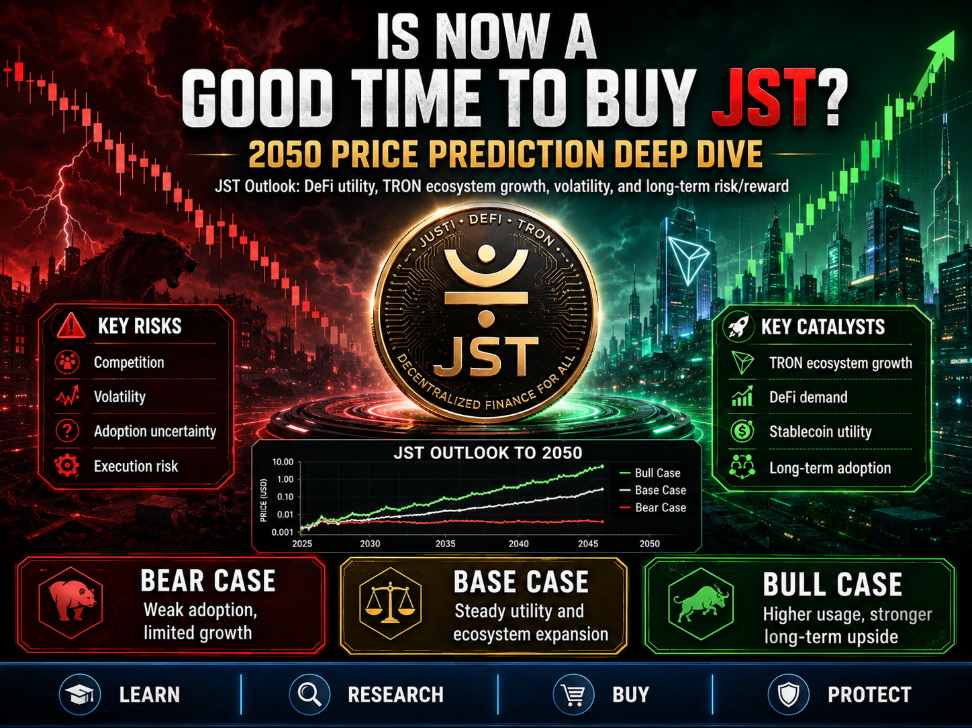
Predicting JST's price in 2050 is not about drawing a K‑line – it is about judging whether the TRON ecosystem, JustLend protocol, and the DeFi governance token model can survive a 25‑year cycle.
Below are three scenario projections. All price ranges are hypothetical scenarios based on current information and do not represent investment advice.
Bear Scenario: $0.005 – $0.05
Core logic: TRON ecosystem growth stalls, DeFi users are siphoned off by next‑generation blockchains and new financial infrastructure, JustLend TVL declines over the long term, and JST's governance rights and buy‑back‑burn narrative lose market recognition.
In this case, JST could lose valuation support over the long term.
The bear scenario could occur under conditions such as:
- TRON's stablecoin transfer advantage is replaced by other chains;
- Regulators impose stricter restrictions on stablecoins and DeFi lending;
- USDJ or related stablecoin mechanisms lose market influence;
- JustLend protocol revenue shrinks, making buy‑backs unsustainable;
- JST governance is deemed too centralized, and the market refuses to pay a governance premium;
- DeFi overall shifts from traditional lending protocols to new on‑chain credit, RWA, and institutional settlement systems.
If these factors occur simultaneously, JST may not only fail to return to its all‑time high but could even fall into a long‑term low‑liquidity zone. The price by 2050 could fluctuate between $0.005 and $0.05.
Under this scenario, "buying JST now" is more like buying an old ecosystem asset that is gradually losing its market position – extremely risky.
Base Scenario: $0.12 – $0.35
Core logic: TRON does not become the most innovative public chain, but it maintains its advantages in stablecoin settlement and low‑fee transfers; JustLend continues to exist as TRON's core lending protocol; JST receives some value support through governance, buy‑backs, and protocol revenue.
Under this scenario, JST may not become a 100x coin, but it has a chance to gradually increase in valuation over long cycles.
The base scenario requires several conditions:
- TRON continues to maintain its status as a stablecoin settlement network;
- JustLend TVL remains at billions of dollars;
- Protocol revenue can sustainably support buy‑backs and burns;
- JST governance mechanisms become more transparent over time;
- The overall crypto market continues to grow by 2050;
- DeFi lending remains one of the fundamental modules of on‑chain finance.
In this case, JST could trade in the 0.12–0.35 range by 2050. This range implies it could re‑approach its historical peak, but it is not assumed to be a super‑explosive asset.
This scenario fits readers who: acknowledge TRON's long‑term existence value, but do not fantasize about JST becoming the next ETH or SOL – they treat it as a moderate‑risk DeFi governance allocation.
Bull Scenario: $0.50 – $1.50
Core logic: TRON achieves breakthrough adoption in stablecoin settlement, RWA, cross‑border payments, on‑chain lending, and low‑fee financial infrastructure; JustLend becomes the indispensable core money market of TRON; JST's governance and protocol revenue are re‑priced by the market.
Under this scenario, JST is not just a "DeFi token on TRON" but becomes an important governance asset of TRON's financial layer.
The bull scenario requires multiple strong conditions to align simultaneously:
- TRON's stablecoin settlement scale continues to expand and remains globally competitive;
- JustLend TVL rises from the current billions of dollars to a significantly higher level;
- The JST buy‑back‑burn mechanism remains sustainable long‑term;
- Governance transparency improves, and the market is willing to pay for governance rights;
- RWA, institutional lending, and stablecoin yield products enter the TRON ecosystem;
- The regulatory environment does not completely suppress DeFi lending and stablecoin systems;
- JST gains more exchange, wallet, and on‑chain application support.
If these conditions hold, JST could reach the 0.50–1.50 range by 2050.
But it must be emphasized that $1 or above is not a "natural" outcome. With the current circulating supply of about 8.544 billion tokens, JST at $1 would mean a circulating market cap exceeding $8.5 billion; if calculated on the 9.9 billion maximum supply, the fully diluted valuation would approach $9.9 billion. Such a valuation would require JustLend and the TRON ecosystem to maintain strong growth over the long term, not just rely on short‑term momentum.
So, the bull scenario is not the baseline judgment – it is the optimistic outcome when multiple high‑probability assumptions converge.
Methodologically, a 25‑year forecast for JST is similar to forecasts for public‑chain ecosystem tokens: neither is pure technical analysis; both are bets on whether an ecosystem can survive and stay relevant over the long haul. Readers may also refer to the SEI Price Prediction 2050 to compare variable differences in long‑term forecasts across different blockchain ecosystem tokens.
VI. JST vs. Other DeFi Governance Tokens: What Else Can Your Money Buy?
To judge whether JST is worth buying, you cannot look at it in isolation. Because capital always has opportunity cost. If you buy JST, it means you are not buying TRX, ETH, AAVE, RPL, RUNE, LDO, MKR, or other DeFi infrastructure tokens.
JST's strengths:
- Backed by the TRON ecosystem;
- Strong demand for stablecoin transfers on TRON;
- JustLend is TRON's core lending protocol;
- JST already has a certain market cap and liquidity;
- Buy‑back‑burn narrative on the supply side;
- Decent exchange support.
But JST's weaknesses are equally clear:
- Less ecosystem innovation compared to Ethereum and some new chains;
- Governance decentralization can be questioned;
- Heavily tied to TRON and Justin Sun's brand;
- USDJ and JustLend's influence remains largely confined to the TRON ecosystem;
- Whether protocol revenue and governance value can translate into token value in the long term still needs verification.
If evaluating a mid‑term DeFi or infrastructure token, you cannot just look at price fluctuations – you need to examine several metrics:
- Is protocol revenue real?
- Is TVL stable?
- Do users have irreplaceable demand?
- Does the token capture protocol value?
- Is supply being continuously diluted?
- Is governance truly effective?
- Are competitors stronger?
- Are regulatory risks manageable?
This is similar to analyzing staking infrastructure tokens. For example, when evaluating tokens like RPL, one also needs to focus on protocol revenue, node demand, ETH staking market share, token value capture, and competitive landscape. Readers can refer to the RPL Price Prediction 2030 for valuation methodology, using it as a cross‑reference for analyzing DeFi governance assets like JST.
For typical newcomers, a more prudent approach at this stage is usually not to bet solely on JST, but to place it within a diversified portfolio. For example:
- Core positions in higher‑liquidity assets like BTC, ETH;
- Ecosystem positions allocated to public‑chain assets like TRX, SOL, SEI;
- DeFi positions considering different types like JST, AAVE, RPL, LDO;
- High‑risk positions reserved for short‑term event trading.
JST can be part of the portfolio, but it should not be the sole bet for most beginners.
VII. Risk Checklist You Must Confirm Before Buying JST
1. Centralization and Figure‑Binding Risk
JST is highly correlated with the TRON ecosystem, which has long been tightly bound to Justin Sun's personal brand. This binding has two sides.
The positive: a strong personal brand and operational capability can bring ongoing exposure, exchange resources, ecosystem push, and market attention.
The negative: if Justin Sun or TRON‑related entities face regulatory, public opinion, legal, or reputational risks, JST may also suffer collateral damage.
For governance tokens, the market looks not only at protocol code but also at governance structure, power distribution, and long‑term trust. If an ecosystem relies too heavily on a few core figures, long‑term valuation could be discounted.
2. Stablecoin and Regulatory Risk
JST is strongly linked to the JUST ecosystem, the USDJ stablecoin system, and TRON DeFi. In the future, if regulators impose stricter requirements on stablecoin issuance, collateralized stablecoins, DeFi lending, and on‑chain yield products, JST could be indirectly affected.
Notably, TRON's stablecoin scale is enormous – DeFiLlama shows TRON's stablecoin market cap at about $89.49 billion, with USDT accounting for ~97.95%. This is both a major advantage and a reason why regulatory scrutiny may be higher.
3. Competition Risk
DeFi lending is not JustLend's exclusive turf. On Ethereum, there are Aave, Compound, and Maker products; Solana, BNB Chain, Base, Sui, Aptos, and others are also developing their own lending protocols.
If users in the future prefer lending protocols with stronger cross‑chain liquidity, clearer institutional compliance, higher yields, or better user experience, JustLend's market share could be diluted.
Once JustLend TVL declines, JST's governance value and buy‑back‑burn expectations will also decrease.
4. Smart Contract, Oracle, and Liquidation Risk
JustLend's official risk documentation explicitly states that the protocol relies on third‑party oracles for price data; if oracles fail or are attacked, it could cause erroneous valuations, erroneous liquidations, or irrational lending parameters. The documentation also mentions that collateral price volatility and liquidity declines could lead to undercollateralization or bad debt.
Such risks do not happen every day, but when they do, the impact is often significant. DeFi lending protocol risks are not just "coin price drops" – they also include contract vulnerabilities, oracle anomalies, liquidation congestion, governance parameter errors, and collateral liquidity dry‑ups.
5. Liquidity and Volatility Risk
JST's current daily trading volume is around $30 million – not insignificant, but still not on the same scale as BTC, ETH, SOL, etc. Under extreme market conditions, the bid‑ask depth of a mid‑cap DeFi token can deteriorate rapidly.
Historically, JST has fallen sharply from its 2021 peak. CoinGecko data shows the all‑time high around $0.1933, and the current price is still about 55% lower; if calculated from bull peak to subsequent bear low, the actual cyclical drawdown was much larger than the simple "distance from peak" percentage.
This indicates that JST is not a low‑volatility asset. Beginners cannot ignore price volatility just because it has a DeFi protocol behind it.
VIII. FAQ: Common Questions About JST
Is JST suitable for long‑term holding to 2050?
Only if you are very bullish on the long‑term existence of the TRON ecosystem and believe that JustLend will remain TRON's core DeFi infrastructure. Then JST could be suitable for holding to 2050.
But from a risk perspective, 25 years is an extremely long time – blockchain landscape, regulation, and DeFi product forms could change completely. For most ordinary investors, JST is more suitable as a mid‑to‑high‑risk DeFi allocation within a diversified portfolio, rather than a sole heavy long‑term bet.
Is JST better for short‑term swing trading or long‑term allocation?
If you are skilled at reading trends, volume, support/resistance, and market rhythm, JST can be traded short‑term.
If you value the TRON ecosystem, JustLend revenue, and long‑term buy‑back‑burn dynamics, JST can also serve as a medium‑to‑long‑term allocation.
But beginners are advised not to start with a "hold to 2050" mindset. A more reasonable approach is to start with a small position for observation, gradually validating the thesis with fundamentals and price action, before deciding whether to increase exposure.
What is the relationship between JST and USDJ? Does buying JST mean holding a stablecoin exposure?
No.
USDJ is a stablecoin within the JUST ecosystem; JST is a governance and protocol‑related token. Buying JST is not the same as holding USDJ, nor does it give you the low‑volatility characteristics of a stablecoin.
On the contrary, JST's price volatility is far higher than that of stablecoins. It may be affected by the USDJ system, JustLend, the TRON ecosystem, and DeFi sentiment, but it is not a stablecoin itself.
The price is far below its all‑time high – is it a bottom‑fishing opportunity or a value trap?
Both possibilities exist.
If you believe that JST's fundamentals are improving, JustLend TVL is stable, buy‑backs and burns continue, and TRON still has growth runway, then the current below‑peak price could represent a medium‑to‑long‑term recovery opportunity.
But if you think the previous peak was just a bull‑market bubble, JST's governance value is limited, and TRON's growth potential is insufficient, then being below the peak may simply be the normal state after a re‑rating.
So, do not use "fallen a lot" as the sole reason to buy.
For a first‑time investor, what is a reasonable allocation size for JST?
For beginners, JST is not suitable as a core position. A more prudent approach is to include it as a small part of a higher‑risk DeFi bucket.
If your crypto portfolio does not yet have core assets like BTC and ETH, it is not advisable to overweight JST first.
If you already have core positions, you can consider a small test allocation, e.g., 1% to 3% of total capital. If just for learning and observation, even lower is fine. What truly matters is first getting familiar with volatility, liquidity, trading depth, and stop‑loss discipline.
IX. Conclusion: Is JST a Good Buy Now?
If you are a short‑term trader, buying JST now means you are participating in a DeFi token that has shown recent relative strength but has already seen some gains. You need to watch support near $0.08, resistance near $0.09, volume changes, and broader market trends – do not chase blindly.
If you are a medium‑term investor, the core logic for buying JST now should be: TRON's stablecoin use case remains strong, JustLend TVL and protocol revenue are supported, and JST's buy‑back‑burn mechanism improves supply structure. When this logic holds, consider buying in batches rather than all at once.
If you are a long‑term holder, especially aiming for 2050, then you are not betting on a short‑term K‑line – you are betting on whether the TRON ecosystem can survive for 25 years, maintain its stablecoin settlement advantage, and keep JustLend as a core DeFi infrastructure. This is an extremely difficult judgment and not suitable for heavy emotional bets.
One‑sentence summary: JST is not a worthless coin with no fundamentals, but it is also not a low‑risk long‑term asset. It is more suitable for investors who already understand the TRON ecosystem, DeFi lending, governance token value capture, and high volatility. Whether it is a good buy now depends on whether you are a short‑term trader, a phased allocator, or a long‑term believer in TRON's relevance through 2050.
Any price prediction spanning 25 years carries huge uncertainty. This article provides an analytical framework, not buy/sell advice. A truly mature decision is not asking "can I buy?" but asking: Why am I buying? How much? What if I'm wrong? When do I exit?