
If you've recently spotted ANSEMSOL on an exchange or in a crypto community, your first reaction was probably: What is this coin? Does it have anything to do with crypto KOL Ansem? How did it pump tens of thousands of percent in just a few days — and is it too late to buy?
Here's the bottom line upfront: ANSEMSOL / $ANSEM is not a traditional crypto project with a whitepaper, roadmap, or protocol revenue. It's a high-risk speculative meme coin that emerged around the name of crypto influencer Ansem and the broader Solana meme coin hype cycle. The version currently commanding the most market attention is commonly known as The Black Bull.
More importantly, multiple tokens using the same or similar ANSEM name have appeared in the market. Newcomers who go by name alone — without verifying the contract address — can easily end up buying the wrong version or an outright copycat. So before you look at price predictions, the first step with ANSEMSOL is figuring out which ANSEM you're actually looking at.
This article breaks down ANSEMSOL from six angles: project background, how it works, market data, real risks, step-by-step buying guide on HiBT, and a framework for reading future price signals — so you can decide whether ANSEMSOL is right for you.
1. What Is ANSEMSOL? Not What You Might Expect
ANSEMSOL is an exchange-level ticker that typically refers to the token known as The Black Bull ($ANSEM), running on the Solana blockchain. Unlike traditional Layer 1s, DeFi protocols, or real-world asset (RWA) projects, ANSEMSOL has no formal whitepaper and no clear product roadmap. Its core value is driven by social attention, KOL influence, community consensus, and short-term trading sentiment.
According to public reporting, $ANSEM is not a single official token — it's more of a cluster of competing Solana meme coins that all orbit the identity of crypto influencer Ansem. A June 29, 2026 Crypto.news roundup explicitly described $ANSEM as a group of rival Solana meme coins rather than a single token officially created and exclusively endorsed by Ansem, with the most-watched version being "The Black Bull" on Pump.fun.
This is where newcomers most commonly get burned: the "ANSEM" you see in different wallets, DEXes, price trackers, or Telegram groups may not share the same contract. Anyone can deploy a token with a similar name in the meme coin market — same name doesn't mean same project.
The current mainstream version, The Black Bull, has the following contract address:
9cRCn9rGT8V2imeM2BaKs13yhMEais3ruM3rPvTGpump
Bitget's market coverage also flags this address as the primary Black Bull version and explicitly warns users to verify the contract address before trading, given that multiple ANSEM versions exist in the wild.
Why Did The Black Bull Emerge as the Dominant Version?
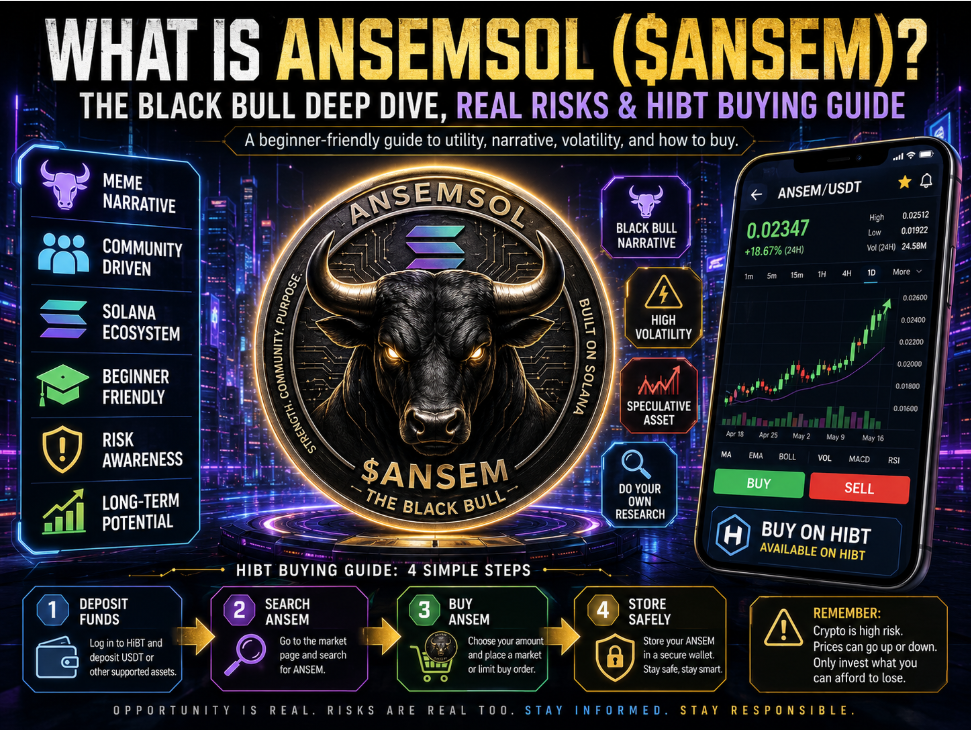
Three main reasons:
First, it capitalized on the native brand equity of the Ansem name. Ansem carries significant weight in the Solana community — sometimes referred to as the "Solana Guy." Public records show he has close to a million followers on X and built a reputation by being early and publicly bullish on Solana, WIF, and BONK. Crypto.news noted that Ansem is widely credited with making key bullish calls on SOL during its run from around $8 to near $300, holds a Computer Science degree from Georgia Tech, and has a background in engineering and crypto research.
Second, The Black Bull launched into a window when Solana meme coin sentiment was heating up again. Solana's low fees, fast finality, and strong speculative culture mean that once a name catches fire across X, Telegram, Pump.fun, and DEX Screener, it can pull in a significant wave of short-term capital in very little time.
Third, Ansem's subsequent announcement about airdropping a portion of his Pump.fun creator fees further amplified market attention. While Ansem didn't deploy the token himself, his public statement that he would redistribute some creator fees as airdrops caused the market to interpret The Black Bull as an experiment in "creator fee recycling back to the community."
One important clarification: The Black Bull becoming the leading version does not mean it was officially created by Ansem, nor does it mean it has long-term fundamentals. It's better understood as a market experiment — one built on KOL influence, airdrop expectations, and meme trading momentum.
2. How ANSEMSOL Actually Works: The Three Mechanisms
You can't analyze ANSEMSOL through a traditional investment lens. Asking about TVL, protocol revenue, developer ecosystem, or long-term roadmap misses the point — those aren't the drivers here. Three mechanisms actually power this token:
Mechanism 1: The Creator Fee Airdrop Flywheel
The most important short-term narrative around ANSEMSOL is Ansem's announcement that he would airdrop a portion of his Pump.fun creator fees to the community — rather than launch a personal token.
According to market reports aggregated by Bitget, around June 27, 2026, Ansem stated he would airdrop part of the creator fees earned through his Pump.fun account. Participation involved retweeting relevant content, following his Pump.fun profile, and submitting your own Pump.fun profile information. Reports noted that his Pump.fun creator fees accumulated to roughly $378,000 within a single week, with airdrop recipients selected randomly on a weekly basis.
This created a short-term flywheel:
Users watch for airdrops → Social media coverage increases → Trading volume rises → Creator fees grow → Airdrop expectations strengthen → More users engage and trade.
From a marketing standpoint, this is highly effective. From an investment standpoint, it's also high-risk — because the flywheel depends on sustained attention and fresh capital inflows. The moment airdrop appeal fades, social discussion cools, or price momentum stalls, the flywheel can reverse quickly.
Mechanism 2: Heavily Concentrated Supply Structure
The second key mechanism is the highly concentrated token distribution.
The Defiant reported that Ansem had airdropped approximately $6.7 million in $ANSEM to over 700 Solana wallets, while still controlling roughly 60% of total supply. The report also noted that the token was created by a separate wallet around June 17, 2026, via Pump.fun, which then transferred the majority of supply to Ansem's address. Ansem currently holds approximately 604 million tokens, or around 60% of total supply.
What does this mean for ordinary investors? Supporters can read it as "Ansem has major skin in the game alongside the community." Risk-averse investors can read it as "a single address has outsized price influence." When one address holds ~60% of supply, regardless of intent, the market has to factor in a basic reality: any transfer, sale, staking action, distribution, or even misinterpretation involving that address could trigger sharp price moves.
Concentrated supply isn't unusual in meme coins — but when you layer KOL narrative on top of it, price swings become even more tied to individual behavior and how the market reads social signals.
Mechanism 3: Social Sentiment Is the Price
ANSEMSOL has no traditional cash flow valuation model. It can't be analyzed like a DeFi protocol's fee income, or a blockchain infrastructure project's developer growth. Its price is driven by:
- Ansem's own social media activity and posting frequency
- Overall Solana meme sector sentiment
- On-chain trading activity across Pump.fun, PumpSwap, Meteora, and similar venues
- Whether airdrop expectations remain alive
- Whether whale wallets are holding, accumulating, or moving out
- Whether the community continues building narrative around The Black Bull
This is fundamentally an attention asset. The Defiant described $ANSEM as an experiment in trading against an individual's online reputation, noting it has no product, revenue, or roadmap, and its value is almost entirely derived from the attention the influencer generates.
ANSEMSOL goes up not necessarily because the project improved. It goes down not necessarily because the project failed. It may simply be because attention moved elsewhere.
3. ANSEMSOL Market Data: What's Happened, and Where Things Stand
The most compelling thing about ANSEMSOL is its jaw-dropping short-term gains. That's also why retail investors need to stay level-headed: the outsized returns of early buyers are not a template that later entrants can replicate.
As of June 30, 2026, CoinGecko shows The Black Bull (ANSEM) trading at approximately $0.1303, with a 24-hour trading volume of around $64.46 million, a circulating supply of approximately 413 million tokens, a maximum total supply of approximately 1 billion tokens, a market cap of around $53.43 million, and a fully diluted valuation of approximately $129 million. CoinGecko also shows a 7-day gain of approximately 29,514.8%, with an all-time high recently set at approximately $0.1519.
Two things this data tells us:
- The extreme gain has already happened.
- It's still in a highly volatile, high-attention phase.
Can the Windfall Returns Be Replicated?
The most-shared content in on-chain markets tends to be early-mover windfall stories. Bitget's reporting cited an on-chain analytics finding of a trader who spent approximately $2,330 buying 14.2 million $ANSEM, realized around $68,000 in profit, and still held around 10 million tokens for an estimated total return of around $614,500 — roughly a 261x gain.
Compelling — but three realities should temper that:
- These returns belong almost exclusively to the earliest participants.
- Early buyers took on massive risks: fake contracts, thin liquidity, total loss scenarios.
- By the time windfall stories are circulating widely, you're typically no longer in "early stage" — you're in the phase where those stories serve as marketing for the next wave of buyers.
Use these stories to understand market sentiment. Don't use them as a buy signal. The real question is: at today's price, does the risk-reward ratio still make sense?
Why Liquidity Matters
The most underappreciated risk in meme coins is liquidity risk.
CoinGecko's market listings show ANSEMSOL's primary trading volume concentrated on DEXes like PumpSwap and Meteora, with varying 2% order book depth across different pools. Some pools may show large volume numbers while actual depth is far thinner than volume implies.
This means that when large holders exit, short-term capital flees, or sentiment suddenly turns, ordinary users may face significant slippage. The price on screen is $0.13, but your actual average fill when you sell could be meaningfully lower — especially with market orders during volatile periods.
ANSEMSOL isn't a coin you analyze by price gain alone. You need to watch liquidity, order book depth, trade flow structure, and large wallet movements.
4. The Real Risks of ANSEMSOL: Read This Section First
Before getting into how to buy, you need to understand the risks. ANSEMSOL is not suitable for everyone — especially not for newcomers who are still learning the basics, don't have stop-loss discipline, or are susceptible to being swept up by get-rich-quick narratives.
Risk 1: Copycat and Impersonator Tokens
The single biggest first-level risk with ANSEMSOL isn't price decline — it's buying the wrong coin.
Public reporting has repeatedly flagged that multiple Solana tokens use the ANSEM name. Crypto.news noted that after Ansem's name went viral, multiple $ANSEM-branded tokens appeared almost simultaneously, some of which Ansem publicly distanced himself from; the article emphasized that no token using his name should be assumed to have any affiliation with him.
Always verify the contract address before buying:
9cRCn9rGT8V2imeM2BaKs13yhMEais3ruM3rPvTGpump
If you trade directly on a DEX, you need to manually verify the contract, liquidity pool, holder distribution, trade routing, and slippage settings. For newcomers, this process is genuinely error-prone. Buying through a centralized platform like HiBT via the ANSEMSOL/USDT spot pair provides a cleaner path and significantly reduces the risk of accidentally using a wrong or copied contract address — though available trading pairs, supported regions, and specific rules should always be confirmed on the HiBT platform directly.
Risk 2: ZachXBT's Allegations
The ANSEM narrative can't be told without acknowledging one prominent critic: ZachXBT.
ZachXBT is a well-known on-chain investigator in the crypto industry. TradingView, citing Cointelegraph reporting, noted that ZachXBT publicly accused Ansem in October 2024 of promoting low-cap Solana meme coins in ways that could result in losses for followers who bought in; Ansem pushed back on those claims and argued that low-cap meme coins simply attract a lot of retail attention.
To be clear: these are public allegations and disputes — not legal verdicts. But for investors, they serve as a useful reminder: KOL influence cuts both ways. Massive followings can drive inflows, but they can also amplify the risk of retail investors chasing tops.
The Defiant's June 2026 reporting noted that ZachXBT's accusations against Ansem haven't resulted in formal conclusions, but they remain highly relevant context for the inherent risks of influencer-driven tokens.
Risk 3: The Meme Coin Lifespan Problem
Meme coins don't build long-term businesses — they play attention games.
A February 2026 arXiv paper (revised May 2026) titled MELT analyzed Solana high-risk meme coin issuance data across more than 41,000 meme coin launches and over 200 million transactions. It found that launchpad models have made meme coin creation trivially easy while dramatically exposing ordinary investors to high-risk issuances. The study also found that on average approximately 36.5% of token supply may be held by coordinated accounts, a structure that masks true concentration.
While MELT wasn't focused on ANSEMSOL specifically, it explains why Solana meme coins carry structurally high risk: near-zero barriers to launch, abundant copycats, complex supply structures, and prices that are almost entirely sentiment-dependent.
For ANSEMSOL specifically, the real warning sign to watch for is narrative fatigue: social data still growing, but price no longer making new highs; volume beginning to shrink; whales starting to move out; airdrop news no longer moving the price. These are signals that the trend is decaying.
Risk 4: No Fundamental Moat
ANSEMSOL's core is attention, not protocol revenue. It has no sustainable cash flows, no clearly defined governance value, and no verifiable business income model.
This is fundamentally different from tokens with actual protocol utility. For comparison, you can explore assets with concrete on-chain application scenarios like What is CAP? and What is RIF?. These carry their own price volatility, but the risk structure is different from a pure meme coin, because they have more clearly defined protocol roles and use cases.
Put simply: ANSEMSOL isn't untouchable — but you can't approach it with a long-term value investing mindset. It's better classified as a high-risk, short-cycle, discipline-intensive speculative position.
5. How to Buy ANSEMSOL on HiBT: A Step-by-Step Guide for New Users
If you've absorbed the risks and still want to take a small position in ANSEMSOL, trading through a platform with a clear and well-defined process is strongly recommended over blindly copying contract addresses and trading on-chain. The following walkthrough assumes HiBT has the ANSEMSOL/USDT spot pair live.
Step 1: Register a HiBT Account and Complete KYC
Go to the HiBT website or app and register with your email or phone number. After registering, set up your account security first: login password, fund password, Google Authenticator or another two-factor authentication method.
Then go to the identity verification page and submit your KYC materials — typically a government-issued ID, facial recognition, and basic personal information. Requirements may vary by region; follow the prompts shown on the HiBT platform.
Don't skip KYC and security setup. Especially when buying high-volatility assets, account security matters more than trade execution speed.
Step 2: Deposit USDT to Your HiBT Account
Once your account is verified, you can fund it with USDT. Common methods include:
- On-chain transfer: Transfer USDT from an external wallet or another exchange.
- Fiat on-ramp: If HiBT supports fiat purchase channels in your region, follow the prompts on the platform.
Pay close attention to network selection when doing an on-chain deposit. TRC20, ERC20, BEP20, and Solana are different networks — they cannot be mixed. The network you select when withdrawing from an external platform must exactly match the network displayed on the HiBT deposit page. A mismatch can result in permanent loss of funds.
Step 3: Navigate to the Spot Trading Section and Search for ANSEMSOL/USDT
Once your deposit clears, go to the HiBT spot trading page and type:
ANSEMSOL
When you find the ANSEMSOL/USDT pair, don't rush to buy. Check three things first:
- Current price and 24-hour change
- Buy/sell order book depth
- Recent trading volume and price range
If you see a sharp short-term spike, a thin order book, and a widening bid-ask spread, wait — don't chase with a market order.
Step 4: Set Your Buy Parameters — New Users Should Start with Limit Orders
For a high-volatility meme coin like ANSEMSOL, market orders are not recommended for beginners. Market orders execute instantly but can suffer significant slippage during sharp price moves.
The more prudent approach is a limit order:
- Decide on the price you're willing to pay.
- Enter your desired quantity or total spend.
- Confirm the estimated fill amount and fees.
- Place the order and wait for the market to come to you.
For example, if the current price is $0.13 and you don't want to chase, you can set a limit buy at $0.12 or lower. A limit order doesn't guarantee a fill, but it protects you from buying at an inflated price during a temporary spike.
Step 5: Confirm the Order and Check Your Position in the Assets Tab
Once your order fills, go to your assets page to view your ANSEMSOL holdings. Record three things:
- Your average entry price
- Total amount invested
- Your planned stop-loss level and take-profit target
Don't wait until after a big price move to figure these out. The classic meme coin trap is: "It went up and I couldn't bring myself to sell; it went down and I couldn't bring myself to stop out." Your exit plan should be set before you buy.
After Buying: Keep on HiBT or Transfer to a Self-Custody Wallet?
If you're a newcomer with a clear short-term trading goal, keeping funds on HiBT is more convenient for managing your position and executing a sell. You won't have to deal with wallet private key management, Solana network congestion, DEX slippage, or contract verification.
If you're already familiar with Solana wallets, private key management, and DEX trading, you can consider withdrawing to a self-custody wallet — but only if you've confirmed that HiBT supports ANSEMSOL withdrawals, your target wallet supports the token, and you can manage your private key securely.
For most newcomers, the priority isn't "on-chain sovereignty" — it's avoiding operational mistakes first.
6. Reading ANSEMSOL's Price Signals: A Framework for What Comes Next
ANSEMSOL doesn't lend itself to straightforward long-term price prediction. Its core variables aren't earnings reports, revenue, or on-chain protocol growth — they're attention, volume, airdrop cadence, and large holder behavior. Instead of asking "what price will it definitely hit," it's more useful to build a signal-watching framework.
Signals That Suggest the Momentum Is Still Alive
If the following signs appear together, short-term heat around ANSEMSOL is likely still running:
- ANSEMSOL/USDT or ANSEM/SOL trading volume continues growing
- Holder address count keeps rising (not just a few large wallets trading among themselves)
- Ansem-related posts continue driving meaningful engagement and new followers
- Airdrop activities continue and attract new participants
- DEX liquidity pool balances show no significant withdrawals
- The broader Solana meme coin sector remains strong
- The Black Bull's official site or community continues developing concepts like the Bull Index and LP Pods
The Black Bull's publicly listed project description mentions the team is attempting to build community liquidity around an on-chain creator narrative — including LP pods, on-chain indices, and verifiable infrastructure. This suggests an effort to evolve the ANSEM story from pure meme into a "creator liquidity infrastructure" narrative. That said, these remain early-stage concepts — they can't yet be equated with an established business model.
Signals That May Indicate Whales Are Distributing
These warrant heightened caution:
- Large wallets routing significant transfers to exchanges or DEX aggregators
- Previously high-conviction holder addresses beginning to split and move out tokens incrementally
- LP liquidity shrinking while price is still being pushed up
- Volume rising but price failing to print new highs
- Social media hype still growing but price reaction weakening
- Positive news triggers smaller and smaller price moves — or even "sell the news" declines
- Buy-side depth shrinking while sell-side order walls grow
None of these signals necessarily means an immediate collapse, but they indicate the market structure is becoming more fragile. In meme coins, the transition from strength to weakness can happen fast. Don't wait until price breaks your psychological support before thinking about risk.
Three Scenarios for the Next 7 Days
This is a scenario-planning exercise, not investment advice.
Scenario
Price Range Reference
Trigger Conditions
Sideways consolidation
$0.085 – $0.135
Attention holds but volume fades; price enters wide range at highs
Bullish breakout
$0.150 – $0.180
Solana meme sector stays active; spot inflows continue; airdrop expectations sustain
Pullback / correction
$0.060 – $0.075
Narrative cools; whales move out; DEX liquidity imbalance; broader market weakens
The real point isn't to predict which scenario plays out — it's to have a strategy in place before it does. If you enter without a stop-loss, every price swing becomes an emotional decision.
7. Who Is ANSEMSOL Actually For? Investment Decision Summary
ANSEMSOL suits three types of participants:
- Short-term traders who can absorb significant drawdowns on their principal
- Users familiar with Solana meme coin dynamics who actively monitor on-chain wallet flows and liquidity
- People treating it as a small speculative position — not a long-term value holding
ANSEMSOL is not suitable for:
- Newcomers still learning the difference between a limit order and a market order
- Anyone looking for stable returns from a single coin
- Anyone using borrowed funds, living expenses, or heavily concentrated capital
The most sensible approach is to treat ANSEMSOL as a high-risk speculative allocation, not a core position. If your total crypto holdings are $10,000 USDT, the amount in high-risk meme coins like this should ideally stay between 1%–5%. More conservative beginners might limit exposure to 0.5%–1% just to observe how the market behaves — don't scale up just because you see someone else's screenshots.
A simple position-sizing formula:
Maximum acceptable loss ÷ Planned stop-loss percentage = Maximum buy-in amount
Example: If you're willing to lose at most $100 USDT and plan to stop out at -30%, your maximum position size is:
$100 ÷ 30% = ~$333 USDT
That's more rational than "I feel like it can still run, let me put in $2,000."
If you want to build out your portfolio with assets that carry lower risk and more identifiable fundamentals, consider researching tokens with defined protocol roles — such as What is CAP? and What is RIF?. These assets have price volatility too, but their risk profiles are structurally different from a pure attention-driven meme coin like ANSEMSOL — and they're better suited for building multi-layered risk exposure.
Closing: ANSEMSOL Is Worth Watching — Not Worth Betting the Farm On
ANSEMSOL is one of the most representative meme coin case studies to emerge from the Solana market in 2026: a powerful KOL narrative, outlandish short-term returns, a creator fee airdrop flywheel generating community momentum — alongside very real risks including copycat tokens, concentrated supply, thin liquidity, and the ever-present threat of sentiment evaporation.
If you treat it as a case study for understanding how Solana meme coins work and how attention-based assets get priced, it's genuinely worth studying. If you treat it as a guaranteed opportunity, you're seriously underestimating the downside.
For newcomers, the safest framework isn't "should I go all in" — it's:
Understand it first. Start small. Set your stop-loss. Only then decide whether to participate.
When buying ANSEMSOL on HiBT: confirm the trading pair, size your position conservatively, default to limit orders, and write down your exit plan before you hit buy. The biggest risk in meme coins isn't price volatility — it's losing your discipline when the volatility hits.