
If you already understand Bitcoin, a natural question might come up: isn't Bitcoin mainly for storing value and sending payments? So why do terms like "Bitcoin DeFi," "Bitcoin smart contracts," and "Bitcoin sidechain tokens" keep showing up in the market?
RIF is a textbook example of a project built around exactly this question.
RIF is not Bitcoin itself, and it's not a "Bitcoin fork" of any kind. The more accurate way to describe it is as an infrastructure token within the Rootstock ecosystem. Rootstock — formerly known as RSK — is a smart contract sidechain tightly bound to Bitcoin. Its goal is to let the Bitcoin ecosystem support DeFi, naming services, payments, stablecoins, cross-chain functionality, and developer tooling, all without altering Bitcoin's core mainchain design.
The simplest way to put it:
Bitcoin handles security and the store-of-value layer, Rootstock extends it with smart contract capability, and RIF handles the infrastructure, incentives, governance, and application services within the Rootstock ecosystem.
This article walks through several key questions in beginner-friendly terms:
- What RIF's actual relationship to Bitcoin is
- Why the Rootstock sidechain can inherit some of Bitcoin's security
- What RIF is actually used for
- Whether RIF is still worth following long-term
- The risks to understand before investing in RIF
- How to buy RIF on a platform like HiBT
- Whether to simply hold, dollar-cost average, or participate in stRIF governance after buying
This is not investment advice. RIF is a crypto asset with significant price volatility, and whether to buy it requires an independent judgment based on your own risk tolerance.
1. What Exactly Is RIF, and What's Its Relationship to Bitcoin?
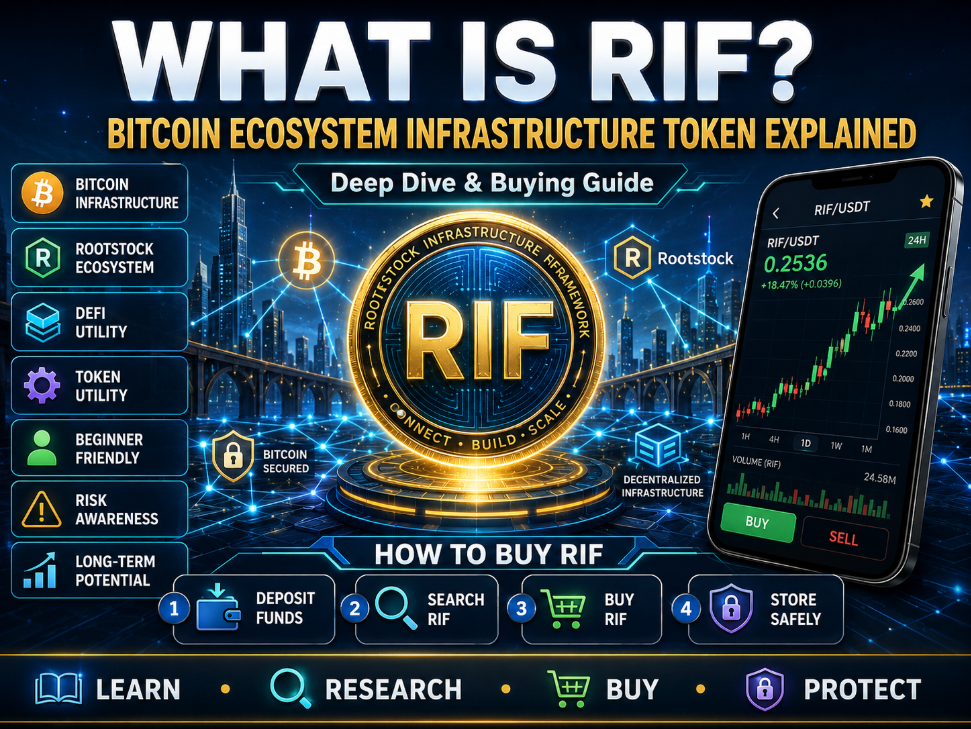
RIF was originally explained as standing for "RSK Infrastructure Framework," and is now more commonly described as the "Rootstock Infrastructure Framework."
The name itself is a clue: this isn't a chain with its own fully independent narrative — it's a set of infrastructure and token systems built around the Rootstock ecosystem.
Is RIF a Blockchain?
Strictly speaking, no — RIF is not an independent blockchain.
The actual chain is Rootstock, formerly known as RSK. Rootstock is a Bitcoin sidechain compatible with the Ethereum Virtual Machine (EVM), meaning developers can deploy smart contracts on it using familiar tools like Solidity.
RIF is the infrastructure token within the Rootstock ecosystem. It doesn't replace BTC, and it doesn't replace rBTC, Rootstock's native gas asset — instead, it serves the infrastructure and community governance layered on top of Rootstock.
A simple way to think about it:
- BTC: the Bitcoin mainchain asset, providing store-of-value and security
- Rootstock: the smart-contract sidechain that taps into Bitcoin's security
- rBTC: the gas asset on Rootstock, pegged to BTC through a two-way bridge mechanism
- RIF: the token tied to Rootstock's infrastructure, incentives, and governance
- stRIF: the governance credential received from staking RIF, used within the RootstockCollective DAO
So RIF isn't "another Bitcoin" — it's an infrastructure token within the smart-contract extension of the Bitcoin ecosystem.
How Does Rootstock Connect to Bitcoin via a Two-Way Peg?
Understanding RIF requires first understanding how Rootstock connects to Bitcoin.
Rootstock uses a two-way peg mechanism. In simple terms, a user locks BTC at a specific address on the Bitcoin mainchain and receives an equivalent amount of rBTC on Rootstock. Going the other direction, when a user wants to move back to the Bitcoin mainchain, they lock or burn rBTC and release the corresponding BTC.
This isn't "minting BTC out of thin air" — it's a lock-and-release mechanism that gives BTC programmable capability on the Rootstock sidechain.
A simple analogy: imagine depositing gold into a vault and receiving a certificate that can circulate within a financial system. The certificate itself isn't gold, but it represents a corresponding amount of gold sitting in the vault.
The relationship between rBTC and BTC works similarly. rBTC lets BTC enter the Rootstock smart contract ecosystem, where it can be used for DeFi, lending, trading, payments, and more.
What Is Merge Mining, and Why Does Rootstock Inherit Some of Bitcoin's Security?
Another important mechanism behind Rootstock is merge mining.
Merge mining means Bitcoin miners can participate in Rootstock block production at the same time they're mining Bitcoin. This way, Rootstock doesn't need to build an entirely separate miner network from scratch — it can draw on the security provided by Bitcoin's existing mining hash power.
This is one of Rootstock's central narratives: it isn't trying to compete with Bitcoin — it's trying to extend smart contract capability on top of Bitcoin's existing security.
That said, beginners should be careful not to read "inherits Bitcoin's security" as "exactly as secure as Bitcoin." Rootstock still has its own sidechain rules, bridging mechanisms, PowPeg design, ecosystem applications, and smart contract risk. Its security model is more complex — and more transparent — than a typical centralized cross-chain bridge, but it isn't entirely free of trust assumptions.
Why Doesn't Bitcoin Itself Support Complex Smart Contracts Directly?
The Bitcoin mainchain's design is deliberately conservative. It prioritizes security, stability, decentralization, and censorship resistance over providing a highly general-purpose smart contract execution environment like Ethereum's.
This design has real advantages: a simpler mainchain, a smaller attack surface, a more stable protocol, and a sharper focus on monetary properties.
But it also has limitations: it's not well-suited to complex DeFi, high-frequency interaction, complex DApps, or the kind of rapid application-layer iteration that's possible on Ethereum.
This is exactly where Rootstock's value proposition comes in: it doesn't require any changes to the Bitcoin mainchain — instead, it builds an EVM-compatible sidechain alongside Bitcoin, letting developers build more financial applications around BTC.
RIF's Core Value Proposition, in One Line
A simple way for an ordinary person to understand RIF:
RIF is the infrastructure token of the Rootstock ecosystem, aiming to let Bitcoin become more than just "an asset you hold" — turning it into an underlying financial network for DeFi, payments, naming services, and Web3 applications.
That's RIF's core value proposition.
2. Who's Behind RIF Labs and IOV Labs? How Do You Verify the Project's Credibility?
In crypto, the biggest problem with many new projects is a lack of transparency. RIF is somewhat different — it's not a brand-new project, but one that's been on the market's radar since around 2018.
But being an "older project" doesn't automatically mean it's worth buying. Judging whether an older project still has value comes down to whether it's still actively developed, still being updated, and still has real ecosystem activity.
Who's on the Founding Team?
A few names come up repeatedly across the Rootstock and RIF teams: Sergio Demian Lerner, Diego Gutiérrez Zaldívar, Gabriel Kurman, Ruben Altman, and Adrián Eidelman.
Sergio Lerner is fairly well known for his Bitcoin security research and his role in Rootstock's technical design. Diego Gutiérrez Zaldívar has long been involved in Latin America's Bitcoin ecosystem and Rootstock-related organizational building. Gabriel Kurman has also been involved in driving the early ecosystem and the project's development.
These public figures and the project's long track record are a meaningful difference between RIF and many anonymous new tokens. A project with a fully anonymous team, an unverifiable background, and no inspectable code carries noticeably higher risk. RIF, at minimum, has a relatively long public development history that investors can cross-check through official documentation, GitHub, historical announcements, talks, interviews, and ecosystem activity.
What's the Relationship Between RIF Labs, IOV Labs, and RootstockLabs?
RIF Labs has appeared alongside names like RSK Labs and IOV Labs throughout the project's development history. Around 2019, the project explained a brand restructuring: after RIF Labs acquired RSK Labs, there were plans to rename the entity IOV Labs, in order to distinguish the company brand from the open-source protocol itself.
More recently, the name RootstockLabs has become more common in the market. Broadly, it can be understood this way:
- RSK/Rootstock: the protocol and network layer
- RIF: the infrastructure framework and token
- IOV Labs/RootstockLabs: the organizational brand driving related technology, products, and ecosystem development
Beginners don't need to get bogged down in the history of every legal entity, but should understand one thing: the project has gone through multiple brand and structural changes, so research should prioritize the latest official documentation rather than relying on early RIF whitepapers or older news coverage.
How Do You Judge Whether an Older Project Is Still Moving Forward?
Judging whether RIF is "still active" shouldn't be based on price alone — look instead at four categories of signals.
First, is official developer documentation being updated? If documentation has gone stale for a long time, that suggests developer support may be lacking. Continued updates to the Rootstock developer portal, PowPeg documentation, and RIF-related pages would be a positive signal.
Second, are there ongoing GitHub commits? Code commits, issue handling, version releases, and SDK updates matter far more than community hype.
Third, does the ecosystem have real applications? For example, are things like RNS, RIF Relay, RIF Flyover, RootstockCollective, or USDRIF still seeing actual usage?
Fourth, is DAO governance actually running? If RIF can be staked as stRIF to participate in the RootstockCollective DAO, investors can watch metrics like proposal volume, voter participation, grant disbursements, and the quality of community discussion.
If an older project has nothing left but its historical narrative — no documentation updates, no developers, no ecosystem applications, no governance activity — that's a warning sign of a "zombie project." The key question for RIF is whether it can move from its legacy Bitcoin-sidechain narrative back into a genuine Bitcoin DeFi growth cycle.
3. What Can RIF Actually Be Used For? Breaking Down Three Core Use Cases
A lot of beginners only ask "will it go up" when buying a token, without asking "what does this token actually do." For RIF, utility is the key to judging long-term value.
What Problem Is RIF Storage Trying to Solve with Decentralized Storage?
RIF Storage was, in its early days, one of the important components of the RIF ecosystem, aimed at providing storage capability for decentralized applications.
Traditional cloud storage relies on centralized providers — AWS, Google Cloud, Alibaba Cloud, Tencent Cloud, and so on. The advantage is maturity and stability; the downside is that users and developers have to trust a centralized platform.
The goals of decentralized storage are: reducing single-point-of-failure risk, improving censorship resistance, keeping application data more open, and letting developers call storage services within a Web3 environment.
That said, beginners should understand that decentralized storage isn't strictly better than traditional cloud services in every scenario. It has advantages in censorship resistance, openness, and storing data for decentralized applications, but it may lag behind mature cloud providers in speed, cost, developer experience, and commercial support.
So RIF Storage's value really comes down to real-world adoption, not just the concept.
RIF Payments and the Lumino Network: Making Payments Faster
The Bitcoin mainchain isn't well-suited to high-frequency, small-value payments, because block confirmation is slow and fees can rise during congestion. Rootstock and the RIF ecosystem try to address this through payment channels, Layer-2 tools, and infrastructure that let the Bitcoin ecosystem support faster, lower-cost payment experiences.
The Lumino Network can be thought of as a "payment channel" solution within the Bitcoin ecosystem. Its goal isn't to replace the Bitcoin mainchain — it's to make small payments, frequent transfers, and in-app payments smoother.
For an everyday user, the important part isn't memorizing the technical terms — it's understanding the problem being solved: the Bitcoin mainchain is well-suited to large, secure settlements; payment channels are well-suited to small, high-frequency payments; and RIF's related tooling is trying to plug that payment capability into the Rootstock ecosystem.
If Bitcoin DeFi and Bitcoin payment use cases grow in the future, RIF's payment infrastructure could benefit. But if users gravitate more toward the Lightning Network, stablecoins, or centralized payment rails, RIF Payments adoption will also face competition.
What's the Point of the RIF Name Service?
The RIF Name Service, or RNS, can be understood as a domain-name system within the Rootstock ecosystem.
Blockchain addresses are usually long strings of characters — hard for ordinary users to remember, and easy to mistype. RNS aims to turn those complex addresses into more recognizable names.
Some parallels: on the traditional internet, you don't need to remember a server's IP address — you just type in a domain name; in the Ethereum ecosystem, users can rely on ENS domains; in the Rootstock ecosystem, RNS helps users manage more user-friendly identities and addresses.
Whether ordinary users actually need this depends on how active the Rootstock ecosystem is. If Rootstock wallets, DeFi, payments, NFTs, or identity use cases grow, RNS becomes more valuable. If ecosystem applications stay limited, so does demand for the naming system.
What Do You Actually Get from Holding RIF?
RIF's core value today isn't limited to "paying for usage" — it also includes governance and incentives.
By staking RIF, users receive stRIF. stRIF is the governance credential within the RootstockCollective DAO, and can be used to: participate in DAO governance, vote on project proposals, support Bitcoin Builders, take part in reward distribution, and influence how Rootstock ecosystem funding is allocated.
This means RIF isn't just an in-app payment token — it's increasingly taking on community-governance and ecosystem-incentive characteristics too.
But ordinary investors should keep a level head about "governance value." If your holding is small, and you don't vote or research proposals, stRIF governance may have limited practical relevance for you. It's better suited to people who genuinely follow the Rootstock ecosystem long-term, are willing to participate in the DAO, and want to research proposals.
4. RIF's Tokenomics: Supply, Unlocks, and Price Drivers
Is RIF's Total Supply 100 Million or 1 Billion?
This is an important correction to make, since it's a common mistake: RIF's total supply is 1 billion tokens — that is, 1,000,000,000 RIF — not 100 million.
This unit is easy to get wrong in Chinese-language content, and articles should consistently write it as "1 billion (1,000,000,000 RIF)" to avoid misleading readers.
RIF is now highly circulated — third-party market data shows circulating supply close to total supply. So compared to newer tokens with large future unlocks still ahead of them, RIF's incremental release pressure is relatively more transparent.
For investors, this means: the gap between FDV and current market cap isn't large, there's less need to worry about a sudden mass unlock of previously locked tokens, and price pressure is more likely to come from market buying/selling, ecosystem adoption, and overall market conditions rather than a long-term linear unlock schedule.
Of course, being close to fully circulated doesn't mean there's no sell pressure at all — older holder wallets, exchange inventory, large-holder transfers, and ecosystem fund spending can all still affect price.
What Do Current Market Cap and Volume Tell You?
RIF isn't a tiny-cap new token, but it's also not a top-tier mainstream asset like BTC or ETH. It sits more in the category of a mid-cap, established infrastructure token.
If 24-hour trading volume stays in the tens of millions of dollars, that suggests it still has meaningful market attention and trading depth. But compared to top-tier assets, RIF's liquidity remains limited, and price is more vulnerable to market sentiment and sector rotation.
To gauge RIF's level of market attention, look at: whether it's still supported by major exchanges, whether RIF/USDT trading depth is stable, whether 24-hour volume is consistent over time, whether volume is concentrated on just a few platforms, whether community discussion is picking back up alongside the Bitcoin DeFi narrative, and whether new applications or incentives are appearing within the Rootstock ecosystem.
If price rises without a corresponding increase in volume, be cautious that the short-term rally may not be sustainable. If ecosystem progress is clearly happening but the price stays depressed, that could mean the market simply hasn't re-rated it yet — or it could mean attention is genuinely lacking.
What Does a Steep Pullback from All-Time Highs Actually Tell You?
RIF reached a notable high during a previous market cycle, and price pulled back significantly afterward as DeFi activity cooled, the altcoin market lost momentum, and the Bitcoin-ecosystem narrative weakened.
When beginners see "it's down a lot from its high," two flawed reactions are common.
The first is assuming "it's dropped so much, it must be cheap now." This is a mistake — a token down 80% from its high can still drop another 80%. A price pullback doesn't mean it's undervalued; it may simply reflect lower growth expectations from the market.
The second is assuming "it's dropped so much, the project must have no future." This isn't necessarily true either. Cyclical drawdowns are common for older projects — what actually matters is whether development is continuing and whether the project can keep pace with a new narrative cycle.
The real question for RIF isn't "how far is it from its all-time high" — it's: can the Rootstock ecosystem still grow; will Bitcoin DeFi become a durable long-term trend; does RIF have genuine demand within the new governance and incentive system; are developers willing to build applications on Rootstock; and can stRIF governance actually drive stronger community participation?
Only if these questions trend in a positive direction does the historical high become a meaningful reference point. Otherwise, that high is just a price mark left behind by past bull-market sentiment.
What Does the stRIF Governance Mechanism Mean for Long-Term Holders?
Staking RIF to receive stRIF has become an important part of RIF's recent narrative.
For long-term holders, stRIF means you're not just a passive holder — you can also participate in RootstockCollective DAO governance. Through voting, you can influence which projects receive support, which builders receive grants, and which directions get prioritized for resources.
The potential value of this kind of mechanism: it strengthens long-term holding incentives, reduces short-term circulating sell pressure, ties the token more directly to ecosystem growth, makes community fund allocation more transparent, and attracts developers and users to participate in governance.
But it also has real limits: governance influence is limited for smaller individual holders, voting requires time and effort to understand the issues, the quality of DAO governance depends on community engagement, and if ecosystem project quality is weak, the governance mechanism itself can't manufacture value out of nothing.
So stRIF is best suited to people who genuinely want to participate in the Rootstock ecosystem. If you're just trading RIF short-term, staking for stRIF isn't necessarily something you need to do.
5. Risks You Need to Understand Before Investing in RIF
RIF isn't a pure meme coin, and it's not a brand-new listing either — but it still carries clear risks. In particular, it's an "ecosystem-dependent token," meaning its price is heavily tied to how Rootstock and Bitcoin DeFi develop.
Ecosystem Dependency Risk
RIF's value doesn't come purely from the token itself — it comes from demand within the Rootstock ecosystem.
If DeFi, payments, RNS, stablecoins, developer tooling, and DAO governance on Rootstock keep growing, RIF has more use cases and more opportunities to capture value.
Conversely, if Rootstock's ecosystem grows slowly, and users gravitate instead toward Ethereum, Solana, Base, Sui, B², Stacks, or other Bitcoin Layer-2 ecosystems, RIF faces a real demand shortfall.
This is the core risk of any ecosystem-dependent token: a project can look technically sound, have real history, and have a compelling vision — but if the ecosystem lacks real users, the token's value still gets capped.
The Trust Assumptions Behind the Two-Way Peg and PowPeg
Rootstock's two-way peg is more complex than a typical centralized bridge and has stronger security design, but it isn't entirely free of trust assumptions.
Because the Bitcoin mainchain itself doesn't support complex smart contract logic, Rootstock needs mechanisms like PowPeg, PowHSM, and bridge contracts to handle the conversion between BTC and rBTC. This design is more distributed than relying on a single custodian, but users still need to understand the participants involved and the security boundaries.
Risks include: operational risk among PowPeg participants, the complexity of the bridging process, user operational errors, potential delays in extreme scenarios, smart contract or front-end risk, and shifts in market trust around rBTC liquidity.
Beginners shouldn't oversimplify "inherits Bitcoin's security" into "every Rootstock application is as safe as Bitcoin." The Bitcoin mainchain, the Rootstock sidechain, the RIF token, DeFi applications, and the cross-chain bridge each carry their own distinct layer of risk.
The Risk of Declining Project Attention
RIF being an older project is both an advantage and a risk.
The advantage: it has a longer history, more complete documentation, and more mature infrastructure. The risk: the market may perceive it as "not new enough," and social media discussion may lag behind hotter, newer projects.
The crypto market is heavily narrative-driven. Even a technically solid project can see prolonged price stagnation if it isn't attracting new users, developers, and capital attention.
To judge current attention levels, watch: discussion volume on X/Twitter, how often the official blog is updated, developer activity, GitHub commits, changes in trading volume, whether new ecosystem incentives are launching, whether new exchange listings or partnerships are appearing, whether Rootstock's TVL is growing, and whether RIF-related DAO proposals are active.
If these indicators keep trending downward, that signals insufficient market attention, and expectations should be adjusted down accordingly when investing.
If you're comparing this against another asset in the same "infrastructure-type" category, HiBT's analysis on whether now's a good time to buy RPL offers a useful evaluation framework — RPL leans toward Ethereum staking infrastructure while RIF leans toward Bitcoin sidechain infrastructure, but neither should be judged by short-term candlestick patterns alone; both come down to ecosystem adoption, protocol role, and long-term demand.
6. A Practical Guide to Buying RIF on HiBT: Five Steps
If you've finished your basic research and decided to buy RIF through an exchange, you can follow the steps below. This uses HiBT as the example, but whether RIF/USDT is actually supported, which deposit networks are available, and what the fees are should always be confirmed against HiBT's own pages and announcements.
Step 1: Register an Account and Complete KYC
After visiting HiBT's website or app, register using your email or phone number. New users should immediately complete: setting a login password, binding an email or phone number, enabling Google Authenticator or another 2FA method, and completing identity verification (KYC).
KYC usually requires an ID document, facial verification, or address information. Review time depends on the platform's risk controls and how clear your submitted materials are — sometimes it's quick, sometimes it takes longer.
If you plan to use a fiat channel, raise withdrawal limits, or trade long-term, it's best to complete KYC in advance rather than waiting until after you've already bought.
Suggested screenshots: registration page, KYC verification page, security settings page, account tier page.
Step 2: Deposit USDT or USDC
Buying RIF/USDT usually means having USDT ready first. There are two common funding methods.
Fiat deposit or quick buy. Suits beginners with no existing crypto. It's simple, but may involve exchange-rate spreads, processing fees, and regional restrictions.
On-chain transfer of USDT or USDC. Suits users who already hold stablecoins on another exchange or wallet. It's flexible, but you must select the correct network.
Beginners should check: whether the deposit currency is USDT or USDC, whether the deposit network matches the sending network, whether a Memo or Tag is required, whether a small test transfer arrives successfully, whether on-chain fees are reasonable, and whether the platform supports that particular network.
If you're unsure which network to choose, pick the one you're most familiar with that the platform clearly supports, with acceptable fees and confirmation speed.
Suggested screenshots: deposit entry point, USDT network selection, deposit address page, deposit confirmation record.
Step 3: Search for the RIF/USDT Pair
Go to HiBT's spot trading section and search "RIF."
Don't rely on the ticker symbol alone — verify the project name too. Some similarly-named tokens exist on the market, and "RIF" as an abbreviation is even used outside crypto entirely. The correct project name should correspond to "Rootstock Infrastructure Framework" or "RSK Infrastructure Framework."
Things to verify: that the trading pair is RIF/USDT, that the project name is correct, that it's in the spot trading section, whether there's a futures or leverage entry point as well, whether similarly-named tokens exist elsewhere, and whether any platform risk warnings are shown.
Beginners should prioritize spot trading and avoid jumping into leveraged futures right when first getting familiar with RIF.
Suggested screenshots: RIF search results, RIF/USDT trading page, project info page, order book depth chart.
Step 4: Limit Order or Market Order?
RIF is a mid-liquidity token — not as deep as BTC or ETH, but not as completely illiquid as a tiny new token either. So your order type should depend on actual order-book conditions.
Market orders suit small, fast fills — convenient, but can incur slippage if the book is thin.
Limit orders give you control over your entry price — controllable, but may not fill immediately.
A more disciplined approach: check the order book first, test with a small amount first, use limit orders and buy in batches, avoid chasing market orders during a fast short-term rally, set the maximum price you're willing to pay in advance, and don't deploy your entire planned capital in one go.
If you're building a long-term position, consider splitting your buying into several smaller purchases rather than going all-in at once.
Suggested screenshots: limit order input, market order input, bid-ask spread, trade details.
Step 5: Keep on the Exchange or Withdraw to a Wallet?
After buying RIF, you have two common options.
Keep it on your HiBT account. Suits short-term trading, swing trading, and beginners not yet comfortable with on-chain wallets. Convenient for buying and selling, but your assets are custodied by the exchange, so you bear platform account-security risk.
Withdraw to a wallet that supports the Rootstock network. Suits people planning to hold long-term and participate in RNS, Rootstock DeFi, or stRIF governance. Gives you full control over your assets, but you're responsible for safeguarding your seed phrase, understanding network selection, paying on-chain gas, and avoiding approval-related risks.
If you're just learning and observing with a small amount, keeping it on the exchange is simpler. Only if you plan to actually participate in the Rootstock ecosystem do you need to dig further into Rootstock wallets, rBTC gas, RNS domains, RIF staking, and DAO governance.
Suggested screenshots: assets page, withdrawal page, Rootstock wallet receiving page, RNS domain page.
7. What Do You Do After Buying? Staking, Dollar-Cost Averaging, and Position Management
Buying RIF isn't the end — it's the beginning of position management.
Should an Everyday Investor Stake RIF for stRIF?
Staking RIF for stRIF suits three kinds of people.
First, people who genuinely believe in the long-term Rootstock ecosystem. If you're just trading short-term, staking isn't necessarily something you need to do.
Second, people willing to actually participate in governance. stRIF's core value is governance rights — if you're not reading proposals, not voting, and not engaging with the community, its practical value to you diminishes.
Third, people willing to take on on-chain operational risk. Staking requires connecting a wallet, confirming contracts, paying gas, and managing private keys. Beginners should test with a small amount first.
The potential upside of staking: gaining governance rights, participating in ecosystem rewards, deepening your long-term holding experience, and gaining a more thorough understanding of the Rootstock ecosystem.
But staking also has costs: the process is complex, it requires learning how the DAO works, there may be contract risk, it can affect short-term liquidity, and the returns aren't guaranteed to offset a falling token price.
So beginners can start by simply holding RIF as a spot position, and consider staking once they're more familiar with the process.
Is RIF Suitable for Dollar-Cost Averaging?
RIF, as a Bitcoin-ecosystem infrastructure asset, is notably more volatile than BTC. A dollar-cost averaging (DCA) strategy can reduce the risk of buying everything at a single high point, but it doesn't guarantee a profit.
DCA suits people who: believe in the long-term development of Bitcoin DeFi, can tolerate sustained volatility, don't want to actively time the market, are willing to keep tracking the Rootstock ecosystem, and maintain strict position-size discipline.
DCA doesn't suit people who: are only looking for a quick windfall, can't tolerate a 30%-50% drawdown, don't pay attention to project progress, have a very short investment horizon, or tend to average down emotionally.
Compared to building a position all at once, DCA's advantage is spreading out your cost basis and reducing timing pressure. The downside is that if the market rallies quickly, returns may lag behind a lump-sum purchase; and if the project's fundamentals deteriorate, continued DCA buying can turn into continuously buying a falling asset.
So RIF dollar-cost averaging should be paired with regular check-ins — for example, reviewing monthly: is Rootstock's TVL growing, is RIF's trading volume stable, is DAO governance active, are official docs and code being updated, is the Bitcoin DeFi narrative strengthening, and are stronger competitors emerging in the market.
How Should You Size Your Position?
RIF is more mature than many new tokens, but it's still not a low-risk asset. For beginners, it's not advisable to make RIF a core, heavily-weighted holding.
A more sensible position-sizing logic: treat BTC and ETH as your core holdings, treat RIF as exposure to a Bitcoin-ecosystem extension, avoid over-concentrating in any single ecosystem token, don't borrow to buy, don't invest money you need for living expenses, and don't use leveraged futures to amplify your position.
If your total portfolio is 100%, keep your high-risk altcoin allocation to a relatively small share, and then allocate only part of that toward RIF. The exact percentage depends on your own risk tolerance, but the principle holds: even if RIF drops sharply, it shouldn't affect your daily life or your main investment plan.
Common Mistakes Beginners Make
When buying an infrastructure-type token like RIF, beginners tend to make four mistakes.
First, treating "Bitcoin ecosystem" as if it means "as stable as BTC itself." This is wrong — RIF and BTC carry completely different risk profiles.
Second, focusing only on the historical high without looking at current adoption. A steep drawdown from a past high doesn't guarantee a return to that level.
Third, seeing staking and governance and assuming guaranteed returns. Governance rights aren't a cash-flow guarantee, and staking doesn't eliminate price risk.
Fourth, over-concentrating a position around a single narrative. Even if you believe in Bitcoin DeFi as a theme, you shouldn't put everything into just one token.
For a comparison point with a much earlier-stage project that has a very different level of information transparency, see HiBT's basic introduction to what the IDOL token is. The contrast highlights how differently a mature infrastructure project and an early-stage narrative-driven project can look in terms of disclosure, community discussion, historical data, and overall risk structure.
8. FAQ
1. Are RIF and RSK the same token?
No. RSK is Rootstock's earlier name, and is still often used to refer to the Rootstock sidechain itself. RIF is the infrastructure token within the Rootstock ecosystem.
The more precise relationship: Rootstock/RSK is the smart contract sidechain; rBTC is the gas asset on Rootstock; RIF is the token tied to infrastructure, incentives, and governance; and stRIF is the DAO governance credential received from staking RIF. So don't conflate RIF, RSK, and rBTC with one another.
2. Did RIF's renaming to "Rootstock Infrastructure Framework" affect existing holdings?
Generally, a name change is mostly a branding and narrative-level shift, and doesn't automatically change the token contract itself. What investors should actually watch for is whether the project has published any official announcement about contract migration, token swaps, or network upgrades.
Without an official migration announcement, existing RIF holdings typically aren't affected just because of the name change. When trading, still verify the contract address, the exchange's project page, and official documentation.
3. What fees apply to trading RIF on HiBT?
Generally three categories: spot trading fees, deposit/withdrawal network fees, and bid-ask spread/slippage costs. Exact rates should be confirmed on HiBT's fee page and order confirmation screen. RIF isn't a top-tier-depth asset like BTC or ETH, so for larger trades, still check order book depth to avoid unnecessary slippage from market orders.
4. Is RIF recognized or endorsed by financial regulators?
RIF is a crypto asset, and shouldn't be understood as an investment product endorsed by any regulator. Rules around trading, holding, staking, and DeFi participation vary by country and region.
Investors should check local regulations to determine whether they can buy, hold, or participate in related on-chain activity. An exchange listing is not a regulatory endorsement, and a project's official documentation is not an investment guarantee.
5. How closely does RIF's price track Bitcoin's?
RIF is a Bitcoin-ecosystem-related asset, so it's influenced by overall Bitcoin market sentiment. But it isn't BTC itself — its price swings can be larger, it may fail to rally even when BTC is up, and it can move independently on ecosystem-specific news even when BTC is flat.
Factors influencing RIF's price include: overall BTC market conditions, the strength of the Bitcoin DeFi narrative, Rootstock ecosystem data, RIF staking and governance developments, exchange liquidity, and overall risk appetite in the altcoin market.
So you can't simply predict RIF's price from BTC's price movement alone.
6. Is RIF suitable for long-term holding?
Whether RIF suits long-term holding depends on whether you believe in the future of Rootstock and Bitcoin DeFi.
If Rootstock continues attracting developers, users, and capital, RIF has long-term research value as an infrastructure and governance token. If Rootstock's ecosystem growth stays slow, RIF may significantly underperform other popular assets over time.
Before committing to long-term holding, it's worth reviewing project progress at least once per quarter, rather than buying and then ignoring it entirely.
9. Risk Disclosure and Disclaimer
This article is intended for crypto education and trading-process explanation purposes only. It does not constitute investment advice, financial advice, or any recommendation to buy or sell.
RIF is a high-volatility crypto asset, and its price can be affected by market sentiment, Bitcoin price action, Rootstock ecosystem progress, liquidity changes, regulatory policy, smart contract risk, and exchange risk. Past price performance doesn't predict future returns, and a previous all-time high doesn't guarantee the price will reach it again.
Information sources for this article fall into two categories. Primary sources include Rootstock's official documentation, its developer portal, RootstockCollective documentation, the official blog, block explorers, and the project's own public materials. Secondary sources include CoinGecko, CoinMarketCap, exchange market pages, media coverage, influencer commentary, and community discussion.
Investment decisions should prioritize primary sources, combined with independent judgment based on on-chain data and trading depth. Third-party market data can change over time, so real-time market cap, volume, circulating supply, trading pairs, and platform fees should be double-checked before publishing.
If this article's author, the publishing platform, or any related trading platform has a partnership, promotional arrangement, holding, market-making relationship, or other commercial interest connected to the RIF project, that should be clearly disclosed within the article. Transparent disclosure helps build content credibility and aligns with EEAT standards for crypto content.
One final reminder: what matters most about RIF isn't "whether it counts as a Bitcoin-ecosystem concept" — it's whether the Rootstock ecosystem can genuinely grow. Understanding that distinction first, before deciding whether to buy, is the more responsible starting point for any beginner investor.