
Last updated: July 28, 2026
Disclaimer: This article is for educational purposes only and is not financial, tax, legal, or investment advice. Stocks, ETFs, crypto assets, and tokenized stocks all involve risk. Always do your own research and consult a qualified professional before investing.
Buying US stocks in 2026 is easier than ever, but it is also more confusing than ever.
For beginners, the traditional path is still simple: open a brokerage account, deposit money, search for a stock or ETF, and place an order. But for crypto users, there is now a second path: tokenized US stocks and RWA assets, where users may use crypto such as USDT or USDC to access stock-like market exposure through a digital asset platform.
These two paths are not the same. A real stock bought through a regulated broker may give you shareholder rights, brokerage protections, tax forms, and access to retirement accounts. A tokenized stock or RWA asset may track the price of a stock, ETF, or private-market asset, but it does not automatically mean you directly own the underlying company’s registered shares.
This guide explains both paths: the traditional brokerage route and the crypto-native tokenized stock route. It is designed for beginners who want to understand how US stocks work, how to buy them, how taxes apply, and how tokenized stocks differ from real stocks.
Chapter 1: What Is a Stock and How Do You Actually Make Money from It?
A stock is a security that gives its holder a share of ownership in a company. When you buy one share of Apple, Microsoft, NVIDIA, or another public company through a brokerage account, you are buying a small ownership claim in that company. The SEC’s investor education site explains that stocks represent ownership in a company, and public companies generally file regular reports with the SEC.
There are two main ways investors make money from stocks.
The first is capital appreciation. This happens when the stock price rises above the price you paid. For example, if you buy a stock at $100 and later sell it at $130, your gain is $30 before taxes and fees.
The second is dividends. Some companies distribute part of their profits to shareholders as cash dividends. Dividend stocks are often mature companies with steady cash flows. Growth companies, especially in technology, may reinvest profits instead of paying large dividends.
For beginners, long-term investing is usually easier to understand than short-term trading. Short-term traders must predict market direction, manage emotions, monitor news, and handle taxes on frequent realized gains. Long-term investors focus more on business quality, diversification, and time in the market.
Historically, US stocks have rewarded patient investors, but not in a straight line. The S&P 500 is often used as a broad benchmark for the US stock market. Long-term data providers commonly describe the S&P 500’s historical average annual return as roughly around 10%, though actual returns vary widely by decade and past performance does not guarantee future results.
A beginner should understand one important point: buying a stock is not the same as buying a lottery ticket. You are buying exposure to a business. The stock price can rise or fall in the short term, but over the long term, a company’s revenue, profits, competitive advantage, balance sheet, and industry position matter.
Apple, Microsoft, and NVIDIA are good examples of why beginners are attracted to US stocks. Apple represents consumer hardware and services. Microsoft represents enterprise software, cloud computing, and AI infrastructure. NVIDIA represents GPUs, AI computing, data centers, and semiconductor demand. But popularity alone is not a reason to buy. A good company can still be a bad investment if the price is too high.
Chapter 2: How Does the US Stock Market Work?
Most beginners hear two names first: NYSE and Nasdaq.
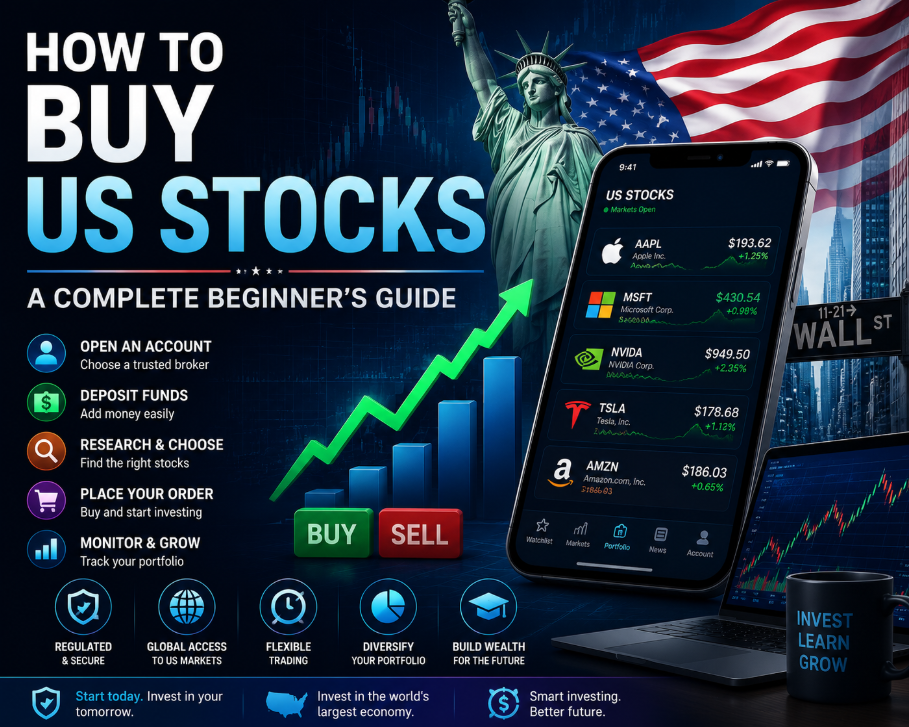
The New York Stock Exchange is one of the world’s most established stock exchanges. Nasdaq is known for technology and growth companies. For a beginner placing orders through a broker, the difference usually does not matter much. You do not need to open separate accounts for NYSE and Nasdaq. A normal US brokerage account lets you search for a ticker symbol and place an order through the broker’s trading system.
US stocks have different trading sessions.
The main session is the regular market session. NYSE lists its core trading session as 9:30 a.m. to 4:00 p.m. Eastern Time. It also lists early trading and late trading sessions outside those hours.
Beginners should generally focus on regular trading hours. Pre-market and after-hours trading can have lower liquidity, wider spreads, and sharper price moves. A stock may appear to be up or down sharply after hours, but the available trading volume may be thin, and your order may execute at a worse price than expected.
Stocks can also be grouped by style.
Growth stocks are companies expected to grow revenue and earnings faster than the market. They may pay little or no dividend because they reinvest heavily. NVIDIA and many AI-related companies are often discussed as growth stocks.
Value stocks are companies trading at lower valuations relative to earnings, book value, or cash flow. They may be mature businesses that the market is temporarily undervaluing.
Dividend stocks are companies that regularly return cash to shareholders. These can appeal to investors who care about income, but dividends are not guaranteed.
For many beginners, ETFs are easier than individual stocks. An ETF is not one stock. It is a fund that trades like a stock and holds a portfolio of assets. Investor.gov explains that an ETF share represents part ownership of the ETF’s portfolio and the income the portfolio generates.
A simple analogy is this: buying one stock is like buying one peanut. Buying an ETF is like buying a mixed-nut box. You still own something, but your risk is spread across many holdings.
That is why many beginners start with an S&P 500 ETF rather than trying to pick the next winning stock. Instead of betting only on Apple, Microsoft, NVIDIA, Amazon, or Tesla, an S&P 500 ETF gives exposure to a broad basket of large US companies.
Chapter 3: How to Open a US Stock Brokerage Account
The traditional way to buy US stocks is through a brokerage account.
A brokerage account is an investment account that lets you buy and sell stocks, ETFs, options, bonds, mutual funds, and other securities depending on the broker. For US residents, the process is usually straightforward.
Step 1: Choose a Broker
When choosing a broker in 2026, do not focus only on commissions. Many mainstream US brokers offer $0 online commissions for US-listed stocks and ETFs, so the real differences are now in fractional shares, app experience, research tools, customer service, retirement accounts, margin rates, option fees, order execution quality, and supported products.
Fidelity, Charles Schwab, and Robinhood are common examples, not recommendations.
Fidelity states that it offers $0 commissions for online US stock and ETF trades, and it also supports fractional share investing in US stocks and ETFs.
Charles Schwab states that listed stocks and ETFs have $0 online commission, and its fractional share feature allows investors to buy based on dollar amounts rather than full shares.
Robinhood states that investing accounts are commission-free for stocks and ETFs, and it also supports fractional shares for stocks and ETFs.
For a beginner, the most practical questions are simple:
Can I start with a small amount?
Can I buy fractional shares?
Does the app make orders easy to understand?
Does the broker support ETFs and retirement accounts?
Does it provide tax documents clearly?
Does it have strong security and customer support?
A broker with the lowest headline fee is not always the best broker for a beginner. A clean interface, clear order screen, reliable tax reporting, and educational tools may matter more.
Step 2: Submit Your Information
A US brokerage account usually asks for your legal name, date of birth, residential address, Social Security number or taxpayer identification number, employment information, investment experience, and identity verification.
The SSN or TIN is not random paperwork. Brokers need taxpayer information because investment income, dividends, interest, and sale proceeds may need to be reported to the IRS. IRS Form W-9 is used to provide a correct taxpayer identification number to a person or entity required to file information returns with the IRS.
This is one reason crypto users sometimes look for tokenized stock alternatives. If you already hold USDT or USDC and are used to digital asset platforms, a traditional broker’s identity, tax, and bank-linking process may feel unfamiliar. But that traditional process also comes with clearer regulatory structure and tax reporting.
Step 3: Deposit Money
Most US users fund brokerage accounts with ACH bank transfers. ACH is usually low-cost or free, but it may take time to settle. Wire transfers may be faster but can involve bank fees. Some brokers support checks, account transfers, direct deposit, or other funding methods.
For beginners, ACH is usually the simplest path. The important point is to deposit money you can afford to invest. Stocks can fall, and money needed for rent, bills, emergency savings, or short-term expenses should not be placed into volatile assets.
Step 4: Place Your First Order
After funding the account, search for a ticker symbol. For example, Apple trades as AAPL, Microsoft as MSFT, NVIDIA as NVDA, and the SPDR S&P 500 ETF Trust as SPY.
The two most important order types are market orders and limit orders.
A market order tells the broker to buy or sell immediately at the best available price. It is simple, but the final execution price may differ from the last quoted price.
A limit order lets you set the maximum price you are willing to pay when buying, or the minimum price you are willing to accept when selling. Investor.gov explains that a limit order executes only if the stock reaches the specified price or better.
For beginners, limit orders are often better for learning discipline. Instead of clicking buy because the chart is moving, you decide your price first.
Step 5: Understand Brokerage Protection
Traditional brokerage accounts may be covered by SIPC if the brokerage firm fails and customer securities or cash are missing. SIPC says it protects securities and cash in a brokerage account up to $500,000, including up to $250,000 for cash.
This protection is not the same as protection against market losses. If you buy a stock and it falls 40%, SIPC does not reimburse you. SIPC is designed for broker failure and missing customer assets, not bad investments.
This distinction becomes very important when comparing traditional brokers with tokenized stock platforms. Tokenized stocks and crypto-native RWA assets generally should not be assumed to have SIPC-style protection unless the platform clearly states a regulated structure that provides it.
Chapter 4: Taxes on US Stock Investment
Taxes are one of the biggest differences between buying real stocks through a broker and trading tokenized assets through a crypto platform.
For US taxpayers, stocks can create taxable events when you sell at a gain, receive dividends, or generate other investment income. This chapter is a simplified overview. Tax rules can change, and individual situations vary.
Short-Term vs Long-Term Capital Gains
If you sell a stock after holding it for one year or less, the gain is usually a short-term capital gain. The IRS states that net short-term capital gains are taxed as ordinary income at graduated tax rates.
For 2026, the ordinary federal income tax brackets still include rates from 10% up to 37%. For single filers, the top 37% bracket begins above $640,600 of taxable income. For married couples filing jointly, the top 37% bracket begins above $768,700 of taxable income.
If you sell after holding for more than one year, the gain is usually a long-term capital gain. Long-term capital gains generally receive more favorable tax treatment.
For 2026, the IRS lists the maximum zero-rate and 15% long-term capital gain amounts by filing status. For “all other individuals,” which generally includes single filers, the 0% long-term capital gain bracket goes up to $49,450 of taxable income, and the 15% bracket goes up to $545,500. For married filing jointly, the 0% amount goes up to $98,900, and the 15% amount goes up to $613,700. Gains above the 15% threshold are generally in the 20% long-term capital gain range, though additional taxes may apply in some cases.
The simple beginner rule is this: holding longer than one year can matter a lot for taxes.
Qualified vs Ordinary Dividends
Dividends can also be taxed differently.
Qualified dividends may be taxed at long-term capital gains rates if they meet IRS requirements. Ordinary dividends are generally taxed as ordinary income. Many brokerage platforms report dividend categories on Form 1099-DIV, but you still need to understand what you own and how it is taxed.
Retirement Accounts
US investors may also use retirement accounts such as Roth IRAs, Traditional IRAs, and 401(k)s.
A taxable brokerage account is flexible, but realized gains and dividends may create current-year tax consequences.
A Traditional IRA or Traditional 401(k) may provide tax-deferred growth, meaning taxes are generally paid later when money is withdrawn.
A Roth IRA or Roth 401(k) uses after-tax money, but qualified withdrawals may be tax-free if requirements are met.
For beginners, the order often looks like this: build emergency savings first, capture any employer 401(k) match if available, then consider IRA and taxable brokerage investing depending on your goals.
Tax-Loss Harvesting
Tax-loss harvesting means selling an investment at a loss to offset realized capital gains. If capital losses exceed capital gains, the IRS allows individuals to deduct the lesser of $3,000, or $1,500 if married filing separately, or the total net loss against income, with additional unused losses generally carried forward.
This is useful, but beginners should not buy bad investments just to create tax losses. Tax strategy should support an investment plan, not replace one.
Chapter 5: A Second Path — Buying Tokenized US Stocks with Crypto
Now we reach the crypto-native path.
The traditional path looks like this:
You open a brokerage account, connect a bank account, deposit dollars, buy a stock or ETF, and receive brokerage statements and tax documents.
The tokenized stock path looks different:
You use a wallet or crypto account, deposit USDT or USDC, search for a tokenized stock or RWA asset, and trade it through a digital asset platform.
This second path is not just “new technology.” It solves a real user problem: some crypto users already hold stablecoins and do not want to move funds through a bank, wait for ACH settlement, or learn a traditional brokerage workflow before getting stock-like exposure.
What Are Tokenized Stocks and RWA Assets?
Tokenized securities, sometimes called digital securities, are financial instruments such as stocks, bonds, or fund interests that are formatted as or represented by a crypto asset recorded on a blockchain or similar ledger. Investor.gov explains that tokenized securities are securities and are subject to SEC regulation and investor protections when they meet the relevant securities framework.
But not every stock-like token is the same.
Some tokenized products may represent actual securities. Some may represent contractual claims. Some may be synthetic price exposure. Some may be exchange-listed products wrapped into a crypto format. Some may be platform-specific RWA assets.
That is why the most important question is not “Is this tokenized?” The important question is: what exactly does the token give you?
Does it give direct ownership of registered shares?
Does it give a claim on a custodian?
Does it only track price?
Can it be redeemed?
Who issues it?
Who holds the underlying asset?
What happens if the platform fails?
The SEC has also stated that tokenization does not magically change the nature of the underlying asset. A stock, bond, note, investment contract, option, or security-based swap can be tokenized, but the legal and investor-protection analysis still depends on the product structure.
Buying Tokenized US Stock Exposure on HiBT
HiBT can be understood as a crypto-native route for users who want to explore stock-related tokenized assets and RWA products using digital assets.
The basic process is straightforward.
First, register a HiBT account.
Second, complete the required identity and security setup.
Third, deposit USDT or another supported asset.
Fourth, search for a tokenized stock, ETF-related asset, or RWA product.
Fifth, place an order, monitor the position, and sell or withdraw according to platform rules.
This feels familiar to crypto users because the workflow resembles spot crypto trading. You search a ticker, view the chart, check the order book, choose market or limit order, and manage the asset inside a digital asset account.
But the asset is different from BTC or ETH. A tokenized stock-related asset is tied to traditional financial market logic. Its price may depend on the underlying company, ETF, index, or real-world asset, while its trading experience still depends on crypto platform liquidity and rules.
What Can Tokenized Stock Users Explore?
A useful way to understand tokenized assets is by category.
Some assets give users exposure to private-market or stock-adjacent themes. For example, users researching SpaceX-related market exposure can read this guide to SPCX as a SpaceX-related tokenized asset. This type of asset is especially interesting for crypto users because some private or hard-to-access markets are not normally available through a simple retail brokerage account.
Some assets focus on ETF-style exposure. Users who want to understand a leveraged Nasdaq-related tokenized asset can read this guide to the tokenized version of a leveraged Nasdaq ETF concept, TQQQB. This is important because leveraged ETF-style products can be much more volatile than ordinary index funds.
Some assets focus on individual stock themes. For semiconductor and AI infrastructure exposure, users can study MVLLB as a Marvell Technology-related tokenized stock asset. For memory chips and AI infrastructure cycles, users can review MUUB as a Micron-related tokenized asset. For broader RWA stock-token examples, users can read SNXXB as an RWA tokenized stock case.
RWA is not limited to public stocks. It also connects to infrastructure, mapping, DePIN, AI, and real-world data networks. Users who want to go beyond stock-like assets can explore GEOD as a DePIN and real-world infrastructure asset.
The goal is not to buy every token. The goal is to understand how traditional finance narratives are entering crypto markets.
Tokenized Stocks vs Real Stocks
A real stock held at a regulated broker may provide direct shareholder ownership, voting rights, dividends, regulatory disclosure, broker tax forms, and potential SIPC protection if the broker fails.
A tokenized stock or RWA asset may provide price exposure, crypto-native trading access, smaller entry sizes, and potentially more flexible trading hours. But it may not provide voting rights, traditional shareholder status, direct dividend handling, or SIPC protection.
This difference is not a small detail. It is the core of the decision.
If you want full shareholder rights and traditional tax reporting, use a regulated broker.
If you already hold crypto and want stock-like exposure through a digital asset platform, tokenized stocks may be worth researching.
If you do not understand the structure, do not buy.
Chapter 6: What Stocks or ETFs Should Beginners Buy First?
Beginners often ask, “What should I buy first?”
The safest answer is not a ticker. The better answer is a framework.
If you are starting with $100, one simple example is to put most of it into a broad-market ETF and a smaller portion into one company you want to study. For example, a beginner might place 80% into an S&P 500 ETF and 20% into one individual stock. This is not a recommendation, but it shows the idea: the ETF provides diversification, while the individual stock gives you a learning case.
If you start with only individual stocks, you may become emotionally attached to one company. If that company drops 30%, you may panic. If it rises 30%, you may become overconfident. A broad ETF can reduce single-company risk.
When choosing individual stocks, focus on business quality rather than social media hype.
For an AI stock, ask:
Is revenue growing?
Is the company profitable?
Does it have a real competitive advantage?
Does it generate cash flow?
Is the valuation already too aggressive?
Does it depend on one product cycle?
NVIDIA, Microsoft, Apple, Amazon, and Tesla are popular examples, but each has different risks. NVIDIA is tied to AI chips and data center demand. Microsoft is tied to cloud, enterprise software, and AI integration. Apple is tied to hardware, services, and ecosystem retention. Tesla is tied to EVs, autonomy, energy, and execution risk.
For most beginners, dollar-cost averaging is easier than market timing. Dollar-cost averaging means investing a fixed amount regularly, such as weekly or monthly. You buy more shares when prices are lower and fewer shares when prices are higher.
This does not guarantee profit, but it reduces the pressure to guess the perfect entry point.
The same logic applies whether you use a broker or a tokenized stock platform. The investment logic is still about asset quality, valuation, risk, and time horizon. The difference is the channel, tax treatment, ownership rights, and platform structure.
Chapter 7: Risks of Investing in US Stocks
US stocks can create wealth, but they also create losses. Beginners should understand risk before chasing returns.
Market Volatility
The stock market can fall 10%, 20%, or more. A 20% drop is usually called a bear market. If you are investing through a diversified ETF and your time horizon is long, the best response may be to do nothing, continue your plan, and avoid panic selling.
But if you bought a concentrated position in one high-risk stock, a 20% drop may require reassessment. Did the business change, or did only the market price change? Beginners need to learn this difference.
Inflation and Interest Rates
Growth stocks are sensitive to interest rates. When rates rise, future profits are discounted more heavily, and high-valuation growth stocks can fall even if the companies remain strong.
Inflation also affects company costs, consumer spending, profit margins, and central bank policy. Crypto users should pay special attention here because liquidity conditions often affect both tech stocks and digital assets.
Company Risk
A single company can underperform, lose market share, face lawsuits, miss earnings, dilute shareholders, or even fail.
This is why index ETFs are often more beginner-friendly than single stocks. A single stock can go to zero. A broad index fund cannot avoid all market risk, but it reduces the impact of one company failure.
ETF Risk
ETFs are diversified, but they are not risk-free. A technology-heavy ETF can still fall sharply if growth stocks sell off. A leveraged ETF can decline quickly if the underlying index moves against it. A thematic ETF can become overvalued if investors crowd into a trend.
Read the ETF prospectus, expense ratio, holdings, index methodology, and risk factors before buying.
Tokenized Stock and RWA Risk
Tokenized stocks have additional risks that traditional stock investors may not face.
The first is platform counterparty risk. If the platform has operational, liquidity, custody, or solvency problems, your asset may be affected.
The second is tracking risk. The token price may not perfectly match the underlying stock or ETF, especially during volatile markets or when the underlying market is closed.
The third is liquidity risk. If the order book is thin, you may face wide spreads or difficulty selling.
The fourth is regulatory uncertainty. Tokenized securities and RWA assets are still developing, and rules may change.
The fifth is rights risk. A tokenized stock may not give you shareholder voting rights, direct dividends, or SIPC-style protection.
These risks do not mean all tokenized stocks are bad. They mean users must read the product rules carefully and avoid assuming that a stock-like token is identical to a real stock.
FAQ
How much money do I need to start buying stocks?
With fractional shares, some platforms allow investors to start with very small dollar amounts. In practice, you may be able to start with $1, $5, or $10 depending on the broker and asset. However, starting small does not remove risk. It only lowers the amount at risk.
Can beginners buy stocks without a SSN?
For a traditional US brokerage account, US users are usually asked for a taxpayer identification number such as an SSN because brokers need tax information for reporting. IRS Form W-9 is used to provide a taxpayer identification number for information reporting purposes.
Non-US users may have different requirements depending on the broker, country, tax status, and platform policy. Crypto-native tokenized stock platforms may have different onboarding flows, but they may also have their own KYC, regional restrictions, and risk rules.
Are ETFs safer than individual stocks?
ETFs are usually more diversified than individual stocks because one ETF can hold many companies. That can reduce company-specific risk. However, ETFs can still fall when the market or sector declines. A leveraged or narrow thematic ETF can be very risky.
Are tokenized stocks the same as real stocks?
No, not always. A tokenized stock may track the price of a real stock, but it may not give the same ownership rights, voting rights, dividends, tax treatment, or investor protections as shares held through a regulated broker. The exact answer depends on the product structure, issuer, custodian, and platform rules.
How are stock gains taxed in the US?
For US taxpayers, short-term gains from stocks held one year or less are generally taxed as ordinary income. Long-term gains from stocks held more than one year may qualify for 0%, 15%, or 20% federal long-term capital gains rates depending on taxable income and filing status.
Can I buy US stocks 24/7?
Traditional US stocks do not trade 24/7 in the normal stock market. NYSE’s core trading session is 9:30 a.m. to 4:00 p.m. Eastern Time, with early and late sessions available for certain trading activity.
Some tokenized stock or RWA platforms may offer more flexible trading hours, but that does not mean liquidity, pricing, rights, or protections are the same as traditional stock trading.
Final Thoughts: Choose the Path That Matches Your Goal
There are now two major ways to access US stock exposure in 2026.
The first is the traditional broker path. It is best for users who want real stock or ETF ownership, shareholder rights, retirement account options, tax documents, and traditional investor protections.
The second is the tokenized stock or RWA path. It may appeal to crypto users who already hold USDT or USDC, understand digital asset platforms, and want to explore stock-like exposure through a crypto-native interface.
Neither path is automatically better. They serve different users.
If you want to own real shares of Apple, Microsoft, NVIDIA, or an S&P 500 ETF with traditional protections, a regulated broker is the clearer path.
If you want to understand how stocks, ETFs, private-market themes, DePIN, and RWA assets are entering crypto markets, then tokenized assets on platforms such as HiBT may be worth studying.
The most important rule is simple: before buying anything, know what you actually own.
A real stock, an ETF, a tokenized stock, a leveraged ETF token, and an RWA asset may all appear on a price chart. But legally, financially, and operationally, they can be very different products.