
If you’ve stumbled across TQQQB on a trading platform, price chart, or social media feed, your first questions are probably: What exactly is TQQQB? Is it a new cryptocurrency, or is it tied to a US stock ETF? Why does it keep coming up alongside the Nasdaq-100, AI tech stocks, leveraged ETFs, and RWA assets?
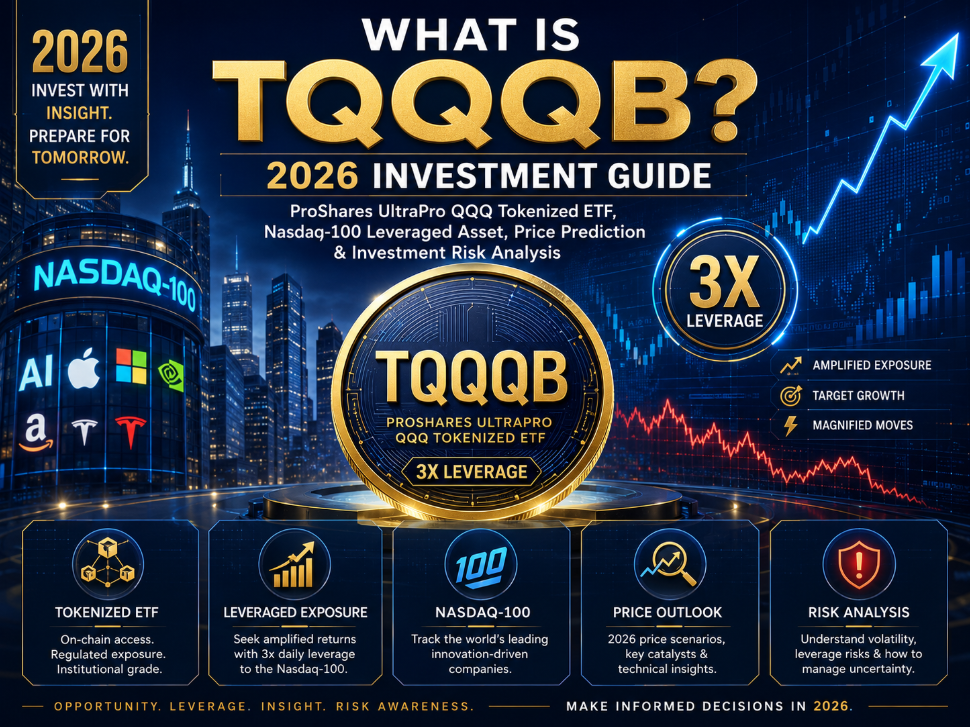
In short, TQQQB is not a traditional blockchain token, meme coin, DeFi governance token, or generic AI coin. It’s best understood as a tokenized ETF linked to the ProShares UltraPro QQQ – an asset that brings the price exposure of the traditional TQQQ ETF into the crypto trading environment via a blockchain-based token. The core idea isn’t “a project launched a new coin”; it’s about wrapping a conventional financial instrument into a format that crypto users can trade.
According to CoinMarketCap’s description of the ProShares UltraPro QQQ Tokenized bStocks, TQQQB is a tokenized bStock that provides economic exposure to the underlying ProShares UltraPro QQQ, and, where permitted by applicable law, may include rights to convert into the underlying security on platforms like Binance.com.
That means TQQQB is not an ordinary stock, nor is it a TQQQ ETF share held in a traditional brokerage account. Instead, it’s a tokenized representation of a traditional ETF that has crossed over into crypto markets. When traders look at TQQQB, they’re not focused on the development of some blockchain ecosystem – they’re tracking the Nasdaq-100 index, the TQQQ leverage mechanism, big tech trends, AI industry cycles, RWA (real-world asset) infrastructure, and crypto market liquidity.
You can check live TQQQB price, trading data, and market info on Hibt, and also explore the TQQQB price prediction page for market sentiment and reference forecasts.
1. What Is TQQQB? And Why Is a Nasdaq-100 Leveraged ETF Entering Crypto?
When users search “what is TQQQB,” the first step is to clarify its asset class.
TQQQB is not a typical crypto project token. It’s not a Layer-1 blockchain asset, a DeFi governance token, a GameFi asset, or a meme coin. It sits closer to a tokenized ETF, and can be grouped under tokenized stocks and the broader RWA (Real World Assets) category.
RWA refers to real-world assets – stocks, ETFs, bonds, funds, gold, real estate, commodities, and other traditional holdings – that are brought onto blockchains and crypto markets via tokenization.
Tokenized ETFs are a major subset of RWA. Instead of issuing a token that powers a protocol, they express the price performance or economic exposure of a traditional ETF in token form, allowing crypto users to trade it with digital assets like USDT.
The underlying traditional product is the ProShares UltraPro QQQ – ticker TQQQ. As ProShares states, TQQQ seeks daily investment results, before fees and expenses, that correspond to three times (3x) the daily performance of the Nasdaq-100 Index.
So, in simple terms:
- TQQQB is a tokenized asset tied to TQQQ.
- TQQQ itself is a 3x daily leveraged ETF on the Nasdaq-100.
- TQQQB lets crypto users gain related price exposure via a token.
That’s why it draws attention – TQQQB sits at the intersection of three hot themes: US tech stocks, leveraged ETFs, and on-chain RWA.
2. Is TQQQB a Stock? Is It an ETF?
This is the most common misunderstanding for newcomers.
TQQQB is not a Nasdaq-listed stock, nor is it a TQQQ ETF share held in a conventional securities account. More precisely, it’s a tokenized representation of the ETF’s price performance.
The traditional TQQQ ETF is bought through a brokerage account, and you hold actual fund shares; trades occur on traditional stock exchanges. TQQQB, on the other hand, appears as a token on crypto platforms, typically traded via a TQQQB/USDT pair.
They are related, but not identical.
When you buy TQQQB, you gain economic exposure to TQQQ’s price movements, along with the trading convenience offered by on-chain or crypto-exchange infrastructure. Whether you have direct ETF share ownership, dividend rights, traditional investor protections, or redemption/conversion privileges depends on the issuer, the platform, and applicable laws.
The key takeaway for beginners:
TQQQB is not the TQQQ in your brokerage account – it’s a tokenized expression of TQQQ-related exposure.
This distinction applies to all tokenized ETFs and tokenized stocks. They may track or mirror traditional assets, but their legal and economic structures are not necessarily equivalent to holding the underlying security directly.
3. Why Are Traditional ETFs Becoming Tokenized?
The move of traditional ETFs into crypto is part of the broader RWA trend.
In the past, if you wanted to invest in US ETFs, you needed to open a brokerage account, buy shares through a broker, and operate within stock-market trading hours, geographic restrictions, funding/withdrawal processes, tax rules, and regulatory requirements.
Now, tokenized ETFs aim to bring these assets into the crypto ecosystem. Users can trade them with USDT from their digital-asset wallets, enjoying a more familiar crypto-native experience.
Three core drivers underpin this trend:
First, crypto users want exposure to traditional assets.
Historically, crypto markets revolved around BTC, ETH, DeFi tokens, meme coins, and on-chain applications. As the space matures, users increasingly want to access US stocks, ETFs, bonds, gold, and other real-world assets from the same portfolio.
Second, traditional finance seeks more flexible global distribution.
ETFs have fixed trading hours, while crypto markets operate nearly 24/7. Tokenized ETFs allow global users to gain price exposure on a more flexible schedule.
Third, RWA enables traditional assets to enter the Web3 financial ecosystem.
Going forward, tokenized ETFs won't just be for spot trading – they could also be used in on-chain asset management, DeFi collateral, portfolio construction, RWA indices, and cross-chain financial products.
Thus, TQQQB represents not a single isolated asset, but a broader attempt to bridge traditional ETFs with blockchain markets.
4. What Is ProShares UltraPro QQQ (TQQQ)? And Why Isn’t TQQQB an Ordinary Tech ETF?
To understand TQQQB, you first need to understand TQQQ.
TQQQ is a leveraged ETF issued by ProShares that seeks to deliver three times the daily performance of the Nasdaq-100 Index. ProShares explicitly notes that TQQQ is the only ETF targeting 3x daily returns on the Nasdaq-100.
The critical terms here are “daily” and “3x.”
A standard ETF typically tracks the index itself – for example, QQQ tracks the Nasdaq-100. If the Nasdaq-100 rises, QQQ tends to rise in line; if it falls, QQQ follows.
TQQQ is not a standard index ETF. It uses leverage to amplify the daily gains and losses of the Nasdaq-100. In theory, if the Nasdaq-100 gains 1% in a single day, TQQQ aims to gain about 3%; if the index drops 1%, TQQQ aims to drop about 3%. Actual results may vary due to fees, tracking error, derivative costs, and market conditions.
As SEC filings make clear, TQQQ seeks 3x returns for a single day, not for any other period.
This is the root of TQQQB’s high-risk, high-reward profile.
When the Nasdaq-100 is in a strong uptrend, TQQQ can amplify gains, and TQQQB tends to attract attention.
But in volatile or declining markets, the leverage mechanism magnifies losses, and TQQQB’s price risk increases substantially.
5. What Is the Investment Logic Behind TQQQB?
The investment logic can be thought of as a chain:
- The Nasdaq-100 Index rises.
- TQQQ, as a 3x daily leveraged ETF, is pushed higher.
- TQQQB, as a tokenized asset tied to TQQQ, may see its price affected.
But this chain is not mechanical, and it is not risk-free.
The Nasdaq-100 represents a basket of the largest non-financial companies listed on the Nasdaq. According to Nasdaq, the index includes 100 of the largest non-financial stocks, spanning technology, consumer services, healthcare, industrials, and more.
Because the Nasdaq-100 is heavily influenced by major tech companies, it’s often viewed as a barometer for technology, AI, cloud computing, semiconductors, software platforms, and internet giants.
When investors are bullish on US tech stocks, AI infrastructure, semiconductor cycles, cloud growth, and big-tech profitability, leveraged products like TQQQ attract short-term traders and risk-tolerant investors.
TQQQB brings this TQQQ exposure into crypto, allowing digital-asset users to participate via the TQQQB/USDT pair.
So, TQQQB’s investment logic is not typical crypto-project logic – it’s a combination of Nasdaq-100 tech trends + TQQQ leverage mechanics + RWA tokenization.
6. Why Does TQQQB Attract AI and Tech-Stock Investors?
One major reason TQQQB garners interest is the deep correlation between the Nasdaq-100 and big tech, AI, and semiconductor themes.
The AI wave has intensified focus on tech stocks. Major companies – NVIDIA, Microsoft, Apple, Amazon, Meta, Alphabet, and others – are pouring resources into AI infrastructure, cloud computing, chips, data centers, software services, and AI applications.
Nasdaq data shows the Nasdaq-100 has long been centered on growth-oriented sectors like technology, consumer services, and healthcare, with a strong presence of innovative companies.
When AI investment enthusiasm rises, markets tend to watch whether tech earnings can continue to grow. Tech-stock gains can lift the Nasdaq-100, and TQQQ’s 3x daily leverage can amplify those short-term upward moves.
Conversely, if AI capital spending disappoints, semiconductor cycles cool, tech valuations become excessive, or interest-rate conditions worsen, the Nasdaq-100 can pull back, putting significant pressure on both TQQQ and TQQQB.
Thus, TQQQB is suitable for studying tech upcycles, but it should not be simplistically treated as “AI goes up, so TQQQB goes up.”
7. What’s the Difference Between TQQQB and ETH?
TQQQB and ETH are entirely different asset classes.
ETH is the native asset of the Ethereum network. Its value derives from Ethereum usage, gas fees, Layer-2 activity, DeFi, stablecoins, RWA onboarding, smart-contract applications, and developer ecosystem. ETH is more like a foundational crypto infrastructure asset.
TQQQB is a tokenized ETF asset. Its value is tied to Nasdaq-100 tech-stock performance, TQQQ’s leveraged ETF mechanics, RWA structuring, exchange liquidity, and risk appetite.
ETH represents blockchain infrastructure value.
TQQQB represents tokenized exposure to traditional financial tech assets.
ETH’s risks include crypto market cycles, competition among Layer-1s, regulatory changes, on-chain activity, and network demand.
TQQQB’s risks include Nasdaq-100 declines, tech-valuation corrections, leverage-induced decay, tokenization structural risks, trading liquidity, and regulatory constraints.
So, ETH and TQQQB are not substitutes – they serve completely different roles.
If you want to understand a foundational crypto asset, you can check the ETH price prediction on Hibt. If you want to understand US tech indices, leveraged ETFs, and RWA tokenization, TQQQB is a better case study.
8. How Does TQQQB Differ from Ordinary RWA Assets?
TQQQB falls under RWA, but it’s not a typical RWA asset.
Some RWA tokens correspond to single-company stocks – for example, cases like AXTIB illustrate stock tokenization.
Others lean toward AI infrastructure – like CRWVB, which is more about AI cloud-computing tokenized stocks.
Still others focus on AI robotics – such as AIRH, tied to AI robotics assets.
There’s also content on the institutional path of traditional finance entering crypto – like What Is the Ethereum ETF, which helps explain the relationship between ETFs, institutional capital, and crypto markets.
What makes TQQQB unique is that it’s not a single-company stock token – it’s a tokenized ETF tied to TQQQ, a 3x leveraged Nasdaq-100 ETF.
That means TQQQB layers multiple logics:
- Nasdaq-100 index logic
- Tech-stock and AI-cycle logic
- TQQQ leveraged-ETF logic
- RWA tokenization logic
- Crypto market liquidity logic
As a result, TQQQB carries more complex risks than an ordinary stock token, and it demands a deeper understanding of the underlying product mechanics.
9. What Determines TQQQB’s Price?
The most common question: why does TQQQB rise or fall?
TQQQB’s price is influenced by five main categories of factors.
1. Nasdaq-100 Index Performance
Since TQQQ tracks 3x the daily Nasdaq-100, the index’s moves are the most important underlying variable. A rising Nasdaq-100 typically benefits TQQQ; a falling one weighs on it.
2. Major Tech-Stock Performance
The Nasdaq-100 is heavily concentrated in large tech and growth companies. Stocks like Apple, Microsoft, NVIDIA, Amazon, Meta, Alphabet, Broadcom, and Tesla can significantly move the index.
3. AI Industry Cycles
Growth in AI infrastructure investment, semiconductor demand, cloud expansion, and data-center buildouts can boost tech valuations. Conversely, cooling AI spending, falling capital expenditures, or earnings misses can trigger corrections.
4. Interest Rates and the Macro Environment
Tech stocks are often sensitive to interest rates. Expectations of rate cuts, loose liquidity, or improved risk appetite tend to support them; rising rates, a stronger dollar, economic slowdowns, or risk-off sentiment can pressure the Nasdaq-100.
5. TQQQB’s Own Liquidity
Because TQQQB trades in crypto markets, it’s also affected by USDT liquidity, trading volume, bid-ask spreads, order-book depth, RWA sector sentiment, and exchange-specific rules.
Thus, TQQQB’s price is not determined solely by crypto markets, nor solely by TQQQ – it’s the product of both traditional and crypto-market forces.
10. The Biggest Risk: Leveraged ETF Mechanics
The single most important risk to highlight is the leveraged ETF mechanism.
Many newcomers assume:
If the Nasdaq-100 rises 10% over a long period, TQQQ should rise about 30% over that same period.
That is not accurate.
TQQQ seeks daily 3x returns, not 3x returns over any extended period. SEC filings explicitly state that TQQQ is designed to achieve 3x results for a single day, not for any other time frame.
This creates three critical issues:
First, volatility is amplified.
If the Nasdaq-100 drops sharply in one day, TQQQ can fall roughly 3x as much, and TQQQB can take a significant hit.
Second, long-term performance can deviate from a simple 3x multiple.
Due to daily rebalancing, TQQQ’s longer-term returns are affected by compounding paths. In sustained uptrends, compounding can boost returns; in choppy markets, volatility drag can weigh on performance.
Third, sideways markets can cause decay.
If the index oscillates up and down, even if it ends near where it started, a leveraged ETF can suffer poor performance because of daily reset and volatility drag.
Therefore, TQQQB is not a “buy and hold for 3x tech returns” vehicle. It’s better suited for users who understand leverage, manage position sizes, monitor market trends, and can tolerate high volatility.
11. TQQQB Price Prediction: How to Analyze Future Moves?
TQQQB price prediction cannot rely solely on chart patterns. For this type of asset, analysis should incorporate at least four dimensions.
Dimension 1: Nasdaq-100 Trend
If the index is in an uptrend, with growing tech earnings and strong risk appetite, TQQQ may find support, and TQQQB could attract interest.
If the index enters a correction, TQQQ’s losses are magnified, and TQQQB’s risk rises sharply.
Dimension 2: AI Industry Development
AI infrastructure, semiconductors, cloud, data centers, software platforms, and big-tech profitability are key variables for the Nasdaq-100. Continued AI commercialization tends to benefit tech stocks.
Dimension 3: Fed Policy and Interest Rates
Rate changes affect tech valuations. Easing or rate-cut expectations usually favor growth stocks; tightening or high rates can pressure them.
Dimension 4: TQQQB Trading Liquidity
Monitor trading volume, bid-ask spreads, order depth, and price deviations. Insufficient liquidity can cause slippage and execution difficulties, even if your directional view is correct.
You can check the TQQQB price prediction page for market-sentiment references. But remember: predictions are research aids, not investment guarantees.
A more prudent analytical path:
- Assess the Nasdaq-100 trend.
- Evaluate tech earnings and valuations.
- Understand TQQQ’s leverage mechanics.
- Observe TQQQB’s trading depth and RWA market sentiment.
- Decide whether to participate based on your risk tolerance.
12. How to Buy TQQQB – A Beginner’s Walkthrough
If you’re searching “How to buy TQQQB” or “TQQQB purchase,” follow these steps.
Step 1 – Check the TQQQB price feed.
Go to the TQQQB/USDT market page on Hibt to view real-time price, trading data, and charts.
Step 2 – Prepare USDT funds.
TQQQB is typically traded as a TQQQB/USDT pair. Before buying, set a budget – don’t go all-in just because tech stocks or AI are hot.
Step 3 – Confirm the token issuance mechanics.
Review the underlying asset relationship, issuer disclosures, custody arrangements, geographic restrictions, redemption/conversion rights, and exchange rules.
Step 4 – Search for TQQQB/USDT.
On the trading interface, search for TQQQB and verify the correct pair name, price, volume, and depth to avoid mistaking it for a similarly coded asset.
Step 5 – Choose your order type.
- Market order – for quick execution, but slippage may occur if liquidity is thin.
- Limit order – to control your entry price. For tokenized ETFs like TQQQB, beginners are advised to use limit orders to avoid unfavorable fills when depth is low.
Step 6 – Size your position carefully.
TQQQB is not a low-risk asset. It involves the Nasdaq-100, 3x leverage, tokenization structure, and crypto volatility. Beginners should not allocate oversized positions.
Step 7 – Have an exit plan before you enter.
Ask yourself:
- At what price levels will you take partial profits?
- At what levels will you cut losses?
- What if the Nasdaq-100 turns down?
- What if TQQQB volume dries up?
- What if tech valuations correct?
TQQQB is not about “can I buy it” – it’s about “do I truly understand its leverage and volatility?”
13. What Are the Risks of Investing in TQQQB?
A complete risk disclosure is essential, because TQQQB is neither an ordinary token nor an ordinary ETF.
1. Leveraged ETF risk – TQQQ is a 3x daily leveraged ETF, and TQQQB is a tokenized version. Leverage magnifies both gains and losses.
2. Volatility decay – Because TQQQ resets daily, long-term holding can result in path-dependent decay that may differ significantly from a simple “3x over time” expectation.
3. Sharp drawdowns – When the Nasdaq-100 falls quickly, TQQQ can drop even more, and TQQQB may suffer severe losses.
4. Tech-valuation risk – The Nasdaq-100 is heavily influenced by large tech names. Overvaluation, earnings misses, or fading AI enthusiasm can trigger index corrections.
5. Macro and interest-rate risk – High rates, tightening liquidity, a strong dollar, or recession fears can pressure tech and risk assets.
6. RWA tokenization risk – TQQQB is not an ETF share in a brokerage account. You must assess whether the underlying exposure is accurately mapped, whether the issuer is transparent, whether custody is reliable, whether redemption restrictions exist, and whether geographic limitations apply.
7. Liquidity risk – If TQQQB trading volume is low, spreads may widen, execution may be difficult, and prices may deviate from the underlying.
8. Crypto market risk – Although TQQQB is tied to traditional assets, it trades in crypto markets. Declines in BTC, ETH, contraction in USDT liquidity, or broad risk-off sentiment can affect TQQQB short-term.
9. Regulatory risk – Tokenized ETFs sit at the intersection of securities and crypto regulation. Different jurisdictions may impose varying requirements on trading, holding, distribution, and disclosure.
For these reasons, TQQQB is not suitable for beginners who do not understand leveraged ETFs, tokenized ETF structures, or high volatility, and who are unwilling to tolerate large swings.
14. Who Is TQQQB Suitable For?
TQQQB is not for everyone.
It may suit the following types of investors:
- Those bullish on tech stocks and the Nasdaq-100 trend – if you believe AI, semiconductors, cloud, software, and big tech have further upside, and you can handle market volatility, TQQQB can be a research candidate.
- Those who understand leveraged-ETF risks – only if you grasp daily reset, volatility decay, sharp drawdowns, and leverage amplification should you consider participation.
- Those who want crypto-based access to US tech assets – if you’re already comfortable with USDT and crypto trading, and want to explore tokenized versions of traditional tech ETFs, TQQQB is a prime example.
- Those with strict position discipline – TQQQB is not for full-portfolio allocation, indefinite holding, or stop-loss-less strategies. It demands clear position sizing and exit plans.
Conversely, TQQQB is not for:
- Those seeking low-risk assets.
- Those who don’t understand leverage mechanics.
- Those planning to hold indefinitely with no risk management.
- Those unable to stomach sharp short-term swings.
- Those chasing price spikes without due diligence.
For newcomers, TQQQB is better used as an educational entry point into tokenized ETFs, leveraged ETFs, and RWA – not as a blind speculation vehicle.
15. Future Trends: How RWA Is Changing Investing
TQQQB represents not just a single token, but a larger movement: traditional financial assets are entering crypto markets.
Going forward, tokenized ETFs may evolve in several directions:
- More index ETFs tokenized – beyond leveraged tech ETFs like TQQQ, we may see tokenized versions of S&P 500, Nasdaq-100, sector ETFs, bond ETFs, commodity ETFs, and thematic ETFs.
- More stocks on-chain – large-cap tech, AI companies, semiconductor firms, industrials, and consumer stocks could appear as tokenized stocks.
- RWA + DeFi integration – tokenized ETFs may enter on-chain asset management, portfolio construction, collateralized lending, RWA indices, and automated strategy products.
- Unified global investment access – crypto users might manage BTC, ETH, tokenized stocks, tokenized ETFs, stablecoin yield products, and on-chain RWA assets from a single account.
TQQQB sits at the convergence of “US tech index + leveraged ETF + RWA tokenization.”
It’s not an asset that can be explained in a simple coin primer – it’s an ideal educational page within Hibt’s TradFi + RWA + Crypto content matrix.
16. TQQQB FAQ – Common Questions for Beginners
What is TQQQB?
TQQQB is a tokenized ETF asset linked to the ProShares UltraPro QQQ, falling under tokenized stocks and RWA. It is not a typical crypto token; it provides economic exposure to TQQQ via a tokenized format.
What is the TQQQB coin?
Many search for “TQQQB coin,” but a more accurate term is “TQQQB tokenized ETF asset.” Though it trades as a token, its underlying logic is closer to a Nasdaq-100 3x leveraged ETF exposure than to a blockchain project token.
Is TQQQB the same as TQQQ ETF?
No. TQQQB is not a TQQQ ETF share held in a traditional brokerage account. It is a tokenized expression of TQQQ-related price performance. Whether you have direct ETF ownership, dividend rights, redemption rights, or conversion rights depends on the issuer and platform.
What is the relationship between TQQQB and TQQQ?
TQQQ is the ProShares UltraPro QQQ, which seeks 3x the daily performance of the Nasdaq-100. TQQQB is a tokenized bStock asset that provides related economic exposure.
How do I buy TQQQB?
Use platforms that support TQQQB trading. Beginners should first check the TQQQB/USDT market page, prepare USDT, search for the TQQQB/USDT pair, and then place a limit or market order according to their risk tolerance.
What affects TQQQB’s price?
Primarily the Nasdaq-100 trend, tech-stock performance, AI industry cycles, TQQQ’s leveraged mechanics, RWA market demand, crypto liquidity, and exchange depth.
How should I read TQQQB price predictions?
Don’t rely solely on historical charts. Combine analysis of the Nasdaq-100 trend, tech earnings, AI cycles, interest rates, TQQQ mechanics, and TQQQB trading volume. You can consult the TQQQB price prediction page, but remember predictions are not guarantees.
Is TQQQB suitable for long-term investing?
No – it should not be treated as a low-risk, buy-and-hold asset. Because TQQQ is a daily 3x leveraged ETF, long-term holding requires careful consideration of volatility decay, market cycles, leverage drawdowns, and risk capacity.
What’s the difference between TQQQB and ETH?
ETH is Ethereum’s native asset, representing crypto infrastructure value. TQQQB is a tokenized ETF asset tied to a leveraged Nasdaq-100 tech ETF. They are not the same class.
Is TQQQB worth investing in?
That depends on your outlook on the Nasdaq-100 and tech trends, your understanding of 3x leveraged ETFs, your acceptance of RWA tokenization risks, and your position-management skills. Beginners are advised to research first, start with small observation positions, and avoid blind heavy allocations.
Conclusion: TQQQB Is Not an Ordinary New Coin – It’s a Prime Example of US Tech Leveraged ETFs Entering Crypto
TQQQB’s core value is not whether it’s a short-term hot token, but what it represents: a new bridge between traditional finance and crypto – the Nasdaq-100 3x leveraged ETF, brought into crypto markets through tokenized ETF and RWA formats.
It connects to:
- TQQQ
- The Nasdaq-100 tech index
- AI, semiconductors, cloud, and big-tech trends
- Leveraged ETF mechanics
- Crypto users’ desire to access traditional asset exposure via USDT
So, to understand TQQQB, you can’t use just a “crypto hype” lens, nor just a “plain ETF investing” lens. The more accurate view is as a composite asset combining “US tech index + 3x leveraged ETF + RWA tokenization + crypto trading access.”
For beginners, before investing in TQQQB, answer at least six questions:
- What exactly is TQQQB?
- How does it relate to TQQQ?
- Is it a traditional ETF share?
- What does TQQQ’s 3x daily leverage mechanism mean?
- What factors drive TQQQB’s price?
- Can you accept high volatility, liquidity, and tokenization-structure risks?
When you can answer these, then combine research with the TQQQB real-time price, the TQQQB price prediction, the ETH price prediction, What Is the Ethereum ETF, What Is CRWVB, What Is AXTIB, and What Is AIRH – that is the more prudent path.
TQQQB is not for everyone, but it is an excellent gateway asset for understanding tokenized ETFs, RWA assets, Nasdaq-100 leveraged products, and the broader trend of traditional finance moving on-chain.