
This article is for crypto asset research and educational purposes only and does not constitute investment advice. All price predictions are scenario simulations based on public data, regulatory trends, RWA sector development, and Polymesh on‑chain adoption; they are not guaranteed to be achieved. Data reference date: May 18, 2026.
Introduction: When Wall Street starts moving stocks, bonds, and funds onto the blockchain, where does POLYX stand?
RWA – real‑world asset tokenization – is no longer just a concept inside the crypto circle.
In the past, many people talked about RWA as "putting houses, bonds, stocks, and gold on chain". It sounded grand, but real implementation was very slow. The reason is simple: traditional finance is not DeFi. Assets such as securities, bonds, and funds are naturally subject to regulatory constraints – not everyone can issue them, trade them, or settle them.
However, from 2025 to 2026, the RWA sector has clearly entered a new phase. CoinGecko's 2026 RWA report shows that the market size of tokenized real‑world assets grew by 256.7% between early 2025 and the end of Q1 2026, from approximately US5.42 billion to about US19.32 billion; tokenized government bonds remain the largest category, and tokenized commodities, stocks, and ETFs are also beginning to grow.
That is why POLYX deserves a separate analysis.
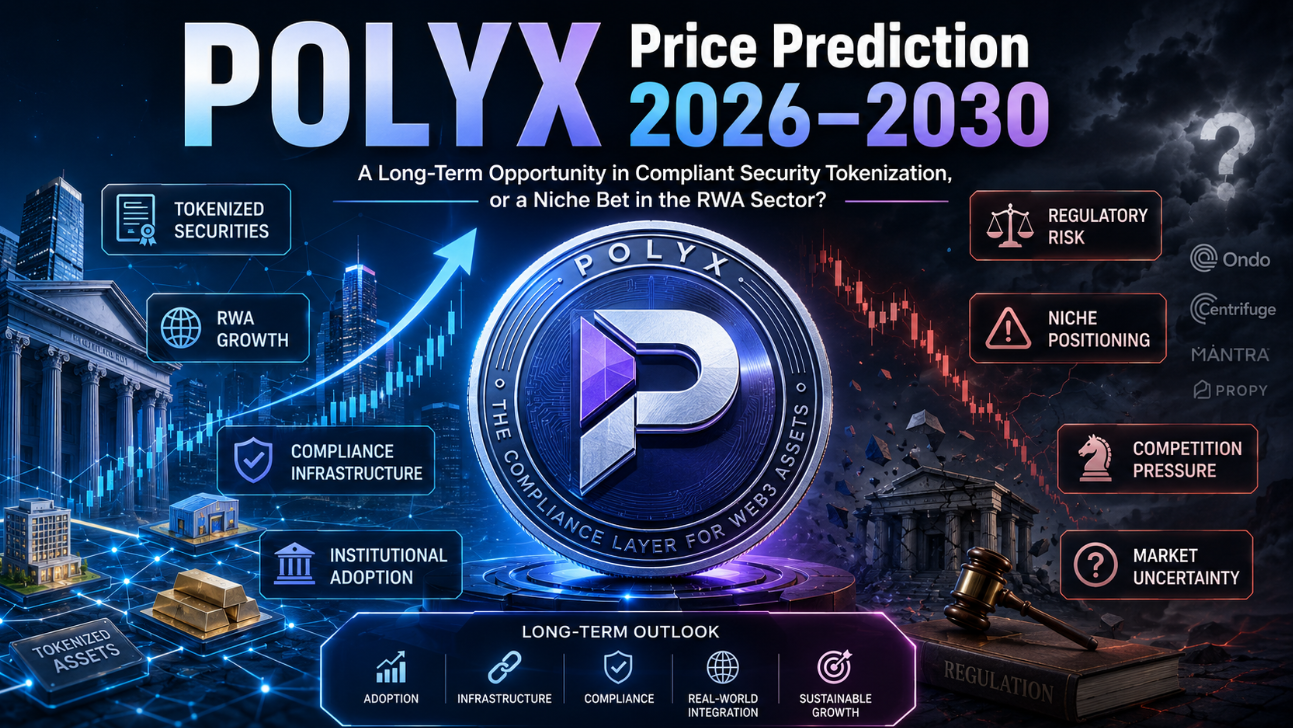
Polymesh, the blockchain behind POLYX, is neither an ordinary public chain nor an ordinary DeFi project. It is positioned as a public permissioned blockchain built specifically for compliant assets, security tokens, RWA, and institutional‑grade financial applications. CoinMarketCap's description of Polymesh also clearly states that Polymesh is an institutional‑grade blockchain for regulated financial assets, with its core being to solve the problems that ordinary public chains face in meeting the requirements of securities assets regarding identity, compliance, governance, and settlement.
Therefore, the pricing logic of POLYX is different from ordinary altcoins.
Ordinary altcoins rely more on narratives, trading sentiment, community heat, and liquidity. POLYX is closer to a "compliant financial infrastructure token". Its long‑term value depends on:
- How many real securities assets are issued on Polymesh;
- How many institutions are willing to use Polymesh;
- Whether POLYX generates real demand from transaction fees, staking, security, and governance;
- Whether global regulation allows security tokenization to continue developing;
- Whether the RWA sector moves from concept to real trading and settlement.
This is also the core prediction framework of this article:
RWA regulatory maturity curve × BTC macro cycle × Polymesh on‑chain adoption data
At the same time, we will use HIBT as a functional token reference. Exchange‑platform assets like HIBT derive value from real trading volume, user growth, fee revenue, and ecosystem activity; POLYX derives value from compliant asset issuance, on‑chain securities turnover, node staking, and institutional adoption.
If you want to understand different valuation methods for functional tokens, you can read the HIBT‑related content below:
- Ethereum (ETH) Price Prediction 2026–2030
- RPL Price Prediction 2026–2030
- SNX Price Prediction 2026–2030
- YFI Price Prediction 2026–2030
Part 1: What is POLYX? Without understanding compliant tokenization, all forecast numbers are noise
1.1 What problem does Polymesh solve?
Ordinary public chains can issue tokens, but they are not necessarily suitable for issuing securities.
Why?
Because securities assets naturally need to handle many compliance issues:
- Who can buy;
- Who can sell;
- Which country's users can buy;
- Whether KYC/AML has been completed;
- Whether investor qualifications are met;
- Whether transfer is restricted;
- Whether the identity of the asset issuer and holder can be verified;
- Whether regulators can trace when auditing is needed;
- How corporate actions, dividends, voting, and governance are executed.
Ordinary public chains like Ethereum and Solana are open networks, with the advantages of being permissionless and highly liquid, but securities assets are not completely permissionless assets. Security tokens, without compliant identity, transfer restrictions, permission management, and regulatory audit support, are difficult for traditional institutions to truly use.
Polymesh is positioned to provide a dedicated base layer for such assets.
It is not meant to serve meme coins, nor to do ordinary DeFi, but to serve assets that need a compliance framework: securities, funds, bonds, private equity, RWA.
This is the first layer of POLYX's value source:
If security tokenization truly expands in the future, the market will need not just a chain that can issue tokens, but infrastructure that embeds compliance, identity, governance, and settlement natively.
1.2 The four roles of POLYX
According to the official Polymesh developer documentation, POLYX is the native utility token of the Polymesh network, primarily used to pay transaction fees, staking, governance, and to be distributed as block rewards to operators and stakers.
More specifically, POLYX has four roles.
First, paying on‑chain transaction fees. Transaction fees on Polymesh must be paid with POLYX. The official documentation explains that transaction fees are determined by the computational and storage complexity and size of the transaction; all on‑chain transactions require a fee.
Second, staking to secure the network. Polymesh uses a Nominated Proof‑of‑Stake mechanism, allowing node operators and nominators to stake POLYX to secure the network and earn rewards.
Third, governance participation. Polymesh's governance system allows POLYX holders to participate in the prioritization, signaling, and governance process of Polymesh Improvement Proposals (PIPs).
Fourth, economic incentives. Newly issued POLYX is distributed via block rewards to node operators and stakers, incentivizing network operation and security maintenance. The official tokenomics document shows that POLYX has no fixed maximum supply; new tokens are created through PoS block rewards; the annual issuance cap is 140 million POLYX.
But investors must understand one thing:
More use cases do not necessarily mean the price will rise.
What truly drives POLYX's price upward is not static functions like "can pay fees", "can stake", "can govern", but whether the Polymesh network is genuinely used by institutions. If on‑chain securities issuance, trading volume, and settlement volume grow, then the demand for POLYX fees, staking, and network security will truly increase.
1.3 Real‑world use cases: Where is Polymesh's opportunity?
Polymesh's core use cases include:
- Security token issuance;
- Private equity tokenization;
- Fund share tokenization;
- Bond and note tokenization;
- Compliant RWA issuance;
- Inter‑institutional asset transfer and settlement;
- On‑chain lifecycle management of regulated assets.
But caution is needed here: POLYX's long‑term price depends not on "the RWA sector is hot", but on how much real business Polymesh can capture.
The growth of the RWA sector is the big backdrop; whether Polymesh can become mainstream infrastructure is another question.
CoinGecko's 2026 RWA report shows that the tokenized RWA market has grown significantly, but the largest share remains tokenized government bonds; categories such as commodities, stocks, and ETFs, although growing fast, are still in early stages overall.
This means POLYX does not face the question "is there market space", but rather "can Polymesh gain share in this space".
1.4 Comparison with HIBT: Real trading volume vs. compliant securities trading volume
For exchange‑platform assets like HIBT, the most direct value indicators are:
- Number of users;
- Trading volume;
- Fee revenue;
- Market depth;
- Listing capability;
- User retention;
- Platform ecosystem activity.
POLYX's core indicators are:
- Number of on‑chain securities issuances;
- Security token trading and settlement volume;
- Number of institutional partnerships;
- Number of node operators;
- POLYX staking ratio;
- On‑chain transaction fees;
- RWA sector market share.
Therefore, newcomers can understand it this way:
HIBT is supported by real trading demand; POLYX is supported by real demand to put compliant assets on chain.
Both are functional tokens, but HIBT is more like a trading gateway, while POLYX is more like compliant financial infrastructure.
If an exchange platform has no real trading volume, its platform token value weakens. If Polymesh has no real securities issuance and settlement, POLYX's value also weakens.
1.5 POLYX's competitors: Securitize, tZERO, Ondo, traditional giants
The sector where POLYX operates is not without competition.
Main competition comes from four types of players.
The first type is Securitize. It is one of the most watched compliant platforms in RWA and security tokenization. In March 2026, Reuters reported that NYSE partnered with Securitize to develop a tokenized securities platform, and Securitize will become the first digital transfer agent authorized to create blockchain securities for corporate and ETF issuers.
The second type is tZERO. It leans more toward security token trading and alternative asset liquidity.
The third type is Ondo Finance. Ondo leans more toward tokenized Treasury bonds and institutional‑grade yield‑bearing RWA products, closer to DeFi users in market awareness and liquidity.
The fourth type is self‑built systems of traditional financial giants. If institutions such as BlackRock, Fidelity, Nasdaq, NYSE, and JPMorgan choose to build their own chains or private settlement systems instead of using third‑party public blockchains, POLYX's market space will be compressed.
Polymesh's differentiation lies in:
- It is not a single issuance platform, but a base chain designed specifically for regulated assets;
- It emphasizes identity, permissions, governance, and compliance;
- Its node operation is permissioned, making it more suitable for institutional contexts;
- POLYX directly participates in network fees, staking, and governance.
But its risks are also evident:
- The sector heats up slowly;
- Strong dependence on regulation;
- Lower liquidity than mainstream public chains;
- Long institutional adoption cycle;
- Traditional financial giants may bypass third‑party chains.
POLYX vs. HIBT valuation quick reference table

The core conclusion of this table is:
POLYX will not explode suddenly like a meme coin; it depends much more on whether regulation, institutions, and real securities business gradually materialize.
Part 2: 6 core variables that will determine POLYX's fate over the next 5 years
2.1 Variable one: Global RWA regulatory progress
The single biggest variable for POLYX is regulation.
The RWA sector is different from ordinary DeFi. Ordinary DeFi can grow rapidly in gray areas, but security tokenization must face regulation. Without regulatory clarity, institutions will not enter on a large scale; if regulation is too tight, projects also struggle to expand.
Currently, the global regulatory attitude is not a one‑sided positive, but a mix of "encouraging innovation" and "emphasizing risks".
In a 2025 report, Reuters mentioned that IOSCO issued a risk warning about asset tokenization, arguing that although tokenization may improve settlement efficiency and reduce costs, it also brings issues such as unclear investor rights, third‑party issuer risks, and dependence on traditional infrastructure.
This is critical for POLYX.
If clear security tokenization rules emerge in markets like the US, EU, and Singapore in the future, compliance chains like Polymesh will benefit. If regulation remains vague, or if large institutions can only do tokenization within private systems, POLYX's external growth will be constrained.
2.2 Variable two: Transmission of the BTC halving cycle
Although POLYX is an institutional‑sector token, it is still a crypto market asset.
If BTC enters a strong cycle, market risk appetite rises, and funds will flow from BTC and ETH into sectors such as RWA, DePIN, AI, infrastructure, and Layer‑1. As a compliant RWA asset, POLYX may gain a narrative premium.
But POLYX is different from ordinary altcoins; its rise may not fully follow retail sentiment but is more influenced by RWA news, regulatory progress, institutional partnerships, and exchange liquidity.
Therefore, to assess POLYX's cycle, you need to look at two lines simultaneously:
- Whether BTC is in a bull market;
- Whether RWA is in a policy and business expansion period.
Only when both are moving upward can POLYX form a major trend.
2.3 Variable three: Capital scale of the RWA sector
The larger the RWA sector, the larger POLYX's potential space.
CoinGecko data shows that by the end of Q1 2026, the tokenized RWA market size reached approximately US$19.32 billion, an increase of more than 250% compared to the beginning of 2025. Tokenized government bonds contributed the largest growth, and categories such as commodities, stocks, and ETFs are also starting to expand.
But there is a key point here:
RWA sector growth does not automatically mean POLYX will rise.
The reason is that RWA funds can flow to many platforms:
- Ethereum;
- Solana;
- Avalanche;
- Ondo;
- Securitize;
- BlackRock‑related ecosystem;
- Exchange‑built platforms;
- Bank private chains;
- Permissioned institutional networks;
- Polymesh.
Therefore, POLYX forecasts must focus on two levels:
First, whether the total RWA market grows; Second, whether Polymesh's share of the RWA market grows.
If the RWA market grows but Polymesh does not capture core asset issuance and settlement business, POLYX's price elasticity will be limited.
2.4 Variable four: Polymesh on‑chain adoption speed
This is the most important fundamental variable.
To judge whether Polymesh is truly being adopted, look at:
- Number of new security token issuances;
- On‑chain assets under management;
- On‑chain settlement volume;
- Active accounts;
- Number of node operators;
- POLYX transaction fees;
- Quality of institutional partnerships;
- Whether sustainable secondary trading exists.
Among these, the indicators that best predict POLYX's medium‑term price are on‑chain settlement volume and real asset issuance volume.
The reason is simple:
POLYX is network fuel. Only when on‑chain activity increases will demand for fees, staking, security, and governance strengthen.
2.5 Variable five: Token supply structure and inflationary pressure
POLYX has no fixed maximum supply.
Official documentation shows that POLYX is newly issued via block rewards to reward node operators and stakers; the annual issuance cap is 140 million tokens.
The Polymesh official website also explains that the POLYX reward mechanism aims to maintain a staking ratio of around 70%; when total supply reaches 1 billion, annual issuance becomes fixed at 140 million POLYX.
This means POLYX has long‑term inflationary pressure.
But inflation is not necessarily bad. The key is whether demand exceeds new supply.
If Polymesh on‑chain usage grows rapidly, the POLYX staking ratio rises, and transaction fees increase, then inflation can be absorbed. If on‑chain usage is sluggish while new issuance continues, POLYX price will easily be pressured.
This is different from platform assets like HIBT. A platform token with buyback‑and‑burn mechanisms or fee support has more direct bear‑market defense; POLYX's defense comes more from staking, security, and on‑chain activity growth.
2.6 Variable six: Changes in the institutional competitive landscape
POLYX's biggest external risk is that traditional financial giants do not use it.
If institutions such as NYSE, Nasdaq, BlackRock, Fidelity, and JPMorgan choose to build their own tokenization networks or cooperate only with platforms like Securitize, Polymesh's market share could be compressed.
Reuters reported in 2026 that NYSE has partnered with Securitize to develop a tokenized securities platform, while Nasdaq is also advancing efforts related to tokenized stock trading and settlement.
This shows that the RWA sector is indeed growing, but also that competition is intensifying.
POLYX's long‑term value does not depend on "whether RWA will succeed", but on:
When RWA succeeds, can Polymesh become an indispensable infrastructure in that success?
Part 3: 2026 POLYX price prediction – the year of regulatory thaw, will institutional money really come in?
3.1 Three scenario assumptions
Pessimistic scenario: Regulation remains unclear, institutions stay on the sidelines If US regulation remains vague in 2026, the RWA sector is hot but security tokenization adoption is slow, and new issuances on Polymesh are limited, then POLYX may remain in a low‑valuation range. Pessimistic range: 0.25–0.35
Note that CoinMarketCap currently shows POLYX price around $0.05378, market cap about $56.37 million, circulating supply about 1.04 billion, total supply about 1.27 billion, all‑time high about $0.7547. Therefore, $0.25 is not sideways at a low level, but a level after significant recovery from the current price.
Baseline scenario: Europe and Asia drive compliant RWA adoption If MiCA, Asian market regulations, and institutional pilots all advance, the RWA market continues to expand, and Polymesh gains more issuers and node participation, POLYX may enter a medium valuation range. Baseline target: $0.45
Optimistic scenario: US security tokenization framework becomes significantly clearer If the US SEC or relevant regulatory bodies provide a clearer framework for security tokenization, and Polymesh gains major institutional partnerships or new asset issuances, POLYX may approach its all‑time high range. Optimistic range: 0.60–0.75
3.2 2026 prediction range
2026 POLYX prediction range: 0.25–0.75 Baseline target: $0.45
The premise for this range is that POLYX recovers from an extremely low valuation, not that Polymesh has already become the mainstream global security tokenization infrastructure.
To reach $0.45, at least the following need to be seen:
- Continued growth of the RWA market;
- Improved POLYX exchange liquidity;
- Increased Polymesh on‑chain activity;
- Stable staking ratio;
- Substantive institutional or issuer partnerships;
- No further regulatory suppression of security tokenization.
3.3 Two key catalyst windows in 2026
First window: Q2 – US regulatory policy expectation window. If the US releases clearer policy signals on tokenized securities, digital transfer agents, and on‑chain settlement, compliance infrastructure tokens like POLYX will directly benefit.
Second window: Q4 – Institutional allocation and year‑end product launch window. Traditional financial institutions often plan next year's product lines at year‑end. If more security tokenization pilots, on‑chain fund shares, and bond tokenization partnerships appear in Q4 2026, POLYX may get a narrative follow‑up boost.
3.4 HIBT reference: Valuation recovery structure of institutional‑service assets
The recovery of institutional‑service assets is usually not completed by a single violent price spike, but goes through three stages:
Stage one: regulatory expectations improve, price bounces first. Stage two: institutional partnerships materialize, the market reprices. Stage three: real revenue and usage appear, valuation becomes more stable.
POLYX is currently closer to the period around stage one.
That is, POLYX can rise on RWA narratives, but without real issuance and settlement data, price increases can easily reverse.
2026 regulatory event triggers
If the US or EU clearly supports compliant security tokenization before Q3 2026 and allows more regulated platforms to conduct on‑chain securities issuance, the 2026 POLYX forecast can be raised by 30%–50%.
If IOSCO, the SEC, or EU regulation further emphasizes the risks of tokenized securities and causes pilot projects to be delayed, the 2026 POLYX forecast should be lowered by 30%–40%.
HIBT comparison note for the same period: HIBT's recovery depends on trading volume; POLYX's recovery depends on compliant asset issuance and settlement volume. Rallies without real business data are closer to sentiment‑driven recoveries.
Part 4: 2027 POLYX price prediction – the watershed year when RWA goes from "concept" to "reality"
4.1 Why is 2027 the year of separating hype from reality for RWA?
The RWA sector may continue to heat up in 2026, but the real differentiation will occur in 2027.
The reason is that by 2027, the market will no longer be satisfied with concepts like "we are going to do tokenization", but will start to ask:
- How many real assets have been issued?
- How many real investors are participating?
- Does secondary liquidity exist?
- Are asset rights clear?
- Does regulation recognize it?
- Is on‑chain settlement more efficient than traditional systems?
- Is fee revenue growing in real terms?
Academic research also reminds us that the key bottleneck for RWA tokenization is not "whether it can be on‑chained", but "whether it can be traded after being on‑chained". A 2025 paper on RWA liquidity challenges pointed out that many RWA tokens have low trading volume, long holding periods, and few active addresses; structural barriers include regulatory thresholds, custodian concentration, whitelisting, valuation opacity, and lack of trading venues.
This is very important for POLYX.
If Polymesh only helps issue assets but has no real turnover and settlement, POLYX's long‑term value will be limited. If it can create a sustainable on‑chain lifecycle for compliant securities assets, then POLYX will enter the mainstream view.
4.2 2027 prediction range
2027 POLYX prediction range: 0.55–1.80 Baseline target: $1.10
For this range to hold, three prerequisites are needed:
First, the RWA sector continues to expand. Second, Polymesh gains real institutional adoption. Third, POLYX supply pressure is absorbed by staking and network demand.
If POLYX can break its all‑time high of $0.7547 and on‑chain adoption data grows in tandem, the market will begin to reprice it from a "niche RWA token" to a "compliant securities infrastructure asset".
But if the rise is solely due to RWA hype while real on‑chain data does not improve, then levels above $1 could easily become high‑risk chasing zones.
4.3 Three necessary conditions for POLYX to enter the mainstream view
First, the number of on‑chain STOs and security‑type assets grows significantly. If Polymesh has real issuance cases every quarter and the scale gradually expands, that is the strongest signal.
Second, institutional partnerships are not just announcements but generate on‑chain transactions. Many projects have partnership news, but what truly matters is trading volume, settlement volume, and active accounts.
Third, exchange liquidity improves. If POLYX wants to enter the view of mainstream investors, it needs better trading depth and more market coverage. Otherwise, low liquidity will amplify volatility and also limit institutional participation.
4.4 HIBT reference: Opportunities and risks of institutional‑grade chips being locked
Institutional‑grade assets have one characteristic: chips may be more concentrated.
This has both benefits and risks.
The benefit is that if institutions hold for the long term, the circulating supply decreases, and price elasticity increases. The risk is that if large holders sell off in a concentrated manner, retail investors can hardly react in advance.
POLYX investors should focus on:
- Whether large holders continue to stake;
- Whether large amounts of POLYX are transferred to exchanges;
- Whether node operators are stable;
- Whether institutional addresses hold for the long term;
- Whether abnormal high‑volume selling occurs during price rises.
2027 regulatory event triggers
If around 2027, markets such as the US, EU, and Singapore form replicable frameworks for security token issuance and secondary trading, the POLYX forecast can be raised to 1.50–2.20.
If the RWA sector grows but regulation restricts secondary liquidity, leading to tokenized securities that "can be issued but cannot be traded", the POLYX forecast should be lowered by about 40%.
HIBT comparison note for the same period: HIBT's bull market strength depends on user and trading volume expansion; POLYX's bull market strength depends on institutional asset issuance and compliant trading expansion. Both fear "many announcements, little data".
Part 5: 2028 POLYX price prediction – real test of bear‑market resilience for compliant infrastructure
5.1 Are compliant infrastructure tokens more bear‑market resistant?
In theory, POLYX has better bear‑market resistance than purely speculative coins.
The reason is that security tokenization, bonds, fund shares, and compliant asset settlement do not fully depend on retail bull‑market sentiment. If institutions truly use Polymesh as infrastructure, then even in a bear market, on‑chain business may continue to operate.
But reality is more complex.
Although the RWA sector is different from crypto speculation, it is also affected by market liquidity. In a bear market:
- Institutional pilots may slow down;
- Secondary trading of tokenized assets may decline;
- Risk asset valuations compress;
- POLYX liquidity falls;
- Staking yields may not offset price declines;
- New issuances may decrease.
Therefore, POLYX is not a bear‑market safe‑haven asset; it may only have stronger fundamental support than pure sentiment coins.
5.2 2028 prediction range
2028 POLYX prediction range: 0.35–0.85 Baseline target: $0.55
This forecast assumes that 2028 enters a market cooling period, POLYX retreats from its 2027 highs, but retains some valuation support due to its compliant infrastructure nature.
If POLYX reached above $1.50 in 2027, a return to $0.35–$0.85 in 2028 would not be surprising. If it did not truly strengthen in 2027, it could return to the $0.10–$0.40 range in 2028.
5.3 Health of POLYX's revenue model in a bear market
Whether POLYX can hold its price in a bear market depends on whether on‑chain securities trading has "rigid demand".
If the assets issued on Polymesh are long‑term hold assets, trading volume may drop in a bear market, but asset management and settlement will still exist. If Polymesh is mostly speculative RWA, activity will drop sharply in a bear market.
Investors need to look at:
- Whether transaction fees are stable;
- Whether asset issuance continues;
- Whether settlement volume declines;
- Whether the staking ratio is stable;
- Whether node operators exit;
- Whether institutional partnerships are paused.
5.4 Comparison of HIBT's bear‑market defense mechanism
Platform assets like HIBT, if they have real fee revenue, buyback‑and‑burn mechanisms, user retention, and trading activity, can form more direct support in a bear market.
POLYX's defense mechanism is different:
- POLYX has no simple "platform profit buyback" logic;
- It depends on staking, security, on‑chain fees, and institutional usage;
- An inflation cap exists, but demand must continuously grow to absorb new supply;
- Low liquidity in a bear market can amplify declines.
Therefore, POLYX's bear‑market risk exposure is higher than that of strong‑revenue platform assets, but lower than that of purely speculative tokens.
2028 regulatory event triggers
If in the 2028 bear market regulation still supports security tokenization and Polymesh's on‑chain settlement volume remains stable, the forecast can be raised to 0.60–1.10.
If regulation tightens, the number of new STOs grows negatively for two consecutive quarters, and the POLYX staking ratio declines significantly, the forecast should be lowered to 0.15–0.45.
HIBT comparison note for the same period: HIBT's bear market looks at whether fee revenue still exists; POLYX's bear market looks at whether compliant assets are still circulating on chain. Both essentially must answer one question: Are there still real users willing to use the platform in a bear market?
Part 6: Long‑term POLYX forecast 2029–2030 – Market cap ceiling after the tokenized securities market matures
6.1 2029 prediction range
2029 POLYX prediction range: 1.20–3.50 Baseline target: $2.20
The core logic for 2029 is: If RWA completes regulatory and product validation during 2026–2028, 2029 may enter a phase of mass adoption.
For POLYX to reach above $2, we need to see:
- Polymesh becomes an important security token issuance infrastructure;
- On‑chain settlement volume continues to grow;
- Institutional nodes and issuers increase;
- Stable demand for POLYX staking;
- Improved exchange liquidity;
- Continued expansion of total RWA sector size.
If only part of these conditions are met, POLYX may only reach around $1; if most are met, $2–$3.5 becomes discussable.
6.2 2030 prediction range
2030 POLYX prediction range: 2.50–8.00 Baseline target: $4.80
The $8 level in 2030 is a long‑term optimistic scenario.
Based on a rough estimate with the current circulating supply of about 1 billion tokens, if POLYX reaches $4.80, its circulating market cap would enter the tens of billions of dollars; if it reaches $8, that would mean the market prices Polymesh as a significant participant in global RWA compliant infrastructure.
This is not impossible, but the requirements are very high.
For POLYX to go from around $0.05 to $4.80 or $8, it is not just "good market conditions" that are needed; it must complete a cognitive leap from a niche asset to mainstream RWA infrastructure.
6.3 What 5 conditions must be met to reach $8?
First, a mature global regulatory framework for security tokenization. Current probability: Medium. The direction is progressing, but differences between jurisdictions remain large.
Second, Polymesh obtains a large volume of real asset issuances. Current probability: Medium‑low; more public on‑chain data is needed for verification.
Third, POLYX generates stable fee and staking demand. Current probability: Medium. The mechanism exists, but the scale of demand still needs to grow.
Fourth, traditional giants do not completely bypass Polymesh. Current probability: Uncertain. Actions by NYSE with Securitize, Nasdaq, etc., show that traditional giants are actively positioning, and competition will intensify.
Fifth, the crypto market in 2030 is in a strong cycle. Current probability: Not assessable. Macro liquidity remains an important factor determining the upper valuation limit.
Therefore, $8 can be taken as a long‑term optimistic ceiling, but not as a baseline expectation for ordinary investors.
6.4 How should we think of this compared to traditional securities settlement infrastructure?
Some people might say: "The global securities market is hundreds of trillions of dollars; if Polymesh takes just 1%, POLYX will explode."
This statement is too crude.
Because Polymesh does not necessarily capture the total asset value directly. What it can capture includes:
- On‑chain transaction fees;
- Asset lifecycle management fees;
- Node and staking demand;
- Governance participation value;
- Network security demand;
- Additional value generated by ecosystem applications.
Therefore, a more reasonable valuation method is not to multiply the global securities market cap by 1%, but to look at:
How much on‑chain securities assets does Polymesh process, how many on‑chain transactions does it generate, and how much real POLYX demand does it create?
If Polymesh can handle 1% of global tokenized securities settlement volume in the future, and these activities continuously require POLYX for fee payment and staking security, then POLYX can enter a revaluation of billions or even tens of billions of dollars.
6.5 What is POLYX currently missing to become a mainstream allocation?
POLYX's biggest problem today is not unclear positioning, but insufficient validation.
It still needs:
- More large‑scale public issuance cases;
- Higher on‑chain settlement volume;
- Better exchange liquidity;
- A clearer regulatory environment;
- Stronger institutional endorsement;
- A clearer relationship between fee revenue and POLYX demand.
Functional tokens typically go through three stages to complete a long‑term revaluation:
Stage one: Niche awareness. Only a few people understand the sector's value.
Stage two: Catalytic breakout. Regulation, institutional partnerships, or market cycles drive price revaluation.
Stage three: Data validation. Real revenue and on‑chain usage prove the valuation reasonable.
POLYX is currently between stage one and stage two, and has not yet completed stage three.
2029–2030 regulatory event triggers
If major global financial markets form mature security tokenization rules before 2029 and allow compliant secondary circulation, the 2030 forecast can be raised by 40%–80%.
If self‑built systems of traditional financial giants become mainstream and Polymesh fails to capture key market share, the 2030 forecast should be lowered by more than 50%.
HIBT comparison note for the same period: HIBT's long‑term revaluation depends on continuous growth in user scale and trading revenue; POLYX's long‑term revaluation depends on continuous growth in compliant securities assets and on‑chain settlement. Neither can complete a long‑term value jump through a single round of hype.
Part 7: 6 core indicators that POLYX investors must track in real time
7.1 Number of active on‑chain STOs and fundraising scale
This is POLYX's most direct business growth indicator.
Investors should observe:
- How many new security tokens are added each quarter;
- How large the fundraising scale of each project is;
- Whether real institutions are participating;
- Whether it is just a pilot or long‑term operation;
- Whether it generates on‑chain transactions and settlements.
If the number of STOs grows but the fundraising scale is small, it indicates still early stage. If both the number and scale of STOs grow, POLYX's fundamentals will improve significantly.
7.2 Polymesh on‑chain settlement volume
On‑chain settlement volume is more important than announcements.
What truly drives POLYX demand is on‑chain activity:
- Issuance;
- Transfer;
- Dividends;
- Voting;
- Compliance checks;
- Asset management;
- Transaction settlement.
If settlement volume continues to grow, POLYX's fee demand and network value will be stronger.
7.3 Number of node operators and staking ratio
Polymesh node operators are permissioned roles.
This means node quality and compliance are very important, but it also means the degree of decentralization is not as open as ordinary public chains.
Investors should look at:
- Whether the number of node operators is increasing;
- Whether the staking ratio is stable;
- Whether any nodes exit;
- Whether staking rewards are sustainable;
- Whether a decline in staking ratio and a rise in exchange balances occur.
7.4 Global regulatory update calendar
POLYX investors must watch regulation.
Focus especially on:
- US SEC policy on security tokenization;
- The connection between EU MiCA and securities‑class assets;
- Singapore MAS's attitude toward RWA and tokenized funds;
- Pilots in Hong Kong, Switzerland, and the Middle East;
- Statements by IOSCO, ESMA, and other international regulatory bodies on tokenization risks.
Because POLYX's biggest variable is not technology, but "whether compliant finance is allowed on chain".
7.5 Total RWA sector TVL and market share
Growth in total RWA scale is the big backdrop.
CoinGecko shows that by the end of Q1 2026, the tokenized RWA market reached about US$19.32 billion, a significant increase from the beginning of 2025.
But POLYX investors cannot look only at the total market; they must look at Polymesh's share.
If the RWA market grows 10 times but Polymesh's share falls, POLYX may not benefit. If the RWA market grows 3 times while Polymesh's share increases significantly, POLYX may perform better.
7.6 Movements of institutional and whale addresses
For low‑liquidity, institution‑narrative assets like POLYX, special attention should be paid to whale behavior.
Observe:
- Whether whales continue to stake;
- Whether they unstake;
- Whether they transfer to exchanges;
- Whether they sell after positive announcements;
- Whether new addresses accumulate over the long term;
- Whether node‑related addresses are stable.
The logic of monitoring abnormal whale movements for HIBT also applies to POLYX: When prices rise, see whether whales are locking up or distributing.
Part 8: Complete practical handbook for newcomers – How to build a POLYX investment framework?
8.1 Who is suitable to hold POLYX?
POLYX is suitable for three types of people.
First, those who believe in the long‑term trend of compliant RWA. If you do not believe that securities, funds, and bonds will go on chain, then holding POLYX is not for you.
Second, those who can tolerate low liquidity and long validation cycles. POLYX does not have strong daily sentiment like hot meme coins; its catalysts are slower.
Third, those willing to track regulation and on‑chain data. POLYX's investment logic must be dynamically updated; you cannot just buy and forget.
POLYX is not suitable for three types of people:
- Those who want to get rich quickly;
- Those who cannot accept a 50% drawdown;
- Those unwilling to study regulation.
8.2 Three‑tier position‑building price design
Based on the 2026 forecast range of 0.25–0.75, a three‑tier accumulation strategy can be designed.
Tier one: around $0.28 – left‑side observation position. This level is suitable for small trial positions, provided the RWA sector is still growing and Polymesh's fundamentals have not deteriorated.
Tier two: around $0.38 – trend recovery position.
If POLYX recovers from its current low to $0.38, it indicates the market has started to reprice it. This level is suitable for observing whether on‑chain data grows in tandem.
*Tier three: around $0.50 – confirmation position.* If POLYX can firmly hold above $0.50, together with regulatory positives, institutional partnerships, or on‑chain settlement growth, you may consider continuing to hold. But if it is only a sentiment rally, it is not suitable to chase.
Example position allocation:
- $0.28: 30%
- $0.38: 30%
- $0.50: 20%
- Reserve cash: 20%
If the price does not pull back, do not chase all at once due to FOMO.
8.3 Profit‑taking rhythm planning
POLYX is more suitable for gradual profit‑taking, not waiting for a single ultimate target.
Refer to:
- Around $0.45: Recover part of principal;
- Around $0.75: Near all‑time high area, reduce risk;
- Around $1.10: Entering the 2027 baseline target area, gradually reduce position;
- Around $1.80: Check if valuation is overheating;
- Above $3.50: Re‑evaluate whether long‑term logic has materialized;
- Around $8: Only meaningful under extremely strong RWA adoption and a strong bull cycle.
Many functional token investors lose money not because the project has no value at all, but because they lack discipline at high valuation stages.
8.4 Position size red line
POLYX is an asset with low liquidity, strong regulatory variables, and long validation cycles; it is not suitable for heavy positions.
Ordinary investors can refer to:
- Conservative: No more than 2%–3% of portfolio;
- Balanced: No more than 5%;
- Aggressive: No more than 8%–10%.
It is not recommended to exceed 10%.
The reason is simple: POLYX's upside comes from long‑term variables with high uncertainty, not from short‑term certain cash flows.
8.5 Five scenarios where the forecast completely fails
First, the US places security tokenization platforms under strict regulation and suspends related activities. This would directly suppress the valuation of compliant RWA chains.
Second, the quarterly number of new STOs on Polymesh chain grows negatively for two consecutive quarters. This indicates business expansion has stalled.
Third, giants like BlackRock, NYSE, and Nasdaq launch their own security tokenization systems and abandon third‑party platforms. This would significantly compress Polymesh's institutional imagination space.
Fourth, POLYX is delisted from major exchanges. Low liquidity would further worsen price performance.
Fifth, BTC cannot maintain its strength in the post‑halving cycle of 2026. Even though POLYX is in the institutional sector, it is difficult to completely escape overall crypto market liquidity.
Conclusion: The essence of POLYX investment – you are not buying a token; you are betting that "Wall Street on chain" will truly happen
POLYX is a very special asset.
It is not like a meme coin relying on community sentiment, nor like an ordinary DeFi token relying on TVL mining, nor like a pure Layer‑1 relying on developer ecosystem expansion. It bets on a slower, more complex, but if successful, potentially more enduring direction:
Compliant financial assets on chain.
Final forecast of this article:
- 2026: 0.25–0.75, baseline $0.45
- 2027: 0.55–1.80, baseline $1.10
- 2028: 0.35–0.85, baseline $0.55
- 2029: 1.20–3.50, baseline $2.20
- 2030: 2.50–8.00, baseline $4.80
A one‑sentence summary of POLYX's long‑term investment value:
If compliant assets such as securities, funds, and bonds truly go on chain at scale, and Polymesh can become an important infrastructure in that process, then POLYX will have the opportunity to complete its value revaluation from a niche RWA token to an institutional‑grade functional asset.
If you can only look at one indicator to judge POLYX's price trend over the next 12 months, I suggest:
The number of real securities asset issuances and settlement volume on the Polymesh chain.
The RWA narrative will repeatedly heat up, regulatory news will constantly change, and prices will fluctuate significantly. But what truly determines whether POLYX can strengthen in the long term is never the story, but whether institutions are truly using Polymesh.
A final sentence for newcomers:
In the compliance sector, patience itself is the scarcest Alpha; but patience does not mean holding stubbornly – only patience that is continuously validated by data deserves to be held for the long term.