
Preface: Why SNX Price Predictions Are More Complex Than Most Altcoins
In crypto, many tokens have simple price logic.
Exchange tokens follow trading volume. Layer-1 tokens follow ecosystem activity and gas fees. Meme coins follow sentiment and community strength. AI tokens follow narrative heat.
But SNX is different.
Synthetix, the protocol behind SNX, is neither a standard trading platform nor a simple governance protocol. It started as a synthetic asset protocol, then gradually evolved into DeFi derivatives liquidity infrastructure. It has undergone multiple reconstructions: from V2 to V3, from Ethereum mainnet to Optimism and Base, from SNX-collateralized debt pools to multi-collateral architectures, and from inflationary incentives to buyback-and-burn mechanics.
This makes SNX price prediction unusually complex.
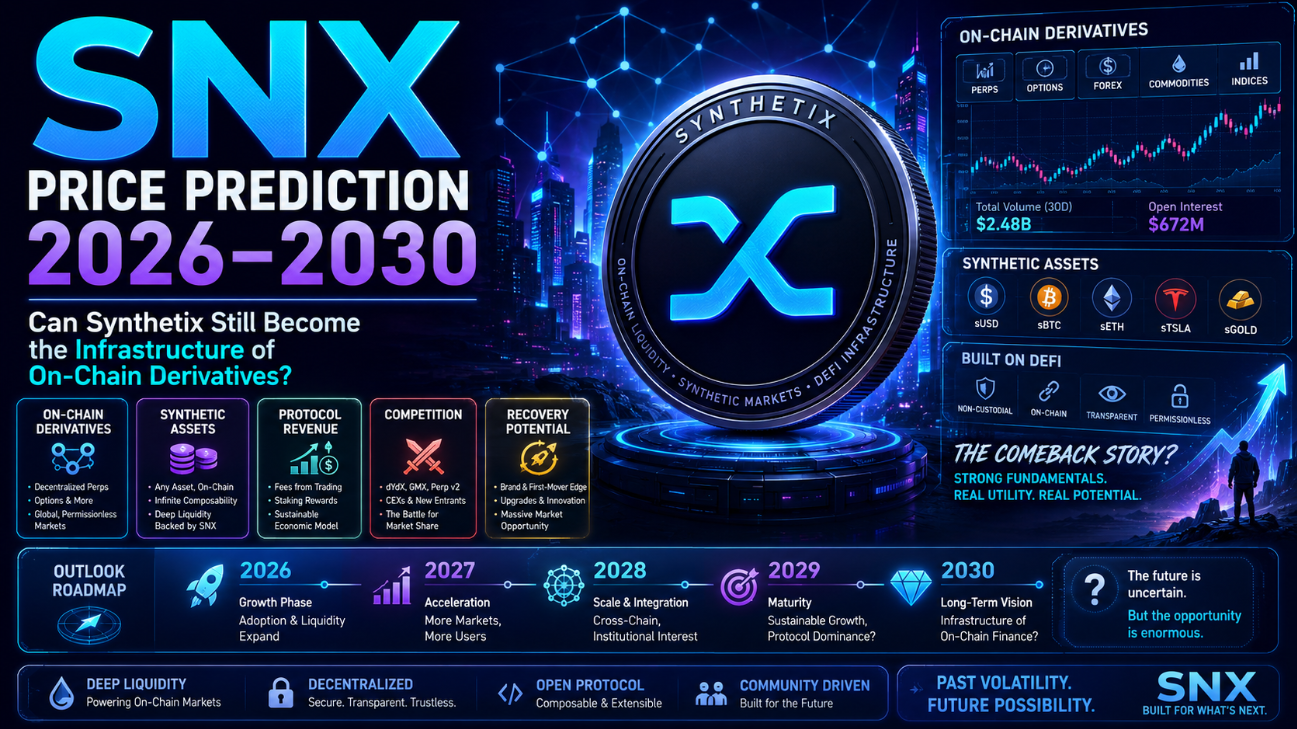
If you only look at the charts, it appears to be an old DeFi token that crashed hard from its highs. If you only follow narratives, it might seem poised to ride the next wave of on-chain derivatives growth. If you only look at history, you'll find it was nearly forgotten by the market, only to resurface repeatedly through protocol upgrades and new products.
So when you search for "SNX price prediction," most results fail to solve the real problem. They usually just give you a table:
- 2026: $X
- 2027: $X
- 2030: $X
But they rarely explain: Why that price? What conditions must be met? And if those conditions fail, how should the prediction be invalidated?
This article doesn't try to answer "SNX will definitely hit $X." Instead, it builds a practical framework to help you judge:
- What problem does Synthetix actually solve?
- Why does SNX have value?
- Is its value-capture mechanism still effective?
- Did V3 genuinely change the old logic?
- If on-chain derivatives explode, will SNX benefit—or be left behind?
- What is the rational price range for SNX between 2026 and 2030?
At HIBT, every price prediction starts with one question:
Can I explain, in plain language that anyone can understand, what problem this project actually solves?
If not, any purchase is closer to speculation than investing.
Chapter 1: Before You Understand SNX, You Must Understand Who "Synthetic Assets" Actually Help
Synthetix first made its mark with "synthetic assets."
Simply put, synthetic assets mean: You don't need to hold an actual asset to gain price exposure to it on-chain.
For example:
- You want to trade gold without opening a traditional brokerage account.
- You want forex exposure without dealing with complex banking systems.
- You want to trade stocks, commodities, or indices on-chain, even though real-world assets can't be directly moved to the blockchain.
- You want to trade derivatives in a DeFi way, without leaving your money on a centralized exchange.
Synthetix attempts to solve exactly this.
Through synthetic assets and collateral mechanisms, it allows on-chain users to gain price exposure to different assets. Synthetix officially positions itself as a DeFi derivatives liquidity protocol, providing infrastructure for on-chain derivatives trading.
1. Where Do sUSD, sBTC, and Others Come From?
Early Synthetix's core model was: users collateralize SNX, mint sUSD, then trade various synthetic assets through the system.
The hardest part to understand is the debt pool.
Many newcomers assume: "I collateralize SNX, borrow sUSD—it's basically like MakerDAO where I collateralize ETH to borrow DAI."
But Synthetix's debt pool is more complex.
In the Synthetix system, SNX stakers collectively bear the system's debt. If the prices of different synthetic assets within the system change, your debt share changes too. In other words, you aren't simply borrowing a fixed amount of debt—you're taking on the combined risk of the entire system.
This is why many people who buy SNX later realize they never truly understood the risk.
They thought they were earning staking yield. In reality, they were simultaneously exposed to price volatility, debt fluctuations, collateral ratio drops, and liquidation risk.
2. Why Does the Word "Debt" Matter So Much?
Because much of SNX's historical risk stems from its debt structure.
- If SNX price drops, collateral ratios fall, and stakers must add collateral or repay debt.
- If markets swing violently, debt pool structure amplifies psychological pressure on users.
- If protocol revenue isn't enough to cover the risk, users reduce staking, weakening system liquidity.
This is the biggest difference between SNX and ordinary governance tokens.
- UNI's value revolves around governance, potential protocol fees, and the Uniswap ecosystem.
- BNB's value revolves around exchange ecosystem, fee discounts, and chain usage.
- But SNX's value has long been embedded in a complex system of collateral, debt, trading fees, and derivatives liquidity.
You cannot analyze SNX the same way you analyze ordinary platform tokens.
3. What Did Synthetix V3 Change?
Synthetix V3 aims to make the protocol more modular, flexible, and scalable.
When introducing V3, Synthetix noted that it supports multi-collateral staking. Governance can enable different collateral assets to back synthetic assets, with customizable parameters for each collateral type—such as collateral requirements and reward mechanisms.
This means Synthetix is no longer just the old single-SNX-collateral debt pool model. It is evolving into more flexible derivatives infrastructure.
Official V3 documentation also states that V3 allows users to pool collateral, create on-chain financial markets, and provide Synthetix liquidity and infrastructure to other protocols.
This is critical for SNX price prediction.
Because if V3 succeeds, SNX's value logic could upgrade from "legacy DeFi collateral token" to "on-chain derivatives infrastructure equity token." But if V3 fails, SNX may become just another old project that keeps telling new stories without recovering real growth.
HIBT Case Study: The One-Sentence Test
HIBT's "Hold It Before Trading" principle doesn't mean holding forever. It means understanding the asset's logic before you trade.
For SNX, use this test:
Can I explain, in one sentence, what problem Synthetix solves?
A passing answer might be:
Synthetix is an on-chain derivatives liquidity protocol that lets users trade synthetic assets and perpetual contracts in a decentralized way, while allowing SNX to capture protocol value.
If all you can say is "SNX is a DeFi coin that pumped hard before," you aren't ready to take a heavy position.
Chapter 2: Where SNX Token Value Comes From—Why It Can Be Valuable, and Why It Can Crash
SNX value can be broken into three layers:
- Collateral value
- Fee and protocol revenue value
- Governance and protocol control value
The importance of these three layers shifts over time.
- Early on, SNX's core value came from collateralizing to mint synthetic assets. Users needed to stake SNX to participate.
- Later, as Synthetix Perps grew, fee revenue became a more important pricing anchor.
- More recently, with inflation ending, buybacks and burns, V3 multi-collateral, and new chain deployments, SNX's value-capture logic changed again.
1. Collateral Value: Important in the Past, But Not Enough Alone
Early SNX demand was tightly bound to system collateral.
Users staked SNX, minted sUSD, participated in the system, and earned rewards. As long as the system grew, demand for SNX collateral could increase.
But the problem is: collateral demand isn't free.
- If SNX price crashes, stakers face margin calls and liquidation pressure.
- If system trading volume is insufficient, fee revenue isn't attractive enough.
- If inflation rewards are too high, long-term holders get diluted.
So simply saying "SNX can be staked, therefore it has value" is not enough.
2. Fee Revenue: The Most Important Pricing Anchor for SNX
For SNX between 2026 and 2030, the most important variable isn't the narrative—it's protocol revenue.
DefiLlama describes Synthetix as a DeFi derivatives liquidity protocol where TVL is the total value of assets held in protocol smart contracts, Perp Volume is the notional trading volume of perpetual contracts, and Revenue relates to fees paid by users and distributed to SNX stakers or V3 LPs.
This means judging SNX's value requires looking beyond Twitter hype at:
- Perpetual contract trading volume
- Protocol fees
- Protocol revenue
- Whether fees flow to SNX holders or the SNX ecosystem
- Whether buybacks and burns are ongoing
- Whether users are actually trading on Synthetix
If trading volume doesn't rise, no amount of V3 storytelling can support long-term valuation.
3. Inflation Rewards: Once a Growth Tool, Now a Long-Term Drag
SNX once relied on inflationary rewards to attract stakers. This was common in early DeFi.
The upside: Rapid user attraction, higher staking ratios, expanded protocol liquidity.
The downside: If real protocol revenue is insufficient, inflationary rewards essentially dilute long-term holders.
Synthetix later shifted through governance to terminate SNX inflation and introduce buyback-and-burn mechanisms. The Block reported in 2023 that Synthetix ended SNX token inflation via SIP-2043, adopting buybacks and burns as new strategies.
This was a major turning point for SNX.
Because long-term, markets assign higher valuations to tokens with real revenue + low inflation + buyback-and-burn, not tokens with high inflation + high APY + low real revenue.
4. Buyback and Burn: Can It Become a New Price Floor?
Synthetix introduced Core V3, Perps V3, USDC collateral, and Base chain expansion in the Andromeda Release—along with a mechanism to use Base Perps fees to buy back and burn SNX.
This is extremely important.
Because buyback-and-burn connects protocol revenue directly to SNX demand.
If Synthetix Perps trading volume grows, fee revenue increases, and buyback-and-burn strengthens, then SNX's price support becomes clearer. But if trading volume is insufficient and buyback amounts are limited, this mechanism remains more narrative than substance.
Investors need to look at actual data, not just the words "buyback and burn."
5. Multi-Chain Deployment: Amplifying Demand, or Diluting Focus?
Synthetix has expanded from Ethereum mainnet to Optimism, Base, and other ecosystems. Perps V3 documentation notes it uses low-latency oracles like Pyth Network, dynamic funding rates, and price impact mechanisms. It supports over 80 markets including crypto, commodities, and forex, while working to reduce trading fees and improve LP risk management.
Upsides of multi-chain:
- Access to more users
- Lower transaction costs
- Better Perps product availability
- Riding Base and Optimism ecosystem growth
Risks:
- Fragmented liquidity
- Complex user entry points
- Increased incentive costs
- Inconsistent product experience across chains
Multi-chain deployment is not automatically bullish. It only benefits SNX if it brings real trading volume and fee growth.
HIBT Case Study: Value Source Checklist
When HIBT judges whether a token's rally has substance, it asks five questions:
- Does this token have real usage demand?
- Is protocol revenue growing?
- Does revenue flow to the token?
- Is supply being continuously diluted?
- Is user growth dependent on short-term subsidies?
If a token rises in price but not in revenue, users, or usage—that's an "air rally." For SNX to regain long-term valuation, it must prove itself through trading volume and revenue.
Chapter 3: Six Variables That Will Move SNX Price
Variable 1: Protocol Trading Volume and Fee Revenue
This is the most important variable.
SNX's long-term value should not be driven by influencer calls. It should be driven by Synthetix's trading volume, fees, and revenue.
If Synthetix Perps can consistently attract traders, SNX has a foundation for repricing. If traders migrate to Hyperliquid, GMX, dYdX, Vertex, and other platforms, SNX's upside gets compressed.
Variable 2: SNX Staking Ratio
The staking ratio reflects holder confidence.
If more SNX is staked, users are willing to participate in the protocol and bear associated risks. But if staking yields drop, risks rise, or the staking experience is too complex, the staking ratio may fall.
However, beginners shouldn't assume "higher staking ratio is always better."
An excessively high staking ratio may mean less circulating supply and greater short-term price elasticity—but also higher stampede risk during exits.
Variable 3: BTC and ETH Macro Cycles
SNX is a high-beta DeFi asset.
In bull markets, it may outperform BTC and ETH. In bear markets, it may fall harder than BTC and ETH.
So SNX analysis cannot be separated from market cycles.
If BTC and ETH enter a risk-appetite expansion phase, capital may flow into DeFi blue chips. If the market enters a risk-off phase, complex assets like SNX are often sold first.
Variable 4: On-Chain Derivatives Competition
Synthetix faces fierce competition.
- GMX has real users and Arbitrum ecosystem strength.
- dYdX has order books and professional traders.
- Hyperliquid is growing fast with UX approaching centralized exchanges.
- Vertex, Aevo, Drift, and others are also fighting for volume.
DefiLlama's Synthetix V3 page lists competitors including GMX V2 Perps, Aevo Perps, Avantis, Ostium, and dYdX V3.
So the question for SNX isn't "Will on-chain derivatives grow?" It's: Can Synthetix capture enough share of that growth?
Variable 5: Base and Optimism Ecosystem Growth
Base and Optimism matter for Synthetix.
If Base becomes one of the mainstream on-chain trading entry points, Synthetix Perps on Base could benefit. If Optimism's ecosystem continues developing, Synthetix as an early core DeFi protocol may gain ecosystem tailwinds.
But ecosystem growth is only an external condition. Ultimately, it still comes down to trading volume, fees, user retention, and product experience.
Variable 6: Team and Community Execution
Synthetix is one of the few DeFi projects that has survived multiple cycles while continuously iterating.
This demonstrates strong community resilience. But the project also depends heavily on core contributors, governance coordination, and roadmap execution.
If the team and community keep shipping products, improving UX, and growing protocol revenue, SNX has a chance to revalue. If the roadmap shifts too often, migration costs are too high, or user understanding costs remain too steep, SNX's valuation will be suppressed.
HIBT Case Study: Variable Weight Matrix
HIBT can assign weights to SNX's influencing factors:

This helps beginners avoid treating all news as equally important. What truly changes SNX's long-term price is always trading volume, revenue, supply, and value accrual.
Chapter 4: 2026 SNX Price Prediction—The Year V3 Fully Lands, and Old/New Logic Switch Is Most Dangerous
2026 is a critical year for SNX.
Synthetix's official 2026 roadmap states the goal is to combine DeFi foundations with real scale, push trading volume, unlock composability, and make Synthetix a major Perps venue on Ethereum Mainnet.
This makes Synthetix's strategic focus crystal clear: Not just synthetic assets, but on-chain perpetual contracts and derivatives infrastructure.
But 2026 is also the riskiest year.
Because protocol reconstruction periods usually mean:
- The old model is no longer strong enough.
- The new model hasn't been fully validated.
- Users need to migrate their understanding.
- Trading volume may fluctuate.
- Token value-capture mechanisms need to be reinterpreted by the market.
2026 Bear Case: 0.80–2.50
If V3 migration underperforms, Base and Optimism growth disappoints, Synthetix Perps trading volume fails to recover meaningfully, and the market enters a bear phase, SNX may remain in an undervalued state.
In this scenario, buyback-and-burn cannot form strong support. SNX continues to be viewed as a legacy DeFi asset.
**Bear range: **0.80–2.50
2026 Base Case: 3–6
If V3 lands steadily, Perps product volume gradually recovers, protocol revenue improves, and the market begins to reprice SNX's post-inflation buyback-and-burn logic, SNX has a chance to return to a neutral valuation band.
This range isn't euphoric bull market pricing—it's fundamental repair.
**Base range: **3–6
2026 Bull Case: 8–15
If DeFi derivatives become a hot narrative again in 2026, Synthetix achieves clear volume growth on mainnet, Base, or Optimism, and buyback-and-burn amounts keep expanding, SNX could see a strong rebound.
But this scenario requires market sentiment, product growth, and revenue improvement to happen simultaneously.
**Bull range: **8–15
HIBT Case Study: Upgrades Aren't Buy Signals—Post-Upgrade Data Is
When HIBT analyzes protocol upgrades, it distinguishes between two types of milestones:
Technical milestones: V3 launch, Perps V3 release, multi-chain deployment.
User growth milestones: Volume growth, fee growth, active trader growth, increased buyback-and-burn.
Only the second type truly affects long-term valuation.
This logic applies to other long-term assets too. In HIBT's LTC (Litecoin) Price Prediction 2026–2030, what matters isn't "Litecoin has existed for a long time," but whether its position in payments, cycles, liquidity, and market awareness remains valid.
Chapter 5: 2027 SNX Price Prediction—The Year On-Chain Derivatives Go Mainstream: Will SNX Be the Leader or the Disrupted?
If 2026 is the protocol reconstruction year, 2027 may be when on-chain derivatives competition truly heats up.
By then, the market will have clearer answers on:
- Whether Hyperliquid keeps growing.
- Whether dYdX reclaims market share.
- Whether GMX recovers strength.
- Whether Perps products on Base become mainstream.
- Whether Synthetix's infrastructure model gets adopted by more frontends and protocols.
The question for SNX becomes:
Is it the underlying infrastructure for on-chain derivatives, or is it being replaced by newer platforms with better user experience?
2027 Bear Case: 1.50–4
If the on-chain derivatives market grows but most share goes to Hyperliquid, dYdX, GMX, and other protocols—leaving Synthetix with only a small slice—then SNX may perform flatly.
Sector growth does not equal SNX growth.
**Bear range: **1.50–4
2027 Base Case: 6–12
If Synthetix maintains an important position in Perps infrastructure, protocol trading volume grows steadily, and the buyback-and-burn mechanism continues running, SNX has a chance to achieve more rational valuation.
**Base range: **6–12
2027 Bull Case: 18–35
If on-chain derivatives enter an explosive phase and Synthetix becomes a key liquidity layer—with multiple trading frontends and protocols plugging into its infrastructure—SNX could be repriced as a core DeFi derivatives asset.
**Bull range: **18–35
HIBT Case Study: Sector Share Method
HIBT's sector share method works like this:
- Estimate the total on-chain derivatives market size.
- Estimate what share Synthetix can capture.
- Estimate protocol revenue.
- Judge whether that revenue can flow to SNX.
- Derive a rational market cap range.
This is more rigorous than simply saying "on-chain derivatives will explode, so SNX will pump."
The same logic applies to narrative-driven assets. In HIBT's WLD Price Prediction 2026–2030, the core isn't just "AI is hot"—it's whether Worldcoin's identity network, user growth, and token capture mechanics actually hold up.
Chapter 6: 2028 SNX Price Prediction—Post-BTC Halving Cycle: Do DeFi Blue Chip Rules Still Apply?
2028 sits near the next Bitcoin halving cycle.
Although SNX isn't a BTC ecosystem asset, the entire crypto market still moves with BTC liquidity cycles.
Historically, bull markets start with BTC and ETH strength, then capital flows outward to DeFi, Layer 2, AI, Meme, and other high-beta assets.
As a legacy DeFi blue chip, if SNX's fundamentals have recovered, it could gain stronger elasticity during risk-appetite expansion phases.
But the question is: By 2028, will SNX still be a high-beta asset?
If Synthetix revenue stabilizes, buybacks continue, and products mature, SNX may evolve into more of an infrastructure yield asset. If Synthetix growth stalls, SNX may just become a cyclical rebound token.
2028 Bear Case: 2–6
If the market cycle is mediocre and Synthetix growth is limited, SNX may only see a mild rebound.
**Bear range: **2–6
2028 Base Case: 10–22
If DeFi blue chips regain market attention, Synthetix Perps trading volume grows steadily, and SNX's buyback-and-burn mechanism gains market recognition, then SNX has a chance to enter a stronger recovery band.
**Base range: **10–22
2028 Bull Case: 30–60
If 2028 enters a strong bull market and on-chain derivatives become a core narrative, SNX could return to valuation levels close to its previous cycle's core asset status.
**Bull range: **30–60
HIBT Case Study: Cycle Positioning Method
HIBT doesn't recommend looking at absolute prices alone. Look at historical percentiles:
- SNX current price / all-time high
- SNX market cap / all-time high market cap
- SNX protocol revenue / historical peak revenue
- SNX buyback amount / market cap
- SNX performance relative to ETH
If SNX price is low but protocol revenue is also low, it may not be an opportunity. If SNX price is low but revenue, volume, and buybacks are recovering, that may be cyclical undervaluation.
Chapter 7: 2029 SNX Price Prediction—DeFi Infrastructure Maturity: Is SNX's Moat Deep Enough?
By 2029, the DeFi derivatives market may have entered maturity.
Mature competition is completely different from early-stage competition.
- Early stage: It's about the story.
- Mid stage: It's about growth.
- Maturity: It's about moats and profitability.
For Synthetix to retain value in 2029, it must prove it isn't an obsolete protocol—it still has irreplaceable infrastructure value.
1. Where Is SNX's Moat?
Potential moats include:
- Years of protocol security and operational track record
- DeFi-native liquidity infrastructure
- Synthetic asset and perpetual contract mechanism expertise
- Ecosystem deployments on Optimism, Base, and others
- Community governance and developer network
- Protocol-level liquidity and composability
But none of these moats are absolute.
If new protocols offer lower fees, better UX, deeper liquidity, and stronger incentives, users will migrate.
DeFi users have no loyalty—only yield, experience, and security.
2. Will AI Trading and On-Chain Quant Strategies Change the Landscape?
By 2029, AI-driven on-chain trading and automated strategies may be more prevalent.
This is both opportunity and challenge for Synthetix.
- Opportunity: More automated trading means more volume.
- Challenge: The protocol must offer sufficient depth, low latency, and stable risk management—or professional traders will choose other platforms.
2029 Bear Case: 3–8
If Synthetix fails to develop a clear moat and protocol revenue remains limited, SNX may become an ordinary legacy DeFi asset.
**Bear range: **3–8
2029 Base Case: 18–40
If Synthetix becomes one of the on-chain derivatives infrastructure layers, maintaining stable trading volume and revenue, SNX has a chance to earn mature protocol valuation.
**Base range: **18–40
2029 Bull Case: 55–100
If Synthetix becomes the liquidity layer behind multiple frontends, markets, and on-chain trading products, SNX may re-enter the core DeFi asset tier.
**Bull range: **55–100
HIBT Case Study: The Moat Test
HIBT judges whether a DeFi protocol has a moat by asking five questions:
- Is the cost of leaving it high for users?
- Is its liquidity difficult to replicate?
- Is its revenue sustainable?
- Does its security record form a trust asset?
- Can new competitors easily steal users with subsidies?
If most answers are no, then the so-called moat may just be historical baggage.
Chapter 8: 2030 SNX Price Prediction—Where Is the Ceiling for a Synthetic Asset Protocol?
By 2030, SNX faces an endgame judgment.
It may become part of on-chain derivatives infrastructure. It may be treated as a legacy asset from the previous DeFi generation. Or it may be heavily marginalized due to failed product migration, competitive defeat, or regulatory issues.
This is why the 2030 prediction range must be extremely wide.
1. SNX's Endgame Vision
If everything goes well, Synthetix could become the underlying liquidity protocol for on-chain derivatives.
It wouldn't necessarily face all users directly. Instead, it would provide base-layer liquidity to different trading frontends, aggregators, strategy protocols, and structured products.
This is the "infrastructure layer" model.
If this endgame holds, SNX's value wouldn't come from a single trading interface—it would come from the entire on-chain derivatives ecosystem using Synthetix liquidity.
2. SNX's Risk of Going to Zero
But extreme risks cannot be ignored.
SNX is not BTC. It is not ETH. It is not an irreplaceable monetary asset, nor a universal settlement layer.
If:
- Synthetix users keep bleeding away
- Trading volume stays depressed long-term
- Buyback-and-burn scale remains tiny
- Competitors take comprehensive leads
- Regulators restrict synthetic assets
- Protocol security suffers a major incident
Then SNX's long-term value could collapse significantly.
2030 Bear Case: 2–8
If Synthetix is marginalized and protocol activity keeps shrinking, SNX may remain depressed long-term.
**Bear range: **2–8
2030 Base Case: 35–80
If Synthetix becomes one of the on-chain derivatives base layers, maintaining stable revenue and buyback-and-burn, SNX has a chance to enter a long-term mature valuation band.
**Base range: **35–80
2030 Bull Case: 120–300
If synthetic assets and on-chain derivatives become a mainstream DeFi narrative, Synthetix becomes a core liquidity protocol, SNX supply continues contracting, and protocol revenue keeps growing—only then could SNX enter the extreme bull range of 120–300.
But this scenario has very high requirements. It should not be treated as a base expectation.
HIBT Case Study: Endgame Valuation Three-Step Method
HIBT's endgame valuation works like this:
Step 1: Set a 2030 target scenario. Example: SNX becomes one of the on-chain derivatives infrastructure layers by 2030.
Step 2: Estimate probability of achievement. Example: You assign 50% probability to base case, 20% to bull case, 30% to bear case.
Step 3: Use discount thinking to judge whether the current price offers enough margin of safety.
A higher target price doesn't automatically mean it's worth buying. What matters is whether the combination of target price, probability of achievement, waiting time, and risk cost still leaves sufficient margin of safety.
Chapter 9: SNX Investment Playbook—What Should Ordinary Investors Do After Reading These Predictions?
1. What Type of Investor Is SNX Suitable For?
SNX is not suitable for three types of people:
- Those who don't understand DeFi debt and staking mechanics.
- Those who can't handle 50%+ volatility.
- Those who only want to hear "how much it will pump."
SNX is more suitable for investors who:
- Understand DeFi fundamentals
- Are willing to track on-chain data
- Can accept long-term volatility
- Can distinguish between narrative and revenue
- Won't fully dismiss the project after short-term drops
- Won't blindly add to positions after short-term pumps
2. Stake SNX or Just Hold SNX?
Staking SNX lets you participate in protocol revenue and ecosystem incentives. But staking is not risk-free yield.
You need to understand:
- Is there a lock-up period?
- Are you taking on debt risk?
- Does yield come from real fees or subsidies?
- Is exit convenient?
- Does yield cover SNX price volatility risk?
Simply holding SNX is simpler, but you miss potential staking yields or protocol distributions.
For beginners, starting with a small direct-hold position to observe is usually safer than jumping straight into complex staking.
3. Five Buy and Trim Indicators
If you're tracking SNX, focus on five metrics:
- Synthetix Perps trading volume Sustained growth is the most direct positive signal.
- Protocol fee revenue Fee growth means real user usage, not empty narrative.
- Buyback-and-burn scale If buyback amounts keep expanding, token value accrual becomes clearer.
- SNX staking ratio Changes reflect holder confidence, but read alongside yield data.
- Competitor data If Hyperliquid, GMX, and dYdX grow fast while Synthetix stalls, SNX needs re-evaluation.
4. How Large Should Your SNX Position Be?
For ordinary investors, consider:
- Conservative: SNX = 0–2% of crypto portfolio
- Balanced: SNX = 2–5% of crypto portfolio
- Aggressive: SNX = 5–10% of crypto portfolio
It is not recommended for average users to make SNX a core position.
A more rational structure:
- BTC / ETH: Core positions
- Major DeFi / L2 / Infrastructure: Medium positions
- SNX, LQTY, WLD and other high-volatility assets: Small positions
- Meme and short-term narratives: Minimal positions
If you want to compare with another DeFi infrastructure asset's long-term logic, read HIBT's LQTY Price Prediction 2026–2030. LQTY and SNX both involve protocol mechanics, real yield, and token capture issues—but their risk structures are completely different.
5. Three Biggest Mistakes When Holding SNX in a Bear Market
Mistake 1: Only looking at all-time highs. SNX pumped hard before. That doesn't mean it will automatically return.
Mistake 2: Treating staking yield as risk-free. If the token drops 70%, even a high APY may not cover the loss.
Mistake 3: Only watching project updates, not user data. Constant development doesn't guarantee the market will buy in.
HIBT Case Study: Complete Investment Decision Process
Using HIBT's process to analyze SNX:
- Confirm you can explain what problem Synthetix solves.
- Track trading volume, fees, buyback-and-burn, and staking ratio.
- Judge where SNX's current price sits in historical and fundamental percentiles.
- Set three-scenario price ranges.
- Decide on small position, staged buying, or continued observation.
- Set prediction invalidation conditions.
- Take partial profits when target ranges are hit—don't fantasize about selling the exact top.
Conclusion: Five Assumptions Behind All SNX Predictions in This Article
All predictions in this article rest on five premises:
Assumption 1: The Ethereum ecosystem continues to grow. Synthetix's core activity remains tightly linked to Ethereum, L2s, and on-chain derivatives. If ETH loses dominance, SNX will be significantly affected.
Assumption 2: The Synthetix team and community continue executing. SNX's long-term value depends on continuous protocol iteration. If execution falters, governance splits, or the roadmap becomes chaotic, valuation will be revised downward.
Assumption 3: The on-chain derivatives market continues expanding. If users always prefer CEXs for perpetual contracts and on-chain derivatives fail to attract mainstream users, Synthetix's ceiling drops significantly.
Assumption 4: Regulation doesn't fully block synthetic assets. Synthetic assets and derivatives are naturally more exposed to regulatory scrutiny. If major markets impose strict limits on on-chain synthetic assets and perpetuals, SNX risk rises.
Assumption 5: No completely disruptive protocol emerges. If a more efficient, cheaper, safer, and easier-to-use on-chain derivatives protocol appears at scale and drains users, Synthetix's historical status won't protect SNX's price.
Summary: SNX Is a High-Beta Asset, Not a Low-Risk Asset
SNX is worth watching.
It has real protocol history, real product iteration, real DeFi demand, and was once an important representative of the synthetic assets and on-chain derivatives赛道.
But SNX is absolutely not a simple "buy-the-dip" coin.
Its problems are equally obvious:
- Heavy historical baggage
- Complex mechanics
- High user understanding costs
- Strong competitors
- Large price volatility
- Protocol revenue must be re-proven
- V3 and buyback-and-burn logic still needs data validation
So the most rational stance toward SNX isn't blind bullishness or outright dismissal. It's placing it in a "high-risk DeFi infrastructure watchlist."
If Synthetix trading volume, fees, buyback-and-burn, staking ratio, and multi-chain user growth all improve together, SNX has a chance to re-enter the market's field of view. If these metrics don't improve, even the most beautiful roadmap is just narrative.
A truly mature investor doesn't ask:
"Will SNX pump to $100?"
They ask:
"If SNX is going to hit $100, what levels must protocol revenue, trading volume, market share, and token capture reach?"
That is the question that makes SNX price prediction genuinely valuable.
FAQ: Common Questions About SNX Price Predictions
1. What is SNX? SNX is the native token of the Synthetix protocol. Synthetix is a DeFi derivatives liquidity protocol originally known for synthetic assets, later expanding into on-chain perpetual contracts and multi-chain derivatives infrastructure.
2. What does Synthetix do? Synthetix allows users to gain synthetic asset and derivatives trading exposure on-chain. Simply put, it tries to bring price exposure to gold, forex, crypto assets, commodities, and other markets into DeFi.
3. Why did SNX price crash so hard? SNX's crash had both market cycle and internal tokenomic/ protocol growth reasons. High inflation, complex debt mechanics, DeFi downturn, intensifying competition, and insufficient real revenue were all major factors.
**4. Can SNX reach $100 by 2030?** It's possible, but requires Synthetix to become one of the on-chain derivatives infrastructure layers, with sustained trading volume growth, fee growth, expanded buyback-and-burn, and market share gains. If protocol growth underperforms, the $100 target is very hard to reach.
5. Is SNX suitable for long-term holding? SNX suits investors with DeFi research capability, high volatility tolerance, and willingness to track protocol data. It is not suitable for complete beginners who don't understand synthetic assets, debt pools, and on-chain derivatives to hold heavily for the long term.
6. What is SNX's biggest risk? Biggest risks include insufficient protocol revenue, competitors taking market share, V3 migration underperforming, regulatory restrictions on synthetic assets, complex staking mechanics driving user attrition, and overall DeFi market risk-appetite decline.
7. What matters most when judging whether SNX is worth buying? The five most important metrics: Synthetix Perps trading volume, protocol fee revenue, buyback-and-burn scale, SNX staking ratio, and market share comparison against competitors like GMX, dYdX, and Hyperliquid.
Author Bio
Author: Luke | Web3 SEO & Crypto Research Contributor
Long-term focus on cryptocurrency trading platforms, DeFi protocols, Web3 infrastructure, and on-chain data research. Specializes in breaking down complex crypto assets' business models, token value capture, risk structures, and long-term valuation logic from an ordinary investor's perspective.
This article is for informational and educational purposes only and does not constitute investment advice.
Risk Disclosure & Disclaimer
This content is for cryptocurrency knowledge and market research purposes only. It does not constitute investment advice, financial advice, or trading recommendations. SNX is a high-volatility, high-risk DeFi asset subject to market cycles, protocol security, liquidity changes, regulatory policy, tokenomic adjustments, and competitive landscape shifts. All price predictions carry significant uncertainty. Readers should make independent judgments based on their own risk tolerance and conduct thorough research before investing.
References & Data Sources
- https://blog.synthetix.io/2026-roadmap/
- https://blog.synthetix.io/what-is-synthetix-v3/
- https://defillama.com/protocol/synthetix
- https://blog.synthetix.io/the-andromeda-release-buyback-and-burn/
- https://www.theblock.co/post/267138/synthetix-snx-token-inflation-buybacks-burns
- https://defillama.com/protocol/synthetix-v3