
This article is for crypto asset research and educational purposes only and does not constitute investment advice. All price predictions are scenario-based extrapolations grounded in public data, cycle assumptions, and valuation models, and are not guaranteed to materialize.
Data reference date: May 18, 2026.
Introduction: Why PYTH’s Prediction Deserves More Serious Attention Than Most Altcoins
Many newcomers see “price prediction” and immediately think: Is this just wild guessing?
Indeed, many crypto price prediction articles simply throw out bold numbers — like “PYTH will reach $10” or “this coin will 100x” — without explaining where the number comes from or under what conditions the prediction would fail.
PYTH is different.
The Pyth Network behind PYTH belongs to the oracle sector. Oracles are not typical meme narratives nor projects driven purely by community hype. They solve a fundamental problem for DeFi, derivatives, on-chain trading, and lending protocols: how smart contracts obtain real, fast, and trustworthy external market prices.
According to Pyth’s official documentation, PYTH is the governance token of Pyth Network and supports participation in governance and Oracle Integrity (the economic security mechanism related to oracle data quality) through staking.
Therefore, predicting PYTH cannot rely solely on price charts. Three key aspects must be examined:
- On-chain real usage: Are Pyth’s price feeds being adopted by more protocols? Is it expanding to more chains, more DeFi applications, and more derivatives markets?
- Crypto market macro cycle: If 2026–2027 enters a new risk asset expansion phase, oracles, RWA, derivatives, and on-chain trading infrastructure typically receive higher valuations.
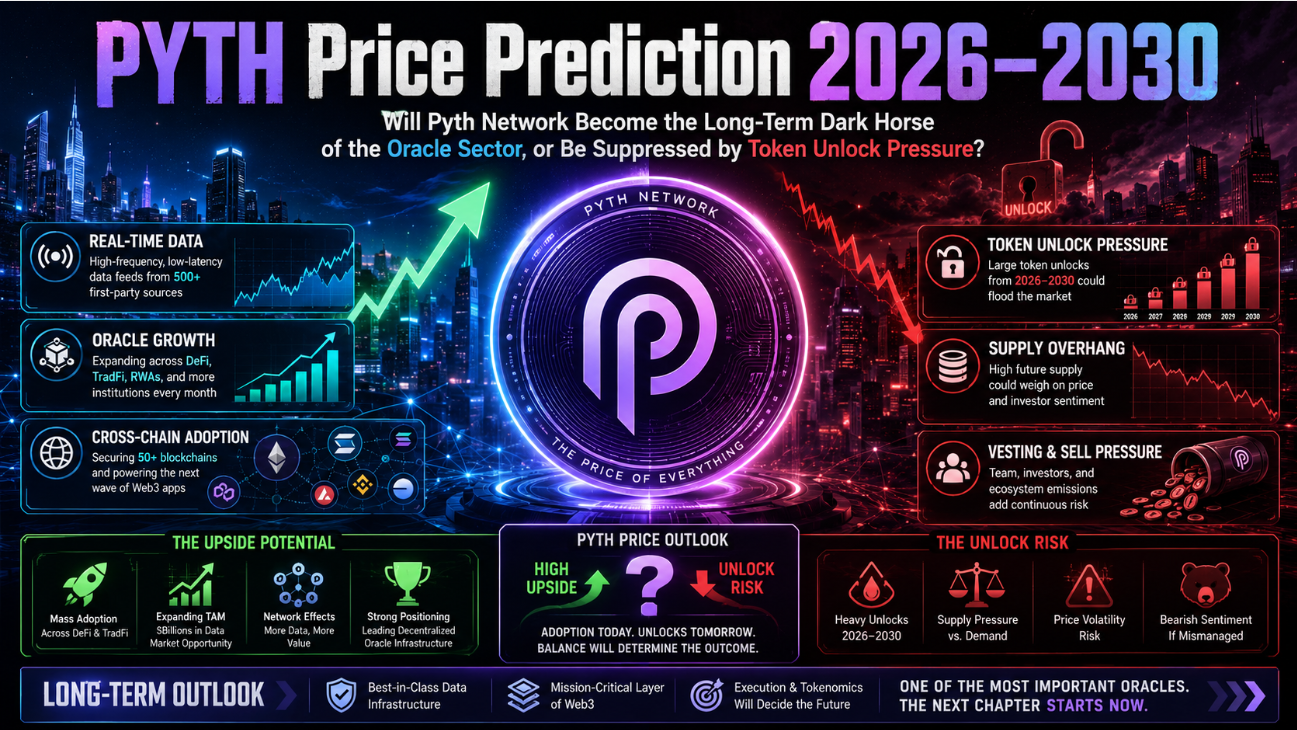
- Token supply pressure: PYTH has a total supply of 10 billion tokens, with approximately 5.75 billion currently in circulation. According to Tokenomics.com, around 2.83 billion PYTH (about 28.3% of total supply) will unlock around May 20, 2026.
This article will not tell you “PYTH will definitely reach X dollars.” Instead, it uses a beginner-friendly framework — on-chain data + macro cycle + ecosystem expansion + unlock pressure — to project possible PYTH price ranges for 2026–2030.
We will also use HIBT-related content as a reference for the value logic of utility tokens and trading platform assets. You can further read HIBT’s analyses on platform coins, DeFi assets, and price prediction assets:
- RPL Price Prediction 2026–2030
- SNX Price Prediction 2026–2030
- Ethereum ETH Price Prediction 2026–2030
- YFI Price Prediction 2026–2030
Note: This article does not fabricate HIBT’s historical price data. When using HIBT as a reference, we focus on “how trading platform-type assets capture users, trading volume, trust, and ecosystem value,” rather than inventing unverifiable price movements.
Part 1: What Is PYTH? Newcomers Must Understand This First
1.1 What “Data” Does Pyth Network Actually Sell?
In one sentence:
Pyth Network is an oracle network that provides real-time financial market data for blockchain applications.
In traditional finance, exchanges, market makers, and data providers hold vast amounts of price data — real-time BTC, ETH, SOL prices, as well as quotes for stocks, forex, gold, and crude oil. These data are critical for trading systems.
However, blockchain smart contracts cannot directly access the outside world.
For example, an on-chain contract wanting to know “what is SOL’s real price right now” cannot simply open an exchange webpage. It needs an intermediary layer to securely transmit external prices on-chain. That intermediary is an oracle.
Pyth’s core feature is its emphasis on first-party data — sourcing prices directly from exchanges, market makers, financial institutions, etc., rather than relying solely on secondary aggregated data. DeFiLlama also highlights that Pyth is a first-party financial oracle network that publishes real-world financial data on-chain in a tamper-resistant, decentralized manner.
This is the foundational value of PYTH.
If on-chain trading, perpetual contracts, options, RWA, prediction markets, and structured products continue to grow, these applications will need faster, more accurate, and more reliable data. Pyth’s market opportunity comes from the overall expansion of on-chain financial infrastructure.
1.2 Real Utility of the PYTH Token: Governance, Staking, Fee Capture — Which Drives Price Appreciation?
According to official documentation, PYTH is first and foremost a governance token. Holders can stake to participate in Pyth DAO governance, with 1 staked PYTH equaling 1 vote.
More importantly, PYTH is tied to Oracle Integrity Staking. Data publishers can self-stake PYTH, and other stakers can delegate PYTH to publishers. If data is inaccurate or anomalous, a portion of the stake may be slashed.
This shows PYTH is not just a “voting coin” — it has the potential to become part of the network’s security and data quality mechanism.
However, newcomers should note:
Having utility does not automatically mean the price will rise.
The long-term price performance depends not on how many uses are written in the whitepaper, but on whether those uses create real demand:
- Are more protocols required to use Pyth data?
- Does using Pyth generate fees?
- Do those fees flow back to the DAO, stakers, or ecosystem?
- Does staking PYTH reduce market circulation?
- Can network growth outpace the selling pressure from token unlocks?
If the answers to these questions become increasingly positive, PYTH has the potential for long-term re-rating.
1.3 Comparison with HIBT: Differences in Valuation Logic Between Platform Coins and Oracle Tokens
The value logic of trading platform assets like HIBT primarily comes from:
- User growth
- Trading volume growth
- Fee revenue
- Platform product expansion
- Brand trust
- Listing and liquidity capabilities
- Platform activities, rebates, and ecosystem incentives
In contrast, PYTH’s value logic comes more from:
- Data source quality
- Number of integrated protocols
- Number of supported chains
- Price data query volume
- DAO revenue and protocol fees
- Staking scale
- Competitive landscape in the oracle sector
Newcomers can understand it this way:
HIBT is more like a “trading entry-point asset,” while PYTH is more like an “on-chain financial infrastructure asset.”
Platform-type assets grow by focusing on users and trading volume; oracle-type assets grow by focusing on protocol adoption and data usage frequency.
This is why PYTH predictions cannot focus solely on “whether there is hype,” but on whether it truly becomes foundational infrastructure for on-chain finance.
Part 2: The 5 Major Variables Affecting PYTH’s Price
2.1 Variable One: BTC Macro Cycle
PYTH is an infrastructure asset, but it cannot escape the BTC cycle.
In bull markets, risk appetite rises, and capital flows from BTC and ETH into infrastructure, DeFi, oracles, RWA, AI, Layer 2, and other sectors. As an oracle project, PYTH’s valuation elasticity increases significantly during risk expansion phases.
Conversely, in deep bear markets, altcoins struggle to perform independently. Even if fundamentals continue improving, prices may be dragged down by overall market liquidity.
Thus, PYTH’s biggest variable is not Pyth itself, but whether BTC maintains mid-to-long-term strength.
Judging criteria include:
- Whether BTC holds key long-term moving averages
- Whether BTC’s market dominance has peaked and is declining
- Whether high-beta assets like ETH/SOL begin to catch up
- Whether on-chain stablecoin supply is expanding
- Whether CEX and DEX trading volumes rise in tandem
If BTC is strong, SOL is strong, and DeFi TVL recovers, PYTH’s projected range should be adjusted upward.
2.2 Variable Two: Oracle Sector Competition — Chainlink vs Pyth
The biggest competitor in the oracle sector remains Chainlink.
Chainlink’s advantages:
- Strong brand recognition
- Longer security track record
- Broader integration ecosystem
- Solid position in traditional DeFi projects
- More complete product lines (CCIP, Data Streams, etc.)
Pyth’s advantages:
- High-speed price updates
- Stronger first-party data narrative
- Deeper ties to Solana and high-performance chain ecosystems
- Greater appeal for derivatives, perpetual contracts, and high-frequency trading scenarios
This means PYTH’s opportunity is not to “completely replace Chainlink,” but to capture a larger share in high-frequency financial data, derivatives, Solana ecosystem, and new multi-chain protocols.
If Pyth becomes the default data source in more perpetual DEXs, RWA protocols, prediction markets, and on-chain trading products, PYTH’s valuation has room for upward repair.
2.3 Variable Three: Rise and Fall of the Solana Ecosystem
PYTH has very deep ties to the Solana ecosystem.
This is both an advantage and a risk.
Advantage: Solana’s high-performance positioning is well-suited for high-frequency trading, DeFi, meme trading, perpetual contracts, and mobile applications. If the Solana ecosystem continues expanding, Pyth as key infrastructure will benefit.
Risk: If SOL suffers major ecosystem decline, network trust crises, or developer migration, PYTH’s market narrative will also be hit.
Therefore, when predicting PYTH, one must simultaneously monitor SOL:
- Whether SOL price remains strong
- Whether Solana TVL continues growing
- Whether Solana DEX volume is rising
- Whether Solana perpetual contract ecosystem is expanding
- Whether Pyth can shed the label of “Solana-only ecosystem”
If Pyth establishes presence across EVM, Move, Cosmos, Monad, and other ecosystems, its long-term valuation will be healthier.
2.4 Variable Four: Institutional Adoption Speed
Pyth’s long-term upside comes from the on-chain migration of traditional financial data.
If more stocks, ETFs, forex, commodities, interest rates, and bonds data move on-chain in the future, oracles will serve not just DeFi but the entire on-chain financial market.
This is critical for PYTH.
Oracle projects ultimately compete not on storytelling, but on becoming the on-chain financial data standard.
If Pyth achieves real adoption in RWA, on-chain stocks, on-chain forex, derivatives settlement, and institutional-grade DeFi, PYTH should not be valued as an ordinary altcoin but re-rated as “financial data infrastructure.”
2.5 Variable Five: Token Unlock Pressure
This is the biggest risk variable for PYTH in 2026.
According to Tokenomics.com, as of May 2026, approximately 71.7% of PYTH has unlocked, with the remaining 28.3% (about 2.83 billion PYTH, representing 39.5% of current market cap) unlocking around May 20, 2026.
Large unlocks create three effects:
- Markets front-run expectations — many sell weeks before the unlock.
- Unlocks do not mean all tokens are sold, but they increase potential selling pressure.
- If fundamentals are strong, unlocks can become “sell the news.” But in low-liquidity environments, they can cause further price declines.
Tokenomics.com also shows historical impacts: after the May 2025 unlock, the maximum drawdown within 12 days was 20.4%; after TGE, the maximum 3-day drawdown was 47.4%.
Therefore, 2026 PYTH predictions must be handled conservatively and cannot rely solely on bull market imagination.
Chapter 3: 2026 PYTH Price Prediction — A Year of Halving Dividend vs Unlock Pressure Game
3.1 Three Scenario Assumptions
2026 is a pivotal year for PYTH.
On one hand, the crypto market may still be in the mid-to-late post-halving cycle, offering valuation repair opportunities for infrastructure assets. On the other, PYTH faces large unlocks that the market must absorb.
Thus, 2026 cannot be simply bullish nor completely bearish due to unlocks.
Bearish Scenario
If BTC weakens, Solana cools, persistent selling follows the unlock, and Pyth adoption shows no clear growth, PYTH may remain in a low-valuation range long-term.
Bearish Range: 0.18–0.25
Base Scenario
If unlock pressure is gradually digested in 2026, BTC avoids a deep bear market, Solana remains active, and Pyth continues gaining DeFi and derivatives adoption, PYTH has a chance to return to mid-tier valuation.
Base Target: $0.35
Bullish Scenario
If altcoin catch-up rallies occur in H2 2026, SOL regains strength, and Pyth breaks through in multi-chain and institutional financial data scenarios, PYTH could challenge higher ranges.
Bullish Range: 0.45–0.55
3.2 2026 Predicted Range
2026 PYTH Price Range: 0.18–0.55
Base Target: $0.35
Based on the ~0.04357 PYTH price shown on CoinGecko in mid-May 2026, this range implies the market needs to re-price PYTH meaningfully rather than a minor rebound. At that time, market cap was ~251 million and FDV ~$436 million, with an all-time high of $1.20.
In other words, $0.35 represents a recovery from extremely low valuation to medium infrastructure valuation.
3.3 Which Quarter Is Most Likely to See a Stage High?
Two key windows in 2026:
- First: 1–3 months after the unlock. If no sustained dumping occurs, the market may view it as “maximum bad news priced in.”
- Second: Q4 2026. If BTC, ETH, and SOL are all strong, capital may seek undervalued infrastructure assets.
If PYTH fails to reclaim key moving averages after the May–July unlock, full-year performance may be weak.
2026 Prediction Update Triggers
Raise targets if:
- No new lows within 30 days post-unlock
- Multiple major perpetual DEX or RWA integrations
- SOL price and Solana TVL strengthen together
- PYTH staking rate rises significantly, reducing sell pressure
Lower targets if:
- Heavy volume decline post-unlock
- BTC breaks long-term bull/bear line
- Solana TVL shrinks noticeably
- Chainlink or other oracles significantly capture Pyth’s core markets
Chapter 4: 2027 PYTH Price Prediction — Ecosystem Explosion or Narrative Fade?
4.1 Typical Performance of Utility Tokens in Mid-Bull Market
If PYTH successfully digests unlock pressure in 2026, 2027 raises a more critical question: Is Pyth real infrastructure or just a cycle narrative?
Utility tokens in mid-bull usually follow three paths:
- Real demand growth → continued re-rating.
- Solid fundamentals but weak token capture → lags ecosystem growth.
- Early over-pumping → mid-cycle profit-taking and correction.
Which path PYTH takes depends on whether Pyth Network can convert “data usage” into “token value.”
4.2 2027 Predicted Range
2027 PYTH Price Range: 0.40–1.20
Base Target: $0.75
Core assumptions:
- 2026 large unlock largely absorbed
- Continued protocol adoption expansion
- Oracle sector regains market attention
- No major systemic issues in Solana
- PYTH not proven to be a “governance-only, weak value capture” token
Challenging the ~$1.20 all-time high (recorded March 2024 per CoinGecko) becomes a key psychological level, but breaking it depends on whether 2027 revenue, adoption, staking, and ecosystem position significantly exceed 2024 levels.
4.3 Three Top Warning Signals
If holding PYTH in 2027, watch:
- Price makes new highs but on-chain adoption does not grow in tandem (emotion/liquidity-driven).
- Staking rate declines while exchange balances rise (selling pressure building).
- BTC dominance drops sharply then rebounds (altcoin cycle often ends).
4.4 Operational Insights from HIBT Cases
While trading platform and oracle assets differ, both are utility-type assets. A common mid-bull phenomenon is fundamentals improving while price has already front-run.
For PYTH holders: Do not equate “project is good” with “price won’t fall.” Even with more integrations, 30%–50% mid-term corrections are possible after sharp short-term gains.
HIBT-related research often emphasizes using “staged position building + phased profit-taking” for utility assets rather than all-in long-term holding. Similar logic applies to DeFi infrastructure analyses such as RPL Price Prediction and SNX Price Prediction.
2027 Prediction Update Triggers
Raise 20%–40% if Pyth becomes core data source for multiple mainstream on-chain derivatives protocols.
Lower 25%–35% if price nears ATH but protocol revenue, staking, and integrations show no clear growth.
Part 5: 2028 PYTH Price Prediction — Bear Market Defense: Is the Moat Deep Enough?
5.1 Resilience of Oracle Projects in Bear Markets
If 2028 enters a cooling phase, PYTH’s challenge is not storytelling but defending real demand.
Speculative coins fall hardest in bears due to lack of cash flow and real usage. Oracles fare relatively better because DeFi protocols still need price data to operate.
However, infrastructure assets still face valuation compression. Markets shift from “future potential” back to “current revenue, usage, and sustainability.”
5.2 2028 Predicted Range
2028 PYTH Price Range: 0.25–0.60
Base Target: $0.38
This assumes a defensive market in 2028, with PYTH pulling back from 2027 highs but retaining fundamental support. A drop from ~$1 to $0.25–$0.60 after a bull peak is common (50%–70% drawdowns for infrastructure assets).
The key question is whether people continue using Pyth after the correction. If data calls, integrations, and staking remain, bear market lows may become entry windows for the next cycle.
5.3 Can PYTH’s Revenue Model Offset Losses?
This must be viewed cautiously. Long-term value depends on how closely network fees, DAO revenue, and staking mechanisms connect to token value. Stronger fee capture or buyback mechanisms would improve bear market resilience.
If PYTH remains primarily governance with weak value capture, token performance may lag even if the network succeeds.
This is a common issue for many utility tokens: Project success ≠ Token success.
5.4 Bear Market Insights from HIBT: Bottom-Support Mechanisms Matter
Platform coins with real fee income, buybacks, user incentives, and ecosystem apps tend to find better price support in bears than pure narrative coins.
PYTH’s support mechanisms differ: staking reduces circulation, data quality/security demand, DAO governance needs, potential protocol fee flows, and long-term ecosystem demand.
Whether PYTH has effective “floor mechanisms” depends on how tightly the DAO binds revenue to token demand.
2028 Prediction Update Triggers
Raise to 0.35–0.80 if integrations and staking rate continue growing in the bear market.
Lower to 0.12–0.35 if usage declines, Solana TVL shrinks, and staking rate falls.
Part 6: 2029–2030 Long-Term PYTH Prediction — Where Is the Next Cycle’s Ceiling?
6.1 2029 Predicted Range
2029 PYTH Price Range: 0.80–2.50
Base Target: $1.50
2029 represents new cycle warm-up. After 2028 bear market shakeout, useful infrastructure projects regain attention. Investors will ask:
- Is Pyth still a top oracle?
- Does it hold meaningful share in high-frequency financial data?
- Has it entered RWA, on-chain stocks, forex, and commodities markets?
- Has the PYTH token developed stronger value capture?
- Is its differentiation from Chainlink recognized?
If yes, PYTH has a chance to break its 2024 ATH and enter new valuation territory.
6.2 2030 Predicted Range
2030 PYTH Price Range: 1.50–5.00
Base Target: $3.00
The $3 base target implies mature infrastructure asset valuation; $5 requires Pyth to become one of the core players in on-chain financial data markets.
With 10 billion total supply, 5 implies ~50 billion FDV. This requires Pyth to evolve from “a good oracle project” into an important data layer of the on-chain financial era.
6.3 Conditions Required for PYTH to Reach $5
At minimum:
- Pyth becomes the leading standard in high-frequency financial data.
- Overall oracle market expands dramatically beyond DeFi into on-chain stocks, forex, commodities, RWA, and institutional settlement.
- PYTH token value capture mechanism strengthens significantly (staking demand, fee flows, DAO revenue usage).
- Solana remains strong while Pyth reduces single-chain dependency.
- Strong bull market with elevated risk asset valuations.
Meeting only 2–3 conditions may lead to 1–3; all five are needed for $5 to be realistic.
6.4 Compared to Platform Assets’ Long-Term Path, Where Is PYTH’s Ceiling?
Top platform assets achieve long-term re-rating through user entry points + trading revenue + ecosystem expansion + brand trust.
PYTH’s long-term re-rating comes from financial data standards + on-chain infrastructure + protocol adoption + security staking.
Different paths, but one shared principle: Sustained upside requires strong binding between the token and real business value.
If Pyth Network is useful but PYTH token capture remains limited, its valuation ceiling will be suppressed. If PYTH becomes core to data security, governance, fees, and ecosystem incentives, it can upgrade from ordinary oracle token to core asset of the on-chain financial data layer.
2029–2030 Prediction Update Triggers
Raise if Pyth enters high-value scenarios like RWA, on-chain stocks, institutional DeFi, and prediction markets.
Lower if competitors (Chainlink, RedStone, API3, Switchboard, etc.) clearly dominate Pyth’s core markets.
Part 7: Beginner Practical Guide — How to Use the Prediction
7.1 Staged Accumulation Strategy
Predictions are not for mindless buying at a certain price but for building a plan.
Using the ranges in this article, newcomers can divide PYTH into three tiers:
- Deep Undervaluation Zone (0.05–0.12): Suitable for long-term observers, provided fundamentals have not deteriorated. Cheap price with declining ecosystem is a trap, not an opportunity.
- Reasonable Accumulation Zone (0.12–0.25): Good mid-to-long-term entry if unlock pressure eases, market stabilizes, and integrations continue.
- Trend Confirmation Zone (0.25–0.40): Better for right-side traders. Higher entry price but clearer trend.
Do not chase without a plan. PYTH is a high-volatility asset and unsuitable for full-position bets.
7.2 Stop-Loss and Take-Profit Logic
Short-term traders: Use technical structure (breaking key support, high-volume breakdown, BTC weakening).
Long-term investors: Base stops on fundamental failure, such as:
- Stagnant integration growth
- Declining staking rate
- Protocols migrating to competitors
- Systemic Solana weakness
- Long-term lack of improvement in PYTH value capture
Take-profit: Do not wait for the absolute top.
- Near $0.35: Recover part of principal
- Near $0.75: Reduce position risk
- Near $1.20 ATH: Watch for volume breakout
- Above $2: Reassess if valuation is overheating
7.3 Five Must-Monitor Data Sources
- Number of Pyth integrated protocols (DeFi, perps, RWA, prediction markets).
- Solana TVL and DEX volume.
- PYTH staking rate (higher = stronger holder confidence and lower sell pressure).
- Exchange balances (rising balances signal potential selling).
- BTC dominance (declining favors altcoin diffusion; sharp rebound pressures alts).
7.4 Three Scenarios Where the Prediction Fails
- Pyth is clearly marginalized by competitors.
- PYTH token value capture fails to improve (strong network but weak governance-only token).
- Prolonged bear market where BTC/ETH/SOL enter deep decline and liquidity contracts suppress infrastructure assets.
Conclusion: The Boundaries of Prediction
PYTH is a project worth serious study, but it is not a risk-free “sure thing.”
Advantages:
- Core oracle sector
- Serves on-chain financial infrastructure
- Tied to Solana, high-frequency trading, derivatives, RWA narratives
- Token has governance and staking utility
- Long-term upside if financial data on-chain accelerates
Risks:
- Significant 2026 unlock pressure
- Chainlink remains a strong competitor
- PYTH value capture still needs validation
- High correlation with Solana ecosystem
- Large gap from all-time high requiring substantial repair
Core Predictions in This Article:
- 2026: 0.18–0.55, base $0.35
- 2027: 0.40–1.20, base $0.75
- 2028: 0.25–0.60, base $0.38
- 2029: 0.80–2.50, base $1.50
- 2030: 1.50–5.00, base $3.00
One-sentence summary:
PYTH’s long-term value does not depend on whether it becomes the “next 100x coin,” but on whether Pyth Network can become core data infrastructure for the on-chain financial era and enable the PYTH token to genuinely capture that value.