
ICP is one of the most controversial projects in the crypto market.
It was once hailed as a "tier-1 blockchain" by many, but after a massive drop from its post‑listing highs, it was labeled by a large number of investors as a "scam," a "money‑grabbing scheme," or something that "will never recover."
However, if you judge ICP only by its historical drop, you will miss a more important question:
Is ICP telling a story that has already failed, or is it building a long‑term infrastructure that the market simply doesn't understand yet?
This article will not simply shout "ICP will definitely go up," nor will it dismiss it outright just because it once crashed.
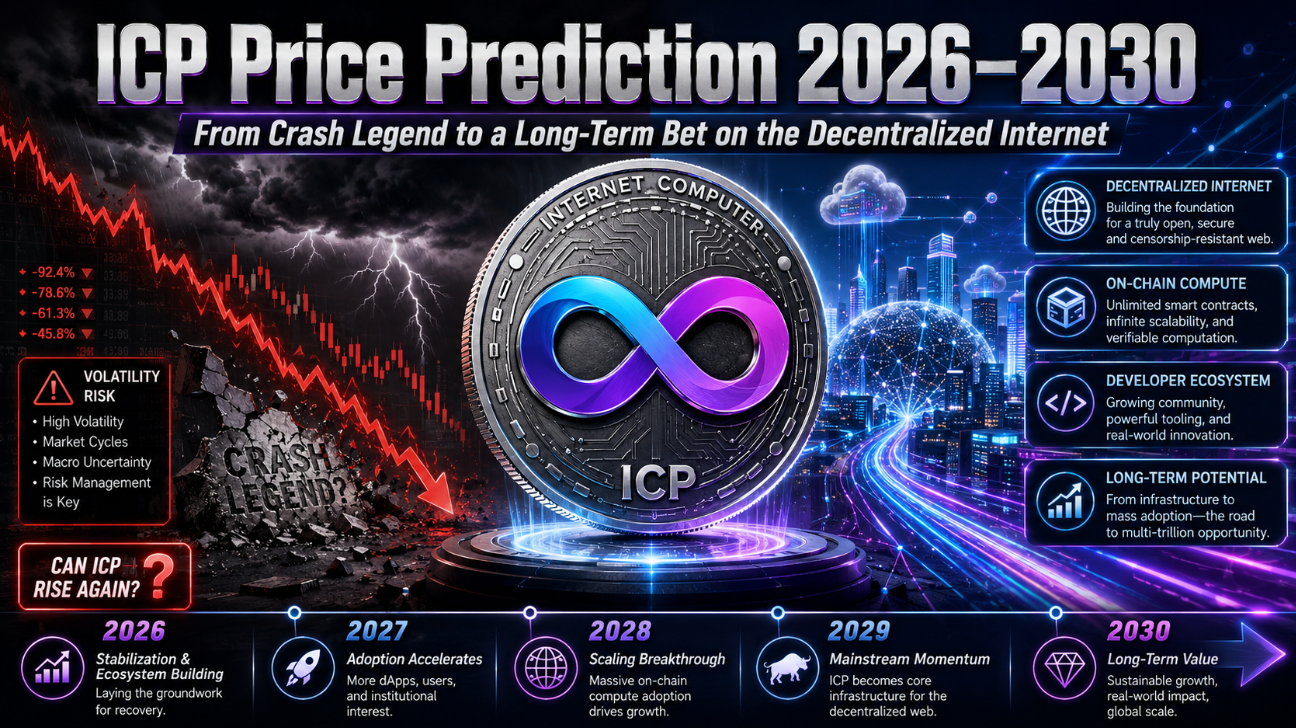
We will evaluate it in a more rational way:
- Is ICP's technical logic still valuable?
- Can the Internet Computer truly support Web3 applications?
- What does NNS staking and governance mean for ordinary investors?
- What are the possible price ranges for ICP from 2026 to 2030?
- How should newcomers manage their positions and risks on HiBT?
If you have previously read PYTH Price Prediction 2026–2030 , FIL Price Prediction 2026–2030 , and TIA Price Prediction 2026–2030 , you will notice a common theme: the coins truly worth researching are not those with the wildest short‑term swings, but those with a clear infrastructure logic behind them.
ICP is exactly that kind of project.
1. Why is ICP still worth serious analysis?
Many newcomers, when they see ICP, think:
"Didn't this coin drop from several hundred dollars? Is it even worth looking at?"
That question is understandable.
But investing cannot be based solely on all‑time highs.
Because historical highs can come from:
- Extremely low circulating supply at the initial listing
- Emotional bubbles during a bull market
- The effect of simultaneous exchange listings
- Excessively high market expectations
- Severe mismatch between early valuation and real adoption
The extreme price behavior of ICP in its early days does not directly represent its real value today.
What really matters is: Is the Internet Computer still being built? Is the ecosystem growing? Is there market demand for its technical roadmap?
ICP's core goal is to extend blockchain from "processing only financial transactions" to an infrastructure that can host complete applications. According to official documentation, ICP's Canister smart contracts contain not only code but also state data, enabling them to be used for websites, messaging apps, decentralized trading applications, and more.
In one sentence:
What ICP wants to do is not another Ethereum, but a decentralized cloud computing network that can run Web3 applications.
That is the biggest difference between ICP and many other blockchains.
Ethereum is more like a "decentralized financial settlement layer."
Solana is more like a "high‑performance transaction execution layer."
ICP, on the other hand, is trying to be a "decentralized AWS."
This direction is ambitious, but also very difficult.
2. ICP's technical logic: gimmick or real demand?
ICP's most core concept is the Canister.
Ordinary smart contracts are usually better suited for handling assets, transactions, and state changes.
A Canister is more like a computing unit that can run complete application logic. It runs as a WebAssembly module and has its own state, memory, and resource consumption mechanism.
This means that in theory, ICP can support:
- On‑chain websites
- Decentralized social applications
- On‑chain identity systems
- Web3 game backends
- AI application infrastructure
- Multi‑chain interaction services
This is the core of ICP's long‑term narrative.
But the problem is also obvious:
Strong technology does not guarantee that the market will pay for it.
ICP's biggest problem is not "can it do it?", but rather:
Why would developers abandon the more mature ecosystems of Ethereum, Solana, AWS, or Cloudflare and choose ICP instead?
If ICP cannot offer sufficiently low costs, a sufficiently good developer experience, and a strong user onboarding process, then its technological advantages will be hard to translate into price appreciation.
Therefore, investing in ICP cannot rely solely on "technical vision."
You must also look at:
- Number of active Canisters
- Number of real users
- Developer growth
- Application retention
- On‑chain revenue
- Quality of ecosystem projects
These are the key factors that will determine ICP's long‑term price.
3. NNS governance and staking: yield opportunity or liquidity trap?
ICP also has a very important mechanism: the NNS (Network Nervous System) governance system.
Users can stake ICP into Neurons, participate in network governance, and receive voting rewards.
That sounds appealing.
But newcomers must be aware:
ICP staking rewards are not a free lunch; the biggest cost is liquidity.
The voting power of ICP is influenced by factors such as the amount staked and the lock‑up period. According to official information, the Dissolve Delay Bonus increases with longer lock‑up times, capped at 8 years; the Age Bonus also increases over time, capped at 4 years.
In other words:
The longer you lock, the higher your governance weight and potential rewards.
But the problem is:
If you choose an 8‑year lock‑up and the price crashes during that period, you cannot exit flexibly.
If you need cash flow in the future, you will be in a very passive position.
Therefore, for newcomers, ICP staking should be viewed in three categories:
Category 1: Short‑term traders
Not suitable for long lock‑ups. Your core goal is liquidity and swing trading opportunities.
Category 2: Medium‑term holders
You can consider staking a small portion, but do not lock up all your ICP.
Category 3: Long‑term believers
If you truly believe that ICP will become the decentralized cloud computing infrastructure of 2030, you might consider longer‑term staking.
But the prerequisite is that this must be money you do not need to touch for more than five years.
4. Who are ICP's competitors?
ICP does not lack competition.
It faces a very complex market.
1. Filecoin
Filecoin is more focused on decentralized storage. It solves the problem of "where data is stored."
If you are interested in the decentralized storage track, you can refer to FIL Price Prediction 2026–2030 .
FIL and ICP are not exactly direct competitors, but both compete for Web3 infrastructure capital.
2. Arweave
Arweave focuses on permanent storage. It is more like a "decentralized archive."
If ICP handles application computing and Arweave handles permanent data storage, the two are partly complementary and partly competitive.
3. Near, Solana, Ethereum Layer 2
These chains place more emphasis on application ecosystems and user scale.
Although they are not "decentralized clouds," developers may prefer these ecosystems because they have more users and more mature tools.
4. AWS, Google Cloud, Cloudflare
These are ICP's biggest long‑term invisible competitors.
If centralized cloud services remain cheaper, more stable, and more compliant, most developers will have little incentive to migrate to ICP.
So for ICP to truly win, it needs to prove that decentralized hosting is not idealism, but a real business need.
5. 2026 ICP Price Prediction: Recovery window or continued bottoming?
The core question for ICP in 2026 is:
Is the market willing to re‑value ICP?
2026 could be a year of recovery.
If the overall market turns around and AI, Web3 infrastructure, and multi‑chain applications regain capital attention, ICP will have a chance to be re‑priced.
However, if the market remains conservative, ICP may continue to oscillate at low levels.
2026 ICP Price Range Prediction
Bear Case: $3 – $6
This scenario usually means:
- Overall crypto market is sluggish
- ICP ecosystem growth is not obvious
- Investors continue to avoid older, highly volatile projects
- The staking and governance narrative fails to attract new capital
In this range, ICP is more of a "trading existing supply" asset rather than a trending market.
Base Case: $8 – $15
This is a relatively reasonable neutral forecast.
It requires:
- BTC and ETH lead a market recovery
- The number of ICP ecosystem applications grows steadily
- The AI + on‑chain computing narrative begins to regain attention
- The market no longer views ICP solely as a "crashed coin"
In this scenario, ICP may not explode, but it could recover from undervaluation.
Bull Case: $20 – $35
This requires stronger catalysts:
- The ICP roadmap continues to deliver
- Real‑world cases of on‑chain AI applications appear
- The number of developers grows significantly
- The entire Web3 infrastructure sector strengthens
DFINITY's 2025 roadmap update mentioned directions such as the World Computer, Self‑Writing Internet, decentralized AI, multi‑chain integration, and developer experience improvements. If these enter a verifiable implementation phase by 2026, they could become important catalysts for ICP's re‑pricing.
6. HiBT Practical Tips: How to build your first ICP position in 2026?
Newcomers should not buy all at once.
A more reasonable approach is:
- First tranche: Use only 20%–30% of your planned capital
- Second tranche: Add on a retest of key support
- Third tranche: Add after trend confirmation
For example, if you plan to invest 1,000 USDT:
- First position: 200–300 USDT
- Second position: 300 USDT
- Third position: remaining capital waiting for a breakout or pullback
When trading on HiBT, it is not recommended to chase prices with market orders.
It is better to use limit orders to place bids in batches.
Especially for a volatile coin like ICP, it is easy to buy at a short‑term peak when emotions run high.
7. 2027 ICP Price Prediction: What are the real conditions for ecosystem explosion?
By 2027, the key factor determining ICP's price will not be how many visions the team has presented.
It will be whether the ecosystem has seen real growth.
To judge whether ICP has entered a genuine upward cycle, focus on three indicators:
1. Number of active Canisters
If the number of Canisters grows but most have no users, the significance is limited.
What matters more is whether active Canisters are growing.
2. Daily transactions and call volume
If users are actually using ICP applications, on‑chain interactions will increase.
This indicates that the ecosystem is not just spinning its wheels.
3. Developer growth
Developers are the long‑term lifeblood of any public blockchain.
Without developers, even the best underlying network will struggle to form an application ecosystem.
2027 ICP Price Range Prediction
Bear Case: $4 – $8
If by 2027 the ICP ecosystem still has not produced a breakout application, the market will continue to doubt its long‑term value.
In this case, ICP may only rebound in line with the broader market rather than rising independently.
Base Case: $15 – $28
In this scenario, ICP benefits from the AI and Web3 infrastructure narrative.
But it has not yet become a core target for mainstream capital.
Price appreciation comes mainly from:
- Valuation recovery
- Moderate ecosystem growth
- The AI theme driving interest
- Rotational capital flows into older projects
Bull Case: $40 – $65
This requires a true ecosystem breakthrough for ICP, such as:
- A hit on‑chain application
- AI applications running at scale on ICP
- Multi‑chain integration bringing in many new users
- Significant expansion of the developer community
If these conditions appear, ICP could transform from a "controversial old coin" into a "core asset of AI + Web3 infrastructure."
8. HiBT Practical Tips: If ICP reaches $40, how to take profits?
If ICP rises from low levels to $40, the biggest mistake newcomers should avoid is:
Continuously fantasizing that it will return to its all‑time high.
A more reasonable approach is a three‑stage profit‑taking plan:
- First stage: When the gain reaches about 100%, sell 20%–30%
- Second stage: Near a strong historical resistance level, sell another 20%–30%
- Third stage: Keep the remaining position and wait to see if the trend continues
The funds from profit‑taking can be split into two parts:
- One part converted to USDT to lock in profits
- One part converted to BTC or ETH to reduce portfolio volatility
ICP is suitable as a high‑risk enhancement position, not as the core of your entire portfolio.
9. 2028 ICP Price Prediction: Bull market peak or value return?
2028 is likely to be the year with the strongest cyclical sentiment.
But it is precisely at times like this that you must be most careful.
Because many people make the same mistake at the end of a bull market:
Mistaking a short‑term bubble for long‑term value.
If ICP surges in 2028, you need to judge where that increase comes from.
If it comes from:
- Real ecosystem growth
- Increased application revenue
- Developer expansion
- Growing demand for AI computing
Then the rise is healthier.
If it comes only from:
- Social media hype
- KOL shilling
- Rotational capital flows
- Emotional fantasies of "going back to $700"
Then the risk is extremely high.
2028 ICP Price Range Prediction
Bear Case: $8 – $15
If the market peaks early, ICP may only have a brief rebound before falling back.
In this case, chasing the price is very risky.
Base Case: $35 – $60
If the bull market develops normally and the ICP ecosystem grows to some extent, then $35–60 is a relatively understandable cyclical target range.
This range does not mean ICP has fully succeeded.
It means the market has re‑assigned it a relatively high valuation.
Bull Case: $80 – $130
This range requires strong narrative resonance:
- Explosion of the AI sector
- Revaluation of Web3 infrastructure
- The emergence of benchmark applications in the ICP ecosystem
- Significantly increased trading volume on major exchanges
But even if this range is reached, you should not blindly believe that ICP will necessarily return to its earlier extreme highs.
The highs of 2021 had a unique background and should not be simply extrapolated.
10. HiBT Practical Tips: How to defend when bear market signals appear?
If ICP has already risen substantially, be cautious when the following signals appear:
- Trading volume spikes but prices fail to make new highs
- KOLs collectively shout super‑high target prices
- A large number of newcomers start entering
- Whale addresses transfer funds to exchanges
- The ICP/BTC relative strength begins to weaken
There are two defensive methods:
Method 1: Direct batch profit‑taking
Suitable for newcomers. Simple, clear, low risk.
Method 2: Spot + futures hedging
Suitable for experienced users.
For example, you hold ICP spot and simultaneously open a small short position to hedge downside risk.
However, newcomers are not advised to easily use high leverage, because ICP is very volatile and a single wick can trigger liquidation.
11. 2029–2030 ICP Price Prediction: Long‑term value or relic of the past?
Whether ICP succeeds by 2030 depends on three variables.
1. Number of developers
Without developers, ICP is just a technology demonstration.
If the number of developers continues to grow, the ecosystem will have vitality.
2. Number of sovereign applications
ICP's strongest narrative is "decentralized application hosting."
Therefore, there must be a number of applications that genuinely do not rely on centralized cloud services.
3. Depth of AI integration
If AI applications in the future require decentralized computing, data sovereignty, and on‑chain verification, ICP may gain new opportunities.
But if AI applications continue to run mainly on centralized clouds, ICP's AI narrative will be weakened.
2029–2030 ICP Price Range Prediction
Bear Case: $2 – $8
Conditions:
- The technical roadmap becomes marginalized by the market
- Developer attrition
- Regulatory crackdown on decentralized hosting
- AI narrative fails to achieve real implementation
In this case, ICP may become "a once‑great story."
Base Case: $25 – $55
This is a realistic long‑term neutral scenario.
ICP does not become a global‑scale infrastructure, but retains a certain niche.
It may serve:
- Niche Web3 applications
- Decentralized identity
- On‑chain social media
- Multi‑chain services
- Some AI applications
In this scenario, ICP still has long‑term value, but is not necessarily a mainstream asset.
Bull Case: $100 – $200
This is a very aggressive prediction.
It requires ICP to truly become one of the core pieces of Web3 infrastructure.
Conditions include:
- Explosive demand for decentralized cloud computing
- AI applications begin migrating to on‑chain environments
- Multiple real, high‑user‑count applications appear in the ICP ecosystem
- Developer tools mature significantly
- Mainstream capital re‑values ICP
If all these conditions appear, ICP will have a chance to enter a triple‑digit long‑term valuation.
12. Is DCA into ICP worthwhile?
Suppose you start a monthly DCA of 50 USDT into ICP from 2026 to 2030.
Total principal over 5 years:
50 × 12 × 5 = 3,000 USDT
Three possible outcomes:
Bear Case
ICP remains depressed for a long time. Your principal could shrink significantly.
Conclusion: You should not DCA a heavy position into ICP.
Base Case
ICP enters a stable recovery cycle.
Long‑term DCA has a chance to generate decent returns.
Conclusion: A small, long‑term DCA could be considered.
Bull Case
ICP becomes a core narrative of Web3 infrastructure.
DCA returns could be very high.
Conclusion: High returns come from high uncertainty; do not treat it as a stable asset.
Compared to BTC and ETH:
- BTC is more suitable as a core position
- ETH is more suitable as a medium‑to‑long‑term growth position
- ICP is more suitable as a high‑risk satellite position
13. 6 Major Misconceptions About Investing in ICP
Misconception 1: Believing that because of its all‑time high, it must go back there
ICP's former highs had a unique market background.
Just because it once reached several hundred dollars does not mean it will return there.
Price is not memory. Price is the result of the market re‑valuing an asset.
Misconception 2: Equating strong technology with a rising token price
ICP's technology is indeed unique.
But price appreciation requires:
- Users
- Capital
- Applications
- Revenue
- Market consensus
Technology is only the foundation, not the whole story.
Misconception 3: Blindly locking for 8 years
8‑year staking may look like higher rewards, but liquidity risk is enormous.
If you need money in the future, or if the market changes significantly, a long lock‑up can put you in a very passive position.
Misconception 4: Trading ICP with high leverage on HiBT
ICP is highly volatile.
High leverage can turn normal fluctuations into liquidation risk.
The best strategy for newcomers is not to seek overnight riches, but to survive first.
Misconception 5: Looking only at ICP/USDT, not ICP/BTC
If ICP rises 20% but BTC rises 40%, ICP is actually underperforming the market.
To truly judge strength and weakness, look at ICP's performance relative to BTC and ETH.
Misconception 6: Treating a roadmap as a guaranteed commitment
A roadmap is a direction, not a promise.
Investors must look at actual delivery, not just official visions.
This is especially true for a complex project like ICP – pay close attention to the speed of execution.
Conclusion: ICP is not a coin for everyone
The core investment logic of ICP can be summarized in one sentence:
High technological vision, high uncertainty, high volatility – requires small positions, long time horizons, and strong discipline.
ICP is not suitable for:
- Those who want to get rich quickly
- Those who cannot stomach large drawdowns
- Those unwilling to learn the technical logic
- Those who like to go all‑in on a single bet
ICP is suitable for:
- Those who can accept a 5‑year time horizon
- Those willing to track ecosystem data
- Those who allocate small positions to high‑risk opportunities
- Those who understand the long‑term logic of Web3 infrastructure
Before you start trading ICP on HiBT, it is recommended to do three things:
First, determine your maximum allowable loss.
Second, set a plan for buying in batches and taking profits in batches.
Third, never let your ICP position exceed the portion of your total assets that you can afford to risk.
Price predictions will always be wrong.
But position management, stop‑loss discipline, and long‑term understanding – those are the things you can truly control.