
Risk Disclaimer: This article is for educational and operational-pathway purposes only and does not constitute any investment, legal, tax, or financial advice. QCOMB is a tokenized-stock-related asset that is exposed to both the price movements of Qualcomm’s underlying QCOM shares and to exchange liquidity, on-chain transfers, platform custody, and changes in the regulatory environment. Newcomers should always start with a small test amount and avoid chasing rallies with heavy positions.
1. What Exactly Is QCOMB? Is It the Same as QCOM on Nasdaq?
Many crypto newcomers who first see QCOMB naturally assume it means “Qualcomm stock has been put on the blockchain.” That direction is correct, but not fully precise.
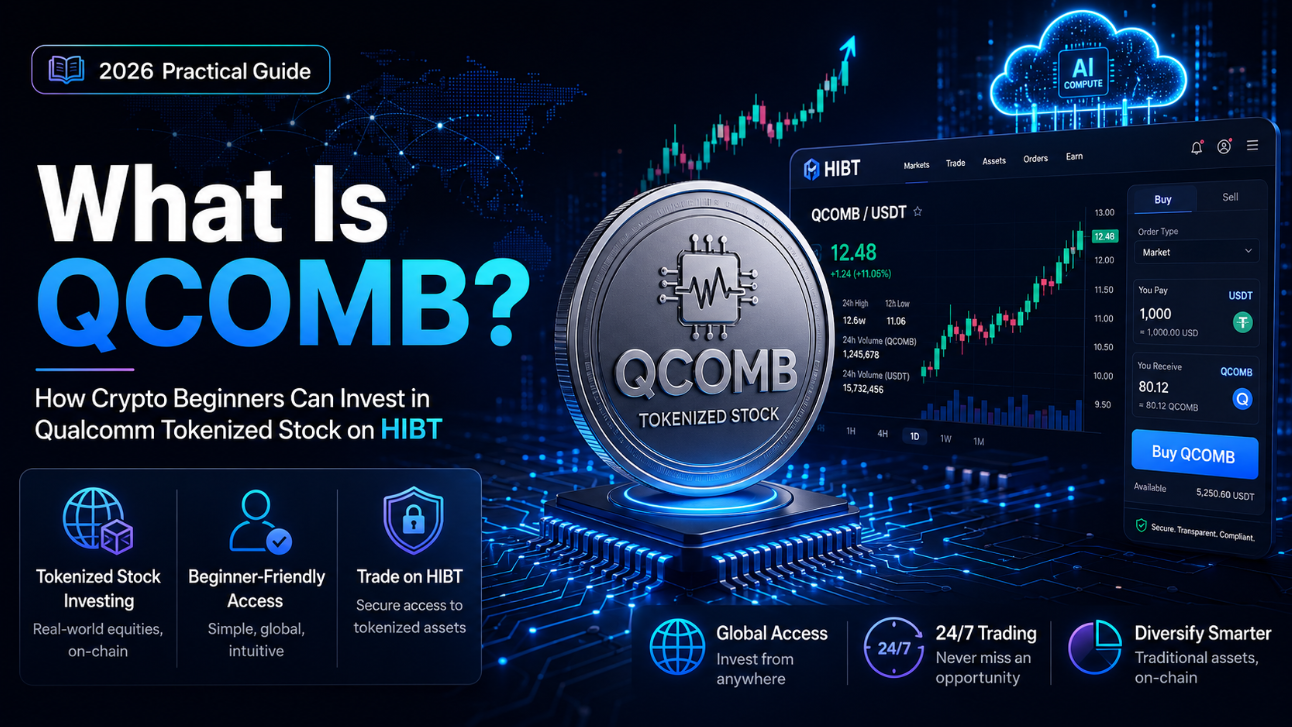
More rigorously, QCOM is the Nasdaq-listed ticker for Qualcomm Incorporated; QCOMB stands for Qualcomm Tokenized bStocks, a tokenized stock exposure built around the underlying Qualcomm QCOM shares. It is not a common stock directly issued by Qualcomm, nor is it an independent altcoin, and certainly not a meme coin priced purely by community sentiment.
The B in the ticker usually indicates membership in the bStocks tokenized stock system. According to Binance Academy’s explanation of bStocks, bStocks are tokenized securities issued by BTech Holdings Limited, each bStock backed 1:1 by the corresponding U.S. stock held by a regulated custodian, and issued as BEP-20 tokens running on BNB Smart Chain; at the same time, bStocks are not equivalent to directly holding the underlying company’s shares, but rather provide exposure tied to the underlying stock’s price performance and economic rights.
Therefore, the correct understanding of QCOMB is:
- It is not Qualcomm’s underlying stock itself;
- It is not an official company token issued by Qualcomm;
- It is not an ordinary crypto project token;
- It is a tokenized stock product designed around the QCOM underlying shares.
As of the time of writing, the CoinMarketCap page shows QCOMB’s name as Qualcomm Tokenized bStocks, the contract address displayed as 0x5f7a…2fefe1, and categorizes it under the Tokenized Assets and Tokenized Stock labels; Binance’s QCOMB price page also shows the same abbreviated contract address.
This matters for newcomers because, on BSC, anyone can create a similarly named token. If you only look at the name without verifying the contract, you may end up buying a fake QCOMB.
When verifying the QCOMB contract, it is recommended to check at least four points:
- Contract address: Does it match the official page, CoinMarketCap, and BscScan / block explorer?
- Token name: Is it “Qualcomm Tokenized bStocks,” rather than a misspelled imitation?
- Official links: Does the page include official trading pairs, official price pages, or authoritative market pages?
- Trading pair: Is the pair QCOMB/USDT on the exchange, rather than some unfamiliar contract or DEX pool?
Why was Qualcomm chosen as a tokenized underlying? The reason is not complicated: Qualcomm is not a small-cap concept coin, but a globally recognized chip company. It has both traditional mobile-phone chip, baseband, and patent-licensing businesses, and is continuously expanding in automotive chips, edge AI, AI PCs, and data-center AI chips. For RWA tokenized products, highly liquid, highly recognizable, large-cap U.S. companies like this are more suitable as underlying assets for tokenized stocks.
In other words, the core of QCOMB is not “speculating on a new coin,” but letting crypto users use their USDT accounts to gain exposure to Qualcomm stock price movements.
2. Qualcomm Fundamentals: How Did This Chip Giant Transform from a “Mobile Baseband Vendor” into an “AI Compute Player”?
To understand QCOMB, you cannot stare only at the on-chain price. The underlying anchor of QCOMB is the Qualcomm QCOM stock, and the price of Qualcomm’s stock ultimately depends on the company’s fundamentals, industry cycles, earnings performance, and U.S. tech-stock valuations.
Qualcomm’s strongest historical label is “mobile chip and baseband company.” But today’s Qualcomm is far more than a mobile chip supplier. Its business can be broken down into two main parts:
- QCT: Qualcomm CDMA Technologies – the chip business, covering mobile phones, automotive, IoT, AI PCs, data centers, and other hardware platforms.
- QTL: Qualcomm Technology Licensing – the technology licensing business, mainly derived from Qualcomm’s long-accumulated communication patents.
According to Qualcomm’s fiscal 2026 Q2 earnings report, total revenue for the quarter was $10.599 billion, down 3% year over year on a GAAP basis and down 2% on a Non-GAAP basis; QCT revenue was $9.076 billion, down 4% YoY, while QTL revenue was $1.382 billion, up 5% YoY.
From a structural perspective, QCT remains Qualcomm’s largest revenue source. What truly deserves attention is that the mobile-phone business is under pressure. In Qualcomm’s fiscal 2026 Q2, Handsets revenue was $6.024 billion, down 13% YoY; automotive revenue was $1.326 billion, up 38% YoY; and IoT revenue was $1.726 billion, up 9% YoY.
This set of data tells two things.
First, Qualcomm remains highly dependent on mobile chips.
Mobile revenue of $6.024 billion is still the largest revenue source within QCT. As long as the global Android phone cycle remains weak, OEMs continue destocking, memory prices rise, or the Chinese market underperforms, Qualcomm’s short-term revenue will be noticeably affected.
Second, automotive and IoT have become important growth drivers.
The 38% YoY growth in automotive revenue is critical. Qualcomm is not only making chips for mobile phones but also expanding in intelligent cockpits, in-vehicle connectivity, ADAS, and edge AI computing platforms. The advantage of the automotive business is longer product lifecycles, higher order visibility, and higher customer switching costs; the downside is slower mass-production ramp-up, unable to scale as quickly as flagship mobile chips.
Qualcomm management also noted in the Q2 earnings call that the company is navigating a “challenging memory environment,” and that Q3 guidance incorporates the impact of memory supply constraints and related pricing on demand from certain mobile OEMs; the company expects QCT mobile revenue from Chinese customers to bottom out in Q3 and recover sequentially in the following quarter.
This is why the market is simultaneously worried about Qualcomm’s mobile business yet willing to assign it an AI premium: the traditional mobile business is under short-term pressure, but automotive, IoT, AI PCs, and data centers are reshaping Qualcomm’s growth narrative.
More importantly, data-center AI chips. Reuters reported that Qualcomm expects its data-center chip business to contribute approximately $5 billion in revenue by fiscal 2027, and roughly $15 billion by 2029; the company also expects non-mobile chip revenue to reach approximately $40 billion by 2029.
This is not a completely baseless “pie in the sky,” but it also cannot be treated as already-realized profit. Entering the data-center chip market, Qualcomm faces strong competition from Nvidia, AMD, Broadcom, Marvell, Amazon, and Google. Its opportunity lies in low-power designs, edge AI technology accumulation, connectivity capabilities, and custom ASIC directions; the challenge lies in ecosystem, software stack, customer migration costs, and large-scale production validation.
As for the OpenAI-related narrative, for now it is better characterized as a “potential catalyst” rather than a certain revenue source. In April 2026, there were market reports about OpenAI collaborating with Qualcomm and MediaTek to develop AI-native device chips, but most of the information came from media and analyst clues rather than full commercial contract disclosures.
On the valuation front, as of July 8, 2026, QCOM’s latest price was approximately $182.97, with a market cap of about $196.1 billion and a P/E ratio of roughly 19.6x. The Yahoo Finance page showed QCOM’s market cap at approximately $201.356 billion and P/E at about 20.52x, but target-price data may differ across pages and timestamps. StockAnalysis’s aggregated data from 37 analysts showed an average target price of about $215.42 for QCOM, with a Hold rating.
This means Qualcomm is not the kind of pure-concept AI stock trading at hundreds of times price-to-sales. It has mature cash flows, dividends, buybacks, patent licensing, and large-scale chip revenue, but it also faces mobile-phone cycles, Apple’s self-developed baseband replacement, and intense competition in AI data centers. Reuters has reported that Apple plans to advance its own modem development and aims to challenge Qualcomm’s related technology around 2027; this remains one of Qualcomm’s long-term fundamental risks.
So, Qualcomm’s fundamentals can be summarized in one sentence:
It is a mature chip giant whose valuation is not as exaggerated as pure AI concept stocks, but whether it can achieve a higher valuation depends on whether automotive, AI PCs, edge AI, and data-center chips can truly offset the cyclical pressure of the mobile business.
3. Tokenized Stock Mechanics: How Does QCOMB “Represent” Qualcomm’s U.S. Stock on BSC?
The underlying logic of QCOMB is to package the traditional U.S. stock QCOM’s price exposure into a BEP-20 token that can circulate on BNB Smart Chain.
The traditional path is: you open an account at a broker, deposit USD, and buy QCOM during Nasdaq trading hours.
The tokenized path is: the issuer and custodial structure build a backing relationship around the QCOM underlying shares, then issue QCOMB, allowing users to trade this tokenized stock exposure through their crypto trading accounts.
A few key points from the bStocks documentation: each bStock is backed 1:1 by real U.S. stocks; the underlying stocks are held by a regulated custodian; bStocks are BEP-20 tokens on BNB Smart Chain; and some eligible users may perform 1:1 conversions or self-custody.
But newcomers must remember: 1:1 backing does not equal zero risk.
Because what you hold is not QCOM common stock in a traditional brokerage account, but a tokenized asset jointly constituted by the issuer, custodian, exchange, on-chain contract, and redemption mechanism. If any link in the chain goes wrong, holders may be affected.
For example:
- Legal or operational issues at the issuer or custodial structure;
- The exchange suspending deposits, withdrawals, redemptions, or trading;
- Anomalies in the on-chain contract or user mis-transfers;
- Large price deviations from the underlying stock during U.S. market closures;
- Insufficient order book depth leading to widened slippage on buy/sell orders.
Another very important time gap: U.S. stocks do not trade 24/7. Nasdaq’s official trading hours are Monday–Friday, 9:30 AM–4:00 PM ET; pre-market is 4:00–9:30 AM ET, and after-hours is 4:00–8:00 PM ET. But tokenized stocks on crypto exchanges may support longer trading windows, which creates premiums and discounts.
- When the U.S. market is open, QCOMB’s fair price should generally track the QCOM underlying stock price as closely as possible.
- When the U.S. market is closed, QCOMB’s price is driven more by the exchange’s order book, market expectations, latest news, market-maker quotes, and arbitrage capital.
- If Qualcomm releases earnings, partnership news, or risk events after the close, QCOMB may react first in the crypto market, but it is also more prone to excessive volatility.
A simple formula to judge whether QCOMB is reasonable:
QCOMB Premium / Discount = (QCOMB Current Price ÷ QCOM Underlying Reference Price) − 1
For example, if the QCOM underlying reference price is $183 and the QCOMB spot price is $190, then QCOMB is trading at roughly a 3.8% premium. Unless you are very confident about a major positive catalyst, it is not advisable to chase when the premium is obvious.
Conversely, if QCOMB is more than 5% below the QCOM underlying stock, it is not necessarily a “bargain.” The discount may stem from insufficient liquidity, redemption friction, market-maker quote tightening, platform restrictions, or short-term panic.
The core of tokenized stocks is not “always equal to the U.S. stock price,” but rather to use custody, market making, arbitrage, and redemption mechanisms to keep the on-chain price orbiting around the underlying stock price.
4. Why Would a Crypto User Buy QCOMB on HIBT Instead of Opening a Traditional Brokerage Account?
For users who already hold USDT, the biggest appeal of QCOMB is the short path.
Buying QCOM through a traditional broker typically involves these steps:
- Account opening;
- Identity verification;
- Filling out investment experience, risk tolerance, and tax documentation;
- Linking a bank account or initiating a cross-border wire transfer;
- Waiting for funds to arrive;
- Currency conversion into USD;
- Waiting for U.S. market trading hours;
- Placing an order to buy QCOM.
Take Interactive Brokers as an example: its official documentation states that fund arrival may depend on the bank and transfer method, taking up to four business days at the longest; wire transfers may also range from instant to four business days depending on the bank.
If you already hold USDT on-chain or on an exchange, and HIBT has opened the QCOMB/USDT trading pair, the path becomes much closer to:
- Register on HIBT;
- Deposit USDT;
- Search for QCOMB/USDT;
- Buy QCOMB with USDT;
- Sell later to convert back to USDT.
HIBT’s Chinese-language market page already shows the QCOMB/USDT page and a “Go to Trade” entry, but real-time price, volume, and order book depth should be verified on the spot trading page after logging in. Before checking QCOMB’s live market data, it is recommended to first visit QCOMB Live Price & Market to get an intuitive feel for the current order book depth and bid–ask spread.
On fees, HIBT’s Help Center shows that the standard spot trading maker fee is 0.2% and the taker fee is 0.2%, with the fee calculated as the total value of the acquired asset multiplied by the rate; if the platform adjusts fees later, follow HIBT’s announcements.
This offers some advantage for small investors: no need to convert to USD first, no need to stay up late waiting for the U.S. market to open, and no need to go through a full broker deposit process for a small position.
But it is not a “cost-free advantage.” You need to additionally bear:
- Exchange account risk;
- USDT deposit network selection risk;
- Tokenized stock redemption and regulatory risk;
- QCOMB vs. QCOM underlying premium/discount risk;
- Platform order book depth risk and slippage.
Therefore, the HIBT path is more suitable for users already familiar with USDT, exchange spot trading, and on-chain transfers. Traditional U.S. stock investors who place more value on full shareholder rights, broker regulatory protection, and long-term holding records may still find the traditional brokerage path clearer.
5. HIBT Walkthrough: A Complete 8-Step Process from Registration to Buying QCOMB
The following is a more conservative operational workflow from a newcomer’s perspective. Pages may vary by country/region, account level, and time; always refer to the real-time display on the HIBT App or web version.
Step 1: Register a HIBT account.
Usually, you can register with an email or phone number, set a login password, and complete email/SMS verification. It is recommended to use a long-term, stable email address, not a temporary one. The first thing after registration is not to deposit, but to enable security settings such as Google Authenticator, a fund password, and an anti-phishing code.
Step 2: Complete necessary verification.
Whether KYC is mandatory, and to what level KYC is required for depositing, trading, and withdrawing, depends on HIBT’s current rules. Newcomers should not wait until after buying to discover withdrawal restrictions; confirm account permissions before depositing.
Step 3: Deposit USDT.
HIBT’s official deposit tutorial shows that, taking USDT as an example, users first need to select the deposit currency and then the deposit network; different networks have different speeds and fees. The tutorial notes that USDT-TRC20 represents the TRON network, USDT-ERC20 represents the Ethereum network, and USDT-OKC represents the OKChain network.
Step 4: Confirm the network matches.
This is the most error-prone place. When you withdraw USDT from an external wallet or another exchange to HIBT, you must ensure that the “withdrawal network on the external platform” and the “deposit network on HIBT” are the same. HIBT’s tutorial explicitly warns that different networks are not interoperable, and choosing the wrong network may cause a deposit failure; incorrect blockchain transfer information or network selection may result in unrecoverable assets.
Step 5: Start with a small test.
Do not make a large transfer for the first deposit. It is recommended to test the deposit process with 10–30 USDT first, confirming arrival speed, network, address, and asset display are all correct. Only after the small test succeeds should you consider a formal deposit.
Step 6: Search for QCOMB in the spot trading zone.
Enter the spot trading zone and search for “QCOMB” or “QCOMB/USDT.” If the page shows similar tickers at the same time, prioritize confirming that the name is Qualcomm Tokenized bStocks, the trading pair is QCOMB/USDT, and it comes from HIBT’s official spot trading page.
Step 7: Use a limit order for the first trade.
Newcomers are not recommended to use a market order right away, especially when order book depth is uncertain. Tokenized stocks usually have lower liquidity than mainstream coins like BTC, ETH, or SOL, and a large market order may sweep through the order book, causing slippage. A more conservative approach is to first check the bid–ask spread, then place a limit order near a reasonable price level.
Step 8: After buying, record your cost and the underlying reference price.
After buying QCOMB, record at least four data points: purchase price, quantity, fee, and the QCOM underlying reference price at the time. Only then can you judge whether your entry was at par, a premium, or a discount. For later exit, you can generally sell QCOMB in the spot market back to USDT; if the platform supports withdrawing QCOMB to a BSC wallet, you also need to prepare BNB for on-chain gas and confirm the wallet network is BNB Smart Chain.
For a newcomer’s first trade, it is recommended to use only a very small amount—not because QCOMB is unworthy of attention, but because what you are truly testing is the complete workflow: registration, verification, deposit, searching, placing an order, execution, checking positions, selling, and withdrawing. Getting the workflow right is more important than how much you make on the first trade.
6. QCOMB vs. TCCBSC vs. FLOKI: They Are Completely Different Asset Classes
Many crypto newcomers call everything tradable on an exchange a “coin.” But from an asset-logic perspective, QCOMB, TCCBSC, and FLOKI are entirely different things.
QCOMB is a tokenized stock exposure. Its core pricing anchor is the underlying Qualcomm QCOM stock, and its influencing factors include Qualcomm’s earnings, mobile chip cycles, automotive business growth, edge AI, AI PCs, data-center chips, Apple’s self-developed baseband, U.S. tech-stock valuations, and overall Nasdaq risk appetite.
TCCBSC belongs to another category of tokenized asset logic. If you are not yet familiar with the classification of tokenized assets, you can first learn about what TCCBSC is, which represents a completely different tokenized asset structure.
FLOKI, on the other hand, is a community-driven token. Its price is influenced more by meme culture, community heat, exchange liquidity, ecosystem narratives, and short-term market sentiment. Friends interested in community tokens can also check out what FLOKI is; after comparing them, you will understand more clearly what QCOMB’s “stock-like attributes” mean.
The biggest difference among the three lies in their pricing logic:
- Meme coins mainly depend on sentiment, traffic, community consensus, and short-term capital flows;
- Tokenized stocks mainly depend on the underlying stock’s performance, earnings, valuation, and macro markets;
- Ordinary project tokens also depend on on-chain ecosystem, tokenomics, unlocks, governance, and use cases.
Therefore, you cannot hold QCOMB with a “double-your-money-and-pull-out-the-principal” coin-trading mindset. A more reasonable approach is to place it in a “U.S. tech-stock exposure,” “chip blue-chip exposure,” or “RWA allocation basket,” rather than treating it as a short-term get-rich-quick tool.
If you hold both QCOMB and FLOKI on HIBT, you can divide them this way:
- QCOMB is an allocation position, with its core thesis driven by Qualcomm fundamentals and U.S. stock risk appetite.
- FLOKI is a speculative position, with its core thesis driven by community heat and meme cycles.
- The two cannot use the same take-profit / stop-loss logic.
- Even more so, you cannot expect QCOMB to pump like a meme coin just because FLOKI might spike in the short term.
If you want to further explore QCOMB’s future price direction, you can refer to the QCOMB Price Prediction page, but note: HIBT’s price prediction page explicitly states that “all price predictions are generated based on user feedback,” so it is more suitable as an observation tool rather than an investment promise.
7. Risk Checklist: Five Real Questions You Must Face Before Buying QCOMB
1. Underlying stock fundamental risk.
If the QCOM underlying stock drops 30%, QCOMB will theoretically follow. QCOMB is not a stablecoin and not a capital-protected product. Qualcomm still relies heavily on the mobile business, and the Q2 earnings report showed Handsets revenue down 13% YoY, indicating that mobile-cycle pressure is real.
2. Apple self-developed baseband replacement risk.
Apple has long sought to reduce its dependence on Qualcomm’s baseband chips. Reuters reported that Apple plans to advance its own modem development and aims to challenge Qualcomm’s related technology around 2027. If Apple’s substitution progresses faster than the market expects, Qualcomm’s mobile and licensing revenue could come under pressure.
3. AI data-center expectation risk.
Qualcomm’s data-center business targets are attractive, but targets do not equal realized revenue. It faces competition from Nvidia, AMD, Broadcom, Marvell, and cloud vendors’ self-developed chips. If customer validation falls short, the ecosystem is immature, or cost advantages are not obvious, the AI valuation premium may contract.
4. Price depeg risk.
When the U.S. market is closed, platform liquidity is insufficient, market-maker quotes shrink, or major news breaks, QCOMB may trade at a premium or discount of more than 5% relative to the QCOM underlying stock. When newcomers encounter this, do not immediately assume it is an opportunity; first confirm the QCOM underlying stock’s latest price, whether the U.S. market is open, whether order book depth is adequate, and whether the platform has any deposit or withdrawal restrictions.
5. Platform and redemption risk.
When you buy QCOMB on HIBT, you are trusting the platform’s trading system, risk control, cold wallets, deposit/withdrawal processes, abnormal market handling, and customer service. If you hold a balance in your platform account rather than tokens already withdrawn to a self-custody wallet, you also need to consider additional exchange account risk.
6. Legal and compliance risk.
Mainland China maintains a strict prohibition on virtual currency and related trading activities. The 2021 Notice on Further Preventing and Handling the Risks of Virtual Currency Trading Speculation clearly states that virtual currencies do not have the same legal status as fiat currency, that virtual-currency-related business activities are illegal financial activities, and that overseas virtual-currency exchanges providing services to mainland residents via the internet are also considered illegal financial activities.
If you are located in mainland China or subject to relevant regulations, participating in virtual-currency trading, tokenized securities trading, or overseas exchange activities may involve compliance risks. This article is not encouraging regulatory evasion, but reminding you: before considering returns, first confirm whether your jurisdiction allows such transactions.
7. Operational risk.
The three most common mistakes for newcomers are: entering the wrong contract address, selecting the wrong network, and sweeping the order book with a heavy market order. The avoidance methods are simple: only enter trading pairs from the official page; verify the network before depositing; test with a small amount first; prioritize limit orders; and do not chase rallies when QCOMB is trading at a clear premium.
8. Investment Strategies: Is QCOMB Suitable for Dollar-Cost Averaging, Swing Trading, or Long-Term Allocation?
QCOMB is not for everyone. It is better suited for three types of users:
- Those who already understand U.S. stock volatility;
- Those familiar with USDT deposits and exchange spot trading;
- Those who want to use their crypto account to allocate chip or U.S. tech-stock exposure.
As of July 8, 2026, the QCOM underlying stock price was approximately $182.97, with a market cap of about $196.1 billion and a P/E of roughly 19.6x. CoinMarketCap showed the QCOMB price at approximately $185.70, with 24-hour trading volume of about $592,000; HIBT’s QCOMB price prediction page showed the current price at approximately ¥1,260.86, but the prediction page itself also warned that predictions are based on user feedback and should not be treated as a deterministic target price.
If we use the StockAnalysis-aggregated QCOM average target price of $215.42 as a reference, that represents roughly a 17%–18% theoretical upside from $182.97; but analyst target prices are not guaranteed returns, nor are they maturity promises.
More conservative strategies can be divided into three types.
Type 1: Dollar-cost averaging (time-based).
Suitable for those bullish on Qualcomm’s long-term transformation but who do not want to watch the market every day. You can buy a fixed small amount weekly or monthly, reducing timing pressure. The downside is that if Qualcomm’s valuation de-rates, the early stages of averaging may also show sustained unrealized losses.
Type 2: Drawdown-based accumulation.
Suitable for those willing to wait for price. For example, start with a 20% base position, then add in batches when QCOM or QCOMB pulls back 10%, 15%, or 25% from a recent high. This method is more disciplined than chasing rallies, but the prerequisite is that you can actually follow the rules—not panic when it drops and not chase when it rallies.
Type 3: Rebalancing.
Suitable for those who already have a crypto asset portfolio. You can keep QCOMB within 3%–10% of total assets, selling a portion when it rises too much and buying back when it falls below the target ratio. The focus is not on predicting short-term moves, but on preventing a single asset from disproportionately affecting the entire account.
As for how much QCOMB should account for in a total crypto portfolio, newcomers are advised not to exceed 5%–10%. If you have no prior tokenized stock experience, you can start with 1%–3%. Because even though QCOMB is backed by a mature U.S. company like Qualcomm, your holding path is still a tokenized asset in a crypto exchange account.
Earnings seasons require extra caution. The Yahoo Finance page shows that Qualcomm’s next earnings date is expected around July 29, 2026. Before and after earnings, the QCOM underlying stock may swing violently based on revenue, guidance, gross margin, mobile demand, and AI data-center outlook, and QCOMB will follow. Newcomers without earnings-trading experience are not advised to make heavy directional bets before the report.
9. Conclusion: QCOMB Is Not a Get-Rich-Quick Tool, but an On-Ramp to the RWA Era
The most valuable thing about QCOMB is not whether it can double in the short term, but that it allows crypto users to more intuitively understand this: in the future, more and more real-world assets may enter crypto accounts in on-chain form.
- Stocks can be tokenized;
- Government bonds can be tokenized;
- Gold can be tokenized;
- Funds, indices, hashrate contracts, and private equity may also come on-chain in different forms.
This is the long-term trend of RWA.
But a correct trend does not mean every product is safe. Putting assets on-chain does not make risk disappear; 24/7 trading does not mean it is easier to make money; buying U.S. stock exposure with USDT does not mean you have the full shareholder rights of a traditional brokerage account.
After reading this article, the thing you should do most is not to immediately load up on a heavy position, but to complete three things:
First, verify the asset.
Confirm the relationship between QCOMB and QCOM, check the official page, CoinMarketCap, BscScan / block explorer, and the HIBT trading page, and do not buy a fake contract.
Second, test with a small amount.
Use the smallest possible amount to run through the complete HIBT workflow: registration, verification, deposit, searching, limit-order placement, position checking, selling, and withdrawal.
Third, build a watchlist.
Track Qualcomm earnings over the long term, QCT mobile revenue, automotive business growth, AI data-center orders, Apple self-developed baseband progress, QCOM underlying valuation, QCOMB premium/discount, and HIBT order book depth.
QCOMB is not a “crypto get-rich-quick button,” but an entry point for crypto users to access Qualcomm stock exposure and the RWA tokenization trend. Mature investors do not only ask “will it go up,” but first ask:
- What exactly am I buying?
- What drives its price?
- What extra risks am I taking on?
- If the underlying stock drops 30%, will I still know why I hold it?
Being able to answer these questions before considering a purchase is the real sign that a newcomer is beginning to advance.