
Introduction: When Crypto Users Want to Ride the AI Wave, Are There More Stable Options Beyond Trading Altcoins?
Over the past two years, AI has become the dominant narrative shared by both crypto and the U.S. equity markets.
In the crypto space, concepts like AI Agents, DePIN compute, decentralized AI models, AI data labeling, and AI Meme coins have come and gone in waves. Their characteristics are high volatility, strong storytelling, and thrilling upside when they rally—but the risks are equally obvious: many projects have no stable revenue, no mature customer base, and no long-term earnings track record to validate them.
If a crypto user wants exposure to the AI and cloud computing sectors, is there an option closer to "real business revenue" beyond buying various AI-themed tokens?
Microsoft is the most representative example.
Microsoft is not a project that lives on pitch decks and hype. It is a global technology giant spanning cloud computing, enterprise software, productivity subscriptions, gaming, security, developer tools, and AI infrastructure. Microsoft’s full fiscal year 2025 revenue reached 281.7 billion**, with operating income of **128.5 billion. Azure full-year revenue exceeded $75 billion for the first time, growing 34% year-over-year.
For crypto users, the biggest difference between Microsoft and AI-themed tokens is that AI is not Microsoft’s only story. It is a growth engine layered on top of mature businesses like Azure, Microsoft 365, GitHub, Windows, Dynamics, LinkedIn, and Xbox.
MSFTB offers crypto users a new path: without opening a separate U.S. brokerage account or converting USDT into USD, you can gain exposure to Microsoft’s stock price performance through the MSFTB/USDT trading pair on HIBT. According to HIBT’s announcement, the platform has listed MSFTB (Microsoft Tokenized bStocks), with the trading pair MSFTB/USDT, token type BSC. Trading opened on July 1, 2026, at 15:00 (UTC+8), and withdrawals opened on July 2, 2026, at 15:00 (UTC+8).
But let’s be clear first: MSFTB is not a regular altcoin, not a cryptocurrency officially issued by Microsoft, and not equivalent to directly holding MSFT shares in a Nasdaq account. It belongs to the category of tokenized stocks, a form of RWA (Real World Assets) tokenization. It carries both the price fluctuations of Microsoft’s underlying stock and the risks associated with tokenized securities, trading platforms, on-chain transfers, custody, liquidity, and regulation.
This article explains, from the perspective of a crypto newcomer:
- What exactly is MSFTB?
- How does it differ from MSFT common stock?
- Why is Microsoft called the "shovel seller" of the AI era?
- How to buy MSFTB through HIBT?
- What risks must you know before buying?
I. MSFTB Fundamentals: Is It Microsoft Stock or Just Another Crypto Token?
1. MSFTB Is Not a Regular Cryptocurrency—It Is Tokenized Exposure to Microsoft Stock
One-sentence explanation of MSFTB:
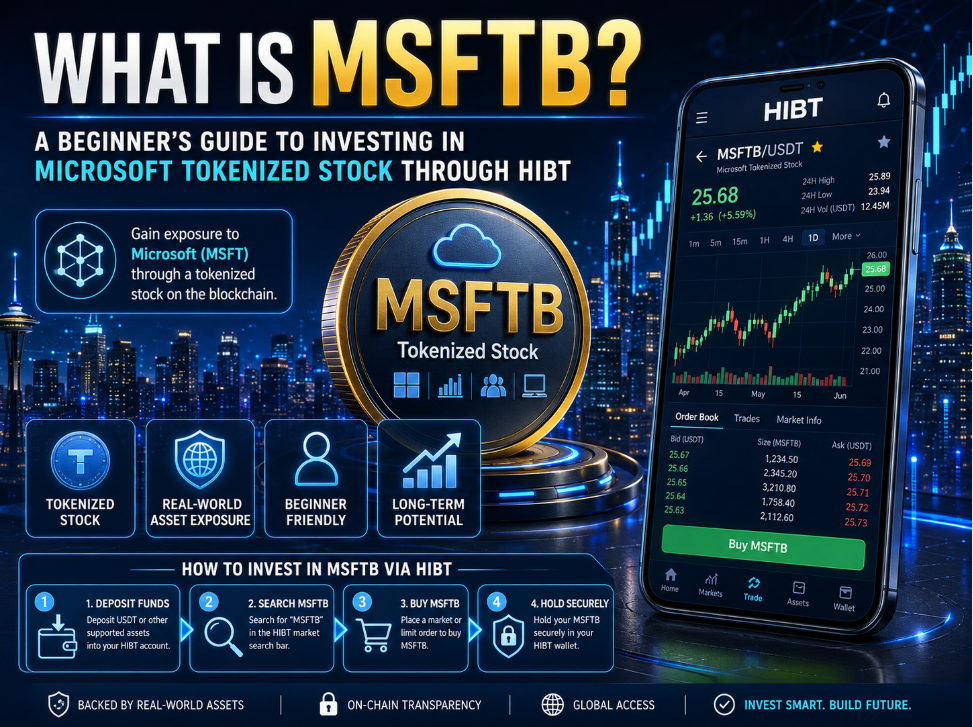
MSFTB is a tokenized security product designed around Microsoft stock (MSFT), allowing users to gain economic exposure to Microsoft’s stock price performance within a crypto trading environment using USDT.
There are three layers to distinguish.
Layer 1: MSFT MSFT is Microsoft’s ticker on the Nasdaq. Buying MSFT through a traditional broker means holding Microsoft stock within the conventional securities system.
Layer 2: MSFTB MSFTB stands for Microsoft Tokenized bStocks, the tokenized version of Microsoft under the bStocks framework. Public disclosures from bStocks indicate that these products are issued by BTech Holdings Limited as Certificates representing specific financial instruments. Each bStock is backed 1:1 by the corresponding underlying stock, but bStocks themselves are not stocks or equity shares, and holders do not directly own the underlying listed company’s shares.
Layer 3: HIBT HIBT provides the MSFTB/USDT spot trading gateway. According to HIBT’s announcement, MSFTB is listed on the platform as the MSFTB/USDT pair, token type BSC, with links to the bStocks official website and the BscScan block explorer.
So, a more accurate understanding of MSFTB is not "Microsoft issued a coin," but rather:
- MSFTB is a tokenized security tied to Microsoft stock;
- It provides economic exposure to MSFT price performance;
- Holding MSFTB does not make you a registered shareholder of Microsoft;
- Its price is influenced not only by MSFT but also by the issuer, custodian, trading platform, on-chain transfers, and regulatory rules.
2. What Is the Difference Between MSFTB and MSFT Common Stock?
MSFT is a traditional U.S. stock.
MSFTB is a tokenized stock.
MSFT trades on the Nasdaq, typically requiring a traditional securities account, USD funding, broker onboarding, trading permissions, and U.S. market hours. MSFTB, on the other hand, is quoted in USDT within a crypto trading environment, making it more accessible to users already holding stablecoins and familiar with token-to-token trading interfaces.
The core difference is not price—it is rights structure.
If you buy MSFT common stock, you are operating within the traditional securities system: brokers, clearinghouses, registry systems, shareholder rights, dividend rules, voting rights, and regulatory protection.
If you buy MSFTB, you are operating within the tokenized securities system: issuer, underlying asset custody, exchange matching, on-chain contracts, deposits and withdrawals, regional restrictions, and compliance documentation.
bStocks’ official disclosures emphasize 1:1 backing and on-chain transferability, but they also clearly state that bStocks are not stocks or shares and do not allow holders to directly own the underlying listed company’s shares or equity.
Therefore, newcomers evaluating MSFTB should not only ask, "Does it track MSFT price?" but also:
- Who issued this token?
- How are the underlying Microsoft shares custodied?
- Does it support deposits and withdrawals?
- Can it be transferred on-chain?
- Is trading permitted in my jurisdiction?
- What are my rights in extreme scenarios involving the platform or issuer?
3. How Does a Tokenized Stock Achieve 1:1 Pegging to the Real Stock?
The core design of bStocks is to use tokenization to represent the economic exposure of underlying stocks or ETFs.
Public disclosures show that bStocks are issued by BTech Holdings Limited. Each bStock is backed 1:1 by the corresponding underlying stock, with the underlying assets held by a regulated custodian. Users can also convert between underlying stocks and bStocks under supported rules.
But "1:1 pegging" must not be misunderstood as "no risk."
A more accurate understanding is:
- Price design: MSFTB should fluctuate around the value of MSFT common stock;
- Asset backing: bStocks emphasize underlying stock support;
- Rights structure: MSFTB is not Microsoft common stock itself;
- Extreme scenarios: The peg can still be affected by platform liquidity, redemption mechanisms, custody arrangements, and regulatory restrictions.
This is similar to stablecoins. USDT is pegged to the U.S. dollar, but holding USDT is not the same as holding USD in a bank account. MSFTB is pegged to Microsoft stock exposure, but holding MSFTB is not the same as directly holding Microsoft stock.
4. How Does Microsoft Actually Make Money?
Many newcomers only know Microsoft for Windows and Office, but today’s Microsoft is far more than an operating system company.
Microsoft’s current revenue can be divided into three major segments:
- Productivity and Business Processes: Core products include Microsoft 365, Office, Teams, LinkedIn, and Dynamics 365.
- Intelligent Cloud: Core products include Azure, server products, enterprise cloud services, and AI infrastructure.
- More Personal Computing: Core products include Windows, devices, search advertising, and Xbox content and services.
Microsoft’s Q3 FY2026 earnings report showed quarterly revenue of 82.9 billion**, up **18%** year-over-year; net income of **31.8 billion, up 23%; Microsoft Cloud revenue of $54.5 billion, up 29%; and Azure and other cloud services revenue up 40%.
This makes Microsoft’s growth engine clear: it is not relying solely on Windows or Office, but on the compound growth of "cloud computing + AI + enterprise software subscriptions."
5. Why Is Microsoft Called One of the Biggest "Shovel Sellers" of the AI Era?
During the Gold Rush, the most stable business was not panning for gold—it was selling shovels.
The AI era is the same. Many AI application companies are fighting for users and use cases, but the ones that truly make sustained profits are often those providing underlying cloud compute, enterprise software entry points, developer tools, and data infrastructure.
Microsoft is positioned exactly across these layers:
- Azure provides cloud computing and AI infrastructure;
- Microsoft 365 integrates Copilot into Word, Excel, PowerPoint, Outlook, and Teams;
- GitHub Copilot targets developers;
- Dynamics 365 and Power Platform target enterprise workflows;
- The OpenAI partnership strengthens Microsoft’s strategic position in the large model era.
In Microsoft’s Q3 FY2026 earnings, CEO Satya Nadella stated that the company’s AI business annualized revenue run rate exceeded $37 billion, up 123% year-over-year.
Microsoft also noted that Microsoft 365 Commercial cloud revenue grew 19%, driven by higher average revenue per user (ARPU) from Microsoft 365 E5 and Microsoft 365 Copilot.
This is the key difference between Microsoft and many AI-themed tokens:
- AI-themed tokens rely more on expectations and market narratives;
- Microsoft’s AI growth has already entered cloud revenue, software subscriptions, enterprise contracts, and earnings metrics;
- But given Microsoft’s massive scale, its upside elasticity is typically lower than small-cap AI tokens;
- So MSFTB is better suited as an AI tech blue-chip holding, not a short-term get-rich-quick tool.
II. Why Should Crypto Users Allocate to MSFTB on HIBT?
1. MSFTB Lowers the Barrier for Crypto Users to Access U.S. Tech Giants
Buying MSFT through a traditional broker typically requires registering an account, completing identity verification, linking a funding method, currency exchange, waiting for funds to settle, and then entering the U.S. stock market during trading hours.
For users already holding USDT, this path is not convenient. You need to move from on-chain assets back into the fiat system, then into a securities account, potentially involving foreign exchange costs, cross-border deposits, bank card restrictions, broker reviews, and trading session limitations.
HIBT’s MSFTB offers an alternative: trade MSFTB/USDT directly with USDT.
This provides several practical advantages for crypto users:
- No need to convert USDT into USD first;
- No need to open a separate traditional U.S. brokerage account;
- Operate within a familiar spot trading interface;
- Add Microsoft as an AI tech blue-chip exposure to your portfolio;
- Manage it alongside BTC, ETH, stablecoins, and other RWA assets.
HIBT’s official registration tutorial shows that users can open the website, click the registration button in the top-right corner, register with a phone number or email, and complete account creation with a verification code.
2. 7×24 Trading Experience, Closer to Crypto Habits
Crypto users are accustomed to 7×24 trading: checking charts anytime, placing orders anytime, adjusting positions anytime.
Traditional U.S. stocks have fixed trading sessions. Even with pre-market and after-hours trading, newcomers may not have smooth access.
One of the attractions of tokenized stocks is placing traditional equity assets into a trading environment closer to crypto. HIBT’s announcement states that MSFTB is a BSC-type asset, supporting deposit, trading, and withdrawal schedules, meaning it carries both on-chain asset properties and platform trading properties.
But a necessary reminder: 7×24 trading does not mean Microsoft’s underlying stock trades 7×24.
When the U.S. market is closed, MSFTB prices may be influenced more by intra-platform buy/sell orders, market maker liquidity, news expectations, user sentiment, and premium/discount dynamics. In other words, MSFTB trading is more flexible, but its price may not always tightly track MSFT common stock at every moment.
3. Microsoft Is the "Blue-Chip of Blue-Chips," but Not a Risk-Free Asset
Compared to a high-growth, high-valuation AI single-name stock like Palantir, Microsoft is more like the ballast among mature tech giants.
Its strengths:
- Massive revenue scale;
- Diversified business lines;
- Strong cash flow;
- High enterprise customer stickiness;
- Benefits from both cloud computing and AI;
- Office, Windows, Azure, GitHub, LinkedIn, and Xbox mutually reinforce one another.
Microsoft’s FY2025 revenue was 281.7 billion**, net income **101.8 billion, and Azure full-year revenue exceeded $75 billion. This financial scale is entirely different from most AI-themed tokens.
But maturity does not mean zero risk.
As of July 2, 2026, Microsoft’s stock price was approximately 384.28**, with a market cap of about **2.86 trillion and a P/E ratio of roughly 22.87x. For a global tech giant, this valuation is not extreme, but it is not cheap either. It remains exposed to U.S. interest rates, AI capital expenditure, cloud growth rates, antitrust investigations, and the overall tech valuation cycle.
So, MSFTB is better positioned as an "AI tech blue-chip allocation," not a "short-term high-volatility speculation token."
4. Who Is MSFTB Suitable For?
MSFTB is more suitable for these types of users:
- Those already holding BTC and ETH who want to add some U.S. tech giant exposure;
- Those bullish on AI and cloud computing but do not want to buy high-volatility AI small-cap tokens;
- Those already holding USDT who want to participate in Microsoft’s price performance using their crypto account;
- Those looking to gradually transition from a pure crypto portfolio to a "crypto + RWA" portfolio;
- Those willing to use a small position to observe the development of tokenized stocks over the long term.
MSFTB is not suitable for these types of users:
- Those chasing short-term 10x or 100x returns;
- Those completely unaware of the systemic risks of U.S. tech stocks;
- Those who mistakenly believe MSFTB is an official Microsoft token;
- Those unable to withstand drawdowns in U.S. stocks;
- Those completely unfamiliar with the legal structure of tokenized stocks;
- Those in jurisdictions where virtual assets or tokenized securities are explicitly restricted;
- Those accustomed to going all-in, borrowing to buy, or frequently chasing rallies and panic-selling.
MSFTB is not a low-risk savings product, nor is it a principal-guaranteed instrument. It simply offers crypto users an additional entry point to access Microsoft’s stock economic exposure.
III. HIBT Practical Guide: The Complete Path from Registration to Holding MSFTB
1. Step One: Register a HIBT Account
The first step for newcomers is not depositing funds or immediately buying MSFTB—it is completing account registration and security setup.
According to HIBT’s official web registration tutorial, users can open the HIBT website, click the registration button in the top-right corner, register with a phone number or email, and complete account creation with a verification code. If a referral code is required, confirm during registration; the referral relationship cannot be changed after registration.
After registration, it is recommended to:
- Set a strong password;
- Bind an email or phone number;
- Enable Google Authenticator or two-factor authentication (2FA);
- Check login devices;
- Never send verification codes to anyone;
- Never click registration links sent by unknown "customer service";
- Confirm you are accessing the official HIBT portal.
Recommended images for official release:
- HIBT homepage registration entry;
- Email/phone registration page;
- Verification code page;
- Account security settings page;
- Google Authenticator page.
2. Step Two: Complete KYC
Before operating assets on a trading platform, you typically need to complete KYC (Know Your Customer) identity verification. HIBT’s help documentation shows that new users must complete KYC and bind a phone number before trading.
Newcomers usually need to prepare:
- A valid government-issued ID;
- A clear photo of the ID;
- Name and date of birth matching the ID;
- Phone number or email verification code;
- Facial recognition or additional information if required.
Do not commit to a fixed review timeframe. Standard accounts may be processed quickly, but if the ID is blurry, information is inconsistent, regional restrictions apply, network anomalies occur, or manual review is triggered, it may take longer.
Suggested page wording: "The specific review time is subject to the HIBT interface display. It is not recommended to make large deposits before completing identity verification and security setup."
3. Step Three: Deposit USDT into Your HIBT Account
After completing account registration and KYC, you can consider depositing USDT.
HIBT’s deposit tutorial shows that users can click Deposit on the App homepage, search for or select USDT, and then choose the deposit network. For USDT, HIBT supports multiple networks: USDT-TRC20 (via TRON network), USDT-ERC20 (via Ethereum network), and USDT-OKC (via OKChain network). Different networks have different speeds and fees.
This is where newcomers most commonly make mistakes: the same token does not mean the same network.
When withdrawing USDT from another platform, you must select the exact same network shown on HIBT’s deposit page. HIBT’s tutorial explicitly warns that different networks are not interoperable. If you select USDT-TRC20 on HIBT, the sending platform must also select TRC20; selecting different networks may result in a failed deposit.
For beginners, TRC20 is recommended for the first deposit because HIBT’s network selection tutorial notes that USDT-TRC20 is fast and has lower fees, suitable for small deposits and withdrawals. ERC20 has higher fees and slower settlement, making it more suitable for larger amounts.
The safe process is:
- Select USDT deposit on HIBT;
- Confirm the supported networks;
- Select the exact same network on the withdrawal platform;
- Copy the deposit address;
- Start with a small test, e.g., 10–20 USDT;
- Confirm arrival before transferring the full amount;
- Save the transaction hash for future reference.
4. Step Four: Find the MSFTB/USDT Trading Pair
Once USDT has arrived, you can enter HIBT’s spot trading zone, search for MSFTB, and find the MSFTB/USDT trading pair.
HIBT’s announcement states that MSFTB’s listed trading pair is MSFTB/USDT, token type BSC, with deposits already open. Trading opened on July 1, 2026, at 15:00 (UTC+8), and withdrawals opened on July 2, 2026, at 15:00 (UTC+8).
After entering the trading page, newcomers should focus on these areas:
- Confirm the trading pair is MSFTB/USDT;
- Check whether the current price is significantly deviating from the MSFT reference price;
- Check whether the bid-ask spread is too wide;
- Check whether the order book depth is sufficient;
- Check whether the 24-hour trading volume is stable;
- Check for abnormal pumps or dumps.
Do not just look at whether you "can buy"—look at whether you "can buy at a reasonable price."
5. Step Five: Limit Order vs. Market Order—Which Should You Choose?
For newcomers buying MSFTB for the first time, limit orders are recommended over market orders.
The advantage of a market order is fast execution; the disadvantage is an uncontrollable execution price. If MSFTB order book depth is insufficient, a market order may consume multiple price levels, causing noticeable slippage.
The advantage of a limit order is price control. You can reference the MSFT stock price, the current MSFTB price, and the bid-ask spread, then set a buy price you are comfortable with.
A more suitable approach for newcomers:
- Buy in small amounts;
- Place orders in batches;
- Prioritize limit orders;
- Avoid large market orders when the order book is thin;
- Avoid impulsive orders before or after major events like Microsoft earnings, CPI releases, or FOMC meetings;
- After execution, check your position, execution price, fees, and balance changes.
If the goal is simply to learn the process, you can complete a full cycle with a very small amount: deposit USDT, buy MSFTB, check your position, place a sell order, and observe the fees and trade records.
6. Step Six: Leave It on the Exchange or Withdraw to a Self-Custody Wallet?
HIBT’s announcement states that MSFTB’s token type is BSC, with a BscScan block explorer address provided, indicating that MSFTB carries on-chain asset properties.
But whether you should withdraw to a self-custody wallet depends on your experience.
If you are a newcomer with a small holding, leaving it on the exchange is convenient for trading and tracking P&L. The downside is that you bear the platform account and custody risks.
If you are familiar with wallets, seed phrases, the BSC network, contract addresses, and fake token identification, you can consider self-custody. The downside is operational complexity—if you send to the wrong address, wrong chain, or leak your seed phrase, your assets may be irrecoverable.
Newcomer principles:
- Small amounts: leave on the platform to learn;
- Large amounts: study wallet security first;
- First withdrawal: always test with a small amount;
- Never add the MSFTB contract from unknown links;
- The contract address must come from HIBT’s announcement, the bStocks official website, or the official block explorer link.
IV. MSFTB Investment Strategy: When to Buy, How Much to Buy, and How to Sell?
1. Microsoft Is Near Historical Highs—Can You Still Buy?
MSFTB tracks MSFT common stock, and Microsoft’s current core tension is:
The company quality is extremely high, but the market has already priced in high expectations.
From a fundamentals perspective, Microsoft’s Q3 FY2026 revenue was 82.9 billion**, up **18%** year-over-year; net income **31.8 billion, up 23%; Azure and other cloud services revenue up 40%; AI business annualized revenue run rate exceeding $37 billion, up 123%.
These figures show that Microsoft’s AI and cloud growth is not just a concept—it is already in the earnings report.
But from a valuation and market positioning perspective, Microsoft’s stock has long been near historical highs. As of July 2, 2026, MSFT was approximately 384.28**, with a market cap of about **2.86 trillion. This means the market has already priced in substantial AI and cloud growth expectations.
So, newcomers should not equate "Microsoft is a good company" with "MSFTB is a buy at any price."
More reasonable questions to ask:
- Does the current price already reflect future growth?
- Can Azure sustain its high growth rate?
- Can Copilot continue to lift ARPU?
- Will AI infrastructure investment generate sufficient returns?
- If tech valuations compress broadly, can I withstand the drawdown?
2. How to View AI Infrastructure Investment Bubble Risk?
Microsoft is one of the core beneficiaries of the AI era, but also one of the largest AI capital expenditure spenders.
Microsoft’s Q3 FY2026 earnings noted that gross margin was affected by AI infrastructure investment and AI product usage growth; Microsoft Cloud gross margin declined to 66%, primarily due to continued investment in AI infrastructure and AI product usage growth.
This shows that AI growth is not cost-free. Microsoft must invest heavily in data centers, GPUs, servers, power, networking, and R&D talent.
If AI demand continues to grow rapidly, these capital expenditures may translate into long-term revenue and profit. But if AI application monetization falls short of expectations, the market will re-examine Microsoft’s AI return on investment.
Therefore, buying MSFTB is not simply betting that "AI will definitely explode." It is betting that Microsoft can convert AI infrastructure investment into Azure revenue, Copilot subscriptions, enterprise software value-add, and long-term cash flow.
3. What Percentage of Your Portfolio Should MSFTB Represent?
For crypto users, MSFTB is better suited as a "tech blue-chip base position" rather than a "high-risk sprint position."
If you are a newcomer, consider keeping MSFTB within 1%–5% of your total assets to familiarize yourself with the trading logic of RWA tokenized stocks.
If you already understand U.S. stocks, are familiar with Microsoft’s fundamentals, and want to reduce pure crypto asset volatility, you can consider MSFTB as part of a tech blue-chip allocation, e.g., 5%–10%.
If you are already heavily positioned in BTC, ETH, SOL, AI tokens, and altcoins, it is not recommended to add a large additional bet on MSFTB. Although Microsoft is more stable than small-cap AI tokens, it remains a tech stock risk asset and does not fully hedge crypto market risks.
A more sensible portfolio framework:
- BTC/ETH as the crypto core;
- USDT as liquidity and defensive reserves;
- QQQB as broad tech index exposure;
- MSFTB as a tech blue-chip base position;
- PLTRB and similar high-growth single names as offensive positions;
- A small allocation of altcoins as high-risk opportunity bets.
If you are looking for more diversified allocation opportunities on HIBT, you can also explore analyses of other assets on the platform. For example, Is JST a Good Buy Right Now? can serve as a reference case for judging entry timing and understanding the platform’s analysis style.
4. DCA (Dollar-Cost Averaging) or All-In?
For most crypto newcomers, dollar-cost averaging (DCA) is more suitable than going all-in at once.
The reason is simple: Microsoft is a great company, but great companies also experience pullbacks. Especially when tech stocks are at highs and AI expectations are strong, a one-time purchase is more likely to encounter short-term valuation volatility.
Three approaches to consider:
First, time-based DCA.
Buy a fixed amount every week or every month, without trying to predict short-term highs and lows.
Second, dip-based accumulation.
When MSFT or MSFTB retraces a certain percentage from highs—e.g., 10%, 15%, or 20%—buy in batches, provided the fundamentals have not deteriorated.
Third, portfolio rebalancing.
If MSFTB rises to become too large a percentage of your portfolio, sell a portion back into USDT or BTC/ETH; if it falls but the thesis remains intact, add according to plan.
Newcomers should avoid the pattern of "chasing when it rises, buying more when it falls, and adding heavier as it falls further." That is not DCA—it is undisciplined averaging down.
5. How to Use HIBT Spot Trading for Swing Trades?
MSFTB is a spot asset. Newcomers should prioritize spot logic over futures/contract logic.
If you want to swing trade, consider a few simple rules:
- Set a maximum loss before buying;
- Take profits in batches on the way up, rather than fantasizing about selling at the exact top;
- Reduce your position if key support breaks or the earnings thesis changes;
- Avoid going all-in before Microsoft earnings releases;
- Avoid impulsive orders when the U.S. market is closed, the order book is thin, or prices are clearly deviating;
- Do not frequently chase rallies and panic-sell just because MSFTB can trade 24 hours.
A simple position discipline could be:
- Plan to buy 1,000 USDT of MSFTB, but do not buy all at once;
- Start with 200–300 USDT to observe;
- If the price retraces and Microsoft’s fundamentals are unchanged, add in batches;
- If the price rallies too fast, sell a portion to recover your principal;
- Maintain a long-term core position, but always keep USDT liquidity.
For newcomers, trading discipline is more important than predicting short-term price movements.
V. MSFTB’s "Relatives": A Look at the HIBT Tokenized Stock Ecosystem
1. Beyond MSFTB, What Other AI + Tech Tokenized Stocks Are Available?
MSFTB is not an isolated asset. It is part of the HIBT tokenized stock ecosystem.
HIBT’s announcement center shows that around July 1, 2026, the platform listed QQQB, PLTRB, MSFTB, METAB, and LITEB, where MSFTB corresponds to Microsoft Tokenized bStocks, PLTRB to Palantir Tokenized bStocks, METAB to Meta Tokenized bStocks, LITEB to Lumentum Tokenized bStocks, and QQQB to Invesco QQQ Trust.
If categorized by investment logic:
- MSFTB: Microsoft—AI, cloud computing, enterprise software, and tech blue-chip;
- PLTRB: Palantir—AI big data, government technology, and defense software;
- METAB: Meta—social advertising, AI content distribution, and the metaverse;
- QQQB: Nasdaq-100 ETF—basket of tech stocks, index exposure;
- LITEB: Lumentum—optical communications, lasers, and AI data center hardware supply chain.
In HIBT’s tokenized stock section, AI and cloud computing are just one part. If you are interested in the optical communications sector, you can read more about What is LITEB? to understand Lumentum’s tokenized stock fundamentals as a reference for sectoral diversification within tech.
2. Why Is MSFTB Better Suited as a "Ballast"?
Within a tech tokenized stock portfolio, MSFTB’s characteristics are "high quality, large scale, diversified business, and relatively lower volatility."
It is not as dependent on a single high-growth narrative as PLTRB, nor as niche a supply chain segment as LITEB, and certainly not as sentiment-driven as AI small-cap tokens.
Microsoft’s strengths:
- Azure cloud computing is the core growth engine;
- Microsoft 365 has high-stickiness subscription revenue;
- Copilot can lift software ARPU;
- GitHub, LinkedIn, Dynamics, Windows, and Xbox form a diversified business;
- The company’s cash flow and profit scale are exceptionally strong.
But "ballast" does not mean "it won’t fall." If Nasdaq tech stocks correct broadly, MSFT will also be affected. If AI capital expenditure returns fall short of expectations, Microsoft’s valuation may also compress.
So, MSFTB is suitable as a tech blue-chip base position, not as the sole holding in a full portfolio.
3. What Is the Difference Between a Tokenized ETF and a Tokenized Single Stock?
The core difference between QQQB and MSFTB is "diversification" versus "concentration."
QQQB corresponds to Invesco QQQ Trust, backed by a basket of Nasdaq-100 companies. It is more diversified, with lower single-company risk, but upside elasticity is typically also diluted.
MSFTB corresponds to Microsoft as a single company. Its business is very strong, but it remains a single-name stock. If Microsoft misses earnings, Azure growth slows, or antitrust risks escalate, MSFTB will face direct pressure.
Newcomers can pair them like this:
- Want stability: QQQB as core, MSFTB as satellite;
- Bullish on Microsoft’s long-term AI and cloud: MSFTB as core tech blue-chip;
- Want higher elasticity: add a small allocation of PLTRB, LITEB, and other single names;
- Completely unfamiliar with U.S. stocks: study QQQB first, then consider MSFTB.
Do not start by betting everything on a single tokenized stock. Crypto users are most easily drawn to labels like "AI leader," "trillion-dollar giant," and "OpenAI partner," but investing truly tests position management, not story memorization.
4. How Do Tokenized Stocks Pair with BTC and ETH?
MSFTB, QQQB, and similar RWA assets should not replace BTC and ETH—they should complement them.
- BTC is more like the core asset of the crypto market and a macro risk asset;
- ETH is more like the smart contract ecosystem and on-chain economic infrastructure;
- MSFTB is more like AI tech blue-chip exposure;
- QQQB is more like broad tech index exposure;
- USDT is the liquidity and risk management tool.
A mature crypto portfolio should not consist only of altcoins, nor should it be all-in on BTC. The value of RWA assets is allowing crypto users to access more traditional asset exposures within the same account system.
But remember: tokenized stocks are not "lower-risk versions of U.S. stocks." They are a combination of "U.S. stock risk + tokenized structure risk + platform risk."
VI. Risk Radar: 5 Hidden Risks You Must Know Before Buying MSFTB
Risk One: Legal and Compliance Risk
Tokenized stocks are defined differently across jurisdictions.
bStocks’ public disclosures explicitly state that Tokenized Securities are only offered to eligible users in permitted jurisdictions; bStocks are not offered, sold, distributed, or made accessible in the U.S. or to U.S. persons, and are not registered under U.S. securities laws.
For users in mainland China, extra caution is required. Relevant statements from China’s securities regulator reiterate that the mainland maintains a prohibitive policy stance on virtual currency-related business activities. Bitcoin, Ethereum, Tether, and other stablecoins do not have legal tender status equivalent to fiat currency. Engaging in virtual currency-related business activities within the mainland constitutes illegal financial activity. Relevant documents also state that overseas entities and individuals must not illegally provide virtual currency-related services to mainland entities in any form.
The 2021 Notice on Further Preventing and Handling Risks of Virtual Currency Trading and Speculation also states that participating in virtual currency investment and trading carries legal risks, and related losses are borne by the participants themselves.
Therefore, this article cannot and will not conclude that "users in mainland China can definitely hold MSFTB legally." Users must make their own judgment based on the laws, taxes, and platform rules of their country or region.
Risk Two: Issuer and Redemption Risk
MSFTB is not MSFT stock held directly by you on the Nasdaq—it is a tokenized security.
bStocks’ public disclosures state that each bStock is backed 1:1 by the corresponding underlying stock, but bStocks themselves are not stocks or shares and do not represent direct ownership of the underlying listed company’s shares by the holder.
This means you face a longer chain of trust:
- Are the underlying Microsoft shares truly held?
- Is the issuer operating according to rules?
- Is the custody mechanism secure?
- Are the conversion and redemption mechanisms stable?
- In extreme market conditions, will trading, withdrawals, or conversion be suspended?
- Can the platform fulfill its matching and asset management responsibilities?
1:1 backing is not "no risk"—it is "mechanism-supported." Whether the mechanism can function normally under extreme conditions is a question investors must consider.
Risk Three: MSFTB and MSFT Price De-Pegging Risk
MSFTB should theoretically follow MSFT price performance, but in actual trading, premium or discount may occur.
Common causes include:
- U.S. market closure;
- Insufficient MSFTB order book liquidity;
- Abnormal market maker quotes;
- Suspended platform deposits or withdrawals;
- On-chain transfer congestion;
- Overheated market sentiment toward AI or RWA assets;
- Concentrated buying or selling by users.
CoinGecko shows that MSFTB falls under the categories of Tokenized Stock, RWA, and bStocks Ecosystem, with trading markets on both centralized exchanges and DEXs. The actual traded price of such assets is affected by liquidity, depth, and spreads across different markets.
When retail investors see a de-peg, they should not immediately think about arbitrage. Arbitrage requires speed, size, redemption rights, trading channels, and risk management capabilities. A more realistic approach for newcomers:
- Do not chase when there is a clear premium;
- Check the reason first when there is a clear discount;
- Reduce trade size when the order book is thin;
- Skip the trade if you cannot confirm the price is reasonable.
Risk Four: Microsoft’s Business Also Has Black Swan Risks
Microsoft is one of the world’s strongest technology companies, but it is not without risk.
Major risks include:
- Antitrust investigations;
- AI infrastructure investment returns falling short of expectations;
- Slowing Azure cloud growth;
- Changes in partnerships like OpenAI;
- Intensifying cloud computing competition;
- Rising U.S. interest rates compressing tech stock valuations;
- Corporate IT budget cuts affecting Microsoft 365 and Azure demand;
- Unstable performance in Xbox, Windows, and devices.
Microsoft’s Q3 FY2026 earnings showed that More Personal Computing revenue declined 1%, Xbox content and services revenue declined 5%, and Windows OEM and Devices revenue declined 2%. This shows that even when Microsoft is strong overall, some business lines experience cyclical fluctuations.
So, buying MSFTB is not buying a "company that cannot have problems." It is buying long-term exposure to an excellent company within the AI and cloud computing cycle.
Risk Five: Newcomer Operational Errors
The three most common newcomer mistakes when buying MSFTB are:
First, sending USDT to the wrong chain.
HIBT’s deposit tutorial explicitly warns that different networks are not interoperable. Deposit and withdrawal networks must match, otherwise deposits may fail or assets may be lost.
Second, buying fake MSFTB.
If you operate on-chain, do not rely solely on name and icon. You must verify the official contract address. HIBT’s announcement provides MSFTB’s BscScan block explorer address, which is an important basis for identifying the official asset.
Third, ignoring fees and slippage.
MSFTB is not a top-tier trading pair like BTC/ETH with extreme depth. Market orders, thin order books, and wide bid-ask spreads can all eat into your profits.
Newcomer safety principles:
- Test small first, then buy formally;
- Confirm the network before initiating a transfer;
- Check the order book before deciding to place an order;
- Use limit orders first, then consider market orders;
- Understand the risks before talking about returns.
Conclusion: The Future of RWA Through MSFTB—A Crypto Newcomer’s Next Decade
What makes MSFTB truly worth watching is not just whether it can go up, but what it represents: traditional U.S. equity assets are entering the crypto trading environment.
In the past, crypto users’ main choices were BTC, ETH, stablecoins, exchange tokens, layer-1 tokens, DeFi tokens, AI tokens, and Meme coins.
In the future, as RWA evolves, users may be able to trade within the same crypto account:
- Tokenized U.S. stocks;
- Tokenized ETF assets;
- Tokenized Treasury bonds;
- Tokenized gold and commodities;
- On-chain funds;
- Real-world yield-bearing assets.
MSFTB is a sample of this trend.
It allows crypto users to access global tech giants like Microsoft using USDT, and it blurs the boundary between traditional financial assets and the crypto market.
But the newer the asset form, the more caution it requires.
- MSFTB is not a regular token;
- It is not MSFT common stock;
- It is not an official token issued by Microsoft;
- It is not a risk-free U.S. stock substitute;
- It is certainly not an AI get-rich-quick tool suitable for everyone.
After reading this article, crypto newcomers can immediately do three things:
First, understand the difference between MSFT and MSFTB.
Do not treat tokenized stocks as real U.S. stocks, and do not treat MSFTB as an official cryptocurrency issued by Microsoft.
Second, complete a small test on HIBT.
Register, complete KYC, deposit a small amount of USDT, find the MSFTB/USDT trading pair, buy a small amount with a limit order, and observe your position, fees, and trade records.
Third, establish position discipline.
MSFTB is suitable as part of an AI tech blue-chip allocation, not for going all-in. For newcomers, small sizing, batch buying, and regular review are more important than predicting short-term price movements.
As "buying Microsoft with USDT" gradually becomes a reality, the boundary between crypto and traditional finance will continue to blur. RWA tokenization may reshape global asset allocation, but in this process, the users who truly survive long-term are not the most aggressive ones—they are the ones who best understand asset structure, risk boundaries, and position management.
Disclaimer: This article is for informational and educational purposes only and does not constitute investment advice, legal advice, or tax advice. MSFT, MSFTB, tokenized securities, and virtual assets all carry risks including price volatility, liquidity, compliance, custody, platform, and principal loss. Before any transaction, please make prudent decisions based on the legal requirements of your jurisdiction, your personal risk tolerance, and independent judgment.