
As of July 1, 2026, LITEB can no longer be understood through the traditional crypto framework of “new coin,” “altcoin,” or “project token.” Its more accurate positioning is this: a tokenized stock product that tracks Lumentum Holdings Inc. (Nasdaq: LITE), meaning it brings a traditional U.S. equity asset into a crypto trading environment via a tokenized structure.
That sounds simple, but it’s a critical distinction for newcomers. If you treat LITEB like an ordinary crypto project, you’ll go looking for its whitepaper, team, roadmap, tokenomics, staking model, and ecosystem incentives. But if you use those metrics to evaluate LITEB, you’re essentially off track from the very first step.
The core of LITEB is not “whether this project will succeed in the future.” Instead, it boils down to three questions:
- How will the underlying stock, Lumentum Holdings, perform going forward?
- Is the pegging mechanism between LITEB and the LITE stock stable?
- Can the exchange, issuer, custodian, and regulatory environment sustain this tokenized structure over the long term?
Lumentum itself is a photonics and optical technology company. Its official investor relations page positions it as a supplier of optical and photonic solutions serving AI, cloud computing, and next‑generation communications infrastructure, with products ranging from high‑performance lasers to modules and optical subsystems. As of current market data, the LITE stock trades at around $858.06, with a market cap of roughly $82.55 billion – meaning it’s no longer a small‑cap concept stock, but a major player in the AI optical‑communications supply chain that has drawn significant capital‑market attention.
Yet LITEB is not the LITE stock itself. It is a tokenized vehicle for stock‑price exposure. And that’s exactly what this article aims to clarify.
I. First, Correct a Common Misconception: LITEB Is Not a Regular Altcoin
Many newcomers, upon seeing LITEB for the first time, instinctively assume it’s a newly listed coin, sometimes even confusing it with codes like LIT, LTC, or LITE. But LITEB is fundamentally different from ordinary altcoins.
Typical crypto projects have their own on‑chain ecosystems, smart contracts, community governance, token release schedules, project teams, and roadmaps. For example, a DeFi token might represent protocol governance rights; a GameFi token might power an in‑game economy; a Layer‑1 token might be used for gas, staking, and validator nodes.
LITEB does not follow that logic.
The core value behind LITEB does not come from the on‑chain project itself, but from the traditional equity asset it maps to. In other words, you shouldn’t start evaluating LITEB’s price by asking “Is the team building anything?” – you should start with “How is Lumentum and the underlying LITE stock performing?”
That’s also why LITEB has no conventional crypto whitepaper, no independent technology roadmap, and no “ecosystem narrative” like those of public blockchains, DeFi, or AI Agent projects. Its narrative is much closer to RWA (Real World Assets) – i.e., tokenization of real‑world assets.
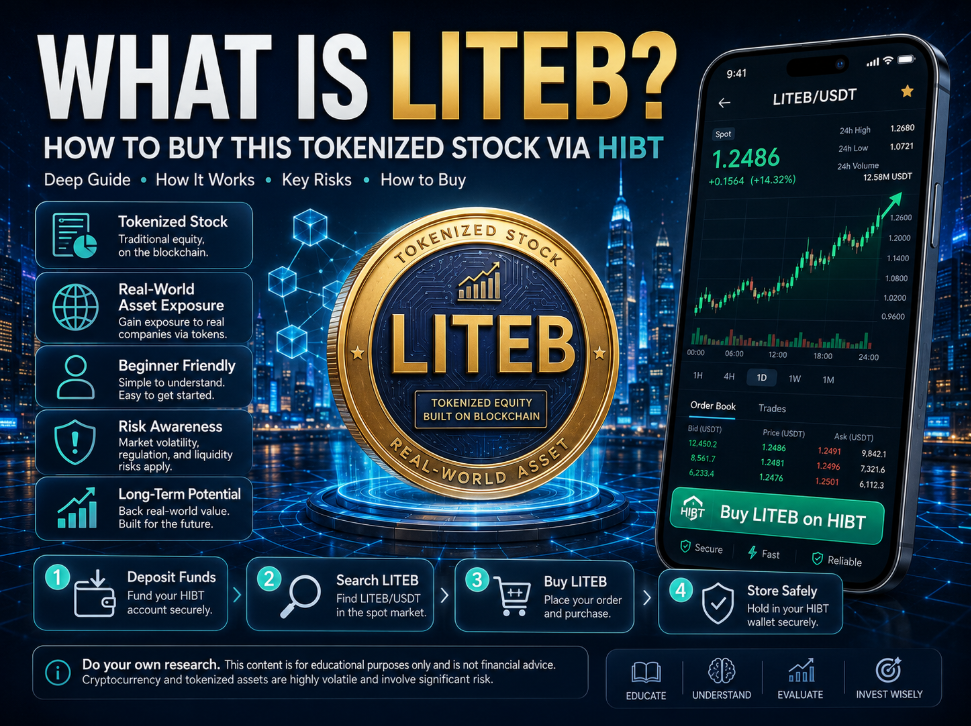
So why is there a “B” in the name?
That “B” mainly comes from the naming convention of the bStocks series. Public materials show that bStocks’ first‑generation products include CRCLB, MUB, NVDAB, SNDKB, TSLAB, etc. – all using the “U.S. stock ticker + B” format to indicate their bStocks Tokenized Securities nature. Thus, LITEB can be understood as the bStocks tokenized stock product corresponding to Lumentum Holdings, not as a standalone Web3 project called “LiteB.”
This article focuses on answering:
- What exactly is LITEB?
- How does it differ from the LITE stock?
- Why would someone choose LITEB instead of directly buying LITE?
- What risks does LITEB carry?
- If you want to buy it on a platform like HIBT, how should you proceed?
But this article will not turn into a full‑fledged equity research report on Lumentum Holdings. That is, we won’t deeply dissect Lumentum’s financials, customer mix, gross‑margin trends, or valuation multiples. Instead, we’ll focus on the “tokenized stock” layer: what exactly you are buying, what risks you are taking, and how you should build the right framework for evaluating it.
II. What LITEB Actually Is: It Tracks Lumentum Holdings, Not an On‑Chain Project
LITEB tracks Lumentum Holdings Inc., whose Nasdaq ticker is LITE. Lumentum’s main businesses include optical communications, data‑center connectivity, optical components, industrial lasers, and sensing elements. Its official page highlights product applications in Data Center, DCI, Metro, Long Haul, Submarine, Industrial Laser, and Sensing VCSEL.
Why has this company been pulled into the AI narrative?
Because AI compute does not rely solely on GPUs. Large data centers – both within and between them – need high‑speed, low‑latency, high‑bandwidth data transmission. Optical communication components, lasers, optical modules, photonic switching, and related technologies become increasingly important. The larger the AI model, the denser the data flows required for training and inference, and the stronger the demand for the underlying optical‑communications infrastructure.
That’s one of the core reasons Lumentum is being re‑priced by the market: it doesn’t directly sell AI models or GPUs, but sits in the “optical hardware layer” behind AI infrastructure.
LITEB is a tokenized structure built on top of this underlying stock.
Based on bStocks’ public structure, bStocks are issued by BTech Holdings Limited, which is disclosed as an affiliate of the Binance Group. Each bStock is backed 1:1 by the corresponding underlying stock or ETF and held by a regulated custodian. bStocks also exist as BEP‑20 tokens on BNB Chain, enabling on‑chain transfers and DeFi integration.
This means LITEB’s underlying logic can be broken down into four layers:
- Layer 1: Lumentum Holdings as a company.
- Layer 2: The actual LITE stock on Nasdaq.
- Layer 3: The issuer, custodian, conversion, and pegging arrangements.
- Layer 4: The LITEB token price that users see on the exchange.
The most common confusion for beginners is between Layer 2 and Layer 4. Seeing LITEB’s price track LITE does not mean you become a registered shareholder of Lumentum. bStocks’ public disclosures explicitly state: bStocks are not stocks or shares, nor do they entitle holders to directly own the stock or shares of the underlying listed company.
That sentence is extremely important.
In other words, holding LITEB typically means you hold a tokenized security or certificate linked to the price performance of LITE stock – not a directly registered or indirectly custodied U.S. equity position in a traditional brokerage account. It gives you primarily price exposure, not a full shareholder identity.
III. Does Holding LITEB Equal Holding LITE Stock?
Not entirely.
A more accurate statement: LITEB gives you tokenized exposure that closely tracks LITE’s price performance, but it is not equivalent to directly holding LITE stock.
Traditional U.S. stock holders usually care about several rights:
- Voting rights?
- Dividend entitlements?
- Participation in corporate actions?
- Clear custodian and brokerage records?
- Coverage under traditional investor‑protection frameworks?
For tokenized stock products like LITEB, the rights structure depends on the offering documents, platform terms, local regulatory arrangements, and product design. bStocks’ public materials mention that stock splits and dividend‑related adjustments are handled automatically to help users maintain continuous price exposure – yet they also clearly state that bStocks are not stocks or shares, do not represent an affiliation with the issuer of the underlying asset, and do not give holders direct ownership of the underlying company’s stock.
Therefore, beginners must separate economic exposure from shareholder rights.
When you buy LITEB, what you primarily get is the trading result of LITE’s upward or downward price movements.
But you cannot simply assume you have the same voting rights, corporate governance rights, and legal recourse as a shareholder of the underlying stock.
This distinction makes LITEB more of a trading‑oriented, on‑chain, U.S.‑equity‑exposure tool rather than a traditional long‑term shareholding vehicle.
If you highly value shareholder rights, dividend tax treatment, voting rights, and traditional brokerage protections, buying the actual LITE stock through a regulated U.S. broker may suit you better.
If you value 24/7 trading, stablecoin pricing, on‑chain transfers, portfolio combinations, and unified management within a crypto account, then LITEB makes more sense.
IV. How Does LITEB Differ from xStocks and Ondo Global Markets?
Tokenized stocks are not limited to the bStocks solution. The market also offers different approaches like xStocks, Ondo Global Markets, and others.
xStocks’ public materials describe it as bringing U.S. stocks and ETFs on‑chain, with each token backed 1:1 by real shares, and emphasize that non‑U.S. users can get 24/7 market access, instant on‑chain settlement, fractional ownership, and the ability to use stock exposure within DeFi. Its website also states that xStocks can be issued on multiple chains (Solana, Ethereum, Mantle, TON, Ink, etc.) and stresses that they are not synthetic assets.
Ondo Global Markets takes another route. Ondo’s documentation shows that its tokenized stocks are issued by Ondo Global Markets (BVI) Limited, and they typically use an “on” suffix (e.g., TSLAon) to indicate “on‑chain” or “Ondo.”
Compared to these, the bStocks structure that LITEB belongs to is more tightly tied to the combination of “BTech Holdings Limited + bStocks + BNB Chain BEP‑20 + platform trading.” The biggest differences between these solutions are not necessarily whether they can track U.S. stocks, but rather:
- Different issuing entities;
- Different applicable jurisdictions;
- Different custody and redemption arrangements;
- Different underlying chains;
- Different support for DeFi composability;
- Whether users can directly perform 1:1 conversions;
- Different handling of dividends, stock splits, and corporate actions;
- Different tradable platforms and liquidity depths.
So, newcomers should not just look at the label “tokenized stock” – they must also examine the legal documents and transaction structures behind them. Two products tracking the same U.S. stock can carry completely different risks due to variations in issuer, custodian, on‑chain network, market depth, and regional restrictions.
V. How Is LITEB’s Price Formed? It’s Not Simply Equal to LITE’s Price
In theory, LITEB’s price should fluctuate around LITE’s price.
If LITE rises, LITEB should generally rise too; if LITE falls, LITEB should come under pressure. That’s the fundamental basis for tokenized stocks.
But in real‑world trading, LITEB’s price does not necessarily equal LITE’s price at every second.
The reason is straightforward: although LITEB tracks LITE, it trades on crypto markets. Crypto markets are continuous, globally accessible, and stablecoin‑denominated, whereas U.S. stocks have fixed trading hours, pre‑market/after‑hours sessions, and traditional matching rules. The time structures, participant bases, and liquidity structures of the two markets are not perfectly aligned.
bStocks’ public materials note that users can convert between supported underlying stocks and bStocks at a 1:1 ratio, and each bStock is backed 1:1 by the corresponding underlying stock. Theoretically, this conversion and arbitrage mechanism should help keep the price anchored to the underlying stock. But whether that re‑anchoring works smoothly depends on sufficient market‑making, availability of conversions, trading hours, order‑book depth, and user eligibility in their respective regions.
Several situations can cause LITEB to deviate:
- U.S. markets closed, but crypto markets still active. On weekends, holidays, or outside U.S. trading hours, LITE has no fresh primary trading price, but LITEB can still move based on changing market expectations. In such cases, LITEB’s price may reflect investors’ anticipation of the next U.S. market open rather than a real‑time executed stock price.
- Insufficient liquidity. LITEB may not have the deep liquidity of BTC, ETH, or SOL, nor the natural traffic of more popular U.S.‑stock mappings like TSLAB or NVDAB. If the order book is thin, large buy or sell orders can cause significant slippage.
- Overheated market sentiment. When the AI optical‑communications narrative is strong, users may be willing to pay a premium for LITEB; during panic, it may trade at a discount.
- Restrictions on acquiring or custodied conversion of the underlying stock. The biggest fear for tokenized stocks is not whether they “look like stocks,” but whether the underlying assets can continuously, transparently, and stably back the token supply. Events around SpaceX‑related tokenized products in June 2026 reminded the market: when underlying shares are scarce, demand overheated, and allocation insufficient, some platforms may fail to secure enough underlying shares, leading to order cancellations or product‑supply issues.
Thus, when looking at LITEB, you cannot just stare at the candlestick chart. You must also monitor LITE’s price, LITEB’s order‑book depth, 24‑hour volume, bid‑ask spread, trading hours, and platform announcements.
VI. Why Do Some People Buy LITEB Instead of Directly Buying LITE?
If LITEB isn’t the stock itself and may offer fewer rights, why do people still buy it?
The answer: it solves trading convenience and on‑chain composability – not because it replaces traditional brokerage accounts.
First, LITEB offers a nearly 24/7 trading experience.
Although U.S. stocks have pre‑market and after‑hours sessions, the main liquidity is still concentrated during regular trading hours. For users in Asia, Southeast Asia, the Middle East, and Latin America, U.S. market hours often fall at night. Tokenized stocks like LITEB allow these users to express their views more flexibly on crypto platforms, especially for those accustomed to stablecoin trading and round‑the‑clock markets.
Second, LITEB lowers the account barrier to U.S. equity exposure for some users.
Not every user in every region can easily open a U.S. brokerage account. Some lack suitable bank accounts; others face regional restrictions; some are unfamiliar with traditional brokerage processes; and many keep most of their assets in stablecoins like USDT or USDC. For them, accessing U.S. equity exposure through a crypto exchange is a much shorter path.
Third, LITEB may offer room for on‑chain portfolio strategies.
Because bStocks exist as BEP‑20 tokens and are designed to be compatible with BNB Chain wallets and on‑chain applications, they can theoretically be used in DeFi scenarios such as lending, collateralization, liquidity pools, and combo trading. This is something traditional stocks cannot easily do – shares in a brokerage account typically cannot be quickly plugged into DeFi combinations like on‑chain assets.
Of course, this does not mean every newcomer must buy LITEB.
If you simply want to invest in Lumentum for the long term and can conveniently open a regulated U.S. brokerage account in your region, buying LITE directly may be clearer.
If you are primarily a crypto trader who wants to manage assets in USDT while trading the AI optical‑communications theme on a short‑term basis, LITEB’s convenience will be more apparent.
If you are interested in another type of asset that operates through staking, yield mechanisms, or protocol design, you may want to read What is CAP . The risk structure of CAP and LITEB are completely different: the former is closer to on‑chain protocol assets, while the latter is closer to tokenized exposure to traditional stocks.
VII. Core Risks of LITEB: Beginners Must Clearly Understand Before Deciding to Buy
LITEB’s biggest risk is not “whether it will go to zero like an altcoin,” but whether you truly understand that what you are buying is not a traditional stock, but a multi‑layer structured product.
1. Issuer credit risk.
LITEB’s token value depends on the issuer, custodian, exchange, and underlying stock support mechanism. If BTech Holdings Limited, the custody arrangements, conversion mechanisms, or platform operations encounter problems, the recourse available to users may differ from that for U.S. equity positions in traditional brokerage accounts. bStocks’ public materials also warn that the platform may, at its discretion, restrict, suspend, reject, cancel, or revoke certain access or transactions to address legal, product‑limitation, eligibility, sanctions, or documentation requirements.
This is no small matter. Traditional stock risks mainly come from company operations and market prices, while tokenized stocks add an extra “wrapper risk” layer. You have to watch not only Lumentum, but also whether the LITEB wrapper itself remains stable.
Similar issuer‑trust issues also appear in many new token mechanisms. Readers can cross‑reference What is RIF to build a more complete risk‑assessment framework using different asset cases.
2. Regulatory risk.
Tokenized stocks are still in a rapidly evolving regulatory environment. The U.S. SEC’s January 2026 statement on tokenized securities noted that stocks, bonds, notes, investment contracts, securities options, etc., can all be tokenized, but the assessment depends on the economic substance of the instrument, not just its name. Reuters also reported in June 2026 that the SEC is preparing new policies that might allow crypto firms to offer blockchain‑based stock trading, with the industry eyeing a so‑called “innovation exemption,” but such arrangements are still in the policy‑development and debate stage.
This shows that tokenized stocks are not unregulated, but the regulatory framework is still taking shape. Favorable policies could lead to rapid industry expansion; tightening policies could result in regional restrictions, delistings, conversion limits, or trading‑eligibility changes for certain products.
3. Liquidity risk.
LITEB does not necessarily have the deep liquidity of BTC, ETH, or SOL, nor does it naturally attract the same flow as popular U.S.‑stock mapping products like TSLAB or NVDAB. Data aggregators show that LITEB’s active trading venues are concentrated on a few platforms, and its 24‑hour volume is far below that of mainstream crypto assets.
That means the price you see when buying may not be the price you can get when selling larger amounts. The thinner the order book, the larger the slippage. If newcomers buy or sell at market price, they may eat through multiple price levels in an instant.
4. Spread and de‑pegging risk.
LITEB tracks LITE, but not every second is exactly LITE. Especially during non‑U.S. trading hours, LITEB’s price may move ahead of LITE based on expected news. If you only watch LITEB’s ups and downs without also checking LITE, pre‑/after‑hours action, industry news, and order depth, you are prone to misjudgment.
5. Platform and account risk.
When buying through centralized platforms like HIBT, you also bear operational risks such as account security, KYC reviews, withdrawal network selection, fund‑transfer errors, and regional restrictions. HIBT’s public materials show it supports spot and derivatives trading and is registered in Canada; its help center explains that KYC involves identity information, document submission, OCR, facial liveness checks, sanctions and PEP screening.
Therefore, before buying LITEB, newcomers should ask themselves at least five questions:
- Do I understand that LITEB is not LITE stock?
- Can I accept not having full shareholder rights?
- Can I accept short‑term price differences between LITEB and LITE?
- Have I confirmed that my region allows trading such products?
- Am I willing to first test the platform, deposit, trade, and withdrawal processes with a small amount?
If these questions are not clearly answered, it is not advisable to go in with heavy positions.
VIII. How LITEB Might Move: Don’t Use Standard Coin‑Price Prediction Templates
Many crypto articles like to write “2030 price prediction,” “2040 price prediction,” “2050 price prediction.” But for LITEB, that approach is highly misleading.
Because LITEB is not a project coin priced by its own ecosystem expansion, token burns, staking yields, or on‑chain user growth. Its price is essentially driven by two variables combined:
- Variable 1: How the underlying LITE stock will perform in the future.
- Variable 2: How LITEB’s premium or discount to LITE changes.
So predicting LITEB is not simply predicting “coin price” – it’s predicting “Lumentum stock + tokenized‑stock industry + platform liquidity + regulatory environment.”
Consider three scenarios.
Bear scenario: Lumentum could be hit by a slowdown in AI capital expenditure, falling orders in the optical‑communications supply chain, a pullback from excessive valuations, and a broad risk‑off sentiment. If LITE drops significantly, LITEB will likely suffer in tandem. More troublingly, if overall sentiment turns sour, LITEB – being a relatively niche tokenized stock – may experience shrinking liquidity, widening discounts, and higher sell‑side slippage. In that case, LITEB’s decline may come not only from the underlying stock but also from the liquidity retreat in the tokenized market itself.
Base scenario: Lumentum continues to benefit from AI data centers, optical‑communications upgrades, and cloud‑infrastructure build‑outs, but stock‑price gains gradually moderate toward rationality. With market‑making, exchange support, and arbitrage mechanisms in place, LITEB fluctuates around LITE, with premiums or discounts staying within reasonable ranges. In this scenario, LITEB acts more as a convenient U.S.‑equity exposure tool than a high‑volatility speculative instrument.
Bull scenario: AI optical‑communications demand surprises on the upside, Lumentum’s orders, revenue, and earnings elasticity are unleashed, and tokenized‑stock regulations become clearer, attracting more institutions and on‑chain users to RWA stock assets. Then LITE could continue to be re‑priced upward, and LITEB may gain higher liquidity due to its trading convenience and expanding on‑chain use cases. But even in a bull market, one must guard against overvaluation, excessive short‑term premiums, and the risk of chasing.
Thus, the most correct way to analyse LITEB is not to ask “how many times can it go up,” but:
- Is LITE’s current valuation already over‑discounting AI optical‑communications expectations?
- Is LITEB currently trading at a premium or discount to LITE?
- Is the bid‑ask depth sufficient?
- Is trading taking place during U.S. market hours?
- Are there any regulatory, platform, or underlying‑asset events?
- Is there short‑term sentiment inflating the price?
Only by putting these questions together do you get a proper framework for analysing LITEB.
IX. A Step‑by‑Step Example: How to Buy LITEB on HIBT
Below, we use HIBT as the operational context to guide newcomers through buying LITEB. Remember that whether LITEB/USDT trading is actually available, which regions are supported, the minimum order size, fees, withdrawal status, and KYC requirements should all be based on the HIBT app, official trading page, and official announcements.
Step 1: Register a HIBT account.
Go to the HIBT website or app, click Sign Up, create an account using an email or phone number, enter the verification code, and set your login password. The HIBT registration page supports email sign‑up and also allows referral codes. After registering, enable two‑factor authentication (e.g., Google Authenticator or SMS verification) as soon as possible to protect your account.
Step 2: Complete KYC identity verification.
In the user centre, go to the identity verification page and submit your ID information and supporting documents as instructed. HIBT’s help centre explains that users must complete KYC verification step by step and may link a phone number; its KYC policy also mentions identity verification, contact details, document submission, OCR recognition, liveness detection, and risk screening.
Typically, you will need:
- A valid government‑issued ID (e.g., national ID card, passport, or driver’s licence);
- Name and date of birth matching the ID;
- Facial recognition or a short selfie video;
- In some cases, proof of address or additional documents.
Processing time depends on the clarity of your submission, regional risk levels, and the platform’s verification queue. If your documents are clear and complete, approval is usually faster; if they are blurry, inconsistent, or trigger manual review, it may take longer.
Step 3: Deposit funds into your HIBT account.
Common paths for newcomers:
- Fiat on‑ramp: Buy USDT or other stablecoins via supported bank cards, third‑party payments, or C2C trading. Whether fiat channels are available in your region is shown on the platform.
- Stablecoin deposit: If you already have USDT in another wallet or exchange, deposit it into HIBT. On the HIBT app, go to the home page, tap Deposit, select USDT, and choose the deposit network.
Network consistency is critical. For example, if you choose TRC20, you must withdraw from the external platform via TRC20. If you choose ERC20, BEP20, or another network, you must match that as well. HIBT’s help centre warns that if the network selected for deposit and withdrawal does not match, funds may not arrive.
Step 4: Search for LITEB in the trading section.
Go to the spot trading page, type LITEB in the search box, and confirm the trading pair is LITEB/USDT. Do not confuse LITEB with LITE, LIT, LTC, or similar codes.
When confirming, focus on four things:
- The pair name is LITEB/USDT;
- The full asset name indicates a tokenized stock related to Lumentum Holdings;
- There is a description like “Tokenized Stock” or “bStocks”;
- The trading page shows normal buy/sell orders and trade history.
If the platform also offers other products related to LITE (e.g., futures, ETFs, leveraged tokens, or simulated stock products), be sure to distinguish them carefully. On your first attempt, don’t just click the first search result – go to the detail page and verify the asset description.
Step 5: Choose your order type.
Common order types are market orders and limit orders.
Market orders are for those who want immediate execution, but they are prone to slippage – especially for products with moderate liquidity like LITEB. A large market order may execute at a price significantly different from the last seen price.
Limit orders are more suitable for cautious users. You can set a price you are willing to pay and wait for the market to match it. The downside is that if the price never reaches your limit, the order may not fill.
For your first LITEB purchase, it is strongly recommended to use a limit order with a small amount to test, rather than using a large market order.
Step 6: Confirm fees and minimum trading units.
Fee rates vary by platform, VIP level, and promotional periods. bStocks’ official materials once mentioned that certain trading pairs enjoyed zero Maker fees during specific periods, but such promotions are time‑limited and scope‑limited – they do not mean that all platforms, at all times, for all pairs are fee‑free.
So, when trading on HIBT, rely on the fees displayed on the trading page, the order confirmation screen, and the platform’s fee schedule. Before placing an order, pay attention to:
- Buy price;
- Buy quantity;
- Estimated total cost;
- Trading fees;
- Whether it is spot trading;
- Whether leverage or futures are involved.
Step 7: Check your holdings after purchase.
After the order is filled, go to the assets page or spot account page to view your LITEB balance, average entry price, current valuation, and profit/loss. It is helpful to add both LITE and LITEB to your watchlist so you can easily track the spread between them.
If HIBT supports price alerts, you can set key alerts for:
- LITEB dropping below your stop‑loss;
- LITEB reaching your target price;
- An abnormal spread between LITEB and LITE;
- Sharp movements in LITE during pre‑market or after‑hours trading.
Step 8: When exiting, choose to sell or withdraw.
If you are just trading the spread, you can sell LITEB on HIBT’s spot market to get USDT back.
If the platform supports on‑chain withdrawals and you prefer self‑custody, you need to confirm LITEB’s supported network, withdrawal address format, fees, arrival time, and wallet compatibility. Since bStocks materials mention it is a BEP‑20 token on BNB Chain, you would theoretically need a wallet address compatible with BNB Chain – but whether withdrawal is actually open, the withdrawal network, and contract address must be confirmed on HIBT’s page.
If you are unfamiliar with on‑chain operations, do not withdraw large amounts on your first try. Test with a small amount first, confirm receipt, and then proceed further.
X. LITEB Pitfall Guide for Beginners
1. Do not treat LITEB as a “cheap potential coin.”
LITEB’s price level depends on LITE stock – not on whether the token itself looks cheap. If LITE has already rallied significantly, LITEB may be at an elevated level too. Don’t assume it has altcoin‑style 100x potential just because it appears on a crypto exchange.
2. Do not watch LITEB without watching LITE.
LITEB is a mapped asset. At a minimum, you should also track Lumentum’s earnings, AI optical‑communications news, Nasdaq quotes, pre‑/after‑hours prices, peer performance, and LITEB’s own order book.
3. Do not chase when spreads are abnormal.
If LITEB trades at a clear premium to LITE, first determine whether it is an expected premium during U.S. market closure or a temporary mispricing due to thin liquidity. If you don’t understand the source of that spread, don’t chase.
4. Do not ignore regional restrictions.
Tokenized stocks involve securities‑related attributes, and user eligibility differs by region. bStocks’ materials explicitly state that they are not offered to U.S. persons and are not publicly offered in the U.S. Before trading on HIBT or any platform, confirm that your region allows access to such products.
5. Do not go heavy on your first attempt.
For your first purchase of LITEB, it’s wiser to use a very small position to run through the entire workflow: registration, KYC, deposit, searching for the pair, placing a limit buy, checking your holding, selling, and withdrawing. Only after you have completed a full cycle will you know whether the platform experience, fees, slippage, and deposit/withdrawal processes work for you.
XI. FAQ: Common Questions About LITEB
Can LITEB be held for the long term?
Yes, it can be held long‑term, but it is not suitable for everyone to do so. Holding LITEB for the long term essentially means being bullish on Lumentum Holdings’ stock while accepting the risks of the tokenized structure, issuer risk, platform risk, and regulatory changes.
If you are simply bullish on Lumentum itself and can conveniently buy U.S. stocks, LITE may be clearer. If you prioritise stablecoin account management, on‑chain transferability, and trading convenience, LITEB becomes more meaningful.
Is LITEB suitable for short‑term arbitrage?
It is more suitable for experienced traders to observe spreads and execute short‑term strategies. Because LITEB and LITE may have temporary premiums or discounts – especially during U.S. market closures, news releases, or crypto liquidity shifts. But arbitrage is not risk‑free; ordinary users may lose on slippage, fees, execution speed, and information latency.
How to choose between LITEB and directly buying LITE?
If you value shareholder rights, traditional brokerage protection, long‑term investment records, and tax clarity, prioritise LITE.
If you value USDT pricing, trading convenience, 24/7 markets, on‑chain composability, and unified crypto‑account management, consider LITEB.
But do not view them as identical. LITEB is closer to a “tokenised wrapper for underlying exposure,” not the traditional stock itself.
What to do when the price gap between LITEB and LITE is too wide?
Do not rush to buy or sell. Check:
- Is it currently regular U.S. trading hours?
- Has LITE shown large pre‑/after‑hours moves?
- Is LITEB’s order book thin?
- Are there platform maintenance, deposit/withdrawal suspensions, or announcements?
- Are there major Lumentum‑specific news?
- Are there industry headlines moving the AI optical‑communications sector?
If you cannot find a rational explanation, it is better to wait for the spread to narrow rather than blindly follow.
How much position should a beginner use for their first LITEB purchase?
A safer approach is to use a very small portion – for instance, less than 1% of total investment capital, or even less. The first goal is not to make money, but to familiarise yourself with the process: deposits, correct pair, slippage, selling, and withdrawals.
After you have fully understood the product, platform, and risks, you can decide whether to increase the position.
Can LITEB de‑peg?
Yes. Any tokenised asset can experience short‑term de‑pegging or widened spreads. Especially in low‑liquidity conditions, extreme markets, U.S. market closures, underlying‑asset constraints, platform conversion suspensions, or regulatory events, LITEB can deviate from LITE.
When assessing risk, don’t just rely on the phrase “1:1 backing” – also look at actual traded prices, depth, redemption mechanisms, and platform status.
Does LITEB pay dividends?
This depends on the offering documents and platform rules. bStocks’ public materials state that dividend‑related adjustments and corporate actions like stock splits are handled automatically to help users maintain continuous exposure – but this does not mean you have the same dividend and voting rights as a direct shareholder. Beginners should refer to the specific product documents and not assume that “buying LITEB equals receiving dividends directly.”
XII. Summary: Who Is LITEB For, and Who Is It Not For?
LITEB is suitable for three types of users:
- Crypto users who already understand the tokenized‑stock structure and want to trade U.S.‑equity‑themed assets using USDT.
- Users who are interested in the AI optical‑communications supply chain, are bullish on Lumentum Holdings, but are temporarily unable to use a traditional U.S. brokerage account.
- More advanced traders who can monitor the spread between LITE and LITEB and manage slippage, position sizing, and trading risk.
LITEB is not suitable for three types of users:
- Newcomers who mistake it for an ordinary altcoin and are solely looking for a 100x coin.
- People who know nothing about Lumentum and pay no attention to stock fundamentals, yet buy impulsively just because it’s “newly listed.”
- Long‑term conservative investors who cannot accept issuer risk, platform risk, regulatory risk, and liquidity risk.
One sentence summary: LITEB is not “another new coin” – it is a tokenized expression of exposure to Lumentum Holdings stock. Its opportunity comes from the AI optical‑communications stock narrative, 24/7 crypto market trading, and the RWA tokenisation trend; its risks come equally from stock volatility, the tokenised wrapper, regulatory uncertainty, and liquidity‑driven premiums/discounts.
If you plan to buy LITEB through HIBT, the correct order is not “buy when you see it rising” – instead: first confirm the trading pair, then understand the product structure, test with a small amount, and finally, based on LITE’s performance, LITEB’s spread, and your own risk tolerance, decide whether to add to your position.
For beginners, the most important thing is not to catch every upward move, but to first figure out: what exactly have you bought?