
If Bitcoin proved that "value transfer" could be completed without traditional banks, and Ethereum proved that "smart contracts" could execute on a public ledger, then Arcium aims to solve an even deeper challenge: Can a blockchain maintain public verifiability while keeping data completely private?
This is the core narrative driving ARX.
ARX is the native token of the Arcium network. Arcium is a decentralized confidential computing network designed for the Solana ecosystem and broader Web3 environments. Its main objective is to enable developers to run calculations over sensitive data without ever exposing that underlying data, while ensuring the execution output remains fully verifiable.
For crypto newcomers, this concept can sound quite abstract. You can loosely conceptualize Arcium as an "encrypted version of cloud computing": users submit data to the network, the decentralized infrastructure processes it, yet the computing nodes can never see the original unencrypted records, and external observers cannot peek into the inputs. Once execution finishes, the final proof is published on-chain for trustless verification.
ARX operates as the economic coordination vehicle inside this network, utilized for settling network processing fees, staking, node task scheduling, and decentralized governance.
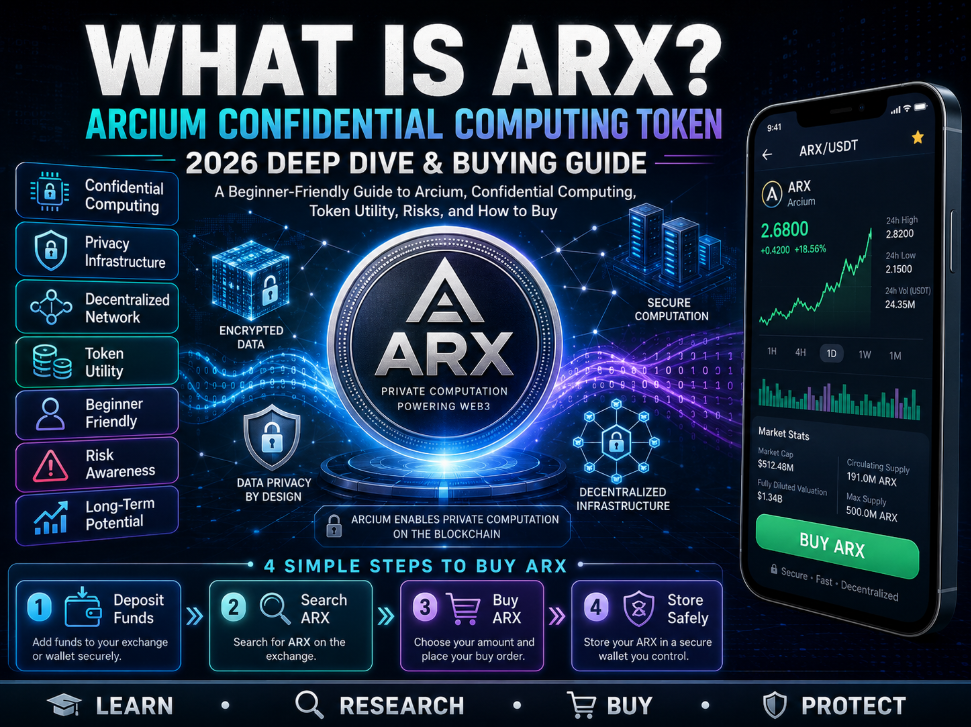
However, beginners must immediately separate one crucial boundary: ARX is not a legacy "privacy coin" like Monero or Zcash. It does not exist purely to conceal peer-to-peer asset transfer trails. ARX powers Arcium's confidential computing network, where the value proposition extends far beyond "anonymous payments" to unlocking private computation for decentralised finance, artificial intelligence, healthcare analytics, dark pool trading architectures, and cross-institutional data collaborations.
This guide explores why public blockchains demand confidential computation, unmasks the cryptographic mechanics of Arcium, parses ARX's token utilities, evaluates its listing momentum, maps out key risk vectors, and defines live purchasing paths to equip beginners with a comprehensive evaluation framework.
Disclaimer: This article is for crypto asset educational and market research purposes only and does not constitute any investment advice. As a newly listed token in 2026, ARX is subject to extreme market price volatility, and the confidential computing track remains in an early stage of structural development. Please refer to official project portals, active exchange dashboards, and live on-chain browsers for accurate real-time metrics regarding trading pairs, pricing, circulating supply, staking conditions, and node distribution parameters.
1. What is ARX? Resolving the Conflict Between Transparency and Data Privacy
One of public blockchain technology's greatest strengths is absolute transparency. Once an execution is broadcast, any network participant can scrutinize the transaction hash via an on-chain explorer. When a smart contract deploys, its capital movements, state calls, wallet balance histories, and transactional paths are completely public and trackable. For decentralized networks, this absolute auditability is vital because it removes the requirement to trust a central authority, allowing participants to verify system state transitions independently.
However, this structural strength introduces an operational bottleneck: In the real world, not all data belongs in the public domain.
Consider these highly practical scenarios:
- Healthcare institutions want to securely collaborate to train complex AI diagnostics without leaking proprietary patient records.
- Institutional financial firms want to execute massive blocks on-chain without exposing their trading intentions to predatory front-running.
- Corporate entities need to share joint risk-control indices without exposing underlying proprietary customer databases.
- Retail users want to utilize DeFi dApps without broadcast-mapping their entire net worth, active trading strategies, and exact yields to the general public.
- DAOs require private voting or sealed bidding architectures for strategic asset acquisitions while keeping the aggregate computation auditable.
- Large-scale AI models require vast inputs of sensitive data, but data providers refuse to expose original files to the model operator's computing instances.
This introduces a foundational structural conflict: Blockchains require transparency to remain secure, while institutional business demands strict confidentiality.
If networks force total transparency, high-value enterprise utility remains blocked from migrating on-chain. Conversely, if total opacity is implemented, networks forfeit the verifiability, trustless auditability, and decentralization advantages of blockchain ledger tracking.
Arcium targets this friction directly, engineering an architectural state where the data inputs remain hidden, yet the computational outputs remain verifiable and trustless.
By leveraging cutting-edge cryptography, decentralized computing nodes handle calculations on fragmented data fractions without ever reconstructing the clear-text input. This enables external auditors to verify that the computation executed precisely according to programmatic rules without exposing sensitive contents.
Achieving this is technically complex because legacy computing architectures require servers to read clear-text inputs to process data. When you upload records to a traditional cloud instance, the host reads that data. Even if the operator promises safety via legal agreements, the framework relies entirely on centralized trust. Arcium removes this centralized dependency, replacing server promises with mathematical guarantees.
The Evolution: What was Elusiv?
The core engineering team behind Arcium initially entered the Solana ecosystem under the brand Elusiv. Elusiv functioned primarily as an application-specific privacy layer, optimizing private asset transfers, anonymous token routing, and localized on-chain transactional privacy.
In 2024, the development team executed a major pivot, transitioning the architecture into Arcium—evolving from an isolated privacy layer into a generalized, multi-chain confidential computing network.
This pivot expanded the project's macro scope. While Elusiv focused on masking specific transactional footprints, Arcium serves as decentralized privacy-preserving computing infrastructure that any on-chain application can tap into.
This architectural shift expands the addressable use cases into:
- Confidential DeFi protocols
- Decentralized dark pool trading architectures
- Sealed-bid on-chain auctions
- Privacy-preserving machine learning (Confidential AI)
- Cross-institutional data collaborations
- Secure financial and healthcare data analytics
- Private DAO governance architectures
- Confidential asset tokenization frameworks
- Enterprise-grade on-chain asset processing
This is why ARX cannot be categorized alongside legacy anonymous payment coins. It functions as a base-layer infrastructure asset enabling scalable confidential execution across developer ecosystems.
The Economic Role of ARX
As the native cryptographic token of the Arcium network, ARX acts as the economic engine driving four main functional loops:
- Settling Processing Fees: Paying for computational resource utilization across the network.
- Staking & Delegation: Collateralizing tokens to secure node operations and back network integrity.
- Resource Scheduling Allocation: Mapping network task scheduling weights relative to active staking densities.
- Protocol Governance: Participating in decentralized vote consensus regarding network parameters.
To prevent common newcomer misconceptions, remember that ARX is not a pure payment anonymizer, a speculative AI model proxy token, or an alternative Layer-1 competitor to Solana. It is a specialized confidential execution infrastructure asset bridging public networks and private data layers.
2. Arcium's Core Cryptography: Breaking Down MPC Confidential Computing
Arcium's underlying architecture leverages complex cryptographic primitives, including Multi-Party Computation (MPC), Fully Homomorphic Encryption (FHE), Zero-Knowledge Proofs (ZKP), and customized innovations like the Multiparty eXecution Environment (MXE) and the Confidential SPL (C-SPL) token standard. While the granular mathematical logic is complex, the foundational mechanics can be understood through simple analogies.
Demystifying Multi-Party Computation (MPC)
Consider a practical real-world scenario: Three executives want to calculate their average salary without revealing their exact personal income to one another. Under legacy models, they must appoint a trusted accountant to collect the numbers. However, this means the accountant gains access to all clear-text salaries, introducing a centralized point of failure.
MPC alters this process through data fragmentation:
- Each executive takes their salary number and mathematically splinters it into random, unreadable numerical fractions (data shares).
- These independent fractions are distributed across a decentralized set of computing nodes.
- Individually, each node holds an unreadable string of data that reveals nothing about the original salary.
- Using cryptographic algorithms, the nodes calculate their localized fragments simultaneously and combine their intermediate outputs.
- The final aggregate result reveals the precise average salary, yet no single node or participant ever views any clear-text salary input.
This captures the essence of Arcium's decentralized execution architecture: Inputs are splintered, independent nodes handle encrypted shares, zero single nodes view the original record, and the system outputs a verifiable result.
How Does Arcium Differ From Hardware TEE Architectures?
Alternative confidential computing frameworks frequently rely on TEEs (Trusted Execution Environments), which utilize specialized hardware enclaves (like Intel SGX) to shield clear-text execution inside a protected silicon chip layer.
While TEEs offer processing speeds and lower development friction, they carry structural hardware dependencies. If an enclave features a manufacturing vulnerability, faces side-channel physical attacks, or encounters supply chain exploitation, the security model fails.
Arcium shifts its security guarantees away from hardware black boxes, anchoring trust instead in mathematical cryptography. By deploying MPC architectures, trust is distributed across independent network nodes, ensuring that single node exploits cannot reconstruct the underlying database.
However, mathematical cryptography carries a processing cost. MPC requires significant network communication overloads, node synchronization pacing, and resource optimization. Arcium’s core engineering focus centers on ensuring these cryptographic computations run fast and cost-effectively enough to support real-world decentralised apps.
Understanding Multiparty eXecution Environments (MXE)
An MXE (Multiparty eXecution Environment) functions as an isolated, secure workspace inside the Arcium network where confidential computations occur.
While public blockchains require every node to execute transactions openly for validation, Arcium’s MXE allows a specific cluster of nodes to collaborate within an encrypted workspace. By blending MPC, FHE, and ZK proofs, developers can spin up tailored, verifiable private workspaces matching their application needs.
This parallel execution architecture prevents performance bottlenecks. Instead of queuing tasks through a single-threaded lane, Arcium uses MXEs to distribute varied computational workloads across specialized node clusters simultaneously.
Think of it like an enterprise service center: Instead of routing all inquiries through a single queue, the center runs multiple specialized windows concurrently, with each window configured with custom security clearance, designated participants, and specialized rules optimized for specific institutional workflows.
Real-World Use Cases for Arcium's Infrastructure
- Decentralized Dark Pools: Institutional market participants can route massive orders without exposing their trading strategies, protecting trades from front-running and predatory MEV bots before settlement while maintaining post-trade auditability.
- Confidential AI Models: Health networks, financial houses, and security firms can feed valuable, sensitive data to refine AI models without exposing the underlying intellectual property or private databases to the model operator.
- Confidential Asset Standards (C-SPL): Utilizing the Confidential SPL standard announced at Breakpoint 25, Solana developers can transition standard tokens to support encrypted balances, shielding wallet totals from public scraping.
- Sealed-Bid Auctions & Private DAOs: Facilitating tamper-proof, on-chain procurement tenders, private capital raises, and private DAO governance votes where individual inputs remain hidden until official closing blocks.
3. ARX Utility: The Four Core Economic Functions of the Token
Before deploying capital into ARX, it is crucial to analyze the token's precise functionality within the network ecosystem. ARX serves four main economic roles:
1. Network Settlement Fees
Every developer dApp, enterprise network, or automated model pulling confidential execution power from the Arcium network must settle processing fees using ARX. This links network adoption directly to token utility: as demand for dark pools, private asset standard routing (C-SPL), and secure AI modeling scales, the baseline volume of fees settled in ARX expands.
2. Node Collateral Staking & Delegation
Operating an Arx Node requires the operator to stake ARX as collateral to back their processing integrity. Network participants who do not wish to run independent server infrastructure can delegate their ARX tokens to active nodes.
This mirrors Proof-of-Stake (PoS) consensus models: nodes maintain the physical infrastructure, delegators back them with capital, and successful computational deliveries yield network rewards that are shared proportionally. Malicious or underperforming nodes face slashing penalties or loss of delegation backing.
3. Computational Work Scheduling Allocation
Arcium does not allocate computational tasks randomly. A node’s probability of being selected to execute an incoming MPC task is directly proportional to its active staking density. Capital concentration matches processing resource allocation, ensuring that operators with significant skin-in-the-game handle sensitive processing loads, protecting the network from sybil attacks.
4. Decentralized Governance Rights
ARX holders govern network parameters via the DAO. This includes voting on protocol fee architectures, node onboarding requirements, staking/slashing rules, and ecosystem fund allocations.
Critical Distinction: Governance authority does not equate to corporate stock equity or legal profit-sharing. ARX is a decentralized utility asset; revenues directed to the treasury fund ongoing developer grants, liquidity depth programs, and core network expansion. Future implementation of alternative token mechanics—such as buybacks or burns—is subject to DAO vote and compliance verification.
4. Evaluating ARX's Listing and TGE Phase
ARX officially entered public secondary market trading on June 22, 2026. For beginners, entering an asset during its Token Generation Event (TGE) phase presents a mix of high volatility and rapid price discovery.
Navigating Initial Distribution Sources
ARX liquidity originates from distinct early allocations. Prior to public trading, distribution pathways included testnet incentive allocations, points systems, community waves, and public sale avenues (such as the CoinList sale conducted in early 2025 at $0.20 per token). Furthermore, checking mechanisms like the Retroactive Token Grant (RTG) Checker went live just ahead of the TGE alongside strategic airdrop campaigns (e.g., the Binance Wallet Booster Campaign).
For secondary buyers, this indicates that a portion of early holders possess a cost basis below the initial public market quote. The opening trading windows process a mix of early airdrop claims, strategic market making, and immediate retail speculation, which can lead to sharp short-term price swings.
The Dynamics of Coordinated Multi-Exchange Debuts
ARX executed a simultaneous launch across major bursa venues (including specialized zones like the MEXC Innovation Zone and Binance Alpha). While a coordinated multi-exchange rollout confirms deep initial trading liquidity, strong market awareness, and institutional backing, an exchange listing is not a low-risk certification.
The opening day of a TGE typically follows a distinct rhythm: high pre-open social media expectations -> volatile price action as trading opens -> immediate token claims and profit-taking from early allocations -> high-frequency automated arbitrage across venues -> sharp price retracements after the initial speculative peak -> transition into an extended organic price discovery phase.
Rules for Capital Preservation During a TGE
- Avoid deploying un-capped Market Orders during the opening minutes of trading, as shallow localized liquidity can trigger devastating execution slippage. Utilize Limit Orders exclusively.
- Cross-reference the live circulating market cap against the asset's Fully Diluted Valuation (FDV). If the FDV scales to an irrational multiple before the network logs consistent fee revenues, the market will eventually correct the valuation lower.
- Filter out social media hype and FOMO. Treat the asset objectively based on its structural release pacing and real-world utility rather than short-term price charts.
5. Three Core Risk Points to Understand Before Investing in ARX
While the cryptographic capabilities of Arcium are notable, long-term sustainability depends on managing three main risk factors.
1. Cryptographic Engineering and Adoption Risks
Confidential computing remains an evolving frontier. While primitives like MPC and FHE work in controlled settings, scaling them across broad Web3 architectures introduces significant processing, latency, and resource overhead. The ultimate success of Arcium depends on developers actively building applications that require private computing power.
Investors can track real network adoption by monitoring key on-chain metrics:
- The cumulative volume of confidential computations successfully delivered by the mainnet (which crossed the 1 million milestone during early testing).
- The active daily transaction count running across the mainnet infrastructure.
- The growth rate of verified, functioning Arx Nodes active in the staking network.
- The number of production-ready applications integrating Arcium’s processing layer.
- Active development metrics and repository adjustments on GitHub.
2. Fully Diluted Valuation (FDV) and Unlock Pacing
ARX features a maximum supply capped at 1,000,000,000 tokens. At the June 22, 2026 TGE, roughly 20.88% of the total supply (approximately 208.8 million ARX) unlocked into immediate circulation. The remaining 79.12% of the supply—encompassing core team allocations, early institutional backers, and ecosystem research reserves—is scheduled to vest linearly over a 4.5-year trajectory.
This structure introduces a steady expansion of circulating supply over time. If the onboarding of fee-paying applications keeps pace with this vesting velocity, the market can absorb the expanding supply. However, if unlock dates release significant token volume during a broader market cooling phase, the asset can face structural downward pressure.
3. Cryptographic Track Competition
Arcium operates within a highly competitive sector. Alternative networks are deploying varied technical solutions to tackle the data privacy problem:
- Hardware-enforced TEE platforms that prioritize processing speed over mathematical decentralization.
- Pure ZK-privacy layers optimized for scaling transaction verification rather than complex data manipulation.
- Dedicated privacy-centric Layer-1 and Layer-2 networks competing for developer mindshare.
Arcium's long-term competitive moat depends on whether its parallel MXE model and Solana ecosystem integrations (like the C-SPL standard) can secure a dominant market share before competing architectures achieve scale.
6. How to Buy ARX: Spot Trading Guide on HiBT
If HiBT has opened spot trading for the ARX/USDT pair, newcomers can utilize the following execution sequence.
Step 1: Secure Account Setup and Identity Verification (KYC)
Navigate to the official HiBT interface or mobile application to register an account using your email or mobile phone. Once registered, complete your basic KYC check to optimize your daily funding limits, open advanced trading parameters, and minimize future compliance pauses.
Immediately activate your full account security suite: Google Authenticator (2FA), Email and SMS confirmation loops, a Funding Password, and an Anti-Phishing Code.
Step 2: Deposit Stablecoin Liquidity (USDT)
If you do not hold stablecoins, access the Quick Buy portal to purchase USDT via local fiat options, or transfer external USDT liquidity from your self-custodial Web3 wallet to your designated HiBT deposit address.
⚠️ Network Alignment Check: Verify that the selected funding network (e.g., Solana, TRC-20, ERC-20) matches perfectly on both the sending and receiving ends. Cross-network transfer errors lead to irreversible asset loss. Route a minimal test transaction to confirm receipt before moving significant principal capital.
Step 3: Locate the ARX/USDT Pair and Place Your Order
Enter the HiBT Spot Trading terminal, navigate to the market search bar, and input ARX. Select the verified ARX/USDT pair. Prior to confirmation, ensure that the asset corresponds exactly to Arcium (ARX), review the 24-hour volume metrics, and check the order book depth.
For newly listed assets experiencing high TGE volatility, favor Limit Orders over Market Orders. This ensures your trade executes exclusively at your targeted entry quote or better, insulating your capital from execution slippage.
Step 4: Asset Custody and Post-Purchase Management
Following execution, determine your storage framework:
- Exchange Spot Account: Suited for short-term swing traders requiring immediate liquidity to capture short-term price moves without managing external private keys.
- Self-Custodial Wallet Routing: For long-term participants planning to delegate tokens to active Arx Nodes, withdraw the assets to a compatible self-custodial wallet. Ensure you source staking and delegation links exclusively from official Arcium portals to avoid phishing traps and malicious smart contract approvals.
7. Future Growth Trajectories: A Multi-Scenario Analysis
The long-term market performance of ARX depends on Arcium’s transition from an innovative technological narrative into an adopted enterprise utility layer.
🚀 Optimistic Scenario: Institutional Integration and Ecosystem Scale
Arcium emerges as the leading confidential execution layer for Web3. The C-SPL token standard sees widespread adoption among Solana projects, decentralized dark pools capture a meaningful share of institutional volume, and privacy-preserving AI models route their data workloads through Arx nodes.
- Result: Processing fee generation scales, driving consistent buy-side demand for ARX to settle transactions. Strong staking demand from node operators absorbs the systematic vesting unlocks smoothly, driving long-term valuation growth.
↔️ Neutral Scenario: Steady Development Amid Technical Friction
The network functions reliably, but enterprise onboarding and developer integration move at a slow, deliberate pace due to the high processing and latency overhead of advanced cryptography.
- Result: Initial speculative TGE hype stabilizes, and the token shifts into a horizontal consolidation phase. Trading volumes mirror incremental baseline growth as the market evaluates real-world usage data, making ARX a range-bound asset driven by specific ecosystem milestone updates.
📉 Pessimistic Scenario: Technical Bottlenecks and Supply Dilution
The processing overhead of MPC and FHE proves too restrictive for high-frequency applications, or developers favor alternative hardware-based TEE privacy solutions.
- Result: As real-world network utilization stalls, fee generation falls short of expectations. The steady entry of vested tokens from early allocations encounters shallow market depth, leading to structural downward pressure on the valuation multiple.
8. Sector Positioning: Comparing ARX with Ecosystem Peers
ARX occupies a foundational role within the decentralized physical infrastructure (DePIN) and privacy infrastructure verticals, separating it from standard application-layer tokens.
ARX vs. Application-Layer Assets
Application-layer tokens (e.g., lending protocols, decentralized exchanges, P2P marketplaces) capture value based on localized metrics like user counts, daily active traders, specific platform fee splits, and Total Value Locked (TVL).
Infrastructure-layer assets like ARX operate at a deeper systemic layer. They provide specialized compute utilities to external applications, capturing value as the total volume of network tasks, node infrastructure staking, and resource allocation overhead expands across the entire ecosystem.
Ecosystem References: If you prefer to focus on application-layer capital efficiency and liquidity designs within the Solana ecosystem, you can study what $O coin to analyze a completely different application architecture. Alternatively, you can evaluate what HOME (Defi App) to understand how utility-focused frontends approach value capture.
9. Frequently Asked Questions (FAQ)
Q: Is ARX structurally identical to legacy privacy tokens like Monero or Zcash?
A: No. Monero and Zcash are optimized for transaction anonymity—masking senders, receivers, and values on a transactional ledger. ARX powers a decentralized confidential computing network designed to execute complex programmatic calculations over encrypted data inputs, keeping the data private while ensuring the final output remains publicly verifiable.
Q: How can retail token holders earn rewards within the Arcium network?
A: Beyond secondary market spot trading, holders can delegate their ARX tokens to active, verified Arx Nodes. The delegated capital increases the node’s task scheduling weight, and the resulting cryptographic processing fees are shared proportionally between the operator and delegators.
Q: Does the Arcium network feature an inflationary supply mechanic?
A: ARX has a hardcapped maximum supply of 1 billion tokens with no post-launch dilution. The network's economic engine relies on a dynamic balance: low-volume processing phases deploy targeted incentives to sustain node availability, while high-demand execution phases leverage fee-burning mechanics to offset circulating expansion.
Conclusion
Arcium tackles one of the most critical challenges facing public blockchains: preserving data privacy without sacrificing decentralized verifiability. By transitioning from an isolated privacy app (Elusiv) into a generalized confidential computing layer, the network positions itself to capture value across the DeFi, AI, and institutional enterprise sectors.
However, because the underlying cryptographic primitives are complex and the token faces systematic vesting releases over a 4.5-year horizon, ARX remains a specialized, high-volatility infrastructure asset. It is tailored for participants who understand on-chain performance metrics, look past short-term speculative peaks, and manage their positions with defined risk parameters.