
HOME is the native utility and governance token of the Defi App ecosystem, built around cross-chain trading, gas abstraction, staking rights, governance participation, platform incentives, and potential protocol value capture.
One thing needs to be clear up front: the HOME discussed in this article is Defi App's HOME — not the real-estate-backed HOME stablecoin associated with the BACON protocol, and not the early 2021 BSC project called HomeCoin. All three may use the name or ticker HOME, but their asset type, contract address, network, use case, and risk profile are completely different.
This article is not investment advice. HOME is a highly volatile crypto asset, and its price can be affected by market sentiment, exchange listings, token unlocks, product growth, user retention, cross-chain security, DeFi competition, and macro market conditions. All data here was compiled from publicly available sources at the time of writing — pricing, circulating supply, exchange support, and contract addresses change in real time, so check official documentation, exchange pages, CoinGecko, CoinMarketCap, and block explorers before buying.
1 | What Kind of Token Is HOME, Exactly? Ruling Out Two Common Misconceptions
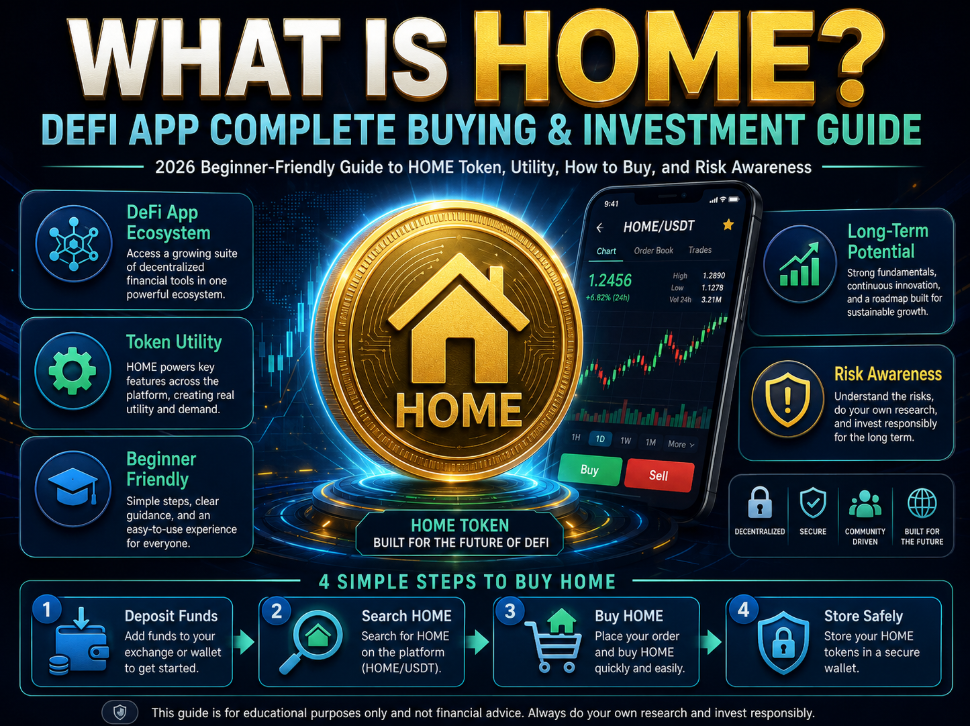
When newcomers search for HOME, it's easy to run into several entirely different projects.
This is HOME's biggest first-layer risk: it's not that you can't understand the project — it's that you might search for the wrong token, buy the wrong token, or import the wrong contract from the start.
Before getting into Defi App's HOME, two common misconceptions need to be ruled out.
Misconception one: Is HOME a stablecoin?
No.
Defi App's HOME is not a stablecoin, doesn't peg to $1, and isn't backed by real estate assets, mortgages, property rights, or collateral.
There has been a HOME Coin in the market associated with concepts like BACON, HomeCoin, and real-estate-backed assets. That category of project follows a different logic:
- Backed by real estate or mortgage-related assets
- Attempting to issue a stablecoin or real-estate-linked on-chain asset
- Emphasizing pegged value, property collateral, stability, or asset backing
- Leaning toward RWA / real estate finance
Defi App's HOME follows none of this logic.
Defi App's HOME is a platform ecosystem token whose price moves with the market; it makes no promise to peg to the dollar and offers no guarantee of principal stability. Its value comes from Defi App product usage, platform rights, token utility, market supply and demand, and investor expectations — not from a property reserve or stablecoin mechanism.
So if you come across a HOME claiming to be "real-estate-backed," a "stablecoin," "pegged to the dollar," or "backed by real residential assets," it's almost certainly not the Defi App HOME discussed here.
Misconception two: Is HOME the early 2021 BSC altcoin HomeCoin?
Also no.
Back in 2021, BSC had a number of small-cap projects using names like HomeCoin or HOME. Some leaned into charity, community, or "home" narratives, but they have no direct connection to Defi App's HOME.
Defi App's HOME corresponds to an actively operating DeFi application ecosystem, whose core idea is turning complex DeFi operations into something closer to an ordinary app experience — including cross-chain swaps, perpetuals, yield aggregation, gasless transactions, and self-custody wallet management.
To confirm you're buying the right Defi App HOME, check:
- Whether the project name is Defi App
- Whether the exchange page displays Defi App or HOME
- Whether official documentation points to the same token
- Whether the contract address matches the official one, CoinGecko, and CoinMarketCap
- Whether the chain is an officially supported network
- Whether it cross-verifies on major exchanges or block explorers
Don't just look at the HOME ticker. A ticker is not a unique identity — the contract address is the real identity of an on-chain asset.
What chain is Defi App's HOME actually on?
According to public materials, HOME is the native token of the Defi App ecosystem. Official documentation states a total supply of 10 billion tokens, designed around Defi App's platform activity, governance rights, and staking rewards.
Based on exchanges and market-data platforms, HOME may circulate in different forms across networks such as BNB Chain, Base, Solana, or other officially supported paths. Deposit and withdrawal networks supported by different platforms may vary, so before buying, users must confirm:
- Which network the current exchange supports
- Whether the withdrawal network matches your wallet's network
- Whether the contract address is the official one
- Whether it's an internally mapped exchange asset
- Whether deposits and withdrawals are supported
- Whether there's a cross-chain bridge or official routing path
At the time of writing, major market-data platforms showed HOME's maximum supply at 10 billion tokens, with circulating supply at roughly 4 billion, putting the circulating ratio at around 40%. Figures may vary slightly across platforms due to differences in update timing, accounting methodology, and on-chain identification.
In terms of market cap, HOME is no longer an entirely illiquid early-stage token, but it remains a highly volatile, emerging DeFi token. Its price performance depends not only on the Defi App product itself but also on market sentiment, token emissions, exchange depth, and the broader DeFi cycle.
In short: Defi App's HOME is a utility and governance token serving a cross-chain DeFi SuperApp — it is not a stablecoin, not a real-estate token, and not the earlier, unrelated HomeCoin of the same name.
2 | What Real Problem Does Defi App Solve? Why "DeFi Is Too Hard to Use" Is Worth Building a Product Around
To understand HOME, you first need to understand the problem Defi App is trying to solve.
DeFi isn't lacking in value — it's lacking in usability.
For experienced users, DeFi is a free, open, composable financial system. You manage your own assets and participate in trading, lending, yield, perpetuals, cross-chain transfers, and liquidity mining without needing permission from a bank or traditional financial institution.
But for newcomers, DeFi often feels like a different experience entirely:
- Not knowing how to use a wallet
- Not knowing how to switch networks
- Not understanding what gas even is
- Needing to buy ETH, BNB, or SOL before you can even trade
- Having to find a bridge to move across chains
- Waiting for funds to arrive after bridging
- Not understanding DEX slippage
- Being afraid to click contract approvals
- Accidentally landing on a phishing site
- Losing track of assets scattered across different chains
- Wanting yield but not knowing which protocol is safe
- Wanting to trade perpetuals but having to switch to yet another platform
This is the biggest barrier to DeFi adoption: it's not a lack of opportunity, it's that the barrier to entry is too high.
The three biggest hurdles for DeFi newcomers
First, the user experience is complex.
On a traditional exchange, a user only needs to:
- Register an account
- Deposit funds
- Search for a token
- Buy or sell
In DeFi, a user might need to:
- Install a wallet
- Back up a seed phrase
- Add a network
- Prepare gas
- Find a DEX
- Check the contract
- Set slippage
- Approve the token
- Connect the wallet
- Bridge assets
- Watch out for phishing
- Manage multi-chain assets
These steps are extremely unfriendly to beginners.
Second, the learning curve is steep.
DeFi users need to understand a lot of concepts:
- Private keys
- Seed phrases
- Gas
- Slippage
- Approvals
- Liquidity pools
- Cross-chain bridges
- Oracles
- Liquidation
- Perpetual funding rates
- Smart contract risk
Many people get scared off by these concepts before they've even started trading.
Third, the technical barrier is intimidating.
A single mistake during an on-chain operation can directly cause a loss of funds.
For example:
- Withdrawing to the wrong network
- Connecting to a fake website
- Importing a fake contract
- Approving a malicious contract
- Being unable to transfer because there's no gas
- Bridging assets to the wrong chain
- Getting sandwich-attacked because of unnoticed slippage
- Getting liquidated due to not understanding liquidation mechanics
So what DeFi truly lacks isn't another swap button — it's an entry point that hides this complexity.
How Defi App addresses "DeFi is too hard to use"
Defi App's product positioning is to turn complex DeFi operations into something resembling an ordinary app experience.
Its core focus areas include:
- Cross-chain operations
- Gasless transactions
- Unified wallet management
- Self-custody
- Swaps
- Perpetual contracts
- Yield aggregation
- A beginner-friendly interface
- Tools for professional users
According to official documentation, Defi App lets users complete swaps, perpetual trading, and yield operations in a single interface, covering EVM and Solana ecosystems, while emphasizing that users shouldn't need to manually handle cross-chain transfers, gas, or switching between multiple wallets.
Cross-chain capability: users don't need to bridge assets around themselves
A typical DeFi user wanting to move from one chain to another usually has to go through:
- Finding a bridge
- Confirming the source and destination chains
- Paying gas on the source chain
- Waiting for the bridge to complete
- Having gas ready on the destination chain too
- Going to a DEX to swap
- Bearing bridge risk and slippage throughout
Defi App aims to push these steps into the background.
Users only need to think about:
- What assets do I have right now
- What asset do I want to convert to
- Which chain do I want to use it on
- How much will I end up receiving
The bridging, routing, gas, and network-switching in between are abstracted away by the platform as much as possible.
This matters a lot for newcomers, because most of them don't actually dislike DeFi — they just don't want to become a part-time on-chain engineer.
Gasless transactions: no need to prepare gas separately for every chain
Gas is one of the most common sticking points for DeFi beginners.
You might hold USDC but no ETH, so you can't operate on Ethereum. You might hold USDT but no BNB, so you can't transfer on BNB Chain. You might hold assets on Solana but no SOL, so you can't pay the transaction fee.
This is the awkward state of "having assets you can't move."
Defi App's gas-abstraction design tries to let users avoid having to separately hold native gas tokens for every chain. Official documentation states that Defi App achieves gas abstraction through smart account infrastructure, letting users complete transactions more smoothly on supported chains.
The benefits of this design:
- Beginners don't need to learn each chain's gas rules in advance
- Cross-chain operations feel more like ordinary in-app actions
- Transaction paths get shorter
- Users are less likely to get stuck from lacking gas
- HOME has a real use case within gas abstraction
But it also introduces new questions:
- Who actually fronts the gas?
- How does the platform settle the cost?
- How is HOME used within this?
- If the platform's subsidy strategy changes, do user costs rise?
- Does the gas-sponsoring mechanism introduce new trust assumptions?
These questions are explored further in the risk section below.
A unified interface: usable by both beginners and professionals
Another characteristic of Defi App is that it serves two very different types of users at once.
For beginners, it lowers the barrier to entering DeFi:
- No need to understand too many on-chain details
- No need to manually search for a bridge
- No need to manage gas across multiple chains
- No need to constantly switch wallets
- Trading can be completed through a more intuitive interface
For professional users, it also offers more aggregation capability:
- Multi-chain trading
- Perpetual contracts
- Yield strategies
- Wallet management
- Trading competitions
- A higher-frequency trading experience
- Potential advanced features and reward systems
A good DeFi entry point can't serve only beginners, and it can't serve only power users either. It needs to lower the barrier without sacrificing the efficiency that professional traders require.
Where Defi App is better — and worse — than Uniswap or a cross-chain bridge
Defi App isn't simply a substitute for Uniswap, nor is it purely a cross-chain bridge.
It's more like an aggregating entry point.
Compared to Uniswap, Defi App's potential advantages include:
- Better suited to beginners
- A smoother cross-chain experience
- Going beyond swaps to also cover perpetuals and yield
- Handling gas and routing on the user's behalf
- Functioning more like a one-stop trading interface
But its disadvantages are also clear:
- Uniswap's protocol is more mature
- Uniswap has deeper liquidity
- Uniswap's brand is stronger
- Defi App still needs to prove it can retain users long-term
- Aggregator-style products depend on the security of underlying protocols and routing
- If the experience offers no clear edge, users may still go back to native DEXs
Compared to traditional cross-chain bridges, Defi App's advantage is:
- Not forcing users to face complex bridging steps directly
- Combining trading and cross-chain into a single action
- Lowering switching costs
- Better suited to non-professional users
But the disadvantage is:
- The backend pathway is more complex
- Users need to trust its routing and execution
- Cross-chain risk doesn't disappear — it's just hidden from view
- If something goes wrong in the backend, it's harder for newcomers to identify the source of risk
So Defi App's "everything app" model is essentially a trade-off:
It exchanges a better experience for more complex backend execution. If execution is reliable, it can substantially lower the barrier to DeFi. If execution is opaque or something goes wrong with security, the risk gets amplified too.
3 | What Gives the HOME Token Its Value? Breaking Down Use Cases and Token Economics
A well-built DeFi app doesn't automatically mean its token has value.
Many protocols have users, revenue, and trading volume, yet the token still fails to capture that value. Whether HOME is worth following comes down to two key questions:
- Does HOME have a genuine use case within the product?
- Is its supply and emission structure healthy?
What does HOME actually do within the product
According to Defi App's official documentation, HOME is the ecosystem's native token, built around protocol activity, governance rights, and staking rewards.
Its potential uses mainly fall into the following categories.
First, gas-abstraction-related uses.
Official documentation states that Defi App's gas abstraction lets users operate on supported chains without individually holding native gas tokens. HOME can serve as a functional medium within this mechanism, tied to the platform's gas sponsorship and transaction execution.
In simple terms, HOME isn't merely a "voting token" — it may also be involved in abstracting the actual transaction costs users face.
If Defi App's user base grows and cross-chain transactions and gasless operations increase, HOME's use case within the system may strengthen.
Second, governance voting.
HOME stakers can participate in governance, influencing the platform's future direction. Governance may cover:
- How fees are used
- Whether buybacks happen
- Whether stakers receive a share of revenue
- Which features get prioritized for development
- Which protocols or chains get prioritized for integration
- How incentives are distributed
- How platform ecosystem rules are adjusted
The value of governance depends on whether it's actually effective. If every key decision is made by the team, governance is just a formality. If HOME stakers can genuinely influence fee allocation and feature direction, the governance value becomes much stronger.
Third, XP boosts and platform incentives.
Official documentation states that locking HOME activates an XP multiplier boost. Users performing actions like swaps, perpetual trading, or deposits within Defi App may earn additional XP, which in turn could affect eligibility for future activities, airdrops, or platform rewards.
This kind of mechanism is useful for growth, since it can encourage users to:
- Hold HOME
- Lock HOME
- Use Defi App more frequently
- Participate in trading, yield, and platform activities
- Stay within the ecosystem instead of selling short-term
But it's worth noting: if XP and reward mechanisms rely too heavily on subsidies, they can encourage farming and short-term users. Genuinely healthy growth should gradually shift from being reward-driven to being product-value-driven.
Fourth, staking and potential protocol value capture.
HOME's long-term value may come from stakers' governance over how protocol fees are used.
For example, governance could decide:
- Whether protocol fees are used for buybacks
- Whether a portion is distributed to stakers
- Whether they're used for liquidity incentives
- Whether they're used for ecosystem subsidies
- Whether they go into the treasury for long-term development
If mechanisms like these genuinely materialize, HOME's connection to platform activity would strengthen considerably.
But it must be emphasized:
Potential revenue is not the same as guaranteed revenue. A governance discussion is not the same as something already implemented. Staking rights are not the same as a legal dividend. HOME is not a stock and offers no guarantee of platform profit distribution.
Token economics: 10 billion total supply, roughly 40% currently circulating
HOME has a total supply of 10 billion tokens. At the time of writing, major market-data platforms showed circulating supply at around 4 billion tokens, or roughly 40% of total supply.
This circulating ratio carries two implications for a new token.
First, HOME is no longer an extremely low-float token.
Some new tokens release only 5% or 10% at TGE, making the price easy to push up with relatively little buying. HOME's current circulating ratio of around 40% suggests a fairly substantial share of supply is already in the market, making price discovery somewhat more complete.
Second, a large amount of supply has yet to be fully released.
If roughly 40% is currently circulating, that implies nearly 60% of tokens may still be gradually released in the future through ecosystem incentives, the team, early backers, the foundation, protocol development, or other mechanisms.
This carries potential dilution pressure.
What the gap between current market cap and FDV tells you
The gap between HOME's market cap and FDV is an important indicator for assessing valuation.
Market cap represents the total value of currently circulating tokens at the market price. FDV represents the fully diluted valuation if all 10 billion HOME tokens were valued at the current price.
If a token's current market cap is around $100 million while its FDV is close to $250 million or $300 million, that suggests:
- A meaningful share is already circulating
- But future supply releases could still dilute holders
- The market is pricing in the entirety of future supply
- If product growth can't keep pace with unlocks, the price will face pressure
- If product growth outpaces supply emission, FDV pressure could be absorbed
The most common mistake beginners make is looking only at "market cap isn't that high" while ignoring FDV.
For example, a token might appear to have only a $100 million market cap, seemingly leaving plenty of room to grow. But if FDV is already close to $300 million while the project's revenue, user base, and token value capture haven't clearly materialized, the market may have already priced in a lot of future expectation.
So evaluating HOME requires looking beyond price or market cap alone, also considering:
- FDV
- The unlock schedule
- Remaining supply
- User growth
- Trading volume
- Protocol fees
- Whether HOME is genuinely being used
- Whether staking and locking can absorb circulating supply
In the early stage of a token's listing, sentiment and narrative often move faster than fundamentals. In the meme-coin category, for instance, many projects don't rely on clear cash flow at all — their price gains come purely from community buzz, the speed of spread, and market sentiment. To understand the difference between "narrative-driven" and "product-driven" tokens, see What Is WIF. WIF leans more toward sentiment and community-driven dynamics, while HOME needs to validate its value through product usage, user retention, and token utility.
4 | Can You Buy It Now, Where, and How to Avoid Buying the Wrong "HOME"
HOME already has multiple trading channels available, but the question isn't simply "can I buy it" — it's:
- Are you actually buying Defi App's HOME?
- Is the price you're paying reasonable?
- Does the platform have sufficient liquidity?
- Do you understand the unlock and volatility risks?
- Can you safely manage your wallet and contract address?
How to confirm you're buying Defi App's HOME
Verify in the following order before buying.
First, check the project name.
The exchange page should display:
- Defi App
- HOME
- HOME/USDT
- Or explicitly state it's the Defi App ecosystem token
If the page instead shows:
- HomeCoin
- BACON HOME
- Real-estate-backed HOME
- A token calling itself a stablecoin
- Or any other real-estate-stablecoin project
then it isn't the HOME discussed in this article.
Second, check official channels.
You need to cross-verify against:
- Defi App's official website
- Defi App's official documentation
- Defi App's official X / Discord
- CoinGecko
- CoinMarketCap
- Official exchange announcements
- Block explorers
Don't copy a contract address from a Telegram group, an X comment, a DM from "customer service," or an airdrop page.
Third, check the contract address and network.
HOME may exist as different contracts or mapped assets across different chains, and exchanges may support different networks too.
You must confirm:
- Whether the contract address is the official one
- Whether the network is officially supported
- Whether the exchange's deposit network matches your wallet's network
- Whether a cross-chain version exists
- Whether deposits and withdrawals work normally
- Whether there's a fake contract impersonating it
Fourth, check whether market-data platforms agree.
If the HOME price you see on some DEX differs drastically from what mainstream platforms like CoinGecko, CoinMarketCap, Coinbase, or Binance show, be very cautious.
Possible reasons include:
- Buying the wrong contract
- A fake pool
- Extremely low liquidity
- Exchange price lag
- A same-named token
- Malicious manipulation
Which platforms can HOME currently be traded on
At the time of writing, Defi App's HOME already shows trading or pricing data on multiple exchanges or channels.
Commonly referenced platforms include:
- Binance Alpha
- Binance Futures' HOMEUSDT perpetual
- Coinbase
- HiBT
- MEXC
- Bybit
- Toobit
- Other platforms supporting HOME/USDT or related HOME pairs
Different platforms support different product types.
For example:
- Some platforms support spot trading
- Some only support Alpha or event-based trading
- Some platforms support perpetual contracts
- Some only offer price data
- Some platforms support deposits and withdrawals
- Some platforms may restrict users from certain regions
Before buying, verify:
- Whether it's spot trading
- Whether your region is supported
- Whether deposits and withdrawals are open
- Which network is supported
- Whether the pair is HOME/USDT
- Whether there's a minimum order amount
- Whether order book depth is sufficient
- Whether there's a trading risk warning
Verifying the official contract using CoinGecko / CoinMarketCap plus a block explorer
Beginners can verify using this process:
Step one, open CoinGecko or CoinMarketCap and search for Defi App.
Don't just search HOME, since too many tokens share that name. Search the full project name:
- Defi App
- HOME Defi App
Step two, once on the corresponding token page, check:
- Token name
- Symbol
- Price
- Market cap
- Circulating supply
- Maximum supply
- Contract address
- Supported networks
- Market listings
- Exchange list
Step three, click through the contract address to the block explorer.
On the block explorer, confirm:
- Whether the token name corresponds to Defi App / HOME
- Whether the contract is verified
- The number of holder addresses
- Total supply
- Recent transfers
- The top ten holder addresses
- Whether there's been any unusual minting
- Whether high-risk permissions exist
Step four, compare against the exchange announcement.
If the token type, contract address, network, and market data in the exchange announcement don't match, don't deposit or buy.
What the recent 7-day and 30-day volatility tells you
HOME has shown noticeable volatility through 2026. At the time of writing, market-data platforms showed substantial 24-hour, 7-day, and 30-day price swings, with a clear drawdown from historical highs to the current price.
This points to a few things:
- HOME remains in a high-volatility stage
- Market sentiment has a major impact on price
- Exchange activity, unlocks, and sector hype can cause sharp short-term swings
- Chasing the price short-term carries significant risk
- Beginners are better served buying in batches and observing, rather than going all-in at once
For beginners, a healthier entry pace is to:
- Confirm the project and contract first
- Watch 24-hour trading volume
- Observe the 7-day and 30-day trend
- Wait for extreme volatility to cool down
- Buy in batches
- Avoid chasing the price on a day of a sharp rally
- Avoid using borrowed money or living expenses to buy
- Set a maximum acceptable loss range
If you only want to jump in because you saw "HOME pumped again," that's not investing — that's emotional trading.
5 | A Complete Walkthrough for Buying HOME on HiBT
Below is a walkthrough using HiBT as an example for how a beginner can buy HOME.
According to HiBT's public announcement, HOME/USDT has launched on the platform, with the token type listed as BSC; deposits, trading, and withdrawals open according to the announced schedule. Before acting, always defer to HiBT's current page, since the trading pair, deposit network, withdrawal status, and regional support may change at any time.
Step one: Register on HiBT and complete KYC
Start by going to HiBT's official website or app and registering an account with your email or phone number.
After registering, it's recommended to immediately set up security:
- Use a strong password
- Enable Google Authenticator or another two-factor method
- Set a funds password
- Enable an anti-phishing code
- Never share verification codes with anyone
- Never download an unfamiliar app
- Never click links from fake customer service
- Never let anyone else operate your account on your behalf
Then go to the identity verification page to complete KYC.
Why do compliant exchanges require KYC?
Main reasons include:
- Meeting anti-money-laundering requirements
- Complying with regulations across different jurisdictions
- Reducing the risk of account takeover and fraud
- Supporting fiat deposits and withdrawals
- Applying user thresholds for certain higher-risk products
- Strengthening account security and the ability to trace funds
HiBT can be described as a digital asset trading platform aimed at a global user base. Public materials note that HiBT has a Canadian registration background and discloses US and Canada MSB-related compliance status, with headquarters in Dubai. Before publishing, editors should double-check HiBT's latest licensing, terms of service, restricted regions, and compliance page to make sure the description stays accurate.
Step two: Fund your account — fiat or stablecoin
After completing KYC, you'll need to prepare funds to buy HOME.
There are generally two common methods.
The first is a fiat deposit. If HiBT supports bank cards, third-party payment methods, or P2P in your region, you can use local currency to buy USDT or USDC.
This route suits beginners, but note:
- Payment channel fees
- Exchange rate spread
- Settlement time
- P2P counterparty risk
- Different regions support different methods
- Additional identity verification may be required
The second is depositing a stablecoin. If you already hold USDT/USDC on another exchange or wallet, you can deposit it into HiBT and then buy HOME.
When depositing, you must pay attention to:
- Selecting the correct coin
- Selecting the correct network
- Copying the correct deposit address
- Testing with a small amount before depositing a large sum
- Not confusing networks like BSC, ERC-20, TRC-20, Base, and Solana
- Confirming which network HiBT currently supports
For the HOME/USDT pair, the most common path is to prepare USDT first, then buy HOME on the spot market.
Step three: Find the HOME trading pair on the spot market
Once funds arrive, go to HiBT's spot trading page.
You can search for:
- HOME
- HOME/USDT
- Defi App
After landing on the trading page, don't rush to place an order — confirm first:
- Whether the project is Defi App
- That it's not BACON HOME
- That it's not the early HomeCoin
- That it's not some other token sharing the HOME name
- Whether the pair is HOME/USDT
- Whether the token type matches the announcement
- Whether the current price roughly matches mainstream market-data platforms
- Whether the order book has depth
- Whether 24-hour trading volume looks normal
- Whether deposits and withdrawals are open
If the exchange page doesn't clearly explain the project's origin, it's best to pause.
Step four: Market order vs. limit order — how to place orders for newly listed or highly volatile tokens
When buying a highly volatile token like HOME, order type matters a lot.
Market orders:
- Execute immediately
- Simple to use
- Suited to pairs with good liquidity
- But prone to slippage when volatility is high or the order book is thin
Limit orders:
- Let you set your own buy price
- Only execute once the market reaches that price
- Better suited to highly volatile assets
- Help avoid getting filled at a price that's just spiked
- May not execute immediately
Beginners are generally better off using limit orders.
A more cautious approach:
- Start with a small test order
- Observe the average execution price
- Check fees clearly
- Buy in batches
- Avoid chasing the price after a sharp rally
- Avoid placing large orders when the order book is thin
- Don't put all your funds into a single new token
- Set stop-loss and take-profit levels ahead of time
A simple position-sizing approach: if you plan to deploy 100% of your intended capital, start by buying only 20%–30%, observe the price, volume, and project data, and decide whether to continue from there. Don't go all-in just because of one green candle.
Step five: After buying — keep it on the exchange or move it to a self-custody wallet
After buying HOME, there are two ways to hold it.
Option one: keep it on HiBT.
Suited for:
- Beginners
- Short-term traders
- People unfamiliar with wallets
- Anyone who may need to sell at any moment
- Anyone who doesn't want to manage a private key
Advantages:
- Simple to operate
- Convenient trading
- No need to manage a wallet
- Can quickly convert back to USDT
Disadvantages:
- Assets are custodied by the exchange
- You bear platform risk
- Account security depends on the platform and your own security settings
- Maintenance, risk controls, or regional restrictions could affect your ability to act
Option two: move it to a self-custody wallet.
Suited for:
- Users familiar with on-chain operations
- Those wanting to participate in the Defi App ecosystem
- Those wanting to use cross-chain swaps, yield, staking, or other features
- Those capable of safely safeguarding a private key and seed phrase
Before withdrawing, you must confirm:
- Which HOME network HiBT supports
- Whether your wallet supports that network
- Whether the wallet address is correct
- Whether you need that network's native gas
- Whether it can be recognized within Defi App
- Whether the contract address is the official one
If it's the BNB Chain network, you can use MetaMask to add BNB Smart Chain and import the HOME contract. For other networks, follow official documentation and the network supported by the exchange.
Regardless of the network, it's recommended to:
- Test with a small amount first
- Transfer larger amounts only after confirming receipt
- Avoid connecting to unfamiliar websites
- Avoid clicking on airdrop DMs
- Avoid approving unknown contracts
- Periodically revoke suspicious approvals
- Never enter your seed phrase on any website
Buying a recently popular new token like HOME on a compliant exchange follows a process similar to many other new tokens: first verify the project, then confirm the trading pair, then test with a small order, and finally size your position based on your risk tolerance. The logic in What Is BLESS for buying new tokens can also help readers generalize this approach: a new token isn't off-limits, but it has to be verified first, traded second, and risk-managed throughout.
Chapter 6 | What's HOME Actually Worth? Multi-Scenario Price Projections
HOME's price can't be judged with a simple "bullish" or "bearish" call.
Its valuation depends on a number of variables:
- Defi App's user growth
- Trading volume
- Frequency of cross-chain swap usage
- Perpetual contract trading volume
- The scale of yield aggregation
- HOME's staking ratio
- Actual usage of gas abstraction
- Protocol fees
- Whether governance materializes
- The token unlock schedule
- How much the market buys into the "DeFi SuperApp" narrative
- The overall crypto market cycle
The projections below are not investment advice or a price prediction — they're meant to help readers build an analytical framework.
For convenience, let P0 represent the current market reference price, or your average buy-in cost.
Bearish Scenario
Core assumptions:
- Defi App's user growth slows
- Overall DeFi enthusiasm declines
- Cross-chain transaction demand falls short of expectations
- The gasless experience fails to form a clear advantage
- Users are mostly drawn in by short-term rewards, with weak retention
- Unlocks and ecosystem incentives create sustained sell pressure
- Competitors replicate similar features
- HOME's staking and governance value remains unclear
Possible performance over 6–12 months:
- Price may trade in a 0.4P0–0.9P0 range
- If the broader market declines, it could break below prior lows
- A drop in trading volume would weaken any rebound
- FDV pressure would make new buyers cautious
- Falling short on user growth would undermine the platform-token logic
Possible performance over 1–3 years:
- If Defi App fails to build stable user habits, HOME could remain below P0 long-term
- If protocol fees fail to grow, governance and staking value will stay weak
- If unlocks keep flowing without enough demand to absorb them, price could be suppressed for a long period
- The project might keep running, but the token would struggle to command a high valuation
Key triggers to watch:
- Falling daily active users
- Declining trading volume
- Low usage of perpetual and yield features
- A low HOME staking ratio
- Increasing unlock pressure
- Competing products offering a better experience
- Declining risk appetite in the DeFi market
Suitable strategy:
- Don't chase rallies
- Manage position size
- Wait for extreme volatility to cool down
- Focus on watching users and volume
- Reduce risk exposure ahead of unlocks
Neutral Scenario
Core assumptions:
- Defi App's user base grows steadily
- The cross-chain swap and gasless experience earns recognition from a portion of users
- Perpetual contracts and yield products see meaningful usage
- HOME staking and XP incentives create demand to hold the token
- Unlock pressure is gradually absorbed by the market
- Multi-chain coverage continues to expand
- The DeFi market remains moderately active overall
Possible performance over 6–12 months:
- Price may trade around 0.8P0–2P0
- If users and volume continue improving, there's room for valuation recovery
- Staking and locking could absorb part of the circulating float
- Exchange-related activity could drive periodic moves
- But volatility would still be substantial
Possible performance over 1–3 years:
- If Defi App keeps growing, price could reach 2P0–4P0
- The market would gradually re-price it based on user scale, trading volume, and protocol fees
- HOME could shift from "new-token narrative" toward "platform utility token"
- But remaining supply releases would still cap the upside
Key triggers to watch:
- Genuine user growth
- Stable trading volume
- Increasing gasless usage frequency
- A rising HOME staking ratio
- Growing platform fees
- Expanding multi-chain coverage
- No significant dumping from unlocks
- Sustained market interest in the DeFi SuperApp narrative
Suitable strategy:
- Build positions in batches
- Track protocol data
- Don't chase rallies during spikes
- Adjust position size in line with the unlock schedule
- Watch whether the product genuinely retains users
Bullish Scenario
Core assumptions:
- Defi App's "everything app" model proves itself
- Large numbers of new users enter DeFi
- The gasless and cross-chain experience becomes a clear advantage
- Swaps, perpetuals, and yield all see volume increase simultaneously
- HOME staking and governance rights attract long-term holders
- Protocol fees start flowing back to the token
- Multi-chain ecosystem integration deepens
- Major exchanges and the market continue supporting it
- DeFi enters a new growth cycle
Possible performance over 6–12 months:
- Price could reach 2P0–5P0
- New exchange support or a major product launch could drive a rapid surge
- Improving user growth and staking data would boost market confidence
- Even in this scenario, drawdowns of 30%–60% are still possible
Possible performance over 1–3 years:
- If Defi App genuinely becomes a key entry point for DeFi users, price could reach 5P0–8P0 or higher
- The market may re-rate HOME from an ordinary platform token into a DeFi SuperApp ecosystem asset
- If protocol fees, staking, and governance form a closed loop, FDV pressure could be absorbed by growth
- But the long-term outcome still depends on real revenue and user retention, not slogans
Key triggers to watch:
- Clear growth in daily and monthly active users
- Continued expansion of cross-chain swap volume
- Perpetual contracts generating stable revenue
- Yield products attracting genuine deposits
- A rising HOME staking ratio
- Transparent disclosure of protocol fees
- Smooth multi-chain integration
- Price remaining stable even after unlocks
- The DeFi market entering an upcycle
Suitable strategy:
- Build positions gradually even when bullish
- Take partial profits during extreme rallies
- Don't treat the bullish scenario as a guaranteed outcome
- Keep tracking the data
- Focus on whether revenue can support the valuation
Why You Must Watch FDV, Circulating Market Cap, and Remaining Supply
Roughly 40% of HOME's supply is currently circulating, with around 60% potentially still to be released gradually in the future.
This means:
- The current price isn't the price under the final supply state
- Unlocks could bring sell pressure
- Ecosystem incentives may continue flowing into the market
- Releases tied to the team, early backers, and the foundation will affect supply and demand
- If product growth can't outpace new supply, the price will face pressure
- If user and revenue growth are fast enough, supply pressure could be absorbed
So judging HOME shouldn't come down to just "is the price low," but rather:
- Whether the circulating market cap is reasonable
- Whether FDV is too high
- The timing of remaining supply releases
- Who the unlock recipients are
- Whether they're likely to sell after unlocking
- Whether HOME is locked up through staking
- Whether protocol revenue is growing
- Whether users are genuinely sticking around
If you only look at short-term candles, it's easy to get swept up by sentiment. If you look at FDV, unlocks, users, and revenue together, your judgment will be much closer to the fundamentals.
7 | Risks to Know Before Buying HOME
HOME has a clear product backstory and a DeFi SuperApp narrative, but the risks can't be ignored either.
Crypto assets fall under the YMYL high-risk content category, and DeFi-related tokens especially need their risks spelled out clearly.
Wrong-Token Risk
This is one of HOME's most direct risks.
There's more than one HOME in the market.
You might encounter:
- Defi App's HOME
- BACON / the real-estate-backed HOME Coin
- The early BSC project HomeCoin
- A fake token sharing the same name
- A fake HOME airdrop
- A fake DEX pool
- A forged contract
Buying the wrong token can lead to:
- Ending up with an entirely different project
- Being unable to sell
- Extremely low liquidity
- Transfers being restricted by a malicious contract
- A wallet approval being stolen
- Assets that can't be recovered
Ways to avoid buying the wrong token:
- Search the full project name, Defi App
- Don't rely only on the HOME ticker
- Cross-check against official documentation
- Cross-check against CoinGecko / CoinMarketCap
- Cross-check against exchange announcements
- Cross-check against a block explorer
- Never copy a contract address posted by a stranger in a community group
Unlock Dilution Risk
About 40% of HOME's supply is currently circulating, with the rest still to be released gradually.
For price, this means:
- Future market supply may increase
- Unlock recipients may include the team, early backers, the foundation, and ecosystem incentive programs
- If tokens are sold after unlocking, the price could come under pressure
- If user growth is insufficient, new supply will be hard to absorb
- FDV could suppress valuation for a long period
Beginners need to understand:
A good project doesn't mean the current price is safe. People using the product doesn't mean the token won't be diluted by unlocks. A market cap that looks low doesn't mean FDV is cheap too.
Before buying, always check:
- The unlock schedule
- The size of the next unlock
- Who the unlock recipients are
- Whether unlocked tokens can be transferred to an exchange
- How price has behaved after past unlocks
- Whether a staking mechanism exists to absorb circulating supply
The Technical and Trust Assumptions Behind "Zero Gas Fees, Fully Self-Custodial"
Defi App emphasizes gasless transactions and self-custody, which is very appealing for the user experience.
But any product that "abstracts away complexity" is shifting that complexity to the backend.
Users need to understand:
- Gas hasn't disappeared — someone is fronting it, or it's being settled through some mechanism
- The platform sponsoring gas may rely on a treasury, routing system, or smart account infrastructure
- If the subsidy rules change, user costs could change too
- If the smart account, routing, or approval mechanism runs into trouble, it could affect asset safety
- Self-custody doesn't mean zero risk — users still need to manage private keys, approvals, and contract interactions
"Fully self-custodial" means assets aren't directly held by the platform, which is an advantage. But on-chain interaction still carries contract risk, signature risk, routing risk, and approval risk.
So users shouldn't ignore the underlying risks just because something is labeled "no gas" or "self-custodial."
Early-Product Risk
Defi App's direction is clear, but the competition is intense.
It faces competition from:
- Uniswap
- 1inch
- Matcha
- Jupiter
- MetaMask
- Coinbase Wallet
- Rabby
- Aave
- Hyperliquid
- GMX
- Various cross-chain bridges
- Various yield aggregators
- Centralized exchanges' Web3 wallets
To succeed, Defi App needs more than just "lots of features" — it needs to prove:
- Users are genuinely willing to use it every day
- The trading experience beats native DEXs
- Cross-chain pathways are secure and reliable
- The gasless experience is sustainable
- Perpetual and yield products are competitive
- Beginners won't churn after a risk event
- Professional users are also willing to stick around
- HOME can actually capture the value of product growth
Many SuperApps fail not because they lack features, but because they have too many features, none of which are strong enough.
If Defi App can't establish a clear edge in a few core use cases, HOME's long-term value will suffer.
Smart Contract and Cross-Chain Security Risk
Defi App touches cross-chain trading, swaps, perpetuals, yield, and wallet management — none of which are low-risk modules.
Potential risks include:
- Smart contract vulnerabilities
- Cross-chain routing failures
- Bridge risk
- Oracle anomalies
- Abnormal perpetual contract liquidations
- Approval risk
- Trading slippage
- MEV attacks
- Abnormal funding rates
- Issues in the underlying protocol of a yield strategy
- A third-party integrated protocol being attacked
Even if the platform itself has no malicious intent, an issue with an integrated protocol or underlying routing could still cause users to lose money.
So when participating in the Defi App ecosystem, don't put all your assets into a single strategy, and don't blindly approve large spending limits.
Market Sentiment Risk
HOME carries two characteristics simultaneously:
- It has a real product
- It has a new-token narrative
This combination is especially prone to being amplified by market sentiment.
On the way up, the market tends to emphasize:
- The DeFi SuperApp angle
- Gasless transactions
- Cross-chain capability
- Self-custody
- Support from platforms like Binance / Coinbase
- User growth
- HOME staking and governance
On the way down, the market tends to shift focus to:
- Unlocks
- FDV
- Sell pressure
- User retention
- Insufficient revenue
- Intense competition
- Unclear value capture for the token
The same project can be priced completely differently in a bull market versus a bear market.
So before buying HOME, ask yourself:
- Am I trading short-term or holding long-term?
- How much of a drawdown can I tolerate?
- Do I understand the unlocks?
- Will I panic-sell during a downturn?
- Am I buying purely because of community hype?
- Do I have a clear stop-loss and take-profit plan?
A Scam-Prevention Checklist
Before buying or using HOME, go through this checklist:
- Only access it through Defi App's official channels
- Don't click on unfamiliar airdrop links
- Don't believe in "claiming a supplementary HOME airdrop"
- Don't copy a contract address from a group chat message
- Never enter your seed phrase on any website
- Never give a verification code to customer service
- Never approve an unknown contract
- Never download an unofficial wallet
- Test with a small amount before any large transaction
- Cross-check against CoinGecko, CoinMarketCap, and exchange announcements
- Confirm the project is Defi App
- Confirm it isn't BACON HOME or HomeCoin
- Periodically revoke suspicious approvals
- Don't put all your funds into a single DeFi app
The simplest rule: if you can't confirm the project name, contract address, chain, trading platform, and liquidity, don't buy.
Conclusion: HOME Is Worth Watching, But Don't Judge It on the "Everything App" Narrative Alone
The Defi App behind HOME has zeroed in on one of DeFi's biggest problems: it's too hard to use.
If a product can genuinely achieve:
- Simpler cross-chain trading
- Not requiring users to handle gas themselves
- Completing swaps, perpetuals, and yield through a single interface
- Maintaining self-custody
- Serving both beginners and professionals at once
then it does have a real shot at becoming an important entry point for DeFi users.
That's also why HOME is worth following.
But investors shouldn't judge it on narrative alone. What truly determines HOME's long-term value comes down to questions like:
- Does Defi App have a real, continuously growing user base?
- Is the gasless experience sustainable?
- Is cross-chain routing secure and reliable?
- Are the perpetual and yield products competitive?
- Is HOME actually being used by users?
- Can staking and governance capture protocol value?
- Are protocol fees growing?
- Is unlock pressure under control?
- Is FDV supported by fundamentals?
- Do users stick around once the rewards run out?
If these indicators keep improving, HOME could gradually evolve from a buzzy new token into a platform token backed by genuine product fundamentals.
If user growth slows, unlock pressure mounts, and value capture for the token remains unclear, HOME's price could fall back into the supply-and-demand dynamics typical of a highly volatile asset.
For an ordinary beginner, the safest approach isn't chasing hype, but rather:
- Confirming first that you're buying Defi App's HOME
- Then confirming the contract and the exchange
- Testing with a small order
- Buying in batches
- Continuously tracking the data
- Setting a risk ceiling
- Not treating HOME as a stable asset
- Not treating any new token as a sure thing
FAQ
Is Defi App's HOME the same as the stablecoin HOME Coin?
No. Defi App's HOME is the utility and governance token of a DeFi SuperApp ecosystem; it doesn't peg to the dollar and isn't a real-estate-backed stablecoin. The real-estate-related HOME projects tied to BACON / HomeCoin are not the same asset as Defi App's HOME.
Is HOME the HomeCoin from 2021?
No. This article covers Defi App's HOME, not the early BSC-based HomeCoin. Before buying, always verify the project name, official channels, contract address, and exchange page to avoid buying the wrong token.
Where can I buy HOME right now?
At the time of writing, HOME shows trading or pricing data on several platforms, including Binance Alpha / Futures, Coinbase, HiBT, MEXC, Bybit, and Toobit. Product types, regional availability, and supported deposit/withdrawal networks may vary by platform, so always check the exchange's live page before buying.
Can I buy HOME on HiBT?
According to HiBT's announcement, HOME/USDT has launched, with the token type listed as BSC. But trading status, deposits/withdrawals, and regional support may change, so before acting, search for HOME/USDT on HiBT's official trading page and confirm the project is Defi App's HOME.
What's the minimum amount of HOME I can buy?
The minimum purchase amount depends on the exchange's rules and the minimum order size for the trading pair. Beginners should start with a small test order to confirm the execution price, fees, slippage, and that the trading pair is correct before deciding whether to continue buying.
How is HOME different from a meme coin like WIF?
WIF leans more toward being driven by community sentiment and meme culture, with the core focus on spread, hype, and market consensus. HOME leans more toward being product-driven, with the core focus on Defi App's genuine user base, trading volume, gasless usage, staking, governance, and protocol fees. Both are high-risk, but the analytical frameworks differ.
Is HOME a stable-yield token?
No. HOME offers no guaranteed yield, and no guarantee of buybacks, dividends, or price appreciation. Even if governance decides in the future to use protocol fees for buybacks or staker incentives, that's subject to official rules and governance outcomes — it shouldn't be treated as a stable-yield asset.
What's the biggest risk with HOME?
The main risks include buying the wrong token, unlock dilution, FDV pressure, product growth falling short of expectations, the sustainability of the gasless mechanism, smart contract vulnerabilities, cross-chain security risk, intense DeFi competition, and market sentiment swings.
Is HOME suitable for long-term holding?
Whether it's suitable for long-term holding depends on whether Defi App can continue attracting genuine users and whether HOME develops real demand within the product. If users, trading volume, protocol fees, and staking scale keep growing, HOME may have a reasonable case for mid-to-long-term holding. If growth stalls or unlock pressure becomes too large, the risk of holding long-term increases significantly.
Author info card
Author: HiBT Research Institute Content Team Editor: HiBT Risk Education Editorial Team Research focus: DeFi applications, cross-chain trading, platform utility tokens, new exchange listings, crypto asset risk education Article type: Project explainer, buying guide, investment risk analysis Last updated: June 18, 2026
Sources
This article drew on the following types of publicly available material:
- Defi App's official website
- Defi App's official documentation and HOME tokenomics
- CoinMarketCap's Defi App (HOME) market page
- CoinGecko's HOME pricing and market page
- Coinbase's Defi App (HOME) market page
- Binance Alpha / Binance Futures' HOME listing announcement
- HiBT's HOME/USDT listing announcement
- Market data from exchanges including MEXC and Bybit
- On-chain data and the HOME contract, as viewed on block explorers
- Public materials on DeFi, cross-chain bridges, smart accounts, and gas abstraction
Risk disclaimer
This article is for information-sharing and crypto education purposes only and does not constitute investment advice, legal advice, tax advice, or a recommendation to buy or sell. HOME is a highly volatile crypto asset that may rise or fall sharply, including the possibility of significant losses. Defi App's related features carry risks involving cross-chain transfers, smart contracts, perpetual contracts, yield strategies, and wallet approvals. Before buying, independently verify official information, the contract address, exchange support, liquidity, the unlock schedule, and your own region's compliance requirements, and make decisions carefully based on your personal risk tolerance.