
Data Verification Date: July 10, 2026 (UTC+8)
Risk Disclaimer: This article is for informational research and investor education only. It does not constitute investment advice, legal advice, tax advice, or any return guarantee. GLWB is a tokenized stock / Tokenized bStocks asset, involving risks including U.S. stock price volatility, tokenization structure, platform counterparty, price dislocation, liquidity, regulation, tax, on-chain operation, and principal loss.
I. Why Should Crypto Newcomers Pay Attention to "Traditional Manufacturing Tokenization" Assets Like GLWB?
When crypto newcomers hear about AI, their first instinct is usually:
- AI concept tokens;
- AI Agent tokens;
- Decentralized compute;
- AI data labeling;
- AI model protocols;
- AI + Meme narratives.
These directions do have imagination space, but the problems are also obvious: many AI concept tokens lack stable revenue, and valuations rely heavily on narratives, community heat, and liquidity. When market sentiment cools, price swings can be extremely violent.
GLWB works on a completely different logic.
It is not an AI concept token. It is tokenized stock exposure to Corning, a traditional manufacturing leader. Corning is not some new company that appeared in 2026 — it is a materials science company with over 170 years of history, covering fiber optics, glass, ceramics, display materials, environmental technology, life sciences, and semiconductor-related materials. Corning describes itself as a global leader in materials science innovation, with more than 170 years of invention and product innovation history.
This is the most important significance of GLWB for crypto newcomers:
It is not asking you to keep chasing "AI narrative tokens." It is giving you a way to participate in traditional hard-tech companies behind AI infrastructure through crypto trading methods.
1. What Is the Difference Between GLW and GLWB?
Newcomers first need to distinguish between two tickers.
GLW is the NYSE stock ticker for Corning Incorporated.
GLWB is Corning Tokenized bStocks, a tokenized mapping asset of Corning stock.
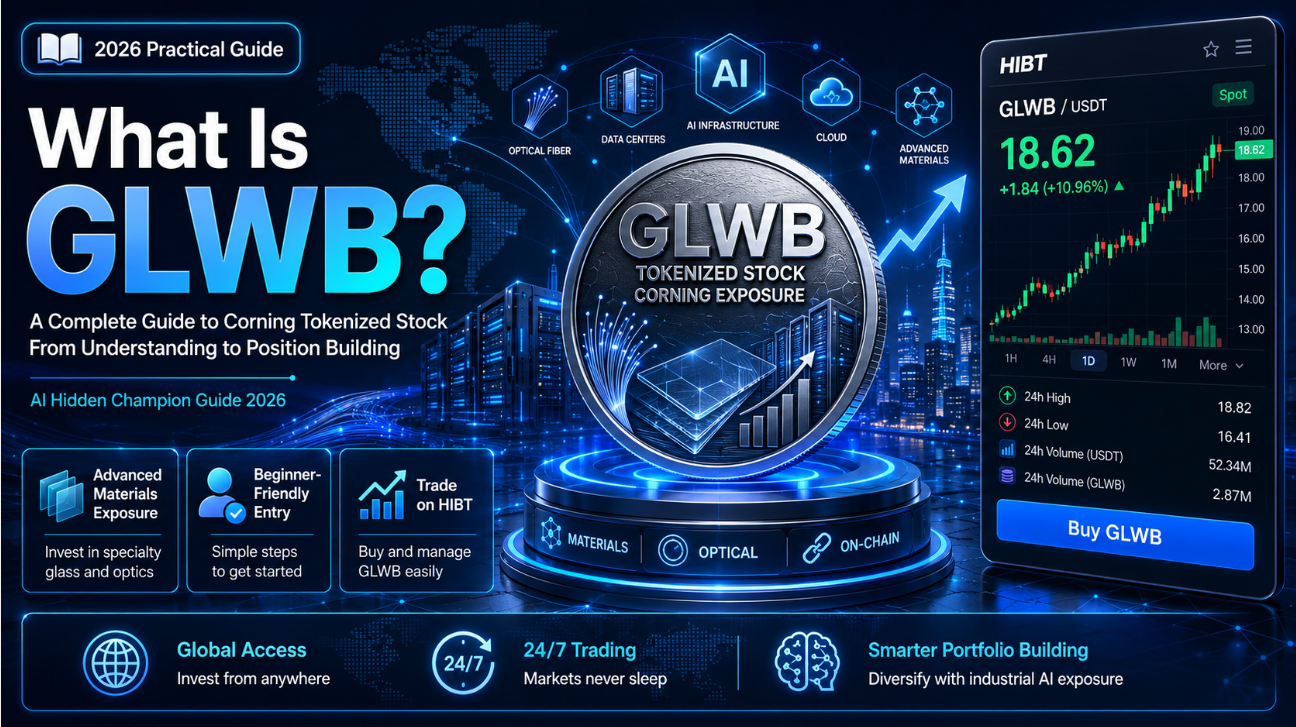
HIBT official announcement shows that GLWB's trading pair is GLWB/USDT, running on BSC, trading start time is July 9, 2026, 07:00 UTC, and withdrawal open time is July 10, 2026, 07:00 UTC; the project description is "GLWB is a tokenized bStocks that gives you economic exposure to Corning Tokenized bStocks."
So the correct understanding is:
- GLW is a traditional U.S. stock;
- GLWB is a tokenized stock asset;
- GLWB is not an independent cryptocurrency;
- GLWB's price is highly correlated with GLW stock;
- Holding GLWB does not equal directly holding GLW stock in a traditional brokerage account.
As of this article's verification, GLW's real-time price is approximately around $192, and GLWB's price in public market data sources also fluctuates roughly in the $180–200 range, though specific prices change with the market in real time.
2. How Do Tokenized Stocks Work?
bStocks is a tokenized security product. Binance Academy's explanation of bStocks is: each bStock is typically backed 1:1 by the corresponding U.S. stock, tradable 24/7 in the spot market, and exists as a BEP-20 token on BNB Smart Chain.
But newcomers must pay attention:
bStocks are not stocks themselves, nor do they represent direct ownership of the underlying listed company's shares.
Binance's bStocks page explicitly states that bStocks are not stocks or shares, and holders do not directly own the underlying listed company's stock.
Therefore, GLWB is better understood this way:
GLWB is a tokenized asset that allows users to gain economic exposure to Corning stock through a crypto trading platform, rather than traditional U.S. stock account holdings.
3. Three Reasons for Crypto Newcomers to Allocate GLWB
Reason 1: AI data centers need more than just GPUs — they also need fiber optics and connectivity materials.
AI compute clusters are not just a bunch of GPUs thrown together. Tens of thousands of GPUs need high-speed communication, and data must flow quickly between servers, switches, racks, and data centers. Traditional copper cables hit limits in higher bandwidth, longer distance, and lower power consumption scenarios, so the importance of fiber optics and optical connectivity solutions rises.
Reason 2: Corning has real orders and cash flow, not just narratives.
In January 2026, Corning and Meta announced a multi-year agreement worth up to $6 billion, under which Corning will supply next-generation fiber, cable, and connectivity products for Meta's advanced AI data centers, and build a new cable manufacturing facility in Hickory, North Carolina. Reuters also reported that Meta will pay Corning up to $6 billion over the coming years for AI data center fiber cable supply.
Reason 3: GLWB allows crypto users to participate in traditional manufacturing leaders without a U.S. stock account.
Traditionally, buying GLW stock requires a U.S. brokerage account, USD deposit, U.S. stock trading hours, and securities account rules. Through HIBT's GLWB/USDT trading pair, users can participate in Corning stock-related economic exposure using USDT. For newcomers already familiar with crypto trading, this path is closer to buying BTC, ETH, or other spot assets.
4. The Essential Difference Between "Buying Coins" and "Buying GLWB"
When buying ordinary cryptocurrencies, common valuation logic includes:
- Protocol revenue;
- On-chain activity;
- Tokenomics;
- Community consensus;
- Exchange liquidity;
- Narrative heat;
- Market risk appetite.
When buying GLWB, the core logic becomes:
- Corning orders;
- Corning earnings reports;
- Fiber optics business growth;
- AI data center capex;
- Gorilla Glass product cycles;
- CPO technology adoption;
- U.S. stock valuation levels;
- Tokenized stock premium or discount.
The price drivers of these two asset types are completely different.
So GLWB is not suitable to be treated as "the next 100x coin." It is better viewed as:
A bridge asset for crypto users to allocate traditional hard-tech leaders in the AI infrastructure era.
II. What Exactly Is GLWB? Breaking Down Corning Fundamentals and Price Mechanics
To understand GLWB, you cannot just look at the candlestick chart on HIBT. What truly matters is: how does this company make money, and why has its business been repriced by the market in 2026.
1. Corning's Business Is Not Just "Glass"
Many newcomers hear "Corning" and only think of Gorilla Glass on smartphones. In reality, Corning's business scope is much broader.
Corning's Q1 2026 earnings report shows that the company adjusted its segment structure starting Q1 2026, currently including Optical Communications, Glass Innovations, Automotive, Solar, Life Sciences and Emerging Growth Businesses, and other segments.
The segment most worthy of GLWB investors' attention is Optical Communications — the optical communications business.
Corning Q1 2026 results show core sales grew 18% to $4.35 billion, core EPS grew 30% to $0.70; among them, Optical Communications sales grew 36% year-over-year, and Solar sales grew 80% year-over-year.
This shows that Corning's core growth in 2026 is not simply from mobile phone glass, but driven by AI data centers, optical communications, and emerging businesses.
2. How to Understand Corning's Five Business Segments?
First, Optical Communications: The "Nervous System" of AI Data Centers
This is the segment currently drawing the most market attention.
AI data centers require massive amounts of fiber, cable, connectors, and high-speed communication components. Capex from Meta, NVIDIA, hyperscale cloud providers, and AI OEMs will all directly impact Corning's optical communications business.
In Corning's Q1 2026 earnings report, Optical Communications net sales were $1.846 billion, up 36% year-over-year; net income was $387 million, up 93% year-over-year.
This data explains why GLW / GLWB is being repriced by the market as an AI infrastructure asset.
Second, Glass Innovations: Display and Specialty Materials
In Corning's Q1 2026 earnings report, Glass Innovations net sales were $1.42 billion, up 1% year-over-year. This segment includes the former display technology and specialty materials businesses.
Gorilla Glass is also one of Corning's brand moats. Corning's official website shows that Gorilla Glass has been used by more than 45 major brands across over 8 billion devices.
Third, Automotive: Environmental and Automotive Materials
Corning has long provided ceramic substrates, emissions control materials, and other products to the automotive industry. This segment's growth is not as exciting as AI fiber optics, but it carries traditional manufacturing cash flow characteristics.
Fourth, Solar: A New Growth Business
Corning's Q1 2026 earnings report shows Solar segment net sales of $370 million, up 80% year-over-year, but net income declined year-over-year. This indicates that the solar business has growth potential, but also faces capacity expansion, maintenance, and profit volatility issues.
Fifth, Life Sciences and Emerging Growth Businesses
Corning also has presence in life sciences, pharmaceutical glass, laboratory consumables, and other directions. This segment is not a short-term main catalyst for GLWB, but it reflects the diversification of Corning's materials platform.
3. Why Is the Meta $6 Billion Agreement Important?
The Meta-Corning agreement is a key event in the GLWB narrative.
Corning's official announcement describes this as a multi-year, up-to-$6 billion commitment, under which Corning will supply the latest generation of fiber, cable, and connectivity products to meet the density and scale demands of advanced AI data centers; meanwhile, Corning will build a new cable manufacturing facility in Hickory and expand North Carolina capacity.
This matters not just because of the large dollar amount, but because it validates three things:
First, AI data centers truly need large volumes of high-performance optical connectivity products.
Second, large tech companies are willing to lock in long-term supply.
Third, Corning is not passively waiting for orders — it is expanding U.S. domestic manufacturing capacity.
The market reaction was also very clear. After Reuters reported this deal, Corning was repriced by the market as a traditional manufacturer in the AI data center fiber supply chain.
4. NVIDIA and CPO: Corning's Long-Term Imagination Space
Another long-term highlight for GLWB is CPO, or Co-Packaged Optics.
To put it simply, in traditional data centers, electrical-to-optical signal conversion mainly happens in external modules on switches or servers. As AI cluster scale grows, data transmission bandwidth and power consumption pressure increase, and the industry is pushing optical connectivity closer to chips and switch ASICs.
Corning's May 2026 announcement shows that the company and NVIDIA announced a long-term partnership to expand U.S. optical connectivity capacity by 10x, build three new manufacturing plants, and create more than 3,000 high-paying jobs. Corning also stated that its new Photonics Market-Access Platform plans to establish a $10 billion revenue stream by 2030.
Meanwhile, Corning's partnership with Broadcom also shows the company is entering the CPO supply chain. Corning's 2025 announcement shows that the company will supply cutting-edge optical components for Broadcom's Bailly CPO system, described as the industry's first CPO-based 51.2 Tbps Ethernet switch.
This is the long-term imagination space for GLWB:
If AI data centers gradually shift from "copper connectivity" to "optical connectivity," Corning could upgrade from a traditional fiber supplier to a core materials and components supplier for AI optical interconnects.
5. Gorilla Glass: The Mobile Glass Moat Still Exists
Although the market is now more focused on AI fiber optics, Corning's consumer electronics materials business remains important.
In March 2026, Corning launched Gorilla Glass Ceramic 3, and announced that the Motorola razr fold would be the first smartphone to feature this material. Corning officially stated that in lab testing, this material can withstand at least 20 repeated drops on a simulated asphalt surface.
This shows Corning's materials innovation continues, especially in foldable screens, premium phones, drop-resistant glass, and glass-ceramic directions.
But investors should note: Gorilla Glass is Corning's moat, but it is not necessarily the sole core driver of the stock price rise in 2026. The current GLWB narrative is still more weighted toward AI data center optical communications.
6. How to Understand GLWB's Issuance and Custody Mechanism?
HIBT announcement shows that GLWB runs on the BSC network, provides economic exposure to Corning Tokenized bStocks, and lists the bStocks official website and BscScan contract address.
From the bStocks mechanism perspective, bStocks typically emphasize 1:1 underlying stock backing, 24/7 trading, on-chain transfer, and Proof of Collateral.
But newcomers must keep in mind:
- HIBT is the trading entry point;
- bStocks is the tokenized stock structure;
- GLW is the underlying U.S. stock;
- GLWB is not GLW stock itself;
- Underlying stock backing, custody, dividend handling, Proof of Collateral, and other information need to be verified against bStocks official disclosure and HIBT announcements.
Regarding dividends, bStocks FAQ states that dividends are typically handled through a Multiplier mechanism, not directly distributed as cash like traditional stock accounts. So GLWB holders should not simply understand it as "receiving a cash dividend," but rather pay attention to token multipliers, net value adjustments, and platform announcements.
III. GLWB Investment Logic: Value Assessment Under the 2026 AI Infrastructure and Materials Science Cycle
Investing in GLWB is essentially answering one question:
Do you believe that the physical infrastructure demand of AI data centers will sustainably drive Corning's optical communications and materials businesses?
1. "Fiber In, Copper Out": Why Do AI Data Centers Need Fiber Optics?
The larger the AI cluster, the more data transmitted between GPUs, switches, servers, storage, and networks.
Traditional copper cables have the advantage of being cheap, mature, and low-latency, but in higher bandwidth, longer distance, and larger-scale cluster scenarios, they hit power consumption, heat dissipation, and signal attenuation limits.
The advantages of fiber optics are:
- High bandwidth;
- Long transmission distance;
- Low electromagnetic interference;
- Better suited for large-scale data center connections;
- Better energy efficiency potential in some scenarios.
This is the core logic of "fiber in, copper out."
Not all connections will immediately switch from copper to fiber, but the larger the AI data center scale, the more obvious the value of optical communications.
2. Corning Fiber Optics Business: Cyclical and Structural Forces Combined
Corning is not the first time the market has chased it because of fiber optics.
During the 2000 dot-com bubble, Corning was also a star company in the fiber optics boom. A 2002 Forbes article mentioned that Wall Street once chased Corning as an internet concept stock, with the stock rising from roughly $10 on a split-adjusted basis to $113 by the end of 2000. Later, the telecom bubble burst, fiber supply exceeded demand, and Corning's stock price fell sharply.
This history is very important for GLWB investors.
The AI fiber optics demand in 2026 is indeed different from the 2000 internet bubble: today's demand comes from actually running cloud computing, AI training, AI inference, and data center construction, not just the imagination that "the future internet will be huge."
But the risks are also similar:
- If tech giants slow capex;
- If AI data center construction overheats;
- If fiber optics capacity expands too fast;
- If CPO adoption lags expectations;
- If customer bargaining power strengthens;
Corning could also see valuation correction.
So the core of GLWB is not "AI will definitely go up," but rather the judgment:
Whether current orders and capacity expansion can translate into sustained revenue and profit.
3. Large Customer Orders Are a Positive, but Also a Risk
Meta's up-to-$6 billion agreement is a major positive, but large customer orders also bring concentration risk.
If Meta continues expanding AI data centers, Corning benefits clearly.
But if in the future:
- Meta cuts capex;
- AI training demand slows;
- Data center projects are delayed;
- Meta switches to other suppliers;
- Optical connectivity technology routes change;
Corning's growth expectations could be revised down.
Corning's Q1 2026 earnings report also mentioned that, in addition to Meta, the company secured two more large hyperscaler agreements of similar scale and duration, strengthening the company's position in the AI data center connectivity supply chain. But this also means the market's valuation of Corning is increasingly dependent on the hyperscaler capex cycle.
4. Key Catalysts Affecting GLWB in 2026
First, Meta Fiber Optics Order Delivery Progress
Investors should watch:
- Hickory facility construction progress;
- North Carolina capacity expansion;
- Meta data center construction pace;
- Whether Corning optical communications revenue is realized;
- Whether gross margin improves.
Second, NVIDIA Partnership and Photonics MAP
Corning's long-term partnership with NVIDIA is an important catalyst for the market's repricing of Corning. Corning's announcement states that the company will expand U.S. optical connectivity capacity by 10x and build three new plants.
If this partnership successfully lands, GLWB's long-term narrative will be stronger.
Third, CPO Technology Adoption Speed
Broadcom's CPO systems, NVIDIA's optical connectivity roadmap, AI switches, and data center interconnect architectures are long-term technical variables that GLWB investors need to track.
But note: CPO is a long-term opportunity, not necessarily immediate mass adoption. Some market views also hold that widespread CPO adoption may take time, and in the short term it will still coexist with copper cables, pluggable optical modules, and other solutions.
Fourth, Gorilla Glass and Foldable Phones
Gorilla Glass Ceramic 3 debuting on the Motorola razr fold is a reflection of Corning's consumer electronics materials innovation. If foldable screen penetration increases in the future, demand for premium glass materials may continue to grow.
Fifth, U.S. Stock Valuation and AI Stock Sentiment
GLWB is not a pure on-chain asset; it is affected by GLW's underlying stock.
As of this article's verification, Corning's 52-week price range is approximately 51.32–271.78, and the current price has already pulled back from the high, indicating that GLW experienced significant AI trading volatility in 2026.
For GLWB investors, it is essential to simultaneously observe the overall U.S. stock market sentiment toward AI infrastructure stocks.
IV. Step-by-Step Guide: The Complete Path to Buying GLWB on HIBT
This section is aimed at complete newcomers. The focus is not on complex financial models, but on explaining each step clearly to avoid buying the wrong trading pair, transferring to the wrong network, or accidentally entering the futures page.
1. Register a HIBT Account
After entering the HIBT official website or app, register an account using email or phone number.
After registration, it is recommended to immediately complete three things:
- Set a strong password;
- Enable Google Authenticator or another 2FA;
- Set an anti-phishing code.
Do not send verification codes, login passwords, fund passwords, private keys, or seed phrases to any "customer service." Real official customer service will not ask you to transfer funds privately or send verification codes.
2. Complete KYC Verification
KYC's purpose is to confirm identity, reduce fraud and money laundering risk, and also affect account functions, deposit/withdrawal permissions, and limits.
Common reasons for newcomer KYC failure include:
- Blurry ID photo;
- Expired ID;
- Face recognition failure;
- Name and ID information mismatch;
- Unsupported ID type uploaded;
- VPN usage causing region anomalies;
- Multiple accounts with duplicate verification;
- Region does not support the relevant product.
Mainland China, Southeast Asia, and U.S./European users may differ in ID, address proof, source of funds, and trading restrictions. Actual rules are subject to HIBT page prompts and local laws and regulations.
3. Prepare USDT
To purchase GLWB/USDT, you usually need to prepare USDT first.
There are two common methods:
First, On-Chain Deposit of USDT
Suitable for users who already hold USDT on other exchanges or in wallets.
HIBT's deposit/withdrawal network instructions remind that when selecting a deposit network, the withdrawal network from the other exchange or wallet must match the HIBT deposit network; for example, if you choose USDT-ERC20 deposit network, the withdrawal network must also be USDT-ERC20, otherwise assets may be lost.
Newcomers must confirm:
- The token is USDT;
- The network matches;
- The address is copied correctly;
- First-time small-amount test;
- Do not choose unfamiliar networks just to save fees.
Second, P2P or Quick Buy
Suitable for newcomers who do not have USDT.
The advantage is low barrier to entry. The disadvantages are:
- Exchange rates may have a premium;
- Merchant credibility varies;
- Payment methods are region-restricted;
- Fiat on/off ramps may trigger bank risk controls;
- Certain regions have compliance risks.
Pure newcomers are not recommended to make a large first deposit. You can first use 50–100 USDT to run through the process.
4. Enter the GLWB/USDT Trading Page
HIBT official announcement shows that GLWB's trading pair is GLWB/USDT, and lists the HIBT trading entry, BSC network, and contract address.
The operation path can be understood as:
- Log in to HIBT;
- Confirm that USDT is already in your account;
- Enter the spot trading page;
- Search for GLWB;
- Select GLWB/USDT;
- Confirm it is not the futures page;
- Check the candlestick chart, order book, and trading volume;
- Choose limit order or market order;
- Enter the purchase amount;
- After placing the order, check the trade history and holdings.
5. How to Choose Between Limit and Market Orders?
For tokenized stocks like GLWB that have recently launched, newcomers should prioritize limit orders.
Limit orders are suitable for:
- Not wanting to chase highs;
- Wanting to control cost;
- When order book depth is average;
- When trading amount is large;
- Wanting to scale in gradually;
- Worried about premium during U.S. stock market closure.
Market orders are suitable for:
- Very small amounts;
- Needing quick execution;
- When order book depth is sufficient;
- Willing to accept slippage.
The most common mistake newcomers make is seeing GLWB rising quickly and chasing with a market order. Because early liquidity of tokenized stocks may not be as deep as BTC or ETH, market orders can cause significant slippage.
6. How to Manage Your Position After Buying?
After buying GLWB, do not just look at the floating P&L in your HIBT account. Also track:
- GLW underlying stock price movement;
- GLWB/USDT order book depth;
- Corning earnings reports;
- Meta / NVIDIA / Broadcom partnership progress;
- Optical communications business revenue;
- CPO technology adoption;
- Gorilla Glass new products;
- HIBT announcements;
- bStocks Proof of Collateral;
- Dividend or corporate action handling rules.
Regarding dividends, bStocks FAQ states that dividends are not distributed separately as cash, but handled through a Multiplier mechanism. But how GLWB specifically reflects dividends should be subject to bStocks official disclosure and HIBT announcements at the time.
7. Selling and Withdrawal Path
The GLWB liquidation path is typically:
- Sell GLWB in the GLWB/USDT trading pair;
- Receive USDT;
- Leave USDT in HIBT to continue trading, or withdraw to a personal wallet;
- If fiat currency is needed, choose a compliant off-ramp path;
- Record transactions and tax information according to local legal requirements.
When withdrawing, confirm:
- Withdrawal token;
- Withdrawal network;
- Receiving address;
- Fees;
- Minimum withdrawal amount;
- Arrival time;
- Whether additional risk control review is needed.
V. Peer Tokenized Asset Comparison: How to Choose Between GLWB, CBRSB, and WDCB?
HIBT has more than just GLWB as a tokenized stock. What newcomers truly need to learn is not "which one rose more today," but understanding their positions in the AI infrastructure industry chain.
1. GLWB vs CBRSB: Connectivity Layer vs Compute Core Layer
CBRSB corresponds to Cerebras Tokenized bStocks, belonging to the AI chip and wafer-scale computing narrative. HIBT announcement shows that CBRSB/USDT also provides economic exposure to Cerebras Tokenized bStocks.
The core difference between GLWB and CBRSB is:
- GLWB: More weighted toward the AI data center connectivity layer, representing fiber optics, cable, connectors, CPO, and materials science;
- CBRSB: More weighted toward the AI compute core layer, representing dedicated AI processors and chip architecture.
If you compare an AI data center to a human body:
- CBRSB is more like "brain compute";
- GLWB is more like "nervous system connectivity."
The two are not substitutes for each other, but complementary.
2. GLWB vs WDCB: Data Transmission vs Data Storage
WDCB corresponds to Western Digital Tokenized bStocks, representing storage hardware company exposure. HIBT announcement shows that WDCB/USDT provides economic exposure to Western Digital Tokenized bStocks.
The difference between GLWB and WDCB is:
- GLWB: Solves how data is transmitted at high speed;
- WDCB: Solves how data is preserved long-term;
- GLWB benefits from optical communications and AI cluster connectivity;
- WDCB benefits from HDD, SSD, data center storage, and storage cycles.
If AI data centers continue expanding, both transmission and storage matter, but the corresponding cycles differ:
- Fiber optics orders are affected by data center construction pace;
- Storage hardware is affected by NAND / HDD / SSD cycles;
- Both are related to AI capex, but fluctuation rhythms differ.
3. AI Infrastructure Full-Chain Allocation Strategies
The following are for educational example only and do not constitute investment advice.
Conservative: GLWB-Focused
Suitable for:
- Bullish on AI data center connectivity demand;
- Not wanting to buy too many high-volatility small tokens;
- Wanting to participate in traditional manufacturing cash flow;
- Able to accept U.S. stock volatility.
Example structure:
- GLWB: 60%;
- USDT: 30%;
- BTC / ETH: 10%.
Growth-Oriented: GLWB + CBRSB
Suitable for:
- Bullish on both AI compute and AI connectivity;
- Able to accept higher volatility;
- Willing to track industry news;
- Having some trading experience.
Example structure:
- GLWB: 45%;
- CBRSB: 30%;
- BTC / ETH: 15%;
- USDT: 10%.
Cyclical: GLWB + WDCB
Suitable for:
- Bullish on AI data center expansion;
- Also wanting to play a storage cycle reversal;
- Able to understand hardware industry volatility;
- Not pursuing a single asset's explosive gain.
Example structure:
- GLWB: 45%;
- WDCB: 25%;
- BTC / ETH: 15%;
- USDT: 15%.
4. Be Careful When Stating HIBT Fees
Many articles directly write HIBT Maker 0.03% / Taker 0.05%, but we need to be rigorous here.
HIBT official fee adjustment announcements mention that Maker 0.03% / Taker 0.05% is the futures trading fee. If GLWB/USDT is traded as a spot tokenized stock, the actual fee should be subject to the HIBT trading page, account level, activity rules, and real-time prompts.
Such details are very important for newcomers, because futures fees, spot fees, activity fees, and VIP fees may not be the same set of rules.
VI. Full Risk Landscape: 6 Pitfalls You Must Know Before Investing in GLWB
GLWB is backed by 170-year-old Corning, but that does not mean it is risk-free. The risks of tokenized stocks come from both the underlying stock and the tokenization structure and trading platform.
1. Corning Business Cyclical Risk
Corning experienced the fiber optics boom during the 2000 internet bubble, and also experienced a sharp pullback after the bubble burst. A 2002 Forbes article mentioned that Corning's stock once rose from roughly $10 on a split-adjusted basis to $113 during the telecom boom.
Today's AI data center demand is more real than back then, but cyclical risk still exists.
If future AI data center construction overheats, capex slows, or fiber optics capacity becomes excessive, Corning's valuation could correct, and GLWB would also come under pressure.
2. Large Customer Concentration Risk
Meta's up-to-$6 billion agreement is a positive, but it will also make the market highly focused on whether large customer orders are realized.
If Meta, NVIDIA, Amazon, Microsoft, and other hyperscalers reduce capex, or switch to other suppliers, Corning's AI growth expectations could be revised down.
3. Regulatory Policy Risk
GLWB is a tokenized stock exposure, sitting at the intersection of securities regulation and crypto regulation.
The bStocks page explicitly states that bStocks are not stocks or shares, and holders do not directly own the underlying company's stock. This structure may be subject to different regulatory requirements in different jurisdictions.
For users, you must confirm whether your jurisdiction allows trading such products. You cannot assume you are compliant just because the page loads.
4. Price Dislocation and Liquidity Risk
GLWB is theoretically strongly correlated with GLW's underlying stock, but short-term premiums or discounts can occur.
Common situations include:
- U.S. stock market is closed, but GLWB is still trading;
- AI news ferments over the weekend;
- GLWB order book is thin;
- Bid-ask spread widens;
- Market sentiment pushes GLWB up or down first;
- Price converges after U.S. stock market opens.
Public market data sources show that GLWB's circulating supply, trading volume, and price data may differ between platforms. For example, Binance's price page shows GLWB's current price, 24-hour trading volume, market cap, and circulating supply, but this data changes in real time, and different platforms may use different calculation methodologies.
So newcomers should not only look at "current price," but also at order book depth and spread.
5. Platform Counterparty Risk
By trading GLWB through HIBT, you are taking on centralized exchange risks, including:
- Account security;
- Deposit/withdrawal delays;
- System maintenance;
- Risk control review;
- Trading suspension;
- Customer service response;
- Platform reserve transparency;
- Tokenized stock custody chain transparency.
Recommendations:
- Do not put all funds on a single platform;
- Enable 2FA;
- Set a withdrawal whitelist;
- Diversify large asset management;
- Regularly check HIBT and bStocks official announcements.
6. Leverage and Futures Misoperation Risk
The most dangerous operation for newcomers is intending to buy GLWB spot, but accidentally entering the futures page.
Spot buying's maximum risk is price decline causing loss.
If futures trading uses leverage, short-term volatility can cause liquidation.
Before operating, you must confirm:
- The current page is spot;
- The trading pair is GLWB/USDT;
- Leverage is not enabled;
- It is not a perpetual contract;
- It is not a fake token;
- You can afford the maximum loss.
VII. GLWB Action Strategies for Different Investors
Different users suit different strategies. Do not copy someone else's position just because they posted gains.
1. Short-Term Traders: 1–30 Days
Short-term traders focus on volatility and events.
Suitable to watch:
- GLW U.S. stock pre-market and after-hours;
- GLWB/USDT order book depth;
- Meta / NVIDIA / Broadcom news;
- Corning product launches;
- AI infrastructure stock overall sentiment;
- RSI;
- MACD;
- Trading volume;
- U.S. tech stock indices.
Short-term discipline:
- Do not chase highs after a single-day surge;
- Do not heavy-buy during U.S. stock market closure;
- Do not use large market orders;
- Keep single-trade loss within 1%–3% of account;
- Take profits in batches after gains;
- Do not go all-in before earnings betting on direction.
2. Medium-Term Holders: 1–6 Months
Medium-term investors are suitable for trading around events.
Key events include:
- Corning quarterly earnings;
- Meta fiber optics order progress;
- NVIDIA partnership progress;
- Broadcom CPO adoption;
- AI data center capex;
- Gorilla Glass new product launches;
- Wall Street analyst rating changes;
- HIBT / bStocks announcements.
Medium-term strategies can be:
- Small position observation before earnings;
- Add position after earnings confirm growth;
- Buy in batches at key support levels;
- Reduce in batches near 52-week highs;
- Avoid chasing highs after positive news is realized.
3. Long-Term Allocators: 6+ Months
Long-term investors buying GLWB have the core logic:
Long-term AI infrastructure expansion + Corning materials science moat + optical connectivity technology upgrade.
Suitable to focus on:
- Whether Optical Communications continues to grow;
- Whether Photonics MAP is realized;
- Whether NVIDIA / Meta partnerships are delivered;
- Whether CPO enters scaled adoption;
- Whether Gorilla Glass maintains consumer electronics moat;
- Whether Corning's profit margin improves;
- Whether company valuation is too high.
Long-term buying is not recommended to go all-in at once.
You can use:
- First purchase: 25% of planned position;
- Buy another 25% after a 10%–15% pullback;
- Buy another 25% after earnings confirm growth;
- Reserve the remaining 25% for extreme pullbacks.
Profit-taking discipline:
- Take profits in batches after price breaks historical highs;
- Reduce position when AI infrastructure sentiment overheats;
- Trim when valuation clearly prices in future revenue;
- Reassess when fiber optics orders fall short of expectations.
4. Pure Newcomer Minimalist Path: Start with 100 USDT
For complete newcomers, the most important thing is not how much you make the first time, but learning the complete process first.
Minimalist checklist:
- Register on HIBT;
- Complete KYC;
- Enable 2FA;
- Prepare 100 USDT;
- Enter GLWB/USDT;
- Confirm it is the spot page;
- Glance at GLW underlying stock price;
- Buy a small amount of GLWB with a limit order;
- Record the purchase price;
- Observe for 7 days without frequent trading.
Newcomer mindset management:
- Do not stare at 1-minute candlesticks;
- Do not chase highs and sell lows;
- Do not use futures;
- Do not go all-in;
- Do not borrow money;
- Do not believe "guaranteed profit";
- Do not mistake traditional large companies for low-risk assets.
VIII. Conclusion: GLWB Is a Bridge to "Hard-Tech AI Infrastructure," Not the Destination
The significance of GLWB is not just that there is another trading pair on HIBT.
Its more important value is helping crypto newcomers understand a deeper trend:
The end of AI is not just models, nor just chips, but materials science, optical communications, power, cooling, storage, data centers, and manufacturing capability.
Corning is called the "AI Hidden Champion" not because it builds large models, nor because it issues AI tokens, but because AI data centers need its fiber, cable, connectors, glass, and materials processes.
GLWB puts this traditional manufacturing leader exposure into a crypto trading scenario.
This is a typical case of TradFi and Crypto convergence:
- Traditional listed company;
- Tokenized stock;
- BSC on-chain contract;
- HIBT trading entry;
- USDT-denominated;
- Global crypto user participation.
But GLWB is a bridge, not the destination.
What truly matters is that through GLWB, users learn:
- How to distinguish underlying stock from tokenized stock;
- How to understand the AI infrastructure industry chain;
- How to read traditional company earnings reports;
- How to judge whether orders are realized;
- How to identify premiums and discounts;
- How to manage platform risk;
- How to control position sizing.
Information Sources to Track Continuously
GLWB holders are recommended to follow long-term:
- Corning investor relations page;
- Corning quarterly earnings reports;
- Meta data center capex;
- NVIDIA optical connectivity partnership progress;
- Broadcom CPO technology roadmap;
- HIBT announcement board;
- bStocks Proof of Collateral;
- GLWB/USDT real-time market data;
- GLW underlying stock price and 52-week range.
Pre-Investment Self-Check Checklist
Before buying GLWB, ask yourself:
- Do I know GLWB is not an independent cryptocurrency?
- Do I know GLWB is Corning Tokenized bStocks?
- Do I know holding GLWB does not equal directly holding GLW stock?
- Have I completed KYC?
- Is my USDT deposit path secure?
- Did I confirm the trading pair is GLWB/USDT?
- Did I confirm the current page is spot, not futures?
- Do I understand Corning's 2000 fiber optics bubble history?
- Do I understand large customer concentration risk?
- Can I accept losses?
- Did I set a stop-loss?
- Did I not put all funds into a single asset?
If the answer to any of these questions is no, you should not rush to place an order.
GLWB is suitable for learning about RWA, tokenized stocks, and AI infrastructure investment logic, but it is not suitable to be treated as a guaranteed profit tool.
IX. FAQ: Frequently Asked Questions About GLWB
1. What is GLWB?
GLWB is Corning Tokenized bStocks, a tokenized stock asset providing economic exposure to Corning stock. It is not an independent cryptocurrency, nor is it an ordinary token officially issued by Corning.
2. Are GLW and GLWB the same thing?
No. GLW is Corning's stock ticker on the New York Stock Exchange; GLWB is tokenized stock exposure. GLWB's price is strongly correlated with GLW stock, but in the short term may be affected by liquidity, premium/discount, U.S. stock market closure, and platform trading depth.
3. Does holding GLWB equal holding Corning stock?
No. bStocks official documentation explicitly states that bStocks are not stocks or shares, and holders do not directly own the underlying listed company's stock. GLWB provides economic exposure, not traditional shareholder status.
4. Why is GLWB related to AI?
Corning provides fiber, cable, and optical connectivity products for AI data centers. In 2026, Corning reached a multi-year agreement with Meta worth up to $6 billion, and announced a long-term partnership with NVIDIA to expand U.S. optical connectivity capacity.
5. Does GLWB pay dividends?
bStocks FAQ states that dividends are typically handled through a Multiplier mechanism, rather than direct cash distribution. Specifically for GLWB, whether, when, and how Corning's dividends are reflected should be subject to bStocks official disclosure and HIBT announcements.
6. Is GLWB suitable for long-term holding?
If you are long-term bullish on AI data centers, fiber connectivity, CPO technology, and Corning's materials science moat, GLWB can be a watchlist asset. But long-term holding still requires regular review of Corning earnings, order realization, valuation levels, and platform risk.
7. Between GLWB and CBRSB, which is better for the AI narrative?
GLWB is more weighted toward the AI connectivity layer and materials science; CBRSB is more weighted toward AI chips and compute core. The two are not substitutes, but different links in the AI infrastructure chain.
8. What is the difference between GLWB and WDCB?
GLWB represents data transmission and optical connectivity; WDCB is more weighted toward data storage and HDD / SSD cycles. AI data centers need both transmission and storage, but the corresponding companies, cycles, and risks differ.
9. How much should a newcomer buy the first time?
Pure newcomers are not recommended to buy large amounts. You can first use 50–100 USDT to test the complete process, confirm you can complete deposit, place orders, check positions, sell, and withdraw, before considering whether to increase position size.
10. What is GLWB's biggest risk?
Main risks include Corning business cycles, large customer orders falling short of expectations, AI infrastructure valuation overheating, price dislocation, insufficient liquidity, platform counterparty risk, regulatory changes, tax compliance, and misuse of futures leverage.
About the Author
The author of this article has long focused on crypto trading platforms, RWA tokenized assets, AI infrastructure, materials science, semiconductor industry chains, and newcomer investment education. The author specializes in breaking down complex financial products from four dimensions: product operations, industry logic, platform data, and risk disclosure. The writing focus is not to encourage readers to blindly buy, but to help newcomers build correct understanding: first understand the asset, then decide whether to participate; first control risk, then consider returns.
Disclaimer
This article is for information sharing, market research, and investor education only. It does not constitute investment advice, trading advice, legal advice, tax advice, or financial planning advice. Information involving GLWB, GLW, HIBT, bStocks, Corning, CBRSB, WDCB, and others may change with market conditions, platform announcements, regulatory policies, product rules, company earnings, and trading status. Readers should refer to HIBT official pages, bStocks official disclosure, Corning investor relations pages, regulatory public information, and local laws and regulations.
Tokenized stocks are high-risk financial products. They may involve significant price volatility, insufficient liquidity, underlying asset dislocation, platform trading suspension, deposit/withdrawal delays, opaque custody mechanisms, complex tax filing, regulatory restrictions, on-chain operation errors, and principal loss risk. Any investment decision should be made independently by the reader based on their own risk tolerance. Do not borrow money to invest. Do not go all-in on a single asset. Do not use high-leverage trading. Do not believe any guaranteed return promises.