
Data Verification Date: July 9, 2026 (UTC+8)
This article is for informational research and risk education only and does not constitute investment advice. CBRSB is a tokenized stock-type asset. Although its price is pegged to Cerebras Systems Inc.'s underlying share CBRS, it still carries platform risk, liquidity risk, premium/discount risk, custody risk, regulatory risk, on-chain transfer risk, IPO new-issue volatility risk, and high-valuation AI chip stock risk. Readers should verify all information against Hibt, CoinMarketCap, CoinGecko, BscScan, Yahoo Finance, Cerebras' investor relations page, bStocks official materials, and applicable local laws and regulations before taking any action.
I. What Is CBRSB? Is It the Same as Cerebras (CBRS) on Nasdaq?
Many crypto newcomers see CBRSB for the first time and mistakenly assume it's an "AI-themed altcoin," while others think it's an on-chain stock issued directly by Cerebras. Neither understanding is accurate.
CBRSB's full name is Cerebras Tokenized bStocks. The name breaks down into three layers:
First, Cerebras refers to the US-listed company Cerebras Systems Inc.;
Second, Tokenized means it is an on-chain tokenized security;
Third, bStocks means it belongs to the bStocks tokenized security series issued by BTech Holdings Limited.
According to the official bStocks description, bStocks are tokenized securities issued by BTech Holdings Limited, which is a Binance Group-affiliated company. bStocks represent an economic interest in the underlying security but do not constitute direct ownership of the underlying company's stock, nor do they grant users direct shareholder ownership of the listed company. bStocks can provide 1:1 economic exposure, but this does not mean the user is directly registered as a shareholder of the underlying company in the traditional securities registry system.
1. Are CBRSB and CBRS Underlying Shares the Same Thing?
No.
CBRS on Nasdaq is the Class A common stock of Cerebras Systems Inc. When you purchase CBRS through a traditional broker, you hold equity in US stocks within your brokerage account.
CBRSB, on the other hand, is an on-chain tokenized security. It provides economic exposure to the price of CBRS underlying shares, rather than registering you directly as a Cerebras shareholder. CoinMarketCap's description of CBRSB also states that CBRSB is a tokenized bStocks that provides economic exposure to Cerebras Tokenized bStocks and, where permitted by applicable law, entitles holders to convert into the underlying security.
A more accurate statement is:
CBRS is a traditional US stock; CBRSB is a bStocks tokenized security with CBRS underlying shares as its reference asset.
2. Is CBRSB Issued by Cerebras Itself?
No. CBRSB is not an on-chain stock issued by Cerebras Systems Inc. itself, nor does it represent official endorsement of this tokenized product by Cerebras. The official bStocks disclaimer explicitly states that bStocks do not represent an affiliation with the underlying asset issuer and do not allow holders to directly own shares of the underlying listed company.
This point is very important for newcomers. When you buy CBRSB, you are not participating in an on-chain fundraising directly issued by Cerebras, nor are you buying a "Cerebras official coin." You are buying a tokenized security product whose economic exposure to CBRS underlying shares is mapped through the bStocks mechanism.
3. What Does Cerebras Systems Do?
Cerebras Systems is an AI infrastructure company whose core products include the Wafer-Scale Engine, the CS-series AI supercomputers, the AI inference cloud, and the AI training cloud. Yahoo Finance's profile of Cerebras shows that the company designs and manufactures AI computing platforms, delivering them to data centers and supercomputing scenarios through rack-scale systems and software.
Cerebras' most recognizable product is the Wafer-Scale Engine 3 (WSE-3). Cerebras' official page states that the WSE-3 is currently the largest AI chip, with an area of 46,225 square millimeters, 4 trillion transistors, and 125 petaflops of AI compute delivered through 900,000 AI-optimized cores.
This is why Cerebras is often referred to as a "wafer-scale AI chip company": instead of stitching together many small chips through high-speed interconnects, it directly turns an entire silicon wafer into one ultra-large-scale compute chip.
4. How to Verify CBRSB's Contract Address?
The CoinMarketCap page shows that CBRSB belongs to Cerebras Tokenized bStocks, with a short contract address of 0xe81c...12da4e, and links to BscScan; the full contract address shown on the BscScan path is:
0xe81c6bb0266cd68b4f17278531dd03ea1f12da4e
CoinMarketCap also displays CBRSB's real-time price, 24-hour trading volume, market cap, circulating supply, and contract entry point.
Newcomers can follow these steps to confirm they are not buying a counterfeit token:
Open CoinMarketCap and search for Cerebras Tokenized bStocks;
Confirm the ticker is CBRSB;
Check that the short contract address displays as 0xe81c...12da4e;
Click Explorer or BscScan to verify the full contract address;
Then go to Hibt's spot market and search for CBRSB/USDT, confirming the page is from Hibt's official domain;
Do not purchase through unfamiliar community links, private message links, or unofficial redirect pages.
If you are accessing through an internal link in this article, you can open Hibt's CBRSB quote page. The Hibt page shows the CBRSB/USDT trading entry, but before trading, you should still verify against the real-time order book, trading status, and platform prompts.
5. Who Provides the "1:1 Backing" Behind Each CBRSB?
The official bStocks announcement states that each bStock is backed 1:1 by real US stocks held by a regulated custodian and can be verified through the Proof of Collateral page. The announcement also notes that bStocks can be traded 24/7 in the spot market, support withdrawal to BNB Smart Chain-compatible wallets, and that corporate actions such as dividends and stock splits are handled through a Multiplier mechanism.
Therefore, CBRSB's roles can be understood as follows:
BTech Holdings Limited: Tokenized security issuer;
Regulated custodian: Holds the corresponding underlying CBRS stock;
BNB Smart Chain: On-chain token operation and transfer environment;
Hibt: Provides users with CBRSB/USDT trading access, account asset display, deposit/withdrawal, and matching services.
Whether a user can convert CBRSB into actual CBRS underlying shares depends on whether the platform supports conversion, whether the user's region is eligible, whether KYC is passed, and whether the bStocks conversion rules apply. Do not assume that all Hibt users can convert CBRSB into CBRS underlying shares in a traditional brokerage account at any time.
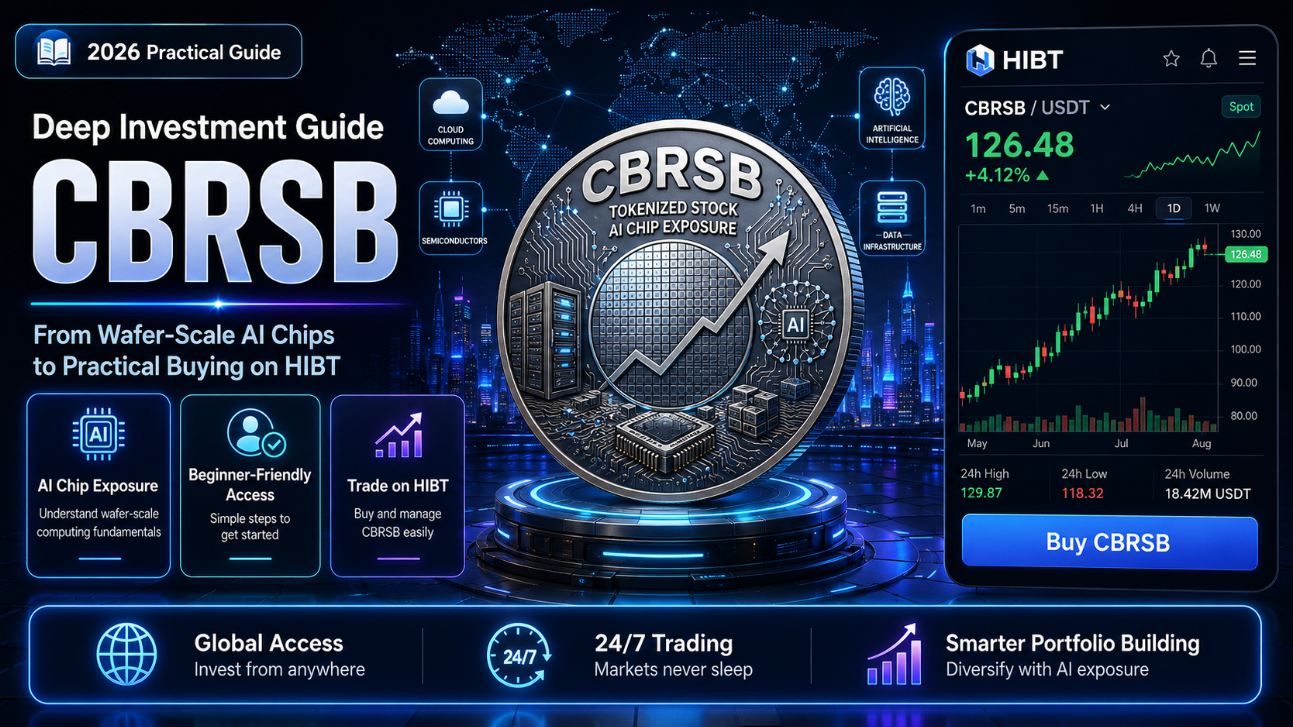
II. Cerebras Fundamentals Deconstructed: Why Is This "Wafer-Scale Chip" Company the Focus of the AI IPO?
CBRSB's price is not determined by crypto sentiment alone. Its core anchor is the Cerebras underlying share CBRS, and CBRS's core logic stems from AI inference demand, the wafer-scale chip architecture, partnerships with customers like OpenAI and AWS, and market imagination around Nvidia alternatives.
1. How Big Is the WSE-3 Chip?
According to Cerebras' official disclosure, the WSE-3 uses a 5nm process, has 4 trillion transistors, 900,000 AI cores, 125 petaflops of peak AI performance, 44GB of on-chip SRAM, and supports 1.5TB, 12TB, or 1.2PB of external memory configurations.
These specs mean three things for AI inference and training:
First, on-chip compute and on-chip memory are highly concentrated, reducing the latency caused by multi-card interconnect in traditional GPU clusters;
Second, it is attractive for low-latency inference scenarios, especially interactive AI, code assistants, enterprise search, and real-time agents;
Third, it is not a direct copy of a single GPU, but a fundamentally different system architecture.
But strong technical specs do not guarantee commercial success. Wafer-scale chips also face challenges in manufacturing yield, thermal management, cost, software ecosystem, customer migration costs, and model adaptation.
2. Is "8–21x Faster than Nvidia" a Real Moat or Marketing Hype?
Cerebras' core selling points are high speed, low latency, and massive on-chip interconnect. The Cerebras website showcases evaluations from multiple customers on its inference speed, and notes that some models can achieve very high token output speeds. The official WSE-3 page also emphasizes that compared to the NVIDIA B200, the WSE-3 has more transistors and higher compute capability.
But investors cannot rely solely on marketing numbers. The advantages of the wafer-scale architecture typically appear in specific workloads, especially models that fit its software stack, memory structure, and inference path. Its limitations include:
Not all models can be easily migrated;
Not all AI workloads are suitable for wafer-scale architecture;
Ecosystem maturity lags behind Nvidia CUDA;
Customers need to trust the supply chain, delivery capability, and long-term service capability;
If model size, inference mode, or cost structure changes, the performance advantage may be eroded.
So, Cerebras' technology moat is real, but whether it can translate into sustained profitability depends on customer order execution, gross margin, software ecosystem, and data center delivery capability.
3. What Do 2025 Revenue and Q1 2026 Earnings Tell Us?
Public reports show that Cerebras' 2025 revenue was approximately $510 million, up 76% year-over-year. MarketWatch also reported that the company's valuation at IPO was extremely high, with trading multiples far above the traditional semiconductor industry average.
Cerebras' Q1 2026 earnings report shows GAAP quarterly revenue of $193.4 million, up 94% year-over-year; core revenue of $191.3 million, up 92% year-over-year; GAAP net loss of $14 million; core net loss of $2.5 million. The company also provided full-year 2026 core revenue guidance of $855 million to $865 million.
Key takeaways from this data set:
Growth is very fast;
AI inference demand is indeed translating into revenue;
But the company is still in a high-investment phase;
The market cares more about gross margin, order delivery, and customer concentration than just revenue growth.
Reuters reported that although Cerebras' first post-IPO earnings report showed revenue nearly doubling, the stock price fell after-hours, partly because the full-year adjusted gross margin guidance was 38%–41%, lower than mature competitors like Nvidia and AMD, also reflecting the cost pressure from manufacturing large chips and temporary system leasing.
4. The OpenAI Order Is the Biggest Catalyst, and Also the Biggest Risk
Cerebras' Q1 2026 announcement revealed that the company had reached a multi-year agreement with OpenAI, under which OpenAI will deploy 750MW of Cerebras high-speed inference compute, with a transaction value exceeding $20 billion.
This is a very strong fundamental catalyst for CBRSB, because it proves that Cerebras is not just laboratory technology, but has entered the real compute infrastructure procurement scope of top-tier AI customers.
But this is also a source of risk:
A large order amount does not mean all revenue is recognized immediately;
750MW of compute capacity requires data centers, power supply, delivery, deployment, and operations coordination;
If OpenAI's demand rhythm changes, Cerebras' revenue expectations may be revised downward;
If solutions from Nvidia, AMD, Google TPU, or AWS Trainium are more cost-effective, Cerebras' share may be squeezed;
If customer concentration is too high, any change in a core customer will amplify stock price volatility.
So, the OpenAI contract is not a "risk-free moat," but a combination of "high-growth narrative + high execution risk."
5. How to View the IPO Valuation and Current Price?
Cerebras' official announcement shows that the company's IPO in May 2026 was priced at $185 per share, issuing 30 million shares and raising approximately $5.55 billion, and began trading on Nasdaq under the ticker CBRS on May 14, 2026. Kiplinger reported that Cerebras opened at $350 on its IPO day, reached a high near $385, and closed at $311.07, with a post-IPO valuation exceeding $56 billion.
As of this article's verification, CBRS's current price is approximately $181.72, with a 52-week range of approximately $160.81–$386.34. In other words, CBRS has fallen significantly from its post-IPO high and is now near its IPO pricing.
This means for CBRSB investors:
First, short-term sentiment has cooled, and it is no longer in the IPO-day euphoria phase;
Second, a pullback from the high does not mean undervaluation, it may simply be a valuation reversion;
Third, if the company's subsequent order execution is strong, the stock price may recover;
Fourth, if gross margin, customer concentration, or delivery rhythm falls short of expectations, the stock price may continue to decline.
6. Valuation Difference with QCOMB
Both CBRSB and QCOMB are tokenized stocks related to chips, but their risk-return profiles are completely different.
QCOMB is backed by Qualcomm, a mature communications chip giant, with businesses including mobile chips, communication patents, automotive chips, and edge AI. Cerebras, on the other hand, is a high-growth, high-valuation, high-uncertainty AI infrastructure new issue. You can compare the valuation differences between mature chip companies and emerging AI chip companies by reading What Is QCOMB.
In short, QCOMB leans more toward the mature chip cycle, while CBRSB leans more toward a high-volatility AI new-issue option. Both are AI-related, but you cannot buy them using the same logic.
III. Tokenized Stock Mechanics: How Does CBRSB "Represent" Cerebras Underlying Shares on BSC?
The most important thing for newcomers to understand about CBRSB is: 1:1 backing does not equal zero risk.
1. What Is the Issuance Logic of bStocks?
The official bStocks introduction states that bStocks are tokenized securities representing 1:1 economic exposure to US-listed stocks, with underlying stocks held in regulated custody accounts. Eligible direct stock positions can be converted into corresponding bStocks at a 1:1 ratio, and can also be converted back into direct stock positions.
In the CBRSB scenario, it can be simplified to:
What the user sees is the CBRSB on-chain token;
CBRSB's economic anchor is the CBRS stock of Cerebras Systems Inc.;
CBRSB's price should fluctuate around the CBRS underlying share price;
But the actual transaction price is also affected by exchange liquidity, order book depth, market makers, USDT price, and expectations during market closures.
2. Can Users Convert into Real CBRS Stock?
The bStocks mechanism includes conversion and redemption design, but actual availability depends on many conditions. The official announcement mentions that bStocks and underlying stocks can be converted at a 1:1 ratio with no conversion fee; but the disclaimer also emphasizes that tokenized securities are only for eligible users in permitted regions, and conversion back to the traditional securities environment requires meeting conditions.
For Hibt users, a safer understanding is:
You mainly buy and sell through the CBRSB/USDT trading pair;
What you see in your Hibt account is your CBRSB balance;
Whether on-chain withdrawal, conversion to CBRS underlying shares, or enjoyment of certain corporate action processing is available depends on the rules of Hibt and bStocks at the time;
Do not treat the CBRSB in your Hibt account as directly equivalent to CBRS stock in a traditional brokerage account.
3. What Is CBRSB's Premium/Discount?
In theory, CBRSB should track the CBRS underlying share, but because the crypto market trades 24/7 while US stocks have fixed trading hours, the two may deviate in the short term.
Calculation formula:
CBRSB Premium/Discount Rate = CBRSB Current Price ÷ CBRS Underlying Reference Price - 1
Example:
CBRSB current price is 182.63 USDT;
CBRS underlying reference price is 181.72 USD;
Assuming USDT ≈ USD;
Premium/Discount Rate = 182.63 ÷ 181.72 - 1 ≈ 0.50%.
This means CBRSB is trading at approximately a 0.50% premium to the CBRS underlying share. CoinMarketCap shows CBRSB price at approximately $182.63, 24-hour volume at approximately $685,700; finance tools show CBRS current price at approximately $181.72.
If CBRSB is higher than the CBRS underlying share price, it is at a premium; if lower, it is at a discount.
4. Why Does the US Stock Market Closure Distort CBRSB's Price?
Normal US stock trading hours are 9:30–16:00 ET, while CBRSB can trade 24/7 in the crypto market. This time difference creates several risks:
When the US market is closed, CBRSB may reflect post-market earnings, OpenAI partnership news, AWS partnership progress, or AI chip industry news in advance;
If post-market news is misinterpreted by the market, CBRSB may rise first and then fall, or fall first and then rise;
When the CBRS underlying share opens, the price may re-anchor, causing CBRSB's premium or discount to correct quickly;
If CBRSB's order book is thin, small orders can also cause significant deviation.
For example, if Cerebras announces post-market that OpenAI order execution exceeded expectations, CBRSB may rise first in the crypto market; but if institutions still believe the valuation is too high after the US market opens, the CBRS underlying share may fall instead, and CBRSB may then experience a pullback.
So, trading CBRSB requires not only watching AI news, but also checking "whether CBRSB is currently overpriced relative to CBRS."
IV. Why Should Crypto Users Buy CBRSB on Hibt Instead of Opening an Account with a Traditional Broker?
There is no absolute answer to this question. Hibt and traditional brokers are two different paths, suitable for different users.
1. The Traditional Broker Path to Buying CBRS Underlying Shares
If buying CBRS through traditional brokers such as Interactive Brokers, Futu, or Tiger Brokers, you typically need to:
Register a brokerage account;
Submit identification, address proof, and tax documents;
Wait for account review;
Deposit USD or local currency;
May need currency exchange;
Place orders during US stock trading hours;
Hold CBRS stock in the brokerage account after execution.
The advantage of traditional brokers is that the legal relationship of assets is closer to traditional securities accounts, with more standardized shareholder rights, dividends, tax documents, trading depth, and price anchoring.
The disadvantage is that the account opening process is longer, the barrier is higher for users in some regions, depositing and currency exchange are complex, and US stocks can only be traded during designated hours.
2. The Hibt Path to Buying CBRSB
If you already hold USDT, the path to buying CBRSB through Hibt is shorter:
Register on Hibt;
Complete KYC;
Deposit USDT;
Go to the spot market and search for CBRSB;
Select CBRSB/USDT;
Place a buy order with USDT;
View your position on the assets page.
Hibt's CBRSB page provides the CBRSB/USDT entry, but the real-time quotes on the page may change with trading status, so you should verify against Hibt's real-time display before operating.
For crypto users who already hold USDT, the advantage of this path is speed, familiarity, and no need to first complete traditional brokerage deposit and currency exchange. But the cost is that you take on additional Hibt platform risk, CBRSB premium/discount risk, USDT stablecoin risk, and tokenized security compliance risk.
3. How Do Hibt Fees Compare to Traditional Broker Costs?
Hibt's Help Center shows that spot maker fees are 0.2%, taker fees are 0.2%, with a minimum order amount of approximately 5 USDT, subject to the page display.
Traditional broker costs typically include:
Trading commissions;
Bid-ask spread;
Currency exchange costs;
Cross-border deposit and withdrawal costs;
Tax processing costs;
Possible account management or third-party fees.
If it's just a small amount for experience, and you already hold USDT, Hibt may be more convenient.
If it's long-term, large-scale, serious allocation of CBRS underlying shares, the traditional broker path is usually more suitable as a core securities account.
4. What Do You Actually Own When Holding CBRSB Through Hibt?
What you own is the CBRSB asset recorded in your Hibt account, or the on-chain CBRSB token that can be transferred to a BNB Smart Chain wallet when the platform allows withdrawal. It is distinctly different from CBRS stock in a traditional brokerage account:
You do not necessarily have traditional shareholder voting rights;
You cannot by default directly attend shareholder meetings;
How dividends, stock splits, and corporate actions are handled depends on bStocks and platform rules;
You rely on the issuer, custodian, trading platform, and on-chain contract to jointly maintain product operation;
If the platform suspends trading, deposits, withdrawals, or risk control reviews, your liquidity will be affected.
The bStocks announcement mentions that corporate actions such as dividends and stock splits are automatically handled through the Multiplier mechanism, and the net dividend value is reflected in the position value through on-chain adjustments after deducting applicable US withholding tax. But whether this equally applies to Hibt users should still be based on the rules of Hibt and bStocks at the time.
V. Step-by-Step Guide: How to Complete CBRSB Registration, Deposit, and Trading on Hibt
This chapter provides a complete path for newcomers who have never bought tokenized stocks. The core principles are only two: small test amounts, limit orders first.
1. Register on Hibt and Complete KYC
Go to Hibt's official website or app, and register with a long-term stable email or phone number. Do not use temporary emails, as subsequent login verification, withdrawal confirmation, account recovery, and risk control notifications may all rely on email.
After registration, it is recommended to complete immediately:
Set a strong password;
Enable two-factor authentication;
Bind email and phone;
Complete identity verification KYC.
Hibt's KYC guide shows that identity verification typically requires users to submit official identification documents, such as ID card, passport, or driver's license, and may require facial recognition or liveness detection.
Users from mainland China need to pay special attention: CBRSB involves offshore trading platforms, crypto assets, and tokenized securities — three types of risk. Policies in different regions may change, so do not interpret "the platform is accessible" as "the local law allows it." If unsure, you should first confirm local laws, fund in/out restrictions, and tax obligations.
2. How to Deposit USDT?
Hibt's deposit and withdrawal help center shows that users need to select the correct network when depositing or withdrawing; if the network does not match, assets may not arrive and may even be lost. Hibt's official tutorials also emphasize that the deposit/withdrawal network must match.
Common USDT networks include:
TRC20: Usually lower fees, faster arrival, commonly used by many users;
ERC20: Ethereum network, strong compatibility, but on-chain fees are usually higher;
BEP20: BNB Smart Chain network, lower fees, suitable for BSC ecosystem, but must confirm platform support.
The most common mistake newcomers make is network mismatch. For example, if you select a USDT-TRC20 address on Hibt, you must also select TRC20 on the external platform; if you transfer from ERC20 or BEP20 to a TRC20 address, funds may not be automatically credited.
3. How to Search for the CBRSB/USDT Trading Pair?
After USDT arrives, go to the spot trading page and search for CBRSB or CBRSB/USDT.
When confirming, pay attention to:
Whether the trading pair is CBRSB/USDT;
Whether the asset name is Cerebras Tokenized bStocks;
Whether the page is from Hibt's official domain;
Whether the external contract address matches CoinMarketCap/BscScan;
Do not enter the trading page through unfamiliar community links.
You can also enter the trading page from Hibt's CBRSB quote page.
4. How to Choose Between Limit and Market Orders?
For your first trade, it is recommended to use a limit order rather than a market order.
The advantage of a limit order is that you can specify the price you are willing to trade at, avoiding being filled at unfavorable prices when the order book is thin. Market orders are faster, but will directly take the sell or buy orders in the order book. If CBRSB trading depth is insufficient, market orders may experience significant slippage.
Before placing an order, observe at least three things:
How wide is the spread between the best bid and best ask;
How much depth is there within 1%–2% of the order book;
Whether CBRSB's current price is at a premium or discount to the CBRS underlying share.
If you're unsure, your first trade can be a test with only 10–20 USDT, rather than investing a large amount at once.
5. How to Calculate Actual Costs?
Assume you buy 1 CBRSB at 182 USDT, with Hibt's fee at 0.2%.
Buy fee = 182 × 0.2% = 0.364 USDT
Actual cost ≈ 182.364 USDT
If you later sell at 200 USDT:
Sell fee = 200 × 0.2% = 0.40 USDT
The rough net profit is not 18 USDT, but:
200 - 182 - 0.364 - 0.40 = 17.236 USDT
If you also consider withdrawal fees, bid-ask spread, slight deviation between USDT and USD, and CBRSB premium/discount changes, actual returns will be even lower.
6. How to Withdraw USDT After Selling CBRSB?
After selling CBRSB, you will receive USDT. The withdrawal process is typically:
Go to the assets page;
Select USDT;
Click withdraw;
Select the withdrawal network;
Fill in the external wallet address;
Enter the withdrawal amount;
Verify fees, minimum withdrawal amount, and arrival network;
Complete email, SMS, or 2FA security verification.
Hibt's withdrawal tutorial states that when withdrawing, you must confirm that the receiving platform supports the same network, fees are displayed on the withdrawal page, specific fees are subject to the page display; some tokens also have minimum withdrawal amount limits.
7. How to Read Hibt's CBRSB Price Prediction Page?
Hibt's CBRSB Price Prediction page shows that all price predictions are generated based on user feedback; the page also displays long-term prediction values for 2027, 2028, 2029, 2030, 2040, 2050, and notes "for reference only, not investment advice."
This type of prediction page is suitable for scenario reference, not as a basis for trading. CBRSB's real price anchor still needs to return to the CBRS underlying share, bStocks liquidity, and platform order book.
VI. CBRSB Price Trends and Prediction Reference: Is Now a Good Entry Point?
This question cannot be simply answered with "buy" or "don't buy." CBRSB judgment requires looking at three layers simultaneously:
CBRS underlying share fundamentals;
CBRSB's premium/discount to CBRS;
Order book depth and trading activity of the Hibt trading pair.
1. How Should You View RSI, MACD, and MA?
Since CBRSB is a newly issued tokenized stock with a short K-line history, directly using CBRSB's RSI, MACD, and MA may have insufficient samples. A more reasonable approach is:
Short-term: look at CBRSB/USDT order book, spread, and volume;
Medium-term: look at CBRS underlying share's daily RSI, MACD, 20-day and 50-day moving averages;
Long-term: look at OpenAI order execution, AWS partnership progress, gross margin, data center delivery, and AI inference demand.
CBRS has fallen significantly from its IPO day high to around $180, which may be an oversold rebound opportunity, or it may be a valuation reversion process. Kiplinger reported that CBRS reached a high near $385 on its IPO day, closing at $311.07; and as of this article's verification, CBRS price is approximately $181.72.
So, for CBRSB, you cannot just look at "it has fallen by half" in the short term; you also need to see whether the post-decline valuation matches revenue, gross margin, and order fulfillment capability.
2. How to View Support and Resistance Levels?
Public quote pages show that CBRS's 52-week range is approximately 160.81–386.34.
From a technical perspective:
160–170 area: Near the 52-week low, a key short-term support zone;
180–200 area: The current repricing zone, also the common anchoring range for CBRSB;
250–300 area: The area where multiple investment banks' initial target prices are concentrated, also a rebound resistance zone;
$386.34: 52-week high, representing the most extreme post-IPO optimistic sentiment.
For CBRSB, you should not only watch the CBRSB K-line. What is more important is: whether CBRSB shows an abnormal premium or discount of more than 1%–3% relative to the CBRS underlying share.
3. How to Estimate a Reasonable Price Range for H2 2026?
A simple framework can be used:
CBRSB Reasonable Reference Price ≈ CBRS Underlying Share Price × (1 ± Reasonable Premium/Discount Range)
Assuming the CBRS underlying share fluctuates between 160–250, and CBRSB's premium/discount is controlled within ±2%:
When CBRS = $160, CBRSB reasonable reference range is approximately 156.8–163.2 USDT;
When CBRS = $180, CBRSB reasonable reference range is approximately 176.4–183.6 USDT;
When CBRS = $200, CBRSB reasonable reference range is approximately 196–204 USDT;
When CBRS = $250, CBRSB reasonable reference range is approximately 245–255 USDT.
This is not a price prediction, but an anchoring judgment framework. What really affects H2 2026 trends is Cerebras' subsequent earnings, OpenAI order execution, AWS partnership delivery, gross margin guidance, data center expansion, and Nvidia competitive pressure.
4. What Does the Deviation Between Analyst Target Prices and Current Price Indicate?
Investing.com shows that 11 analysts have an average 12-month target price of approximately $291.09 for CBRS, with a high of $340 and a low of $209. Other reports show that UBS raised Cerebras' target price from $300 to $320, maintaining a Buy rating.
This shows that Wall Street still has long-term growth expectations for Cerebras. But newcomers should note: analyst target prices are not guaranteed returns and often lag market sentiment changes. The implicit premises behind high target prices are: smooth OpenAI order fulfillment, gross margin improvement, customer base diversification, and sustained expansion of AI inference demand.
As long as one of these conditions falls short of expectations, the stock price may continue to be under pressure.
5. How to Reference Hibt's CBRSB Price Predictions?
Hibt's CBRSB price prediction page gives long-term price ranges for 2026–2030, 2040, and 2050, and notes that predictions are generated from user feedback for reference only.
For tokenized assets of high-valuation IPO new issues like CBRSB, long-term predictions should be treated with particular caution. Because prices in 2040 or 2050 depend not only on Cerebras, but also on:
Whether the bStocks mechanism will exist long-term;
Whether Hibt will continue to support CBRSB/USDT;
Whether tokenized securities regulation will change;
Whether BNB Smart Chain and the custody mechanism will remain stable;
Whether Cerebras can continue to compete against Nvidia, AMD, Google TPU, AWS Trainium, and others;
Whether the OpenAI order will truly translate into long-term revenue and cash flow.
So, prediction pages can help users with scenario calculations, but cannot replace fundamental research and risk management.
6. Will CBRSB React Faster or Slower During Major Events?
If the event occurs during US stock trading hours, the CBRS underlying share usually reacts first, and CBRSB follows.
If the event occurs during US market closure, after-hours, weekends, or Asian trading hours, CBRSB may reflect market expectations before the CBRS underlying share.
Typical events include:
Cerebras earnings releases;
OpenAI order execution progress;
AWS partnership delivery status;
New generation competitive product releases from Nvidia or AMD;
AI inference price wars;
Data center power supply and delivery delays;
IPO lock-up batch releases;
Major customer order cancellations or delays.
Newcomers should not simply interpret this time difference as an arbitrage opportunity. In actual trading, fees, order book, slippage, platform risk control, and information lag may all turn arbitrage into chasing rallies and selling dips.
VII. CBRSB vs QCOMB vs XEM: A Comparison Framework for Three Completely Different Asset Classes
Many newcomers tend to treat all assets on an exchange as "coins" and operate them with the same trading logic. CBRSB, QCOMB, and XEM are actually three completely different asset classes.
1. CBRSB's Pricing Logic
CBRSB is a tokenized stock of a high-valuation AI chip new issue, with its core anchor being the CBRS underlying share. Its main influencing factors are:
AI inference demand;
WSE-3 technology roadmap;
OpenAI order execution;
AWS partnership progress;
Gross margin changes;
Customer concentration;
Competition from Nvidia, AMD, Google, AWS, and others;
IPO lock-up and institutional holding changes;
CBRSB's own liquidity and premium/discount.
It is not a meme coin, and not suitable for holding with a "double and take out the principal" logic.
2. QCOMB's Pricing Logic
QCOMB is a tokenized stock of a mature communications chip company, with its core anchor being Qualcomm's underlying share. Qualcomm is more influenced by smartphone replacement cycles, AI terminals, automotive chips, communication patent licensing, and semiconductor valuations. You can compare the cycle differences between mature chip stocks and emerging AI chip stocks by reading What Is QCOMB.
Cerebras is more like a high-volatility growth stock, while Qualcomm is more like a mature semiconductor platform company. Both are AI-related, but one is "new-architecture AI inference infrastructure," and the other is "mature communications and terminal chip ecosystem." You cannot buy both just because they both have an AI narrative.
3. XEM's Pricing Logic
XEM is the native token of the NEM public chain. It is neither a tokenized stock nor pegged to a US stock company. XEM's price is more influenced by public chain ecosystem, crypto cycles, community activity, exchange liquidity, and market risk appetite. You can understand the differences between veteran public chain tokens and tokenized stocks by reading What Is XEM.
4. How to Allocate Positions Across Three Asset Classes?
If you are simultaneously observing these three assets on Hibt, you can classify them as follows:
CBRSB: High-risk thematic position, expressing views on AI chip new issues and Cerebras;
QCOMB: Mature chip thematic position, expressing views on Qualcomm and the communications chip cycle;
XEM: Crypto-native observation position, studying veteran public chain cycles;
Meme coins: Speculative position, only suitable for very small proportional participation.
Different position attributes require different take-profit and stop-loss logic. CBRSB requires watching earnings, valuation, and order execution; QCOMB requires watching the mature chip cycle and profit stability; XEM requires watching crypto cycles and on-chain ecosystem; meme coins are more about liquidity and sentiment.
VIII. If You Decide to Invest in CBRSB, How Should You Manage Position Size and Mindset?
CBRSB has stronger fundamental anchoring than ordinary altcoins, but it is still a high-valuation, high-volatility, customer-concentrated, short-listed AI new-issue exposure, and it is held through a tokenized path. The risks should not be underestimated.
1. CBRSB Should Not Exceed 3%–5% of Total Assets
For ordinary crypto newcomers, the proportion of tokenized stocks in the overall crypto portfolio should not be too high. CBRSB, as a high-valuation AI new-issue exposure, is even less recommended to exceed 3%–5% of total assets.
The reasons are simple:
CBRS is an IPO new issue;
Company valuation is extremely sensitive to expectations;
OpenAI order execution still needs time to verify;
Customer concentration and gross margin fluctuation are critical;
CBRSB carries platform and custody risk;
CBRSB may experience premium/discount;
CBRSB trading depth may not be as deep as the US stock underlying share;
Mainland China users also need to consider additional compliance risks.
If you are a newcomer, your first trade should be a small test amount, not treating it as a core asset to overweight.
2. Where Is the Boundary Between "Buying the Dip" and "Catching a Falling Knife"?
CBRS has retraced significantly from its IPO high, and many people will think, "It has fallen so much, is it time to buy the dip?" But buying the dip must satisfy two preconditions:
First, the company's fundamentals have not deteriorated, only market sentiment is overly pessimistic;
Second, the valuation at which you buy already provides enough margin of safety.
If it's simply "from $386 to $180," that doesn't prove it's cheap. A high-valuation stock falling 50% from its high can still fall another 30%–50%. This is the risk of catching a falling knife.
A more reasonable approach is:
First set a maximum position size;
Only make small probes in key support zones;
Wait for earnings to verify orders and gross margin;
Don't keep chasing higher just because the price rebounds;
Don't treat the OpenAI contract as a guarantee of perpetual upside.
3. If CBRS Underlying Shares Fall 40%, How Much Will CBRSB Fall?
In theory, if CBRS underlying shares fall 40%, CBRSB should also fall close to 40%. But the actual situation could be worse:
If the market panics, CBRSB may trade at a discount;
If Hibt's order book thins, selling slippage may amplify;
If bad news occurs during US market closure, CBRSB may fall before the underlying share;
If the platform suspends withdrawals or trading, liquidity will be further restricted.
So, position management should start from "maximum acceptable loss amount," not just look at the stop-loss price.
For example, if your maximum acceptable loss is 200 USDT, and you believe CBRSB could fall 40% in extreme cases, then your position should ideally not exceed 500 USDT. This way, even if your judgment is wrong, it won't affect your life or overall portfolio.
4. What Other Ways Can Crypto Users Get AI Chip Exposure?
Crypto users can gain related exposure through several approaches:
SPYB: Broad-based index exposure, higher diversification, but smaller exposure to Cerebras;
QCOMB: Mature chip stock exposure, suitable for users bullish on Qualcomm's fundamentals;
CBRSB: High-growth AI new-issue exposure, more concentrated volatility;
Traditional broker direct purchase of CBRS: Clearer legal relationship of assets, suitable for long-term large-scale allocation;
Semiconductor ETF or tech ETF: Higher diversification, but requires traditional broker or corresponding tokenized product support.
If you are just bullish on "AI," you don't necessarily have to bet on CBRSB. The AI industry chain is very long — GPU, inference chips, storage, networking equipment, data center power, and cloud service providers may all benefit, but the risk drivers are completely different.
IX. Final Thoughts: Three Sober Reminders for Crypto Newcomers
1. "A $20 Billion OpenAI Order" Does Not Mean You Will Make Money Buying CBRSB
The OpenAI contract is Cerebras' biggest fundamental highlight, but the order amount does not equal immediate revenue recognition, nor does it equal profit. Cerebras needs to complete data center delivery, system deployment, customer acceptance, ongoing operations, and cost control to convert orders into long-term cash flow.
More importantly, CBRS's current stock price already incorporates a considerable amount of optimistic expectations. When you buy CBRSB, you are not buying Cerebras at a low valuation before the contract announcement, but at a price after the market has already fully discussed OpenAI, AWS, and the AI inference narrative.
In addition, the tokenized path adds extra costs:
Hibt spot trading fees;
Bid-ask spread;
CBRSB premium over CBRS;
Slight deviation between USDT and USD;
Withdrawal fees;
Platform and custody risk;
Regulatory uncertainty.
All of these will erode final returns.
2. IPO New Issue, High Valuation, Customer Concentration, Market Closure Trading, Reliance on Market Makers — Play Defense First
If a tokenized stock simultaneously meets:
IPO new issue;
Valuation highly dependent on future growth;
High customer concentration;
Still trading during US market closure;
Reliance on platform and market makers to maintain price anchoring;
Then industry veterans typically will not go all-in from the start, but will first observe price anchoring, liquidity, premium/discount, earnings verification, and lock-up pressure.
CBRSB's underlying logic can be studied, but it is not a reason for mindless chasing.
3. Mainland China Users Must Pay Extra Attention to Compliance Risks
CBRSB simultaneously involves offshore trading platforms, crypto assets, tokenized securities, and US stock individual stock exposure. Mainland China users participating in such products may face uncertainties regarding account usage, fund in/out, trading restrictions, tax reporting, and regulatory policy changes.
If you are unsure whether you are suitable to participate, the safest approach is not to trade first, but to first confirm legal, compliance, and fund safety boundaries.
FAQ: Common Questions from CBRSB Newcomers
1. What Is CBRSB?
CBRSB is Cerebras Tokenized bStocks, a tokenized security with Cerebras Systems Inc.'s underlying share CBRS as its reference asset, operating in a BNB Smart Chain-related environment. CoinMarketCap classifies it as Tokenized Assets / Tokenized Stock.
2. Is CBRSB the Same as CBRS Underlying Shares?
No. CBRS is the common stock of Nasdaq-listed company Cerebras Systems Inc.; CBRSB is an on-chain tokenized security providing economic exposure to CBRS price, but not equivalent to CBRS underlying shares in a traditional brokerage account.
3. Is CBRSB Issued by Cerebras Itself?
No. CBRSB is not an on-chain stock directly issued by Cerebras. The bStocks mechanism is issued by BTech Holdings Limited, and the official disclaimer also states that bStocks do not represent an affiliation with the underlying asset issuer.
4. What Is CBRSB's Contract Address?
CoinMarketCap shows CBRSB's short contract address as 0xe81c...12da4e, and the BscScan path corresponds to the full address:
0xe81c6bb0266cd68b4f17278531dd03ea1f12da4e
Before trading, verify again through CoinMarketCap, BscScan, and the Hibt page.
5. Why Is Cerebras' WSE-3 Important?
The WSE-3 is Cerebras' third-generation wafer-scale AI chip. Official disclosure shows it has 4 trillion transistors, 900,000 AI cores, 44GB of on-chip SRAM, and 125 petaflops of peak AI performance. Its core value lies in reducing the latency caused by traditional multi-GPU cluster interconnects, and serving AI training and inference workloads.
6. Does CBRSB Pay Dividends?
The official bStocks description states that corporate actions such as dividends and stock splits are automatically handled through the Multiplier mechanism, and the net dividend value is reflected in the token value after deducting applicable US withholding tax. But the specific treatment for Hibt users should be based on platform rules.
7. Is KYC Required to Buy CBRSB on Hibt?
Hibt's KYC guide shows that identity verification typically requires submitting official documents such as ID card, passport, or driver's license, and may require facial recognition or liveness detection. Whether KYC is actually mandatory for deposit, trading, or withdrawal should be based on Hibt's current page prompts.
8. Is CBRSB Suitable for Long-Term Holding?
This depends on whether you are bullish on Cerebras' underlying share, whether you understand the AI chip industry competition, whether you can accept IPO new-issue volatility, and whether you can tolerate tokenized security path risks. CBRSB can serve as a small-proportion high-risk thematic position for observation, but is not suitable to be simply treated as a risk-free long-term allocation.
9. Which Is More Suitable for Newcomers, CBRSB or QCOMB?
Both are individual stock tokenized assets, not low-risk products. CBRSB leans more toward high-growth AI chip new issues, while QCOMB leans more toward mature communications chip companies. Newcomers should not chase highs simultaneously just because of the "AI concept," but should first understand their respective fundamentals and valuation differences.
10. Are CBRSB Price Predictions Credible?
Hibt's CBRSB price prediction page explicitly states that all price predictions are generated based on user feedback, for reference only, and do not constitute investment advice. Predictions can be used for scenario analysis, but cannot replace your own research.
11. Is Now a Good Time to Buy CBRSB?
Whether to buy depends on your risk tolerance, entry price, CBRS underlying share valuation, CBRSB premium/discount, Hibt order book depth, and compliance conditions. Newcomers are more suited to small test amounts, not chasing highs with an all-in approach.
About the Author
The author has long focused on crypto exchange products, tokenized stocks, on-chain data, US stock fundamentals, the AI chip industry chain, SEO content strategy, and newcomer investment education. The author is skilled at dissecting the opportunities and risks of new crypto financial products from the perspectives of contract addresses, bStocks mechanisms, earnings data, platform announcements, technical indicators, and user operational workflows. The goal of this article is not to predict whether CBRSB will definitely rise or fall, but to help newcomers establish the basic habit of "understand the asset first, then decide to trade."
Disclaimer
This article is for information compilation and investment education only, and does not constitute investment advice, securities recommendation, legal advice, tax advice, or financial planning advice. CBRSB is a tokenized security-type asset. Although its price is pegged to Cerebras Systems Inc.'s underlying share CBRS, it is not equivalent to a CBRS stock position in a traditional brokerage account. Users may face multiple risks including market volatility, platform operations, contract, custody, liquidity, premium/discount, regulatory policy, regional compliance, IPO lock-up, customer concentration, AI chip competition, and high-valuation drawdown.
The data in this article is public information as of July 9, 2026, the verification date, and may change subsequently. Readers should verify against Hibt, CoinMarketCap, CoinGecko, BscScan, Cerebras investor relations page, Yahoo Finance, bStocks official materials, and applicable local laws and regulations before any trading.
Please always remember: DYOR, do not invest money you cannot afford to lose, and do not simply interpret the "OpenAI big order" and "AI chip narrative" as "buying CBRSB at any price is safe."