
Risk Disclaimer: This article is for educational and operational guidance purposes only and does not constitute any investment, legal, tax, or financial advice. SOXLB involves three layers of risk: "tokenized asset + leveraged ETF + semiconductor sector volatility." It is not suitable for inexperienced beginners to hold heavily for the long term. Leveraged ETFs can generate substantial losses in a short period of time, and in extreme cases may even approach zero.
1. What Exactly Is SOXLB? Is It the Same Thing as SOXL?
Many newcomers see SOXLB for the first time and instinctively assume it is a new cryptocurrency. That assumption is incorrect.
More accurately, SOXL is the Direxion Daily Semiconductor Bull 3X Shares, a 3x leveraged long ETF traded in the U.S. market. SOXLB is the Semicon Bull 3X ETF Tokenized bStocks, a tokenized ETF exposure designed around SOXL.
In other words, SOXLB is not an independently issued altcoin, not a meme coin, and not a token for some new public chain ecosystem. Its core anchor is SOXL in the U.S. stock market, and SOXL itself is a leveraged ETF that tracks the semiconductor index's single-day 3x performance.
The B in the ticker typically indicates that it belongs to the bStocks tokenized asset system. According to Binance Academy's explanation of bStocks, bStocks are tokenized securities issued by BTech Holdings Limited, with each bStock backed 1:1 by the corresponding U.S. stock or related security held by a regulated custodian, and issued as BEP-20 tokens running on the BNB Smart Chain. At the same time, bStocks are not equivalent to directly holding the underlying stock or ETF; rather, they provide exposure to the price performance and economic rights of the underlying security.
Therefore, the identity of SOXLB can be broken down into two layers:
Layer one: it is the tokenized version of SOXL.
Layer two: SOXL itself is a 3x leveraged ETF for the semiconductor sector.
This means SOXLB is more complex than ordinary tokenized stocks. For example, assets like QCOMB, NVDAB, and AAPLB have a single stock as their underlying; whereas SOXLB's underlying is a leveraged ETF, which in turn uses an index, swaps, derivatives, and stock portfolios to achieve the single-day 3x performance of the semiconductor index.
On the CoinMarketCap page, SOXLB is displayed as Semicon Bull 3X ETF Tokenized bStocks, with tags including Tokenized Assets, Tokenized Stock, and Tokenized ETFs. The contract address is abbreviated as 0xd97d...8eefaf. The page also states that SOXLB provides holders with economic exposure to the Semicon Bull 3X ETF Tokenized bStocks, and under applicable law, the right to convert into the underlying security.
When verifying the SOXLB contract, beginners should not rely solely on the name. Because on the BNB Smart Chain, anyone can create a copycat token called "SOXL," "SOXLB," or "Semiconductor ETF." The correct verification process should include:
First, check whether the first and last digits of the contract address match CoinMarketCap, the official page, and the block explorer.
Second, confirm whether the token name is Semicon Bull 3X ETF Tokenized bStocks.
Third, check whether the page has an official market, official website, BscScan, or authoritative price portal.
Fourth, when searching within HIBT, only trust the official trading zone's SOXLB/USDT pair; do not randomly buy a same-name contract on a DEX.
Why was SOXL, a traditional asset management company's ETF, chosen as the tokenization target? The reason is simple: it is not a small-cap concept asset, but a very active semiconductor leveraged ETF in the U.S. stock market. The semiconductor sector covers core chip companies such as Nvidia, Broadcom, AMD, Micron, Applied Materials, Marvell, and Intel, and is currently at the intersection of multiple trends: AI computing power, data centers, advanced process nodes, memory cycles, and automotive chips.
But precisely because it is popular enough and volatile enough, SOXLB is also more dangerous. It is not a "blue-chip semiconductor long-term holding tool," but a high-volatility, high-leverage, strongly trading-oriented on-chain instrument.
2. SOXL Fundamentals Deconstructed: What Exactly Is This "Semiconductor 3x Leveraged ETF" Investing In?
To understand SOXLB, you must first understand SOXL.
The full name of SOXL is the Direxion Daily Semiconductor Bull 3X Shares. According to the Direxion website, SOXL aims to provide 300% of the daily performance of the NYSE Semiconductor Index, before fees and expenses. The key word here is "daily."
The index it tracks is the NYSE Semiconductor Index, ticker ICESEMIT. The Direxion website explains that this index is a rules-based, modified free-float market-cap-weighted index designed to track the performance of 30 large U.S.-listed semiconductor companies.
As of the March 31, 2026 index data shown on the Direxion page, the top ten weights are:
Nvidia, 8.41%;
Broadcom, 8.28%;
Micron Technology, 7.00%;
Advanced Micro Devices, 6.48%;
Applied Materials, 5.85%;
Marvell Technology, 5.18%;
Intel, 4.13%;
KLA, 4.13%;
Monolithic Power Systems, 4.09%;
Teradyne, 3.96%.
From an industry structure perspective, approximately 75.81% of the index weight belongs to Semiconductors, and about 24.19% belongs to Semiconductor Materials & Equipment. This means SOXL is not betting solely on Nvidia, nor is it betting solely on AI servers; it is betting on the entire U.S.-listed semiconductor industry chain.
However, the biggest characteristic of SOXL is not "semiconductors," but rather the daily 3x leverage.
Many newcomers mistakenly assume that if the semiconductor index rises 50% in a year, SOXL should rise 150%. That understanding is incorrect.
SOXL pursues "single-day" 3x performance, not "long-term cumulative" 3x performance. The Direxion website explicitly warns that leveraged ETFs should not be expected to provide three times or inverse three times the cumulative return of the benchmark index for periods longer than one day.
Here is a simple example:
Day one, the index rises from 100 to 110, a 10% gain.
SOXL theoretically rises about 30%, from 100 to 130.
Day two, the index falls back from 110 to 100, a drop of approximately 9.09%.
SOXL theoretically falls about 27.27%, from 130 to approximately 94.55.
You will notice that after two days the index has returned to its starting point, yet the 3x leveraged ETF has actually lost about 5.45%. This is the compounding path problem of leveraged ETFs, commonly known as leverage decay or volatility drag.
The more violent the swings and the longer the holding period, the more obvious the decay. When the trend is smooth, SOXL can rise dramatically; but during sideways chop or sharp whipsaws, it can also steadily shrink even while the index itself has not fallen significantly.
SOXL in 2026 embodies this extreme volatility. According to the Direxion website, as of July 6, 2026, SOXL's YTD return is approximately 534.57%, and its 1-year return is approximately 962.47%; but during the same period, the short-term drawdowns of this leveraged ETF have also been extremely severe. According to market data, around July 8, 2026, SOXL's price was approximately $165.28, while the market closing price shown on the Direxion website on July 6 was $194.65, representing a short-term pullback of about 15%; the intraday low once reached near $150, and compared to the $194.65 closing price, the maximum intraday drawdown exceeded 20%.
This is the real characteristic of SOXL: it rises fast, and it falls just as hard.
On the fee side, the Direxion website shows SOXL's Gross/Net Expense Ratio as 0.91% / 0.75%, with daily trading volume reaching 41.148 million shares on the page, indicating that it is a highly liquid leveraged ETF. But the expense ratio is not the biggest issue; the biggest issue is leverage and path dependency.
For newcomers, the key to understanding SOXL is not asking "is semiconductors a good sector," but rather asking:
Do I truly understand the daily 3x leverage?
Can I withstand single-day volatility of 10%–20%?
Do I know it is not suitable for long-term passive holding?
Can I enforce strict stop-losses, rather than doubling down on the way down?
If you cannot answer these questions, you should not rashly buy SOXLB.
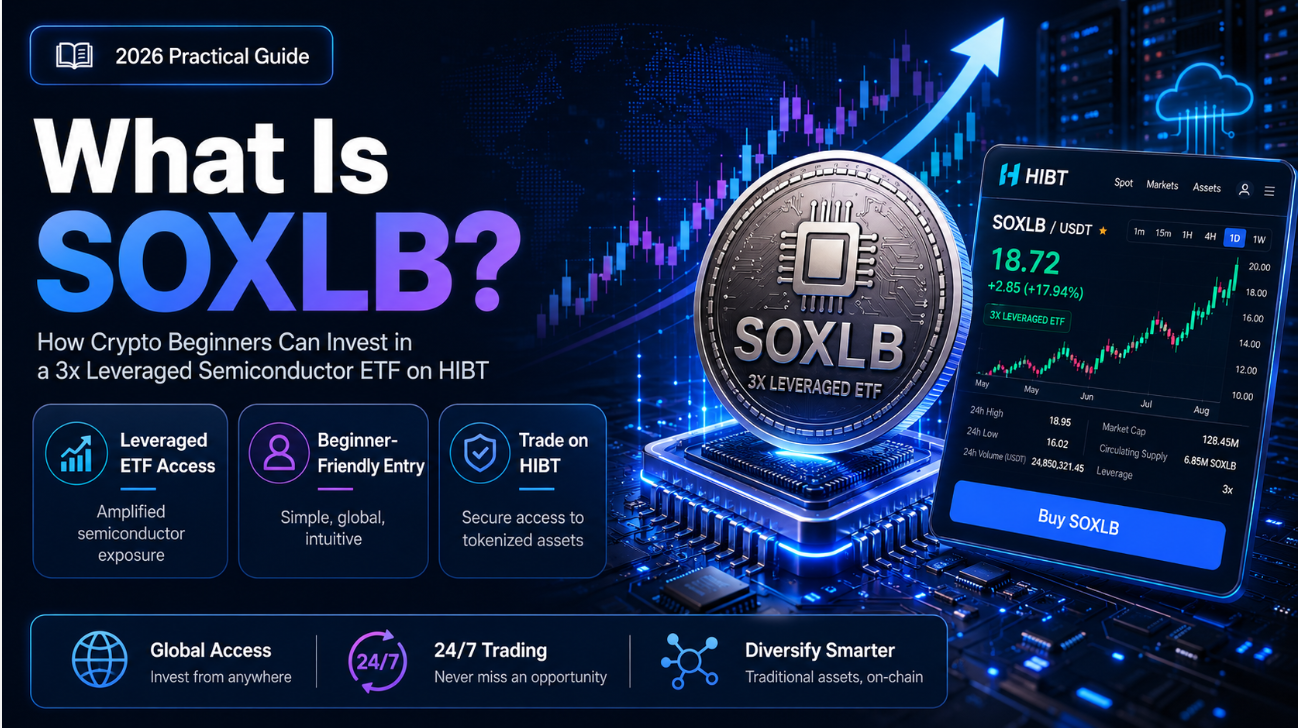
3. The Special Mechanics of a Tokenized Leveraged ETF: How Does SOXLB "Amplify" U.S. Stock Volatility On-Chain?
SOXLB's mechanics are more complex than ordinary tokenized stocks because it does not simply anchor a single stock; it anchors a 3x leveraged ETF.
The traditional path is: you open an account at a U.S. stock broker, deposit USD, and buy SOXL on the NYSE Arca or relevant trading market.
The tokenized path is: the issuer establishes a custody and backing relationship around SOXL as the underlying security, and then issues SOXLB on the BNB Smart Chain, allowing users to trade this tokenized ETF exposure through a crypto asset account.
The public documentation for bStocks states that each bStock is backed 1:1 by the corresponding underlying security, the underlying assets are held by a regulated custodian, the tokens run on the BNB Smart Chain in BEP-20 form, and eligible users can perform 1:1 conversion or self-custody.
But beginners must remember: 1:1 backing does not equal zero risk.
Because what you hold is not SOXL ETF shares in a brokerage account, but a tokenized asset constituted by the issuer, custodian, exchange, on-chain contract, and redemption mechanism. If any one of these links fails, the holder may be affected.
For example:
Legal or operational issues with the issuer or custody structure;
The platform suspends SOXLB deposits, withdrawals, redemptions, or trading;
On-chain transfers using the wrong network, resulting in unrecoverable assets;
During U.S. market closures, SOXLB and SOXL exhibit significant premium or discount;
Insufficient order book depth on the platform, causing severe slippage on large orders.
SOXLB also has an additional problem that ordinary tokenized stocks do not: the underlying SOXL itself generates path dependency through daily leverage reset.
In other words, SOXLB's volatility comes from two layers:
Layer one is the 3x single-day volatility of SOXL itself relative to the semiconductor index.
Layer two is the premium, discount, liquidity difference, and exchange order book fluctuations that SOXLB as an on-chain tokenized asset may exhibit relative to SOXL.
This is the "dual volatility" of a tokenized leveraged ETF.
When the U.S. stock market is open, SOXLB's fair price should generally try to stay close to SOXL's market price.
When the U.S. stock market is closed, SOXLB's price is more determined by market expectations, market maker quotes, the HIBT order book, on-chain liquidity, and breaking news.
If news about Nvidia, AMD, Broadcom, TSMC, U.S. CPI, Federal Reserve interest rates, or AI chip export restrictions emerges while the U.S. market is closed, SOXLB may move first, but it is also more prone to mispricing.
To judge whether SOXLB is fairly priced, a simple formula can be used:
SOXLB Premium/Discount = SOXLB Current Price ÷ SOXL Reference Price − 1
For example, if the current SOXL reference price is $165 and the SOXLB price is $173, then SOXLB is at approximately a 4.8% premium. For ordinary tokenized stocks, a 5% premium is already worth being cautious about; for a leveraged ETF tokenized asset like SOXLB, one must be even more careful, because its underlying volatility is already very high.
Conversely, if SOXLB is at a discount of more than 5% to SOXL, it is not necessarily a bargain. The discount may stem from insufficient liquidity, blocked redemption, market panic, market maker withdrawal, or a platform risk premium.
So, the core of SOXLB is not simply an "on-chain version of a semiconductor ETF," but rather:
On-chain trading access + U.S. semiconductor index + daily 3x leverage + tokenized liquidity risk.
These four layers stacked together constitute its true risk structure.
4. Why Should Crypto Users Buy SOXLB on HIBT Instead of Opening an Account at a Traditional Broker?
For crypto users already holding USDT, the main appeal of SOXLB is a shorter path and more flexible trading hours.
If you buy SOXL through a traditional broker, you typically go through:
Account registration;
Identity verification / KYC;
Filling out investment experience and tax documents;
Linking a bank account;
Cross-border or local deposit;
Currency exchange into USD;
Waiting for funds to arrive;
Placing a buy order for SOXL during U.S. trading hours.
Taking Interactive Brokers as an example, the funding arrival time depends on the bank and transfer method, and may take up to several business days at longest. For crypto users already holding USDT, this process is indeed longer than directly trading with stablecoins.
If HIBT opens the SOXLB/USDT trading pair, the path is much closer to:
Register on HIBT;
Deposit USDT;
Search for SOXLB/USDT;
Buy SOXLB with USDT;
Sell later to convert back to USDT.
The HIBT Chinese market page already shows the SOXLB/USDT page and a "Go to Trade" entry, but the real-time price and trading volume displayed on the public page may be incomplete. Actual order book depth, bid-ask spread, and trading volume should be verified on the logged-in spot trading page. Before getting to know SOXLB's real-time market conditions, it is recommended to first check the SOXLB Price and Market to get an intuitive feel for the current order book depth and bid-ask spread, with particular attention to the price difference between the 24/7 trading window and U.S. market closure periods.
On the fee side, the HIBT Help Center shows that the standard spot trading Maker fee is 0.2% and the Taker fee is 0.2%, with the fee calculated as the total value of the asset received multiplied by the fee rate. If the platform adjusts fees later, the latest announcement shall prevail.
This offers some convenience for small traders: no need to convert to USD first, no need to wait for the U.S. market to open, and no need to go through the full brokerage process for a very small trade.
But SOXLB is not an ordinary spot token. Its path advantage cannot mask its unique risks:
You bear HIBT platform account risk;
You bear USDT deposit and chain selection risk;
You bear the premium/discount risk between SOXLB and SOXL;
You bear the daily 3x leverage decay risk of SOXL itself;
You bear the risk of on-chain price deviation during U.S. market closures;
You may also bear slippage risk caused by insufficient platform liquidity.
Therefore, the HIBT path is more suitable for users already familiar with USDT, exchange spot trading, on-chain transfers, and leveraged ETF risks. Complete beginners should not ignore the underlying asset risk just because "it's easy to buy."
5. HIBT Step-by-Step: The Complete 8-Step Process from Registration to Buying SOXLB
Below is a more conservative operational path organized from a beginner's perspective. Because support pages, regions, account tiers, and available assets may change, please follow the real-time display on the HIBT App or web interface.
Step one: Register a HIBT account.
You can usually register with an email or phone number, set a login password, and complete email or SMS verification. The first thing after registration is not to deposit funds, but to open the security settings and enable two-factor authentication, a fund password, anti-phishing codes, and other security features.
Step two: Complete necessary verification.
Whether KYC is mandatory, how long review typically takes, and which deposit and withdrawal limits correspond to each tier should be based on HIBT's current rules. Users in mainland China should also pay special attention to local laws and regulations; do not mistake platform accessibility for guaranteed compliance.
Step three: Deposit USDT.
According to HIBT's official deposit tutorial, taking USDT as an example, users need to first select the deposit currency, then select the deposit network; USDT-TRC20 represents the TRON network, USDT-ERC20 represents the Ethereum network, and USDT-OKC represents the OKChain network. Different networks may have different arrival speeds and fees.
Step four: Confirm the network matches.
This is the step where beginners most easily make mistakes. The HIBT official tutorial explicitly warns that the deposit network selection is very important; different networks are not interoperable. Users must ensure that the withdrawal network on the external platform or wallet matches the deposit network selected on HIBT, otherwise the deposit may fail.
Step five: Start with a small test amount.
Do not transfer a large amount directly for the first time. It is recommended to first send 10–30 USDT to test the deposit process, confirming that the address, network, arrival time, and asset display are all normal. After the small test succeeds, consider a formal deposit.
Step six: Search for SOXLB in the spot trading area.
Enter the HIBT spot trading area and search for "SOXLB" or "SOXLB/USDT." If multiple similar tickers appear, confirm that the name is Semicon Bull 3X ETF Tokenized bStocks, the trading pair is SOXLB/USDT, and the page is from the official HIBT spot trading area.
Step seven: Use a limit order for the first trade.
SOXLB is extremely volatile, and the platform order book may be thinner than for mainstream coins like BTC and ETH. Beginners are not recommended to use market orders right away, especially not large market orders. A more conservative approach is to first observe the bid-ask spread and order book depth, then place a limit order near a reasonable price level.
Step eight: After buying, record cost, reference price, and stop-loss level.
After buying SOXLB, record at least five data points: purchase price, purchase quantity, fees, the corresponding SOXL reference price at the time, and a preset stop-loss level. SOXLB is not an asset you "buy and wait for it to double"; it is a high-volatility tool that must be traded with an exit plan.
If you want to exit, you can generally sell SOXLB in the spot market in exchange for USDT. If the platform supports withdrawing SOXLB to a BSC wallet, you also need to prepare BNB as on-chain gas, and confirm that the wallet network is the BNB Smart Chain. Whether withdrawal is supported, the minimum withdrawal amount, fees, and arrival time should be based on HIBT's real-time page.
For a beginner's first trade, it is recommended to invest only a very small test amount. The reason is not that SOXLB is completely untradable, but that you need to first confirm whether you can withstand its volatility. For ordinary newcomers, it is not recommended to let SOXLB positions exceed 1%–3% of total assets; it is even less recommended to go all-in on a leveraged ETF.
6. SOXLB vs. TCCBSC vs. FLOKI: It Is Completely Different from Ordinary Tokens
Many crypto newcomers call everything tradable on an exchange a "coin." But from an asset logic perspective, SOXLB, TCCBSC, and FLOKI are completely different types of assets.
SOXLB is a tokenized leveraged ETF exposure. Its price core depends on SOXL, which in turn depends on the single-day performance of the NYSE Semiconductor Index, the semiconductor industry trend, the performance of component stocks such as Nvidia, Broadcom, AMD, and Micron, and the overall risk appetite for U.S. tech stocks.
TCCBSC belongs to another tokenized asset logic. If you are not yet familiar with the classification of tokenized assets, you can first learn what is TCCBSC, which represents a completely different tokenized asset structure.
FLOKI is a community-driven token. Its price is more influenced by meme culture, community heat, exchange liquidity, ecosystem narratives, short-term capital, and market sentiment. For those interested in community-driven tokens, you can also take a look at what is FLOKI. After comparing the two, you will better understand what the "leveraged instrument nature" of SOXLB means.
The biggest difference among the three is:
FLOKI is more of a sentiment asset; its core depends on community and capital heat.
TCCBSC is more of another tokenized asset structure; its core depends on its corresponding asset logic.
SOXLB is a leveraged ETF instrument; its core depends on semiconductor index direction and trading discipline.
You cannot hold SOXLB with the "double-up and take out the principal" coin-trading logic. Because leveraged ETFs are not long-term investment targets, but short-term trading instruments. The Direxion website also explicitly warns that leveraged and inverse ETFs pursue daily targets and should not be expected to track the underlying index's cumulative returns for periods longer than one day; these products are not suitable for all investors and should be used by those who understand leverage risk and actively manage their investments.
If you hold both SOXLB and FLOKI on HIBT, you can categorize them as follows:
SOXLB belongs to the high-volatility trading bucket; its core is directional judgment, stop-loss discipline, and position sizing.
FLOKI belongs to the community speculation bucket; its core is sentiment cycle, heat diffusion, and liquidity.
Both are high-risk, but the risk sources are different.
SOXLB is not a meme coin; it cannot rely on community shilling to change the underlying ETF's net asset value.
FLOKI is not a leveraged ETF, and it will not automatically gain 3x returns just because the semiconductor index rises on a single day.
If you want to further understand SOXLB's future price trend, you can refer to the SOXLB price prediction, but note: the HIBT page explicitly states that "all price predictions are generated based on user feedback." The current public page also shows that some data is empty, so it is more suitable as an auxiliary observation tool and should not be treated as a trading promise.
7. Risk Checklist: Six Real Questions You Must Face Before Buying SOXLB
First, leverage decay risk.
This is the biggest risk of SOXLB, and also the one most easily overlooked by newcomers. SOXL pursues single-day 3x performance, not long-term 3x. If the semiconductor index swings wildly within a month but ultimately returns to its starting point, SOXL may still be at a loss. The more violent the swings and the longer the holding period, the more obvious the decay. Investopedia's explanation of the risks of 3x ETFs also emphasizes that these products reset daily, and long-term returns may become unpredictable due to compounding path and volatility, making them especially unsuitable for long-term investors.
Second, single-day crash risk.
SOXL's volatility can be extreme. Around July 8, 2026, SOXL's price was approximately $165.28, while the market closing price shown on the Direxion website on July 6 was $194.65, representing a short-term pullback of about 15%; the intraday low once reached near $150, and compared to the $194.65 reference price, the maximum intraday drawdown exceeded 20%. If such a drop occurs during the early morning hours in Asia, crypto users may wake up to find that SOXLB has already moved significantly.
Third, price dislocation risk.
SOXLB is a tokenized ETF, not SOXL itself. When the U.S. market is closed, platform liquidity is insufficient, market makers withdraw, or major news hits, SOXLB may exhibit a premium or discount of more than 5% relative to SOXL. Newcomers should not rush to buy the dip when they see a discount, nor should they chase when they see a premium. Instead, they should first confirm the latest SOXL price, whether the U.S. market is open, the HIBT order book depth, and whether deposits and withdrawals are normal.
Fourth, platform solvency risk.
When you buy SOXLB on HIBT, you need to trust the platform's trading system, risk control mechanisms, asset management, deposit and withdrawal services, order matching, and extreme market handling capabilities. If you hold a platform account balance rather than tokens already withdrawn to a self-custody wallet, you also bear exchange account risk.
Fifth, legal and compliance risk.
Mainland China maintains a strict prohibition on virtual currency and related trading activities. The 2021 "Notice on Further Preventing and Handling the Risks of Virtual Currency Trading and Speculation" clearly states that virtual currencies do not have the same legal status as fiat currencies, virtual currency-related business activities are illegal financial activities, and overseas virtual currency exchanges providing services to domestic residents via the internet are also illegal financial activities. If you are located in mainland China or are subject to relevant regulations, participating in virtual currency trading, tokenized security trading, or overseas platform trading may carry compliance risks.
Sixth, operational risk.
Common operational risks for SOXLB include: entering the wrong contract address, selecting the wrong on-chain transfer network, heavy market order sweeping, and treating a leveraged ETF as a long-term asset. The avoidance methods are straightforward:
Only enter trading pairs from the official page;
Before depositing, confirm that the currency, network, and address are completely consistent;
The first transaction should only be a small test;
Prioritize using limit orders;
Write down the stop-loss level before buying;
Do not chase rallies when the U.S. market is closed and SOXLB is at a clear premium;
Do not treat SOXLB as a long-term ballast.
The biggest problem with SOXLB is not "will it go up," but rather "it moves so fast that newcomers often cannot react in time."
8. Investment Strategies: Is SOXLB Suitable for Day Trading, Swing Trading, or Long-Term Allocation?
SOXLB is not suitable as a long-term allocation position; it is more suitable as a short-term directional trading instrument.
As of around July 8, 2026, SOXL's price is approximately $165.28, with a 52-week range roughly between $22.57 and $302.00. This means that even after falling from a high of $302 to near $165, a decline of nearly 45%, it cannot be simply judged as a "bottom-fishing opportunity." For a 3x leveraged ETF, after a high-level pullback it can still fluctuate wildly, and rebounds from lows can also be very rapid.
Three types of strategies are more suitable for SOXLB.
The first is day trading.
Suitable for experienced traders who can watch the market and execute stop-losses. The logic is to use the short-term direction of the semiconductor index, Nvidia, AMD, Broadcom, U.S. stock futures, and the Nasdaq index to complete entry and exit within the same day. The advantage is reducing overnight risk; the disadvantage is that it demands very high execution discipline.
The second is swing trading over 1–3 days.
Suitable for those who can withstand 1–3 days of volatility. For example, when the AI chip sector is clearly strengthening, Nasdaq risk appetite is improving, and the semiconductor ETF is breaking through key levels, participate with a small position. But stop-losses must be set in advance; do not decide to "wait a bit longer" after the price drops.
The third is event-driven trading.
Suitable for short-term trading around events such as Nvidia earnings, AMD product launches, Broadcom results, TSMC monthly revenue, U.S. CPI, Federal Reserve meetings, and AI conferences. The advantage of event-driven trading is concentrated volatility; the disadvantage is that if the direction is wrong, losses are also concentrated.
Strategies that are clearly unsuitable for SOXLB:
Not suitable for long-term dollar-cost averaging;
Not suitable for retirement-style holding;
Not suitable for going all-in;
Not suitable for averaging down on the way down;
Not suitable for beginners without stop-loss discipline.
On the stop-loss side, SOXLB cannot use ordinary stock stop-loss logic. Because single-day 10%–20% swings are not uncommon. If the stop-loss is too tight, it is easily swept out by normal volatility; if the stop-loss is too wide, a single loss may be too large.
A more conservative approach is to combine three types of discipline:
First, position stop-loss.
Control the position from the start, for example to 1%–3% of total assets, so that even a 20% loss has limited impact on the overall account.
Second, price stop-loss.
Set a fixed stop-loss based on the SOXL reference price and the SOXLB entry price, for example a mandatory partial reduction at an 8%–12% loss, and a mandatory exit at a 15% loss, with no temporary rule changes allowed.
Third, time stop-loss.
If the position does not move as expected within 1–3 days after entry, consider exiting even if the price stop-loss has not been triggered. Because the longer a leveraged ETF is held, the more unfavorable the path decay becomes.
The proportion of SOXLB in total crypto assets should be very low. For ordinary newcomers, it is recommended to treat it only as an observation and testing tool, with positions not exceeding 1%–3%; even experienced short-term traders should not let it become a core account position.
In one sentence: SOXLB can be a high-volatility trading instrument for semiconductor direction, but it should not be a long-term ballast.
9. Conclusion: SOXLB Is Not a Get-Rich-Quick Tool, but a "Double-Edged Sword" in the Age of High Leverage
The emergence of SOXLB shows that RWA tokenization is no longer just about moving ordinary stocks on-chain, but is beginning to bring ETFs, leveraged ETFs, commodity ETFs, bond funds, and even more complex financial products into crypto accounts.
Over the next five years, we may see more similar assets:
Tokenized U.S. stocks;
Tokenized gold;
Tokenized U.S. Treasury funds;
Tokenized sector ETFs;
Tokenized leveraged ETFs;
Tokenized inverse ETFs;
Tokenized commodity and index funds.
This is both an opportunity and a risk for crypto users. The opportunity is that with USDT you can access more real-world assets; the risk is that after complex financial instruments are packaged as "a single token," newcomers can easily underestimate their true risks.
The most important thing for newcomers to remember about SOXLB is not that "semiconductors are strong," nor that "AI will keep rising," but rather:
It is not an ordinary coin;
It is not an ordinary ETF;
It is not a long-term investment tool;
It is a tokenized 3x leveraged ETF;
It requires strict position sizing, strict stop-losses, and strict trading discipline.
After reading this article, you should immediately do three things.
First, verify the contract address.
Confirm the relationship between SOXLB and SOXL, cross-check CoinMarketCap, the block explorer, the HIBT market page, and the trading page, and do not buy a fake contract with the same name.
Second, test the process with a small amount.
Use the smallest possible amount to run through the HIBT registration, verification, deposit, search, limit order placement, position checking, selling, and withdrawal process. Do not make a large trade on the first attempt.
Third, establish stop-loss discipline.
Write down position size, stop-loss, holding time, and exit conditions before buying. Without a stop-loss plan, do not touch SOXLB.
SOXLB is not a "crypto get-rich button," but a double-edged sword in the age of high leverage. It can amplify gains during semiconductor trending markets, and it can also rapidly amplify losses during choppy and declining markets. Truly mature traders will not only ask "how much can it rise," but will first ask:
Do I understand the daily 3x leverage?
Do I know it is not suitable for long-term holding?
Can I accept single-day volatility of 20%?
Have I already set a stop-loss?
If the market opens tomorrow and drops 15%, will I exit according to plan, or start fantasizing about a rebound?
Only by honestly answering these questions should you consider trading SOXLB. That is what it means to be responsible with your own capital.