
RE is a very representative new RWA token in the crypto market as of June 2026. It is not like typical DeFi lending projects that revolve solely around on‑chain collateral, liquidation, and interest rates, nor is it like traditional meme coins that rely primarily on community sentiment. Behind RE is the Re Protocol, which attempts to bring stablecoin capital into the real‑world reinsurance market – combining on‑chain funds, licensed insurance institutions, fully collateralized reinsurance contracts, reserve transparency, and yield certificates.
That is also why RE price predictions cannot be based solely on candlestick charts.
If you look only at short‑term price fluctuations, RE looks like a newly launched, highly volatile coin that is easily influenced by exchange listing announcements; but if you look at it from a fundamental perspective, it is an asset that sits at the intersection of multiple narratives: RWA, insurance capital markets, stablecoin yields, on‑chain governance, and more. Short‑term traders care about support, resistance, and volume; long‑term investors should care more about the question: Can Re Protocol truly bring the huge but complex traditional reinsurance market onto the chain?
As of July 1, 2026, data from CoinGecko shows RE trading at approximately $0.67, with a market cap of about $107 million, 24‑hour trading volume of roughly $110 million, and a circulating supply of about 159.6 million tokens. The total supply and maximum supply are both 1 billion tokens. CoinMarketCap data at the same time shows RE at about $0.6708, market cap $107 million, circulating supply 159.6 million, and maximum supply 1 billion.
These figures indicate that RE is still in the early price‑discovery phase following its launch: its circulating market cap is not huge, but its FDV is already approaching $670 million. The circulating supply represents only about 16% of the maximum supply, meaning that future unlocks and supply releases will be important variables affecting long‑term price.
This article is structured in nine parts: Project Overview, Current Market Data, Technical Analysis, Short‑Term Forecast, Medium‑Term Forecast, Long‑Term Scenarios, Core Influencing Factors, How to Buy RE on HiBT, and FAQs. All price ranges are scenario‑based projections derived from publicly available information and do not constitute investment advice.
I. RE Project Overview: What Exactly Is Re Protocol?
RE is the governance token of Re Protocol. To understand RE, you must first understand what Re Protocol aims to do.
Re Protocol's official documentation describes it as a decentralized platform that uses reinsurance contracts to generate yields from staked capital. Users can deposit stablecoins such as USDC, DAI, USDe, and sUSDe into "Insurance Capital Layers." This capital is then allocated by licensed insurance companies to fully collateralized quota‑share reinsurance contracts, allowing users to earn insurance premiums or other stablecoin yields depending on the strategy they select.
Simply put, reinsurance is "insurance for insurance companies." Ordinary insurance companies underwrite risks for users – for example, auto, home, and commercial insurance. If risks become too concentrated, insurance companies transfer part of the risk to reinsurers. Reinsurers collect premiums and assume the agreed‑upon risk exposure.
What Re Protocol wants to do is turn this traditional reinsurance risk‑capital market into an on‑chain, participatory, verifiable, and composable financial infrastructure.
The Re website positions itself as "the Internet capital market for insurance risk" and emphasizes core elements including real reinsurance contracts, verifiable premiums, fully collateralized capital deployment, clear risk limits, and underwriting discipline. The website also discloses TVL of approximately $567 million, total deposits of about $177 million, and describes the global reinsurance market as an $800+ billion market.
This shows that RE is not merely a "story coin." Behind it lies a clear RWA direction: bringing the insurance‑risk capital market on‑chain.
But there is a very important boundary here: RE is not reUSD, nor reUSDe.
Re Protocol's official documentation distinguishes between reUSD and reUSDe. reUSDe leans toward "Insurance Alpha," targeting higher yields through reinsurance underwriting returns. reUSD leans toward "Basis‑Plus," using a delta‑neutral ETH strategy, short‑term Treasury‑like yields, and protocol spreads to target low‑volatility stable returns. The official FAQ states that reUSDe targets approximately 15%–23% APY, while reUSD targets approximately 6%–10% APY. However, these are product yield targets, not fixed returns on the RE token itself.
RE itself is more accurately positioned as a governance token. CoinGecko's description also states that RE is the native governance token of Re Protocol, used to manage protocol upgrades, technical permissions, committee formation, incentive policies, and governance procedures.
So, newcomers must remember this one sentence:
Buying RE does not mean directly buying reinsurance yields; buying RE is primarily buying into the governance and ecosystem‑growth expectations of Re Protocol.
This distinction is crucial. The biggest problem with many RWA projects is not that "the story isn't big enough," but that users fail to clarify the relationship between the token and the real underlying assets. RE's value does not automatically come from premium dividends – it comes from governance, protocol development, ecosystem incentives, market demand, and potential future token‑economic value‑capture mechanisms.
II. RE Current Market Snapshot: Price Discovery Has Just Begun
RE is in a very early market stage.
In terms of timing, RE only received official spot trading support on Binance on June 18, 2026. Binance Square, citing the official announcement, stated that Binance listed Re (RE) at 22:00 (UTC+8) on June 18, 2026, opening RE/USDT, RE/USDC, and RE/TRY spot trading pairs. The announcement also mentioned that RE is deployed on the Ethereum network with contract address 0x526526528f35ac738177003b8773b402b8df8143, and that 6 million RE are reserved for future marketing activities.
In terms of price range, CoinGecko data shows RE's all‑time high at $1.08, reached on June 20, 2026, and its all‑time low of approximately $0.3868, recorded on June 18, 2026. In other words, RE went from its listing low to its peak in a very short period, then pulled back significantly.
In terms of supply structure, CoinGecko shows RE's total supply at 1 billion tokens, current circulating supply at approximately 159.6 million, Market Cap/FDV at about 0.16, and FDV at roughly $668 million. The Tokenomics module also shows that currently, about 162.4 million tokens are unlocked and circulating, approximately 707 million RE remain locked, and another 130 million are TBD locked.
This data is very important for forecasting. Because RE's current price is not determined solely by circulating supply – it is also influenced by future unlocks, release schedules, and the market's ability to absorb them. If the future supply release outpaces the protocol's actual growth, price may face downward pressure. If the protocol's TVL, users, exchange liquidity, and governance demand grow faster than the release pressure, RE may sustain a higher valuation.
In terms of trading markets, CoinGecko shows RE's price aggregated from 18 exchanges and 31 markets. RE is tradable on centralized exchanges such as Binance, OKX, and LBank, with Binance's RE/USDT pair being one of the most active.
This indicates that RE already has decent exchange coverage, but it is still a newly launched asset that has been listed for less than half a month. For new assets, high trading volume does not necessarily mean stable value – in many cases, it is simply the result of early price discovery, arbitrage, market‑making, and speculative trading.
III. RE Current Technical Analysis: Indicators to Watch, But Not to Over‑Rely On
Traditional technical analysis typically looks at RSI, MACD, 50‑day moving average, 200‑day moving average, volume trends, support, and resistance. However, RE has a special problem: its public trading history is extremely short.
RE was only listed on major exchanges on June 18, 2026 – just over ten days ago. Therefore, the 50‑day MA, 200‑day MA, long‑term MACD structures, and full‑cycle RSI do not yet have enough data samples. TradingView's REUSDT technical page also shows many indicator values as empty or unavailable, and its notes mention that technical ratings are merely aggregations of multiple indicator conditions and should not be used as standalone buy/sell signals.
Therefore, technical analysis for RE at this stage cannot use long‑term moving average systems like those for BTC, ETH, or SOL. A more reasonable approach is to look at the "price structure since listing."
Currently, four technical zones are worth watching.
First, around $0.3868 – this is the historical low area from the early listing period. As long as RE does not break below this zone, the listing low remains valid. If it breaks down on heavy volume, it would indicate that the market's initial valuation acceptance has been undermined.
**Second, the **0.53–0.64 zone – this is a short‑term support band formed from CoinGecko's 7‑day low range and 24‑hour low range. CoinGecko data shows RE's 7‑day price range roughly from $0.5315 to $0.8293, and its 24‑hour range from $0.6365 to $0.7674.
**Third, the **0.77–0.83 zone – this is the resistance band from the recent recovery. If RE can re‑establish a foothold above this area, it suggests that short‑term buying interest has returned. If it repeatedly fails to break through, it may form a phase‑based resistance.
**Fourth, around $1.08** – this is RE's current all‑time high and the critical level that must be breached before the market re‑enters a strong trend. CoinGecko shows RE's all‑time high at $1.08, and the current price is still about 38% below that peak.
On volume, RE's 24‑hour trading volume remains relatively high, but CoinGecko also notes that its 24‑hour volume has dropped significantly from the previous day, indicating that recent market activity has cooled off. This is important for short‑term price action: if price rises while volume continues to decline, it may indicate weak chasing momentum; if price retraces but volume shrinks, it could simply be normal consolidation after listing.
Therefore, RE's current technical picture can be summarized as:
- Extremely high volatility in early listing stages;
- 0.53–0.64 is a key short‑term support zone;
- 0.77–0.83 is a key short‑term resistance zone;
- $1.08 is the all‑time high resistance;
- Long‑term moving averages and trend indicators are not yet meaningful for reference;
- Technicals must be viewed together with listing news, exchange liquidity, token unlocks, and protocol TVL.
IV. RE Short‑Term Price Forecast: This Week and This Month
Short‑term forecasts mainly focus on three things: whether post‑listing sentiment recovers, whether trading volume is sustained, and whether price can regain key resistance levels.
For this week (July 1–7, 2026), RE's core observation range is roughly between $0.53 and $0.83. If price holds near $0.64 and volume picks up, the short‑term target could return to the $0.75–$0.83 area. If it breaks below $0.64 with significant volume, it may retest the 0.53–0.58 support zone. Only if market sentiment is exceptionally strong would RE have a chance to challenge above $0.90.
In terms of potential ROI, using the reference price of approximately $0.67, a neutral target of $0.75 for the week corresponds to about 12% upside. A pullback to $0.58 would imply about 13% downside risk. If extreme sentiment pushes it back to $0.90, the short‑term upside would be about 34%. However, such short‑term forecasts are highly dependent on market sentiment and should not be treated as firm targets.
For this month (July 2026), the key question for RE is whether it can break out of the "post‑listing spike – consolidation – secondary pricing" structure.
If RE can maintain exchange momentum and Re Protocol continues to release updates on TVL, partnerships, governance, or ecosystem progress, price could oscillate upward in the 0.70–0.95 range. If the market starts focusing on unlock pressure, high FDV, or difficulties in verifying real RWA yields, price could retreat to the 0.45–0.60 area for consolidation. If the broader market enters a strong risk‑on phase, RE may have a chance to retest the $1.08 all‑time high.
Short‑term drivers go beyond technical indicators and include:
- Liquidity from new trading pairs on Binance and other exchanges;
- Whether RE gains additional platform support;
- Whether Re Protocol's TVL grows;
- Whether the yield performance of reUSD and reUSDe remains stable;
- Whether new partner insurers or capital layers are launched;
- Market attention on RWA and stablecoin yield sectors;
- Risk appetite of BTC, ETH, and the overall market.
Binance further opened RE/U, RE/USD1, and other trading pairs on June 30, 2026, and launched zero Maker fee promotions for RE/U spot and margin pairs. Such trading‑pair expansions help boost short‑term liquidity but may also amplify speculative volatility.
Therefore, RE in the short term behaves more like a "high‑volatility newly listed coin" than a stable trend asset. Short‑term opportunities exist, but position sizing and stop‑loss discipline must be strictly controlled.
V. RE Medium‑Term Price Forecast: Second Half 2026 to 2027
RE's medium‑term price cannot be extrapolated linearly, e.g., "up 5% every month." Because RE has just launched, the real determinants of medium‑term price are not time itself, but whether several key events occur.
Q3 2026, RE's core price range could be between $0.45 and $1.10. The main task of this phase is to complete secondary pricing after listing. If RE continues to attract liquidity, exchange support, and protocol data growth, price may approach $1 again. If the market begins digesting FDV and unlock pressures, price may fall back toward $0.50.
Q4 2026, RE may enter a more explicit fundamental validation period. Investors will begin to focus on Re Protocol's TVL growth, the yield stability of reUSD and reUSDe, the real performance of insurance capital layers, redemption experience, and governance progress. If these metrics improve, RE could find a new valuation center in the 0.80–1.50 range. If they fall short of expectations, price could oscillate between $0.35 and $0.80.
First half of 2027, RE's trajectory will depend more on whether the protocol can transition from "new‑coin listing hype" to "real RWA income and governance value." If Re Protocol can prove that its reinsurance capital layers provide stable yields, transparent reserves, and manageable risks, RE has a chance to enter above $1. If protocol growth slows, the market may re‑price it as an ordinary RWA concept coin, and a return to $0.40–$0.70 would not be surprising.
Second half of 2027, RE's potential space depends on whether the RWA market sees a new narrative expansion. If stablecoin yields, insurance risk, on‑chain credit, and institutional capital converge as market hotspots, RE could enter an optimistic 1.50–2.50 range. If the broader crypto market remains weak, RE could linger between $0.30 and $1.00.
The core logic of the medium‑term forecast is:
- RE in the short term depends on exchanges and sentiment;
- RE in the medium term depends on TVL, yields, governance, and unlocks;
- RE in the long term depends on whether the reinsurance market can truly be effectively connected by on‑chain capital.
This is also why RE is harder to predict than typical DeFi tokens. Typical DeFi tokens mainly rely on TVL, revenue, and users; RE also relies on real insurance operations, compliance structures, custody, reserve proofs, underwriting discipline, and redemption mechanisms.
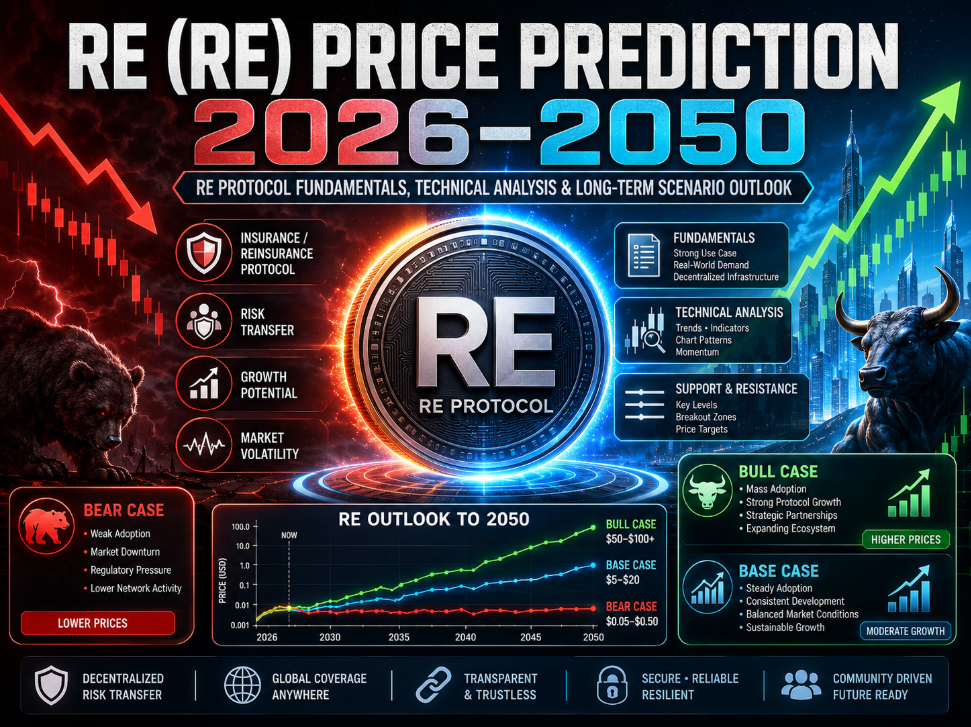
VI. RE Long‑Term Price Prediction: Three Scenarios for 2028, 2030, 2035, 2050
Long‑term predictions must never have a single price target. RE, as a new RWA token, could follow very different paths. Below are three scenario projections: Bear, Base, and Bull.
Bear Scenario: RWA Narrative Cools, RE Returns to Low‑Liquidity Zone
Under the Bear Scenario, Re Protocol fails to achieve meaningful adoption in the reinsurance market. Growth of reUSD and reUSDe users slows, insurance capital layer yields are unstable, regulators tighten controls on on‑chain insurance and stablecoin yield products, and the market once again questions the sustainability of RWA projects.
In this case, RE could face prolonged pressure.
- By 2028, RE might trade between $0.15 and $0.50.
- By 2030, if protocol TVL shrinks, unlock pressures are released but demand is insufficient, RE could remain in the 0.10–0.40 range.
- By 2035, if Re Protocol fails to become a significant RWA insurance infrastructure, RE could degenerate into a low‑liquidity governance token, with prices possibly in the 0.03–0.20 range.
- By 2050, if the project is replaced by newer‑generation RWA insurance protocols, or if the on‑chain reinsurance path is blocked by regulation, RE could approach zero, retaining only a residual trading value between $0 and $0.10.
Core assumptions of the Bear Scenario:
- The RWA insurance market does not truly come on‑chain;
- Regulation of stablecoin yields tightens;
- Protocol TVL declines;
- Reinsurance yields are unstable;
- RE governance value cannot be priced by the market;
- Large unlock supply overhangs price.
This scenario reminds investors that despite RE's novel narrative, it is not without the risk of going to zero. Any project in a new sector, if unable to demonstrate real demand over the long term, can eventually be abandoned by the market.
Base Scenario: Re Becomes a Small but Important RWA Insurance Infrastructure
Under the Base Scenario, Re Protocol does not disrupt the global reinsurance market, but it successfully becomes a recognizable insurance‑risk capital platform within the crypto RWA space. reUSD and reUSDe maintain a certain scale, TVL grows steadily, reserve transparency and yield performance are recognized by the market, and RE becomes the core token for protocol governance and ecosystem incentives.
In this case, RE has the opportunity to gradually establish medium‑to‑long‑term valuation.
- By 2028, RE could trade between $0.80 and $2.00.
- By 2030, if the RWA and stablecoin yield markets continue to expand, RE could enter the 1.50–4.00 range.
- By 2035, if Re Protocol maintains its industry position and develops more mature governance and value‑capture mechanisms, RE could enter the 3.00–8.00 range.
- By 2050, if Re Protocol still exists and becomes a stable infrastructure in the on‑chain insurance capital market, RE could enter the 5.00–15.00 range.
In this scenario, RE is not a 100x miracle coin, but a successful RWA governance asset that has survived multiple cycles. With a maximum supply of 1 billion tokens, RE at $10 would imply a fully diluted valuation of about $10 billion. This scale is not entirely impossible, but the protocol must prove its ability to bridge real insurance risk and on‑chain capital over the long term, not just remain at the narrative level.
Core assumptions of the Base Scenario:
- Re Protocol TVL grows sustainably;
- reUSD and reUSDe build stable user bases;
- Insurance capital layer yields and redemption mechanisms are manageable;
- RWA regulation gradually becomes clearer;
- RE governance rights and ecosystem incentives are recognized by the market;
- Token unlocks are absorbed by real demand.
Bull Scenario: On‑Chain Reinsurance Becomes a Core RWA Sector
Under the Bull Scenario, Re Protocol successfully captures a massive historical opportunity: stablecoin capital no longer chases only DeFi subsidies and on‑chain lending yields, but enters the real‑world insurance risk market on a large scale. On‑chain reinsurance becomes a major sub‑sector of RWA, and Re Protocol, with its first‑mover advantage, transparent reserves, compliant partnerships, institutional insurance network, and governance mechanisms, becomes a leader.
In this scenario, RE could receive a very high valuation re‑rating.
- By 2028, RE could enter the 2.00–5.00 range.
- By 2030, if the RWA insurance sector explodes, RE could enter the 5.00–12.00 range.
- By 2035, if the on‑chain insurance capital market becomes part of a trillion‑dollar RWA market, RE could enter the 15.00–40.00 range.
- By 2050, if Re Protocol becomes one of the global core on‑chain reinsurance capital infrastructures, and the RE token can capture governance, incentives, access, staking, or protocol economic value, RE could enter the extreme bull range above 50.00–100.00.
However, this scenario requires many conditions to align simultaneously. With a maximum supply of 1 billion tokens, RE at $100 implies an FDV of $100 billion. This is not a valuation that an ordinary project can achieve naturally – it is only discussable if Re Protocol truly becomes the core infrastructure for bringing global insurance capital on‑chain and RE token clearly captures protocol value.
Core assumptions of the Bull Scenario:
- The global reinsurance market broadly accepts on‑chain capital;
- Re Protocol continuously expands its insurance capital layers;
- The protocol achieves transparent, compliant, verifiable yield and risk management;
- RWA becomes a long‑term core theme of the crypto industry;
- Institutional capital enters the on‑chain insurance risk market;
- RE governance and staking mechanisms form strong value capture;
- Regulation does not block the development of such products.
Therefore, the essence of RE's long‑term price prediction is not "how high can the K‑line go," but rather an assessment of a deeper question: Can on‑chain capital truly enter the real‑world reinsurance market, and can Re Protocol become the long‑term winner in this market?
VII. Core Factors Affecting RE Price
1. Re Protocol's Own Roadmap and Product Performance
The most direct fundamental variable for RE's price is whether Re Protocol can continue to expand TVL, enhance the appeal of its stablecoin yield products, maintain transparent reserves, and control risks.
Website data shows Re's currently disclosed TVL of approximately $567 million, total deposits of about $177 million, and displays the allocation of different business lines within the insurance portfolio, such as homeowners insurance, commercial auto insurance, small business commercial insurance, workers' compensation, personal auto insurance, etc.
If such data continues to grow, it will strengthen market confidence in RE. If it stagnates or declines, it will weaken RE's long‑term valuation thesis.
2. Real‑World Experience with reUSD and reUSDe
Many users initially pay attention to Re Protocol not to buy RE, but to gain exposure to reUSD or reUSDe stablecoin yields. Official documentation shows that reUSD targets low‑volatility yields, while reUSDe targets "Insurance Alpha," but their redemption mechanisms differ: reUSDe redemptions are processed through quarterly windows, while reUSD can be atomically redeemed when on‑chain liquidity is available, and falls back to a queue mode when liquidity is insufficient.
If user experience is good – yields stable, redemptions smooth, and transparency adequate – RE as a governance token will receive more attention.
If yields are unstable, redemption queues are severe, or reserve transparency is questioned, RE's price will be significantly impacted.
3. Token Unlocks and Market Activities
RE's maximum supply is 1 billion tokens, while the current circulating supply is about 159.6 million, indicating that a large amount of future supply may enter the market. CoinGecko's Tokenomics module shows that approximately 162 million tokens are unlocked and circulating, while over 700 million remain locked.
This means long‑term investors must pay attention to the unlock schedule. If the release pace is too fast and actual buying interest and protocol growth are insufficient, RE could be dragged down by persistent selling pressure.
At the same time, the Binance listing announcement mentioned that 6 million RE are reserved for future marketing activities. Such activities may increase exposure and liquidity in the short term, but could also create profit‑taking pressure after the events conclude.
4. Exchange Liquidity and Market‑Making Depth
RE has already seen active trading on multiple platforms, including Binance, OKX, and LBank, which aids early price discovery. CoinGecko data shows RE's trading market covers 18 exchanges and 31 markets.
However, exchange coverage is not a guarantee of price appreciation. Early liquidity for new coins can increase quickly but may also decline rapidly as interest fades. Investors should observe:
- Whether trading volume on major pairs is stable;
- Whether bid‑ask spreads are narrowing;
- Whether more fiat or stablecoin pairs are added;
- Whether derivative listings introduce excessive leverage;
- Whether large orders easily cause slippage.
5. BTC, ETH, and Overall Liquidity Cycles
Although RE belongs to the RWA insurance sector, it cannot escape the broader crypto market cycle.
If BTC and ETH enter a strong bull market, risk appetite rises, and new‑narrative assets like RE are more likely to attract capital.
If BTC and ETH weaken and the market turns risk‑off, even if RE's fundamentals remain unchanged, it may decline due to liquidity contraction.
6. Regulatory Environment
Re Protocol connects stablecoin capital, insurance yields, reinsurance contracts, KYC/AML, and restricted jurisdictions, making it more dependent on compliance than typical DeFi projects.
The official FAQ explicitly states that Re requires KYC/AML and is not open to users in the United States and certain restricted jurisdictions.
This shows that Re Protocol itself is aware of regulatory boundaries, but future regulatory changes in different regions regarding RWA, insurance yields, stablecoin yields, and the securities nature of on‑chain assets could still directly affect RE's price.
VIII. How to Buy RE on HiBT?
If HiBT has opened RE‑related trading pairs, beginners can follow the steps below. Actual trading pairs, fees, minimum order sizes, deposit/withdrawal statuses, and regional restrictions should be verified on HiBT's official website or app.
Step 1: Register a HiBT account.
HiBT's Help Center explains that HiBT is a digital asset trading service platform registered in Canada in 2021, offering spot and derivatives trading for global users. Users can register via the HiBT website or app using an email or phone number, complete verification, and set a login password.
Step 2: Complete KYC verification and phone number binding.
HiBT's Help Center notes that new users must complete KYC verification and bind a phone number before engaging in trading activities such as buying and selling. The process is to go to account information in the app and follow the prompts for identity verification. Beginners typically need valid identification such as an ID card, passport, or driver's license, ensuring consistency of name, document number, and facial recognition data.
Step 3: Deposit USDT or other stablecoins.
If you already have USDT in other wallets or exchanges, you can deposit it into HiBT via crypto transfer. Using USDT as an example, HiBT's Help Center explains that users can click Deposit on the app home page, select USDT, choose the deposit network, and reminds that different networks are not interchangeable – you must ensure that the network selected on the sending platform matches the deposit network of HiBT.
For your first deposit, it is advisable to test with a small amount first and confirm receipt before transferring larger amounts.
Step 4: Search for RE in the trading section.
Go to HiBT's spot trading page and type "RE" in the search box. Carefully confirm the trading pair name – priority should be given to RE/USDT or other RE pairs supported by the platform. Do not confuse RE with other assets with the same or similar tickers.
If you have not yet studied the project systematically, you can read the article What is RE? on the site before deciding to trade. For new coins, understanding the project is more important than placing an order first.
Step 5: Choose your order type.
Limit orders are more suitable for beginners than market orders. RE is still in early price discovery, with large spreads and potential slippage. Limit orders allow you to control your entry price and avoid being forced to buy at unfavorable prices due to insufficient order‑book depth.
If you use market orders, you must first check the order‑book depth and estimated execution price, especially during rapid price surges.
Step 6: Set price alerts and stop‑loss plans after buying.
After buying RE, do not just stare at your unrealized P&L. You should also monitor:
- Whether RE breaks below the 0.53–0.64 support zone;
- Whether RE breaks back above the $0.83 resistance zone;
- Whether RE approaches the $1.08 all‑time high;
- Whether Re Protocol announces updates on TVL, yields, partnerships, or governance;
- Whether token unlocks, exchange activities, or abnormal market volatility occur.
Step 7: Sell or withdraw.
If you decide to exit, you can sell RE on HiBT's spot market for USDT. To withdraw to a wallet or another exchange, you need to select the coin, fill in the receiving address, confirm the withdrawal network, and complete 2FA verification. HiBT's Help Center reminds that you must confirm that the network supported by the receiving platform matches the network selected on HiBT; otherwise, the withdrawal may fail or assets may be lost.
IX. Risk Warnings: Must Read Before Buying RE
First, RE is a newly listed token with extremely limited historical data.
RE has only been listed on major exchanges since June 18, 2026 – barely over two weeks. Technical indicators, historical supports, trading depth, and user structure have not yet been validated through a full cycle.
Second, the gap between FDV and circulating market cap is large.
RE's current Market Cap/FDV is approximately 0.16, indicating a significant gap between circulating valuation and fully diluted valuation. If future unlock rates outpace market demand growth, price could face downward pressure.
Third, RE is not a reinsurance yield certificate.
Buying RE does not mean holding reUSD or reUSDe, nor does it mean directly receiving insurance premium yields. RE is primarily a governance and ecosystem token, and its value‑capture path still needs market validation.
Fourth, the RWA insurance sector is highly complex.
Reinsurance is a specialized financial and insurance field involving underwriting, claims, reserves, custody, compliance, risk control, KYC, redemption, and regulation. Ordinary users cannot simply focus on the words "high yield."
Fifth, regulatory and jurisdictional restrictions pose risks.
The official FAQ explicitly states that Re requires KYC/AML and restricts participation from the United States and certain other jurisdictions. If regulations tighten in the future, RE's trading, liquidity, and protocol use cases could all be affected.
Sixth, market sentiment risk.
RE is still in its early coin stage, and its price is easily influenced by exchange listings, social media buzz, short‑term speculative flows, and broader market fluctuations. It can rise fast and fall just as fast.
Similar RWA and novel protocol projects often face the problem of "strong narrative but complex rights boundaries." Readers may also refer to the article What is RIF? to further understand the differences in token mechanisms, including issuers, governance rights, income rights, and risk structures.
X. FAQ: Common Questions About RE Price Predictions
Can RE reach $1?
It is possible, but not based solely on sentiment. RE's all‑time high has already reached $1.08, showing that the market has accepted prices above $1 in the short term. However, whether it can reclaim $1 depends on whether RE can break above the $0.83 resistance zone with support from volume, exchange liquidity, and protocol fundamentals.
If it is only a short‑term bounce, $1 may remain a resistance level. If Re Protocol's TVL grows, yield products remain stable, and the market re‑embraces the RWA insurance sector, then $1 could become new medium‑term support.
Is RE suitable for long‑term holding?
RE is suitable for investors with deep understanding of RWA, reinsurance, stablecoin yields, and governance tokens to observe over the long term. However, it is not suitable for those who blindly buy heavy positions without understanding the project.
Holding RE long‑term is essentially a bet on whether Re Protocol can bring stablecoin capital into the real‑world reinsurance market and maintain a compliant, transparent, scalable capital‑layer structure over the long haul. If this thesis holds, RE has long‑term growth potential. If it fails, RE may remain just a short‑lived RWA concept coin.
Can RE reach $10 by 2030?
It is possible in the Bull Scenario, but the difficulty is high. With a maximum supply of 1 billion tokens, $10 would imply a fully diluted valuation of about $10 billion. This valuation would require Re Protocol to achieve a very significant market position in the RWA insurance sector, and the RE token must clearly capture governance, access, incentive, or ecosystem value.
If the protocol only operates at a small scale, $10 would be overly optimistic.
Can RE reach $100 by 2050?
This is an extreme bull scenario, not a baseline forecast. $100 would imply a fully diluted valuation of $100 billion for RE. Only if Re Protocol becomes one of the core global on‑chain reinsurance capital infrastructures and the RE token has a strong value‑capture mechanism would this be worth discussing.
For ordinary investors, $100 should not be treated as a price target, but rather as an "upper bound imagination under an extreme success scenario."
What are the differences between RE, reUSD, and reUSDe?
RE is a governance token, mainly used for protocol governance, technical permissions, committees, incentive policies, and ecosystem coordination.
reUSD is a relatively low‑volatility stablecoin yield product.
reUSDe is a yield product leaning toward "Insurance Alpha."
Official documentation shows that the strategies, yield targets, collateral assets, and redemption methods of reUSD and reUSDe are different. Beginners should not mistake buying RE for directly earning reUSD or reUSDe yields.
What allocation size is recommended for a first‑time RE purchase?
RE is a highly volatile new coin, not suitable for heavy positions by beginners. A safer approach is to use a very small allocation, e.g., less than 1% of total capital, to first observe price fluctuations, trading depth, spreads, and your own risk tolerance.
If you do not yet hold core assets like BTC and ETH, it is not advisable to overweight newly listed RWA governance tokens like RE first.
XI. Conclusion: RE's Opportunities Are New, and Its Risks Are Also New
RE is a very noteworthy new RWA token in the 2026 crypto market. What makes it unique is that it is not simply putting government bonds, stocks, or real estate on‑chain, but rather attempting to connect stablecoin capital with the real‑world reinsurance risk market. This direction is both large and complex.
From a fundamental perspective, Re Protocol has a clear sector positioning, a real insurance‑risk narrative, reUSD and reUSDe products, reserve transparency design, KYC/AML mechanisms, and exchange liquidity support.
From a technical perspective, RE is still in early listing stages. 0.53–0.64 is the short‑term support zone, 0.77–0.83 is the short‑term resistance zone, and $1.08 is the all‑time high resistance. Because the listing history is so short, the 50‑day and 200‑day moving averages are not yet meaningful.
From a long‑term forecast perspective, RE could follow three completely different paths by 2050:
- Under the Bear Scenario, if the RWA insurance sector fails, regulations tighten, and protocol growth stalls, RE could fall into a low‑liquidity range of 0–0.10.
- Under the Base Scenario, if Re Protocol becomes a small but important on‑chain insurance capital infrastructure, RE could enter the 5–15 range by 2050.
- Under the Bull Scenario, if on‑chain reinsurance becomes a core RWA sector and Re Protocol becomes a global‑scale infrastructure, RE could potentially reach the extreme valuation range above 50–100.
One‑sentence summary: RE is not a coin you can judge by looking at K‑lines alone. It is more like a long‑term bet on whether the reinsurance market can be restructured by on‑chain capital. In the short term, you can trade volatility; in the medium term, watch TVL and unlocks; in the long term, watch whether the RWA insurance sector truly succeeds.
All content in this article is for research and educational reference only and does not constitute investment advice. Crypto assets are extremely risky, and RE is a newly listed, highly volatile asset. Before investing, be sure to conduct your own research on project documentation, trading depth, unlock schedules, regulatory risks, and personal risk tolerance, and make decisions cautiously.