
As of June 2026, SNX sits in a position that's both genuinely awkward and genuinely worth re-examining.
On one hand, SNX currently trades around $0.23, with circulating market cap shrunk to roughly $80 million — a drawdown of nearly 99% from its 2021 all-time high near $28.5. For many longtime users, SNX was once a DeFi blue chip, the leading synthetic-asset protocol, and a significant derivatives protocol within the Ethereum ecosystem. Today, it has clearly faded from mainstream view: ranking has slipped, trading volume has contracted, community attention has cooled, and market confidence in it has hit a low point.
On the other hand, Synthetix hasn't shut down. To the contrary, it's executing a genuinely aggressive turnaround: completely abandoning the old narrative centered on sUSD and synthetic assets, pivoting toward a perpetuals DEX on Ethereum mainnet, while also using governance proposals to deal with sUSD's long-running depeg — clearing out the old system's historical baggage in one decisive move.
This makes SNX a textbook case of a "deep-repricing asset."
Is buying SNX now picking up a once-great DeFi protocol the market has overcorrected on, or catching a falling knife after a fundamentals decline?
If we stretch the timeline out to 2030, 2040, or even 2050, does SNX still have a shot at returning to $5, $20, or even somewhere near its all-time high?
This piece works through three questions:
First, how far has SNX actually fallen?
Second, is Synthetix's pivot to a perp DEX and the retirement of sUSD a net positive or a net negative?
Third, taking a long-term view out to 2050, what's a reasonable price range for SNX?
This article does not constitute investment advice. SNX is a high-volatility, small-cap, intensely-competed DeFi asset, and any long-term forecast here is scenario analysis, not a definitive conclusion.
- How Far Has SNX Actually Fallen?
Many newcomers seeing SNX at around $0.23 will react with: "this coin is cheap."
But cheap isn't the point — where it fell from, and why it fell that far, is the point.
SNX reached an all-time high near $28.5 around February 2021. At the time, the entire DeFi market was in a period of high exuberance, with narratives around synthetic assets, on-chain derivatives, staking yield, and stablecoin minting all running through a strong cycle. As one of the earliest DeFi derivatives protocols, Synthetix was viewed by the market as core infrastructure within the Ethereum ecosystem.
By 2026, SNX's position in the market is entirely different.
At roughly $0.23, the drawdown from the all-time high is nearly 99%. Market cap around $80 million is no longer in the range of a mainstream DeFi blue chip. More importantly, the market no longer prices SNX as the leading synthetic-asset protocol — it's now being re-evaluated as "a perp DEX protocol mid-transition that hasn't yet re-proven itself."
This is the central tension in SNX today:
Its price is genuinely low, but the market isn't pricing it low for no reason.
1.1 A Low Price Doesn't Necessarily Mean Undervalued
In crypto markets, plenty of assets that have fallen 90%, 95%, or 99% from highs can look "historically cheap."
But long-term investing can't be based on drawdown size alone.
An asset falling from $28.5 to $0.23 could have two different explanations.
The first explanation is a cyclical overcorrection. The fundamentals remain intact, and the market oversold the asset due to bear-market conditions, liquidity contraction, and sentiment panic. If the business later recovers and capital flows back, there's room for a substantial rebound.
The second explanation is structural decline. The old business model has failed, users have migrated to competitors, protocol revenue has fallen, and the token's value-capture ability has weakened — the market is simply pricing in a long-term decline in value ahead of time.
What makes SNX genuinely hard to assess right now is that it shows characteristics of both.
On one side, Synthetix still has an active dev team, a governance mechanism, protocol assets, and a perp DEX pivot with a revenue-buyback design.
On the other side, it's also an objective fact that sUSD has been depegged for an extended period, the synthetic-asset narrative has decayed, perp DEX competition is intense, and market share has been taken by rivals like Hyperliquid, dYdX, and GMX.
So SNX isn't simply "fallen a lot, buyable" — it's an asset whose investment case hinges on whether the pivot succeeds.
1.2 Current Technicals: $0.242 Support and $0.27 Resistance
From a short-term technical standpoint, SNX is currently trading around several key levels.
Around $0.242 can be considered the core short-term support zone. This level sits near a low region the market has repeatedly tested — if price keeps finding buyers there, it suggests capital is still willing to position at the lows.
$0.27 is the near-term resistance zone. If SNX can't decisively break through $0.27 and hold above it after breaking out, the short-term bounce is most likely just a weak rebound rather than a trend reversal.
$0.22 is a more dangerous level. If SNX breaks below $0.22 and can't quickly reclaim it, that suggests buying support is weakening further, potentially opening a new leg down.
For swing investors, the key question right now isn't "is $0.23 cheap" — it's three signals:
Can SNX hold the support around $0.242?
Can it break through $0.27 on rising volume?
If it breaks below $0.22, does it quickly recover?
Without these signals, chasing strength short-term still carries elevated risk.
1.3 Fear Index Around 22: Panic Overreaction, or Deteriorating Fundamentals?
The market Fear & Greed Index sits around 22, indicating very low risk appetite currently.
For high-certainty assets like BTC or ETH, extreme fear is often more easily framed as a long-term positioning opportunity. But for a small-cap DeFi asset like SNX, the fear needs to be unpacked.
If the market's fear stems from macro conditions, a broad crypto pullback, or insufficient liquidity, SNX may simply be an overcorrection.
If the market's fear stems from protocol-level fundamentals — sUSD's prolonged depeg, insufficient trading volume, inadequate buyback revenue, competitors continuously taking users — then the fear isn't a sentiment issue, it's the market's genuine pricing of risk.
This is the biggest difference between SNX and BTC or ETH.
When BTC falls, the core issue is usually cyclical. When SNX falls, the core issue may be survival.
So judging whether SNX is buyable can't rely on the fear index alone — it requires looking at what's actually driving the fear.
- Today's Synthetix Is Not the Project You Remember
Many people's mental image of Synthetix is still stuck at "synthetic-asset protocol."
In 2020–2021, Synthetix's core narrative was indeed synthetic assets. Users could collateralize SNX to mint sUSD, then use sUSD to trade synthetic assets like sBTC and sETH. This model was genuinely ahead of its time, attempting to replicate the price exposure of traditional financial and crypto assets entirely on-chain.
By 2026, however, Synthetix's identity has shifted noticeably.
Today's Synthetix is no longer primarily telling a "synthetic asset world" story — it's telling an "Ethereum-native perpetuals DEX" story.
This shift matters a great deal because it directly affects SNX's valuation logic.
In the past, SNX's value came from synthetic-asset minting demand, sUSD use cases, collateral staking yield, and the broader DeFi narrative.
Now, SNX's value depends much more on perpetuals trading volume, protocol revenue, SLP vault scale, the SNX buyback mechanism, and market share within Ethereum's derivatives market.
This is an entirely different business model.
2.1 From Havven to Synthetix, to Perp DEX
Synthetix's predecessor was Havven, whose early goal was building a decentralized stablecoin and payments network. The project later pivoted toward synthetic assets and rebranded as Synthetix.
In DeFi's early days, Synthetix was a genuinely representative protocol. It wasn't simple lending, nor a basic AMM — it was trying to solve a more complex problem: how to create price exposure to various assets entirely on-chain.
This made it, for a time, emblematic of DeFi innovation.
But the difficulty of synthetic-asset protocols is also obvious:
They need stable, reliable collateral.
They need the stablecoin to hold its peg.
They need sufficiently deep liquidity.
They need genuine user trading demand.
They need complex debt-pool and liquidation mechanisms.
When markets are booming, these problems get masked by high yields and rising prices. When markets cool, the system's complexity becomes a burden.
sUSD's long-running depeg is the concentrated expression of exactly this kind of complex-system risk.
2.2 Today's Core Business: A Hybrid Perp DEX
The 2026 version of Synthetix looks much more like perpetuals-trading infrastructure.
Its core design:
Off-chain order-book matching.
On-chain settlement.
Ethereum mainnet security.
Multi-collateral margin.
SLP vaults bearing liquidity and risk.
This hybrid architecture tries to solve two problems simultaneously.
First, purely on-chain trading is slow, costly, and offers a poor matching experience. If every order had to be processed on-chain, Ethereum mainnet's latency and gas costs would severely hurt the perpetuals trading experience.
Second, purely centralized exchanges carry custody risk and transparency problems. Trading perpetuals on a centralized platform offers a good experience, but fund custody, risk-control transparency, and platform credit risk remain long-standing concerns.
Synthetix is trying to take the middle path: using off-chain matching to improve trading efficiency, while using on-chain settlement to preserve transparency and verifiability.
If this model works, it genuinely has a shot at differentiating itself within the Ethereum ecosystem.
But the issue is that perp DEXs are no longer a blue ocean.
Hyperliquid has already built a powerful trading mindshare.
dYdX has its own base of professional trading users.
GMX has long held an important position in on-chain leveraged trading.
Other L2s and app-chains keep launching new derivatives protocols.
So Synthetix isn't entering an empty market from zero — it's trying to find a new position in a highly competitive red ocean.
2.3 What Does the SNX Token Actually Do Now?
SNX's current utility can be understood across three layers.
First, governance. SNX holders can participate in protocol governance, deciding on parameter changes, risk frameworks, revenue use, and upgrade direction. For a DeFi protocol still rapidly transforming, governance rights aren't decorative — many key changes require governance to take effect.
Second, as the underlying backstop for the SLP vault. The Synthetix Liquidity Pool, or SLP, is an important component of the protocol's liquidity and risk-bearing structure. SNX plays a risk-buffer and solvency-backstop role within it. Put simply: for the protocol to run perpetuals trading, someone needs to bear counterparty risk and liquidity risk, and SLP is the key mechanism for that.
Third, as a revenue-capture and buyback vehicle. If the perp DEX generates trading volume, that produces protocol revenue from fees, spreads, and liquidation income. If this revenue is used to buy back SNX, it can create token value capture.
This is also the core question for whether SNX can be repriced going forward.
It's not "SNX used to be strong" — it's "can future protocol revenue sustainably buy back SNX."
2.4 Why Does Multi-Collateral Margin Matter?
After Synthetix's pivot to a perp DEX, the multi-collateral margin design matters a great deal.
The traditional synthetic-asset model relied heavily on sUSD, which created an obvious problem: once sUSD depegged, the entire system's collateral, trading, settlement, and confidence were all affected.
Multi-collateral margin means users can participate using assets like ETH, cbBTC, and wstETH.
This design has three benefits.
First, it reduces dependence on a single stablecoin. After sUSD's problems, the protocol needs to move away from a structure where "all risk is concentrated in one stablecoin."
Second, it improves capital efficiency. Assets like ETH, cbBTC, and wstETH carry strong liquidity and market recognition — wstETH in particular, as a yield-bearing asset, allows for more efficient capital utilization.
Third, it's more aligned with real trading demand. Perpetuals users care more about margin efficiency, asset liquidity, and trading experience than about being forced to hold a particular protocol stablecoin.
So multi-collateral margin is key infrastructure underpinning Synthetix's pivot to a perp DEX.
- Two Major 2026 Events That Are Rewriting SNX's Pricing Logic
A 2050 forecast for SNX can't rely solely on historical price or the broader DeFi narrative. What actually matters are two events unfolding in 2026:
First, sUSD's retirement.
Second, the perp DEX and buyback mechanism becoming the new center of valuation.
Together, these two events make SNX's future genuinely complex — it carries both the opportunity of shedding historical baggage and the risk of new supply pressure and competitive failure.
3.1 SIP-423 Retires sUSD: Shedding Baggage, or Shifting Risk?
sUSD's prolonged depeg has been one of Synthetix's most serious problems over the past several years.
A stablecoin's core asset is confidence. Once users stop believing it can reliably redeem at $1, every trading, collateral, and liquidity mechanism built around it gets affected.
SIP-423's direction is clear: deal with the sUSD problem decisively.
Under the proposal, sUSD will be frozen and redeemed to holders at face value using locked SNX. This means the protocol is choosing to absorb sUSD's historical debt using SNX, making the old system's uncertain risk explicit.
This step carries clear positive significance.
It can end the trust erosion caused by sUSD's prolonged depeg, freeing Synthetix from being dragged down by a failed stablecoin model. For a protocol pivoting to a perp DEX, cleaning up old accounts is a necessary step.
But it also has a clear negative effect.
Because the redemption isn't conjured from nothing — it's carried out via SNX. In other words, sUSD's problem gets converted into future supply pressure on SNX.
So SIP-423 shouldn't be simply read as bullish, nor simply as bearish.
More precisely, it's a "balance-sheet cleanup."
Short-term, it exposes the problem.
Medium-term, it creates sell pressure.
Long-term, if the new business gets traction, it could become the precondition for a genuine restart.
3.2 Supply Overhang Risk: 2027–2028 Unlock Pressure
Under the current plan, roughly $17.5 million worth of sUSD will be converted into SNX, subject to a one-year lockup, before unlocking linearly across 2027–2028.
This means SNX has a very clear supply overhang ahead.
A supply overhang means the market knows in advance that new tokens will enter circulation at a future point, so investors price in that potential sell pressure ahead of time.
This matters especially for a small-cap asset.
If SNX's market cap is only around $80 million, and tens of millions of dollars' worth of SNX will gradually be released in the future, the market will naturally worry about two things:
Will this unlocked SNX get sold?
Can protocol revenue and buybacks offset this new supply?
If perp DEX trading volume is strong and protocol revenue is sufficient, with SNX buybacks running continuously, this unlock pressure could potentially be absorbed by the market.
But if volume doesn't materialize and buybacks fall short while the unlock arrives as scheduled, SNX's price will face greater pressure.
So 2027–2028 is a genuinely critical window for SNX.
It isn't a routine unlock — it's the delayed test of whether the 2026 sUSD cleanup plan actually worked.
3.3 The Buyback Mechanism: SNX's Biggest Potential Bullish Engine Going Forward
What's most worth watching for SNX going forward isn't the narrative — it's the buyback.
If Synthetix's perp DEX can generate genuine trading volume, the protocol earns revenue. That revenue can be used to buy back SNX, reducing market circulation pressure and improving the token's supply-demand balance.
This logic can be broken into a flywheel:
Trading volume increases.
Protocol revenue increases.
Revenue is used to buy back SNX.
SNX buy pressure strengthens, circulation pressure decreases.
Token price improves, attracting more attention.
More capital enters the ecosystem, further improving liquidity.
This is SNX's potential deflationary flywheel.
But this flywheel has one precondition:
Trading volume must genuinely grow.
Without volume, there's no revenue.
Without revenue, there's no sustained buyback.
Without buybacks, SNX is left with only governance, collateral, and historical baggage.
This is where SNX differs from many narrative-driven coins. Its future isn't decided by slogans — it's decided by data.
What investors should be watching isn't Twitter sentiment, but weekly trading volume, protocol revenue, SLP deposit scale, buyback amounts, and actual changes in SNX circulation.
3.4 Putting It Together: Which Way Does SNX's Long-Term Supply-Demand Lean?
SNX's current supply-demand structure can be summarized in one line:
Short-term skewed toward pressure; medium-to-long-term depends on trading volume.
Short-term pressure comes from the sUSD conversion, future unlocks, weak market confidence, and declining small-cap liquidity.
Medium-to-long-term opportunity comes from perp DEX volume growth, protocol-revenue buybacks, an Ethereum ecosystem recovery, and improved capital efficiency from multi-collateral margin.
If trading volume fails to materialize, SNX's supply-demand will lean bearish — because the unlock pressure is real, while the buyback is only a potential expectation.
If trading volume does materialize, SNX's supply-demand will start improving — because revenue-funded buybacks can gradually offset unlock pressure, even creating a deflationary effect.
So SNX's future isn't decided by "sUSD's retirement" alone — it's decided by whether the new business, post-retirement, can actually capture and sustain the protocol's value.
- Is Now a Good Time to Buy SNX? A Reusable Decision Framework
Is now a good time to buy SNX?
A more responsible answer:
If you're a short-term trader, this still isn't a strong confirmation point — wait for price to break $0.27 on volume.
If you're a long-term value investor, now can be a time to start researching and watching with a small position, but it's not suited to a large bet.
If you only want to buy SNX because it's fallen from $28.5 to $0.23, that's a high-risk basis for a decision.
You can evaluate whether SNX is worth buying across three dimensions.
4.1 Valuation: Is $80 Million Undervalued, or Is It Lost Market Share?
SNX's current market cap of around $80 million looks extremely low.
If Synthetix can become a significant perp DEX within the Ethereum ecosystem again, that $80 million market cap clearly has substantial upside.
But if Synthetix can't regain trading volume and remains long-term suppressed by protocols like Hyperliquid, dYdX, and GMX, $80 million isn't necessarily cheap.
A low market cap can mean two different things.
One is being overlooked by the market.
The other is being abandoned by the market.
SNX now has to prove it belongs to the former, not the latter.
4.2 Technicals: $0.242, $0.27, and $0.22
From an operational standpoint, SNX's key price zones are fairly clear right now.
$0.242 is the low-zone support area. If it gets tested repeatedly without breaking, that suggests the market still has buying support there.
$0.27 is the near-term resistance zone. If it breaks on rising volume, that suggests the market is starting to be willing to reprice SNX.
$0.22 is the risk line. A decisive break below it would suggest support below is weakening further.
For newcomers, going all-in at this stage isn't recommended. A more reasonable approach is staged observation:
A small first tranche as a test position.
A second tranche on a pullback to support that holds.
A third tranche added only after confirming a breakout above $0.27 and a hold.
The goal here isn't catching the exact bottom — it's avoiding excessive risk while the structure hasn't yet been confirmed.
4.3 Sentiment: A Fear Index of 22 Only Tells You It's Cheap — Not That It's Safe
A Fear & Greed Index around 22 indicates SNX is currently in an extremely pessimistic environment.
But the smaller the market cap, the less you should equate fear directly with opportunity.
Because small-cap assets can produce two very different outcomes in a fear environment:
One is being overcorrected and then quickly repairing.
The other is liquidity drying up further while price keeps drifting lower.
For SNX to prove it's the former, it needs to show actual business data.
4.4 The Two Leading Indicators That Actually Matter
The most important thing for judging whether SNX is buyable isn't price — it's two data points.
First, Synthetix's perp DEX weekly trading volume. If volume keeps growing, it shows the market is genuinely using Synthetix, rather than this remaining confined to governance proposals and community discussion.
Second, the SLP vault's deposit scale. SLP is an important foundation for the protocol's liquidity and risk-bearing capacity. A growing deposit scale shows capital is willing to enter the system, take on risk, and earn yield.
These two data points determine whether the buyback flywheel can actually start spinning.
If both trading volume and SLP deposits grow, SNX's investment case improves meaningfully.
If both stay weak, no matter how low the price goes, it lacks real support.
4.5 Three Types of Investors, Three Different Answers
For DCA investors, SNX is only suited to a small allocation.
If you believe in Synthetix's long-term pivot, you can DCA in with a very small position over time, but it shouldn't be treated as a core holding. SNX's uncertainty is far higher than BTC or ETH, and higher than most mainstream L1 assets too.
For swing traders, waiting for breakout confirmation is more reasonable.
Around $0.23 looks low, but until $0.27 breaks, the near-term trend still leans weak. Swing trading is better suited to waiting for right-side signals than betting on calling the exact bottom.
For long-term value holders, the focus should be data, not price.
You need to continuously track perp DEX trading volume, protocol revenue, SNX buyback amounts, SLP deposit scale, and the progress of the sUSD conversion and unlock. Only if these variables keep improving does SNX have long-term holding value.
4.6 The Downside Risk: What Happens If the Buyback Engine Stalls Out?
SNX's biggest risk isn't a short-term break below $0.22 — it's the new model failing to gain traction.
If perp DEX volume doesn't materialize, protocol revenue will be insufficient.
If protocol revenue is insufficient, SNX buybacks can't form sustained buy pressure.
If buybacks can't offset future unlock pressure, the SNX converted from sUSD will become market sell pressure.
If sell pressure persists while market share doesn't improve, SNX could enter an extended period of depressed valuation.
This is SNX's core downside risk:
It's not that there's no story — it's that the story has to be backed by trading volume.
- From 2030 to 2050: A Step-by-Step Milestone Forecast for SNX
2050 is an extremely long horizon. For a small-cap DeFi asset like SNX, predicting a single 2050 price directly isn't meaningful. A more reasonable approach breaks it into three checkpoints:
2030 — does the pivot succeed?
2040 — does the protocol still hold market share?
2050 — can SNX still exist as DeFi derivatives infrastructure?
5.1 2030: The First Major Test of Pivot Success or Failure
2030 is a critical checkpoint for SNX.
By then, the market will no longer assign valuation just because "it used to be a DeFi blue chip." Investors will be looking directly at questions like:
Does Synthetix's perp DEX have stable trading volume?
Does the SLP vault have a sufficient capital scale?
Can protocol revenue sustainably buy back SNX?
Has the historical baggage from sUSD's retirement been fully absorbed?
Does SNX still hold a place in the Ethereum derivatives market?
If the answers to these questions lean positive, SNX has a shot at climbing out of small-cap purgatory from around $0.23.
If the answers lean negative, SNX in 2030 may still just be a marginal DeFi protocol token.
There's significant disagreement across different long-term forecasting models for SNX right now. Some algorithmic models are very conservative, suggesting a ceiling of roughly $2 even by 2050; some more moderate models suggest it could return to a $1–$2 range around 2030.
But the biggest issue with most of these models is that they're largely based on extrapolating historical price and volatility, without fully accounting for Synthetix's business pivot, sUSD's retirement, the buyback mechanism, or the competitive landscape of perp DEXs.
So judging SNX in 2030 can't rely on algorithmic forecasts alone — it needs to be combined with fundamental developments. For further reading, HiBT's dedicated DOT price projection for 2030 is a useful comparison reference, which helps understand the assumptions behind different price ranges from a medium-term perspective.
From a more practical standpoint, SNX in 2030 can be split into three ranges:
Weak scenario — SNX may trade only in the $0.5–$1.5 range. This means the protocol survives, but the perp business hasn't really taken off, and buybacks aren't enough to change the supply-demand picture.
Base scenario — SNX may recover to the $2–$5 range. This means Synthetix's perp DEX has found stable footing, protocol revenue has improved, and the market is granting it some renewed DeFi-derivatives valuation.
Optimistic scenario — SNX may challenge the $8–$15 range. This requires Synthetix to win meaningful share within Ethereum-native perp DEXs, with the buyback mechanism continuing to function effectively.
5.2 2040: Is SNX Still a Viable Protocol?
2040 is harsher than 2030.
By that stage, the market won't care anymore about how SNX once handled sUSD, nor about how it once pivoted from synthetic assets. The market will only care about:
Does anyone still use it?
Is it still profitable?
Does it still generate protocol revenue?
Can SNX still capture value?
If Synthetix still exists by 2040 and still holds stable share within the Ethereum ecosystem or cross-chain derivatives markets, it will have already crossed multiple cycles. A DeFi protocol that survives that long typically earns a higher survival premium.
But if, by 2040, the perp DEX sector has become dominated by a small handful of top platforms, with Synthetix's trading volume remaining depressed long-term and the SLP vault shrinking, then SNX — even if still listed and tradeable — would just be a legacy asset.
So a reasonable range for 2040 can be understood as:
Weak scenario — SNX may sit around $1–$3.
Neutral scenario — SNX may sit around $5–$10.
Strong scenario — SNX may return to around $15–$25.
This isn't simply a price prediction — it corresponds to three different protocol states.
$1–$3 means the protocol survives but is marginalized.
$5–$10 means the protocol has stable revenue and a mid-sized market share.
$15–$25 means the protocol has re-established itself as one of DeFi derivatives' core infrastructures.
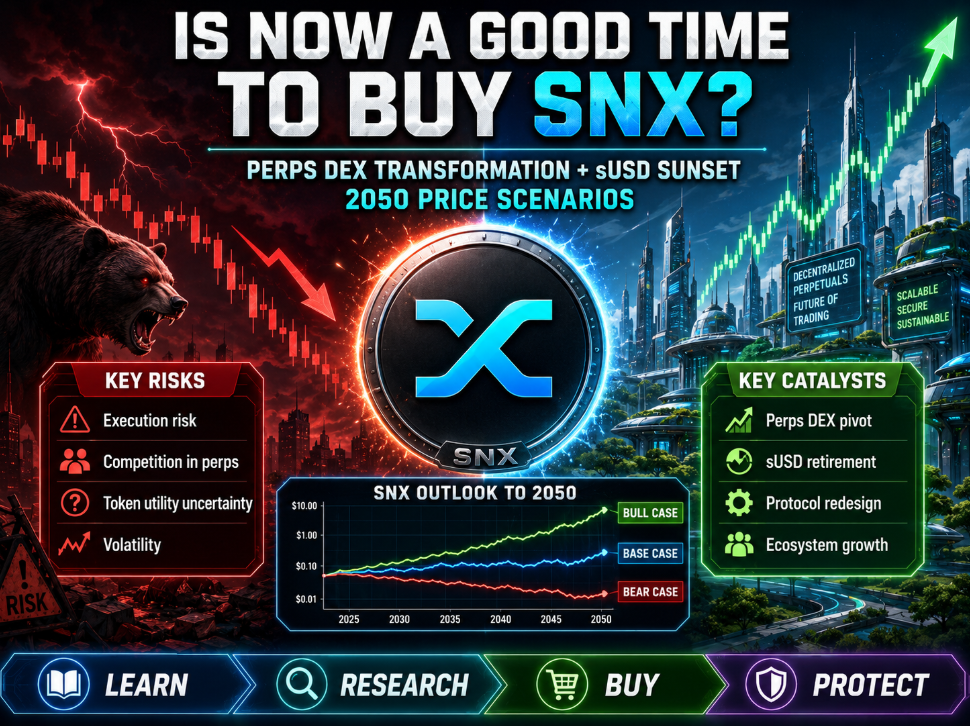
5.3 2050 Bear Scenario: Roughly $2–$3
In the most conservative 2050 scenario, SNX might only reach roughly $2–$3.
That range looks much higher than $0.23, but stretched across a 24-year timeline, it's not actually that impressive.
It represents a state of "the protocol survives but never revives."
In this scenario, Synthetix may still exist, but it's no longer a leading perp DEX player. Hyperliquid, dYdX, GMX, or future new derivatives protocols have captured most of the trading volume, with Synthetix retaining only a small base of Ethereum-native users and long-tail demand.
The buyback mechanism still exists, but because trading volume is insufficient, buyback amounts remain limited.
The historical sUSD problem has technically been resolved, but the trust damage it caused lingers long-term.
SNX wouldn't go to zero under this scenario, since the protocol still has some technical foundation, community, and asset base — but it would also struggle to regain a high valuation.
The essence of this scenario:
SNX survives, but never becomes a core asset again.
5.4 2050 Base Scenario: Roughly $5–$12
Under the base scenario, SNX could enter the $5–$12 range by 2050.
This is a relatively moderate, but not unreasonable, recovery path.
In this scenario, Synthetix doesn't dominate the perp DEX market, but it maintains a stable position within Ethereum-native derivatives. Its hybrid CLOB architecture is embraced by a portion of professional users, the SLP vault continues attracting capital, and protocol revenue is sufficient to support SNX buybacks.
SNX's value in this scenario comes from three sources:
First, protocol revenue generated by perpetuals trading volume.
Second, improved token supply-demand from revenue-funded buybacks.
Third, the brand and security premium of a legacy DeFi protocol that has survived multiple cycles.
If this path holds, SNX wouldn't need to reclaim its $28.5 all-time high to deliver a meaningful return to those who positioned at the lows long-term.
But this scenario has one critical precondition:
The buybacks must be sustained, and trading volume must be genuine.
Without sustained revenue, the $5–$12 range becomes hard to justify.
5.5 2050 Bull Scenario: Roughly $20–$40+
In the optimistic scenario, SNX could return to $20–$40 or above by 2050.
This range would mean Synthetix didn't just survive — it completed a genuine second growth curve.
Achieving this scenario requires meeting multiple conditions.
First, Synthetix becomes one of the leading Ethereum-native perp DEXs.
Second, the on-chain derivatives market expands significantly, with perpetuals trading migrating from centralized platforms on-chain at scale.
Third, the hybrid CLOB architecture proves it can preserve trading experience while leveraging on-chain settlement transparency.
Fourth, the SLP vault continues expanding in scale, capable of absorbing larger trading volume and risk.
Fifth, protocol revenue sustainably buys back SNX, creating long-term deflationary pressure.
Sixth, the 2027–2028 sUSD-conversion unlock pressure gets fully absorbed by the market.
If all these conditions hold simultaneously, SNX has a shot at being re-recognized by the market as a core DeFi derivatives asset.
The $20–$40 range would mean SNX has a shot at returning near, or even close to, its all-time high zone.
But it must be emphasized: this is not the base forecast — it's a strongly optimistic scenario. It requires the business, the market, the cycle, the competitive landscape, and the tokenomics to all align together.
5.6 Why Be Skeptical of Old Predictions of SNX Returning to $100 or Higher?
You can still find some extremely aggressive long-term SNX predictions floating around — $100, $200, or even higher. These types of predictions typically have three problems.
First, they mostly originate from the narrative environment at the top of the 2021 DeFi bull market. Back then, the market was willing to assign synthetic-asset protocols an extremely high premium, and many models simply assumed DeFi would keep growing exponentially and that Synthetix would permanently hold a central position.
Second, they ignore that Synthetix's business identity has changed. Today's SNX is no longer the "leading synthetic-asset" narrative of years past — it's a perp DEX protocol trying to re-find market share in a red-ocean competition.
Third, they ignore market-cap constraints. If SNX rose to $100, the implied market cap would vastly exceed how the market currently values it. That would mean Synthetix would need to become one of the most central protocols in the global on-chain derivatives market, with sustained massive revenue and strong buyback capacity.
That's not entirely impossible in principle, but it isn't a routine recovery scenario — it's an extreme bull-market assumption.
For ordinary investors, the more reasonable approach is:
Treat $2–$3 as the conservative survival scenario.
Treat $5–$12 as the moderate-recovery scenario.
Treat $20–$40+ as the bull scenario contingent on strong business execution.
Anything above $100 should be treated purely as an extreme hypothetical — not a baseline for an investment plan.
- The Key Variables That Determine Which Path SNX Takes to 2050
A 2050 price forecast isn't a prophecy — it's scenario modeling. What actually matters isn't guessing a single number, but understanding which variables could push SNX toward different outcomes.
6.1 How the Perp DEX Competition Plays Out
SNX's biggest competitive pressure right now comes from the perp DEX red ocean.
Hyperliquid has already built a strong trading experience and user mindshare.
dYdX has a base of professional traders and derivatives brand recognition.
GMX has long held an important position in on-chain leveraged trading.
Other new protocols keep competing for liquidity and trading volume.
Synthetix's advantages lie in being Ethereum-native, its security, its hybrid matching architecture, and the accumulated track record of a legacy protocol.
But whether these advantages can actually convert into trading volume still needs to be proven by the market.
If Synthetix can't capture sufficient trading volume, its buyback flywheel can't get started.
Without that flywheel running, SNX's long-term valuation lacks a core support pillar.
6.2 Whether the Buyback Flywheel Can Genuinely Start Spinning
SNX's most important future value path is:
Trading volume grows.
Protocol revenue increases.
Revenue is used for SNX buybacks.
Circulation pressure decreases.
The market re-prices the asset.
This flywheel looks simple, but every link could break.
If volume growth isn't sufficient, revenue falls short.
If revenue falls short, buyback scale stays small.
If buyback scale is too small, it can't offset the sell pressure from sUSD-conversion unlocks.
If sell pressure exceeds buy pressure, price stays under continued strain.
So SNX isn't an asset that can be evaluated on narrative alone — it's an asset that must be validated with revenue data.
6.3 The Overall Health of DeFi and the ETH Ecosystem
SNX is a quintessentially Ethereum-native DeFi asset, and its long-term fate is closely tied to the ETH ecosystem.
If Ethereum remains the world's most important DeFi settlement layer going forward, with on-chain derivatives continuing to grow, SNX has a chance to benefit.
If Ethereum DeFi growth slows, or large amounts of derivatives trading migrate to standalone app-chains or platforms with stronger centralized experiences, SNX's space gets squeezed.
A useful comparison here: DOT leans more toward infrastructure-type tokens, while SNX leans more toward DeFi application/protocol-revenue tokens. For reference, HiBT's DOT price scenarios for 2030 are worth reading, which helps clarify the differences in valuation logic between infrastructure tokens and DeFi application tokens.
Put simply:
DOT's long-term value depends on network architecture and ecosystem position.
SNX's long-term value depends on trading volume, revenue, and buybacks.
Both require long-term survival ability, but they capture value through different mechanisms.
6.4 Regulatory Variables
SNX also faces a very practical issue: regulation.
Perpetual contracts are, by nature, a high-leverage, high-risk financial product. Whether on centralized exchanges or decentralized protocols, derivatives regulation could become increasingly strict.
If future regulation imposes tighter restrictions on on-chain perpetuals, leveraged trading, synthetic assets, protocol front-ends, or liquidity providers, Synthetix's long-term valuation could be affected.
Possible risks include:
Some regions restricting user access to perp DEX front-ends.
Compliance requirements being imposed on on-chain derivatives protocols.
Securities-related scrutiny of governance tokens, protocol revenue distribution, and buyback mechanisms.
Regulatory limits on liquidity vaults and market-making yields.
A friendlier regulatory environment could let on-chain derivatives continue growing.
A tightening regulatory environment would narrow SNX's long-term growth path.
6.5 Whether the sUSD Historical Baggage Is Fully Cleared
sUSD's retirement doesn't mean the market's trust is restored immediately.
Many investors will remember one thing for a long time:
Synthetix once ran a stablecoin system that depegged for an extended period.
This will affect how the market judges the protocol's risk-management capability going forward.
If Synthetix gradually proves itself through the perp DEX, the buyback mechanism, transparent governance, and sound risk control, the historical baggage from sUSD can be absorbed.
But if the new business runs into further risk events, the market will treat the sUSD episode as evidence of "insufficient protocol governance capability."
So sUSD's retirement is only the first step.
What genuinely matters is whether, after retirement, Synthetix can build a simpler, more robust, and more profitable new system.
- How to Buy SNX on HiBT
If you've finished your research and decided to allocate a small position to SNX, you can trade it on HiBT. The process below is a reference for newcomers.
Step 1 — Register a HiBT Account
After visiting the HiBT website, you can register using an email address or phone number.
A few tips for registration:
Use a stable email or phone number.
Set a high-strength password.
Enable two-factor authentication.
Don't reuse your exchange password on other websites.
Crypto account security matters a great deal — newcomers shouldn't skip security settings for convenience's sake.
Step 2 — Complete KYC Identity Verification
Most licensed exchanges require users to complete KYC.
The purpose of KYC is to confirm user identity and guard against money laundering, account takeover, and illegal transactions.
You'll typically need:
A government ID or passport.
Facial recognition.
A commonly used phone number or email.
Some regions may require additional proof of address.
Specific requirements follow what's shown on the HiBT platform.
Step 3 — Funding: Fiat or Stablecoin Path
Before buying SNX, you'll need to fund your account first.
There are two common approaches.
The first is depositing USDT, then using it to buy SNX. This is the most common approach in crypto trading and works well if you already hold stablecoins.
The second is funding through the platform's supported fiat channels. Whether fiat funding is available depends on your region, payment method, and what the platform currently supports.
Regardless of which method you use, pay attention to:
Selecting the correct deposit network.
Copying the address completely and correctly.
Some coins may require a memo or tag.
Doing a small test deposit before sending a larger amount.
A mistaken deposit can result in permanently unrecoverable funds.
Step 4 — Placing an Order: Market or Limit?
You can buy SNX using either a market order or a limit order.
A market order has the advantage of fast execution, suited to users who want to buy immediately. The downside is that small-cap coins are volatile, and market orders may experience slippage.
A limit order has the advantage of letting you control your entry price. For example, with SNX around $0.23, you could set staged limit orders at $0.23, $0.22, $0.20, or other levels, rather than buying all at once.
For newcomers, using limit orders to buy in stages is generally recommended.
The reasoning is straightforward:
SNX has a small market cap and high volatility.
Short-term drops can happen quickly.
Staged buying reduces emotionally driven decisions.
Don't try to buy exactly at the bottom.
A more prudent approach:
A small first tranche as a test position.
A second tranche on a pullback to support that holds.
A third tranche only after confirming a breakout above $0.27 and a hold, before considering adding more.
This approach is far better suited to a high-risk asset than going all-in blindly.
Step 5 — How to Store SNX Safely After Buying
There are two common storage approaches after buying SNX.
The first is keeping it in your exchange account. The advantage is convenience for trading, suited to short-term and swing strategies. The disadvantage is that your assets are custodied by the platform, and you bear the platform's custody risk.
The second is transferring it to a self-custody wallet. The advantage is that you control your own private keys, more suited to long-term holders. The disadvantage is higher operational complexity — if your seed phrase is lost or leaked, the funds may be unrecoverable.
If you're a newcomer, it's best to start by learning with small amounts rather than diving into complex on-chain operations right away.
If you're planning to hold SNX long-term, you can gradually learn about wallets, network selection, contract-address verification, and anti-phishing basics.
- Risk Disclosure
SNX is a high-risk asset and is not suitable for all investors.
1. Extremely High Volatility Risk SNX's market cap of around $80 million means its liquidity and price stability are both weaker than mainstream assets. A single large order, shifts in market sentiment, protocol news, or unlock expectations can all cause sharp swings.
2. Small-Cap Liquidity Risk The smaller the market cap, the more easily it can be pushed by capital flows — and the more easily it can be dumped on. When liquidity is thin, buying may be easy, but selling isn't necessarily easy. Order-book depth can be notably insufficient, especially during extreme market moves.
3. Supply Overhang from the sUSD Conversion While sUSD's retirement helps the protocol clean up its old accounts, the SNX created through the conversion could form clear sell pressure once the 2027–2028 linear unlocks begin. If protocol revenue and buybacks aren't sufficient to absorb the new supply, SNX's price could remain under sustained pressure.
4. Risk of Losing the Competitive Race Perp DEXs are a red-ocean market. Hyperliquid, dYdX, GMX, and more new protocols going forward will all be competing for trading volume. There's no guarantee Synthetix will win this competition. If it's unable to gain market share long-term, SNX's investment thesis would weaken considerably.
5. Protocol Revenue Uncertainty SNX's buyback logic depends on protocol revenue, which in turn depends on trading volume. If trading volume declines, buyback capacity declines too. Investors shouldn't just note "there's a buyback mechanism" — they need to check whether there's sufficient revenue to actually support it.
6. Long-Term Forecast Risk A 2050 forecast carries enormous uncertainty. Over the next 20-plus years, technology roadmaps, regulatory environments, user demand, competitive landscapes, and macro liquidity could all shift dramatically. Every price range in this article is scenario analysis only and does not constitute investment advice.
Always DYOR and size positions according to your own risk tolerance.
- FAQ
Is buying SNX at $0.23 calling the bottom, or catching a falling knife? It's more accurately framed right now as a high-risk watch zone, not a confirmed bottom. If you believe in Synthetix's pivot to a perp DEX and can tolerate substantial volatility, a small staged position can be worth considering. If you're buying purely because SNX has fallen from $28.5 to $0.23, that carries significant risk. A more reliable signal would be sustained trading-volume growth, an expanding SLP vault, a clear increase in SNX buybacks, and price breaking $0.27 on volume.
Is sUSD's retirement good or bad for the SNX I'm holding? Short-term, sUSD's retirement brings uncertainty and future supply pressure. Long-term, if it helps Synthetix clear out the old system's risk and lets the protocol focus on the perp DEX, it could be a necessary restart. So it's neither purely bullish nor purely bearish — what matters is whether the new business can pick up the protocol's value after the retirement.
Is SNX still worth holding long-term after the pivot to a perp DEX? SNX is only worth long-term research if you accept two preconditions: first, that on-chain perpetuals markets will keep growing in the future, and second, that Synthetix can capture stable share within that market. If these preconditions don't hold, SNX's long-term holding case weakens considerably.
Can SNX really return to above $20 by 2050? Possible, but it falls under the optimistic scenario, not the base case. For SNX to return above $20 by 2050 requires the perp DEX business to succeed, protocol revenue to keep growing, the buyback flywheel to form, the sUSD historical baggage to be absorbed, the broader DeFi market to be thriving, and the regulatory environment to avoid deteriorating excessively. If these conditions aren't met, SNX is more likely to stay in a lower price range.
What's the minimum amount needed to buy SNX on HiBT? The exact minimum depends on what's shown on the HiBT trading page. Generally, newcomers can first use a small amount to get familiar with registration, KYC, deposits, order placement, and security settings before committing larger amounts. For a high-volatility asset like SNX, a small test position is far more suitable than going all-in at once.
Between SNX, BTC, and ETH, which is better for long-term holding? The three carry entirely different risk levels. BTC leans more toward a store-of-value asset with the highest long-term certainty. ETH is the core asset of the smart-contract ecosystem, with deeper ecosystem strength. SNX is a DeFi derivatives protocol token — higher potential upside, but also higher risk. For most newcomers, SNX isn't suited to being a core holding — it's better suited as a high-risk satellite position.
- Author's Note and Data Sources
This article is compiled based on public market data, protocol governance information, and industry materials as of June 2026. Primary references include:
SNX price, market cap, all-time-high, and trading-volume data from CoinGecko and CoinMarketCap.
Information related to Synthetix's official governance proposals SIP-423 and SIP-424.
Synthetix's official documentation and roadmap regarding the perp DEX, SLP, and the sUSD-handling mechanism.
Coverage from DeFi media outlets such as The Defiant on sUSD's retirement and Synthetix's pivot.
Public HiBT materials covering account registration, trading services, and compliance information.
This article will be updated following major changes in key data points such as sUSD unlock progress, Synthetix perp DEX trading volume, the SNX buyback mechanism, and SLP vault scale.
Conclusion: SNX's Problem Isn't That It's Cheap — It's Whether It Can Make Money Again
SNX's current price looks extremely cheap.
Around $0.23, a market cap of roughly $80 million, and a drawdown of nearly 99% from its all-time high all make it look like a potential "deep rebound candidate."
But what truly determines SNX's future isn't the fact that it once reached $28.5 — it's whether it can generate trading volume, protocol revenue, and genuine buybacks going forward.
If Synthetix's perp DEX trading volume never materializes, the SLP vault stays undersized, SNX buybacks can't be sustained, and the 2027–2028 sUSD-conversion unlock pressure is gradually released into the market, then even at $0.23 today, SNX might not be the bottom.
But if Synthetix successfully completes its pivot, becomes a significant Ethereum-native perp DEX player, and sustains SNX buybacks through trading revenue, it has a real shot at climbing out of small-cap purgatory.
So the answer to "is now a good time to buy SNX" isn't a simple yes or no.
A more precise conclusion:
For short-term traders, waiting for a confirmed breakout above $0.27 is the more prudent approach.
For long-term researchers, the zone around $0.23 can serve as a small-position watch area.
For value investors, what actually matters isn't price — it's trading volume, revenue, buybacks, and unlock pressure.
SNX's future through 2050 doesn't depend on whether it was once a DeFi blue chip.
It depends on whether it can re-prove itself in the perp DEX wars: not as a legacy protocol left over from history, but as on-chain derivatives infrastructure that can still keep making money.