
Introduction: MAVIA Isn't "Cheap" – It Has Entered the Survival Zone
If you only look at the price, MAVIA looks very cheap right now.
Heroes of Mavia’s token MAVIA reached an all-time high of approximately $10.71 in February 2024. As of late May 2026, Binance’s price page shows MAVIA trading around $0.03, with a market cap of roughly $7.7–8.5 million and a circulating supply of about 247 million tokens. That means MAVIA has dropped over 99% from its all-time high.
Many newcomers see this price action and think: "It's already down this much – how much lower can it go?"
But that is precisely the most dangerous aspect of small-cap GameFi tokens.
A coin dropping from $10 to $0.03 does not mean it has bottomed. If game user numbers continue to decline, token unlock pressure persists, exchange risks escalate, and team transparency remains lacking, it could still drop from $0.03 to $0.01, or even lose liquidity altogether for an extended period.
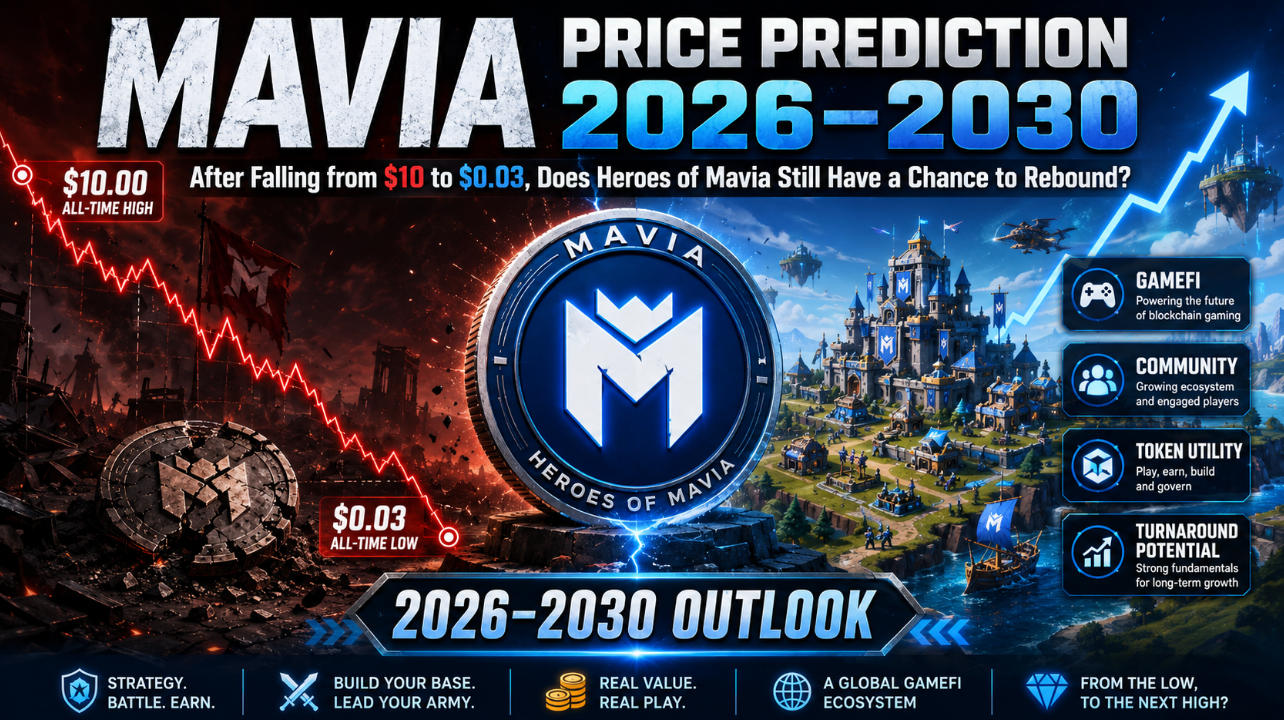
Conversely, if Heroes of Mavia can re-engage players through new versions, Mavia Mini, alliance battles, the Ruby economic system, and Ronin ecosystem traffic, it could see a multi-fold or even ten-fold rebound during the next GameFi sentiment cycle.
Therefore, this article will not simply tell you "MAVIA will definitely rise to $1" or "MAVIA is hopeless." A more reasonable question is:
Is MAVIA a GameFi asset that has been unjustly punished by the market, or has it already entered a death spiral as an old-narrative coin?
To answer this, we must look at the game, token, users, unlocks, exchange risks, and the GameFi cycle – not just the price chart.
Chapter 1: Before You Spend Money, Understand What MAVIA Actually Is
Heroes of Mavia is a mobile strategy game. Its gameplay is easily reminiscent of Clash of Clans: players build bases, upgrade structures, train troops, defend resources, attack other players' bases, and gain stronger combat power through long-term progression.
The biggest difference from traditional mobile games is not that it's "more fun," but that it introduces a Web3 economic system.
In traditional mobile games, when you spend money on items, building upgrades, or skins, those assets remain on the game company’s servers. You don’t truly own them, nor can you freely trade them on open markets.
Heroes of Mavia aims to combine game assets, player economics, token incentives, and on-chain transactions, making players not just consumers but also asset holders, traders, and ecosystem participants.
However, a crucial reminder: adding a token does not guarantee a Web3 game’s success.
What truly determines whether a GameFi game survives is not the token price, but whether players want to play it long-term. If the game itself isn’t enjoyable, no token economy – no matter how sophisticated – will avoid becoming a short-term gambling ground.
What Are MAVIA and RUBY?
Heroes of Mavia uses a dual-token system:
MAVIA is the ecosystem token, primarily responsible for governance, ecosystem incentives, exchange circulation, market pricing, and long-term value capture. The official MAVIA page states that MAVIA is used for ecosystem development, tournaments, and governance, allowing holders to participate in future decisions.
RUBY is more of an in-game currency, used for higher-frequency actions like in-game purchases, upgrades, events, competitions, and marketplace transactions. Phase 2 documentation mentions that Ruby will be used for entry fees, with winners receiving rewards after a 5% burn fee – indicating a built-in burning mechanism.
Why two currencies?
Because if all in-game spending used MAVIA directly, price volatility would severely impact the gameplay experience. Upgrading a building might cost $10 today, but if the token price surges, it could effectively cost $50 tomorrow – driving away ordinary players.
Thus, a more sensible structure is:
- MAVIA handles ecosystem value and external markets.
- RUBY handles in-game spending and player circulation.
This design is theoretically healthier, but its effectiveness depends on one question: Does RUBY consumption drive long-term demand for MAVIA?
If MAVIA is merely a speculative token on exchanges while the game economy runs mostly on RUBY, then MAVIA’s price may not directly benefit from game activity.
Advantages and Risks of Being Built on Ronin
Heroes of Mavia is closely tied to the Ronin ecosystem. The Ronin official documentation describes Ronin as an Ethereum L2 designed for gaming experiences and real crypto applications, built by Sky Mavis (the creators of Axie Infinity). Ronin has supported a single game reaching millions of daily active users and processed billions of dollars in NFT trading volume.
This offers clear advantages for MAVIA:
- Ronin already has a user base familiar with Web3 games.
- Ronin ecosystem users are accustomed to game assets, wallets, and on-chain interactions.
- Projects like Axie and Pixels have brought game development and user growth experience to Ronin.
- MAVIA does not need to educate Web3 game users from scratch.
However, Ronin also carries risks.
In 2022, the Ronin Bridge suffered a major hack. Reuters reported that hackers stole approximately $615 million in crypto assets from the Ronin project tied to Axie Infinity.
Although Ronin has since been fixing security and ecosystem issues, this history reminds investors that GameFi projects face not only price risk but also risks related to bridges, wallets, contracts, security, and ecosystem trust.
What Does the Drop from $10.71 to $0.03 Tell Us?
MAVIA’s all-time high was around $10.71; its current price is about $0.03.
This is not a normal pullback. It represents a complete revaluation of market expectations for the project.
At a minimum, it indicates four things:
- Early valuations were clearly overheated.
- The GameFi narrative failed to sustain buying pressure.
- Token supply and unlock expectations suppressed the price.
- The market still has doubts about project transparency, retention, and commercialization.
But this does not mean the project is dead. For MAVIA, the real question going forward is not "can it get back to $10?" but "can it prove again that it is a game people actually play?"
Chapter 2: MAVIA’s Health Check – Fundamentals You Must Understand Before Predicting Price
1. Supply Structure: A Critical Data Correction First
Your outline mentioned "total supply 250 million, current circulating supply about 20.65%, i.e., 51.6 million." That data appears to be from an early or outdated source.
As of May 2026, multiple price and unlock data platforms show that MAVIA’s circulating supply is close to 247 million tokens, with a maximum supply of approximately 250 million. Tokenomist shows about 246.9 million unlocked, representing 98.79% of total supply. Binance’s price page also shows a circulating supply of 247 million.
This has a huge impact on investment judgment.
If MAVIA were only 20% circulated, the biggest future risk would be "a large number of unlocked tokens dumping on the market."
Since MAVIA is already nearly fully circulated, the biggest risk has shifted from "massive supply unlocks" to "insufficient demand and liquidity drying up."
In other words, MAVIA’s problem is no longer that "79% of tokens are yet to be released." Rather:
Most of the supply is already in the market, yet the price remains around $0.03. This indicates extremely weak market demand.
This is even more concerning than simple unlock pressure.
2. Unlock Timeline: The Biggest Mine Has Passed, But Psychological Scars Remain
Tokenomist shows that Heroes of Mavia’s unlock schedule extends to 2029, with the next unlock on August 6, 2026, releasing tokens to advisors.
This means that technically, MAVIA still has tail-end unlocks, but it is no longer in the early phase of "massive supply inflation."
However, historical unlock issues have left trust wounds in the market.
In 2024, Heroes of Mavia adjusted its token unlock schedule. A CoinMarketCap Academy report on the event noted that the original plan would have increased circulating supply from 12% to 24% between February 2024 and February 2025. The adjustment kept circulating supply below 14% during that period to ease supply inflation pressure.
From a price perspective, reducing unlocks in the short term may support prices. But from a governance perspective, frequent rule changes raise concerns among investors: can the project team alter important rules for token holders at any time?
3. Coinone Risk Warning: Transparency Issues Are More Serious Than Price Drops
In December 2025, South Korean exchange Coinone designated MAVIA as an investment warning project. A Coinness report mentioned that Coinone pointed out issues such as failure to disclose material information in a timely manner or arbitrarily changing rules without justifiable reasons. After a comprehensive review, the exchange found multiple deficiencies in business feasibility and disclosures that could cause harm to users.
Such warnings are fatal for small-cap coins.
Because the worst thing for a small coin is not a single exchange announcement, but the market forming a consensus that "this project is not transparent." Once investors begin to worry that project rules may change arbitrarily and that information disclosure is untimely, long-term capital will stay away, leaving only short-term speculative money hunting for bounces.
For MAVIA, this risk must be factored into any valuation model.
4. Market Cap and Liquidity: Opportunity and Risk Are Two Sides of the Same Coin
Binance’s page shows MAVIA’s current market cap at approximately $7.7–8.5 million, with 24-hour trading volume around $1.5 million.
This market cap range has two characteristics:
First, in a bull market, it can easily be pushed up by capital. Because the market cap is low, a few million dollars of new capital can produce significant percentage gains.
Second, in a bear market, it can also collapse easily. Because liquidity is thin, one large sell order can cause a sharp price drop.
Thus, MAVIA is not a "cheap and safe asset" – it is a "low-cap, high-volatility asset."
It is suitable for speculative observation, not for a core heavy position.
Chapter 3: GameFi’s Cautionary Tale – What Does Axie Infinity Tell Us?
To understand MAVIA, you must understand Axie Infinity.
Axie was once the absolute star of GameFi. It proved that a Web3 game could attract massive users, capital, and media attention during a bull market. But it also proved something else: if a game’s economy depends on new user entry, once growth stalls, both token price and player income can collapse rapidly.
Axie’s crash path roughly followed:
- Early bull market: players flood in, token rises.
- Rising token attracts more players who play for earnings.
- Higher earnings bring more users, creating positive feedback.
- New user growth slows, in-game earnings decline.
- Existing players sell their reward tokens.
- Token decline leads to even lower earnings.
- More players leave.
- The economic system enters a death spiral.
This is the most common problem in GameFi: it looks like a game, but often functions as a "growth financial product."
MAVIA shares similarities with Axie:
- Both are Web3 games.
- Both are tied to the Ronin ecosystem.
- Both emphasize game assets and token economics.
- Both attempt to sustain economic circulation with an in-game currency.
- Both face user retention and token selling pressure issues.
But MAVIA also differs. It is not a copy of Axie’s pet breeding and reproduction economy. Instead, it is closer to a mobile strategy game. In theory, strategy games have stronger long-term progression and competitive retention potential.
The problem: theory is one thing; data is what matters.
A BlockchainGamer.biz analysis of Heroes of Mavia in 2024 noted that the game had approximately 4 million downloads in its early days, but after four months, daily active users were around 74,000. A rough calculation gives a retention rate below 2%, and the article suggested the game might have suffered from insufficient updates.
This gives MAVIA investors an important reminder:
The most important metric for a GameFi project is not price – it’s player retention.
If a game has high downloads but players quickly leave, it suggests users came for airdrops, rewards, or short-term hype – not because they genuinely enjoy playing long-term.
Why Can Mavia Mini and Partnership News Only Bring Short-Term Bounces?
In July 2025, Mavia Mini launched. A CoinMarketCap AI update page mentions that Mavia Mini went live on July 26, 2025, developed by the Nexira team. It is a light game within the Heroes of Mavia universe, sharing the same account and Ruby economy with the main game.
In August 2025, an event related to Dominari Holdings also stimulated market sentiment. A CoinDCX article noted that on August 27, 2025, Dominari Holdings appointed MAVIA founder Tristan Chaudhry to its crypto advisory committee, driving a ~47% price increase for MAVIA in August.
Can these catalysts change the long-term trend?
In the short term, yes. In the long term, not necessarily.
Mavia Mini, partnership announcements, advisory appointments, and tournament events can generate short-term trading volume and community hype. But for MAVIA to rise sustainably, it must produce consistent DAU, paying users, RUBY consumption, and MAVIA value capture.
If it’s just news-driven, price bounces will likely fade within days or weeks.
Chapter 4: 7 Core Variables Affecting MAVIA’s Price Over the Next 5 Years
Variable 1: Game Quality
GameFi is, ultimately, about gaming.
If Heroes of Mavia isn’t fun, players won’t stick around because of the "Web3" label. Updates like Chapter 2, alliance battles, Mavia Mini, competitive gameplay, land system, hero system – all must translate into real player engagement and retention.
If updates are designed merely to pump the token price rather than improve gameplay, any rebound is unlikely to last.
Variable 2: Supply-Side Pressure Is Nearly Over, But Selling Pressure Logic Remains
Although MAVIA is now nearly fully circulated, that does not mean selling pressure is gone. Selling pressure can come from early token holders, the team, advisors, ecosystem reward recipients, and even secondary market investors who have lost confidence.
Supply pressure has shifted from "unlock selling pressure" to "confidence selling pressure."
That can be just as deadly for price.
Variable 3: The 2028 Bitcoin Halving Cycle
The next Bitcoin halving is expected around 2028. Small-cap GameFi tokens typically do not move first. They get chased after BTC, ETH, and major altcoins have already risen, when risk appetite spreads. If MAVIA survives until 2028 and retains sufficient exchange liquidity, it could benefit from the post-halving altcoin cycle.
Variable 4: Exchange Risks
The Coinone investment warning already shows that exchanges have concerns about MAVIA’s disclosure and business feasibility.
If more exchanges follow with risk warnings, trading restrictions, reduced support, or even delistings, MAVIA’s liquidity will deteriorate further.
For small coins, exchange risk often affects price faster than technical risk.
Variable 5: Ronin Ecosystem Competition
Ronin is both an advantage and a competitive arena.
Ronin hosts not only MAVIA but also Axie Infinity, Pixels, Apeiron, and other games. BlockchainGamer.biz reported that Ronin’s daily active wallets exceeded 2 million in July 2024, driven largely by Pixels, CARV, and Apeiron.
This means Ronin has users – but it also means MAVIA must compete with other games for attention, capital, and player time.
If the Ronin ecosystem continues to grow, MAVIA may benefit. If Ronin’s traffic gets absorbed by Pixels, Axie, or new games, MAVIA could be marginalized.
Variable 6: Whether the Web3 Gaming Narrative Revives
GameFi was extremely hot in 2021, but most projects have since faded. Whether GameFi revives in the next bull market remains uncertain.
AI, RWA, DePIN, L2s, and the BTC ecosystem are all competing for narrative mindshare. For MAVIA to rise, it must not only prove it’s a good game but also wait for the market to be willing to value Web3 games again.
If you want to compare another ecosystem asset that once shined and was later repriced by the market, you can read HIBT’s MOVR Price Prediction 2026–2030. MOVR and MAVIA are both assets that have experienced major drawdowns and are searching for new positioning, but MOVR is more of a chain ecosystem play while MAVIA is more of a game asset.
Variable 7: Whether RUBY’s Burning Mechanism Creates an Economic Flywheel
In theory, RUBY’s burning mechanism helps reduce in-game inflation. Phase 2 materials mention that some tournament entry fees will be paid in RUBY, with a 5% burn mechanism.
But burning is not a cure-all.
If there are few users, even a high burn rate is meaningless. If there are many users but MAVIA does not capture RUBY’s economic value, MAVIA may still not rise.
Thus, two things matter:
- Is there genuine consumption of RUBY?
- Does MAVIA receive value回流 (value backflow) from the Ruby economy?
Chapter 5: 2026 Price Prediction – Finding the Bottom in the Bear Market Ruins
As of May 2026, MAVIA is trading at approximately $0.03, with a market cap of around $8 million.
This price already reflects a great deal of bad news: price collapse, GameFi retreat, retention concerns, Coinone warning, transparency issues, and thin liquidity.
But are all the bad news fully priced in? Not necessarily.
2026 Key Catalysts
Three things to watch for MAVIA in 2026:
- Can new versions like Chapter 2 or alliance battles bring back real players?
- Can Mavia Mini become a lightweight entry point rather than a flash in the pan?
- Can Ruby and MAVIA economics be more closely tied together?
If these updates are just press releases, price bounces will be short. If they lead to improvements in DAU, spending, trading volume, and community activity, MAVIA could rebound from extremely depressed valuation levels.
Bear Market Bottom Scenario: 0.01–0.03
If exchange risks escalate further, player metrics do not improve, and Mavia Mini/Chapter 2 fail to boost retention, MAVIA could remain in the 0.01–0.03 range for an extended period. This range does not represent "absolute cheapness" but rather the market’s view that the project is at high risk of failure.
Range-Bound Recovery Scenario: 0.03–0.08
If game updates go smoothly, player metrics stabilize, and Ronin ecosystem traffic provides some support, MAVIA could recover in the 0.03–0.08 range. This is a relatively reasonable neutral scenario for 2026. It does not mean a full turnaround – just that the market is willing to re-observe.
Short-Term Bounce Scenario: 0.08–0.15
If BTC strength returns, the GameFi sector sees a collective rebound, Heroes of Mavia updates exceed expectations, and exchange risks do not expand further, then MAVIA could reach 0.08–0.15. But this range is more suitable for swing trading than for blind long-term hopium.
Chapter 6: 2027 Price Prediction – The Survival Filter Year for GameFi
2027 will be critical for MAVIA.
If 2026 is only a low-level recovery, then 2027 will determine whether the project can remain on the main stage of Web3 gaming.
GameFi projects typically enter an elimination phase by year three. After the initial hype fades, airdrop farmers leave, speculators leave, and only true players remain. If the game itself cannot hold up at that point, the token enters a prolonged low-liquidity state.
2027 Pessimistic Scenario: 0.005–0.02
If Chapter 2 and Mavia Mini data miss expectations, the project’s update pace slows, and community activity declines, MAVIA could drop to 0.005–0.02. The most dangerous thing at this stage is not the low price, but disappearing trading volume. If a coin has extremely low daily volume, it becomes difficult to enter or exit safely, even if the price looks cheap.
2027 Neutral Scenario: 0.02–0.06
If MAVIA maintains its existing user base and sustains interest through seasonal events, tournaments, alliance gameplay, and the Ruby economy, the price could oscillate between $0.02 and $0.06. This is an "alive but not strong" state – the project isn’t dead, but it hasn’t proven it can become a long-lasting GameFi title.
2027 Optimistic Scenario: 0.06–0.20
If a new game model emerges in 2027, the Ronin ecosystem continues to grow, MAVIA’s player metrics clearly improve, and the market enters a pre-bull-run phase, the price could bounce to 0.06–0.20. But this scenario has high requirements: a few announcements won’t be enough – real user and revenue data must be visible.
Chapter 7: 2028 Price Prediction – GameFi Rebound Opportunity in the Bitcoin Halving Year
2028 is the next Bitcoin halving year, and the one where MAVIA has the greatest chance of a cyclical rebound.
Small-cap GameFi tokens have a characteristic in bull markets: they start late but are highly elastic.
Capital typically flows first into BTC, then ETH, then major altcoins, and finally spreads to GameFi, small caps, and old-narrative recovery coins. If MAVIA still has exchange liquidity, game users, and Ronin ecosystem support by 2028, it could be rediscovered by capital.
Optimistic Scenario: 0.15–0.50
If the halving cycle, GameFi narrative revival, and successful game updates all align, MAVIA could bounce to 0.15–0.50. At current $0.03, that’s roughly 5–16x. But note: this is not long-term value confirmation – it’s a strong cyclical rebound scenario.
Neutral Scenario: 0.05–0.15
If the overall market rises but MAVIA lacks strong independent catalysts, it could follow the GameFi sector up to 0.05–0.15. This range would be more of a "passive rebound."
Pessimistic Scenario: Below $0.01
If by 2028 the project is effectively dead – no one discussing the game, trading volume dried up, exchange support diminished – then even a bull market may leave MAVIA at a symbolic price. This is the biggest risk for old GameFi projects: in the next bull run, capital may choose new games rather than old ones.
Chapter 8: 2029 Price Prediction – Bull Market Peak or Dual Game After Full Unlock?
2029 could be MAVIA’s most critical year.
On one hand, Tokenomist shows MAVIA’s unlock schedule extends to 2029, after which supply-side uncertainty will largely end.
On the other hand, if the post-2028 halving market enters a new bull run, 2029 could become a phase of altcoin bubble.
This creates a dual game:
- End of supply pressure is positive.
- But if the project has no growth by then, completing unlocks won’t save the price.
How to Estimate a Reasonable Valuation Ceiling for MAVIA?
GameFi projects should not be valued by "narrative" alone. Three metrics matter:
- DAU: Daily active players.
- ARPU: Average revenue per user.
- Retention: Do players keep coming back?
If a Web3 game has only a few thousand DAU, low ARPU, and poor retention, then even a token market cap of a few tens of millions may not be cheap.
If DAU can return to hundreds of thousands, with active spending and trading markets, stable RUBY burns, and MAVIA value capture, then the market may assign a higher valuation.
2029 Pessimistic Scenario: 0.01–0.05
If MAVIA still hasn’t proven itself by 2029, the price may only oscillate between $0.01 and $0.05.
2029 Neutral Scenario: 0.05–0.30
If the GameFi sector warms up and MAVIA still has a player base, but is not a sector leader, then 0.05–0.30 is a reasonable neutral range.
2029 Optimistic Scenario: 0.30–1.00
If MAVIA becomes an important Ronin ecosystem game again in 2028–2029, with DAU significantly recovered, the Ruby and MAVIA economy forming a closed loop, and bull market capital entering GameFi, the price could challenge 0.30–1.00. But this is a very optimistic assumption and should not be taken as a base case.
Should You Take Profits in 2029?
If you positioned around $0.03 and see multiple-fold or even ten-fold gains by 2029, the most rational move is not to dream of a return to $10, but to sell in batches. Be especially cautious when you see:
- The community starts chanting "back to ATH is only a matter of time."
- Price soars but DAU does not grow.
- KOLs uniformly set extremely high price targets.
- Volume spikes then fades after a peak.
- In-game economic data does not improve concurrently.
GameFi tops often come faster than you expect.
Chapter 9: 2030 Price Prediction – After Five Years, Is MAVIA Still Alive?
By 2030, MAVIA’s biggest challenge will not be price – it will be relevance.
The Web3 gaming industry will continue to evolve, but that does not mean every game from 2024 will survive to 2030. A Web3 game that remains active after five years typically has several characteristics:
- The game itself is genuinely fun.
- Users are not there only for token rewards.
- The economic system avoids infinite inflation.
- The team continues to update.
- The community remains active.
- There is real demand in the marketplace.
- There is a clear relationship between token and game revenue.
MAVIA currently meets some of these, but it is far from certain.
2030 $0.10 Scenario
If MAVIA survives but remains a small-to-medium Web3 game with some users and trading volume, then around $0.10 is a realistic recovery scenario. Buying at $0.03 and selling at $0.10 gives roughly 3x returns. That doesn’t sound spectacular, but for a small coin that has experienced a deep drop, it would be a decent outcome.
2030 $1 Scenario
If MAVIA becomes one of the core games in the Ronin ecosystem again, with DAU, spending, RUBY burns, NFT marketplace activity, and MAVIA governance demand all clearly recovered, then $1 could be a high-valuation range after a strong bull market. From $0.03 to $1 is roughly 33x. But this would require a genuine turnaround, not just market hype.
2030 $5 Scenario
$5 is an extreme optimism scenario. That would mean MAVIA is not only alive but has re-entered the top tier of Web3 game assets, backed by very strong user and revenue data. Given the current market cap, price, exchange risks, and retention history, this is not a base prediction – only a thought experiment for an extreme bull case.
2030 Zero Scenario
If the game is ignored for a long time, the team reduces updates, exchanges gradually delist MAVIA, and the community loses energy, then MAVIA could approach zero. For a small-cap GameFi coin, this is not alarmist – it’s a risk that must be accepted.
MAVIA Price Prediction Summary Table: 2026–2030 Three Scenarios

The point of this table is not to memorize specific numbers, but to understand:
MAVIA’s upside depends on game users and the GameFi cycle; its downside depends on liquidity, exchange risks, and whether the project enters a death spiral.
Chapter 10: Three Types of Players – Which One Are You?
Type 1: The Speculator
If you are purely speculating on MAVIA, don’t get lost in grand narratives. Focus on three things:
- Has trading volume suddenly spiked?
- Is there a major version update or event?
- Is an exchange announcement or unlock date approaching?
For a small-cap coin like MAVIA, short-term opportunities typically come from event-driven moves, not long-term valuation recovery.
Speculators should remember: the sharper the bounce, the more you need to set profit targets in advance. Don’t turn a short-term trade into a long-term belief.
Type 2: The Rebound Trader
If you want to bet on a rebound from around $0.03, your logic must be clear:
The reason to buy is not "it’s dropped too much" but "bad news is largely priced in, and catalysts lie ahead."
Consider these three add signals:
- Game DAU recovers.
- RUBY consumption or burn data improves.
- Mavia Mini or main game events bring real user growth.
Stop-loss signals must also be clear:
- Trading volume continues to shrink.
- Exchange risks escalate.
- No substantial updates from the team for a long time.
- Community is reduced to price shilling.
- No real consumption in the in-game economy.
Type 3: The Long-Term Holder
MAVIA is not suitable for ordinary people to hold a heavy long-term position.
If you truly want to hold until 2030, keep the position size to 1%–3% of your total crypto portfolio, and definitely no more than 5%.
Why?
Because MAVIA is not BTC or ETH. Its fate is highly dependent on a single game, team execution, user retention, exchange support, and the GameFi cycle. A problem with any one link could lead to a long-term zero.
Long-term holders should check each quarter:
- Is DAU growing?
- Are RUBY burns real?
- Does MAVIA have new use cases?
- Does the Ronin ecosystem continue to support it?
- Is exchange liquidity stable?
- Is the team consistently updating the product?
If these metrics deteriorate for two consecutive quarters, don’t comfort yourself with "long-termism."
Chapter 11: Risks You Cannot Ignore – These Questions Have No Answers, But You Must Know Them
Risk 1: Project Transparency Risk
The Coinone investment warning cited information disclosure and rule-change issues with MAVIA.
This kind of risk is hard to quantify but has enormous impact.
Once the market perceives a project as non-transparent, long-term capital exits, leaving only short-term speculators.
Risk 2: Low Liquidity Risk
MAVIA’s market cap is about $8 million, with 24-hour trading volume around $1.5 million.
This means it is easy for capital to pump in the short term, but also easy for a large sell order to crash the price.
For ordinary investors, there is only one way to protect yourself: small position size, don’t chase highs, and don’t use leverage.
Risk 3: GameFi Death Spiral
The death spiral typically goes:
- Token falls.
- Player earnings decline.
- Players leave.
- Game activity drops.
- Market confidence erodes.
- Token falls further.
- Team reduces updates.
- More players leave.
Has MAVIA shown early signals? Price collapse, retention concerns, exchange warning, transparency controversy – these are risk signals. But as long as the game is still being updated, users exist, and Ronin ecosystem traffic continues, it is not yet completely dead.
Risk 4: The Next Bull Market May Not Belong to GameFi
Even if the crypto market enters another bull run in 2028–2029, capital may favor AI, RWA, DePIN, the BTC ecosystem, or prediction markets over GameFi.
For example, HIBT’s UMA Price Prediction 2026–2030 discusses UMA, which is more about oracle and prediction market infrastructure. It is fundamentally different from a single-game token like MAVIA. One relies more on financial infrastructure demand, the other on game users and community activity.
So, do not assume that MAVIA will rise just because "a bull market is coming."
Risk 5: Prediction Articles Themselves Can Mislead You
All price predictions have limitations, including this one.
Predictions can only build scenario frameworks based on current information – they cannot foresee:
- Sudden regulatory changes.
- Exchange delistings.
- Whether the team continues building.
- Whether players stay long-term.
- Sudden emergence of stronger competitors.
- A security incident on Ronin.
- The market abandoning the GameFi narrative.
Therefore, do not treat any prediction article as a buy or sell signal. The real value is learning to analyze the variables, not memorizing price targets.
Appendix: MAVIA Key Data Quick Reference

Conclusion: MAVIA Is Not a "No-Buy," But "Cheap" Alone Is Not a Reason to Buy
What makes MAVIA most attractive right now is its sufficiently low market cap and rebound elasticity after an extreme drop.
But that is also what makes it most dangerous.
A drop from $10.71 to $0.03 does not guarantee a rebound – nor does it mean there is no opportunity. What will truly determine MAVIA’s future price is not its all-time high, but whether in the coming years it can prove three things again:
- That Heroes of Mavia is still a game people want to play long-term.
- That a real value backflow can form between the Ruby economy and the MAVIA token.
- That the project team can rebuild market trust and avoid further exchange risks.
If these three things are not achieved, MAVIA could remain at low levels for a long time, or even gradually lose liquidity. If these three things are achieved, MAVIA could become a small-cap GameFi rebound candidate in the 2028–2029 cycle.
One-sentence summary:
MAVIA is not a coin suitable for heavy long-term conviction – it is a high-risk, high-volatility GameFi speculative asset whose fate depends heavily on game data and cycle sentiment. The real reason to buy should not be "it was once $10," but "it is in the process of regaining real players."