
In the crypto industry,
there is a very special type of project:
They have almost no retail discussion buzz.
Prices stay low for a long time.
Yet they silently support the entire Web3 infrastructure.
UMA is exactly such a project.
Many people, when they first see UMA,
instinctively think:
“Isn’t this an old, out-of-fashion DeFi coin?”
After all:
- All-time high of $43
- Now long-term hovering below $1
- Market cap just a few tens of millions of dollars
- Far less presence than Chainlink
But the issue is:
UMA’s real value
is not in “market hype”.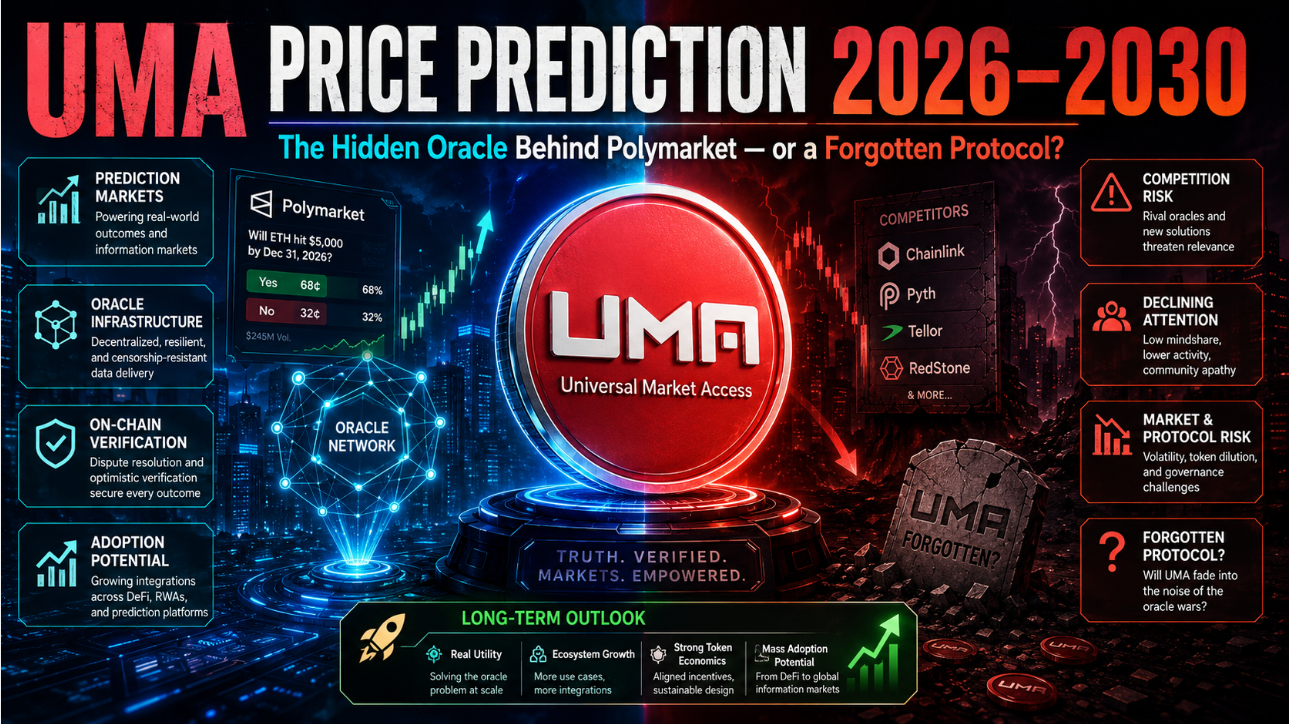
It lies in:
It has become part of the prediction market infrastructure.
Especially:
Polymarket.
This rapidly rising prediction market platform
has its core “truth verification layer”
powered by UMA.
That is why
many institutions are starting to re‑examine UMA.
Because:
If prediction markets truly explode in the future,
UMA could become
one of the most undervalued infrastructures in all of Web3.
If you also pay attention to
- cross‑chain infrastructure
- the AI Agent sector
- Layer 2 scaling
- cross‑border payment narratives
we also recommend reading:
These projects, like UMA,
are typical cases where
market awareness is far below real influence.
Chapter 1: What exactly is UMA?
This is the most common point of misunderstanding.
Many people think:
UMA is just
“another oracle project.”
But in fact,
UMA’s true positioning is:
“The subjective fact verification layer.”
What does “subjective fact” mean?
For example:
Chainlink’s strengths are:
- BTC price
- ETH price
- weather data
- sports scores
These belong to
objective data
because the answer is clear.
But many Web3 problems are not objective.
For example:
- Has a certain candidate truly conceded?
- Has a certain protocol fulfilled its promise?
- Does a certain political event count as “happened”?
- Has a certain DAO proposal met its conditions?
These questions
cannot be solved by a simple API.
They require
“human consensus adjudication.”
That is exactly where UMA excels.
Chapter 2: What is the “Optimistic Oracle”?
The Optimistic Oracle is UMA’s core mechanism.
It is also the biggest difference
between UMA and Chainlink.
Chainlink model
Chainlink uses a
Push Oracle.
That is:
it actively fetches data,
then aggregates it and puts it on chain.
UMA model is completely different
UMA adopts:
“Assume correct unless challenged.”
What does that mean?
For example:
Someone submits:
“Trump wins the election.”
The system does not verify immediately.
Instead, it enters a
challenge window.
If no one objects,
the result is automatically established.
If someone objects,
UMA token holders vote to decide.
Why is this important?
Because this mechanism is extremely cost‑effective.
It is especially suitable for:
- prediction markets
- DAO disputes
- subjective judgment problems
That is also why
Polymarket ultimately chose UMA
rather than relying solely on Chainlink.
Chapter 3: Why can UMA become core infrastructure for Polymarket?
This is UMA’s biggest long‑term thesis.
Many people see
Polymarket’s trading volume explode
but do not know that
a large number of its markets
depend on UMA for settlement.
How big is Polymarket really?
Today,
prediction markets are no longer just “niche gambling”.
They are gradually becoming
“Web3 information financialization platforms.”
Especially during
the US election cycle,
Polymarket’s traffic exploded.
A large number of users started using
- political predictions
- macroeconomic predictions
- sports predictions
- AI event predictions
And all these markets
ultimately need
a “truth adjudication layer”.
UMA is exactly that role.
UMA’s real value capture logic
Many people mistakenly think:
“Polymarket is hot, so UMA must surge.”
But the reality is not that simple.
Because:
Growth in prediction market trading volume
does not necessarily mean
UMA’s value will grow in sync.
Why does this “paradox” occur?
This is the most critical step in understanding UMA.
Reasons include:
- UMA’s token value capture is limited
- Protocol revenue is not fully returned to the token
- Inflation continuously dilutes holders
- Polymarket is gradually strengthening its own system
Thus:
A very counter‑intuitive phenomenon appears:
Polymarket hits new highs,
while UMA remains at historical lows.
That is also why
UMA is one of the hardest projects to value in all of Web3.
Chapter 4: Will Polymarket “abandon UMA” in the future?
This is one of UMA’s biggest potential risks.
And a real concern for many institutions.
Why does this concern exist?
Because:
Polymarket is gradually building
its own settlement system.
For example:
Launching
- pUSD
- its own stablecoin logic
- deeper infrastructure
This means:
In the future, Polymarket may think:
“Why still rely on UMA?”
What consequences would this bring?
If, in the future, Polymarket:
- reduces the proportion of UMA usage
- switches to Chainlink in some scenarios
- builds its own oracle
then
UMA’s long‑term value logic would be severely weakened.
This is UMA’s biggest structural risk
Because:
The biggest bullish argument for UMA in the market right now
is simply:
“Polymarket will keep growing for a long time.”
If that premise shakes,
UMA’s valuation logic would be repriced.
Chapter 5: The 2025 governance attack – why was it UMA’s most dangerous signal?
This was one of the most serious trust crises in UMA’s entire history.
Many people have not realized
how important this event was.
What happened?
A whale holding a large amount of UMA voting power
used multiple accounts
to forcibly change
the outcome of a Polymarket prediction,
leading to a dispute over millions of dollars in payouts.
What problem did this expose?
Essentially,
UMA relies on
“token voting to decide truth.”
But the problem is:
if
- a whale holds too many tokens
- voting participation is too low
- community coordination is insufficient
then
truth can be manipulated by capital.
Why is this more dangerous than a normal bug?
Because this is
a “trust crisis at the governance level.”
Technical bugs can be fixed.
But if the market starts to doubt
“whether UMA’s adjudication results are fair,”
then the entire protocol’s value could be shaken.
Chapter 6: The MOOV2 whitelist controversy – why did it disappoint many old users?
In 2025,
UMA promoted the
MOOV2 upgrade.
On the surface,
it was about improving efficiency.
But many community members believed
it actually meant
“the protocol is centralizing.”
Why?
Because proposal rights were restricted.
Only whitelisted users could participate.
Supporters argued:
this would
- prevent spam proposals
- improve efficiency
- reduce attack risks
Opponents argued:
this violated
Web3’s core
“open participation spirit.”
This is UMA’s biggest contradiction going forward
Because it must find a balance between
- decentralization
- security
- efficiency
And these three
often cannot be satisfied at the same time.
Chapter 7: 11% annual inflation – why do so many people underestimate this problem?
This is one of UMA’s most easily overlooked risks.
Many newcomers only look at the price
but ignore
changes in token supply.
How high is UMA’s annual inflation rate?
About 11%.
What does that mean?
If you
hold UMA
but do not stake,
then
your purchasing power will be continuously diluted.
Why does the protocol do this?
Because UMA needs to
- incentivize voting
- maintain governance participation
- ensure oracle security
Therefore,
the protocol keeps minting new tokens
to reward participants.
What problem does this cause?
In the long run,
UMA must satisfy:
protocol growth rate > inflation rate.
Otherwise,
even if the protocol becomes more and more popular,
holders may still lose money.
Chapter 8: AI oracle – why could it change UMA’s fate?
This is one of the most promising directions for UMA’s future.
What is an AI oracle?
UMA is trying to integrate
- LLMs
- AI Agents
- automated verification systems
into the oracle mechanism.
For example:
OOTruthBot.
Why is this important?
Because the biggest problem with traditional oracles
is that
human adjudication is too expensive.
But if AI can participate in
- preliminary judgment
- automatic challenges
- fast verification
then
oracle costs will drop dramatically.
Why is UMA particularly suitable for AI?
Because the Optimistic Oracle itself is
“correct by default.”
AI is very suitable to act as
the “first‑layer adjudicator.”
Only when AI finds a problem
does human intervention become necessary.
What could this bring?
If the AI oracle matures,
UMA’s processing capacity could increase from
a few thousand proposals per month
to
hundreds of thousands
or even millions.
This would completely change UMA’s valuation logic.
Chapter 9: The EigenLayer partnership – can it solve the governance problem?
This is another key direction for UMA’s future.
Why does UMA need EigenLayer?
Because UMA’s current biggest problem
is actually
insufficient governance security.
And EigenLayer specializes in
- restaking
- economic security
- slashing mechanisms
The goal of the partnership
is to
increase the cost of attacking the oracle.
Why is this important?
Because if attacking UMA
also means bearing
ETH restaking penalties,
then the cost of governance attacks would rise significantly.
This could rebuild market confidence.
Chapter 10: UMA vs Chainlink – who is stronger?
This is one of the most misunderstood questions.
In fact,
the two are not
direct competitors at all.
Chainlink is better for:
- price data
- high‑frequency data
- objective data
UMA is better for:
- subjective judgments
- prediction markets
- DAO arbitration
- conditional verification
Essential difference
Chainlink sells
“real data.”
UMA sells
“real consensus.”
These are completely different things.
That is also why
even though Chainlink’s market cap is far higher than UMA’s,
UMA still has a reason to exist.
Because many problems
simply cannot be solved through an API.
Chapter 11: UMA vs Pyth – why high‑frequency oracles aren’t necessarily suitable for prediction markets?
Many people compare
Pyth Network with UMA.
But in reality,
the problems they solve are completely different.
What is Pyth’s greatest strength?
Pyth excels at:
- high‑frequency price updates
- derivatives trading
- second‑level market data
- high‑frequency financial scenarios
For example:
- real‑time BTC price
- ETH perpetual contract mark price
- high‑frequency liquidation systems
Pyth’s model is
continuous data pushing.
Thus,
it is very suitable for
- high‑frequency trading
- liquidation systems
- on‑chain derivatives
But prediction markets have different problems
The real issue in prediction markets
is often not
“what is the price?”
but rather
“does a certain event count as having happened or not?”
For example:
- Has a certain candidate formally conceded?
- Has a certain protocol breached its terms?
- Has a certain DAO proposal met its conditions?
- Has a certain sports event been canceled due to weather?
These questions
cannot be judged simply through an API.
This is UMA’s core moat
What UMA is truly strong at
is not speed.
It is
“the ultimate ability to adjudicate subjective problems.”
Therefore,
Pyth cannot easily replace UMA.
At least in the areas of
- prediction markets
- DAO arbitration
- conditional contracts
UMA still has unique value.
Chapter 12: UMA vs Kleros – a battle of two “truth mechanisms”
This is a comparison many overlook, but it is very important.
Kleros and UMA
are both doing
on‑chain adjudication.
But their methods are completely different.
UMA model
UMA uses
- open token‑holder voting
- optimistic verification mechanism
- “correct by default” model
Advantages:
- low cost
- high scalability
- suitable for large‑scale prediction markets
Disadvantages:
- whales can easily influence results
- high risk of governance attacks
Kleros model
Kleros uses
- random juries
- arbitrator screening
- small‑scale adjudication
Advantages:
- more suitable for complex disputes
- higher attack cost
Disadvantages:
- lower scalability and efficiency
- slower processing speed
Which model is more likely to succeed?
In the short term,
UMA is better for
- large‑scale prediction markets
- high‑frequency adjudication needs
In the long term,
Kleros may be safer for
- legal disputes
- DAO governance
- high‑value arbitration
Chapter 13: Why “Polymarket surges, UMA doesn’t” is the biggest valuation puzzle for the project?
This is the most critical question
in all UMA research.
Many newcomers cannot understand:
why is it that
- Polymarket trading volume hits new highs
- prediction markets keep exploding
yet
UMA’s price remains persistently low?
The reasons are actually complex
There are five main ones.
1. UMA has no direct transaction fee sharing
Many protocols
- buy back tokens
- burn tokens
- distribute revenue
But UMA currently
has weak value capture ability.
2. Inflation continuously dilutes holders
Even if the protocol grows,
new supply still
dilutes holder value.
3. Market fears Polymarket will de‑UMA‑ify
This is the most critical issue.
If in the future
Polymarket gradually
- builds its own oracle
- increases Chainlink’s share
- establishes an internal adjudication system
UMA’s long‑term value would be reassessed.
4. Governance attack damages trust
Many institutions now question
“Can UMA really adjudicate large‑scale markets safely?”
This is an important factor suppressing valuation.
5. Small market cap discourages institutional entry
UMA’s current market cap is extremely low.
That means
- low liquidity
- high volatility
- easy manipulation by whales
Institutional capital finds it hard to take a heavy position.
Chapter 14: UMA price prediction for 2026 (in‑depth edition)
Finally, the most critical part.
All predictions below
are not “certain answers”.
Rather, they are
probability models based on
- Polymarket growth
- AI oracle progress
- governance security
- inflation changes
- macro market cycles
Bear case: $0.30 – $0.45
Trigger conditions:
- Polymarket reduces reliance on UMA
- another governance attack
- AI oracle fails to advance
- inflation continues to suppress price
In this case,
UMA could be marginalized for a long time.
Base case: $0.80 – $1.50
This is the most reasonable range currently.
Conditions include:
- Polymarket maintains growth
- UMA proposal volume stabilizes
- EigenLayer partnership continues to advance
- governance problems do not worsen further
This means:
UMA survives successfully,
but has not yet truly exploded.
Bull case: $2.50 – $3.30
Requires:
- prediction markets fully explode
- AI oracle implemented
- EigenLayer rebuilds governance trust
- Polymarket remains deeply tied to UMA
This would mean:
the market starts to re‑price UMA.
Chapter 15: 2027–2028 – UMA’s real “verification period”
Many protocols
can tell a story
but cannot prove
that they truly have long‑term demand.
2027–2028
is UMA’s real verification phase.
What will the market focus on?
Including:
- monthly proposal volume
- protocol revenue
- Polymarket market share
- AI oracle usage rate
- share of revenue from non‑prediction‑market sources
If these data keep growing,
UMA could enter
a true infrastructure revaluation phase.
What does UMA really need to prove?
The core is just one sentence:
“An oracle can verify not only prices, but also truth.”
If the market accepts this,
UMA’s long‑term potential will be very large.
Chapter 16: By 2030, does UMA have a chance to return to double digits?
This is the ultimate question.
The answer is:
Possible,
but extremely difficult.
Why?
Because UMA’s problems today
are no longer just
“is the technology good?”
They are:
- Is governance trustworthy?
- Is inflation sustainable?
- Will Polymarket remain tied to UMA long‑term?
- Will AI replace human verification?
- Does the market truly need a “subjective truth layer”?
If UMA succeeds, what will happen?
UMA could become:
- the DAO arbitration layer
- the AI truth verification layer
- prediction market infrastructure
- Web3 conditional settlement layer
At that time,
its valuation logic would completely change.
But the failure path is equally clear
If in the future:
- Polymarket de‑UMA‑ifies
- governance is manipulated again
- a cheaper AI‑based solution emerges
- regulation cracks down on prediction markets
then UMA could gradually be marginalized.
Chapter 17: UMA investment strategy – why is it not an ordinary altcoin?
The biggest mistake many people make
is treating UMA as
a “cheap speculative coin”.
That is the most dangerous approach.
Who is UMA really suitable for?
It is suitable for:
- people who deeply research DeFi infrastructure
- people who understand oracle mechanisms
- people who follow prediction markets long‑term
- people who can accept high volatility
Who is it not suitable for?
It is not suitable for:
- people who only look at candlesticks
- people who don’t understand governance mechanisms
- people who buy only because it’s “cheap”
Because UMA’s real value
comes from
protocol usage
not short‑term market sentiment.
Chapter 18: Core risks that newcomers must understand
This is the final and most important part.
1. Governance risk is far higher than for ordinary DeFi
UMA’s biggest risk
is not price volatility.
It is:
“whether truth can still be trusted.”
2. Inflation will continuously dilute holders
If you do not stake,
holding long‑term will lead to continuous dilution.
3. Reliance on Polymarket is a double‑edged sword
Polymarket’s success
will boost UMA.
But once Polymarket pivots,
UMA will suffer a huge impact.
4. AI is both an opportunity and a threat
AI could help UMA scale up.
But it could also create
a lower‑cost alternative.
5. Small market cap means extreme volatility
UMA’s market cap is very small.
Therefore,
it can surge sharply
and also crash sharply.
This is a double‑edged sword.
Final conclusion: Is UMA worth long‑term attention?
In the end,
UMA’s core question is just one sentence:
“Does the future of Web3 need a ‘truth verification layer’?”
If the answer is
“Yes,”
then UMA still has huge long‑term potential.
Because it is no longer
just an oracle.
It is trying to become
the “fact‑adjudication infrastructure” in the Web3 world.
That is why,
even though the price has been low for a long time,
many institutions continue to study UMA.
But one thing must be admitted:
UMA is also
one of the most complex, most dangerous, and most easily misunderstood infrastructure projects in the entire crypto industry.
It faces:
- governance attacks
- centralization controversy
- high inflation
- insufficient value capture
- reliance on Polymarket
- AI substitution risk
Any one of these
is enough to affect its long‑term valuation.
So, what is UMA more like?
It is not like
a simple DeFi coin.
It is more like
a long‑term experiment about “who defines on‑chain truth.”
If, in the future:
- prediction markets continue to expand
- DAO governance scales up
- AI Agents collaborate widely
- Web3 enters real‑world social scenarios
then
UMA may be rediscovered by the market,
and even become
a key protocol for the entire “on‑chain fact verification layer”.
But if:
- prediction market hype fades
- Polymarket de‑UMA‑fies
- AI replaces human adjudication
- governance trust continues to deteriorate
then
UMA could gradually be marginalized.
Therefore,
the most reasonable attitude toward UMA
is not
“blindly bullish”
nor
“completely bearish”.
It is:
continuously track real on‑chain data.
Including:
- UMA proposal volume
- Polymarket transaction size
- protocol revenue
- governance participation rate
- AI oracle adoption rate
- EigenLayer partnership progress
Because these
are the core variables that will truly determine UMA’s future value.