
1. What Is TSMB? Why Is TSMC Stock Showing Up on Crypto Exchanges?
Many newcomers see "TSMB" for the first time and immediately ask: Is this a cryptocurrency, or is it actually TSMC stock?
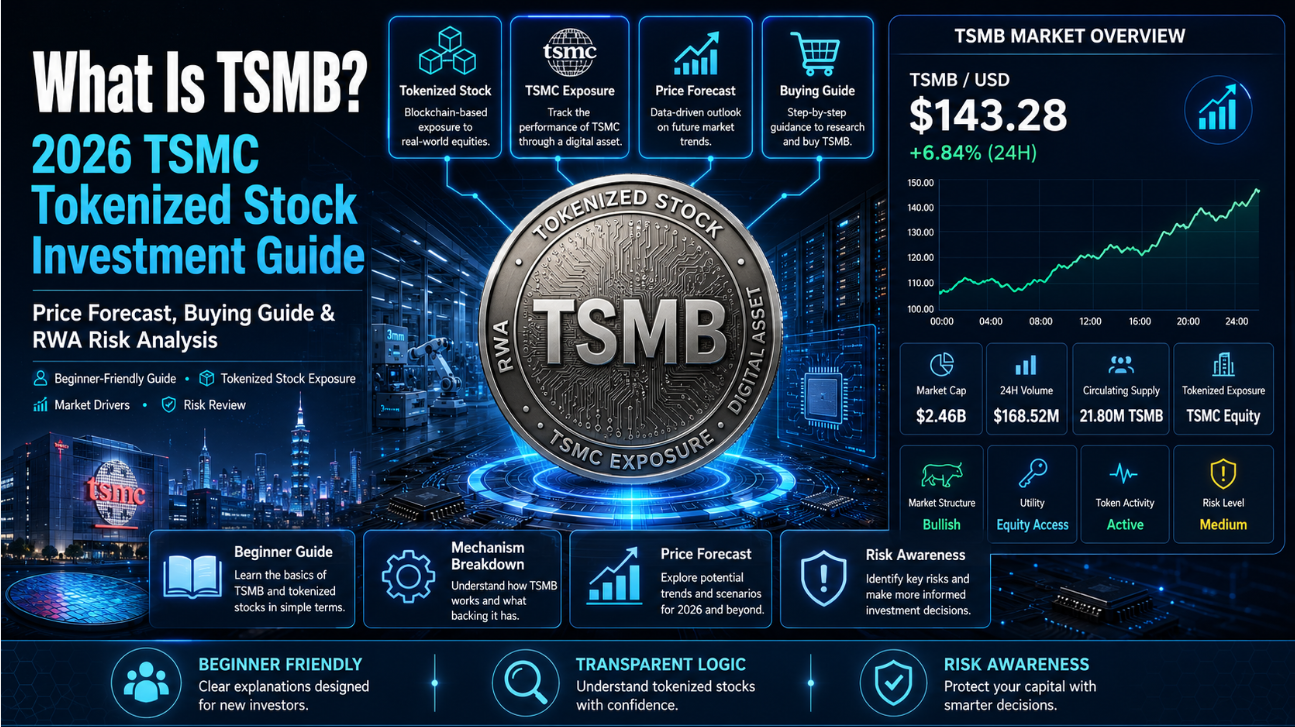
Simply put, TSMB stands for TSMC Tokenized Stock – a blockchain-based representation of TSMC equity. It falls under the "tokenized stock" category, which is part of the broader RWA (Real World Assets) movement. CoinGecko classifies TSMB as a "TSMC bStocks Tokenized Stock," confirming that it is not a speculative altcoin but a tokenized asset tied to a major public company.
You can track TSMB's real-time price, trading volume, and market activity on Hibt's TSMB/USDT live price page.
TSMB is not a new Layer-1 blockchain coin, a DeFi governance token, or a meme asset. It is best understood as a "blockchain-based wrapper for a traditional equity exposure." In other words, TSMB allows crypto users to gain price exposure to TSMC-related assets without leaving the digital asset ecosystem.
1.1 What Is the Core Definition of TSMB?
Think of TSMB as TSMC equity entering the crypto world in tokenized form. Traditional TSMC stock trades on regulated securities exchanges, requiring a brokerage account, fiat currency, and standard market hours. TSMB, however, trades in a 24/7 digital asset environment, typically paired against USDT.
The overarching trend here is RWA – bringing real-world assets onto public blockchains. In the past, on-chain assets were largely limited to BTC, ETH, stablecoins, DeFi tokens, and NFTs. Today, equities, ETFs, bonds, commodities, and other traditional instruments are increasingly being issued on-chain as tokenized stocks.
According to xStocks' official documentation, their mandate is to bring widely traded US stocks and ETFs onto the blockchain, enabling more flexible circulation across different networks and trading venues. That is the exact backdrop against which TSMB was launched.
1.2 How Does TSMB Relate to TSMC Common Stock?
TSMB is connected to TSMC stock, but the two are not interchangeable.
TSMC stock is a traditional equity security. Buying it through a broker gives you specific legal rights, settlement protections, and corporate privileges governed by securities law.
TSMB, by contrast, is a tokenized representation of that equity. It trades on crypto exchanges and is priced in digital assets.
Crucial takeaway for beginners: Buying TSMB is not the same as buying TSMC stock directly in a brokerage account.
Holding TSMB primarily gives you economic exposure to TSMC's price movements. However, whether you are entitled to voting rights, dividends, corporate governance privileges, or redemption mechanisms depends entirely on the specific issuer, custody structure, and exchange policies. Binance's TSMB listing, for example, explicitly notes that it provides economic exposure to TSMC tokenized bStocks and outlines specific conversion rights to the underlying security.
1.3 Why Are More Technology Stocks Becoming Tokenized?
TSMB is not an isolated phenomenon; it is part of the broader expansion of the RWA sector.
Historically, crypto markets revolved around native assets like BTC, ETH, DeFi protocols, NFTs, memes, and Layer-2 scaling solutions. Investors bought these primarily to participate in network ecosystems or community narratives.
However, a larger question has emerged: Can traditional financial assets be integrated into the blockchain ecosystem?
If stocks, ETFs, gold, bonds, and mutual funds can be traded as tokens, the crypto market will evolve from a "coin-to-coin" trading environment into a multi-asset trading hub. In the near future, a single wallet might simultaneously hold BTC, ETH, stablecoins, tokenized stocks, and tokenized bonds.
Other prominent assets in this space include AVGOB (Broadcom-related), AAOIB (AI-focused equity), and ARMB (ARM-related). To build a more comprehensive framework for evaluating RWA tokenized stocks, you can explore Hibt's detailed guides on what AVGOB is, what AAOIB is, and what ARMB is.
2. What Is TSMC? Why Does TSMB Command Investment Attention?
Understanding TSMB requires looking beyond the token itself – you must understand the underlying company: TSMC.
TSMC is arguably the most critical semiconductor manufacturer globally. According to its official corporate profile, TSMC has been the world's dedicated pure-play foundry since 1987, supporting a vast ecosystem of global clients and partners. Reuters describes TSMC as the world's largest contract chipmaker, noting that its growth has been supercharged by surging demand for AI processors.
This means TSMB's core value proposition is not "on-chain utility" but rather TSMC's long-term strategic position in the AI and semiconductor industry.
2.1 What Kind of Company Is TSMC?
TSMC is not a consumer-facing brand like Intel or AMD selling retail chips. Instead, it is the manufacturing backbone of the global chip industry.
Most leading chip designers do not own their own fabrication plants; they outsource manufacturing to foundries. TSMC's competitive edge lies in its ability to produce chips using the most advanced process nodes for a global clientele.
This places TSMC at a critical juncture of the semiconductor value chain. Everything from AI accelerators, smartphone processors, HPC (High-Performance Computing) chips, data center CPUs, to networking silicon depends on advanced wafer fabrication.
From an investment standpoint, TSMB is not a short-term concept play. It represents a core enterprise that connects AI, cloud computing, consumer electronics, and the global semiconductor supply chain.
2.2 Why Has TSMC Become a Core Asset in the AI Era?
The most visible aspects of the AI boom are large language models, GPUs, and AI applications. But the real structural driver is the underlying semiconductor supply chain.
AI models require massive compute; compute requires GPUs and accelerators; those accelerators require advanced process nodes; and those nodes depend almost exclusively on foundries like TSMC.
In short, AI growth impacts not only Nvidia, AMD, Broadcom, and Marvell (chip designers) but also the manufacturing layer. As long as demand for AI servers, data centers, and HPC continues to grow, advanced manufacturing capacity will remain a critical bottleneck – and a key value driver.
TSMC's Q2 2026 earnings underscore this dynamic: the company posted net revenue of $40.2 billion, a gross margin of 67.7%, and an operating margin of 60.3%. Management guided Q3 2026 revenue to a range of $44.6 billion to 45.8 billion. Reuters further reported that TSMC's Q2 net profit surged 77% year-over-year to NT706.6 billion, driven almost entirely by advanced AI processor demand.
These figures make it clear: analyzing TSMB requires tracking TSMC's operational and financial performance, not just crypto market sentiment.
2.3 Where Does TSMB's Investment Thesis Come From?
TSMB's thesis rests on three interconnected pillars:
- TSMC's Corporate Growth: Investors must monitor AI chip orders, advanced node ramp-ups, advanced packaging capacity, data center capital expenditures, customer concentration, and margin sustainability. If TSMC continues to benefit from the AI wave, TSMB is likely to receive strong support from its underlying asset.
- The Semiconductor Cycle: Semiconductors are inherently cyclical. Global macroeconomics, consumer electronics replacement cycles, inventory adjustments, corporate IT spending, and the pace of AI infrastructure buildouts all influence TSMC's stock performance – and by extension, TSMB.
- RWA Market Maturation: If the broader crypto community increasingly embraces tokenized equities, demand and liquidity for TSMB could expand. However, this is a secondary market factor; it does not replace TSMC's fundamental business health.
Therefore, TSMB's value is a function of: TSMC Fundamentals + Semiconductor Cyclicality + RWA Adoption Rates.
3. How Does TSMB Work? The Mechanics of Tokenized Stocks
A common beginner question: How can a blockchain token like TSMB accurately track the price of TSMC stock?
The answer lies in the operational mechanics of tokenized stocks. These instruments are typically created through a structured process involving underlying equity, custodial issuance, on-chain minting, and exchange circulation.
3.1 The Operating Mechanism of Tokenized Stocks
TSMB's lifecycle can be broken down into five distinct stages:
- Underlying Asset Base: TSMC common stock or TSMC-related securities serve as the foundational value reserve.
- Custodial & Issuance Structure: An issuer or custodian (often a regulated trust or specialist firm) holds the underlying equity and manages the mapping.
- Token Minting: The issuer creates tokens on the blockchain (often Ethereum or an EVM-compatible network), representing fractional or whole economic exposure to the underlying stock.
- On-Chain Recording & Distribution: The blockchain records token ownership and transfers, enabling users to trade these tokens on supported exchanges.
- Trading: Users buy and sell via pairs like TSMB/USDT, gaining price exposure to TSMC without ever touching a traditional brokerage account.
Critical caveat: Tokenization does not automatically confer full legal equity rights. The on-chain token is a representation of value, not a direct legal claim to TSMC shares. Actual rights (voting, dividends, redemption) depend entirely on the issuer's legal framework, custody agreements, and platform-specific terms.
3.2 What Drives TSMB's Price?
TSMB's market price is shaped by three primary forces:
- TSMC's Stock Price: This is the fundamental anchor. Earnings reports, margin trends, AI order flows, capex guidance, and valuation multiples directly influence how TSMB is priced.
- Exchange Supply/Demand & Token Liquidity: Even if TSMC's stock is flat, crypto-specific factors – such as the number of active buyers/sellers, order book depth, bid-ask spreads, and short-term capital flows – can cause TSMB to deviate from its net asset value. CoinGecko tracks TSMB with its own volume and market data, reminding investors that they cannot rely solely on traditional stock tickers.
- Crypto Market Liquidity: The availability of USDT, the trajectory of BTC, the health of the Ethereum ecosystem, and overall risk appetite in the crypto market all affect TSMB. During bullish phases, RWA assets may attract significant inflows; during risk-off events, liquidity can evaporate quickly.
In essence, TSMB's price is the combined result of: TSMC's stock value + Token-specific liquidity dynamics + Broader crypto market conditions.
4. TSMB Price Predictions: Where Could the Upside Come From?
Many users search for "TSMB price prediction" because they want to know: Will TSMB appreciate? Does it offer long-term value from 2026 through 2030?
Let's be direct: a responsible price forecast for a tokenized stock is not a random price target (e.g., "$X by 2027"). Instead, it should be a structured analytical framework.
You can reference Hibt's TSMB price prediction page for the platform's data points, but always cross-reference that with TSMC's stock performance, the semiconductor macro-cycle, and your own risk assessment.
4.1 Which Indicators Matter Most for TSMB Price Forecasting?
- TSMC's Fundamentals: Revenue growth, advanced process technology adoption (e.g., 2nm, A16), AI/HPC revenue mix, gross/operating margins, capital expenditure plans, and customer diversification (e.g., Apple, Nvidia, AMD, Qualcomm).
- The Semiconductor Cycle: Keep a close eye on inventory days, consumer electronics sell-through, data center spending budgets, global PMI data, and corporate IT capex. A sustained AI server build-out supports TSMC; a broad chip downturn would pressure both TSMC stock and TSMB.
- RWA Market Evolution: The long-term viability of tokenized stocks hinges on user adoption. Kraken's introduction to xStocks, for example, notes that these are 1:1 backed by underlying equities. The more trusted and regulated these structures become, the more liquid and stable TSMB could become.
- Trading Depth & Spreads: If the TSMB/USDT order book is thin, even a stable TSMC stock price could result in higher volatility and slippage for TSMB. For beginners, checking liquidity is just as important as checking the price.
4.2 Potential Catalysts for TSMB Appreciation
- Sustained AI Infrastructure Spending: As long as hyperscalers (Amazon, Google, Microsoft, Meta) continue to expand their AI data center footprints, demand for TSMC's advanced nodes will likely remain robust.
- Geopolitical Semiconductor Reshoring: TSMC's expansion in the US (now pledged at $265 billion, according to AP reports) and Japan underscores its strategic importance. Long-term capacity investments reinforce its moat.
- RWA Sector Inflows: If the RWA narrative gains mainstream traction, tokenized blue-chip stocks like TSMB could attract significant new capital from crypto-native users seeking diversified exposure.
- Crypto Infrastructure Maturity: Improved compliance, custody, and cross-chain solutions lower the friction for institutional and retail participation, potentially boosting TSMB's trading volumes.
4.3 What Are the Key Risks to TSMB?
- Downside in TSMC Stock: If TSMC misses estimates, faces margin compression, or loses a major client, TSMB will likely correct in tandem.
- Semiconductor Downturn: Cyclical downturns in memory, PCs, or smartphones could spill over into foundry demand.
- Geopolitical Tensions: TSMC's concentration in Taiwan makes it highly sensitive to cross-strait relations, US-China trade policies, and export controls.
- Limited Token Liquidity: Thin order books can lead to severe slippage and unfavorable execution, especially during volatile market hours.
- Regulatory Scrutiny: Tokenized securities are still in a regulatory gray area in many jurisdictions. Changing rules could affect TSMB's tradability or redemption mechanisms.
So, while TSMB carries both AI and RWA narratives, it is not a low-risk asset.
5. What Is the Relationship Between TSMB and ETH?
A frequent question: If ETH rallies, will TSMB follow?
The nuanced answer is: ETH can influence broader RWA sentiment, but TSMB's core value remains anchored to TSMC equity.
ETH is a Layer-1 protocol asset representing the Ethereum network, DeFi, stablecoins, and smart contract execution. TSMB is an RWA token representing TSMC-related equity.
You can review Hibt's ETH price prediction to understand ETH's distinct drivers, and then contrast those with TSMB.
5.1 Why Does the Ethereum Ecosystem Affect RWA Assets?
Ethereum hosts the majority of DeFi activity, stablecoin settlements, and on-chain asset issuance. Many RWA protocols are built on Ethereum or EVM-compatible networks.
When ETH prices rise and on-chain liquidity expands, market interest in RWA, tokenized equities, and on-chain funds often increases.
However, this correlation is not causation. If ETH rallies but TSMC's fundamentals weaken (e.g., due to a guidance cut), TSMB would still decline. Conversely, if ETH is flat but TSMC delivers blowout earnings, TSMB could rally independently.
5.2 Key Differences in Investment Logic: TSMB vs. ETH
Factor
TSMB
ETH
Value Source
TSMC equity and semiconductor fundamentals
Ethereum network security and utility
Primary Drivers
AI chip demand, advanced nodes, semiconductor cycles
DeFi adoption, Layer-2 scaling, staking yields, developer activity
Risk Profile
Corporate earnings, geopolitics, equity market volatility
Protocol competition, technical upgrades, on-chain security, regulatory shifts
Analysis Method
Equity/industry research
Blockchain network and tokenomic research
They can coexist in a diversified portfolio, but they require entirely different analytical frameworks.
6. How to Invest in TSMB: A Step-by-Step Buying Guide
For users searching "how to buy TSMB," the most critical advice is this: Do not rush to place an order. First, understand exactly what you are buying.
TSMB is not an altcoin or a meme token. It is a tokenized equity asset influenced by stock markets, semiconductor cycles, and crypto liquidity.
6.1 Prerequisites for Buying TSMB
- Acquire USDT: TSMB is almost exclusively traded as TSMB/USDT. You need USDT in a wallet or exchange account.
- Use a Supported Exchange: Start by reviewing Hibt's TSMB/USDT live price page to check current pricing, volume, and spreads.
- Search for the Trading Pair: Enter "TSMB" or "TSMB/USDT" in the exchange's search bar.
- Assess Liquidity: Do not just look at the last price. Examine the order book depth, bid-ask spread, and 24-hour trading volume to gauge slippage risk.
- Place Your Order: Start with a small test order to familiarize yourself with the process before committing significant capital.
- Post-Purchase Monitoring: Track TSMC's stock performance, AI semiconductor news, TSMB/USDT trading depth, and any exchange announcements regarding token mechanics.
6.2 Critical Tips for Beginners
- Prioritize Liquidity: TSMB is not BTC or ETH. Low liquidity can result in orders filling far from the quoted price.
- Mind the Spread: A wide gap between the buy (bid) and sell (ask) prices increases your effective cost of entry and exit.
- Size Your Position Prudently: Do not treat TSMB as a risk-free proxy for TSMC just because it is a famous company. Do not chase it solely because "AI is hot."
The correct approach is not to "ape into AI" but to first understand TSMC's business fundamentals, the semiconductor supply chain, the RWA product structure, and your own risk appetite.
7. TSMB Risk Analysis: 5 Critical Facts to Know Before Buying
A credible investment guide must highlight risks just as prominently as potential rewards. RWA tokenized stocks sit at the intersection of TradFi and DeFi, introducing a risk profile more complex than standard crypto assets.
Risk #1: Limited or No Direct Equity Rights
Holding TSMB does not equate to holding TSMC stock in a brokerage account. You must verify: Is the token fully backed 1:1? Who is the custodian? Can you redeem for the underlying security? Do you receive dividends or voting rights? These vary widely by issuer and platform.
Risk #2: TSMC's Operational and Financial Risks
Since TSMB's value is derived from TSMC, any operational weakness – slower AI order growth, aggressive competition from Samsung or Intel, gross margin erosion, or rising capex – will directly pressure TSMB.
Risk #3: Geopolitical Exposure
TSMC is the world's most important semiconductor foundry, but its geographic concentration exposes it to significant geopolitical risks. US-China trade tensions, export controls, and regional instability can all impact investor sentiment and valuation.
Risk #4: RWA Liquidity Risk
RWA tokens generally have far lower trading volumes than BTC or ETH. Shallow order books can lead to substantial slippage, wide spreads, and difficulty executing larger orders, particularly during volatile market conditions.
Risk #5: Evolving Regulatory Landscape
Tokenized securities are a nascent asset class. Future regulations from the SEC, ESMA, or other global watchdogs could affect TSMB's availability, trading status, or redemption mechanics.
In short: TSMB is not inherently "safer because it is on-chain." It is a hybrid asset requiring fluency in both equity markets and crypto infrastructure.
8. TSMB vs. AVGOB vs. AAOIB vs. ARMB: Choosing Among Semiconductor RWA Assets
If you are interested in AI/semiconductor RWAs, do not isolate TSMB. Compare it with its peers to find the best fit for your thesis.
- TSMB (TSMC): Core logic = chip manufacturing, advanced process nodes, AI silicon supply chain, and global foundry monopoly. Ideal for investors bullish on fabrication and AI compute infrastructure.
- AVGOB (Broadcom): Core logic = AI networking chips, data center connectivity, custom silicon (ASICs), and enterprise software. Read more at what AVGOB is.
- AAOIB (AI-focused equity): Core logic = general AI industry trends and on-chain equity exposure to a basket of AI names. Explore what AAOIB is.
- ARMB (ARM): Core logic = CPU architecture, mobile compute, edge AI, and semiconductor IP licensing. Check what ARMB is.
Bottom line: TSMB = manufacturing; AVGOB = networking & custom silicon; AAOIB = pure AI play; ARMB = architecture/ IP. They overlap in the AI theme but have distinct underlying drivers.
9. TSMB vs. PONS: RWA Equity vs. Pure-Play Web3 Tokens
Many beginners treat all exchange-listed tokens as the same "type" of asset. This is a mistake.
- TSMB is an RWA equity token. Its value is anchored to TSMC's corporate performance, the semiconductor industry, and the RWA market. Analyzing TSMB requires equity research and industry analysis.
- PONS is a Web3 project-native asset. Its value depends on protocol revenue, tokenomics, user adoption, ecosystem growth, and on-chain metrics. Analyzing PONS requires crypto-project fundamental research.
To understand project-based Web3 assets, you can read Hibt's guide on what PONS is.
Key takeaway: TSMB looks backward to traditional corporate value; PONS looks forward to network adoption. Never use the same analytical framework for both.
10. The Future of TSMB: Does TSMC Tokenization Signal a Paradigm Shift?
TSMB's long-term significance extends beyond a single trading pair. It signals a structural trend of traditional equity entering crypto rails.
Three potential transformations lie ahead:
- Digitalization of Global Investment Assets: Stocks, ETFs, bonds, and commodities will increasingly be tokenized. Investors may no longer be limited to brokerage accounts for traditional exposure.
- Convergence of Trading Venues: The wall between stock trading and crypto trading is eroding. Assets like TSMB enable users to gain equity exposure in a USDT-denominated, 24/7 environment.
- RWA as the Bridging Layer: RWA offers the best of both worlds – the transparency and efficiency of blockchains, backed by real-world collateral. The challenge remains custody, compliance, and legal clarity.
However, the RWA trend does not guarantee that every tokenized stock will succeed. Long-term value always depends on the underlying asset's quality, the token's structural transparency, liquidity, regulatory treatment, and genuine user demand. TSMB benefits from a world-class underlying company (TSMC), but it is still subject to the full spectrum of equity, semiconductor, and crypto risks.
11. Summary: Who Is TSMB Suitable For?
TSMB is appropriate for:
- Investors bullish on the AI semiconductor thesis – those who believe AI data centers, HPC, and advanced manufacturing will grow for years.
- Investors bullish on TSMC's long-term competitive moat – those who understand its critical role in the global supply chain.
- Crypto-native users seeking traditional asset exposure – those who prefer USDT-based, 24/7 trading over traditional brokerage accounts.
TSMB is NOT suitable for:
- Speculators chasing short-term moonshots – TSMB is not a meme coin.
- Investors unfamiliar with equity valuation – if you don't understand P/E ratios, margins, or semiconductor cycles, do not take a large position.
- Those ignoring cyclicality – even the best semiconductor companies experience downturns; TSMB will fall with them.
Final verdict: TSMB is a new investment vehicle that bridges TSMC's equity value into the crypto ecosystem. Its core narrative is not "new coin launch" but "on-chain representation of a core AI semiconductor asset."
You can monitor live market data on Hibt's TSMB/USDT live price page and reference the TSMB price prediction page for additional data points. However, the ultimate investment decision must always be based on your own thorough due diligence of TSMC's fundamentals, RWA market trends, and personal risk tolerance.
12. FAQ: Common Questions About TSMB
What is TSMB?
TSMB is the TSMC Tokenized Stock – a blockchain-based token that provides price exposure to TSMC-related equity. It belongs to the tokenized stock and RWA asset classes.
Is TSMB a regular cryptocurrency?
No. Although it trades on crypto exchanges, it is not a Layer-1 coin, DeFi token, or meme coin. Its value is primarily derived from TSMC's stock performance and RWA market dynamics.
Does buying TSMB equal buying TSMC stock?
Not exactly. Buying TSMB gives you economic exposure, but it does not automatically grant full legal shareholder rights (voting, direct dividends, etc.). Those depend on the issuer's specific terms and platform rules.
How do I buy TSMB?
Acquire USDT, go to an exchange that supports TSMB/USDT, search for the pair, review the order book and depth, and place your buy order. You can start by checking Hibt's TSMB/USDT live price page for market info.
How should I evaluate TSMB price predictions?
Focus on TSMC's fundamentals, AI/HPC demand, advanced process technologies, the semiconductor cycle, RWA adoption, and TSMB/USDT liquidity. You may use Hibt's TSMB price prediction page as a reference, but never treat any prediction as a guaranteed outcome.
Will ETH's price movement affect TSMB?
ETH can influence crypto market sentiment and on-chain liquidity, but it is not a direct driver. If TSMC's stock declines, TSMB will likely fall regardless of ETH's performance.
Is TSMB a good long-term hold?
If you are confident in the long-term AI semiconductor trend and TSMC's strategic position, TSMB can be a component of a diversified portfolio. However, if you do not understand equity cycles or tokenized-stock risks, it is not suitable as a core holding.
What is the biggest risk of TSMB?
The primary risks include: a decline in TSMC's stock, a reversal in the semiconductor cycle, geopolitical shocks, insufficient token liquidity, changes to the issuance/custody structure, and adverse regulatory developments. It is a higher-risk hybrid asset – always manage your position size accordingly.