
Data Verification Date: July 13, 2026 (UTC+8) This article is for informational research and risk education only and does not constitute investment advice. WALLET is a highly volatile and uncertain digital asset. New investors should verify the asset source, exchange rules, on-chain contract, liquidity, local legal policies, and their own risk tolerance before investing.
1. What Exactly Is WALLET? Is It the Same Thing as the Robinhood Wallet?
When newcomers first see WALLET/USDT, they are most likely to fall into two misconceptions:
First, thinking that WALLET is an official "wallet coin" issued by Robinhood; Second, thinking that buying WALLET is equivalent to buying Robinhood stock, equity in the Robinhood Wallet App, or some kind of official certificate of interest.
Both of these understandings require careful distinction.
According to the HIBT announcement, the asset listed on the platform is named WALLET (Robinhood Wallet), with the trading pair WALLET/USDT, and the project website is listed as the official Robinhood Wallet page, while the block explorer points to the contract address on the Robinhood Chain. The HIBT announcement states that deposits for this trading pair are open, trading commenced at 04:00 UTC on July 13, 2026, and withdrawals are scheduled to open at 04:00 UTC on July 14, 2026.
However, this does not mean newcomers can directly conclude that WALLET is an officially issued, officially guaranteed, or officially repurchased token by Robinhood.
The Robinhood official page defines the Robinhood Wallet as a self-custody crypto wallet that allows users to manage their own crypto assets. Robinhood also clarifies that self-custody wallet services are provided by Robinhood Non-Custodial, Ltd. and third-party service providers, and that crypto assets held in the wallet are not protected by FDIC or SIPC. Robinhood support documentation further states that the Robinhood Wallet can be used to send, receive, buy, transfer, or swap crypto assets, and supports networks including Robinhood Chain, Ethereum, Bitcoin, Solana, Dogecoin, Arbitrum, Polygon, Optimism, and Base.
Therefore, the most prudent understanding is:
The Robinhood Wallet is a self-custody wallet product within the Robinhood ecosystem. The WALLET token on HIBT is a tradable token named "Robinhood Wallet" and deployed in a Robinhood Chain-related environment. The two share a name and ecosystem narrative, but they cannot be simply equated.
One point deserves special attention: the Robinhood Chain officially describes itself as a Layer 2 blockchain focused on financial services and real-world assets (RWA), and emphasizes that it is permissionless — meaning anyone can access, transfer, or build on it. This means that the mere presence of a token on the Robinhood Chain does not automatically prove that it is a directly issued or officially endorsed investment product by Robinhood.
Therefore, in the mind of a newcomer, WALLET should be categorized as follows:
It is not a mainstream underlying asset like ETH or BTC; It is not a tokenized stock asset like WDCB or CBRSB that has a clear reference to an underlying U.S. stock; It cannot be directly equated to Robinhood stock (HOOD); It is more appropriately understood as a high-risk conceptual asset formed around the narrative of the Robinhood Wallet, Robinhood Chain, and the wallet ecosystem.
If you want to check the real-time price, trading status, and order book depth of WALLET on HIBT, you can open the WALLET Real-Time Market page for reference.
What Is the Underlying Value Anchor Logic for WALLET?
The most important thing newcomers need to understand about WALLET is that it currently does not have a clear "underlying stock anchor" like tokenized stocks do.
For example, the core logic of WDCB revolves around forming a price exposure to Western Digital (WDC) stock; the core logic of CBRSB revolves around forming a tokenized stock exposure to Cerebras (CBRS). The What Is WDCB and What Is CBRSB articles on HIBT both fall into this category of assets that are more "U.S. stock mapping" oriented. The HIBT WDCB article explicitly describes WDCB as Western Digital Tokenized bStocks, while the CBRSB article describes CBRSB as Cerebras Tokenized bStocks.
WALLET is different.
The price of WALLET is more likely to be driven by the following factors:
- Market Attention on Robinhood Wallet and Robinhood Chain If the Robinhood Chain ecosystem gains traction, and narratives such as wallets, RWA, on-chain stocks, and AI agent trading continue to attract market attention, WALLET may receive an emotional premium.
- Trading Liquidity on HIBT If the WALLET/USDT order book depth on HIBT is good, with tight bid-ask spreads and gradually increasing trading volume, the asset is more likely to form a continuous trading price.
- On-Chain Contract and Holder Structure If on-chain chips are excessively concentrated, the proportion of early addresses is too high, or the liquidity pool is shallow, the price may be rapidly pumped or dumped by a small amount of capital.
- Changes in Robinhood's Official Stance If Robinhood officially clarifies in the future that a certain token is unrelated to them, or issues a compliance risk warning, market sentiment could shift quickly.
- Overall Market Risk Appetite During a bull market, small-cap assets with narratives like Robinhood, wallets, RWA, and on-chain finance are prone to being amplified; when risk appetite declines, these assets may also fall faster than BTC and ETH.
In one sentence: WALLET's value does not come from stable cash flows or traditional equity, but from a combination of "wallet ecosystem narrative + on-chain trading heat + platform liquidity + market sentiment."
2. WALLET's Current Market Performance and Price Positioning Analysis
When evaluating a new asset, a newcomer should not ask first, "Will it go up 10x?" but rather three more fundamental questions:
Does it have a real trading entry point? Does it have sufficient trading volume? Does it have a clear price history?
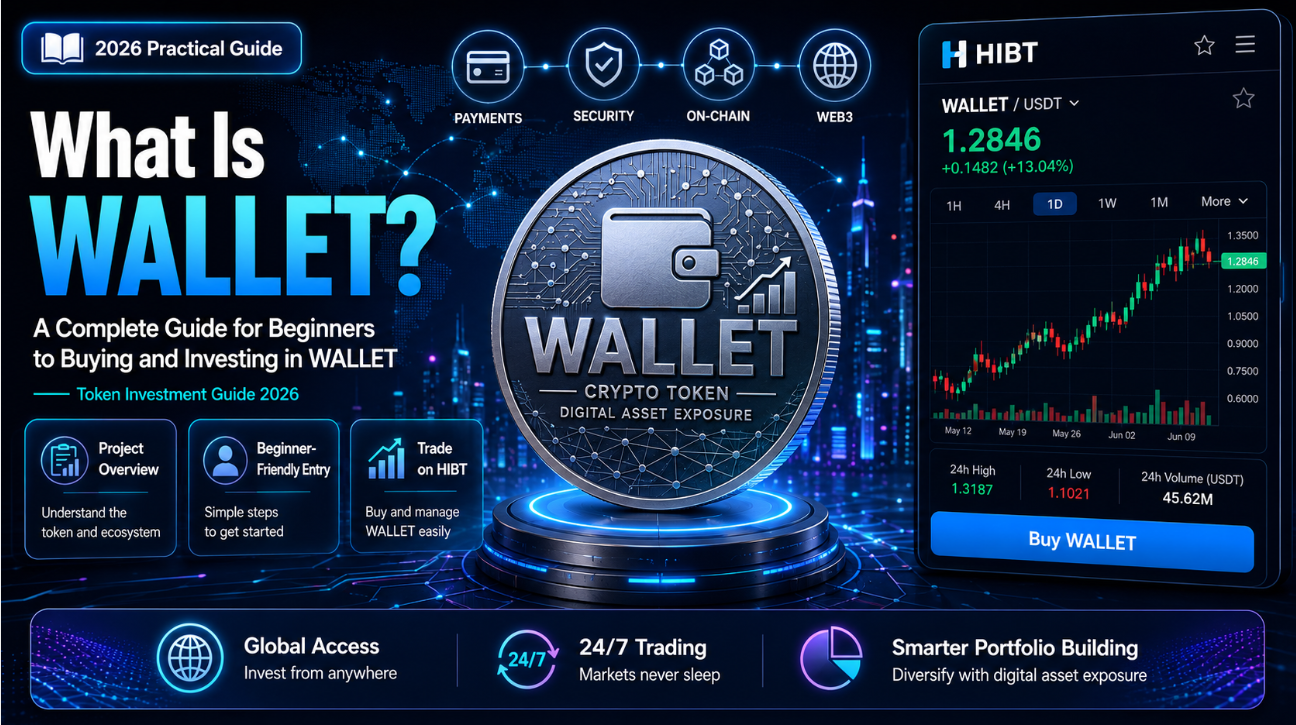
According to the HIBT announcement, WALLET/USDT opened for trading at 04:00 UTC on July 13, 2026, with withdrawals scheduled to open at 04:00 UTC on July 14, 2026. This indicates that it is a newly listed asset on HIBT with a short historical trading sample.
HIBT's WALLET price prediction page shows that the current price of Robinhood Wallet is approximately ¥0.02, and displays predicted prices for 2027, 2028, 2029, and 2030 all at approximately ¥0.02. The page also notes that all price predictions are generated based on user feedback.
This data offers two insights for newcomers:
First, the public price display of WALLET is still at a very early stage, and cannot be evaluated using the methods of mature assets. Second, price prediction pages can serve as a scenario reference, but should not be taken as an official promise, let alone a guarantee of profit.
1. How to View WALLET's Current Price, 24H Volume, and Order Book Depth?
The most direct method is to open the WALLET Real-Time Market.
After entering the page, newcomers should focus on five data points:
Current transaction price; 24-hour price change; 24-hour high and low; 24-hour trading volume; Bid-ask spread and order book depth.
If an asset has a low price but thin order book depth, it does not mean it is "cheap," but rather that "a small amount of capital can significantly affect the price." For example, if you see a price of only ¥0.02, but the sell-side orders at the first level are very few, your actual average execution price when buying with a market order may be far higher than the displayed price. Conversely, if you want to sell, you may need to actively lower your price to get filled.
Newcomers should not only look at "the small price number," but more importantly, at "whether you can buy and sell at a reasonable price."
2. Has WALLET Experienced Severe Volatility?
Since WALLET is a newly listed asset on HIBT, the historical K-line sample is insufficient. For this type of asset, the most dangerous period is often not long after listing, but the first few days after listing.
The reasons are simple:
First, early market maker depth is unstable; Second, the market is still verifying the true background of the asset; Third, community sentiment can heat up or cool down quickly; Fourth, the price may be affected by a few large orders; Fifth, the on-chain chip structure has not yet been fully observed.
Therefore, newcomers should not go all-in on the first day of a new asset's listing out of fear of missing out. A more prudent approach is to observe for 3 to 7 days, watching trading volume, order book, K-line volatility, and on-chain transfers to see if they stabilize.
3. Is WALLET's Circulating Supply and Market Cap Transparent?
For new assets like WALLET, circulating supply, total supply, top 10 address concentration, contract permissions, whether the supply is mintable, and whether there are blacklist or pause-transfer mechanisms are all critical.
If you only look at the exchange page, you may only see the price and trading volume. But if you want to invest seriously, you should further verify on-chain browser information. The HIBT announcement provides the contract address entry on the Robinhood Chain block explorer.
Newcomers are advised to check at least the following:
Whether the contract is verified; What the total supply is; Whether the top 10 holding addresses are overly concentrated; Whether there are obvious project addresses, market maker addresses, or exchange addresses; Whether there have been recent large transfers, concentrated deposits to exchanges, abnormal minting or burning; Whether liquidity is concentrated in the hands of a few addresses.
If you cannot understand on-chain data, at the very least you should do two things: do not go all-in, and do not chase pumps.
4. Positioning Differences Between WALLET, WDCB, and CBRSB
Although WALLET, WDCB, and CBRSB can all be traded by users within the HIBT ecosystem, their underlying logic is different.
WDCB is more like a "tokenized exposure to Western Digital (WDC) stock." Its core variables are Western Digital's fundamentals, AI storage demand, U.S. stock valuation, the bStocks mechanism, custody, and platform liquidity. You can read What Is WDCB to understand the evaluation framework for this type of tokenized stock asset.
CBRSB is more like a "tokenized exposure to Cerebras AI chip stock." Its core variables are the Cerebras underlying stock, the AI chip industry, IPO new stock volatility, the bStocks issuance mechanism, and platform trading depth. You can read What Is CBRSB for a cross-reference.
WALLET, on the other hand, is more of a "wallet ecosystem concept asset." It does not have an obvious traditional stock anchor, and should not be directly treated as a substitute for Robinhood company equity.
To summarize the differences between the three in one sentence:
WDCB looks at Western Digital stock and the AI storage cycle; CBRSB looks at Cerebras stock and the AI chip narrative; WALLET looks at the Robinhood Wallet, Robinhood Chain, on-chain wallet ecosystem, and market sentiment.
3. Five Core Risks to Evaluate Before Investing in WALLET
A truly responsible investment article cannot only talk about opportunities; it must also discuss the worst-case scenarios.
WALLET is attractive to newcomers because of its familiar name, low price, new narrative, and low trading barrier. But it is precisely because of these characteristics that it can lead newcomers to underestimate the risks.
Risk 1: Is WALLET a Platform-Issued Asset? What Happens If HIBT Stops Supporting It?
From the user's operational perspective, when you buy WALLET on HIBT, your most direct dependency is on HIBT's trade matching, account asset records, deposit/withdrawal channels, and risk control rules.
HIBT's disclaimer states that the platform is a trading marketplace where transactions occur between buyers and sellers, and HIBT itself does not participate in the actual transactions. It also notes that trading or holding digital assets carries a significant risk of loss, and users should exercise prudence based on their own financial situation.
This means that if HIBT suspends WALLET trading, wallet maintenance, delays withdrawals, or delists the trading pair in the future, the user's exit path may be affected. Even if the on-chain contract still exists, the disappearance of exchange liquidity will make selling difficult.
Newcomers must understand: Being able to buy does not equal being able to sell at any time; a displayed price does not mean you can sell a large amount at that price.
Risk 2: Does Robinhood Officially Endorse WALLET?
What can be confirmed at present is that Robinhood officially has the Robinhood Wallet and the Robinhood Chain. The Robinhood Wallet is a self-custody wallet, and the Robinhood Chain is a Layer 2 blockchain focused on financial services and real-world assets.
But the more critical question is: Has Robinhood explicitly announced that WALLET is its official investment token? Has it promised that WALLET represents some kind of equity, revenue, fee sharing, governance rights, repurchase mechanism, or user growth dividend?
Without these explicit documents, newcomers cannot treat WALLET as a "Robinhood official coin."
Here is a verification principle:
Check the official website, not the community; Check the official announcements, not screenshots; Check the contract, not the name; Check the risk disclosure, not the slogans.
If a token simply uses a name similar to a well-known brand but lacks an official issuance statement, legal documents, contract verification, equity description, and risk disclosure, then it carries the risk of naming confusion.
Risk 3: WALLET Price May Decouple from HOOD Stock and Robinhood User Growth
Many newcomers think this way:
Robinhood is well-known; The Robinhood Wallet has users; The Robinhood Chain has an RWA narrative; So WALLET is bound to go up.
This logic is incomplete.
WALLET's price may not directly track Robinhood stock (HOOD), nor may it directly track Robinhood Wallet user growth. The reason is: if WALLET has no clear equity design, it cannot automatically share in Robinhood's revenue, profits, user growth, or brand value.
In other words, Robinhood's strong company performance does not mean WALLET will definitely rise; a rise in HOOD stock does not mean WALLET will definitely rise.
WALLET is more likely to follow short-term market sentiment, on-chain trading heat, community propagation, exchange liquidity, and speculative capital inflows and outflows.
Risk 4: Platform Security, Regulatory Licensing, and Custody Risks
When trading any centralized platform asset, you cannot only look at the page functionality; you must also look at the platform risks.
HIBT's terms of service list a series of restricted regions and remind users that if they do not comply with local laws and platform requirements, they should stop using the service. HIBT also states in its prohibited use policy that the platform must not be used for activities that violate sanctions, export controls, or restricted region rules.
Therefore, users in mainland China or other restricted regions need to additionally confirm:
Whether their region allows access to and use of related services; Whether participation in crypto asset trading is permitted; Whether there are issues involving offshore platforms, capital movements, and tax reporting; Whether the platform has different regional restrictions for spot trading, derivatives, withdrawals, and KYC; Whether they can bear the risks of account being frozen, withdrawal delays, or service unavailability.
This article does not recommend, nor will it guide anyone, to circumvent KYC, bypass regional restrictions, or violate local laws and policies.
Risk 5: Compared to ETH, WALLET Carries a Higher Risk Premium
When newcomers are building risk awareness, they can use ETH as a benchmark.
ETH is a mature public chain asset with a longer market history, deeper global liquidity, a more complete ecosystem of applications, and more publicly available research materials. HIBT's ETH Price Prediction page also provides ETH's real-time price, short-term predictions, and long-term predictions as a reference. The page also notes that price predictions are based on user feedback and are for reference only.
The difference between WALLET and ETH is:
ETH is an underlying public chain asset; WALLET is a newly listed concept asset; ETH has more mature trading depth; WALLET has less historical data; ETH has stronger market consensus; WALLET's price is more dependent on narrative and liquidity; ETH is suitable as a core position candidate; WALLET is more suitable as a small proportion observation or trial position.
Therefore, I do not recommend that newcomers treat WALLET as a substitute for ETH. A more reasonable position logic is: ETH/BTC is the foundation, and WALLET is a high-risk satellite position.
4. The Complete Step-by-Step Guide to Buying WALLET on HIBT
If you have already understood the asset positioning and risks of WALLET and still want to make a small trial purchase, you can follow the path below.
The core principles are only two: Test with a small amount first, then consider adding to your position; prioritize limit orders, and do not blindly chase with market orders.
Step 1: Register an HIBT Account and Complete Security Settings
Go to the HIBT website or app and register an account with a long-term, stable email or phone number. Do not use a temporary email, as subsequent login verification, withdrawal confirmation, risk control notifications, and password recovery may all depend on your email.
After registration, it is recommended to complete the following immediately:
Set a strong password; Bind your email and phone number; Enable Google Authenticator or other 2FA; Set a fund password; Check the anti-phishing code; Do not send your verification code to anyone.
HIBT's registration guide also reminds newcomers that registering an exchange account is essentially a risk decision, and requires attention to platform security, fee structure, KYC purpose, and your own risk preparation.
Step 2: Complete KYC Identity Verification
HIBT's KYC instructions mention that KYC is a process used by financial service providers to collect and verify customer identity information, commonly including official ID cards, driver's licenses, or passports. The platform also notes that users can open an account, but trading functions may be restricted before KYC is completed.
In the HIBT real-name verification process, users are also required to fill in their name and ID information, and upload photos of the front and back of their ID card, as well as a photo of themselves holding the ID card. The photos must be clear, and the name and ID number must match the uploaded document. The nationality and region selection must also match the document.
Mainland China users need to pay extra attention to the following: Do not assume that local policies allow trading just because the page can be opened; Do not use false identities or other people's identities to complete KYC; Do not purchase accounts through unofficial channels; Do not ignore the risks of capital movements for short-term speculation; If you are unsure about policy boundaries, you should stop operating first and confirm the legal and compliance requirements.
Step 3: Deposit USDT to HIBT
Buying WALLET/USDT usually requires preparing USDT first.
There are two common types of deposit methods:
One is on-chain deposit, such as transferring USDT from another exchange or wallet to HIBT; The other is the fiat-to-crypto gateway, bank card, third-party payment, or P2P channel supported by the platform. Please refer to the current HIBT page for specific options.
If you choose on-chain deposit, you must confirm three things:
First, whether the selected network is consistent. For example, TRC20, ERC20, BEP20, Arbitrum, Polygon, and other network addresses cannot be mixed.
Second, whether the deposit address is completely correct. It is recommended to copy and verify the first 6 and last 6 characters after pasting, and do not manually type the address.
Third, test with a small amount first. Do not transfer a large amount on the first deposit. You can transfer 10–20 USDT first to test the deposit speed and whether the network selection is correct.
If you choose P2P or fiat channels, pay attention to the merchant's reputation, whether the payment name matches the real name, order time limits, appeal process, and the compliance of the fund source. Do not accept offline private chat transactions, and do not disclose your account information to strangers.
Step 4: Enter the WALLET/USDT Trading Page
After the USDT arrives, enter the spot trading page and search for WALLET or WALLET/USDT.
You can also directly open the WALLET Real-Time Market and enter the trading page from the market page.
After entering the page, do not place an order immediately. First, observe:
What is the current price; How large is the 24-hour price change; Whether the gap between the bid and ask prices is significant; How many orders are within the 1% range of the order book; Whether recent trades are continuous; Whether there has been an abnormal pump or dump just now.
If the price has just skyrocketed, it is best for newcomers not to chase it; if the price is fluctuating wildly, you can wait 15 to 30 minutes to see if the order book stabilizes.
Step 5: How to Choose Between Limit Orders and Market Orders?
Newcomers are more recommended to use limit orders for their first trade.
A limit order is when you set the price you are willing to buy at, and the order is only executed when the market reaches that price. It is suitable for new assets with thin order books and high volatility, as it can avoid excessive slippage.
A market order is executed immediately at the current best market price. It is fast, but if the order book is very thin, it may continuously eat through multiple sell orders, resulting in an actual average execution price that is much higher than the price you saw.
For new assets like WALLET, I recommend:
Use only 10–20 USDT for the first test order; Do not chase a market order during a rapid pump on the 1-minute K-line; Check the bid-ask spread before buying; If the spread exceeds 1%–3%, be even more cautious; For large purchases, split them into multiple limit orders instead of one market order.
Step 6: Where to Store the Assets After Purchase?
After purchase, there are two options:
One is to keep it in your HIBT account for easy trading at any time; The other is to withdraw it to a wallet that supports the corresponding network after the platform opens withdrawals.
The HIBT announcement states that the WALLET withdrawal time is scheduled for 04:00 UTC on July 14, 2026. If you plan to withdraw, you must confirm:
Whether HIBT has opened WALLET withdrawals; Whether the withdrawal network is Robinhood Chain or the designated network supported by the platform; Whether the external wallet supports this network and this token; Whether the contract address is consistent; Do not send WALLET to an address that does not support Robinhood Chain; Test with a small amount for the first withdrawal.
If you are only trading short-term, keeping it on the exchange is more convenient; if you plan to hold long-term and have confirmed that the external wallet supports it, then consider on-chain self-custody. But self-custody also carries risks: lost seed phrases, incorrect addresses, wrong network selection, phishing approvals — all of these can lead to permanent loss of assets.
Step 7: Set Take-Profit and Stop-Loss Levels
For new assets like WALLET, the biggest fear is "planning to trade short-term before buying, but turning into a long-term hold after it drops."
Before buying, write down clearly:
Why am I buying; What is the maximum I can afford to lose; At what point must I exit if it falls; At what point should I take partial profits if it rises; If there is no improvement in liquidity within 7 days, should I exit; If Robinhood officially issues a clarification or risk warning, should I exit immediately.
A simple rule for newcomers is:
Reduce your position or exit if you lose 10%–20%; Take back at least part of your principal if it rises 30%–50%; If it doubles in the short term, do not fantasize about unlimited upside; take partial profits first; Do not add to your position if trading volume suddenly dries up; Be alert for a fake breakout if the price rises but the order book becomes thinner.
Whether HIBT supports conditional orders, stop-loss/take-profit orders, and other automated tools should be based on the current trading page. If there are no conditional orders, you must manually set reminders and execute them strictly.
5. WALLET Price Predictions and Investment Strategy Framework
Price predictions are the most attractive to newcomers, but also the most misleading.
HIBT's WALLET Price Prediction page shows that the current price of WALLET is approximately ¥0.02, and provides a price prediction calculator, short-term price prediction, and long-term price prediction modules. The page also explicitly states that all price predictions are generated based on user feedback.
This sentence is key.
It indicates that price predictions are not official promises, not profit guarantees, and not the platform saying, "It will definitely rise to this price in the future." They are more suitable for scenario analysis, not as a direct reason to buy.
1. How to View WALLET's Short-Term Price?
In the short term (within 30 days), the core of WALLET is not valuation, but liquidity.
Newcomers can focus on observing:
Whether the 24H trading volume on HIBT is continuing to expand; Whether the price can form a stable range after listing; Whether the bid-ask spread is narrowing; Whether on-chain holding addresses are increasing; Whether whales are continuously transferring coins to the exchange; Whether community discussions are shifting from short-term shilling to real usage scenarios; Whether more applications and assets are entering the Robinhood Chain.
If the price rises but trading volume does not follow, it may just be a short-term pump; If trading volume expands but the price cannot break through, there may be selling pressure; If the price is consolidating but order book depth is improving, it may actually indicate that the market is repricing.
2. Is WALLET's Long-Term Thesis Valid?
To hold WALLET long-term, three questions need to be answered:
First, will the Robinhood Wallet continue to grow? Second, will the Robinhood Chain form a real on-chain financial ecosystem? Third, can WALLET really capture the value of this ecosystem?
The first two questions belong to the development of the Robinhood ecosystem; the third question is the most critical for WALLET investment.
Even if the Robinhood Wallet user base grows, it does not mean WALLET will definitely benefit. Unless WALLET has a clear future utility — such as fees, governance, incentives, staking, ecosystem subsidies, application access, points conversion, or other verifiable mechanisms — it will be difficult for it to translate "ecosystem heat" into "value capture."
Therefore, the premise for long-term investment in WALLET is not "I am bullish on Robinhood," but rather "I can prove that there is a sustainable connection between WALLET and the value of the Robinhood ecosystem."
3. How Should Newcomers with Different Capital Amounts Allocate?
If your capital is below 500 USDT, I recommend treating WALLET as a learning position, not a profit position. You can use 10–50 USDT to experience the complete process once: deposit, place an order, stop loss, and review. The key is not how much money you make, but learning to identify the risks of new assets.
If your capital is between 500–5,000 USDT, you can consider using BTC/ETH as your core position and placing WALLET in a 1%–3% observation position. Do not invest more than 20% of your position just because the price is low. Once a low-priced asset loses liquidity, an 80% drop is not difficult.
If your capital exceeds 5,000 USDT, you should treat WALLET even more as a high-risk satellite position. You can build your position in batches, set a maximum loss, and record the reason for each purchase. Do not ignore liquidity just because you have a lot of capital. Once the order book is thin, large capital is actually harder to exit.
4. If You Already Hold WDCB or CBRSB, Do You Still Need WALLET?
This depends on what kind of risk you want to configure.
If you buy WDCB, you are looking at AI storage and Western Digital stock; If you buy CBRSB, you are looking at AI chips and the Cerebras narrative; If you buy WALLET, you are looking at the Robinhood Wallet, Robinhood Chain, and the wallet ecosystem narrative.
The three are not completely overlapping, but they all share one risk source: They all depend on HIBT platform trading liquidity and users' risk appetite for new types of assets.
If you already hold WDCB or CBRSB, and then buy WALLET, on the surface you are diversifying into different themes, but in reality you are still increasing the total exposure to "platform new assets + niche trading pairs + liquidity risk."
A more prudent allocation approach is:
Use BTC/ETH as the core; Use WDCB and CBRSB as tokenized stock thematic positions; Use WALLET as a high-risk observation position for the wallet ecosystem; The total of all high-risk assets should not exceed the portion of your crypto portfolio that you can afford to lose.
6. Six Common Mistakes Newcomers Make and FAQ
Mistake 1: WALLET's Price Is Only ¥0.02 — Is This a Bargain?
Not necessarily.
A low price does not mean cheap, and a low unit price does not mean a high margin of safety.
What truly determines valuation is:
Total supply; Circulating supply; Market cap; Fully diluted valuation; Trading depth; Token holder distribution; Project utility; Future unlock pressure.
A token priced at ¥0.02, if it has an extremely large total supply, may not have a low market cap at all. An asset priced at ¥1,000, if it has a very small supply, is not necessarily expensive.
Newcomers should not judge opportunities based on "low unit price," but should use "market cap + liquidity + value capture mechanism" to judge opportunities.
Mistake 2: Seeing the Name Robinhood, and Assuming It's an Official Asset
This is a very dangerous way of thinking.
To determine whether a token is official, you should at least check:
Whether Robinhood's official website has issued an announcement; Whether Robinhood's official X, newsroom, and docs have mentioned it; Whether the contract is accessible from the official documentation; Whether the exchange announcement clearly states the issuer; Whether there are legal documents explaining the rights; Whether there is a risk disclosure; Whether there is an audit report; Whether there is a clear utility.
A similar name does not mean it's official; Being on the chain does not mean it's official; Being listed on an exchange does not mean it's officially endorsed; High community heat does not mean low risk.
Mistake 3: Can WALLET and Robinhood Stock (HOOD) Replace Each Other?
No.
HOOD is the listed stock of Robinhood Markets, representing equity exposure in the traditional securities market. WALLET is a digital asset traded on HIBT, forming a narrative around the Robinhood Wallet and Robinhood Chain.
The investment logic for the two is completely different.
When you buy HOOD, you are researching Robinhood's revenue, profits, user growth, regulatory risks, valuation, P/E ratio, financial reports, and stock market sentiment. When you buy WALLET, you are researching the contract, on-chain liquidity, exchange order book, market sentiment, wallet ecosystem narrative, project utility, and platform support.
Robinhood's strong company performance does not automatically mean WALLET will rise; WALLET's short-term spike does not mean a change in Robinhood's stock fundamentals.
Mistake 4: I Already Bought WDCB, Do I Still Need to Buy WALLET?
Not necessarily.
WDCB's logic is more oriented toward tokenized stocks and the AI storage cycle; WALLET's logic is more oriented toward the wallet ecosystem and on-chain finance narrative. The two themes are different, but both are new risky assets on HIBT.
If you already hold WDCB, adding WALLET is not simply diversifying risk, but adding another category of high-volatility risk.
A more reasonable approach is to first ask yourself:
Do I already have a BTC/ETH core position? Do I understand the tokenized stock mechanism of WDCB? Do I understand that WALLET is not the same as Robinhood stock? Can I accept WALLET going to zero or being unable to exit for a long time? Do I have a clear stop-loss plan?
If the answer is no, then there is no need to buy WALLET just to "own one more concept."
Mistake 5: Are Exchange Price Predictions Equal to Official Promises?
No.
HIBT's WALLET price prediction page has already stated that all price predictions are generated based on user feedback. This type of prediction is suitable for scenario analysis, such as "If it rises 20%, what is my position worth?" or "If it falls 50%, what is my maximum loss?"
But it cannot replace research, nor can it serve as investment advice.
Predictions are models or user feedback; Promises carry legal liability; Investment advice needs to be tailored to individual risk; Profit guarantees in high-risk assets are usually not credible.
When newcomers see any prediction, they should automatically add a question: If the prediction is wrong, can I afford it?
Mistake 6: What to Do If a Deposit Doesn't Arrive or the Price Fluctuates Wildly?
If a deposit does not arrive, do not panic, and do not immediately look for strangers in the community.
You should check in this order:
Whether the blockchain explorer shows the transaction as successful; Whether the correct deposit network was selected; Whether the deposit address is correct; Whether the required number of confirmations has been reached; Whether a Memo, Tag, or other note was omitted; Whether the HIBT account asset record is delayed; Whether a support ticket needs to be submitted.
If the price fluctuates wildly, do not chase or dump the first thing. First, check:
Whether there is an official announcement; Whether there is platform maintenance; Whether there are abnormal large transfers; Whether the order book suddenly became thin; Whether there are unverified rumors in the community; Whether the K-line has clearly deviated from volume support.
If you cannot judge, the best course of action is often not to add to your position, but to reduce your position or pause trading.
7. Author's Perspective: My Risk Assessment and Final Recommendations
From the perspective of someone who has experienced multiple bull and bear cycles, transitioned from SEO to Web3, and has long observed exchange content and new asset liquidity, WALLET is not an asset suitable for newcomers to go all-in on.
It has merits worth researching:
The Robinhood Wallet is a real self-custody wallet product; The Robinhood Chain is the official on-chain financial infrastructure launched by Robinhood; HIBT has already provided the WALLET/USDT trading entry; Wallets, RWA, on-chain finance, and AI agent trading are all directions worth watching in 2026.
But its problems are also very obvious:
Whether WALLET directly receives official Robinhood token rights needs further verification; The price history is too short; Liquidity and chip structure need to be observed; The price may decouple from HOOD stock and Robinhood business growth; Newcomers are easily lulled by the familiar "Robinhood" name; If platform liquidity declines, exit risks will rise significantly.
If I were operating myself, I would not treat WALLET as a core position. I would use at most a small portion of capital as an observation position, and write down the exit conditions in advance.
For example:
If HIBT order book depth continues to decline, I will reduce my position; If Robinhood officially denies or issues a risk warning, I will exit; If there are large concentrated transfers to the exchange on-chain, I will lower my risk; If the price spikes in the short term but trading volume is unhealthy, I will take partial profits in batches; If the only reason left to buy is "everyone else is shouting about it," I will stop adding; If losses reach the predetermined range, I will execute the stop loss.
For newcomers, I more strongly recommend dividing the overall crypto portfolio into three layers:
Layer 1: Core assets such as BTC and ETH, making up the main position; Layer 2: Industry assets you have truly researched, such as AI, RWA, DeFi, and stablecoin ecosystems; Layer 3: High-risk new assets like WALLET, only as a small proportion of trial positions.
If you only have a few hundred dollars in budget, instead of buying a lot of WALLET right away, it is better to first complete these things:
Learn how to read K-lines and order books; Learn how to use limit orders; Learn how to check on-chain contracts; Learn how to judge exchange announcements; Learn how to set stop losses; Learn how to compare the risk levels of WALLET, WDCB, CBRSB, and ETH.
This is more valuable than buying blindly.
8. Frequently Asked Questions
1. Is WALLET officially issued by Robinhood?
What can be confirmed at present is that HIBT lists WALLET as Robinhood Wallet, and provides the official Robinhood Wallet page and the Robinhood Chain block explorer entry. However, newcomers should not assume that WALLET is an official investment token directly issued, endorsed, or guaranteed in value by Robinhood based on the name alone. Before investing, you should continue to verify Robinhood official announcements, contract sources, issuer descriptions, and platform risk disclosures.
2. Is WALLET the same thing as the Robinhood Wallet App?
They are not on the same level. The Robinhood Wallet App is a self-custody wallet product; WALLET is a digital asset traded on HIBT. The two share a name and ecosystem narrative, but should not be conflated.
3. Can WALLET be held long-term?
Only after you have confirmed its utility, rights, contract security, liquidity, platform support, and Robinhood ecosystem connection is there a basis for discussing long-term holding. Otherwise, it is more suitable as a small observation position, rather than a long-term core position.
4. Which is more suitable for newcomers, WALLET or ETH?
ETH is more suitable as a benchmark asset for newcomers to study crypto assets. WALLET carries higher risk, has less data, and its price is more dependent on narrative and liquidity. Newcomers can first establish a mainstream asset reference through the ETH Price Prediction page, and then decide whether to observe WALLET with a small position.
5. Is KYC required to buy WALLET on HIBT?
HIBT's KYC instructions indicate that the platform may require users to submit official proof of identity, and that accounts that have not completed KYC may have restricted functions. Whether KYC is actually required for deposits, trading, or withdrawals should be based on the current HIBT page prompts.
6. Are WALLET price predictions credible?
They can be referenced, but should not be relied upon. HIBT's WALLET price prediction page states that the predictions are generated based on user feedback. Newcomers should treat predictions as a scenario tool, not a profit promise.
7. What if the WALLET price crashes?
First, check whether there are official announcements, platform maintenance, large on-chain transfers, or liquidity anomalies. If you have already set a stop loss in advance, execute it according to plan. Do not turn a short-term trade into a long-term bag hold just because you are unwilling to admit a loss after losing money.
8. What percentage of an investment portfolio is WALLET suitable for?
For most newcomers, WALLET is not suitable for more than 1%–3% of a crypto portfolio. If you do not understand on-chain contracts, liquidity, and project background at all, you can even refrain from buying and just observe.
Summary: WALLET Is Worth Watching, but Not for Blind All-In Positions
WALLET's appeal comes from the Robinhood Wallet, Robinhood Chain, wallet ecosystem, and on-chain finance narrative. Its opportunity lies in the fact that if the Robinhood ecosystem continues to gain heat, the market may be willing to pay a higher premium for related concept assets.
But its risks are equally obvious: unclear asset rights, short price history, strong dependence on platform liquidity, potential decoupling from Robinhood stock and wallet business, and the tendency for newcomers to ignore risks because of the familiar "Robinhood" name.
Therefore, the most reasonable attitude toward WALLET is not blind bullishness, nor complete rejection, but rather:
Verify identity first; Observe liquidity second; Test with a small order; Enforce strict stop losses; Do not treat it as official equity; Do not treat price predictions as promises; Do not let high-risk assets affect overall capital safety.
If you just want to learn about WALLET, you can start by observing the WALLET Real-Time Market and the WALLET Price Prediction pages. If you want to build a more mature risk gradient, you can also compare the ETH Price Prediction, What Is WDCB, and What Is CBRSB pages.
Remember one thing: For newcomers buying new assets, the first goal is not to make quick money, but to learn to identify risks at the lowest possible cost.