
Data Verification Date: July 13, 2026 (UTC+8) This article is for informational research and risk education only and does not constitute investment advice. GALA is a highly volatile digital asset. Although it is backed by the Gala Games & Entertainment ecosystem, its price is subject to multiple factors including crypto market cycles, GameFi sentiment, token supply, user growth, and trading liquidity. Please make independent judgments based on your own risk tolerance before investing.
I. Introduction: Why Are Investors Still Watching GALA in 2026?
Many crypto newcomers searching for GALA usually have one question: Is GALA just an old coin that was hot during the 2021 GameFi bull run? Is it still worth researching today?
This question is critical.
GALA was indeed a project that gained massive investor recognition during the GameFi, NFT, and Play-to-Earn boom. But it is not merely a "once-popular gaming token." According to Gala's official description, $GALA is a digital utility token within the Gala Games and Entertainment ecosystem, designed to provide convenient and secure payment and settlement among ecosystem participants. The official statement also clarifies that $GALA does not represent equity in Gala Games or any company, nor does it promise dividends, profits, or investment returns.
This point is very important for newcomers: GALA is an ecosystem utility token, not a stock, not a dividend certificate, and not a guaranteed-profit asset.
1.1 What Is GALA? Why Did It Become a GameFi Hot Project?
GALA is the core token of the Gala Games & Entertainment ecosystem. It connects gaming, NFTs, node networks, ecosystem payments, GalaChain transaction fees, and more.
Gala's official materials state that $GALA is the "fuel" of the Gala Games and Entertainment ecosystem and the primary reward mechanism for Founder’s Nodes. Users can also use $GALA to purchase NFTs in the Gala Games store or buy node licenses such as Founder’s Nodes.
GALA became a hot GameFi project for three main reasons:
First, Gala Games is not just a single game, but an attempt to build a Web3 gaming platform. Second, Gala's founding background easily attracts attention from traditional gaming investors. According to Gala's official help center, Gala Games and Entertainment was founded in 2019 by Zynga co-founder Eric Schiermeyer. Zynga previously launched well-known social games such as Poker, Mafia Wars, and FarmVille. Third, GALA is not an ordinary gaming point, but an on-chain token integrated with NFTs, node networks, gaming assets, and ecosystem payments.
Traditional in-game gold coins are mostly usable only within a single game; the vision for GALA is that it aims to serve a more open gaming and entertainment ecosystem.
1.2 What Is the Difference Between GALA and Traditional Gaming Coins?
Many newcomers ask: Games already have gold coins, diamonds, and vouchers—why do we need GALA?
The key difference lies in asset ownership and openness.
Comparison Item
Traditional Gaming Coins
GALA Ecosystem Assets
Asset Control
Primarily controlled by game publishers
Players can hold on-chain tokens and NFTs
Trading Range
Mostly usable only inside the game
Can be transferred and traded on supported platforms and wallets
Game Shutdown Impact
Assets may become invalid
On-chain assets may still exist, but value depends on the market
Economic System
Closed economy
More open Web3 ecosystem
User Role
Players and consumers
Players, holders, node participants, NFT holders
This is the core narrative of blockchain gaming: Players are not just consuming game content—they may also own part of the gaming assets.
But a word of caution here: Owning NFTs or tokens on-chain does not automatically mean the assets have value. If a game has no users, NFTs have no demand, and tokens have no consumption scenarios, even on-chain assets may lack liquidity.
1.3 What Is the Current Market Focus for GALA?
Looking at GALA again in 2026, market attention is concentrated on four main directions:
First, whether GameFi will stage a recovery. Second, whether GalaChain can become a gaming public chain with real users. Third, whether GALA's burn mechanisms, node rewards, and NFT purchases can create sustained demand. Fourth, whether Web3 games can shift from "attracting users solely through earnings" to "genuinely fun games with long-term retention."
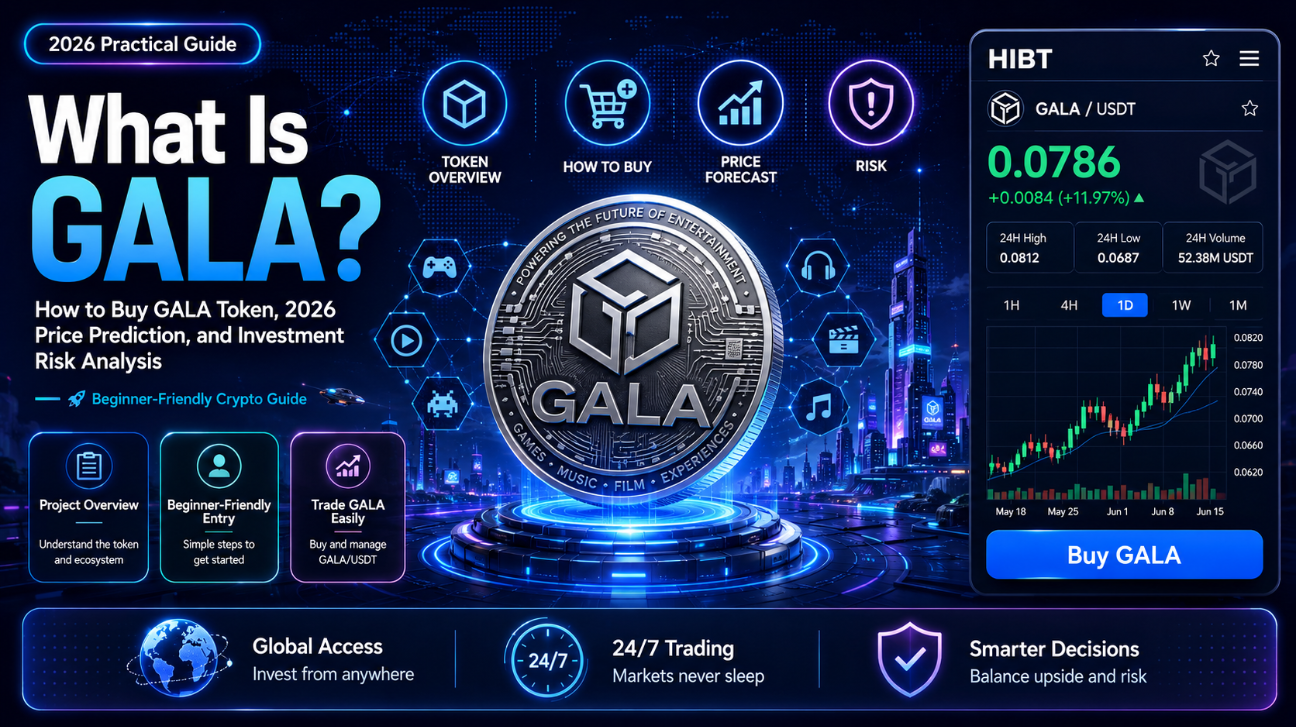
If you want to check GALA's real-time price, 24-hour price change, trading volume, and trading entry, you can visit Hibt's GALA Real-Time Price page. Hibt's market page displays the GALA/USDT trading pair, including 24-hour high, low, volume, turnover, and a "Go Trade" entry.
II. What Is GALA? A Deep Dive into the Gala Games Ecosystem
To judge whether GALA is worth researching, you cannot look at price alone—you must first understand the Gala Games ecosystem behind it.
2.1 What Is Gala Games?
Gala Games is the gaming division of the Gala Games & Entertainment ecosystem. Gala's official help center positions Gala Games and Entertainment as an entertainment company focused on advancing the gaming, music, and film industries, and notes that its founder Eric Schiermeyer is one of the co-founders of Zynga.
This means Gala was not originally created simply to launch a token, but to bring Web3 technology into the entertainment content industry.
From an ecosystem perspective, Gala already extends beyond Gala Games to include:
Gala Games: Gaming ecosystem; Gala Music: Music ecosystem; Gala Film: Film and TV ecosystem; GalaChain: Self-built blockchain infrastructure; Gala Nodes: Node network; Gala NFTs: Gaming and entertainment assets.
This layout makes GALA more than just a gaming token—it is a utility asset designed around a Web3 entertainment ecosystem.
2.2 What Problems Does Gala Games Aim to Solve in the Traditional Gaming Industry?
The traditional gaming industry has a long-standing pain point: players spend purchasing skins, gear, and items, but these assets usually do not truly belong to the players.
If a game shuts down, assets may disappear; If an account is banned, assets may become unusable; If the game does not support trading, assets cannot be freely liquidated; If the publisher changes the rules, players have little say in governance.
Gala's approach is to use blockchain, NFTs, and node networks to give players a stronger sense of participation in the game economy.
It aims to solve the following issues:
Insufficient player asset ownership; In-game items that cannot be freely traded; Game economies fully controlled by centralized companies; Players unable to participate in ecosystem decisions; Lack of interoperability between assets from different games.
Of course, the vision is grand, but execution is difficult. The biggest challenge for GameFi is not "whether you can issue a token," but "whether you can make a game that people actually want to play."
2.3 What Are the Core Components of the Gala Ecosystem?
The Gala ecosystem can be broken down into four core parts.
First, Gala Games. This is the earliest part recognized by the market, covering MMORPGs, strategy, casual, shooter, and other game types. The GalaChain website also showcases game or application portals such as Mirandus, Last Expedition, and Town Star.
Second, GalaChain. GalaChain is Gala's self-built Layer-1 blockchain. The GalaChain website describes it as a secure, low-cost, developer-friendly L1 blockchain, with the goal of bringing more users on-chain.
Third, Gala Nodes. Gala's official Tokenomics materials show that 50,000 Founder’s Nodes underpin the core of the Gala Games ecosystem. After meeting operational requirements, node operators receive daily $GALA distributions and have the opportunity to participate in voting on important ecosystem decisions through the node software.
Fourth, Gala NFTs. In-game items, characters, land, and collectibles within the Gala ecosystem can all exist in NFT form. Gala's official website navigation also mentions that users can purchase game items and other NFTs in the Gala Store.
These four parts together determine the long-term value foundation of GALA: whether games have players, whether NFTs have buyers, whether GalaChain has users, and whether the node network continues to operate.
III. What Are the Use Cases of GALA Token? Where Does Its Investment Value Come From?
Before buying GALA, newcomers must first understand one question: What exactly are you buying when you buy GALA?
You are not buying shares of Gala Inc.; You are not buying ownership of a specific game; You are not buying a fixed-income product; You are buying a utility token within the Gala ecosystem.
3.1 What Role Does GALA Token Play in the Ecosystem?
According to Gala's official materials, the main functions of $GALA include:
Ecosystem payment and settlement; Founder’s Nodes rewards; Purchasing NFTs; Buying node licenses; Network fees for cross-chain transfers from GalaChain to Ethereum and other chains; Gas token within the GalaChain ecosystem.
Gala's official Tokenomics page also states that GALA is the gas token for all transactions on GalaChain, and GALA used as gas is burned. As the Gala Games ecosystem launches more games and NFT items, many NFTs may be sold in GALA, resulting in GALA being burned.
This shows that GALA's value logic is not simply "it rises because people buy it," but is tied to ecosystem usage.
If transactions on GalaChain increase, gas usage rises; If NFT sales increase, GALA consumption rises; If gaming users grow, in-ecosystem payment demand rises; If the node network continues to operate, GALA distribution and governance participation also continue.
3.2 Does GALA Have Real Application Demand?
To judge whether GALA has real demand, you cannot just look at "how many games Gala has"—you need to look at:
Whether games actually have active players; Whether NFTs have real trading volume; Whether GALA is being used for purchases and payments; Whether there is sustained transaction activity on GalaChain; Whether gas burns increase as the ecosystem grows; Whether the node network is operating stably; Whether new game launches can bring in new users.
Many GameFi projects fail not because they lack a token, but because the games are not fun, and users only come for the earnings. Once rewards drop, users quickly leave, and token prices come under pressure.
Therefore, the core of GALA's long-term investment value is not "whether the word GameFi is trending," but whether Gala can consistently produce games and entertainment products that have players, spending, trading, and retention.
3.3 What Is GALA Token's Economic Model?
The token economic model is the part of GALA investment that requires the most long-term observation.
CoinMarketCap data shows that GALA's current total supply is approximately 48.76B, with a maximum supply of 50B and a circulating supply of approximately 48.76B. The page also shows GALA's all-time high of $0.8367 on November 26, 2021, and its all-time low of $0.000151 on December 28, 2020.
CoinGecko data also shows GALA's current circulating supply at approximately 48.74B, with a market cap of approximately $99.416 million and 24-hour trading volume of approximately $14.518 million. It also shows its all-time high of $0.8248 on November 25, 2021, and its all-time low of $0.0001347 on December 28, 2020.
From a supply structure perspective, GALA is no longer a low-supply asset. Newcomers should not only look at "the unit price is very low," but also at total supply and market cap.
Gala's official Tokenomics page also mentions that $GALA began emissions to Founder’s Nodes starting September 11, 2020, with no token sale or pre-mint stage. The team currently holds approximately 2 billion GALA in reserve, and about 20.9 billion GALA were burned on May 15, 2023.
For investors, three things in GALA's economic model deserve focused attention:
First, whether future supply will continue to increase; Second, whether GALA burns can offset emission pressure; Third, whether real ecosystem usage can bring sustained demand.
If ecosystem usage grows slowly while token supply or sell pressure is high, the price will be under pressure. If GalaChain transactions, NFT sales, gaming users, and burn mechanisms continue to improve, GALA may achieve a healthier supply-demand structure.
IV. GameFi Sector Analysis: Opportunity or Bubble?
GALA's core sector label is still GameFi and Web3 gaming.
But anyone who lived through the 2021 bull-bear cycle knows: GameFi was once extremely hot, and also caused severe losses for many investors.
4.1 Why Did GameFi Explode?
GameFi exploded for three main reasons.
First, the Play-to-Earn model created wealth effects. Projects like Axie Infinity gave the market its first glimpse of the possibility of "earning money by playing games."
Second, NFTs enabled on-chain trading of gaming assets. Characters, land, gear, pets, and skins could all be packaged as NFTs, allowing users to hold and transfer them.
Third, bull market liquidity drove valuation inflation. When market liquidity was abundant, users were willing to pay high premiums for new narratives.
In this context, projects like GALA—which had a gaming ecosystem, node network, NFT marketplace, and token economy—naturally attracted massive attention.
4.2 Why Did Many GameFi Projects Later Fail?
GameFi cooled down not because "blockchain games are completely invalid," but because many projects made the same mistakes:
The games were not fun; Users only came for the earnings; Tokens experienced continuous inflation; New user growth could not keep up with sell pressure from existing users; NFT prices were too high, creating excessive barriers to entry for ordinary players; Economic models resembled Ponzi structures, dependent on later entrants buying in; Projects focused on marketing, not product.
This is the lesson newcomers investing in GALA must absorb: GameFi does not succeed simply because it has a game and a token. What truly determines long-term value is user retention and economic circulation.
4.3 What Advantages Does GALA Have Over Other GameFi Projects?
GALA's advantage lies in the fact that it is not a single-game project, but a platform-type ecosystem.
It has its own GalaChain; It has a Founder’s Nodes network; It has multiple games and entertainment directions; It has an NFT asset system; It has relatively clear token use cases; It has expanded from gaming to music, film, and other entertainment directions.
But the risks are also clear:
The gaming industry is extremely competitive; Traditional gamers may not be willing to accept crypto wallets and NFTs; Web3 gaming experiences still need improvement; GameFi narrative sentiment may decline cyclically; GALA's price may be long-term affected by historical bag holders.
So, GALA's opportunity lies in "Web3 gaming platformization," and its risk lies in "whether Web3 gaming can truly break out of its niche."
V. GALA Price Trend Analysis: Is It Worth Attention Now?
Investors searching for GALA will eventually ask one question: Is the current price worth attention?
This question cannot be answered with just "how much it has risen or fallen." It must be combined with historical cycles, current valuation, trading volume, project progress, and market environment.
5.1 How Has GALA Performed Historically?
From a historical price perspective, GALA has experienced extreme bull-bear volatility.
CoinMarketCap shows GALA's all-time high at $0.8367, reached on November 26, 2021; its all-time low was $0.000151, on December 28, 2020. CoinGecko also shows that GALA's current price is still in a deep drawdown from its all-time high.
This illustrates two things:
First, GALA once achieved extremely high valuation during the bull market; Second, after the drawdown from its high, holders have endured very large price volatility.
For newcomers, this is not simply "it has fallen a lot, so it's cheap," nor is it "it has risen before, so it can rise again." What really needs to be considered is:
Is the logic behind GALA's previous rally still intact? Will GameFi regain capital attention? Is the Gala ecosystem more mature than the previous cycle? Does the current price already reflect the risks? Is future new demand sufficient to drive a price recovery?
5.2 What Factors Affect GALA's Price?
GALA's price is mainly influenced by four categories of factors.
First, crypto market cycles. If BTC and ETH strengthen, market risk appetite rises, and high-beta sectors like GameFi, AI, Meme, and RWA are more likely to attract capital. If the broader market weakens, non-core assets like GALA typically draw down more severely.
Second, GameFi sector sentiment. If Web3 games see another breakout hit, GALA may benefit. If the entire GameFi sector remains cold, it is difficult for GALA to independently sustain a long-term trend.
Third, Gala ecosystem progress. New game launches, increased GalaChain activity, NFT sales growth, stable node network operation, and increased GALA burns may all improve market expectations.
Fourth, token supply-demand dynamics. GALA's supply, burns, node rewards, team reserves, and exchange liquidity all affect price. If market buying is insufficient while unlocks or sell pressure increase, the price will be under pressure.
5.3 How to Check GALA Real-Time Market Data?
You can check GALA/USDT market data through Hibt's GALA Real-Time Price page.
Key metrics to watch:
Real-time price; 24-hour price change; 24-hour high and low; 24-hour trading volume; 24-hour turnover; Candlestick trends; Order book depth; Bid-ask spread.
Please note that market page data changes in real time with trading status, page cache, and matching depth. Before actual purchase, please refer to the real-time executed price and order book on Hibt's trading page or App.
VI. GALA Price Prediction: 2026, 2030 Future Trend Analysis
"How high can GALA go in the future" is a highly searched question, but also one of the most misleading for newcomers.
Price predictions can only be used as scenario analysis tools, not as promises of returns.
Hibt's GALA Price Prediction page shows GALA's current price at approximately ¥0.01, and provides forecasts for 2027, 2028, 2029, 2030, and other years. The page also clearly states that all price predictions are generated based on user feedback.
6.1 What Conditions Does GALA Need for a Stronger Future Rally?
For GALA to stage a stronger rally in the future, it needs to meet at least several conditions.
First, a GameFi market recovery. If Web3 games once again attract users and capital, GALA—as an established GameFi ecosystem token—will be more likely to regain attention.
Second, Gala ecosystem user growth. Growth in gaming users, GalaChain users, NFT buyers, and node participants is the foundation of long-term demand.
Third, increased token consumption. If GALA's usage as gas, for NFT purchases, and as an ecosystem payment tool increases, and brings sustained burns, supply pressure may improve.
Fourth, market capital inflows. GALA is a high-beta asset that typically requires a rise in market risk appetite to rally more easily.
Fifth, continued project delivery. Game launches, on-chain tools, developer ecosystem, cross-chain functionality, and GalaChain applications all need to be continuously delivered.
6.2 How Should GALA Price Predictions Be Viewed?
Do not judge the future with a single number. A more mature approach is to use three scenario models.
Bear Market Scenario: If the overall crypto market remains depressed, GameFi continues to cool, Gala gaming users decline, GALA burns are insufficient, and token sell pressure increases, the price may continue to range at low levels or even break below key support.
Neutral Scenario: If the market environment stabilizes, the Gala ecosystem maintains updates, GalaChain trading volume gradually increases, and GALA supply-demand does not significantly deteriorate, the price may fluctuate around the current range, waiting for industry catalysts.
Bull Market Scenario: If GameFi becomes a hot topic again, the Gala ecosystem sees user growth, GALA burns and payment demand rise significantly, and the broader market enters a strong cycle, GALA may achieve a valuation recovery. But even in a bull market, there will be deep drawdowns—do not treat predictions as certainties.
6.3 How to Use Hibt's GALA Price Prediction Tool?
If you want to understand GALA's future price trends under different market models, you can refer to Hibt's GALA Price Prediction page.
This page is suitable for three things:
Calculating future value under different annualized assumptions; Observing the price ranges given by long-term prediction models; Helping yourself plan take-profit, stop-loss, and position sizing.
But the correct way to use it is not "see the prediction and buy." Instead, ask yourself:
If the prediction does not come true, can I accept the loss? If the price drops 50%, do I still have a plan? If the price doubles, will I take profits in batches? If Gala ecosystem data does not improve, will I continue to hold?
The purpose of prediction tools is to help you run risk simulations, not to create an illusion of certainty.
VII. How to Buy GALA? A Complete Beginner's Tutorial
If you already understand GALA's project background, use cases, price volatility, and risks, and still want to buy GALA/USDT on Hibt, you can follow the process below.
7.1 What Do You Need to Prepare Before Buying GALA?
Before buying GALA, you need to prepare:
Hibt account; Identity verification materials; USDT; Security settings; Basic trading knowledge.
It is recommended to complete account security settings first, including strong passwords, email verification, mobile verification, Google Authenticator, fund password, and anti-phishing code.
Newcomers should not use unofficial links, should not open accounts through stranger links in community groups, and should never send verification codes, private keys, seed phrases, or fund passwords to anyone.
7.2 How to Buy GALA/USDT?
The complete process is as follows:
Register a Hibt account ↓ Complete identity verification (KYC) ↓ Deposit USDT ↓ Enter the spot trading zone ↓ Search for GALA/USDT ↓ Enter the buy price and quantity ↓ Confirm the order ↓ Check your asset account after execution
You can also first open the GALA Real-Time Price page to observe price, candlesticks, and trading entry, then enter the trading page to operate.
For your first purchase, it is not recommended to buy a large amount directly. You can start with a small amount for testing, such as 10–20 USDT, to confirm the trading process, execution speed, fees, and asset arrival status before deciding whether to continue.
7.3 What Is the Difference Between Market Order and Limit Order?
A market order is executed quickly at the current best available market price, suitable for trading pairs with good liquidity. The advantage is fast execution; the disadvantage is potential slippage.
A limit order lets you set the price at which you are willing to buy or sell. The advantage is price control; the disadvantage is that it may not be executed.
For newcomers, it is more advisable to use limit orders when buying GALA. Especially when prices are rising rapidly or the bid-ask spread is wide, a market order may cause you to buy at a short-term high.
7.4 Common Mistakes Newcomers Make When Buying GALA
Newcomers buying GALA most easily make four mistakes.
First, going all-in immediately. Seeing GALA's low unit price and pouring in a large amount of capital at once is very dangerous. A low unit price does not equal low risk.
Second, chasing rallies. When prices rise rapidly in a short time, community sentiment is often at its hottest, but this may also be a short-term high.
Third, ignoring liquidity. Only looking at candlesticks without looking at trading volume and order book depth makes it easy to overlook slippage and selling difficulty.
Fourth, ignoring fees and networks. If you later plan to withdraw to a wallet, confirm the supported network, address format, and fees. Do not send assets to the wrong chain.
VIII. GALA Investment Risk Analysis: What You Must Know Before Buying
GALA is a project with a real ecosystem, but that does not mean it is without risk. For newcomers, understanding risk is more important than predicting upside.
8.1 What Are the Biggest Risks of GALA?
First, project growth risk. If Gala ecosystem gaming user growth is insufficient, NFT trading is inactive, and GalaChain usage is low, GALA demand may fall below market expectations.
Second, GameFi sector risk. GameFi has experienced bubbles and cooling before. Even as an established project, GALA will be affected by overall sector sentiment.
Third, token supply risk. GALA has a maximum supply of 50B, and current circulating supply is already close to total supply. But emissions, burns, team reserves, and market sell pressure still need to be continuously monitored.
Fourth, price volatility risk. GALA has experienced massive drawdowns from its all-time high to its lows, showing that it is not a low-volatility asset.
Fifth, unmet expectations risk. If the market expects Gala to produce a breakout hit game but actual user growth falls short, the price may reflect disappointment in advance.
8.2 What Type of Investor Is GALA Suitable For?
GALA is more suitable for:
Investors who are bullish on the long-term development of Web3 gaming; People who are willing to research Gala ecosystem progress; People who can withstand significant volatility; People who are willing to place GALA in a small satellite position; People who can regularly review project and market changes.
GALA is not suitable for:
People seeking short-term stable returns; People who cannot accept large drawdowns; People who buy just because "the price is cheap"; People who do not understand GameFi risks; Newcomers without a stop-loss plan.
8.3 How to Manage GALA Position Sizes Properly?
I recommend newcomers adopt three rules:
First, buy in batches, not all at once. Second, control position size so that GALA does not jeopardize overall capital safety. Third, review regularly—do not let short-term losses turn into long-term beliefs.
If you are a newcomer, you can position GALA as a high-volatility thematic asset, not a core asset. A more stable portfolio approach is: BTC/ETH as the base position, and GALA as a GameFi thematic observation position.
IX. GALA vs. Other Popular Crypto Assets
Establishing a frame of reference helps avoid blind investing.
9.1 What Is the Difference Between GALA and ETH?
GALA and ETH are completely different types of crypto assets and cannot be compared using the same investment logic.
First, from an asset positioning perspective, GALA is more of a GameFi and Web3 entertainment ecosystem token. Its core value mainly comes from Gala Games, GalaChain, NFT assets, node networks, and in-ecosystem payment and consumption demand. In other words, investing in GALA is essentially a bet on whether the Gala ecosystem can attract more players, developers, and NFT trading demand in the future.
ETH, on the other hand, is a foundational public chain asset. ETH's value sources are much broader, including the Ethereum network itself, DeFi, Layer 2s, stablecoins, NFTs, RWA, on-chain applications, and the developer ecosystem. It does not depend on a single game or application, but is the foundational asset of the entire Ethereum ecosystem.
From a maturity perspective, ETH is clearly more mature. Ethereum has been running for many years, with broad ecosystem coverage, strong market liquidity, and higher institutional and developer attention. By comparison, GALA's maturity depends more on whether the GameFi sector recovers, and whether Gala's own gaming, NFT, and GalaChain ecosystems can continue to grow.
From a risk perspective, GALA has higher volatility and uncertainty. If Web3 gaming sentiment cools, Gala ecosystem user growth falls short of expectations, or NFT consumption demand is insufficient, GALA's price may come under significant pressure. ETH is also affected by crypto market cycles, but because its ecosystem is broader and liquidity is stronger, overall risk is relatively more researchable.
From a growth logic perspective, GALA depends on "ecosystem user growth + token consumption." If Gala gaming users increase, NFT trading is active, GalaChain usage rises, and brings more GALA consumption, then its investment logic becomes stronger. ETH's growth logic, on the other hand, mainly comes from Ethereum network usage, Layer 2 expansion, DeFi activity, stablecoin settlement, and on-chain application growth.
Therefore, for most newcomers, ETH is more suitable as a mainstream asset benchmark or core position candidate, while GALA is more suitable as a small GameFi thematic observation position. If you want to first establish a mainstream asset reference, you can check Hibt's ETH Price Forecast. Please note that price predictions are only a market analysis tool and do not represent promises of future returns.
9.2 What Is the Difference Between GALA and RWA Tokens?
In 2026, many investors are not only paying attention to traditional crypto, but also starting to focus on new directions like AI, RWA, and tokenized stocks.
GALA belongs to the GameFi and Web3 entertainment ecosystem asset category; CBRSB and WDCB are more oriented toward tokenized stocks and RWA assets.
Hibt's What is CBRSB article positions CBRSB as Cerebras Tokenized bStocks, and warns of platform risk, liquidity risk, premium/discount risk, custody risk, and regulatory risk. What is WDCB analyzes tokenized assets related to the storage giant Western Digital.
The differences among the three can be understood as follows:
GALA: Focus on Web3 gaming, NFTs, GalaChain, and the entertainment ecosystem; CBRSB: Focus on AI chips, Cerebras underlying stock, and tokenized stock logic; WDCB: Focus on AI storage, Western Digital, and the on-chainization of tech assets.
If your goal is to bet on GameFi, GALA is more relevant. If you are interested in AI stock tokenization and RWA, CBRSB and WDCB are more suitable as cross-sector research subjects.
X. FAQ: Most Common Questions About GALA Investment
Q1: What is GALA?
GALA is a utility token within the Gala Games & Entertainment ecosystem, used for ecosystem payments, node rewards, NFT purchases, GalaChain gas, and other scenarios. It is not equity in Gala Inc., nor does it promise dividends or investment returns.
Q2: Is GALA worth investing in?
It cannot be simply judged. Whether GALA is worth investing in needs to be comprehensively evaluated based on Gala ecosystem development, GameFi industry trends, token economic model, current price, market cycle, and personal risk tolerance.
Q3: Can GALA still rise in the future?
GALA's future price depends on whether the GameFi market recovers, whether Gala ecosystem users grow, whether GALA demand and burns increase, and whether overall crypto market liquidity improves.
Q4: Where can I buy GALA?
You can buy GALA through platforms that support the GALA/USDT trading pair. Hibt provides a GALA Real-Time Price page where users can check GALA/USDT market data and trading entry.
Q5: Is GALA an NFT?
No. GALA is a token; NFTs are a form of digital asset within the Gala ecosystem. You can think of it this way: GALA is the payment and settlement tool within the ecosystem, while NFTs are game items, assets, or collectibles.
Q6: What is the difference between GALA and gaming coins?
Traditional gaming coins are usually only usable within a single game and are controlled by the game publisher. GALA is an on-chain token that can be used in supported wallets, platforms, and ecosystem scenarios, with more open asset properties.
Q7: Is GALA suitable for newcomers to go heavy on?
No. GALA is a high-volatility thematic asset and is more suitable for a small observation position. Newcomers should first understand GameFi risks before considering allocation.
Q8: Can GALA price predictions be trusted?
They can be referenced, but not relied upon. Hibt's GALA Price Prediction page clearly states that price predictions are generated based on user feedback and do not constitute investment advice.
XI. Summary: What Should You Watch Before Investing in GALA?
GALA is a utility token within the Gala Games & Entertainment ecosystem, primarily serving gaming, NFTs, nodes, GalaChain, and the entertainment ecosystem. It is not an ordinary gaming coin, nor is it stock in Gala Inc.—it is a crypto asset deeply tied to the Web3 gaming economy.
Before investing in GALA, you should complete at least five steps of judgment:
First, understand the Gala ecosystem, not just look at the price. Second, analyze whether GameFi has a chance to recover. Third, check the GALA Real-Time Price, paying attention to trading volume, order book, and candlesticks. Fourth, study the token economic model, especially supply, burns, node rewards, and ecosystem demand. Fifth, control risk—don't chase rallies, don't go all-in, and don't treat predictions as promises.
If you are watching GALA, you can use Hibt's GALA Real-Time Price and GALA Price Prediction tools to continuously track market changes. If you want to build a more complete asset comparison framework, you can also refer to ETH Price Forecast, What is CBRSB, and What is WDCB.
Finally, remember one thing: GALA's core opportunity does not lie in "the price is cheap," but in whether the Gala ecosystem can truly bring players, trading, NFT consumption, and on-chain usage.