
Data Verification Date: July 10, 2026 (UTC+8)
Risk Warning: This article is for informational research and investor education only. It does not constitute any investment advice, legal advice, tax advice, or tax-filing basis. DRAMB is a tokenized ETF / Tokenized bStocks asset that involves ETF price volatility, memory-chip cycle risk, price dislocation, liquidity risk, custody risk, platform counterparty risk, regulatory risk, tax risk, and on-chain operational risk.
I. Why Should Crypto Newcomers Care About Tokenized-ETF Assets Like DRAMB?
When many crypto newcomers first start learning about asset allocation, they put all their capital into BTC, ETH, meme coins, or freshly launched small-cap tokens. In the short term, these highly volatile assets can indeed deliver outsized returns; but from a long-term portfolio-management perspective, holding only high-volatility crypto assets easily traps newcomers in three pitfalls:
First, chasing highs when the market is rallying, thinking “if I don’t get in now, I’ll miss the boat.”
Second, panic-selling when the market is dropping, dumping long-term holdings based on short-term emotion.
Third, failing to make cross-market allocations, leaving the portfolio with only crypto and no exposure to stocks, ETFs, cash-like assets, or real-world assets (RWA).
That is why tokenized-ETF assets like DRAMB deserve attention.
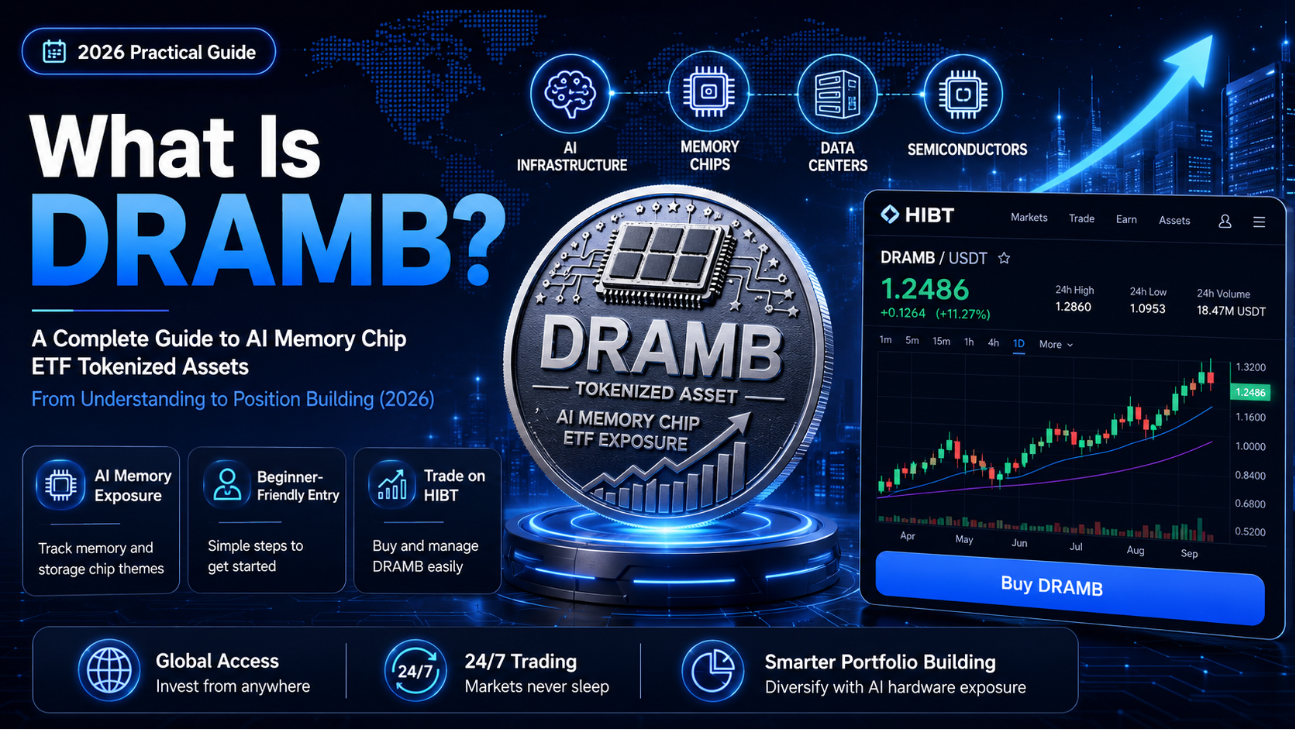
The core of DRAMB is not “yet another new token.” Rather, it takes a traditional AI memory-chip ETF and places it into a crypto trading environment through the bStocks / Tokenized-ETF format, letting crypto users participate in the AI infrastructure track with USDT.
1. What Is the Difference Between DRAM and DRAMB?
Newcomers most easily confuse the two names:
DRAM is the ticker for the Roundhill Memory ETF, listed on the Cboe BZX exchange. Roundhill’s official materials state that DRAM is the Roundhill Memory ETF, positioned as the world’s first ETF focused on memory-chip companies, aiming to provide precise basket exposure to global memory-chip companies.
DRAMB is the Roundhill Memory ETF Tokenized bStocks, a tokenized mapping of the DRAM ETF. HIBT announcements show that the DRAMB/USDT trading pair runs on the BSC network, and DRAMB’s project description is “providing economic exposure to Roundhill Memory ETF Tokenized bStocks.”
So the correct understanding is:
DRAM is a traditional U.S. stock ETF.
DRAMB is a tokenized ETF exposure.
DRAMB is not an independent cryptocurrency, not a new public-chain token, and not a governance token issued by an AI project. Its core value derives from the market performance of the underlying Roundhill Memory ETF.
Put more plainly:
Buying DRAMB is not buying an “AI concept token.” It is participating in the price performance of a basket of global memory-chip companies through a crypto trading vehicle.
2. How Tokenized ETFs Work
bStocks official materials state that bStocks are tokenized securities that can trade 24/7, support transfers on BNB Smart Chain, and are backed by underlying assets and a Proof-of-Collateral mechanism. The official materials also clarify that bStocks are not equivalent to directly holding shares or fund units of the underlying listed companies, but rather provide economic exposure to the related securities.
This point is critically important for newcomers.
Holding DRAMB does not mean you directly hold DRAM ETF shares in a traditional brokerage account, nor does it mean you can exercise traditional fund-shareholder rights directly with the ETF manager. It is better understood as:
Underlying ETF exposure + on-chain token form + HIBT trading gateway + USDT pricing.
The advantages of this structure are:
- You can trade it with a crypto account;
- You can buy it with USDT;
- Trading hours are theoretically more flexible;
- No traditional U.S. stock account is required;
- It lets crypto users access traditional ETFs more easily.
But the trade-offs are:
- An extra layer of platform and tokenization-structure risk;
- Potential premium or discount during U.S. market closure;
- Token liquidity does not necessarily equal the ETF’s own liquidity;
- Regulatory applicability is more complex;
- Dividends, splits, fees, and other mechanics depend on bStocks and platform rules.
3. Three Reasons Crypto Newcomers Should Consider DRAMB
First reason: AI memory is the most easily overlooked bottleneck in the 2026 AI infrastructure build-out.
When people talk about AI, they usually fixate on GPUs, NVIDIA, AI models, and compute centers. But when AI training and inference actually run, data does not exist out of thin air—it needs to be read, transmitted, cached, and stored at high speed. Roundhill investor materials explicitly note that AI is becoming increasingly “memory-bound,” meaning it is increasingly limited by memory bandwidth and storage capacity rather than just by compute power.
Second reason: An ETF is more diversified than a single stock.
If you only buy one memory company—say, Micron, SK Hynix, Samsung, or Western Digital—you must bear single-company risks from earnings, management, production capacity, customers, geopolitics, and technology roadmaps. The DRAM ETF holds 9 memory-related companies, covering HBM, DRAM, NAND, SSD, and HDD, so it is more diversified than a single stock.
Third reason: You can participate in the semiconductor cycle without a U.S. stock account.
Traditionally, buying the DRAM ETF requires an overseas brokerage account, USD funding, trading permissions, and coordination with U.S. trading hours. Through HIBT’s DRAMB/USDT trading pair, crypto users can complete allocation inside the familiar USDT ecosystem. HIBT’s DRAMB market page already shows the DRAMB/USDT trading pair, and announcements confirm that DRAMB on HIBT corresponds to the BSC network and the DRAMB/USDT pair.
II. What Exactly Is DRAMB? Breaking Down the Underlying ETF Holdings and the AI Value Chain
Understanding DRAMB is not about staring at candlestick charts and asking “will it go up today?” It is about first understanding what the underlying ETF holds and why those companies matter in the AI wave.
1. Basic Facts About the Roundhill Memory ETF
Roundhill’s official materials show that the DRAM ETF’s core facts include:
- Ticker: DRAM;
- Exchange: Cboe BZX;
- Inception: April 2, 2026;
- Expense ratio: 0.65%;
- Number of holdings: 9;
- Management style: Actively managed;
- Positioning: Exposure to a basket of global memory-chip companies.
It is not a broad semiconductor ETF; it is narrower and more vertical. Roundhill’s own positioning is that, compared with broad-based semiconductor funds, DRAM is more tightly focused on the HBM, DRAM, NAND, SSD, and HDD memory chain.
This is the biggest difference between DRAMB and ordinary AI-themed assets:
DRAMB is not a bet on “all of AI.” It is a bet on the memory bottleneck inside AI infrastructure.
2. What Do the Nine Core Holdings Represent?
According to the Roundhill Factsheet, as of April 2, 2026, the DRAM ETF’s top nine holdings and approximate weights were: Samsung Electronics 24.99%, SK Hynix 24.22%, Micron Technology 23.83%, Kioxia 4.87%, SanDisk 4.66%, Western Digital 4.64%, Seagate 4.49%, Nanya Technology 3.95%, and Winbond Electronics 2.35%. The document also notes that weight calculations include both stock positions and total-return-swap positions, and that holdings will change over time.
These holdings can be grouped into four categories:
Category 1: HBM / High-End DRAM Leaders
SK Hynix, Samsung Electronics, and Micron Technology are the three most critical companies.
HBM, or High Bandwidth Memory, is a key component in AI training and high-end inference. Roundhill’s AI Memory Stack materials describe HBM as “located next to AI accelerators, critical for both training and inference, difficult to manufacture, and supply-constrained.”
Category 2: NAND and Enterprise SSD
Kioxia, SanDisk, and Western Digital lean more toward NAND Flash, enterprise SSDs, and data storage.
AI model training requires massive datasets, and inference also generates large volumes of logs, vectors, embedding data, and user-interaction data. That data cannot all sit in HBM or ordinary DRAM; long-term storage still depends on NAND, SSD, and lower-cost storage solutions.
Category 3: HDD and Long-Term Storage
Western Digital and Seagate are more closely tied to HDDs, enterprise storage, and long-term data preservation.
AI is not just “compute once.” It involves continuous training, fine-tuning, deployment, and data retention. The more enterprises use AI, the more cheap, high-capacity, long-term storage they need. Roundhill investor materials also note that AI will not fully replace traditional storage; instead, it will increase demand for traditional storage.
Category 4: Regional Memory Manufacturers
Nanya Technology and Winbond Electronics represent part of the Taiwan memory supply chain, reflecting the regional distribution of the global memory supply chain.
The DRAM ETF’s geographic distribution is also fairly concentrated: approximately 49.25% South Korea, 37.65% United States, 6.31% Taiwan, and 4.87% Japan. This shows that, although the DRAM ETF is a “global memory basket,” it is not a highly diversified global broad-based fund. It is clearly concentrated in a handful of memory powerhouses and core manufacturers.
3. What Is the Difference Between DRAM, HBM, and NAND?
Crypto newcomers do not need to become semiconductor engineers, but they should at least grasp the three core memory concepts.
DRAM: System Memory
DRAM is Dynamic Random-Access Memory, found in computers, servers, and AI server system memory. Its hallmark is speed, but data is lost when power is cut. AI servers need large amounts of DRAM to support data reading, model loading, and system operation.
HBM: High Bandwidth Memory
HBM is High Bandwidth Memory, usually working in close proximity to AI accelerators. Its core value is extremely high bandwidth, letting GPUs or AI chips read data rapidly. As AI training and inference increasingly rely on large models, large context windows, and high concurrency, memory bandwidth becomes the bottleneck.
NAND: Long-Term Storage
NAND Flash is found in SSDs and is used for data storage. Training data, vector databases, model files, user data, logs, and enterprise storage all depend on NAND and SSD.
A simple way to think about it:
- HBM determines the speed at which an AI chip “feeds on data”;
- DRAM determines the memory capacity of an AI server while it is running;
- NAND / SSD / HDD determines whether AI data can be preserved long-term and called up efficiently.
Therefore, the underlying logic of DRAMB is not a single product price spike, but demand uplift across the entire AI Memory Stack.
4. Why Are Memory-Chip Prices Rising in 2026?
The central contradiction in the 2026 memory market is:
AI demand is rising, but memory capacity expansion is not keeping pace.
TrendForce’s July 2026 memory-price survey states that the DRAM market remains extremely tight in Q3 2026, but weakening consumer demand and a high-base effect will slow contract-price gains to 13%–18% QoQ. TrendForce also notes that U.S. CSPs locking in capacity through long-term agreements will limit some suppliers’ ability to keep raising prices aggressively.
This illustrates two things:
First, AI servers and cloud-service providers are still propping up high-end memory demand.
Second, memory prices will not rise in a straight line forever. Slowing growth itself is a cyclical signal.
If the market only sees “memory prices are rising,” it is easy to chase highs; if it can simultaneously see “demand is strong” and “growth is slowing,” it will manage position size more cautiously.
5. How Does the ETF Management Fee Affect DRAMB’s Long-Term Value?
Roundhill’s official materials show that the DRAM ETF’s expense ratio is 0.65%.
That means the fund has management costs over a long holding period. As a tokenized-ETF exposure, DRAMB investors should also understand that the underlying ETF’s fees will affect long-term net-asset-value performance.
Newcomers should not only look at “memory chips are going up.” They should also understand:
- ETFs charge management fees;
- ETF holdings are rebalanced;
- An ETF’s market price can deviate from its NAV;
- DRAMB can itself trade at a token-level premium or discount relative to the ETF’s market price.
Therefore, DRAMB’s long-term value is not “memory prices rise = token must rise.” It is determined jointly by the performance of underlying holdings, ETF fees, market supply and demand, the tokenization structure, and platform liquidity.
III. DRAMB Investment Thesis: Valuation Under the 2026 AI Memory Super-Cycle
Investing in DRAMB is fundamentally about answering one question:
Is AI memory demand a short-term price rally, or a long-term infrastructure re-rating?
1. From “Cyclical Commodity” to “AI Infrastructure”
Historically, memory chips have been a classic cyclical industry.
When prices rise, manufacturers expand capacity; after capacity comes online, supply can exceed demand; as inventory builds, prices fall; when prices fall, manufacturers cut output, supply contracts, and the next up-cycle begins.
That is the traditional DRAM cycle.
What makes 2026 different is that AI’s demand for memory and storage is not a one-off consumption event. It is a sustained infrastructure demand. Roundhill investor materials also stress that AI is changing the structure of the memory industry’s former pure commodity cycle. Demand for HBM, DRAM, NAND, and enterprise SSDs is tightening, and capacity expansion requires many years.
This is the core narrative of DRAMB:
Memory chips are no longer just part of the PC and smartphone cycle. They are becoming a critical bottleneck in AI infrastructure.
2. How Does the HBM Capacity Gap Drive DRAMB?
The more powerful the AI chip, the greater the HBM demand.
TrendForce data show that 2026 HBM demand growth is being driven mainly by AI ASIC capacity upgrades, with HBM capacity configurations moving from 96GB/192GB up to 216GB/288GB. Even if certain GPU platforms have limited per-card HBM capacity changes, higher shipment volumes will continue to push total demand higher.
What does that mean for DRAMB?
If SK Hynix, Samsung, and Micron hold advantages in HBM supply, their profit elasticity could improve. Those companies are the DRAM ETF’s core holdings, so DRAMB indirectly gains exposure to the HBM cycle.
But there is risk here too:
HBM will not be in shortage forever. Once capacity is released in the future, customers cut orders, AI capex slows, or new technologies reduce HBM usage, the valuations of memory leaders could also pull back.
3. Key Catalysts for DRAMB in 2026
Catalyst 1: AI Chip Platform Upgrades
NVIDIA Blackwell, Rubin, and various AI ASIC platforms will all increase demand for high-end memory and storage. AI servers do not just buy GPUs; they also need HBM, DRAM, SSD, networking, cooling, power, and data-center infrastructure.
If AI chip shipments are strong, memory manufacturers usually benefit.
Catalyst 2: DRAM and NAND Spot / Contract Prices
DRAMB investors need to monitor memory-price data from DRAMeXchange, TrendForce, and similar sources on a regular basis. TrendForce’s July 2026 data show that AI server demand is still supporting memory prices, but the pace of gains is slowing from earlier high growth rates.
This is critical for short- to medium-term trading.
If prices keep rising but the rate of increase slows, the market may shift from “chasing across the board” to “looking at valuations after earnings are delivered.”
Catalyst 3: Earnings from Micron, Samsung, and SK Hynix
The DRAM ETF’s three core holdings are Samsung, SK Hynix, and Micron. Together, these three companies accounted for more than 70% of the weight in the Roundhill factsheet dated April 2, 2026.
Therefore, DRAMB investors cannot just watch HIBT candlestick charts. They also need to watch these companies’ earnings.
Key items to watch:
- HBM revenue share;
- DRAM average selling price;
- NAND average selling price;
- Data-center customer orders;
- Gross-margin changes;
- Capex plans;
- Management guidance on future prices.
Catalyst 4: U.S. CHIPS Act and Domestic Manufacturing
Micron’s 2025 announcement shows that its U.S. investment plan includes up to $6.4 billion in direct CHIPS Act funding to support manufacturing projects in Idaho, New York, and Virginia. The company also emphasized that these investments are aimed at meeting AI-driven market demand.
For DRAMB, Micron is one of the DRAM ETF’s core holdings, so the expansion of U.S. domestic memory manufacturing will affect the market’s assessment of Micron’s long-term competitiveness.
Catalyst 5: South Korean Semiconductor Investment
South Korea is critically important in the global memory supply chain. The Roundhill Factsheet shows that the DRAM ETF’s geographic exposure to Korean companies is roughly 49.25%.
That means major shifts in South Korean semiconductor industrial policy, Samsung and SK Hynix capacity expansion, export restrictions to China, geopolitics, or exchange rates could materially affect DRAMB.
4. How Should DRAMB Price Predictions Be Used?
HIBT’s price-prediction tool page explains that price predictions typically combine historical performance, market sentiment, market cap, trading volume, and other indicators. But the page’s FAQ also stresses that price predictions cannot guarantee accuracy and should be used only as an auxiliary tool for research and risk management.
The correct way for newcomers to use the DRAMB price-prediction tool is:
- Do not treat predictions as promises;
- Use them to help set target prices;
- Use them to gauge market sentiment;
- Then combine that with DRAM ETF underlying-stock trends, memory prices, earnings, and HIBT order-book depth.
As of the time of this article’s verification, the Roundhill Memory ETF price was approximately $64.36, with intraday trading volume of roughly 73.9 million shares. The 52-week range can be referenced from public market data; some data sources show $26.14–$81.34.
But for DRAMB, you cannot look only at the DRAM ETF’s trading volume. High underlying-ETF liquidity does not mean the HIBT DRAMB/USDT order book is equally deep. When trading, you still need to look at HIBT’s bid-ask spread, slippage, and trading volume.
IV. Step-by-Step Walkthrough: The Complete Path to Buying DRAMB on HIBT
This section is aimed at complete newcomers. The priority is to make the process clear and avoid buying the wrong asset, transferring to the wrong network, or placing the wrong order.
1. Register a HIBT Account
After entering the HIBT official page or app, you can register with an email address or phone number. HIBT’s official materials state that the platform supports spot and derivatives trading services and provides digital-asset trading services.
After registration, it is recommended to do three things immediately:
First, set a strong login password. Do not reuse it across other exchanges, email accounts, or social platforms.
Second, enable Google Authenticator or another 2FA method.
Third, set an anti-phishing code so you do not mistake a fake email for an official notification.
2. Complete KYC Verification
HIBT’s articles on withdrawals and KYC explain that KYC serves anti-money-laundering, anti-fraud, and account-security purposes. Completing KYC usually unlocks higher withdrawal limits and fuller account functionality.
Common reasons newcomers fail KYC include:
- Blurry ID photo;
- Expired ID;
- Face-recognition lighting too dim;
- Name, birth date, or ID number inconsistent;
- Duplicate verification across multiple accounts;
- Uploaded an ID type the platform does not support;
- Using a VPN, causing abnormal region information;
- The region does not support the relevant service.
Document requirements may differ by region. Users in mainland China, Southeast Asia, Europe, and the Americas may differ in document type, proof-of-address requirements, fund paths, and compliance restrictions. The actual situation should be based on HIBT page prompts and local laws and regulations.
3. Prepare USDT: On-Chain Deposit or P2P?
To buy DRAMB/USDT, you generally need to prepare USDT first. HIBT trading tutorials explain that the common digital-asset trading flow is to first purchase or deposit USDT, then use USDT as the base currency for crypto-to-crypto or spot trading.
There are two common deposit methods.
Method 1: On-Chain USDT Deposit
Suitable for users who already hold USDT on another exchange or in a wallet.
When operating, you must confirm:
- The deposit currency is USDT;
- The deposit network and withdrawal network are exactly the same;
- The address was copied correctly;
- Make a small test transfer first;
- Do not pick an unfamiliar network just to save on fees.
For example, if you withdraw USDT from another platform via TRC20, you must select the matching USDT-TRC20 deposit address on HIBT. Choosing the wrong network can lead to irreversible loss of assets.
Method 2: P2P or Quick Buy
Suitable for newcomers who do not yet have USDT.
The upside is an intuitive process. The downsides can include:
- Exchange-rate premium;
- Differences in merchant credibility;
- Payment-method restrictions;
- Bank-card or payment-account risk controls;
- Fiat on- and off-ramp compliance issues.
Newcomers are not advised to make a large first deposit. You can test the full flow with 50–100 USDT first.
4. Go to the DRAMB/USDT Trading Page
HIBT announcements state that DRAMB/USDT is DRAMB’s trading pair, on the BSC network, with trading opening at 06:00 UTC on July 9, 2026, and withdrawals opening at 06:00 UTC on July 10, 2026.
The operation path can be understood as follows:
- Log in to HIBT;
- Confirm that USDT is already in your account;
- Enter the spot or trading page;
- Search for DRAMB;
- Select DRAMB/USDT;
- Confirm you are not on the contract page;
- Review the candlestick chart, order book, and trading volume;
- Choose limit order or market order;
- Enter the purchase amount;
- After placing the order, check trade records and positions.
5. Limit Order or Market Order?
For a newly listed tokenized-ETF asset like DRAMB, newcomers should prioritize limit orders.
Limit orders are suitable when:
- You want to control the purchase price;
- The order book is thin;
- You do not want to pay extra because of slippage;
- You want to buy in batches at pullback levels;
- The trade size is large.
Market orders are suitable when:
- The amount is very small;
- You need immediate execution;
- Order-book depth is sufficient;
- You can accept the actual execution price deviating from the currently displayed price.
The most common mistake newcomers make is seeing DRAMB pump and chasing with a market order. But if the order book is thin, your execution price can be meaningfully higher than the price you saw.
6. How to Set Stop-Loss and Take-Profit?
Although DRAMB is a tokenized-ETF asset, it is not a stablecoin or a low-volatility wealth-management product. Its underlying is a memory-chip ETF, and memory chips themselves are a high-cyclicality, high-volatility sector.
A simple discipline for newcomers is:
- Single position no more than 10%–20% of total capital;
- First purchase uses only 25% of the planned position;
- Reduce the position if it falls below key support or exceeds your loss tolerance;
- After a 20%–30% gain, take back cost in batches;
- Do not go full position ahead of earnings betting on direction;
- Do not chase large purchases during U.S. market closure.
7. How to Manage a Position After Entry?
After buying DRAMB, do not only look at your HIBT account P&L. You also need to keep tracking:
- DRAM ETF underlying-stock price;
- DRAMB/USDT order-book depth;
- DRAM ETF holding changes;
- Samsung, SK Hynix, and Micron earnings;
- DRAMeXchange / TrendForce memory-price quotes;
- AI server and GPU shipments;
- HIBT announcements;
- bStocks Proof of Collateral;
- Whether there are dividends, splits, or token-multiplier adjustments.
In the bStocks mechanism, corporate actions and dividends can be handled through a Multiplier mechanism, with dividends reflected in token value after applicable withholding tax is deducted.
But DRAMB holders should still note: actual dividend handling, receipt form, timing, tax impact, and whether it applies to the relevant product should be based on bStocks official disclosure and HIBT announcements at the time.
8. Sell and Withdrawal Path
The typical DRAMB liquidation path is:
- Sell DRAMB in the DRAMB/USDT trading pair;
- Receive USDT;
- Leave USDT on HIBT, or withdraw to a personal wallet;
- If fiat currency is needed, use a compliant off-ramp channel;
- Handle tax records according to local laws.
When withdrawing, confirm:
- Withdrawal currency;
- Withdrawal network;
- Receiving address;
- Fees;
- Minimum withdrawal amount;
- Estimated arrival time;
- Whether KYC is required;
- Whether there is a risk-control review.
HIBT’s withdrawal guides also remind users to check network, address, fees, and limits when withdrawing, and recommend making a small test transfer first.
V. Side-by-Side Comparison of Similar Tokenized Assets: How to Choose Among DRAMB, CBRSB, and WDCB?
HIBT carries more than just DRAMB. What newcomers really need to do is not “buy whichever is hottest,” but understand what risk each one represents.
1. DRAMB vs. CBRSB: AI Memory ETF vs. AI Chip-Design Stock
HIBT announcements show that CBRSB is Cerebras Tokenized bStocks, trading pair CBRSB/USDT, with the project description “providing economic exposure to Cerebras Tokenized bStocks.”
Both DRAMB and CBRSB sit inside the AI infrastructure narrative, but the logic is different.
DRAMB is more like a basket of AI memory suppliers, covering the storage chain including HBM, DRAM, NAND, SSD, and HDD.
CBRSB is closer to the AI chip-design and wafer-scale-processor narrative, with the core question being whether specialized AI compute architectures like Cerebras can capture market share outside the NVIDIA ecosystem.
Simple comparison:
- Bullish on AI memory shortage and memory price rises: DRAMB is more direct;
- Bullish on breakthroughs in new AI chip architectures: CBRSB is more direct;
- Want to reduce single-company risk: DRAMB is relatively more diversified;
- Want to pursue higher elasticity: CBRSB may be more aggressive.
2. DRAMB vs. WDCB: Basket Memory ETF vs. Single Storage-Hardware Stock
HIBT announcements show that WDCB is Western Digital Tokenized bStocks, trading pair WDCB/USDT, providing economic exposure to Western Digital Tokenized bStocks.
Western Digital itself is also inside the DRAM ETF holdings. The Roundhill Factsheet shows its weight in the DRAM ETF at approximately 4.64%.
That means:
Buying DRAMB, you indirectly hold a small slice of Western Digital exposure, while also holding Samsung, SK Hynix, Micron, Kioxia, SanDisk, Seagate, and other companies.
Buying WDCB, you are making a concentrated bet on Western Digital as a single company.
So:
- Want diversified exposure to the storage industry: DRAMB is more suitable;
- Want to speculate specifically on Western Digital stock elasticity: WDCB is more direct;
- Newcomer who does not understand earnings reports: prioritize the ETF logic;
- Experienced and able to research single companies: can consider a small WDCB position.
3. Portfolio Allocation Strategies
The following are educational examples only and do not constitute investment advice.
Conservative: DRAMB-Focused
Suitable for:
- Bullish on the AI memory industry;
- Do not want to bear single-stock risk;
- Want to allocate through an ETF vehicle;
- Do not want to trade frequently.
Example structure:
- DRAMB: 60%;
- USDT: 30%;
- BTC / ETH: 10%.
Growth: DRAMB + CBRSB
Suitable for:
- Bullish on both AI compute and AI memory;
- Can accept higher volatility;
- Willing to make adjustments around earnings and industry news.
Example structure:
- DRAMB: 45%;
- CBRSB: 30%;
- BTC / ETH: 15%;
- USDT: 10%.
Aggressive: DRAMB + CBRSB + WDCB
Suitable for:
- Has some trading experience;
- Can withstand larger drawdowns;
- Wants a full AI infrastructure chain portfolio;
- Can track U.S. stocks, chip prices, and platform order books.
Example structure:
- DRAMB: 40%;
- CBRSB: 25%;
- WDCB: 20%;
- USDT: 15%.
4. Cross-Platform Price Comparison and Fees
When comparing prices across platforms, newcomers should not only look at the displayed price. They should also look at:
- Bid-ask spread;
- Actual execution slippage;
- Trading fees;
- Deposit and withdrawal fees;
- Whether promotional rates apply;
- Whether VIP tiers apply;
- Whether on-chain wallet withdrawal is supported.
Regarding HIBT fees, it is especially important to be careful: the Maker 0.03% / Taker 0.05% in HIBT announcements refers to futures-rate adjustments. Spot tiered rates have different levels, and the base tier may not be that number. The actual DRAMB/USDT trading rate should be based on the real-time display on the trading page and your account tier.
This is also what an EEAT article must make clear: you cannot simply apply futures rates to DRAMB spot trading in order to emphasize a “fee advantage.”
VI. Risk Panorama: Six Pitfalls You Must Know Before Investing in DRAMB
DRAMB is a tokenized-ETF asset. It looks more stable than a single token, but it is not a low-risk asset. The places where newcomers most often lose money are usually not from misreading the big direction, but from ignoring structural risks.
1. Memory-Chip Cyclical Risk
The storage industry has historically been highly cyclical.
When prices rise, manufacturers expand capacity; after capacity is released, supply can exceed demand; as inventory builds, prices fall; company profits decline, and stock prices pull back.
AI demand may indeed change the memory industry’s valuation logic, but you cannot simply assume that “AI will permanently break the cycle.”
Roundhill’s official risk disclosure also explicitly states that memory companies are susceptible to business cycles, global economic growth, technological changes, government regulation, supply-chain disruptions, competition, price volatility, export controls, and market acceptance. Investing in such companies may involve higher risk and volatility.
2. Regulatory Policy Risk
DRAMB involves tokenized ETFs / Tokenized Securities, so its regulatory complexity is higher than that of ordinary spot tokens.
The SEC’s 2026 statement on Tokenized Securities explains that tokenized securities typically include securities tokenized by issuers or third parties, and relevant market participants still need to comply with U.S. federal securities laws.
In the EU, ESMA’s MiCA page explains that the MiCA framework enhances market integrity, financial stability, and consumer protection by regulating crypto-asset public offerings and service provision.
This means:
- Users in certain regions may be unable to trade;
- Platforms may restrict access from specific regions;
- Products may suspend trading or adjust rules;
- Users need to independently confirm whether their jurisdiction permits trading;
- Tokenized ETFs may face stricter disclosure requirements in the future.
HIBT’s regulatory-licenses page lists Australian financial services licenses, U.S. MSB registration, and Canadian MSB registration, but this does not mean all products are risk-free or available for sale in all jurisdictions.
3. Price Dislocation and Liquidity Risk
DRAMB theoretically tracks DRAM ETF economic exposure, but short-term premiums or discounts can occur.
A common scenario:
During U.S. market closure, AI chip news breaks, and DRAMB is chased higher on HIBT. After the U.S. market opens, the DRAM ETF underlying stock does not rise in sync, the DRAMB premium collapses, and newcomers lose instantly.
Another scenario:
During market panic, the DRAMB order book thins, sell orders smash the price, and a temporary discount forms. If you market-sell when liquidity is very poor, the actual execution price can be meaningfully below the theoretical value.
How to respond:
- Do not chase highs during U.S. market closure;
- Compare with the DRAM ETF underlying stock before buying;
- Look at HIBT order-book depth;
- Prioritize limit orders;
- Build positions in batches;
- Do not use leverage;
- Do not equate the ETF’s own trading volume with DRAMB token liquidity.
4. Platform Counterparty Risk
By buying DRAMB through HIBT, you are taking on centralized-exchange risk.
This includes:
- Account-freeze risk;
- Deposit and withdrawal delays;
- Matching-engine anomalies;
- Platform maintenance;
- Risk-control reviews;
- Slow customer-service response;
- Changes to platform announcements;
- Insufficient asset-custody transparency.
HIBT’s official About page states that the platform provides spot and derivatives trading services, but as a user you still need to understand that a centralized platform is not equivalent to a self-custody wallet.
Large assets are not recommended to stay on a single platform long-term. Users should consider diversification of custody, on-chain self-custody, and capital-security strategies according to their own circumstances.
5. Tax and Compliance Risk
DRAMB involves digital-asset trading and tokenized-securities exposure. Tax treatment may differ by country.
The IRS digital-asset page explains that digital-asset trading may need to be reported on tax returns, and digital-asset income carries tax obligations.
For U.S. users, DRAMB-related transactions may involve capital gains, cost basis, dividend reinvestment, and transaction-record retention.
For mainland China users, virtual-currency trading and related financial activities are subject to strict regulatory restrictions. This article should not be understood as any trading or participation recommendation.
For Southeast Asia users, rules on digital assets, overseas ETFs, capital gains, and dividend taxes vary widely by country. Local professionals should be consulted.
6. Leverage and Contract Misoperation Risk
One of the most dangerous mistakes newcomers make is intending to buy DRAMB spot, but clicking into the contract or leverage page instead.
DRAMB is a high-volatility asset. If you add high leverage on top of that, you can be liquidated quickly.
Before trading, you must confirm:
- The page is spot, not contract;
- The trading pair is DRAMB/USDT;
- No leverage is enabled;
- The purchase amount is within plan;
- Stop-loss has been thought through;
- You are not trading with borrowed money;
- You are not trading with living expenses.
HIBT’s official verification page also reminds users that they can use the official verification function to verify staff account or email authenticity to prevent phishing.
VII. Action Strategies for Different Types of DRAMB Investors
Different users suit different strategies. Do not copy someone else’s position just because they posted gains.
1. Short-Term Traders: 1–30 Days
Short-term traders care about volatility, not long-term conviction.
Worth watching:
- DRAM ETF pre-market and after-hours;
- DRAMB/USDT order book;
- DRAMeXchange / TrendForce price quotes;
- Samsung, SK Hynix, and Micron news;
- NVIDIA and AI server orders;
- RSI, MACD, and trading volume;
- HIBT funding rates and trading heat.
Short-term discipline:
- Do not chase highs after a single-day surge;
- Do not hold heavy overnight positions betting on news;
- Do not buy at high premiums during U.S. market closure;
- Control single-trade loss to 1%–3% of account;
- Use limit orders to reduce slippage;
- Sell in batches after profits.
2. Medium-Term Holders: 1–6 Months
Medium-term investors are better suited to trading around events.
Key events include:
- Micron earnings;
- Samsung earnings;
- SK Hynix earnings;
- TrendForce memory-price reports;
- DRAM ETF holding updates;
- AI server shipment data;
- NVIDIA, AMD, and cloud-provider capex;
- HIBT and bStocks related announcements.
Medium-term strategies can include:
- Small position before earnings to observe;
- Add after earnings confirm the trend;
- Reduce chasing when memory prices keep rising but the rate of increase slows;
- Take profit in batches when the ETF approaches 52-week highs;
- Consider averaging down only when price falls to key support.
HIBT’s price-prediction tool can be used as a reference, but it cannot replace fundamental research. HIBT’s own FAQ also states that predictions cannot guarantee accuracy, and investors should treat it as one of multiple tools.
3. Long-Term Allocators: 6+ Months
Long-term investors buy DRAMB on the core logic that:
AI memory demand is not a short-term hot topic. It is the underlying demand for AI infrastructure for many years to come.
Worth focusing on:
- Whether HBM stays persistently tight;
- Whether DRAM prices stay at elevated levels;
- Whether NAND enters an improving cycle;
- Whether AI inference demand grows;
- Whether cloud-provider capex continues;
- Whether Samsung, SK Hynix, and Micron maintain margins;
- Whether DRAM ETF holdings continue to represent the memory mainline.
Long-term dollar-cost averaging can use a batch strategy:
- First purchase: 25% of planned position;
- Buy another 25% after a 10%–15% pullback;
- Buy another 25% after earnings confirm the trend;
- Reserve the final 25% for extreme pullbacks.
Take-profit discipline:
- When the ETF approaches or breaks through 52-week highs, reduce some first;
- If memory-price growth clearly slows, cut position size;
- If AI capex shows an inflection point, re-evaluate;
- If DRAMB carries a long-term premium, do not blindly add.
4. Pure-Newcomer Minimalist Path: Start with 100 USDT
For complete newcomers, the most important thing is not how much you make on the first trade, but first learning the complete process.
Minimalist checklist:
- Register on HIBT;
- Complete KYC;
- Enable 2FA;
- Prepare 100 USDT;
- Go to DRAMB/USDT;
- Confirm it is the spot page;
- Glance at the DRAM ETF underlying-stock price;
- Use a limit order to buy a small amount of DRAMB;
- Record the purchase price;
- Observe for 7 days without frequent trading.
Newcomer mindset management:
- Do not stare at 1-minute candlestick charts;
- Do not chase highs and sell lows;
- Do not use contracts;
- Do not go full position;
- Do not borrow money;
- Do not ignore risks just because of AI hype;
- Do not mistake “ETF” for “can’t lose.”
VIII. Conclusion: DRAMB Is a Bridge to AI Infrastructure, Not the Destination
The significance of DRAMB is not just “another HIBT trading pair.”
Its more important value is helping crypto newcomers understand three trends.
First, traditional financial assets are entering crypto trading scenarios.
Stocks, ETFs, index funds, bonds, gold, and other traditional assets are entering the on-chain world through tokenization. DRAMB is one case study in this trend: an AI memory ETF.
Second, AI investment is not only about models and GPUs.
Many people see AI and only think of NVIDIA, models, robots, and applications. But what truly underpins AI is compute, memory, storage, networking, electricity, data centers, and manufacturing capacity. DRAMB helps users move from the “AI application layer” down to the “AI infrastructure layer.”
Third, ETFs diversify risk, but they do not eliminate risk.
DRAMB is more diversified than a single stock, but it is still highly concentrated in the memory-chip industry. Memory-industry cycles, Korean exposure, U.S. semiconductor policy, AI capex, export controls, and price volatility can all affect it.
Information Sources to Track Over Time
DRAMB holders are advised to follow long-term:
- Roundhill Investments official holding updates;
- DRAM ETF Factsheet and Investor Deck;
- DRAMeXchange / TrendForce memory prices;
- Samsung Electronics investor-relations page;
- SK Hynix investor-relations page;
- Micron Technology investor-relations page;
- HIBT announcement board;
- bStocks Proof of Collateral;
- HIBT DRAMB/USDT real-time market page.
Pre-Investment Self-Checklist
Before buying DRAMB, ask yourself:
- Do I know that DRAMB is not an independent cryptocurrency?
- Do I know that DRAMB is a tokenized exposure of the DRAM ETF?
- Do I know that holding DRAMB is not the same as directly holding traditional ETF shares?
- Have I completed KYC?
- Is my USDT funding path secure?
- Did I confirm the trading pair is DRAMB/USDT?
- Did I confirm the current page is the spot page, not the contract page?
- Do I know the DRAM ETF’s main holdings?
- Do I understand memory-chip cycle risk?
- Can I accept losses?
- Have I set a stop-loss?
- Am I not putting all my capital into a single asset?
If the answer to any of these questions is no, you should not rush to place an order.
DRAMB is a bridge, not a destination. It is well suited to helping crypto newcomers understand RWA, tokenized ETFs, and the AI memory supply chain, but it is not suitable to be treated as a guaranteed-profit tool.
IX. FAQ: Frequently Asked Questions About DRAMB
1. What is DRAMB?
DRAMB is Roundhill Memory ETF Tokenized bStocks, a tokenized mapping of the DRAM ETF that provides economic exposure related to the Roundhill Memory ETF. It is not an independent cryptocurrency, nor an AI-project governance token.
2. Are DRAM and DRAMB the same thing?
No. DRAM is the U.S. stock-ETF ticker for the Roundhill Memory ETF; DRAMB is a tokenized-ETF exposure traded on platforms like HIBT. DRAMB prices are strongly correlated with the DRAM ETF, but short-term premiums or discounts can occur.
3. Which companies does the DRAMB underlying ETF hold?
The Roundhill factsheet dated April 2, 2026 shows that the DRAM ETF holdings include Samsung Electronics, SK Hynix, Micron Technology, Kioxia, SanDisk, Western Digital, Seagate, Nanya Technology, and Winbond Electronics—nine storage-related companies in total.
4. Why is DRAMB related to AI?
AI training and inference increasingly rely on HBM, DRAM, NAND, SSD, and long-term storage. Roundhill investment materials argue that AI is turning memory and storage from traditional cyclical commodities into important bottlenecks in technology infrastructure.
5. Do you need a U.S. stock account to buy DRAMB?
Trading DRAMB/USDT on HIBT generally uses a HIBT account and USDT, with no traditional U.S. stock brokerage account required. But users still need to complete the platform’s required account registration, KYC, and compliance checks, and confirm whether their jurisdiction allows trading this product.
6. Does DRAMB pay dividends?
In the bStocks mechanism, underlying-asset dividends can be handled through mechanisms such as Multiplier, and net dividend value may be reflected in token value. But whether, when, and how DRAMB reflects ETF dividends should be based on bStocks official disclosure and HIBT announcements at the time.
7. Is DRAMB safer than WDCB?
DRAMB is a basket of storage-ETF exposure; WDCB is a single-company tokenized-stock exposure for Western Digital. DRAMB is relatively more diversified, but still concentrated in the storage industry. WDCB has greater single-stock elasticity, but also higher single-company risk.
8. What is the biggest risk of DRAMB?
Major risks include memory-chip cycle downturn, AI demand falling short of expectations, concentrated ETF holdings, price dislocation, insufficient liquidity, platform counterparty risk, regulatory changes, tax and compliance issues, and newcomers misusing contract leverage.
9. How much is appropriate for a newcomer to buy the first time?
Pure newcomers are not advised to buy large amounts. You can first test the process with 50–100 USDT, confirm you can complete deposit, order entry, position checking, selling, and withdrawal, and then consider whether to increase the position.
10. Is DRAMB suitable for long-term holding?
If you are bullish on AI memory demand, long-term HBM tightness, DRAM/NAND cycle improvement, and the long-term competitiveness of memory leaders, DRAMB can be used as a long-term watchlist asset. But long-term holding also requires periodic fundamental review. You cannot blindly average down just because of the “AI narrative.”
About the Author
The author of this article has long followed crypto trading platforms, RWA tokenized assets, AI infrastructure, semiconductor cycles, and newcomer investor education. The author is skilled at dissecting complex financial products across four dimensions: product practicality, industry logic, platform data, and risk disclosure. The writing focus is not to encourage readers to buy blindly, but to help newcomers build correct cognition: understand the asset first, then decide whether to participate; control risk first, then consider returns.
Disclaimer
This article is for information sharing, market research, and investor education only. It does not constitute any investment advice, trading advice, legal advice, tax advice, or financial-planning advice. Information involving DRAMB, DRAM, HIBT, bStocks, Roundhill Memory ETF, CBRSB, WDCB, and related subjects may change with market conditions, platform announcements, regulatory policies, product rules, ETF holdings, and trading status. Readers should refer to HIBT official pages, bStocks official disclosures, Roundhill Investments official materials, regulatory-agency public information, and local laws and regulations.
Tokenized ETFs are high-risk financial products that may involve substantial price volatility, insufficient liquidity, underlying-asset dislocation, platform trading suspension, deposit and withdrawal delays, opaque custody mechanisms, complex tax filing, regulatory restrictions, on-chain operational errors, and principal-loss risk. Any investment decision should be made independently by readers based on their own risk tolerance. Do not borrow money to invest. Do not go full position on a single asset. Do not use high-leverage trading. Do not believe in any guaranteed-return promise.