
ASSET can be understood as one of the native asset names associated with the Asset Chain ecosystem. It is not the same concept as an "asset token" or a "tokenized RWA." More accurately, ASSET corresponds to the underlying public chain ecosystem designed for bringing real-world assets on-chain, rather than representing a specific property, gold, stock, or bond itself.
It is important to note upfront that ASSET/Asset Chain may still be in its early stages. In public materials, official Asset Chain documentation frequently uses RWA as the native token ticker, while some market platforms have begun using Asset (ASSET) as the project display name. Therefore, before buying, depositing, withdrawing, or participating in airdrops, readers must rely on real-time information from official announcements, exchange listing pages, block explorers, and authoritative market data platforms.
Disclaimer: This article does not constitute any investment advice. Cryptocurrency prices are highly volatile. RWA-related projects also involve multiple risks, including underlying assets, custody, legal compliance, and securities regulations. Any purchase should be based on independent research, risk tolerance, and sound capital management.
1 | Is ASSET a Coin or a Token? Clarifying the "Asset Token" Concept
Many newcomers encountering the name ASSET for the first time easily fall into three misconceptions:
- Thinking ASSET is a blanket term for "asset tokens."
- Believing ASSET represents a specific real estate, stock, bond, or gold asset.
- Assuming ASSET, XEND, and RWA are completely unrelated projects.
None of these understandings are entirely accurate.
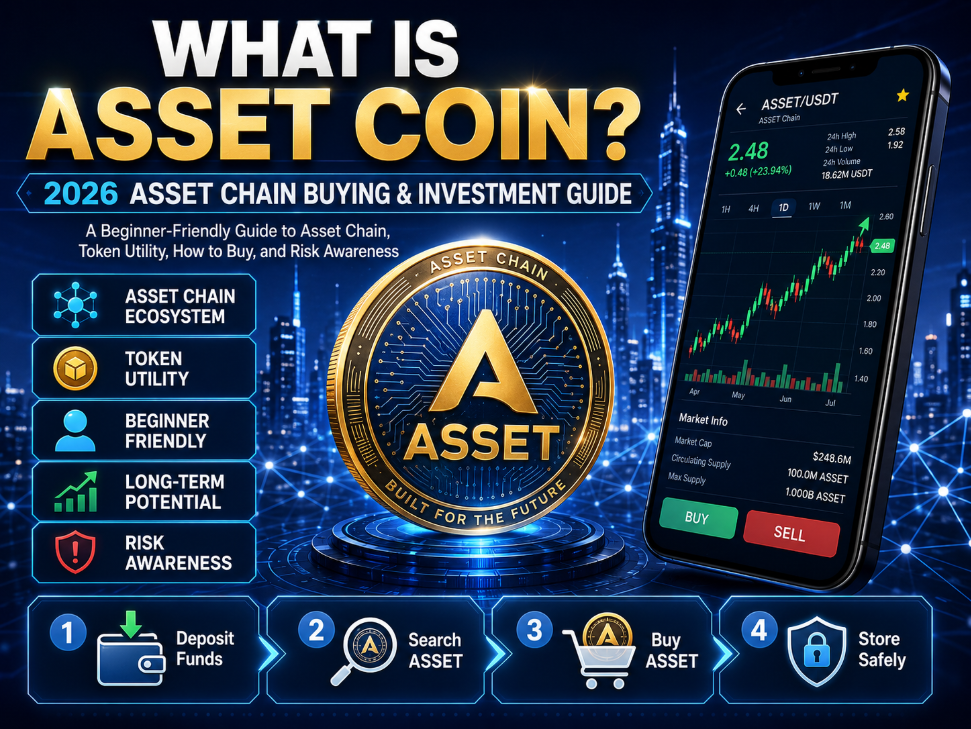
Based on the project's positioning, ASSET is closer to being the native asset of the Asset Chain ecosystem, rather than a general term for all "asset tokens." Asset Chain is a Layer 1 blockchain built for bringing Real World Assets (RWA) on-chain. It aims to provide infrastructure better suited for issuing, managing, trading, and verifying assets like real estate, bonds, stocks, gold, commercial paper, and yield rights on the blockchain.
However, a crucial point must be clarified: current public information shows ASSET and RWA naming conventions existing in parallel.
According to public materials from Asset Chain and Xend Finance, Xend Finance's early token was XEND. As the project pivoted toward bringing real-world assets on-chain, XEND was set to migrate or rebrand to RWA. In Asset Chain's official documentation, RWA is also referenced as the asset used for native tokens, Gas fees, staking, and validator nodes on the Asset Chain.
Meanwhile, on some market platforms, the project appears as Asset (ASSET) and is marked as an early-stage project without complete trading data. This means that for everyday users, the most important thing is not memorizing the name, but learning how to verify facts:
- Does the official website use ASSET or RWA?
- What trading pair is shown on the exchange's listing page?
- What is the native asset ticker on the block explorer?
- Are there official announcements regarding old token migration, new token mapping, or brand upgrades?
- Are the deposit addresses, withdrawal networks, and contract addresses sourced directly from official channels?
In simple terms:
ASSET is not a catch-all term for "all asset tokens"; it is a specific cryptocurrency name tied to the Asset Chain ecosystem. RWA is the broader industry direction of tokenizing real-world assets, and it was also an important ticker in the Xend Finance ecosystem. When understanding ASSET, view it within the context of the Asset Chain RWA public chain ecosystem, not as a voucher pegged to a specific house, stock, or piece of gold.
One-sentence summary:
ASSET is a native asset name related to the Asset Chain ecosystem, serving the RWA public chain infrastructure rather than acting as an on-chain map of a single real-world asset.
2 | Why Build a Dedicated "RWA Public Chain"? What Real Problems Does ASSET Solve?
RWA stands for Real World Assets. It refers to moving off-chain physical or traditional assets onto the blockchain via legal frameworks, custody, data verification, and smart contracts, allowing them to be fractionalized, transferred, collateralized, traded, or integrated into DeFi applications.
Common RWA types include:
- Real estate.
- Government and corporate bonds.
- Gold and commodities.
- Stocks and fund shares.
- Commercial paper, accounts receivable, and yield rights.
- Copyrights, art, and equipment assets.
However, bringing real-world assets on-chain is not as simple as "issuing a token." There are five main challenges:
First, the authenticity of the asset is hard to verify.
If a project claims a token represents a building, a batch of gold, or a stock, users care less about the smart contract code and more about: Does the asset actually exist? Who owns it? Who custodies it? Is it over-collateralized? Can it be redeemed? What legal rights do token holders have if the issuer defaults?
Second, aligning off-chain rights with on-chain tokens is difficult.
Blockchains excel at recording transfers and contract states, but property deeds, securities registration, custody agreements, yield attribution, and bankruptcy liquidation priorities still exist within real-world legal systems. The core of RWA is not merely "tokenizing" an image but legally binding the on-chain token to off-chain legal rights.
Third, different assets require different compliance rules.
The regulatory nature of stocks, bonds, funds, real estate, gold, and yield rights varies entirely. Some assets may be classified as securities, requiring accredited investor thresholds, KYC/AML checks, and cross-border sales restrictions.
Fourth, trading and settlement must be low-cost.
If every asset transfer incurs high Gas fees or suffers from slow confirmation times, RWA tokens will struggle to support high-frequency settlement, on-chain composability, collateralized lending, and global liquidity.
Fifth, institutions need controllable, auditable, and scalable infrastructure.
Traditional institutions entering the RWA space don't just look for "fast blockchains." They look for compliance whitelists, asset issuance management, permission controls, multisig/custody support, auditability, data tracking, and stable developer tools.
This is why projects like Asset Chain are building dedicated RWA public chains. Compared to deploying standard RWA contracts directly on Ethereum, an independent Layer 1 offers several advantages:
- It can design a lower fee structure tailored to RWA scenarios.
- It can bake asset issuance, verification, compliance, and node incentives into the network natively.
- It can increase transaction speeds and improve user experience.
- It can provide developers with unified asset standards.
- It can optimize the real-world asset onboarding process at the foundational network level.
Asset Chain's core selling points include:
- EVM Compatibility: Developers can use Ethereum-like tools and smart contracts.
- Lachesis PoS Consensus: Emphasizes fast finality, low costs, and security.
- High TPS and Sub-second Finality: Aims to make asset transfers, swaps, and on-chain interactions smoother.
- Node Tokenization: Treats the validator node itself as a participatory, yield-generating on-chain asset.
- RWA-centric Onboarding Framework: Goes beyond merely issuing tokens by building infrastructure around asset issuance, management, verification, and trading.
This is why ASSET is worth paying attention to: it isn't just telling an "asset on-chain story," but attempting to become the foundational network fuel for RWA issuance and circulation.
However, this also creates a clear benchmark for success: If Asset Chain fails to attract enough real assets, developers, trading volume, and users, ASSET's value proposition will be very limited. Conversely, if it truly becomes the foundational layer for a wave of RWA projects, ASSET could generate sustained network demand.
3 | What is the ASSET Token Used For? Use Cases and Tokenomics
Judging whether a token is worth your attention requires looking beyond its name, concept, or short-term pumps to see if it has genuine use cases. A token with a foundation for long-term value generally must meet several conditions:
- Users must need it to perform on-chain actions.
- Network growth must drive an increase in token demand.
- The token is not just a reward point but integral to ecosystem operations.
- Token release, staking, fee distribution, and governance mechanisms are relatively clear.
- The project team cannot infinitely inflate the supply to dilute users.
Based on Asset Chain's positioning, the potential use cases for the ASSET/RWA ecosystem token include the following:
3.1 Gas: Foundational Fuel for On-Chain Operations
On a public chain, Gas is the most basic source of demand. Users generally need to pay network fees when performing actions on Asset Chain, such as transferring funds, swapping assets, interacting with smart contracts, buying or moving on-chain assets, participating in asset onboarding, using DEXs, deploying contracts, or calling asset management functions. If the ecosystem thrives, Gas demand will rise alongside transaction volume.
3.2 Staking: Securing the Network and Earning Yield
Asset Chain utilizes a PoS mechanism, where staking plays a vital role in network security. Validator nodes must lock a certain amount of native assets to verify transactions and maintain the network state. Honest nodes earn rewards, malicious or negligent nodes face slashing, and everyday users can delegate their tokens to earn a share of the yield. This provides users a way to participate beyond just holding and helps reduce the tradable supply on the market.
3.3 Node Tokenization: Turning Node Yields into Participatory Assets
A defining feature of Asset Chain is node tokenization. Traditionally, running a PoS validator requires technical skills and high capital. Node tokenization attempts to change this by treating the validator node as a cash-flow-generating infrastructure asset. By splitting and tokenizing node yields, everyday users can share in the profits, making a high-barrier asset highly accessible—perfectly aligning with the core RWA philosophy.
3.4 Governance and Ecosystem Incentives
If ASSET/RWA takes on governance functions, holders might vote on network parameters, fee distribution rules, ecosystem fund allocation, asset standard upgrades, cross-chain bridge integrations, or major contract upgrades. However, users should verify if voting is genuinely executed on-chain or if power remains centralized with whales and the foundation.
3.5 Supply, Max Supply, and Unlocking Schedule
For ASSET's max supply, initial circulation, token distribution, and unlock schedule, you must refer to the official whitepaper, TGE announcements, and exchange disclosures. Before investing, check for lock-up periods, monthly/quarterly unlock rates, market-maker arrangements, and any mapping relationships between XEND, RWA, and ASSET to avoid buying into massive unlock-driven sell pressure.
To understand the analytical framework for utility-driven tokens, you can refer to "What is BR". While BR and ASSET belong to different sectors, both can be evaluated by asking, "Is the token actually being used by the network?"
4 | Should You Buy It Now? Checking ASSET's Launch Status and Liquidity
Because ASSET/Asset Chain may still be in its early phases, public market data, exchange support, contract addresses, and naming conventions can change rapidly. Failing to verify these can lead to buying fake tokens or falling into low-liquidity traps.
4.1 How to Confirm if ASSET Has Officially Launched
Do not rely solely on community screenshots or random links. Verify in this order:
First, check official announcements.
Check the official website, Twitter/X, Telegram/Discord, official Medium/Blog, and the whitepaper for official TGE, exchange listing, deposit network, and contract address announcements. If the team hasn't announced it, do not buy a "front-run ASSET."
Second, check exchange announcements.
If an exchange is listing ASSET, there should be an official announcement detailing the coin name, trading pair, deposit/withdrawal times, supported networks, and the contract address or mainnet info.
Third, check market data platforms.
Use CoinGecko, CoinMarketCap, GeckoTerminal, DEX Screener, exchange pages, and block explorers. If platforms show "Preview Only" or lack price data, the token has not established public liquidity.
4.2 How to Verify the Contract Address using a Block Explorer
If ASSET is a mainnet coin, check the mainnet explorer. If it is an ERC-20, BEP-20, or other standard token, verify the contract address:
- Copy the address from the official website or announcement.
- Search it on the relevant block explorer.
- Check the token name, ticker, and decimals.
- Verify if the contract is authenticated, check holder distribution, and watch for suspicious minting functions or trade restrictions.
- Cross-reference the address with CoinGecko/CMC/Exchange data.
Simple Rule: If the contract address cannot be cross-verified through official channels and authoritative market platforms, do not buy it.
4.3 How to Evaluate Liquidity
Even if ASSET is live, it doesn't mean you should buy it. Look at three metrics:
- 24-Hour Trading Volume: Low volume means you might buy in but won't be able to sell without massive slippage.
- Order Book Depth: Check the spread between the highest bid and lowest ask. See if a large buy/sell order will drastically spike or crash the price.
- Exchange Quality and Trust Score: Trading solely on small DEXs carries significantly higher risks than trading on tier-1 centralized spot markets.
4.4 Who Should Pay Attention to ASSET Right Now?
If ASSET is still in early or pre-launch stages, it is suited for research-oriented users familiar with RWAs, who know how to read block explorers, can tolerate high volatility, and implement strict position sizing. It is not suited for beginners who don't understand contract addresses, buy blindly based on community hype, use borrowed money, or cannot handle 50%+ drawdowns.
5 | Step-by-Step Guide to Buying ASSET on HiBT
Below is a general guide for beginners buying ASSET, using HiBT as an example. If you cannot find ASSET or RWA trading pairs on HiBT, the token may not be listed yet, is restricted in your region, or uses a different ticker.
Step 1: Register a HiBT Account and Complete KYC
Open the HiBT website or App, register via email or phone, and immediately set up basic security (strong password, 2FA, anti-phishing code, fund password). Then, submit your KYC. KYC is crucial for compliant exchanges to meet AML regulations, especially for RWA and tokenized securities which have stricter compliance rules than standard crypto assets.
Step 2: Deposit Funds (Fiat or Stablecoins)
You can deposit fiat if HiBT supports your local banking or P2P channels to buy USDT/USDC. Alternatively, deposit stablecoins from an external wallet. Ensure you select the correct network (e.g., TRC-20 vs ERC-20)—sending to the wrong network will result in permanent loss of funds.
Step 3: Search for the ASSET Trading Pair
Navigate to the spot market and search for ASSET, ASSET/USDT, RWA, RWA/USDT, or Asset Chain. Verify it is the official listing, has sufficient volume, and open deposits/withdrawals. Ignore "internal presale channels" sent by third parties.
Step 4: Choose Between Market and Limit Orders
- Market Orders: Execute immediately at the best available price. Easy to use, but risky for low-liquidity coins due to massive slippage.
- Limit Orders: You set the price. The order only fills if the market reaches your target. Highly recommended for early-stage tokens like ASSET to avoid accidentally spiking the price with a large buy order.
Step 5: Post-Trade: Keep on Exchange vs. Withdraw to Wallet
- Keeping on Exchange: Convenient for trading and you don't manage private keys, but you bear exchange custody risks.
- Withdrawing to Wallet (e.g., MetaMask): Gives you full control to participate in on-chain DeFi, but requires adding the correct Asset Chain RPC details and safeguarding your private keys from phishing attacks.
To understand buying tokens that represent underlying assets, consider tokenized stocks like NVDAB. While ASSET is a native public chain asset and NVDAB is an underlying stock map, both require you to fully understand what the token you are buying actually represents.
6 | How Much is ASSET Worth? Multi-Scenario Price Projections
Conclusion first: Until ASSET has a stable public trading price, clear initial circulation, a complete unlock schedule, and sustained exchange data, any precise price prediction is unreliable. A more responsible approach is to use scenario modeling based on a baseline price (P0).
Conservative Scenario
Core Assumptions: RWA narrative cools down, ecosystem progress is slow, no major exchange listings, low on-chain assets, and continuous unlock sell pressure.
Short-term (6–12 months): Price fluctuates between 0.3 P0 and 1.0 P0. Deep corrections follow initial hype.
Medium-term (1–3 years): Price may trend lower than P0 long-term if unlocks outpace demand.
Neutral Scenario
Core Assumptions: RWA sector grows steadily, Asset Chain meets its roadmap, several real apps launch, stable liquidity forms, and Gas/staking generate baseline demand.
Short-term (6–12 months): Price fluctuates between 0.8 P0 and 2.5 P0, forming market consensus.
Medium-term (1–3 years): If TVL and active addresses grow, the price could reach 2 P0 to 5 P0, dependent on market cycles and unlock schedules.
Optimistic Scenario
Core Assumptions: RWA becomes a core 2026–2028 narrative. Asset Chain attracts massive asset issuers, lists on major exchanges, and sees rapid on-chain growth.
Short-term (6–12 months): Price could reach 2 P0 to 5 P0, driven by major listings, though 30%–60% corrections remain common.
Medium-term (1–3 years): If Asset Chain captures massive RWA market share, the price could reach 5 P0 to 10 P0 or higher, shifting from an "early concept coin" to a "foundational RWA asset."
Model Limitations: These are relative projections based on assumptions, not financial advice. Early token prices are easily manipulated by emotion and low liquidity. Instead of asking "how high will it go," track real asset size, daily active addresses, Gas usage, and exchange depth.
7 | Risks You Must Know Before Buying ASSET
ASSET features a massive narrative but equally complex risks, blending standard crypto volatility with off-chain legal complexities.
7.1 Early Project Risks
Early projects suffer from price discovery issues, poor liquidity, high slippage, and extreme post-launch dumps. They have yet to prove network stability, user adoption, or developer interest.
7.2 RWA Underlying Asset Authenticity Risks
For RWA, the core is the off-chain asset. Does the asset exist? Who audits it? Can you redeem it? If the issuer goes bankrupt, where do you stand in the liquidation hierarchy? If these questions go unanswered, "RWA" is just marketing speak.
7.3 Custody and Issuer Credit Risks
RWAs require issuers, custodians, auditors, legal structures, and price oracles. If a custodian misappropriates funds, or an issuer hides information, the token's value collapses.
7.4 Technical and Smart Contract Risks
As a public chain, Asset Chain faces risks of mainnet outages, RPC instability, bridge hacks, smart contract vulnerabilities, and DEX liquidity pulls.
7.5 Validator Node Centralization Risks
If a few nodes control the majority of the PoS stake, they can centralize block production and governance, censor transactions, or misrepresent node tokenization yields.
7.6 Regulatory Risks
Different jurisdictions view RWAs differently—some treat them as securities, funds, or derivatives, requiring accredited investors and strict cross-border sales blocks. Being on-chain does not bypass the law.
7.7 Anti-Scam Checklist
- Do not enter trading pages via random group links.
- Do not trust "internal presales" or DMs from "official support."
- Do not connect wallets to unknown airdrop sites or grant unlimited approvals.
- Do not copy contract addresses from comment sections.
- Do not share your seed phrase with anyone.
- Do not believe guaranteed yield promises.
Conclusion: Worth Watching, But Learn to Verify First
Asset Chain targets a high-potential sector. Bringing massive traditional financial assets on-chain requires optimized infrastructure for issuance, compliance, and settlement. However, a massive sector does not guarantee the success of a single token.
For beginners, the best strategy is not to buy impulsively, but to build a watchlist tracking official announcements, TVL, active addresses, staking volume, and unlock schedules. Only as these metrics improve can ASSET transition from an early concept to a utility-driven public chain asset.
FAQ
Are ASSET and RWA tokens the same?
Not necessarily. RWA is the industry concept and the intended rebrand ticker for Xend Finance. ASSET is the display name used by some market platforms for the Asset Chain project. Always verify official channels before buying due to parallel naming.
Is ASSET a coin or a token?
If used as the native asset on the Asset Chain mainnet, it acts as a coin. If it exists as a smart contract on another chain during early phases, it is a token. Follow official mainnet details.
Where can I buy ASSET?
If officially launched, you can buy it on exchanges supporting ASSET/USDT or ASSET/USDC. If you can't find it on HiBT, it might not be listed, restricted in your region, or under a different ticker. Avoid unofficial links.
What is the minimum amount of ASSET I can buy?
This depends on the exchange's minimum order size rules and the current token price. Always test with a small amount first.
How does ASSET differ from tokenized stocks like NVDAB?
ASSET is a native public chain asset used for Gas and staking. NVDAB represents price exposure to a specific traditional stock. The assets, risk profiles, and regulatory requirements are entirely different.
Is ASSET the leader of the RWA sector?
It is too early to say. Success depends on real asset scale, developer activity, liquidity, and compliance capabilities. Do not assume success just because it operates in the RWA space.
What is the biggest risk of buying ASSET?
Major risks include early-stage liquidity issues, fake contracts, high volatility, token unlocks, off-chain asset authenticity, custody risks, and regulatory crackdowns.
Is ASSET suitable for long-term holding?
Only if Asset Chain successfully builds genuine network effects (growing TVL, transactions, and developer adoption). If these metrics stagnate, holding carries extreme risks.
Author Info & Disclaimer
Author: HiBT Research Institute Content Team
Editor: HiBT Risk Education Editorial Group
Research Focus: Crypto asset basics, RWA sector, exchange trading processes, token risk education.
Content Type: Crypto education and beginner's buying guide.
Last Updated: June 18, 2026
Risk Disclaimer: This article is for informational and educational purposes only and does not constitute investment, legal, or tax advice, nor a recommendation to buy or sell. The prices of ASSET, RWA, and related crypto assets can fluctuate violently or drop to zero. RWA projects involve complex risks regarding underlying custody, legal rights, securities regulations, and cross-border compliance. Please conduct your own research and make decisions based carefully on your risk tolerance.