
In the crypto market, three-letter token names are the easiest to misread.
When most newcomers see BR for the first time, their instinct might be: Is this a stablecoin? A platform points token? Some new AI or meme coin?
In reality, BR is none of those things.
BR is the native governance and incentive token of the Bedrock protocol — a DeFi protocol built around multi-asset liquid restaking. Its core focus isn't launching a new blockchain or building a standard lending protocol. Instead, it's constructing a multi-asset liquid restaking infrastructure around BTC, ETH, IOTX, and other assets, helping users earn yield while preserving asset liquidity.
The one-liner:
BR's value doesn't rest on a simple crypto narrative. It rests on whether the Bedrock protocol can sustainably attract BTC, ETH, and other major assets into its liquid restaking ecosystem.
This article breaks down 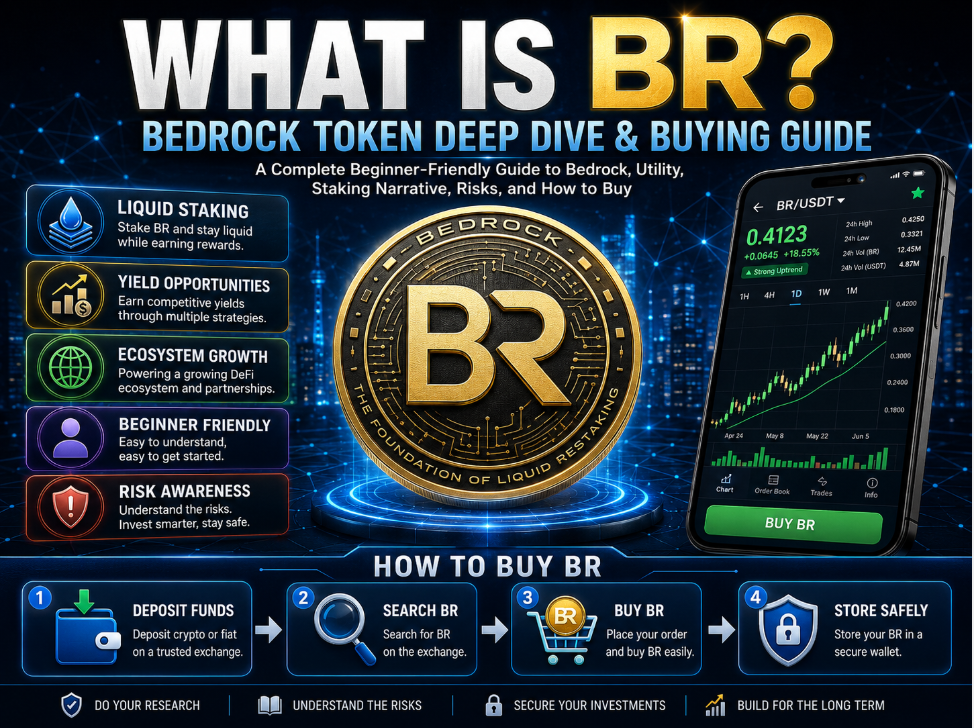 BR comprehensively — what it is, what Bedrock does, how uniBTC, brBTC, and uniETH work, the tokenomics, the price logic, how to buy it, who it's right for, and the risks you need to understand before touching it.
I. What BR Actually Is — Not a Layer 1 Token, Not a Generic DeFi Coin
BR, commonly understood as the Bedrock Token, is the native governance and incentive token of the Bedrock protocol.
It launched in March 2025 via a Binance Wallet IDO, generating substantial market attention — the IDO was oversubscribed by more than 9,653%. That level of demand shows BR attracted enormous early interest, particularly against the backdrop of BTCFi and liquid restaking narratives heating up across the market.
But high subscription enthusiasm doesn't equal low risk, and it doesn't guarantee sustained price appreciation. BR's real value has to be assessed through the lens of the Bedrock protocol itself.
What is the Bedrock protocol?
One-sentence summary:
Bedrock is a multi-asset liquid restaking protocol that lets users stake or restake BTC, ETH, IOTX, and other assets while receiving liquid receipt tokens they can continue using across DeFi.
The problem with conventional staking: once you stake an asset, it's typically locked. You earn yield, but your capital becomes illiquid.
What Bedrock is solving:
- Users want to earn staking yield
- But they don't want to completely sacrifice asset liquidity
- Users want to participate in BTCFi, ETH restaking, and DeFi yield strategies
- But they don't want to manually manage complex positions across multiple protocols
So Bedrock's core value proposition isn't "launching a token." It's building a multi-asset liquid restaking infrastructure layer.
What's the relationship between BR and veBR?
BR is the liquid circulating token. veBR is the vote-escrowed governance token obtained by locking BR.
Think of it this way:
- BR: Transferable, tradeable, the base governance and incentive token of the Bedrock protocol
- veBR: The voting rights token received after locking BR, used primarily for governance, incentive allocation, and protocol revenue-related rights
BR is more of a "liquid asset." veBR is more of a "long-term governance stake."
If you're simply trading BR in the short term, your focus is on price, volume, unlock schedules, market sentiment, and BTCFi sector momentum.
If you lock BR into veBR, your focus expands to include: protocol fee flows, governance voting power, liquidity incentive allocation, long-term ecosystem growth, and whether Bedrock's TVL is sustainably expanding.
This bifurcated design is Bedrock's deliberate attempt to distinguish short-term traders from long-term protocol participants.
What is liquid restaking?
To understand BR, you first need to understand liquid restaking.
Standard staking roughly works like this: you stake your assets, earn yield, but the assets are locked and can't be freely used during the staking period.
Liquid staking goes one step further: you stake your assets and simultaneously receive a liquid receipt token. That receipt token can be traded, used as collateral, deployed in liquidity pools, or further used across DeFi.
Restaking extends this concept further still: assets that have already been staked or wrapped can continue to provide economic security to other networks, protocols, or security layers — earning additional yield in the process.
The core advantages of liquid restaking:
- No full sacrifice of asset liquidity
- Earning yield on top of base staking rewards
- Improved capital efficiency for BTC, ETH, and other major assets
- Brings "idle wallet assets" into active DeFi yield strategies
- Provides security or liquidity support to multiple protocols simultaneously
But this also introduces meaningfully more complex risks:
- Smart contract risk
- Cross-chain bridge risk
- Custody or wrapped asset risk
- Restaking protocol risk
- Liquidity crunch risk
- Unsustainable yield risk
BR is not a token suitable for zero-knowledge retail investors to blindly chase. Its underlying mechanics touch BTCFi, LRT, PoSL, veToken models, and DeFi composite yield strategies — multiple concepts that require genuine understanding.
What chains does BR operate on?
BR's primary circulation environment is the BNB Smart Chain ecosystem, while the Bedrock protocol itself is deployed across Ethereum, Arbitrum, Optimism, and other networks.
Multi-chain deployment is one of Bedrock's defining characteristics.
The advantages:
- Broadens user entry points
- Enhances asset composability
- Increases DeFi use cases
- Brings BTC, ETH, IOTX, and other assets into a unified yield framework
- Strengthens the protocol's TVL expansion capacity
The tradeoffs:
- Higher cross-chain bridge exposure
- Wider smart contract attack surface
- More complex asset transfer pathways
- Higher risk of user operational errors
- More demanding security audit requirements
This is Bedrock's fundamental duality: its opportunity comes from multi-asset, multi-chain, and restaking composability; its risk comes from exactly the same complexity.
II. Bedrock's Core Products — What Are uniBTC, brBTC, and uniETH, and How Do They Relate to BR?
Assessing whether BR has long-term value requires looking beyond the BR token itself.
BR's value foundation rests on whether people are actually using the Bedrock protocol, whether TVL is growing, and whether its core products can attract meaningful BTC, ETH, and other major assets into the ecosystem.
Bedrock's most important products include uniBTC, brBTC, uniETH, and uniIOTX. The three attracting the most market attention are uniBTC, brBTC, and uniETH.
What is uniBTC?
uniBTC is best understood as Bedrock's BTC liquid restaking receipt token.
When users deposit eligible BTC or wrapped BTC assets into Bedrock, they receive uniBTC. This token represents their BTC-related rights within the Bedrock protocol while remaining deployable across DeFi.
Primary use cases for uniBTC:
- Represents the user's staked or restaked BTC position
- Participates in DeFi liquidity pools
- Used as collateral
- Earns BTCFi-related yield
- Moves across multi-chain ecosystems
- Participates in Bedrock ecosystem incentives
For BTC holders, uniBTC's appeal is straightforward: rather than passively sitting on BTC, users can attempt to earn additional on-chain yield without directly selling their BTC.
But it carries real risk.
What you hold isn't native BTC — it's a BTC equity receipt that's been wrapped and mapped through the protocol. This means you're accepting protocol risk, contract risk, cross-chain risk, and reserve verification risk simultaneously.
What is brBTC?
brBTC is one of Bedrock's core products developed specifically for BTCFi 2.0.
If uniBTC is best described as a "BTC liquid restaking receipt," brBTC is better described as a "gateway asset that aggregates multiple BTCFi yield pathways."
brBTC is designed to solve the BTCFi yield fragmentation problem.
In early BTCFi, users might have needed to separately research and navigate Babylon, Kernel, Pell, SatLayer, Lombard, and other BTC restaking or yield protocols — each with different rules, risk profiles, yield sources, and liquidity characteristics. Most users couldn't realistically evaluate all of them.
What brBTC offers:
- Aggregates multiple BTCFi yield sources for the user
- Reduces the cost and friction of manually switching between protocols
- Improves overall BTC capital utilization
- Provides a unified entry point for multi-layer yield strategies
- Reinforces Bedrock's position as a hub in the BTCFi ecosystem
This is a central pillar of BR's value thesis.
If brBTC becomes the primary gateway for more BTC holders entering BTCFi, Bedrock's TVL and protocol revenue could increase materially — and BR's governance value and incentive value would strengthen alongside it.
What is uniETH?
uniETH is Bedrock's liquid asset targeting the Ethereum staking and restaking ecosystem.
It primarily addresses several pain points for ETH holders:
- Want to participate in ETH staking without losing liquidity
- Want to participate in EigenLayer and similar restaking ecosystems without navigating excessive complexity
- Want additional incentives on top of base ETH yield
- Want to continue deploying staking receipts across DeFi
Compared to Lido's stETH:
- stETH is the dominant liquid staking asset in the Ethereum ecosystem with stronger brand recognition and liquidity
- uniETH emphasizes restaking and Bedrock's multi-asset framework
- stETH has deeper market acceptance; uniETH offers more upside elasticity tied to restaking ecosystem expansion
- stETH is more mature; uniETH is earlier-stage with more execution risk
uniETH isn't simply replicating stETH — it layers restaking logic on top of a liquid staking foundation. But precisely because it's more complex, uniETH carries a higher risk profile than straightforward ETH holding.
What is the PoSL mechanism?
PoSL can be understood as Bedrock's Proof of Staking Liquidity mechanism.
Its core objective: let users earn yield through staking or restaking while preserving meaningful liquidity and governance participation rights.
PoSL broadly addresses three types of relationships:
Asset yield relationship: Users deposit BTC, ETH, IOTX, or other assets into the protocol, receive corresponding liquid receipt tokens, and connect to yield sources through the protocol.
Liquidity relationship: The assets users receive — uniBTC, brBTC, uniETH, etc. — can continue to be used across DeFi rather than being fully locked.
Governance incentive relationship: BR and veBR participate in protocol governance, incentive allocation, and potential protocol revenue flows, giving long-term participants a structural reason to support the protocol's development.
The upside of this model is higher capital efficiency. The downside is higher system complexity.
What's the relationship between Bedrock, Babylon, and EigenLayer?
Bedrock's growth is closely tied to two key ecosystems: Babylon (BTC staking and BTCFi) and EigenLayer (ETH restaking).
Babylon's significance: it transforms BTC from a passively held asset into one that can participate in broader security and yield systems.
EigenLayer's significance: it enables staked ETH to provide security to additional actively validated services, unlocking additional yield opportunities.
Bedrock, as a liquid restaking protocol, connects to these ecosystems by:
- Providing BTC holders with uniBTC, brBTC, and similar liquid assets
- Providing ETH holders with uniETH and similar restaking assets
- Converting underlying assets into composable DeFi receipts
- Expanding asset use cases through multi-chain deployment
- Incentivizing long-term participation through BR and veBR
If Babylon and EigenLayer continue growing, Bedrock's ecosystem value gets amplified. If either of these underlying ecosystems underperforms expectations, BR's long-term support weakens proportionally.
Why does reserve transparency matter?
One of the biggest concerns for protocols like Bedrock is that users can't easily verify whether wrapped assets actually have adequate backing.
For example, users holding uniBTC fundamentally need to know: Is there actually enough BTC backing this uniBTC?
Bedrock integrates with DeFiLlama, Chainlink Proof of Reserve, and Secure Mint to make reserve data as on-chain verifiable as possible.
What this means for users:
- Reduces the risk of uncollateralized minting
- Improves asset transparency
- Lets users independently verify reserve status
- Increases DeFi protocol acceptance of uniBTC and similar assets
- Lowers the trust cost associated with "black box" wrapped assets
One important caveat: reserve proofs enhance transparency but cannot eliminate all risk. They don't fully cover smart contract vulnerabilities, cross-chain bridge attacks, governance failures, or extreme liquidity crises.
III. BR Tokenomics in Full — 1 Billion Total Supply: How Much Is Circulating, and Who's About to Sell?
Short-to-medium-term BR price assessment requires looking at token supply dynamics, not just protocol fundamentals.
One of the most common and costly mistakes beginners make: focusing on the project story without reading the unlock schedule. No matter how strong a project's potential, if large unlock volumes hit in the near term and buying pressure is insufficient, prices can still fall.
What is BR's total supply?
BR has a total supply of 1 billion tokens.
Current circulating supply is approximately 250 million tokens — around 25% of total supply.
That means roughly 75% of all BR tokens have yet to fully enter the market.
This is critically important for investors. BR isn't a fully circulated mature token. It's a newer token still in an active release cycle. Future unlocks will continue to influence market supply on an ongoing basis.
Why does the June 20, 2026 unlock matter?
One of BR's most significant near-term events is the token unlock scheduled for June 20, 2026.
This unlock is expected to release approximately 40.63 million BR tokens — roughly 4.1% of total supply.
The breakdown includes:
- Founding team unlock: approximately 25 million BR
- Seed round investor unlock: approximately 15.63 million BR
Why is this event sensitive?
Because founding teams and early investors typically have very low cost basis. Once tokens unlock, they don't necessarily sell immediately — but markets will price in the potential sell pressure well in advance.
Historical patterns for similar token unlock events:
- Markets often de-risk preemptively before the unlock date
- Short-term traders choose to sell and wait on the sidelines
- Market makers reduce inventory risk
- If no large selling materializes post-unlock, prices may recover
- If tokens are transferred to exchanges in bulk after unlock, prices may face continued downward pressure
An unlock doesn't guarantee a crash. But it is always a meaningful variable in near-term price volatility.
For beginners, the most prudent approach isn't blindly buying into an unlock — it's observing: trading volume changes around the event, whether team and investor addresses are moving tokens, whether exchange net inflows are increasing, whether price is breaking key support levels, and whether Bedrock is releasing ecosystem positive catalysts to offset selling pressure.
How should we read BR's token allocation structure?
BR's allocation broadly covers:
- Community airdrop and ecosystem incentives
- Founding team
- Early investors
- Market and partnership allocations
- Strategic reserves
- IDO issuance
- Liquidity provision
The categories most likely to generate near-term price pressure are typically: team unlocks, early investor unlocks, market incentive releases, and selling following the end of liquidity incentive programs.
Community incentives look bullish on the surface — they attract users to the ecosystem. But if incentivized users are purely farming to sell, they become a source of chronic sell pressure.
This is the common DeFi token dilemma: TVL can be inflated through incentives, but token price doesn't necessarily follow.
What is the veBR lock-up mechanism for?
veBR is the vote-escrowed governance version of BR.
Users who lock BR into veBR typically gain access to:
- Governance voting rights
- Influence over incentive allocation
- Protocol revenue-related rights
- Higher weighting in long-term participation rewards
veBR's potential price effect on BR is supply reduction.
If a meaningful share of users voluntarily lock BR into veBR, the tradeable BR supply decreases, which may reduce near-term sell pressure.
Whether this mechanism actually works depends on three conditions.
First, lock-up rewards must be sufficiently attractive. If veBR yields are unimpressive, users won't commit to long-term lock-ups.
Second, protocol revenue must be genuinely growing. Only when the protocol generates real fees does the long-term value of veBR become convincing.
Third, the market must believe in Bedrock's long-term trajectory. If users are primarily short-term speculators, the veBR mechanism won't be enough to keep them committed.
veBR is a potential value support mechanism for BR — not a guaranteed price floor.
Where does BR's current price stand?
BR's all-time high was approximately $0.26. Current price has been fluctuating in the $0.15–$0.17 range, representing a meaningful pullback from the peak.
This pullback could mean either of two things.
The opportunity case: If Bedrock TVL continues growing, brBTC adoption increases, and the BTCFi sector keeps heating up, BR may have room for valuation recovery.
The risk case: If unlock sell pressure intensifies, liquidity deteriorates, and BTCFi enthusiasm fades, BR may continue searching for lower support.
Judging whether current price is "cheap" cannot be done by simply measuring the percentage decline from the all-time high.
More useful lenses:
- The gap between market cap and FDV
- The pace of upcoming unlocks
- Protocol revenue trajectory
- TVL quality (organic vs. subsidized)
- Token holder address distribution
- Exchange-side liquidity depth
- BTCFi sector momentum
- Whether BR is actually capturing protocol value
How does protocol fee revenue flow back to veBR holders?
The long-term value thesis for BR hinges on one core question: does protocol growth actually translate into token value?
If Bedrock's protocol fees, redemption fees, liquidity management revenue, or ecosystem income can flow back to veBR holders through a clear mechanism, then BR isn't merely a governance ticket — it becomes a protocol token with a genuine cash flow rationale.
This logic holds only when:
- The protocol is generating real revenue
- Revenue distribution mechanisms are transparent
- veBR holders actually benefit in practice
- Incentives are not primarily maintained through token issuance alone
- TVL isn't a short-term subsidy-driven illusion
If protocol revenue is insufficient, BR's price becomes far more vulnerable to market sentiment swings and unlock-driven selling.
IV. BR's Price Logic and Key Drivers — What's Pushing It Up, and What's Holding It Down?
BR's price isn't determined by any single factor. It's simultaneously influenced by BTCFi sector temperature, Bedrock TVL, token unlocks, market liquidity, BTC market cycles, protocol security events, and the competitive landscape.
1) BTCFi sector momentum
One of BR's most important narratives is BTCFi.
BTC is the world's largest crypto asset — yet historically, enormous quantities of BTC have sat passively in wallets and on exchanges, never entering DeFi yield ecosystems.
The core BTCFi question is: how do you make BTC behave like ETH — participating in staking, lending, yield strategies, liquidity provision, and restaking?
If this sector succeeds, the theoretical ceiling is very high. Even a small percentage of global BTC supply entering DeFi could generate enormous TVL.
Bedrock is currently attracting BTC into its ecosystem through uniBTC, brBTC, and related products.
If more BTC holders embrace BTCFi going forward, BR could benefit substantially. But if BTCFi proves to be a short-lived trend — with users discovering unstable yields or excessive risk — TVL could unwind quickly.
2) Babylon's development trajectory
Babylon is one of BTCFi's most important infrastructure layers, enabling BTC to participate in broader security and staking systems.
Bedrock's synergy with Babylon is a central component of BR's value thesis.
If Babylon's ecosystem expands rapidly:
- BTC staking demand increases
- uniBTC and brBTC use cases expand
- Bedrock TVL may rise
- BR's governance and incentive value strengthens
If Babylon's progress disappoints:
- BTCFi narrative cools
- brBTC's appeal diminishes
- Bedrock growth slows
- BR's valuation may compress
Monitoring BR means monitoring Babylon — not just Bedrock's own announcements.
3) BTC market cycle
The relationship between BR and BTC isn't a simple correlation, but BTC cycles profoundly shape BR's trajectory.
In a BTC bull market:
- Investor risk appetite increases
- BTC holders are more willing to experiment with DeFi yield
- BTCFi TVL grows more easily
- BR is more likely to command a market premium
- Small-to-mid-cap DeFi tokens show higher upside elasticity
In a BTC bear market:
- Users retreat toward cold wallets and stablecoins
- DeFi TVL shrinks
- Restaking yield loses its appeal
- BR may face simultaneous price decline and TVL contraction
- Liquidity deteriorates and slippage widens
BR is clearly a risk-appetite-sensitive asset. It isn't BTC, and it isn't ETH — it's a high-beta DeFi protocol token that amplifies directional crypto moves.
4) The liquidity crisis warning
BR has already experienced a highly instructive liquidity risk event.
In July 2025, multiple addresses withdrew large sums from PancakeSwap liquidity pools in a short window — totaling over $47 million. BR's price dropped sharply in a compressed timeframe.
This event exposed several structural vulnerabilities:
- BR's on-chain liquidity structure was not as robust as surface metrics suggested
- Large LP withdrawals rapidly amplify price volatility
- Market-making and incentive-driven liquidity isn't reliably durable
- High 24-hour trading volume doesn't guarantee adequate order book depth
- Mid-cap DeFi tokens are highly susceptible to cascading price collapses
The biggest lesson for investors: don't just look at 24-hour trading volume. Also examine order book depth, DEX pool stability, LP concentration, and large holder address behavior.
5) Competitive pressure
Bedrock's sector is not short on competition.
In ETH liquid staking, Lido is the undisputed category leader.
In ETH restaking, EigenLayer, Ether.fi, and Renzo all have significant market presence.
In BTCFi, Babylon itself, pStake, Lombard, Solv, Kernel, and others are all competing for BTC liquidity.
The main sources of competitive pressure on Bedrock:
- Protocols with stronger brand recognition
- Assets with deeper liquidity
- More aggressive yield incentive programs
- Lower-risk custody structures
- Native products with more direct Babylon integration
- More mature DeFi integration networks
BR's long-term value depends on whether Bedrock can establish durable differentiation amid this competition.
If Bedrock remains just one of many BTCFi entry points, BR's valuation upside is constrained. If Bedrock becomes a genuine hub for BTCFi asset aggregation and liquid restaking, BR could command a meaningful premium.
V. How to Buy BR on HiBT — A Simple Step-by-Step Walkthrough
If you've worked through BR's project mechanics and risk profile, and you've decided to participate, you can purchase it through platforms supporting BR/USDT trading. Here's a walkthrough using HiBT as an example.
HiBT is a digital asset trading platform. Per its public disclosures, it is registered in Canada, holds MSB licenses in both the US and Canada, is headquartered in Dubai, and implements cold wallet storage and multi-signature security architecture.
Buying BR comes down to five steps.
Step 1: Register a HiBT account
Sign up using your email or phone number, set a strong password, and enable two-factor authentication immediately.
Step 2: Complete KYC identity verification
This typically requires submitting a government-issued ID — a national ID card, driver's license, or passport. Beginners are advised to complete KYC before depositing funds or placing any trades.
Step 3: Deposit USDT
Since the target trading pair is BR/USDT, depositing USDT is the most direct path. Always confirm you're using the correct network before sending — selecting the wrong chain can result in permanent loss of funds.
Step 4: Search for BR/USDT
Navigate to the spot trading section, search for BR, and confirm the project name is Bedrock. Because "BR" is a very short ticker, there's a real risk of accidentally buying an unrelated token with the same symbol — always verify the full project name.
Step 5: Choose your order type
BR is a mid-to-small-cap token with meaningfully less liquidity than BTC or ETH. Limit orders are generally preferable for new investors, especially for larger position sizes. Splitting orders into multiple tranches reduces slippage exposure.
After taking a position, prioritize monitoring:
- Bedrock protocol TVL
- BR unlock schedule
- BR trading volume and order book depth
- BTCFi sector sentiment
- Babylon ecosystem progress
- Official project announcements and any security incidents
- Whether large holder addresses are transferring tokens to exchanges
One important distinction worth making: BR is a native DeFi protocol token, while products like TSLAB (tokenized Tesla stock) belong to the tokenized equities category. Their risk structures are entirely different. BR's price derives from protocol ecosystem dynamics and token supply/demand mechanics, while tokenized stocks are primarily anchored to the underlying equity's real-world price.
VI. Who Should Actually Participate in BR — Are You Here for Yield or Speculation?
BR isn't right for everyone.
It's neither a low-risk asset nor a straightforward "buy and wait for appreciation" blue-chip. Different participation approaches carry completely different risk profiles.
Type 1: Direct BR holders
These users buy BR as a directional bet on:
- BTCFi sector continued expansion
- Bedrock TVL growth
- Rising brBTC and uniBTC adoption
- Strengthening veBR governance value
- Unlock sell pressure being absorbed by the market
- Mid-to-small-cap DeFi token valuation recovery
This approach carries the highest risk — you're directly exposed to BR price volatility.
Who it suits:
- Those who understand DeFi and restaking mechanics
- Those who can absorb 30%+ drawdowns without panic
- Those who actively track unlock schedules and on-chain data
- Those who won't concentrate their entire portfolio in one position
- Those with a pre-defined stop-loss plan
- Those willing to accept the risk profile of mid-to-small-cap tokens
Who it doesn't suit:
- Complete beginners
- Those who follow influencer calls without independent research
- Those who can't handle sharp drawdowns emotionally
- Those who don't understand unlock sell pressure
- Those seeking stable, predictable returns
- Those who don't have time to track project developments
Type 2: Yield participants via uniBTC, brBTC, or uniETH
These users don't necessarily buy BR directly. Instead, they deploy BTC, ETH, or other assets into the Bedrock protocol to earn liquid restaking yield.
The core risk here isn't BR price volatility — it's protocol risk.
Primary risks include:
- Smart contract vulnerabilities
- Reserve asset risk
- Cross-chain bridge risk
- Restaking yield variability
- LRT discount risk (receipt tokens trading below par)
- Redemption risk in extreme market conditions
Who this suits:
- Long-term BTC or ETH holders looking to improve capital efficiency
- Those who understand DeFi protocol risk
- Those not chasing short-term price appreciation
- Those more focused on yield rates and asset security than price action
But it's not risk-free yield. BTCFi returns can look attractive on the surface while layering in multiple levels of protocol exposure underneath.
Type 3: Long-term veBR participants
These users behave more like long-term protocol supporters.
They lock BR into veBR in exchange for governance voting rights and potential protocol revenue entitlements.
Who this suits:
- Those with genuine long-term conviction in Bedrock
- Those willing to sacrifice liquidity for governance rights
- Those interested in protocol governance participation
- Those who want a stake in incentive allocation decisions
- Those who can accept price volatility during the lock-up period
But locking carries a real cost. If BR's price falls during the lock-up period, veBR holders can't exit flexibly. Whatever governance rights they gain may not compensate for price depreciation.
veBR is best suited for those who genuinely understand the protocol and are committed long-term participants — not short-term speculators.
Type 4: Complete newcomers with no DeFi background
If you have no foundation in DeFi, restaking, BTCFi, unlock schedules, TVL, or liquidity pools, a heavy BR position is not recommended as a starting point.
At minimum, understand these concepts first:
- What is staking
- What is liquid staking
- What is restaking
- What is TVL
- What is a token unlock
- What is a DEX liquidity pool
- What is slippage
- What is smart contract risk
- What is the veToken model
Without clarity on these fundamentals, buying BR easily becomes emotionally driven trading.
It's also worth noting that BR and products like SPCXB (tokenized SpaceX stock) follow entirely different investment logics. SPCXB's value is primarily driven by SpaceX's private valuation and tokenized equity mechanics, while BR is driven by Bedrock's protocol health, BTCFi sector dynamics, token unlock schedules, and DeFi liquidity conditions.
VII. Six Risks Every BR Holder Must Know — These Mistakes Have Cost People Dearly
Investing in BR cannot be reduced to the sentence "BTCFi's future is huge."
The earlier a sector is, the more important it is to put risks front and center.
Risk 1: Token unlock sell pressure
On June 20, 2026, BR will unlock approximately 40.63 million tokens — around 4.1% of total supply.
This includes both founding team and seed round investor allocations.
Teams and early investors don't necessarily sell the moment tokens unlock. But markets will start pricing in that possibility well in advance.
Common patterns:
- Price declines preemptively before the unlock date
- Volatility increases on the unlock day itself
- If no substantial selling materializes, prices may recover
- If tokens are transferred to exchanges in volume, downward pressure continues
- If positive news coincides with the unlock, buying demand may absorb the supply
The takeaway for beginners: never ignore the unlock schedule.
For a token like BR that is still in an active release cycle, supply dynamics directly influence price.
Risk 2: Thin liquidity risk
BR's market depth is far below that of BTC, ETH, or other major assets.
For mid-to-small-cap tokens, the real danger isn't finding buyers on the way up — it's finding buyers when you need to exit.
Thin liquidity problems include:
- Large buy orders push entry cost significantly higher
- Large sell orders cause severe slippage
- No clean exit path in extreme market conditions
- Market makers withdrawing quotes widens spreads abruptly
- DEX liquidity withdrawals trigger cascading price collapses
The 2025 liquidity withdrawal event already proved that BR's price is acutely sensitive to changes in on-chain liquidity depth.
Trading BR requires strict position sizing and avoiding large single market orders.
Risk 3: Protocol security risk
Bedrock is a liquid restaking protocol — its contract and asset pathways are considerably more complex than those of a simple token.
Potential vulnerabilities exist across:
- BTC wrapped asset mechanisms
- ETH restaking asset structures
- Multi-chain bridges
- Price oracles
- Reserve proofs
- DEX liquidity pools
- Yield aggregation strategies
Any one of these failure points could impact user asset security.
Bedrock's integration with Chainlink Proof of Reserve and Secure Mint improves reserve transparency and minting security. But "audited" and "reserve-proven" do not mean zero risk.
DeFi history is filled with audited protocols that were subsequently exploited.
Risk 4: Competitive landscape risk
BTCFi is a high-potential sector — but the final competitive landscape hasn't been determined.
Bedrock could be one of the winners. It could also be marginalized by stronger protocols.
Competition may come from:
- Babylon's native ecosystem products
- pStake, Lombard, Solv, Kernel
- Other BTC yield protocols
- Centralized exchange BTC yield products
- More mature ETH restaking protocols
If users discover that competing protocols offer higher yields, lower risk, or better liquidity, Bedrock's TVL could bleed away.
Once TVL declines, BR's market narrative weakens alongside it.
Risk 5: Decentralization and governance risk
BR has a veBR governance mechanism, but early-stage projects typically still have significant team influence over protocol decisions.
Potential concerns:
- Core protocol parameters controlled primarily by the founding team
- Incentive allocation not fully transparent
- Large token holders commanding outsized governance power
- Early investors having an outsized effect on price
- Community governance not yet mature
Decentralization isn't achieved simply by writing it into a whitepaper. Real decentralization requires time, genuine community participation, transparent execution, and actual power distribution.
Risk 6: Macro and crypto market correlation risk
BR is a mid-to-small-cap DeFi token with high sensitivity to broader risk appetite.
If BTC experiences a sharp decline, BR may face compounding pressure:
- Crypto market sentiment turns broadly negative
- BTCFi TVL experiences net outflows
- Users reduce DeFi risk exposure across the board
- BR liquidity deteriorates further
- Unlock-driven sell pressure becomes far harder for the market to absorb
In bull markets, BR may outperform BTC to the upside. In bear markets, it may underperform BTC to the downside — and by a significant margin.
This is the nature of high-beta assets.
Is BR Worth Buying Right Now?
Viewed purely through a sector lens, BR has genuine appeal.
The case for:
- BTCFi remains in early innings
- BTC asset base is enormous in absolute terms
- Bedrock has developed a coherent product matrix — uniBTC, brBTC, uniETH — rather than a single token
- Babylon and EigenLayer ecosystems provide external growth vectors
- veBR mechanism provides a foundation for long-term governance participation
- Protocol TVL has established meaningful initial scale
The case against:
- June 20, 2026 unlock is a significant near-term overhang
- Circulating supply is still only around 25% of total — substantial future dilution ahead
- A liquidity crisis has already occurred once in BR's short history
- Mid-to-small-cap token volatility is extreme
- BTCFi's business model hasn't been fully validated at scale
- Competitive pressure from well-resourced protocols is real
The rational conclusion:
BR is appropriate for high-risk-tolerance investors who understand BTCFi and DeFi mechanics, can genuinely absorb large drawdowns, and are willing to take a small, disciplined position. It is not appropriate for complete beginners making concentrated bets.
If you're considering a BR position:
- Don't chase price into the June 20 unlock
- Build in tranches and observe carefully
- Start small and treat initial exposure as exploratory
- Monitor TVL and on-chain data actively
- Avoid large single market orders
- Set a defined stop-loss before entry
- Don't treat BR as a stable yield instrument
BR's opportunity lies in BTCFi's long-term future. BR's risk lies in its near-term liquidity profile, token unlock dynamics, and the inherent complexity of the underlying protocol.
FAQ: Common Questions About BR and Bedrock
1. What is the BR token?
BR is the native governance and incentive token of the Bedrock protocol, used for governance, ecosystem incentives, veBR lock-up, and protocol value capture.
2. What does Bedrock do?
Bedrock is a multi-asset liquid restaking protocol that enables BTC, ETH, IOTX, and other assets to participate in staking or restaking while maintaining liquidity through assets like uniBTC, brBTC, and uniETH.
3. Is BR a Layer 1 token?
No. BR is not a chain-native gas token. It's the governance and incentive token of the Bedrock DeFi protocol.
4. What's the difference between BR and veBR?
BR is the liquid, circulating token. veBR is the vote-escrowed governance token received by locking BR, typically used for voting, incentive allocation influence, and potential protocol revenue entitlements.
5. What is uniBTC?
uniBTC is Bedrock's BTC liquid restaking receipt token, representing a user's BTC rights after depositing or participating in Bedrock's BTCFi strategies.
6. What's the difference between brBTC and uniBTC?
uniBTC is more of a foundational BTC liquid restaking receipt. brBTC is more of a BTCFi 2.0 aggregation gateway, designed to consolidate multiple BTC yield sources and reduce the complexity users face managing positions across multiple protocols.
7. What are BR's biggest risks?
BR's primary risks include token unlock sell pressure, insufficient liquidity depth, protocol security vulnerabilities, BTCFi competitive dynamics, governance centralization, and downside exposure to broader crypto market cycles.
8. What impact will the June 20, 2026 unlock have on BR?
This unlock involves approximately 40.63 million BR tokens, including team and early investor allocations. It may create short-term price pressure, but the actual impact depends on whether significant selling materializes post-unlock and on the strength of buying demand at that time.
9. Is BR suitable for beginners?
Heavy positions are strongly discouraged for complete newcomers. BR is a high-volatility, mid-to-small-cap DeFi token best suited for users who already understand DeFi, restaking, TVL dynamics, unlock mechanics, and slippage risk.
10. Is buying BR the same as participating in Bedrock staking?
No. Buying BR means holding the protocol token and accepting token price volatility as your primary risk. Participating in Bedrock staking or restaking means deploying BTC, ETH, or other assets into the protocol, with smart contract risk, reserve risk, cross-chain risk, and protocol yield risk as your primary exposures.
About the Author
Author: HiBT Research
This article was compiled by the HiBT Research team based on publicly available Bedrock protocol documentation, BR tokenomics data, BTCFi sector analysis, on-chain liquidity event research, and DeFi risk frameworks. Its purpose is to help users understand BR's product positioning, value sources, purchase mechanics, and potential risks.
Disclaimer
This article is for informational and educational purposes only. It does not constitute investment advice, financial advice, legal advice, or tax advice.
BR is a highly volatile crypto asset. The Bedrock protocol involves liquid restaking, cross-chain assets, smart contracts, reserve proofs, token unlocks, and market liquidity risks across multiple dimensions. Any price analysis or scenario assessment in this article does not constitute a guarantee of future performance or returns.
Before participating, investors should thoroughly understand BR and the Bedrock protocol's mechanics, honestly assess their own risk tolerance, and make independent decisions in accordance with the laws and regulations applicable in their jurisdiction. Crypto assets can experience extreme price swings; in adverse scenarios, investors may lose a substantial portion or all of their principal.