
$O is the native utility token of the o1.exchange platform, deployed on the Base network. It is primarily used for trading fee discounts, staking benefits, priority access to Alpha features, and ecosystem incentives. It is not exchange equity, nor does it represent dividend rights.
Special reminder: $O undergoes its Token Generation Event (TGE) in June 2026 and is currently in its early listing phase. Its price, circulating supply, exchange support, contract address, staking rules, and revenue-sharing mechanisms can change rapidly. All data in this article is based on public information available at the time of writing. Readers must re-verify information from official announcements, exchange pages, CoinGecko/CoinMarketCap, and the Base block explorer before purchasing.
This article does not constitute any investment advice. Cryptocurrency prices are highly volatile. $O is a newly listed token; its price performance will be heavily affected by its low circulating supply, airdrop releases, unlock schedules, platform growth, and the regulatory environment. Please only participate with funds you can afford to lose and conduct your own independent research.
1. Is $O equity in the exchange? Clarifying "Utility Token" vs. "Equity/Dividends"
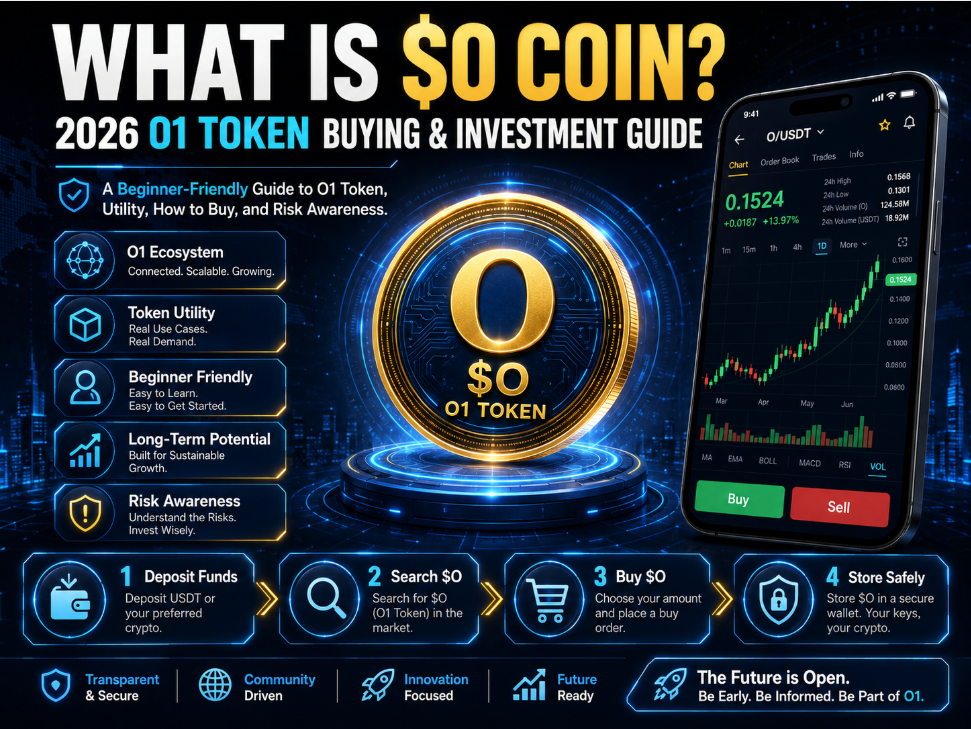
When many newcomers see the words "exchange token," their first reaction is:
- Does buying this coin mean I'm buying shares in the exchange?
- If the exchange makes money, do I get dividends?
- As the platform's trading volume increases, do I automatically get a share of the profits?
- Is this coin like a stock?
For $O, these understandings need to be corrected.
$O is not equity in o1.exchange, nor does it represent ownership in o1.exchange, the MoonX Foundation, or any related legal entity. It is not a stock, a bond, or a traditional yield certificate. Holding $O does not equal owning company equity, voting control, or automatic platform profit distribution.
From a technical perspective, $O is an ERC-20 token deployed on the Base network.
This means:
- It is not the native coin of an independent public chain.
- It runs on Base, an Ethereum Layer 2 network.
- Users must use the Base network when adding $O to their wallets.
- On-chain transfers require ETH on the Base network as Gas.
- The contract address must be verified through official channels or authoritative market platforms.
So what is o1.exchange?
o1.exchange can be understood as an on-chain comprehensive trading terminal for DeFi traders. It is not a single DEX or a pure perpetual contract platform, but rather aims to integrate spot trading, perpetual contracts, prediction markets, charting analysis, on-chain data, wallet management, and trading automation into a single interface.
Why is it called o1?
"o1" comes from the Big O notation O(1) in computer science, which typically represents constant time complexity—meaning execution efficiency remains relatively stable regardless of input size. The name o1.exchange expresses its positioning: compressing complex on-chain trading processes into a faster, simpler, and more all-in-one experience.
But you must be clear here:
The source of $O's value is not "equity value," but "platform utility value."
Its potential value primarily comes from:
- Users holding or staking $O may receive fee discounts.
- The higher the platform trading volume, the stronger the potential demand for fee discounts.
- The staking mechanism may reduce part of the circulating supply.
- Priority access to Alpha features may attract high-frequency traders and professional users.
- Ecosystem badges, trading rewards, and platform campaigns may generate token demand.
- If o1.exchange becomes a major gateway for DeFi high-frequency traders, $O may gain stronger network effects.
But none of these are equity returns in a legal sense.
One-sentence summary:
$O is o1.exchange's utility token on the Base chain. Its core value comes from platform use cases, fee discounts, staking benefits, and ecosystem growth, not exchange equity or statutory dividend rights.
2. What real problems does o1.exchange solve? Why would people pay for its token?
Judging whether a platform token has long-term value requires looking beyond short-term launch pumps or a list of institutional investors. What truly matters is: what problem does this platform actually solve, and do users really need it?
For DeFi traders, a major pain point is "multi-tab hell."
A slightly more professional on-chain trader usually needs to open many tools simultaneously:
- Use TradingView or other charting tools for market trends.
- Use DEX Screener or GeckoTerminal to check on-chain trading pairs.
- Use block explorers to check contracts and whale wallets.
- Use a wallet to manage different addresses.
- Use aggregators to find the best swap routing.
- Use DEXs to place spot orders.
- Use perpetual DEXs for leveraged trading.
- Use Telegram, X, and Discord for news.
- Use bots to monitor new coins and unusual wallet movements.
- Use spreadsheets to track positions and PnL.
The problems this causes are obvious:
- Scattered information.
- Long execution paths.
- Easy to miss opportunities.
- Easy to click on phishing websites.
- Messy wallet authorization management.
- High costs of switching between chains and platforms.
- Low efficiency in manually executing complex strategies.
What o1.exchange wants to solve is consolidating these scattered actions as much as possible into a single on-chain trading terminal.
Its positioning can be compared to a "Bloomberg Terminal for DeFi," but geared more towards on-chain trading scenarios. It doesn't just give users a swap button; it attempts to provide a complete suite of tools from discovering opportunities, analyzing markets, managing wallets, setting orders, and executing strategies, to viewing returns.
What is the difference between o1.exchange and a standard DEX?
Standard DEXs, like Uniswap, are more like on-chain swap protocols. Users enter the page, select a trading pair, and complete the swap. Their strengths are deep base liquidity, mature protocols, and high decentralization.
But standard DEX problems include:
- They mainly solve swapping, not complete trading analysis.
- Limited advanced order features.
- Weak support for multi-wallet, multi-strategy, and multi-chain management.
- Professional traders still need external auxiliary tools.
- Inadequate support for new coin discovery, automated execution, and risk alerts.
o1.exchange is more like a comprehensive terminal covering pre-trade, execution, and post-trade.
Its potential value includes:
- Aggregating multiple liquidity sources.
- Providing richer order types.
- Supporting advanced strategies like limit, TWAP, stop-loss, and sniping.
- Integrating charts and real-time data.
- Supporting multi-wallet management.
- Providing MEV protection.
- Supporting programmatic trading APIs.
- Putting spot, perpetuals, and prediction markets into a unified interface.
What is the difference between o1.exchange and a perpetual DEX?
Perpetual DEXs, such as Hyperliquid and GMX, primarily solve the problem of leveraged contract trading. Their core scenarios are:
- Going long/short.
- Using leverage.
- Trading perpetual contracts.
- Providing or using derivative liquidity.
o1.exchange isn't just a perpetual contract platform. It acts more as an entry and terminal layer connecting different trading scenarios, including:
- Spot trading.
- Perpetual contracts.
- Prediction markets.
- Aggregated swaps.
- On-chain strategy execution.
- Multi-chain asset management.
In other words, Hyperliquid and GMX are more like "specific trading venues," while o1.exchange is more like a "workstation aggregating multiple venues and tools."
Why do the backers matter?
Public information regarding o1.exchange reveals that its seed round financing included participation from institutions such as Coinbase Ventures, a16z, AllianceDAO, The House Fund, and Amber Group.
This has two implications for readers evaluating the project:
- It increases project credibility. Participation by top-tier institutions doesn't guarantee success, but it usually means the project has passed a certain level of vetting regarding the team, product, market opportunity, and technical direction.
- It shows the project is not a completely anonymous, background-less short-term meme project. For newly listed tokens, team background, investors, product data, and public documentation serve as very important E-E-A-T signals. They don't eliminate risk, but they help users distinguish between "early-stage projects with real products" and "pure conceptual hype."
How to view real usage data
o1.exchange disclosed a fair amount of usage data during its test phase. While numbers vary slightly across public channels, roughly we can see:
- Test phase spot trading volume reached over $180 million (some exchange announcements state over $220 million).
- Over 3 million transactions.
- Around 400,000 registered users.
- Achieved a certain level of revenue and usage heat within the Base ecosystem.
- The product covers spot, perpetuals, prediction markets, and multi-chain trading scenarios.
This data illustrates that o1.exchange is not a "whitepaper-first, no product built" project, but already possesses trading activity and a user base.
But please note:
- Test phase data does not equal long-term stickiness.
- Registered users do not equal active users.
- Trading volume does not equal real profit.
- Pre-airdrop activity does not equal sustained post-TGE activity.
- Many projects show excellent pre-airdrop data because users are trading for points. Post-TGE, if incentives decrease, trading volume may drop. Therefore, to judge if $O has real value, one must look not only at pre-TGE data but also at 30-day, 90-day, and 180-day retention and trading volume after the TGE.
3. Why will the $O token rise? Dissecting use cases and tokenomics
A new coin's short-term fluctuations after listing are often dictated by sentiment, circulating supply, exchange heat, and market-making depth. But whether it can hold its ground in the medium to long term fundamentally depends on two questions:
- Does the token have real demand?
- Is the token release structure healthy?
The use cases for $O can primarily be divided into three categories.
Utility 1: Tiered Fee Discounts
The most direct use for $O is for trading fee discounts within the o1.exchange platform.
Simply understood:
- Users hold or stake more $O.
- The platform provides different fee discounts based on holding or staking tiers.
- The more frequent the trading, the more obvious the value of the fee discount.
- For professional traders, high-frequency users, and multi-wallet users, these discounts are more attractive.
This is similar to the logic of many centralized exchange platform tokens.
If a trader has a large monthly trading volume, fees are a tangible cost. Assuming holding or staking $O can lower trading costs, then $O becomes a tool to reduce expenses for these users, rather than just a speculative asset.
However, the value of fee discounts relies on three premises:
- o1.exchange genuinely has sustained trading volume.
- Users are willing to trade on the platform long-term.
- The discount from holding or staking $O is enough to cover the token's price volatility risk.
- If platform trading volume falls, or users are just wash-trading for short-term airdrops, the real demand generated by fee discounts will weaken.
Utility 2: Staking, Badges, and Revenue Share Qualification
The second major use for $O is that, after staking, users may earn ecosystem badges and qualify to apply for a share of platform revenues.
This part is easily misunderstood, so it must be clarified.
According to public materials, users may need to stake a certain amount of $O and meet a specific staking duration to have a chance to obtain limited ecosystem badges. Badge holders may qualify to apply for a portion of the platform's revenue.
Notice the keywords here:
- "May"
- "Qualification to apply"
- "Limited badges"
- "Minimum stake amount TBD"
- "Staking duration TBD"
- "30-day unbonding cooldown"
This means it is not unconditional dividends.
Users cannot simply think: "I bought $O, so I will automatically get a share of the platform's revenue."
A more accurate understanding is:
Staking $O might be the threshold to enter certain platform benefit systems, but the specific thresholds, rules, qualifications, cycles, distribution methods, and restrictions are subject to final official announcements.
The staking mechanism may have two impacts on the token price.
Positive side:
- Staking locks up a portion of $O.
- The circulating supply may decrease.
- Long-term users are willing to hold the coin.
- The higher the platform activity, the more attractive the staking benefits.
Risk side:
- There is a 30-day unbonding cooldown; you cannot sell immediately during a market crash.
- If the revenue share falls short of expectations, staking demand may drop.
- If the threshold is too high, everyday users will feel excluded.
- If rules change frequently, market confidence will suffer.
Therefore, users shouldn't just look at the words "revenue share," but also recognize the limitations like "qualifications, thresholds, cooldowns, and rules not fully finalized."
Utility 3: Priority Access to Alpha Features
o1.exchange is positioned not as a basic Swap, but as a trading terminal and strategy platform. Therefore, $O may also be used for priority access to advanced features.
These features might include:
- Quantitative trading tools.
- Strategy automation.
- Advanced order types.
- AI or Alpha signal-related functions.
- Faster execution tools.
- Advanced data dashboards.
- Wallet and social signal monitoring.
- Professional trader modules.
These benefits might not be hugely attractive to casual users, but they are crucial for professional traders, high-frequency traders, on-chain snipers, and strategy-based users.
If o1.exchange truly becomes the core workstation for DeFi traders in the future, then priority access to Alpha features will strengthen the rationale for holding $O.
But if these features lack a distinct advantage, or if other platforms quickly copy them, this utility will be diluted.
Tokenomics Breakdown
The total supply of $O is 1 billion tokens. It has a fixed supply with no extra inflation or minting plans. At TGE, the initial circulating supply is roughly 16%, or 160 million tokens.
Looking at the allocation structure:
- Community: 25%, primarily for trading point airdrops and subsequent rewards.
- Ecosystem: 25%, for ecosystem incentives, trading competitions, and long-term development.
- Investors: 18%, 1-year cliff followed by 36-month linear unlocking.
- Team: 10%, 1-year cliff followed by 36-month linear unlocking.
- Treasury: 16%, 4% unlocked at TGE, the rest controlled by multisig.
- Liquidity: 6%, 100% unlocked at TGE for initial CEX and DEX liquidity.
The most critical thing to note in this structure is: Only about 16% is circulating at TGE.
A low circulating supply is a double-edged sword.
Pros:
- With little supply at launch, the price is easily driven by market sentiment.
- If demand is strong, a small amount of buying can push the price up.
- Staking and holding expectations may further reduce the float.
Risks:
- FDV (Fully Diluted Valuation) can be pushed up rapidly.
- Subsequent unlocks will bring long-term dilution.
- Early buyers at high prices may face future supply surges.
- Airdrop users might sell in the early days of listing.
- Without sufficient liquidity pools and market-making depth, price volatility will be extreme.
For beginners, do not just look at "Market Cap," but also look at "Fully Diluted Valuation (FDV)."
Suppose the price of $O after listing is $0.50:
- The circulating market cap would be 160 million tokens × $0.50 = $80 million.
- The FDV would be 1 billion tokens × $0.50 = $500 million.
This illustrates that in the low circulating supply phase, the market cap might not look high, but the FDV is already substantial. In the future, as team, investor, ecosystem, and community rewards are gradually released, the market must have enough new demand to absorb this supply.
To understand how to evaluate utility tokens like $O, you can refer to the analytical frameworks of other "utility-driven tokens." For example, some tokens in the DePIN sector derive their value from device connectivity, network usage, node rewards, and real service demand. To understand how these tokens move from a "story" to actual "use cases," you can read What is BR. BR and $O do not belong to the same sector, but both are suitable for analysis from the perspective of "is the token actually being used by the product?"
4. Can you buy it now, where to buy, and how to avoid fake coins
$O entered its TGE and early listing phase in June 2026. Therefore, answering "can I buy it" depends not only on the project itself but also on exchange support, liquidity, contract addresses, and your personal risk tolerance.
Where can you watch $O currently?
Based on public information at the time of writing, $O's trading and listing channels include:
- KuCoin: Announcement shows O/USDT trading opens on June 17, 2026.
- Binance Alpha: Announcement indicates an Alpha campaign launching on June 17, 2026.
- HiBT: Announcement shows the listing of O/USDT, supporting Base network deposits and trading.
- Aerodrome: One of the DEX liquidity channels in the Base ecosystem.
- Market platforms like Bitget, Gate, MEXC, LBank, and Coinbase Exchange showing trading markets.
- o1.exchange's own aggregator interface or related Swap portals.
However, exchange support can change quickly. Before purchasing, verify again:
- Is the platform actually open for spot trading?
- Is the trading pair O/USDT, O/USDC, or O/USD?
- Is the deposit network Base?
- Are withdrawals open?
- Are there regional restrictions?
- Is the order book depth sufficient?
- Is the trading page accessed from official portals?
How to verify the official contract address
$O is an ERC-20 token on the Base network, so the most important step against fake coins is verifying the contract address.
The correct approach is:
- Open the official o1.exchange documentation.
- Open the Token Contract link in exchange announcements like KuCoin or HiBT.
- Open the $O page on CoinGecko or CoinMarketCap.
- Search the corresponding contract address on BaseScan.
- Confirm the token name is o1.exchange.
- Confirm the symbol is O.
- Confirm the total supply is 1,000,000,000.
- Confirm the network is Base.
- Check the number of holding addresses and transfer records.
- Do not copy contract addresses from Telegram groups, X comment sections, or fake customer service DMs.
The publicly displayed Base contract address at the time of writing is:
0x182FA643E5f29d5EcA75e7b9CF9336A3fe4620b2
Even though this article provides the address, readers should not mindlessly copy it. The safest practice is cross-verifying from official documentation, exchange announcements, CoinGecko, CoinMarketCap, and BaseScan. If any single source is inconsistent, pause your operation.
Why you shouldn't rush to chase high prices in the early listing days
The early days of a new coin listing usually have several characteristics:
- Extreme price volatility.
- Very hot market sentiment.
- Airdrop users may dump their tokens.
- Market-making depth is not yet stable.
- There may be price discrepancies across different exchanges.
- The order book (buy/sell walls) may be very thin.
- Small amounts of capital can cause massive pumps or dumps.
- There are many shills and fake news in the community.
Additionally, $O has a low float structure, with only ~16% initial circulation at TGE. This means the price in the first week could see rapid spikes as well as violent pullbacks.
Beginners should not rush in just because they see it "pumped several times over." A safer approach is:
- Observe for 24–72 hours first.
- Check if the trading volume is sustained.
- See if the price stabilizes in a reasonable range.
- See if the order book depth improves.
- See if the airdrop selling pressure has eased.
- See if the price gap between CEXs and DEXs converges.
- Wait to see if the team releases subsequent staking and benefits rules.
- Use small test orders; do not go all-in at once.
If you don't even know how to verify a contract address, it is not recommended to rush into buying $O. Learning how to prevent scams and read the order book is far more important than grabbing the day-one price.
5. Complete steps to buy $O on HiBT
Below is a basic guide for beginners on how to buy $O, using HiBT as an example.
According to HiBT announcements, O/USDT is listed on the Base network. However, exchange pages, open regions, and deposit/withdrawal statuses can change, so always rely on the official HiBT page before executing.
Step 1: Register on HiBT and Complete KYC
First, go to the official HiBT website or App, and register an account using your email or phone number.
After registering, immediately set up your security settings:
- Set a strong password.
- Enable Google Authenticator or other 2FA.
- Set a fund password.
- Enable the anti-phishing code.
- Never share your verification codes, private keys, or seed phrases with anyone.
- Do not click on "official support links" sent by strangers.
Then proceed to the identity verification page to complete KYC.
Why do compliant exchanges require KYC?
Main reasons include:
- Meeting Anti-Money Laundering (AML) requirements.
- Complying with regulatory rules in different regions.
- Reducing fraud and account theft risks.
- Supporting fiat deposits and withdrawals.
- Setting user thresholds for high-risk assets and derivatives.
- Protecting platform and user account security.
HiBT is positioned as a compliant digital asset trading platform for global users. Public information indicates that HiBT has a Canadian registration background and has disclosed MSB compliance qualifications in the US and Canada, while being headquartered in Dubai, offering spot, futures, and other trading services. Before taking action, it is advised to check HiBT's latest license page, terms of service, and regional restrictions to ensure accuracy.
Step 2: Deposit Funds (Fiat or Stablecoins)
After completing registration and KYC, you need to prepare funds.
There are two common methods.
Method 1: Fiat Deposit.
If HiBT supports bank cards, third-party payments, or P2P in your region, you can buy USDT or USDC directly with local currency.
Pros:
- More intuitive for beginners.
- No need to buy crypto on another platform first.
- You can enter the trading process directly.
- Precautions:
- Payment channels may have fees.
- Deposit methods vary by region.
- Beware of counterparty risks in P2P.
- Fiat deposits may require extra verification.
- Arrival times may vary.
Method 2: Depositing Stablecoins.
If you already hold USDT/USDC in another exchange or wallet, you can deposit it into HiBT.
When doing this, you must:
- Confirm the deposit coin.
- Confirm the deposit network.
- Copy the exact address.
- Test with a small amount before sending a large transfer.
- Do not mix up Base, ERC-20, TRC-20, and BEP-20 networks.
- Confirm HiBT supports the specific network before depositing.
If you plan to buy O/USDT, the most common path is to prepare USDT first, then buy $O in the spot market.
Step 3: Search for O/USDT in the Spot Market
Once funds arrive, go to the HiBT spot trading page.
You can search for:
- O
- O/USDT
- o1.exchange
After entering the trading pair, don't place an order immediately. Look at several data points first:
- Current price.
- 24-hour change.
- 24-hour volume.
- The bid-ask spread (difference between the highest buy and lowest sell order).
- Order book depth.
- Recent transaction records.
- Are there abnormal wicks (sudden massive price spikes/drops)?
- Are deposits and withdrawals functioning normally?
- Are there risk warning labels?
Especially for a newly listed coin like $O, you cannot just look at the candlestick percentage. What truly affects your execution is order book depth and slippage.
Step 4: Choosing Between Market and Limit Orders
Beginners mostly use two types of orders:
- Market Orders
- Limit Orders
Market orders execute immediately, but the price depends on the current order book. If the book is thin, market orders can cause massive slippage.
Limit orders let you set your specific buying price, and execution only happens if the market hits that price. This is much better suited for highly volatile, newly listed coins where order book depth is unstable.
For early-stage assets like $O, beginners are highly advised to:
- Prioritize using limit orders.
- Do not rush in with large market orders.
- Use small test orders first.
- Buy in batches (Dollar Cost Averaging).
- Do not chase parabolic green candles (FOMO).
- Pre-determine a maximum loss percentage.
- Do not put all your capital into one new coin.
A simple strategy:
If you are bullish on $O, split your planned position into multiple parts. For example, buy 20% first, observe for 1-3 days, and then decide whether to continue, rather than going all-in on day one.
Step 5: After Trading, Keep on the Exchange or Withdraw to a Wallet?
After buying $O, there are two ways to hold it.
Option 1: Keep it on HiBT.
Suited for:
- Beginners.
- Short-term traders.
- Users who want to sell at any time.
- People unfamiliar with wallet and private key management.
- Pros:
- Simple operation.
- Convenient trading.
- No need to manage private keys.
- Can quickly sell or swap back to USDT.
- Cons:
- Assets are custodied by the exchange.
- You bear platform counterparty risk.
- Account security relies on the exchange and personal security settings.
- Operations can be halted during risk control, maintenance, or regional restrictions.
Option 2: Withdraw to a Self-Custodial Wallet.
Suited for:
- Users familiar with on-chain operations.
- People wanting to participate in o1.exchange ecosystem features.
- Users wanting to use DeFi on the Base chain.
- People who can securely store their seed phrase and private keys.
If you want to withdraw $O to MetaMask, you must first confirm the wallet supports the Base network.
The rough steps are:
- Open MetaMask.
- Select Base from the network list.
- If Base isn't there, add the network manually.
- Network parameters must be verified from the official Base documentation or MetaMask's official portal.
- Ensure you have a small amount of Base ETH in the wallet to pay for Gas.
- When withdrawing from HiBT, select the Base network.
- Copy your Base wallet address.
- Test with a small withdrawal first.
- Once it arrives, decide whether to transfer the rest.
- If the wallet doesn't automatically show $O, use the official contract address to import the token.
Be extremely careful when importing $O:
- The contract address must come from official docs or BaseScan.
- Do not copy addresses sent by strangers in groups.
- Do not connect to fake airdrop websites.
- Do not sign approvals you do not understand.
- Regularly check and revoke suspicious approvals.
The process of buying $O on a centralized exchange is similar to buying other tokenized assets: register, KYC, deposit, search the trading pair, order, and manage assets. For instance, What is NVDAB discusses tokenized Nvidia stock. While the asset nature of NVDAB and $O are entirely different, the fundamental operations within a compliant exchange are comparable.
6. How much is $O worth? Multi-scenario price projections
$O is a newly listed coin, so giving a definitive "it will go to $X" price target is irresponsible.
A more reasonable approach is to break down price performance into several variables:
- Real trading volume on o1.exchange.
- Demand for $O staking and fee discounts.
- Sell pressure from airdrop users.
- Number of exchange listings.
- DEX and CEX liquidity.
- Unlock schedules for investors and the team.
- Hype surrounding the Base ecosystem.
- The overall DeFi market environment.
- Whether prediction markets and perpetual trading volumes scale up.
- Whether the revenue share or badge system genuinely materializes.
The following projections are not predictions; they merely help readers understand the potential price logic under different scenarios.
To avoid short-term price noise, we use P0 as a baseline. P0 can be understood as the relatively stable average price observed after listing (e.g., the average price 3–7 days post-launch, or your own actual average entry cost).
Conservative Scenario
Core assumptions:
- Airdrop users sell off heavily.
- Initial launch hype cools rapidly.
- o1.exchange trading volume drops post-TGE.
- Staking and badge rules lack clarity.
- Revenue share expectations fall through or are delayed.
- Mainstream CEX spot support is limited.
- Future unlock expectations suppress valuation.
- The broader DeFi market weakens.
Short-term (1–3 months post-launch):
- Price may pull back to 0.3 P0 – 0.8 P0.
- If it was overhyped at opening, the retracement will be deeper.
- Price discrepancies between CEXs and DEXs may widen.
- With thin order books, a single large sell order could cause massive impact.
- Community sentiment shifts from FOMO to "wait and see."
Medium-term (6–18 months):
- If platform growth stalls, the price may remain persistently below P0.
- The market will be suppressed by the expectation of team/investor unlocks after the 1-year cliff.
- Without attractive revenue share, staking, or utility, token demand dries up.
- Price movements will follow broader market sentiment rather than platform fundamentals.
Key Triggers to watch for: TGE volume drops sharply; sustained airdrop dumping; lack of real active users; delayed staking rules; limited new exchange listings; Base ecosystem cools; macro risk appetite drops.
Strategy: Do not chase pumps; do not go all-in; wait for selling pressure to exhaust; observe platform data for 30-90 days; track with small positions; set strict stop-losses.
Neutral Scenario
Core assumptions:
- o1.exchange trading volume grows steadily.
- Fee discounts generate a baseline holding demand for $O.
- The staking mechanism absorbs a portion of the circulating supply.
- Airdrop dumping is digested in the first few weeks.
- The platform rolls out advanced trading tools.
- CEX and DEX liquidity gradually improves.
- The Base ecosystem maintains moderate heat.
Short-term (1–3 months post-launch):
- Price fluctuates around 0.8 P0 – 2.0 P0.
- Initial volatility remains high, but higher lows form.
- If volume stabilizes, the market will start pricing the token based on platform data.
- Holding and staking demand offset some selling pressure.
Medium-term (6–18 months):
- If volume, user retention, and staking scale all grow, the price could reach 2 P0 – 4 P0.
- The market will focus heavily on platform revenue, revenue-share rules, and unlock schedules.
- As long as FDV stays within a reasonable range, new buyers will absorb the supply.
- Increased ecosystem partnerships could yield a valuation premium.
Key Triggers to watch for: Volume doesn't collapse 30-90 days post-TGE; fee discounts actually used by real traders; staking TVL grows; transparent badge/revenue rules; CEX listings increase; DEX liquidity improves; Base continues to attract users.
Strategy: Buy in batches; focus on volume and staking data; don't chase parabolic spikes; lower risk ahead of unlock cycles; adjust positions based on fundamentals.
Optimistic Scenario
Core assumptions:
- o1.exchange becomes the dominant trading gateway on the Base ecosystem.
- Spot, perps, and prediction markets scale up simultaneously.
- Revenue share and badge systems are successfully implemented.
- Advanced tools attract professional users.
- Top-tier CEX spot listings bring deep new liquidity.
- $O staking demand surges continuously.
- Multi-chain expansion succeeds.
- The DeFi market enters a new bull cycle.
Short-term (1–3 months post-launch):
- Price could reach 2 P0 – 5 P0.
- New exchange listings or major feature releases can trigger rapid pumps.
- Staking expectations reinforce the holding sentiment.
- However, even in an optimistic scenario, violent pullbacks of 30%–60% are still likely.
Medium-term (6–18 months):
- If platform revenue, volume, and staking grow in tandem, the price could reach 5 P0 – 8 P0 or even higher.
- The market may revalue $O from a "standard new coin" to a "DeFi trading terminal platform coin."
- If top CEXs list the spot pair and form deep liquidity, the valuation ceiling rises further.
- However, investor/team/ecosystem unlocks will still exert long-term dilutive pressure.
Key Triggers to watch for: Multiple Tier-1 CEX spot listings; daily volume hits new highs; real user growth (not just airdrop farming); clear revenue-share rules implemented; staking lock-up percentage jumps; successful expansion to Solana, BNB Chain, etc.; perps/prediction markets bring new revenue streams; macro market enters a risk-on phase.
Strategy: Still buy in batches; take partial profits during extreme pumps; don't treat the optimistic narrative as a guaranteed outcome; track the unlock schedule; prioritize assessing whether platform revenue justifies the valuation.
Why you shouldn't just look at the price, but must look at FDV and Unlocks
$O's TGE circulating supply is ~16%. This means the market is initially trading a tiny fraction of the total supply, not the full 1 billion tokens.
This has two effects:
- It pumps easily in the early days. Because the float is small, even slight buying pressure can dramatically increase the price.
- Future unlocks will constantly inflate supply. Investors (18%) and the team (10%) have a 1-year cliff, followed by 36 months of linear unlocking. The ecosystem, community, and treasury allocations will also release over time. If platform growth fails to keep up with supply releases, the price will face downward pressure.
Therefore, judging whether $O is overvalued requires looking beyond circulating market cap to:
- What is the FDV?
- How many tokens unlock in the next 12 months?
- Who is unlocking them?
- Will there be selling pressure after they unlock?
- Can platform revenue grow?
- Can staking absorb the circulating supply?
- Is the market willing to pay for future growth?
7. Risks you must know before buying $O
$O is backed by a real product and strong institutions, but this does not mean it is risk-free. In fact, newly listed platform utility tokens have highly concentrated risks that must be clearly outlined.
Low Float Risk
The $O TGE initial circulation is roughly 16%. Low float amplifies volatility.
Situations that may occur include:
- Rapid opening pump.
- Doubling in a short time, followed by a rapid crash.
- CEX and DEX prices decoupling.
- Small buy orders pushing up the price.
- A single whale dump smashing the order book.
- Candlesticks look strong, but actual liquidity depth is poor.
- Beginners using market orders execute at average prices far worse than expected.
For beginners, the most dangerous part of low float is: the price you see on the screen is not necessarily the price you can execute at, and the percentage gain you see does not necessarily represent real value growth.
Airdrop and Unlock Sell Pressure
The $O community airdrop totals 25%, with Season 1 releasing 3% at TGE. Airdrop users have zero cost basis, and many will likely sell to cash out early on.
Furthermore, the investor (18%) and team (10%) allocations face future unlocks. While the 1-year cliff delays early dumping, the market typically prices in the future unlock pressure ahead of time.
Pay close attention to:
- The airdrop claim rate.
- The speed of airdrop sell-offs.
- Release rules for Season 2 and Season 3.
- The expiration date of the investor cliff.
- The linear unlock rhythm of the team.
- Whether treasury and ecosystem distribution is transparent.
- Whether market maker arrangements are public.
If $O's price is hyped exceptionally high before the unlocks begin, and platform revenue/real users do not grow in sync, the unlock period will become a severe price pressure point.
Utility Token Classification Risk
The $O team explicitly emphasizes that it is a utility token. It does not represent equity, debt, profit distribution rights, or statutory revenue rights.
This point is critical for investors.
Many people see "qualification for revenue share" and treat $O as a yield-bearing asset. But in reality:
- Holding $O does not equal automatic dividends.
- Revenue share qualification may require staking.
- The minimum staking amount is subject to official confirmation.
- The staking duration is subject to official confirmation.
- The number of badges may be limited.
- Revenue share may require an active application.
- The distribution mechanism could be adjusted.
- Users in certain regions may be prohibited from participating.
- The platform does not guarantee future revenue or token buybacks.
Therefore, do not treat $O as a stable, passive income tool.
A more accurate understanding is: $O is a utility token designed with platform benefits; its value depends on platform development and the execution of its rules, rather than acting as a fixed-yield certificate.
Product Growth Risk
o1.exchange's positioning is highly imaginative, but competition is fierce.
Competitors include:
- Mature DEXs like Uniswap.
- Aggregators like 1inch and Matcha.
- Perpetual trading platforms like Hyperliquid.
- On-chain derivative platforms like GMX.
- Market data tools like DexScreener and GeckoTerminal.
- On-chain trading bots like Banana Gun and Maestro.
- CEXs like Coinbase and Binance.
- Other trading terminals in the Base ecosystem.
To succeed, o1.exchange must prove it isn't just a haphazard stack of features, but a tool that genuinely makes trading faster, safer, and more efficient for users.
If the following occurs, $O's price will suffer:
- User retention drops.
- Volume is solely driven by incentives.
- Product UI/UX is worse than competitors.
- Low adoption of advanced features.
- Poor multi-chain expansion results.
- Restricted access to perps and prediction markets.
- Fee discounts aren't attractive enough to warrant holding the coin.
Regulatory Risk
o1.exchange involves spot trading, perpetual contracts, and prediction markets. Regulatory attitudes toward these businesses vary vastly across jurisdictions.
Potential risks include:
- Certain countries restricting perpetual contracts.
- Certain countries restricting prediction markets.
- Regions requiring strict KYC.
- Certain users being geoblocked from specific features.
- The platform needing to alter its scope of service.
- The token's utility design facing regulatory scrutiny.
- Revenue-sharing mechanisms triggering securities law debates.
Especially when a utility token is tied to platform revenue, badges, staking, and benefit applications, the regulatory risks become highly complex. This doesn't mean the project is inherently flawed, but it means users must look at compliance boundaries, not just yield expectations.
Smart Contract and Wallet Risk
$O is an ERC-20 token on Base. On-chain operations involve wallets, approvals, contracts, and DEX interactions.
Common risks include:
- Buying fake contracts.
- Connecting to phishing websites.
- Signing malicious approvals.
- Granting unlimited spend allowances to fake DApps.
- Stumbling onto fake airdrop claim pages.
- Leaking private keys or seed phrases.
- Selecting the wrong withdrawal network.
- Lacking Base ETH, rendering you unable to transfer.
- Using wallet tools provided by fake customer support.
Anti-Scam Checklist:
- Only access o1.exchange through official channels.
- Only verify contracts via exchange announcements, CoinGecko, CoinMarketCap, and BaseScan.
- Do not trust "internal airdrop claim links."
- Never input your seed phrase into any website.
- Never give verification codes to customer support.
- Do not install unknown browser extensions.
- Do not sign approvals you do not understand.
- Regularly use approval-management tools to revoke suspicious allowances.
- Test with small amounts before moving large funds.
- Verify the network is Base before CEX deposits/withdrawals.
Price Risk
In the early days of listing, $O's price could swing violently due to news, exchange listings, airdrops, market-making, and community sentiment.
Short-term prices do not necessarily reflect long-term value.
Possibilities include:
- Rapid pullback after an initial spike.
- Concentrated selling by airdrop users.
- Short-term hype fueled by mainstream CEX rumors.
- Wicks caused by shifts in market-making depth.
- Panic triggered by whales moving funds to exchanges.
- Macro market dumps pulling down the new coin.
- Unlock expectations suppressing the price early.
For ordinary investors, the most critical element is position management.
Recommended principles:
- Do not borrow money to buy.
- Do not go all-in.
- Do not chase parabolic pumps.
- Do not treat $O as a stable yield product.
- Do not ignore risks just because institutions back it.
- Do not abandon take-profit and stop-loss strategies because of short-term gains.
Conclusion: $O is worth watching, but do not buy it as "exchange equity"
$O is a newly listed utility token worth keeping an eye on because it isn't backed by a pure concept, but by a tangible DeFi trading terminal product: o1.exchange.
The direction of o1.exchange is very clear:
- Integrate spot, perpetuals, and prediction markets into a unified interface.
- Provide professional execution tools for on-chain traders.
- Aggregate liquidity.
- Offer advanced orders and automated trading capabilities.
- Build a one-stop trading terminal for DeFi scenarios.
If this product grows consistently, $O's fee discounts, staking, Alpha features, and ecosystem benefits could form genuine demand.
However, at the same time, $O carries classic "new coin" risks:
- High volatility in the early TGE phase.
- A low float that easily inflates the FDV.
- Selling pressure from airdrops and future unlocks.
- Revenue share qualifications do not equal automatic dividends.
- Platform growth requires continuous validation.
- Regulatory uncertainties surrounding perps and prediction markets.
- High risk of fake contracts and fake airdrops.
Therefore, the right way to view $O is not asking "Will it 10x immediately?", but rather continually observing:
- o1.exchange's real trading volume.
- User retention post-TGE.
- The scale of $O holdings and staking.
- The usage rate of fee discounts.
- Whether the badge and revenue share rules are implemented effectively.
- Whether exchange liquidity improves.
- Whether the market successfully digests future unlocks.
- Whether the platform secures a foothold in the DeFi trading terminal sector.
Only if these metrics consistently improve can $O transition from a "hyped new coin" into a "platform token supported by actual utility." If data falls, rules are delayed, and selling pressure is overwhelming, short-term hype will likely fail to sustain long-term prices.
FAQ
Is $O equity in o1.exchange?
No. $O is an ERC-20 utility token on the Base chain for the o1.exchange platform. It does not represent company shares, debt, profit distribution rights, or statutory revenue rights. Holding $O does not equal holding o1.exchange equity, nor does it equal automatically receiving dividends.
Where can $O be purchased right now?
At the time of writing, $O has trading or listing announcements across multiple CEXs and Base ecosystem DEXs, including HiBT, KuCoin, Bitget, Gate, MEXC, Aerodrome, etc. Binance Alpha also has related campaigns. Before actually purchasing, please rely on official exchange pages and real-time data from market platforms.
What chain is the official $O contract on?
$O is an ERC-20 token deployed on the Base network. The public contract address at the time of writing is 0x182FA643E5f29d5EcA75e7b9CF9336A3fe4620b2. Before buying or importing into a wallet, be absolutely sure to cross-verify this against official documentation, exchange announcements, CoinGecko, CoinMarketCap, and BaseScan.
What is the minimum amount of $O I can buy?
The minimum purchase amount depends on the exchange's rules and the specific trading pair's minimum order size. For example, when buying O/USDT on HiBT, refer to the minimum order size displayed on the page. Beginners are advised to use small test orders to confirm execution prices, fees, and slippage before deciding to buy more.
What is the difference between buying $O and a token like NVDAB?
$O is a platform utility token whose value primarily derives from o1.exchange's trading scenarios, fee discounts, staking, and ecosystem benefits. Tokenized stocks like NVDAB typically represent exposure or mapped assets tied to Nvidia stock, and its underlying logic is closer to bringing traditional equity assets on-chain. While both can be purchased on exchanges, their asset nature, risk sources, and regulatory requirements are completely different.
Will staking $O really give me a share of platform revenues?
Do not simply understand it as "stake and automatically get dividends." Public materials indicate that staking $O may relate to badges and revenue share qualifications. However, the minimum staking amount, duration, and qualification rules are subject to final official announcements. Holding $O itself does not represent automatic acquisition of platform revenue, dividends, or any statutory yield rights.
What is the biggest risk with $O?
Major risks include low-float volatility, airdrop sell pressure, subsequent unlock dilution, slower-than-expected platform growth, uncertain revenue-share mechanisms, regulatory risks, smart contract risks, and fake contract scams. For beginners, the most direct risks are chasing highs right after listing and buying fake coins.
Is $O suitable for long-term holding?
Whether it is suitable for long-term holding depends on whether o1.exchange can sustain growth. Only if platform trading volume, real users, fee revenues, staking scale, and advanced feature usage continue to rise does $O possess a mid-to-long-term holding rationale. If data drops rapidly post-TGE, the risk of long-term holding will increase significantly.
Author Info Card
- Author: HiBT Research Institute Content Team
- Editor: HiBT Risk Education Editorial Group
- Research Focus: DeFi trading tools, exchange tokens, Base ecosystem, platform token valuation, crypto asset risk education.
- Article Type: Project education, buying tutorial, investment risk analysis.
Reference Sources
The writing of this article referenced the following types of public materials:
- o1.exchange Official Website.
- o1.exchange Official Documentation and $O Token Disclosure.
- BaseScan $O Contract Page.
- CoinGecko o1.exchange Market Page.
- CoinMarketCap o1.exchange Market Page.
- KuCoin O/USDT Listing Announcement.
- HiBT O/USDT Listing Announcement.
- Binance Alpha related market announcements.
- Base network public materials.
- Public materials related to DeFi trading terminals, DEX aggregators, perpetual DEXs, and prediction markets.
Risk Disclaimer
This article is solely for information sharing and crypto asset education. It does not constitute investment advice, legal advice, tax advice, or any form of buying/selling recommendation. $O is a newly listed token; its price may experience extreme volatility and even result in massive losses. Utility tokens do not equal equity, and they do not guarantee yields, buybacks, dividends, or revenue distribution. Before purchasing, please verify the contract address, exchange announcements, liquidity, unlock schedules, and compliance requirements in your specific region independently, and make cautious decisions based on your own risk tolerance.