
If you’ve recently come across AEON on OKX, CoinMarketCap, or in crypto communities, a few questions probably popped into your head right away: What is AEON? Is AEON an AI coin? How does it relate to AI Agents? Why did it suddenly gain attention after being listed on an exchange? And does AEON have any real investment value?
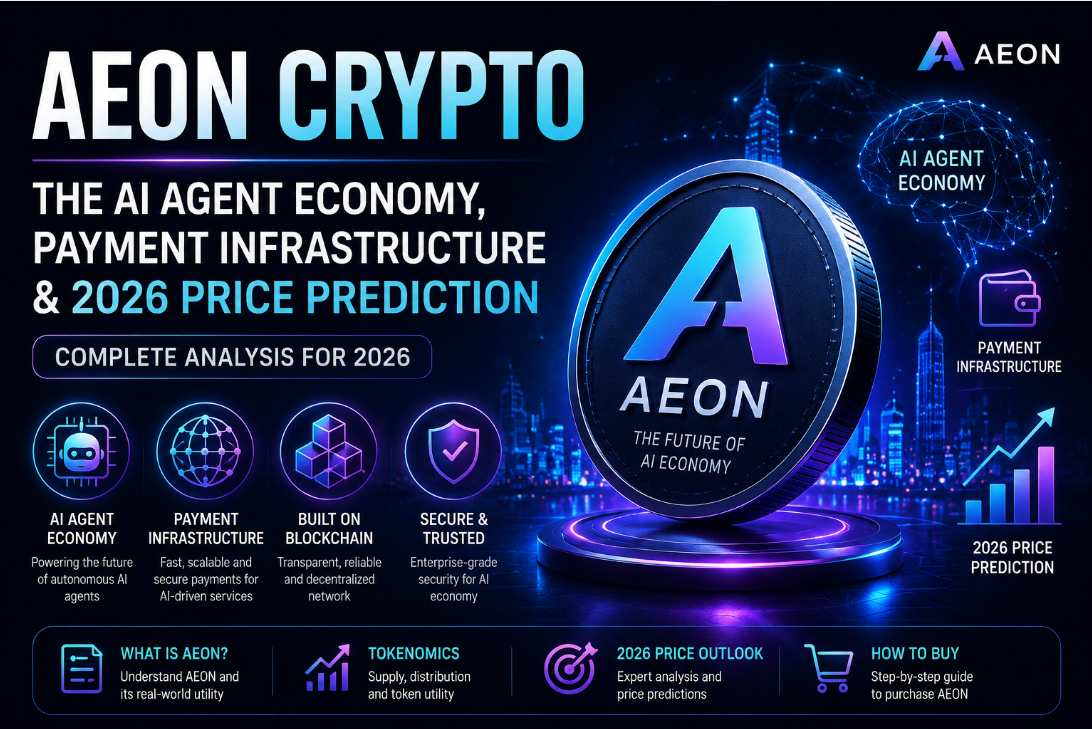
In a single sentence: AEON is a crypto payment infrastructure project built for AI Agents and real-world commercial scenarios. It’s not an AI chatbot, nor is it a model product like ChatGPT. Instead, it tackles a more fundamental problem: when AI Agents can autonomously call tools, purchase services, access APIs, and execute commercial tasks, how should they actually pay?
In the traditional internet, payments usually follow this flow: "User clicks buy → enters payment info → platform confirms → merchant gets paid." But in the AI Agent era, the process might become: "User authorizes a goal → AI Agent finds services → automatically calls APIs → automatically pays → completes the task." AEON focuses precisely on the payment layer in this new economic paradigm.
According to OKX’s listing announcement on July 27, 2026, AEON/USDT spot trading opened at 19:00 (UTC+8) on that date. OKX describes AEON as: a crypto payment infrastructure for AI Agents and real-world commerce, integrating AI-native payment protocols like x402, ERC-8004, and Google AP2, and connecting on-chain crypto assets with a global offline merchant payment network through AEON Pay.
This means AEON’s core narrative is not simply an “AI concept coin,” but a combination of AI Agents + Web3 payments + real-world commercial settlement.
1. What Is AEON? A One‑Sentence Explanation of AI Agent Payment Infrastructure
Many newcomers searching "What is AEON" tend to mistake it for a generic AI token. In reality, AEON is closer to a payment infrastructure project than an AI application itself.
AEON’s official documentation describes AEON Pay as a crypto payment orchestration solution that bridges crypto payments with global fiat acquiring networks, supporting both on‑chain and off‑chain settlement. At the same time, AEON offers merchant‑facing tools like Stripe‑style Checkout, AEON AI Payment, and other infrastructure to give Web2/Web3 merchants and AI Agents crypto settlement capabilities.
In other words, AEON isn’t trying to “build an AI model”—it’s building payment rails for AI and users alike.
1.1 What Is AEON?
AEON can be understood as a crypto payment infrastructure for the AI Agent economy.
Future AI Agents won’t just answer questions; they’ll handle complex tasks on your behalf. For example, you might say: "Book me a flight to Tokyo tomorrow with a budget under $400." The AI Agent would need to search flights, compare prices, confirm times, call the booking platform, complete payment, and return the result.
During this process, the Agent doesn’t just need to “understand the task”—it also needs to “execute the transaction.” That involves identity, permissions, authorization, payment, settlement, risk control, and transaction records.
AEON’s value proposition is to become the payment infrastructure between AI Agents and real‑world services. Users or platforms can authorize Agents—within set rules—to call services, access APIs, or complete payments within a budget.
Core use cases include:
- AI Agents paying to call data APIs.
- Agents automatically purchasing digital services.
- Agents accessing premium content or tools.
- Agents handling travel bookings, subscriptions, software services, cloud computing, and more.
- Machine‑to‑machine settlement between Agents, merchants, and platforms.
From this perspective, AEON is more like the payment layer of the future “machine economy” than a token riding the AI hype wave.
1.2 AEON Is Not Your Typical AI Token
Many crypto newcomers see “AI + Crypto” and instantly think of AI concept coins, AI models, compute tokens, generative content, or trading bots. But AEON’s positioning is different.
AEON is not an AI model, not a ChatGPT competitor, and not a meme coin dressed up in AI narrative. It’s closer to three types of infrastructure:
- AI Agent payment infrastructure.
- Web3 payment protocol and settlement network.
- A foundational component of the Agent Economy.
If AI Agents are the “digital employees” of the future, AEON aims to solve how these employees can pay securely, controllably, and automatically.
That’s the biggest differentiator from many generic AI tokens. Those often emphasize models, compute, content generation, or trading bots, while AEON emphasizes payments and settlement.
1.3 Why Is AEON Gaining Attention Now?
AEON’s spotlight comes from three major trends.
First, the rapid rise of AI Agents.
Earlier AI was mostly about chatting and generating content. Users asked, AI answered; users gave prompts, AI generated images or text. But future AI will evolve into “task‑executing Agents.” It won’t just tell you how to book a flight—it will actually search, compare, reserve, and pay for you.
Second, AI Agents need payment capabilities.
A truly usable AI Agent will inevitably encounter paid scenarios: premium data APIs, cloud compute, software services, real‑world goods or services—all require payment. If every step needs manual CAPTCHA entry, credit card login, or confirmation, true automation is impossible.
Third, crypto is naturally suited for machine payments.
Crypto offers 24/7 settlement, global open networks, programmable assets, smart contracts, and stablecoins—all friendly to high‑frequency, low‑value, automated machine‑to‑machine payments.
So AEON isn’t an isolated event—it’s the result of convergence among AI Agents, Web3 payments, and real‑world commerce.
2. Why Do AI Agents Need Payment Infrastructure? What Problem Does AEON Solve?
To understand AEON’s long‑term value, don’t just watch the price or the exchange listing. More importantly, ask: why does the AI era need new payment protocols?
2.1 Why Traditional Payments Don’t Work for AI Agents
Traditional payment systems assume a human user behind every transaction.
A human opens a webpage, selects a product, enters a card or uses a digital wallet, completes a CAPTCHA, SMS verification, risk check, and order confirmation. That workflow works for humans—but not for AI Agents.
Agents can’t reliably perform all those manual steps. They can’t register a credit card on the fly, enter SMS codes every time, or spend money unattended without limits.
Even bigger is the security issue. If you hand over your bank card or trading account entirely to an Agent, the risk is enormous—the Agent might make mistakes, be exploited by malicious prompts, or be tricked into buying the wrong things.
So an AI Agent payment system must offer new capabilities: allowing Agents to transact automatically while preventing unlimited or unauthorized spending.
2.2 What Capabilities Does AI Agent Payment Need?
A truly workable AI Agent payment system needs at least four layers:
1. Identity Authentication – The system must know “who is paying.” That “who” may not be a human—it could be an AI Agent, a bot, an automated service, or an internal enterprise system.
2. Permission Control – Users must be able to limit Agent behavior: maximum spend, allowed service categories, permitted APIs, time windows for payments.
3. Automated Settlement – Once the Agent confirms the service meets the rules, payment should complete automatically, without waiting for manual approval at every step.
4. Trust Mechanisms – The system must prevent malicious Agents, fake services, duplicate charges, fraud, and erroneous executions. In an Agent economy, “who this Agent is,” “its past reliability,” and “whether this transaction is authorized” become critical.
AEON aims to occupy the infrastructure layer between identity, payments, service invocation, and value exchange.
2.3 AEON’s Role in the Agent Economy
The Agent Economy is an economic system where AI Agents participate as economic actors—not just information assistants, but entities that discover needs, call services, execute transactions, pay fees, and deliver results.
In such a system, AEON’s potential role is the payment layer.
A typical flow might be:
- User authorizes a goal.
- AI Agent understands the task.
- Agent discovers available services.
- Agent checks prices and permissions.
- Agent completes payment via a payment protocol.
- Service provider returns results.
- System records receipts and settlement info.
AEON focuses squarely on the payment and settlement stages.
3. What Is x402 and Why Does It Drive AI Agent Payments?
To talk about AEON, you need to understand x402—because it’s one of the most important protocol concepts in the AI Agent payment space today.
3.1 What Is the x402 Protocol?
x402 is an open payment standard built around the HTTP 402 Payment Required status code. According to x402’s official documentation, it allows services to charge directly for APIs or content via HTTP, enabling clients to pay for resources programmatically without accounts, sessions, or traditional credential management.
In simple terms, x402 aims to make “accessing a resource” and “completing payment” a native part of the internet protocol layer.
In the past, if an API charged fees, developers had to register, bind payment methods, apply for an API key, top up a balance, and then call the interface—not friendly for AI Agents.
x402’s idea: when an Agent requests a paid resource, the server responds with “payment required”; the Agent generates a payment based on the requirements; the server verifies the payment and returns the resource. This turns “pay first, then get service” into an HTTP interaction that machines can execute automatically.
3.2 Why Is x402 Suitable for AI Agents?
x402 fits AI Agents because it embeds payment into the network request flow.
For example, an AI Agent is helping a user write a market report. It needs to call a premium financial data API that costs 0.01 USDT per call. Traditionally, the Agent might get stuck at registration, top‑up, authorization, etc. But if the service supports x402, the Agent can automatically pay when making the API request and receive the data.
Similar scenarios include:
- Agents paying for weather data.
- Pay‑per‑call image generation tools.
- Purchasing professional research report summaries.
- Calling cloud compute or model inference services.
- Booking real‑world services for users.
x402’s core value is making machine‑to‑machine micropayments more natural.
3.3 How Are AEON and x402 Related?
AEON focuses on AI Agent payment infrastructure, while x402 offers an interaction model that suits Agents when paying for services.
According to a PR Newswire release, AEON launched an x402 Facilitator on BNB Chain to drive real‑world autonomous AI payments. The announcement stated that x402 turns the HTTP 402 status into a usable payment rail, enabling Agents to initiate and verify stablecoin payments within standard HTTP interactions.
This means AEON isn’t just telling an “AI payment” story out of thin air—it has direct ties to a concrete protocol like x402.
However, investors should note: having the right protocol direction doesn’t guarantee project success. x402 is still rapidly evolving, and security, standardization, real demand, and scale adoption will take time to validate.
4. What Are ERC-8004 and Google AP2, and Why Do They Impact the Future of AI Payments?
If you only talk about AEON’s price, you miss the bigger picture. To truly understand AEON, you need to place it within the larger AI Agent infrastructure stack.
The AI Agent economy requires at least three layers:
- Identity layer – who the Agent is and whether it’s trustworthy.
- Payment layer – how Agents pay and get paid.
- Application layer – what tasks Agents can actually perform.
ERC-8004 and Google AP2 represent important trends in identity and authorized payments.
4.1 What Is ERC-8004?
ERC-8004 is a standard proposal in the Ethereum ecosystem focused on “Trustless Agents.” According to the Ethereum EIPs page, ERC-8004 aims to help discover, select, and interact with Agents across organizational boundaries via blockchain, supporting an open Agent economy through three lightweight registries: identity, reputation, and verification.
Simply put, ERC-8004 addresses the “ID card” and “credit history” of AI Agents.
In the future, if an Agent is going to buy things, call APIs, or execute tasks for you, you need to know who it is, whether it’s reliable, whether it’s verified, and whether its service claims are real.
ERC-8004’s direction is to provide on‑chain identity, reputation feedback, and verification records for Agents.
Notably, ERC-8004 doesn’t handle payments directly. The EIP explicitly states that payments are orthogonal to the protocol and outside its scope, though x402 payments can enrich feedback signals.
That clarifies the relationship: ERC-8004 focuses on identity and trust, x402 on payment interaction, and AEON attempts to bridge settlement and real‑world commerce within AI payment infrastructure.
4.2 What Is Google AP2?
Google AP2, short for Agent Payments Protocol, is an AI Agent payment protocol direction from Google. In a September 2025 blog post, Google Cloud described AP2 as an open protocol designed with payment and tech companies to establish cross‑platform standards for securely initiating and completing Agent payments. It can be used as an extension to A2A and MCP.
AP2’s core question: when an AI Agent pays on behalf of a user, how can merchants and payment providers be sure this transaction is truly authorized by the user?
Google’s AP2 explanation notes that AI Agents initiating transactions breaks the traditional assumption of “human directly clicks to buy,” so it needs to address authorization, authenticity, and accountability.
AP2 uses Mandates—tamper‑proof, cryptographically signed digital contracts—as verifiable proofs of user instructions. Users can authorize Agents to purchase within specific price, time, and condition limits, rather than giving Agents unlimited payment access.
This matters for payment infrastructure projects like AEON, because it shows that major tech companies are also pushing for Agent payment standardization.
4.3 Why Does AEON Relate to These Protocol Trends?
The AI Agent era won’t need just one token or one payment button—it needs a full protocol stack.
- ERC-8004 tackles Agent identity and trust.
- x402 handles pay‑per‑access machine payments.
- Google AP2 solves authorization and accountability when Agents pay on behalf of users.
AEON attempts to build infrastructure that connects AI Agents, Web3 payments, merchant networks, and real‑world settlement—across these protocol trends.
OKX’s listing announcement specifically highlights AEON’s integration with x402, ERC-8004, Google AP2, and other AI‑native payment protocols—another key differentiator from generic AI tokens.
5. Why Did AEON List on OKX? What Does an Exchange Listing Mean?
Users searching “AEON OKX” are usually most interested in: Is the OKX listing a major positive? Will AEON go up because of it?
5.1 What Does OKX Listing AEON Represent?
OKX announced the listing of AEON/USDT spot trading on July 27, 2026. According to the schedule, deposits opened at 11:00 (UTC+8) on July 27, the call auction ran from 18:00 to 19:00, spot trading opened at 19:00, and withdrawals opened at 21:00.
An exchange listing typically brings three effects:
- Increased liquidity – more users can trade via spot pairs, potentially improving depth and volume.
- More market exposure – listing on a major platform brings the project to many new investors, especially those unfamiliar with the AI Agent payment sector.
- Better price discovery – the market re‑prices AEON through real buying and selling. Short‑term prices may be influenced by sentiment, capital flows, hype, and depth.
5.2 Does OKX Listing Mean AEON Will Definitely Go Up?
No.
An exchange listing is a positive factor, but it’s not a guarantee of price appreciation.
Many newly listed coins experience wild volatility. In the short term, they may rise on hype and inflows, or fall due to early profit‑taking, cooling sentiment, or thin liquidity.
Long‑term, AEON’s value still depends on:
- Whether the product actually launches and works.
- Whether real demand exists for AI Agent payments.
- Whether AEON Pay continues to expand merchant and service scenarios.
- Whether developers adopt the protocol.
- Whether integrations are stable.
- Whether the token captures ecosystem value.
So OKX listing raises AEON’s visibility, but it doesn’t replace fundamental analysis.
6. AEON Price Appreciation Logic: Where Does Future Value Come From?
Whether AEON has a bullish case depends on whether it can capture real value from the AI Agent economy.
6.1 Will AI Agent Market Growth Drive AEON?
If the number of AI Agents increases rapidly, the data, APIs, models, software, merchants, and real‑world services Agents call will also increase. As long as those services have paid tiers, Agent payment infrastructure becomes a critical sector.
For example, an AI Agent might daily:
- Query industry data.
- Buy premium reports.
- Call model inference services.
- Book travel services.
- Pay for cloud compute.
- Renew subscriptions.
All of these require payment, authorization, and settlement. If AEON becomes part of that infrastructure, it could achieve network effects.
But there’s a prerequisite: AI Agents must move from concept to real usage. If Agents stay in demo mode for a long time, the demand for payment infrastructure will be overestimated.
6.2 What Are AEON Ecosystem Growth Metrics?
Investors shouldn’t stare only at price—they should watch ecosystem metrics.
First, protocol development progress. Does AEON continuously update docs, APIs, SDKs, payment interfaces, x402 capabilities, and developer tools? The AEON documentation page shows products including AEON AI Payment, AEON Pay, and AEON Checkout, with Quick Start, API Integration, Pre‑authorization, and X402 QR Code Payment entries.
Second, payment use cases. Can AEON expand from online Web3 payments to offline merchants, cross‑border payments, robotics, API payments, and Agent service marketplaces? That’s key for long‑term value.
Third, partnership ecosystem. Watch for ongoing integrations with exchanges, wallets, merchant networks, AI tool platforms, and developer communities.
Fourth, market metrics. Trading volume on AEON/USDT, holder addresses, order book depth, bid‑ask spread, circulating market cap, and concentration.
Fifth, real usage data. For a payment project, what really matters isn’t the concept—it’s transaction count, settlement volume, active merchants, active Agents, and actual payment scenarios.
6.3 How Is AEON Different from Traditional Crypto Assets?
AEON’s logic differs from assets like ETH or BTC.
ETH is the base asset of the Ethereum ecosystem, with value tied to L2s, DeFi, stablecoins, NFTs, RWA, on‑chain apps, and gas demand. For a mainstream L1 analysis framework, you might refer to ETH Price Prediction.
AEON leans more toward AI Agent payment infrastructure. Its investment thesis isn’t about becoming a general‑purpose L1, but whether it can build a payment network effect within the Agent economy.
In short: ETH is a blockchain infrastructure asset; AEON is an AI payment infrastructure asset. Both are crypto assets, but their value drivers differ.
7. AEON Risk Analysis: What You Must Know Before Investing
AEON’s narrative is fresh and compelling—but the newer the sector, the more you need to respect the risks.
7.1 New‑Coin Volatility Risk
AEON is a newly listed or newly noticed project, and price swings can be extreme.
According to CoinMarketCap, AEON shows a Launch date of July 27, 2026, with max supply and total supply both at 1 billion AEON, and circulating supply at 188 million AEON. These figures may change as the project and platforms update; investors should always check real‑time data.
Common new‑coin risks include:
- Sharp short‑term ups and downs.
- Thin order‑book depth.
- Heavy speculative early trading.
- High sensitivity to market sentiment.
- Uncertain release schedules for circulating supply.
If you can’t handle large short‑term fluctuations, you shouldn’t put heavy weight into new coins.
7.2 AI Agent Payment Adoption Risk
AI Agent payments are a promising direction, but promise doesn’t equal guaranteed adoption.
Many Agent applications are still early. Enabling Agents to pay autonomously requires solving user authorization, merchant trust, payment risk controls, compliance, privacy, task verification, refund disputes, and more.
If AI Agent growth falls short, or if users are unwilling to authorize automatic payments, AEON’s commercial potential may be lower than market expectations.
7.3 Protocol Dependency Risk
AEON is associated with trends like x402, ERC-8004, and AP2—but those protocols are still evolving.
While x402 is suitable for AI Agent payments, its security and real‑world adoption are still under observation. A July 2026 study on x402 payment security noted that as an emerging payment protocol for Web APIs and autonomous AI Agents, x402 relies on third‑party facilitators for payment proof verification and on‑chain settlement, making the facilitator a critical infrastructure component and potential point of failure.
This highlights that AI Agent payments aren’t just about “being able to pay”—they require robust security design.
7.4 Market Liquidity Risk
After listing on OKX, liquidity may improve, but investors should still watch order‑book depth.
If the bid‑ask spread is wide, large trades may cause slippage. New coins can also see sudden pumps or dumps in early trading, making market orders especially risky.
Beginners are better off using limit orders to control execution prices and avoid chasing spikes during volatile periods.
7.5 Narrative Overheating Risk
AI Agents are one of the hottest narratives of 2026—but hot narratives often bring valuation bubbles.
The market may assign overly optimistic expectations in a short time. If product metrics, ecosystem growth, or actual revenue fall short, prices can correct quickly.
So when analyzing AEON, don’t just look at “AI Agents are hot”—ask whether AEON is actually being used.
8. How to Buy AEON: A Complete Beginner’s Investment Process
If you want to buy AEON, first confirm that your region supports the relevant trading, and always rely on the platform’s actual display.
8.1 What to Prepare Before Investing in AEON
First, register on a platform that supports AEON trading.
Currently OKX has announced AEON/USDT spot trading, but token/product availability may vary by region; OKX’s notice also advises users to check specific availability in the app.
Second, complete identity verification.
If the platform requires KYC, you must complete it. Do not use unauthorized workarounds to bypass regional restrictions.
Third, have USDT ready.
AEON is typically traded against USDT. Beginners need to acquire USDT first, then go to the trading page to buy AEON.
Fourth, check order‑book depth.
Before buying, don’t just look at the price change—also examine depth, volume, bid‑ask spread, and short‑term volatility.
8.2 AEON Trading Steps
A beginner flow:
- Deposit or buy USDT.
- Navigate to the AEON/USDT trading pair.
- Choose market order or limit order.
- If you want speed, use a market order but watch for slippage. If you want price control, use a limit order at your desired price.
After buying, manage your position well. Don’t blindly add on short‑term pumps, and don’t panic‑sell on dips. For new projects, a small position for observation is wiser than going all in from the start.
9. AEON Price Prediction 2026: Key Factors Influencing Future Price
A price prediction shouldn’t simply say “will definitely go up.” A more professional approach is to analyze the variables.
9.1 Short‑Term Price Drivers in 2026
In 2026, AEON’s short‑term price may be affected by:
1. Trading heat after the OKX listing. New listings on major exchanges often bring short‑term attention. Volume, capital inflows, and community buzz all affect price.
2. Overall AI sector sentiment. If AI Agents, AI payments, and AI infrastructure become market hotspots, AEON may benefit from sector‑wide capital flows. Conversely, a cooling of AI narratives could weigh on it.
3. BTC and broader market trends. Most altcoins and new coins are influenced by BTC’s movement. If BTC falls sharply, risk appetite shrinks, and AEON is unlikely to rise independently.
4. Project news and partnerships. For example, AEON Pay integrating more merchants, wallets, or AI service platforms could boost confidence. Slow progress could lead to price declines.
5. Circulating supply and unlock schedule. New projects require attention to circulating supply, future unlocks, team and investor holdings. If the market fears selling pressure, price may be affected.
9.2 AEON’s Medium‑to‑Long‑Term Value Model
For the medium‑to‑long term, don’t just watch short‑term charts—look at three core questions:
1. AI Agent Adoption – Do AI Agents truly become mainstream applications? If large numbers of users rely on Agents for shopping, travel, data queries, software calls, and commercial tasks, demand for payment infrastructure grows.
2. Payment Network Effect – The most important thing for a payment project is network effects. The more merchants, service providers, Agents, wallets, and platforms using AEON, the stronger the network value.
3. Developer Ecosystem – Are developers building Agent payment apps, API paid services, merchant tools, and automated settlement systems around AEON? That makes ecosystem value more sticky.
Thus, AEON 2026 price predictions can be framed in three scenarios:
- Bullish: AI Agent payments heat up quickly; AEON gains liquidity after OKX listing; partnerships increase; x402 and AP2 trends spread; the market re‑prices AEON upward.
- Neutral: AEON maintains some attention, but real payment data grows slowly; price mainly follows AI sector and overall crypto market volatility.
- Bearish: AI Agent payment demand falls below expectations; new‑coin hype fades; liquidity dries up; AEON corrects to lower levels to find new support.
10. AEON Price Prediction 2030: Will the AI Agent Economy Reshape Crypto?
Long‑term, AEON’s upside potential hinges on this question: by 2030, will AI Agents become a major gateway to the internet?
10.1 How Could AI Agents Change the Internet by 2030?
If AI Agents truly mature, the way we use the internet could change dramatically.
In the past, users searched, compared, clicked, and ordered themselves. In the future, users might only express a goal, and Agents handle the rest.
For example:
- “Find me a laptop suitable for video editing, under $1000.”
- “Book a flight and hotel for Bangkok next month, total budget under $600.”
- “Automatically buy the data reports I need every morning and generate an investment summary.”
- “Automatically procure cloud server resources for the company, staying under budget.”
All these scenarios require payment capability. Agents need to pay APIs, platforms, merchants, cloud providers, data services, and other Agents.
If this model becomes mainstream, crypto payments and stablecoin settlement could become critical infrastructure for the Agent economy.
10.2 What Conditions Must AEON Meet for Long‑Term Success?
For AEON to succeed by 2030, at least three conditions must be satisfied:
First, AI Agents become mainstream. Without real user demand for Agents, payment infrastructure lacks sufficient transaction volume.
Second, AEON builds strong ecosystem moats. Payment is a competitive space. AEON needs advantages in merchant network, cross‑chain settlement, AI payment interfaces, developer tools, risk controls, and partnerships.
Third, payment protocols gain developer adoption. Whether x402, AP2, or future standards, the ultimate test is whether developers and merchants actually use them. No developers, empty protocols; no merchants or service providers, no value loop.
Therefore, the core of AEON’s long‑term price outlook isn’t “AI is hot”—it’s “can AEON become part of real payment flows in the Agent economy.”
11. How Does AEON Relate to RWA and Tokenized Stock Ecosystems?
AEON itself is not an RWA nor a Tokenized Stock. It’s more like a crypto infrastructure asset focused on AI Agent payments and real‑world commercial settlement.
But from a broader crypto asset classification perspective, AEON, RWA, and Tokenized Stock share one commonality: they all represent crypto moving from “on‑chain native assets” to “real‑world applications.”
In the past, crypto markets revolved mainly around BTC, ETH, L1s, DeFi, and memes. Now, asset types are diversifying.
One category is AI Agent infrastructure, like AEON.
Another is RWA and Tokenized Stock—bringing traditional financial assets onto crypto rails.
If you want to understand this trend, you can explore Hibt’s RWA coverage:
- To learn about Oracle‑related tokenized stocks, read What Is ORCLB.
- For Nasdaq‑100 related assets, see What Is TQQQB.
- For Marvell Technology related assets, check What Is MVLLB.
- For Micron related assets, read What Is MUUB.
- For more RWA tech asset cases, see What Is SNXXB.
If you follow quantum computing tokenized stocks, you can also check QNTB/USDT Real‑Time Quotes and QNTB Price Prediction.
This gives a more complete picture: AEON represents the AI Agent payment direction; QNTB, ORCLB, MVLLB, etc., represent RWA and Tokenized Stock; and ETH represents foundational L1 assets. Together, they show that crypto markets are expanding from pure speculation toward payments, asset tokenization, machine economies, and real‑world financial infrastructure.
12. Summary: What Type of Investor Is AEON Suitable For?
AEON is a crypto payment infrastructure project for the AI Agent economy. Its core logic isn’t just “AI concept”—it’s about helping AI Agents, users, merchants, and service providers complete automated payments, on‑chain settlement, and connections to real‑world commerce.
AEON suits three types of investors:
- Those focused on the long‑term AI Agent trend. If you believe AI will evolve from chatbots into task‑executing agents, AI payment infrastructure deserves research.
- Those who understand Web3 infrastructure investment logic. AEON isn’t a short‑term meme narrative—it’s a payment network and protocol‑ecosystem play that requires monitoring developers, merchants, transaction volume, and real use cases.
- Those willing to take on new‑project risk. AEON is relatively early, with volatility, liquidity, protocol competition, and execution uncertainty that need careful assessment.
AEON is not suitable for:
- Pure short‑term speculators. New coins are volatile and chasing rallies is risky.
- Those unfamiliar with AI payment logic. Buying just because you see “AI” can lead you to overlook real risks.
- Risk‑averse investors. AEON is a high‑volatility, high‑uncertainty emerging sector asset—not a stable yield product.
From 2026 to 2030, AEON’s long‑term opportunity depends on three questions: Will AI Agents become mainstream? Will machine payments actually generate market demand? And can AEON secure a real ecosystem position within protocol trends like x402, ERC-8004, and AP2?
If the answers to these three questions progressively turn positive, AEON could become a project worth continuous attention in the AI Agent payment space. But if AI Agent commercialization underwhelms, or if the payment network fails to generate real transaction volume, AEON may remain just a temporary hype cycle.
Therefore, before investing in AEON, the most important question isn’t “will it go up?”—it’s: Does it truly solve the payment problem in the AI Agent economy? Does it have real users, real merchants, real developers, and real transaction data? Only as these questions are progressively validated will AEON’s long‑term value become clearer.