
Data as of: July 8, 2026
Risk Disclaimer: This article is for educational and operational guidance purposes only and does not constitute any investment, legal, tax, or financial advice. Tokenized stocks carry multiple risks including U.S. stock volatility, crypto asset trading, platform custody, on-chain transfers, and regulatory uncertainty. Newcomers should always start with a small test amount.
1. What Exactly Is NBISB? Is It the Same as NBIS on Nasdaq?
When many newcomers first see NBISB, their first reaction is: "Is this Nebius stock? Or some random altcoin?" This question must be clarified first, or every investment judgment afterward will go off track.
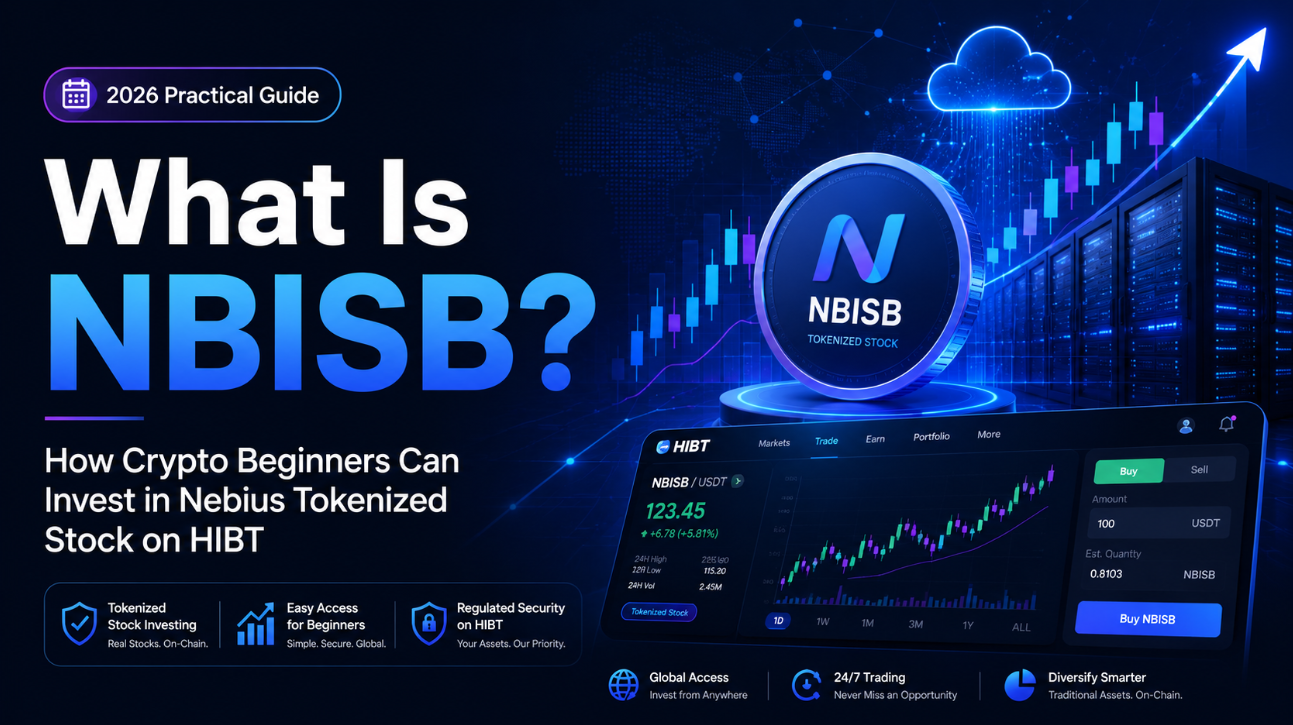
In short, NBIS is the ticker for Nebius Group N.V. on Nasdaq; NBISB is Nebius Tokenized bStocks, a tokenized security / tokenized stock exposure designed around the underlying NBIS shares. It is not a common stock directly issued by Nebius, nor is it a meme coin pumped by community narratives.
Within the bStocks ecosystem, tickers like TSLAB, NVDAB, CRCLB, and NBISB typically use the trailing B to indicate membership in the bStocks tokenized stock system. According to Binance Academy’s explanation of bStocks, bStocks are tokenized securities issued by BTech Holdings Limited, with each bStock backed 1:1 by the corresponding U.S. stock held by a custodian, and they operate as BEP-20 tokens on BNB Smart Chain. At the same time, the official disclaimer makes it clear that bStocks do not represent direct ownership of the underlying company’s stock, but rather provide exposure to the price performance and economic rights of the underlying stock.
Therefore, a more accurate understanding of NBISB is:
- It is not Nebius common stock itself;
- It is not a native token issued by Nebius;
- It is not an independent public-chain project;
- It is a tokenized stock exposure built around the underlying NBIS shares.
CoinMarketCap’s description of NBISB also emphasizes that it is Nebius Tokenized bStocks, offering economic exposure to Nebius Tokenized bStocks and, under legally compliant conditions, the right to convert into the underlying security. The page also shows its contract on BSC as 0xe256...cbcbb1, with a BscScan explorer link.
The most common mistake newcomers make is seeing a token called NBISB on-chain and buying it directly in a wallet or DEX. The correct approach is:
- First confirm whether the official exchange page supports NBISB/USDT;
- Then verify that the contract shown on the official page, CoinMarketCap, and BscScan all match;
- Only then consider placing an order.
If you verify the contract on BscScan, don’t just look at the name or logo. You should check at least four points: does the contract address prefix/suffix match the official one, e.g., 0xE256...cBB1; is the token name "Nebius Tokenized bStocks"; are there official price pages, CMC pages, or exchange pages pointing to it; and do the holders, transfer records, and contract creation time align logically with the official launch time.
This is extremely important because anyone on BSC can create a token with a similar name. The real danger isn’t not knowing about NBISB—it’s thinking you bought NBISB when you actually bought a fake contract.
Why was Nebius chosen as a tokenization target? The reason is not that it’s "easy to pump like a small coin," but that it is already a Nasdaq-listed company operating at the intersection of three hot sectors: AI cloud computing, GPU infrastructure, and RWA tokenization. Nebius’s official website describes itself as an Amsterdam-headquartered, Nasdaq-listed AI cloud company with global operations, providing an integrated AI platform spanning data, model training, fine-tuning, and production deployment.
In other words, the core behind NBISB is not "crypto narrative," but "U.S. AI cloud company + on-chain trading access."
2. Nebius Fundamentals Deconstructed: What Justifies This AI Cloud Company’s Rally?
To understand NBISB, you cannot look only at the on-chain price. That’s because the core anchor of NBISB is the underlying NBIS stock, and Nebius’s share price ultimately depends on its AI cloud business, orders, revenue, capex, valuation, and U.S. equity market sentiment.
Nebius’s origins are deeply tied to Yandex. In a 2024 official announcement, Nebius explained that the company previously traded under the name Yandex N.V. with the ticker YNDX; after successfully divesting its Russian operations, it was renamed Nebius Group N.V., changed its ticker to NBIS, and resumed trading on Nasdaq.
The background of founder Arkady Volozh is also critical. According to Nebius’s official board profile, Arkady Volozh is the CEO, Executive Director, and founder of Nebius Group, having served as Yandex CEO from 2000 to 2022 and returning in 2024. He has a computer science background and has founded and participated in multiple technology companies.
Nebius is not an AI concept stock built from scratch. It retains the engineering team, cloud infrastructure experience, data center capabilities, and global customer resources from the original Yandex system. What truly caused the market to reprice Nebius was major customer orders.
In September 2025, Nebius announced an AI infrastructure agreement with Microsoft. Reuters reported that the agreement spans five years with a base value of $17.4 billion, and Microsoft may purchase additional service capacity, bringing the total contract value to approximately $19.4 billion.
By March 2026, Nebius had also reached an AI compute agreement with Meta. Reuters reported that Meta will purchase $12 billion of AI computing capacity from Nebius by 2027, with the agreement including up to an additional $15 billion in potential capacity purchases over the next five years, for a total value of up to $27 billion.
These orders explain why Nebius’s stock price has been dramatically revalued by the market. Not because "someone in crypto shilled it," but because it transformed from "an AI cloud company with a story" into a large-scale AI infrastructure supplier validated by giants like Microsoft and Meta.
The financial data also reflects the growth rate. Nebius’s Q1 2026 earnings report showed quarterly revenue growing from $50.9 million in Q1 2025 to $399 million, a year-over-year increase of 684%; adjusted EBITDA swung from a loss of $53.7 million in the same period last year to a positive $129.5 million.
But high growth does not equal low risk. Nebius’s model is extremely capital-intensive: data centers, GPUs, power supply, land, facilities, operations, and network architecture all require massive capital investment. Compared with CoreWeave, Oracle, and traditional cloud providers, Nebius’s "vertical integration, self-built infrastructure" approach has two sides:
- Advantage: deeper control over costs, efficiency, and customer experience;
- Disadvantage: enormous capital expenditure. Once demand slows, customer procurement delays, or the financing environment tightens, valuation pressure can amplify rapidly.
On valuation, as of July 8, 2026, the latest NBIS price is approximately $195.19, with an intraday range of about $190.36–$208.50. Yahoo Finance’s Singapore page shows an average analyst target price of around $244.21, a low target of $120, and a high target of $380.
Using $195.19 versus $244.21, there appears to be roughly 25% upside to the target price. But newcomers must understand: analyst target prices are not guaranteed returns, let alone maturity promises. Especially for AI cloud infrastructure companies, valuations are highly dependent on future orders, profit margins, financing costs, and customer concentration. Once expectations are revised downward, stock price drawdowns can be severe.
Another risk comes from Meta. In July 2026, Reuters cited a Bloomberg report that Meta is developing a cloud business and plans to sell excess AI computing capacity. After the news broke, CoreWeave and Nebius both fell, as the market worried that Meta might reduce its reliance on neocloud service providers in the future while becoming a potential competitor.
So, Nebius’s investment thesis can be summarized in one sentence:
It is a high-growth AI cloud company validated by major customer orders, but also a high-valuation, high-capex, high-volatility U.S. equity AI infrastructure target.
3. Tokenized Stock Mechanics: How Does NBISB "Represent" a U.S. Stock on BSC?
The core mechanism of NBISB is moving traditional U.S. stock exposure onto the blockchain.
The traditional path is: you open an account with a broker, buy the Nasdaq stock NBIS, and your holdings are recorded in the broker’s system and the traditional securities clearing system.
The tokenized path is: the issuer or related platform holds the underlying stock or corresponding rights, then issues corresponding tokens on the blockchain, allowing users to trade this tokenized security through their crypto asset accounts.
The official bStocks documentation highlights several key points:
- Each bStock is backed 1:1 by the corresponding U.S. stock;
- The underlying stock is held by a regulated custodian;
- bStocks are BEP-20 tokens on BNB Smart Chain;
- Eligible users can complete a 1:1 conversion between stock and bStocks within the platform;
- bStocks support 24/7 trading and self-custody, though related services may be suspended due to corporate actions, maintenance, or compliance restrictions.
This mechanism sounds a lot like "stocks on-chain," but newcomers must pay attention to one core distinction: 1:1 backing does not equal zero risk.
Because what you hold is not NBIS common stock in a traditional brokerage account, but rather an asset constructed by the issuer, custodian, exchange, on-chain contract, and redemption mechanism. If any link in the chain fails, holders may face risk.
For example:
- Legal issues with the issuer or custody structure;
- The platform temporarily suspending deposits, withdrawals, or redemptions;
- Significant deviation from the underlying stock price when the U.S. market is closed;
- Thin exchange order book depth causing noticeable slippage;
- Regulatory changes that prevent users in certain regions from trading or redeeming.
There is also a critical pricing issue: U.S. stocks do not trade 24/7. Nasdaq’s official trading hours are 9:30 AM–4:00 PM ET, Monday through Friday, with pre-market and after-hours extended sessions. However, tokenized assets like NBISB on crypto exchanges may support longer trading hours, creating a time gap.
- When the U.S. market is open, NBISB’s fair price should generally be close to the NBIS underlying price.
- When the U.S. market is closed, NBISB’s price is driven more by market expectations, order book depth, arbitrage capital, news flow, and trading sentiment.
- If earnings, orders, or regulatory news break after U.S. market hours, NBISB may react first in the crypto market, but it is also more prone to price overshoot.
To judge whether NBISB is fairly priced, newcomers can use a simple formula:
Premium / Discount = (NBISB Current Price ÷ NBIS Underlying Reference Price) − 1
For example, if the NBIS underlying reference price is $195 and the NBISB price is $205, the premium is roughly 5.1%. Unless you are very confident about a major positive catalyst, it is generally unwise to chase in at a clear premium.
Conversely, if NBISB trades more than 5% below the NBIS underlying price, it is not necessarily a bargain. The discount may stem from illiquidity, platform restrictions, redemption friction, market panic, or market maker absence.
Remember: the core of tokenized stocks is not "always equal to the underlying stock price," but rather converging toward the underlying stock price through arbitrage and redemption mechanisms.
4. Why Would Crypto Users Buy NBISB on HIBT Instead of Opening a Traditional Brokerage Account?
For users already holding USDT, the biggest appeal of tokenized stocks is the shorter path.
Buying NBIS through a traditional broker typically involves these steps:
- Account opening;
- Identity verification;
- Filling out investment experience and tax information;
- Linking a bank card or cross-border wire transfer;
- Waiting for funds to arrive;
- Currency exchange into USD;
- Waiting for U.S. market trading hours;
- Placing an order to buy NBIS.
Using Interactive Brokers as an example, its official documentation states that fund transfers can take up to four business days, and whether you can trade within one business day or sooner depends on bank processing speed. For crypto users already holding USDT, this process is indeed longer than directly trading with stablecoins.
If HIBT has already opened the NBISB/USDT trading pair, the user path is much closer to:
- Register on HIBT;
- Deposit USDT;
- Search for NBISB/USDT;
- Buy NBISB with USDT;
- Sell later to convert back to USDT.
HIBT’s official fee schedule shows a standard spot trading maker fee of 0.2% and taker fee of 0.2%, with fees calculated as the total value of the acquired asset multiplied by the fee rate. If actual rates are adjusted, the platform’s subsequent announcements shall prevail.
For small investors, the advantage is simplicity: no need to convert to USD first, no need to wait for the U.S. market to open, and no need to go through a full brokerage process for a very small position.
But it also comes with clear costs:
- You bear exchange account risk;
- You bear USDT deposit and chain-selection risk;
- You bear the redemption and compliance risk of the tokenized security itself;
- You may not enjoy full traditional shareholder rights;
- You need to monitor the premium/discount between NBISB and the underlying NBIS stock.
Therefore, the HIBT path is more suitable for users who "already have USDT, want a small allocation to U.S. AI exposure, and understand on-chain asset risk," rather than for all traditional stock investors.
5. HIBT Walkthrough: The Complete 8-Step Process from Registration to Buying NBISB
Below is a more conservative operational path from a newcomer’s perspective. Since page layouts, supported assets, and account tiers may vary by country/region and time, please refer to the real-time display in the HIBT App or web interface for actual operations.
Step 1: Register an account.
You can usually register a HIBT account with an email, set a password, and complete email verification. Use a secure, frequently used email—do not use a temporary email. The first thing after registration is not to deposit, but to enable two-factor authentication, such as Google Authenticator or the security verification method supported by the platform.
Step 2: Complete necessary identity verification.
Whether KYC is required, and to what level, to trade or withdraw depends on HIBT’s current rules. Newcomers should not wait until they make money to discover withdrawal restrictions. Confirm whether your account meets deposit, trading, and withdrawal requirements before depositing funds.
Step 3: Deposit USDT.
HIBT’s official deposit tutorial shows that when selecting USDT deposit, the platform displays the supported deposit networks; for example, USDT-TRC20 represents the TRON network, USDT-ERC20 represents the Ethereum network, and USDT-OKC represents the OKChain network. Different networks have different speeds and fees.
This is where mistakes happen most easily. When transferring USDT from an external wallet or another exchange to HIBT, you must ensure the withdrawal network and deposit network match. TRC20 cannot be sent to an ERC20 address, and BEP20 should not be arbitrarily sent to an unsupported network. HIBT’s withdrawal guide also warns that if the receiving wallet supports TRC-20 USDT but you select ERC-20 on the exchange, the assets may not arrive normally, and the recovery process is complex, costly, and not guaranteed to succeed.
Step 4: Start with a small test.
Do not deposit a large amount on the first try. It is recommended to test the deposit process with 10–30 USDT first, confirming that arrival speed, network selection, fees, and account display are all normal. Only after a successful small test should you consider a formal deposit.
Step 5: Search for NBISB in the spot trading area.
Enter the spot trading area and search for "NBISB" or "NBISB/USDT." If HIBT has not yet opened this trading pair, or no results appear, do not buy a same-name token on a DEX. You can wait for the official announcement, or choose another already-open tokenized stock target.
Step 6: Verify the trading pair.
If multiple similar tickers appear on the page, prioritize confirming three pieces of information: is the name "Nebius Tokenized bStocks"; is the trading pair NBISB/USDT; and does the platform have a listing announcement, asset introduction, or contract information? Do not place an order just because the name looks similar.
Step 7: Prefer limit orders.
For a first trade, newcomers are advised to use a limit order rather than a market order. The reason is simple: tokenized stock order books may be thinner than those for BTC, ETH, or major altcoins. A large market order could sweep through the book and cause significant slippage. After-hours U.S. stock trading itself suffers from low liquidity, wider spreads, and price uncertainty; Investopedia’s explanation of after-hours trading risks also notes that after-hours trading often features low liquidity, wider bid-ask spreads, and higher volatility.
Step 8: Record your cost basis after buying.
After buying NBISB, record four data points: purchase price, purchase quantity, fees, and the NBIS underlying reference price at the time. This allows you to judge whether you bought at fair value, at a premium, or at a discount. When exiting later, you can generally sell NBISB in the spot market to convert back to USDT; if the platform supports withdrawing NBISB to a BSC wallet, you will need BNB for on-chain gas, and must confirm that your wallet supports BNB Smart Chain.
Newcomers should keep their first position very conservative. Not because NBISB is necessarily bad, but because you need to first verify the full process: registration, deposit, search, order placement, execution, position checking, selling, and withdrawal. Process is more important than profit.
6. NBISB vs. TCCBSC vs. FLOKI: These Are Completely Different Asset Classes
Many crypto newcomers are used to calling everything tradable on an exchange a "coin." But from an investment logic perspective, NBISB, TCCBSC, and FLOKI are fundamentally different asset classes.
NBISB is a tokenized stock exposure. Its core pricing anchor is the underlying NBIS stock, and its drivers include Nebius earnings, Microsoft/Meta orders, AI cloud demand, data center capex, U.S. tech stock valuations, and overall Nasdaq risk appetite.
TCCBSC leans toward a different tokenized asset logic. If you are not yet familiar with the classification of tokenized assets, you can first learn about what TCCBSC is. It represents a completely different asset structure and risk profile compared to NBISB.
FLOKI is a community-driven token. Its price is driven more by meme culture, community hype, exchange liquidity, ecosystem narratives, market sentiment, and short-term speculative capital. Those interested in community tokens can also read what FLOKI is. After comparing the two, you will better understand what NBISB’s "stock-like nature" actually means.
The most critical distinction is:
- Meme coin rallies may come from community consensus and sentiment diffusion;
- Tokenized stock rallies must eventually return to underlying stock fundamentals and valuation logic;
- Meme coins can be analyzed with "sentiment cycles"; NBISB should be analyzed with "stock research + on-chain liquidity."
Therefore, you cannot hold NBISB with a "double-and-take-out-principal" crypto trading mindset. A more reasonable approach is to treat it as part of an "allocation position" or "thematic position"—for example, AI cloud, RWA, or U.S. tech exposure—rather than as a short-term get-rich-quick tool.
If you hold both NBISB and FLOKI on HIBT, a more reasonable portfolio segmentation is:
- NBISB belongs to the AI U.S. stock / RWA allocation bucket;
- FLOKI belongs to the community sentiment / high-volatility speculative bucket;
- The two cannot be compared within the same risk framework;
- Even less should you expect NBISB to pump in the same way as FLOKI just because FLOKI can moon.
7. Risk Checklist: 5 Real Questions You Must Face Before Buying NBISB
1. Underlying NBIS stock risk.
If the underlying NBIS stock drops 30%, NBISB will theoretically follow. Tokenized stocks are not stablecoins, nor are they principal-protected products. Nebius currently carries high market expectations. Once order confirmation slows, AI cloud gross margins fall short of expectations, capex continues to expand, or customer concentration risk rises, the stock price will come under pressure.
2. Valuation risk.
Nebius is a high-growth company, but high growth does not mean it always deserves a high valuation. The market is currently willing to pay a high multiple because of AI compute demand, Microsoft/Meta mega-deals, and future ARR imagination. If the market shifts from "looking at growth" to "looking at profits and cash flow," valuation multiples could contract rapidly.
3. Price dislocation risk.
NBISB may exhibit premium/discount when the U.S. market is closed, exchange liquidity is insufficient, the order book is thin, or major news breaks. When newcomers encounter a deviation of more than 5%, do not immediately assume it is an opportunity. First confirm: what is the latest NBIS underlying price? Is the U.S. market open? Is the order book depth sufficient? Is there major news? Are there any platform deposit/withdrawal restrictions?
4. Platform and redemption risk.
When buying NBISB on HIBT, you need to trust the platform’s trading system, asset custody, deposit/withdrawal handling, risk management, and extreme-market response capabilities. You must also understand that the balance shown on the platform does not mean you have full control over the on-chain asset. If you place high importance on self-custody, you need to confirm whether the asset supports on-chain withdrawal, and what the withdrawal network, fees, arrival time, and minimum withdrawal amount are.
5. Legal and compliance risk.
Mainland China maintains a strict prohibition stance toward virtual currency trading and related business activities. The 2021 Notice on Further Preventing and Handling Risks of Virtual Currency Trading and Speculation clearly states that virtual currencies do not have the same legal status as fiat currency, related business activities constitute illegal financial activities, and overseas virtual currency exchanges providing services to mainland residents via the internet also constitute illegal financial activities.
This means that if you are located in mainland China or subject to relevant regulations, participating in virtual currency trading, tokenized securities trading, or overseas exchange activities may carry compliance risks. This article is not encouraging regulatory evasion, but rather reminding you: before considering returns, first confirm whether your jurisdiction permits such transactions.
Finally, operational risk.
Wrong contract address, wrong network selection, and heavy market-order sweeping are the three most common mistakes for newcomers. The avoidance methods are simple:
- Only enter trading pairs from the official page;
- Only use deposit networks supported by the platform;
- Always start with a small test amount;
- Prefer limit orders;
- Do not chase when the U.S. market is closed and NBISB is at a clear premium;
- Do not send all your USDT at once to an unfamiliar platform or on-chain address.
8. Investment Strategy: Is NBISB Suitable for DCA, Swing Trading, or Long-Term Allocation?
NBISB is not suitable for everyone. It is better suited for three types of people:
- Those who already understand U.S. stock volatility;
- Those who are already familiar with USDT deposits and exchange operations;
- Those who want to use a crypto account to allocate to U.S. AI stock exposure.
If you are a complete beginner, the first step is not to buy, but to build a watchlist.
As of July 8, 2026, NBIS is priced around $195.19, and Yahoo Finance shows an average analyst target price of about $244.21. On the surface, there is still some distance to the average target, but that does not mean "buying now guarantees profit."
More conservative strategies can be divided into three types.
Type 1: Dollar-cost averaging (DCA).
Suitable for those who don’t want to watch the market daily and are bullish on the long-term AI cloud trend. The approach is to invest a fixed small amount weekly or monthly, for example 5%–10% of total planned capital. The advantage is reduced timing pressure; the disadvantage is that if the valuation is significantly revised downward, the early DCA tranches will also suffer unrealized losses.
Type 2: Drawdown-based accumulation.
Suitable for those who can tolerate volatility and are willing to wait for price. For example, build a 20% base position first, then add in batches when NBIS or NBISB pulls back 15%, 25%, and 35% from highs. This approach is more disciplined than chasing highs, but it requires you to write down the rules in advance and not change the plan on the fly when prices drop.
Type 3: Rebalancing.
Suitable for those who already have a sizeable crypto portfolio. You can set NBISB at 3%–10% of total assets, sell a portion if it rises too much, and buy back if it falls below the target allocation. The core of this method is not predicting short-term price moves, but controlling the impact of a single asset on the overall portfolio.
As for how much NBISB should represent in your total crypto assets, newcomers are advised not to exceed 5%–10%. If you have no experience, you can even start from 1%–3%. Although NBISB is backed by a U.S. company, the way you hold it is still a tokenized asset in a crypto exchange account. You cannot treat it exactly the same as a stock position in a traditional brokerage.
Earnings seasons require extra caution. For high-growth AI cloud companies like Nebius, earnings releases are often accompanied by large volatility. Good earnings may lead the market to continue upgrading expectations; disappointing earnings or conservative management guidance can also trigger rapid drawdowns. Newcomers without earnings-trading experience should avoid heavy directional bets ahead of earnings.
9. Conclusion: NBISB Is Not a Get-Rich-Quick Tool, but a Gateway to the RWA Era
The most valuable aspect of NBISB is not whether it can spike in the short term, but that it allows crypto users to more intuitively understand for the first time: in the future, many real-world assets may enter crypto accounts in on-chain form.
- Stocks can be tokenized;
- Government bonds can be tokenized;
- Gold can be tokenized;
- Funds, indices, private equity, and compute contracts may also come on-chain in various forms.
This is the long-term trend of RWA.
But a correct trend does not mean every product is safe; putting assets on-chain does not eliminate risk; 24-hour trading does not make it easier to profit. On the contrary, tokenized stocks layer traditional financial risks on top of crypto market risks.
For newcomers, after reading this article, the most important thing is not to immediately buy a heavy position, but to complete three things:
First, verify the asset.
Confirm the relationship between NBISB and NBIS, check the official page, CMC, BscScan, and exchange page, and do not buy fake contracts.
Second, run a small test.
Use the smallest possible amount to go through the full HIBT process: registration, deposit, search, limit-order placement, position checking, selling, and withdrawal.
Third, build a watchlist.
Track Nebius earnings, Microsoft/Meta order progress, AI cloud industry competition, NBIS underlying valuation, NBISB premium/discount, and HIBT trading depth over the long term.
NBISB is not a "crypto get-rich-quick button," but rather an entry point for crypto users to access U.S. AI cloud assets and the RWA tokenization trend. Truly mature investors will not only ask "will it go up," but first ask:
- What exactly am I buying?
- What drives its pricing?
- What additional risks am I taking on?
- If the price drops 30%, will I still know why I hold it?
Being able to answer these questions before buying is the true mark of a newcomer advancing to the next level.