
Introduction: Why Should Crypto Users Care About a "Mysterious" AI Big-Data Company?
Over the past two years, AI has been the central narrative shared by both the crypto and US stock markets.
Crypto users are familiar with AI concept tokens: AI Agents, DePIN, compute networks, data labeling, decentralized model markets, and AI memes. They offer high elasticity, but they share one obvious problem: many projects are still at the narrative stage, with unclear real revenue, stable clients, or long-term contracts.
If a crypto user wants to participate in the AI rally, besides buying AI concept tokens, is there an asset closer to "real AI commercialization"?
Palantir is a subject worth studying.
Palantir Technologies, ticker PLTR, is a US-based data analytics and artificial intelligence software company. It has long served US intelligence agencies, the Department of Defense, government agencies, and large enterprises, earning it the frequent label of "the most mysterious company in Silicon Valley." Palantir's own website states its positioning directly: it builds software that helps organizations integrate data, make decisions, and run operations.
Unlike common crypto project teams, Palantir does not rely on token issuance for fundraising, community shilling, or "future ecosystem" storytelling. Its core competitiveness comes from long-term government contracts, complex data systems, AI platform execution capabilities, and high-barrier client relationships.
The emergence of PLTRB gives crypto users a new option: instead of opening a US stock account or buying only AI concept tokens, they can gain exposure to Palantir through a tokenized stock product traded with USDT on HIBT.
According to the HIBT announcement, the platform has listed PLTRB (Palantir Tokenized bStocks), with the trading pair PLTRB/USDT, token type BSC, spot trading opening at 15:30 (UTC+8) on July 1, 2026, and withdrawals opening at 15:30 (UTC+8) on July 2, 2026.
But we must state this clearly at the beginning: PLTRB is not an ordinary cryptocurrency, nor is it PLTR stock held directly in a Nasdaq account. It is a tokenized stock—a form of RWA (Real World Asset) tokenization. It carries the volatility of a single US stock, along with the risks of tokenized securities, trading platforms, on-chain transfers, custody, compliance, and liquidity.
This article will explain from a newcomer's perspective:
- What exactly is PLTRB?
- How does it differ from PLTR common stock?
- Is Palantir really "real AI"?
- Why are crypto users paying attention to PLTRB?
- How do you buy PLTRB on HIBT?
- What hidden risks must you know before buying?
I. PLTRB Deconstructed: Is It Palantir Stock or a Cryptocurrency?
1. PLTRB Is Not an Ordinary Cryptocurrency—It Is Tokenized Stock Exposure to Palantir
One-sentence explanation of PLTRB:
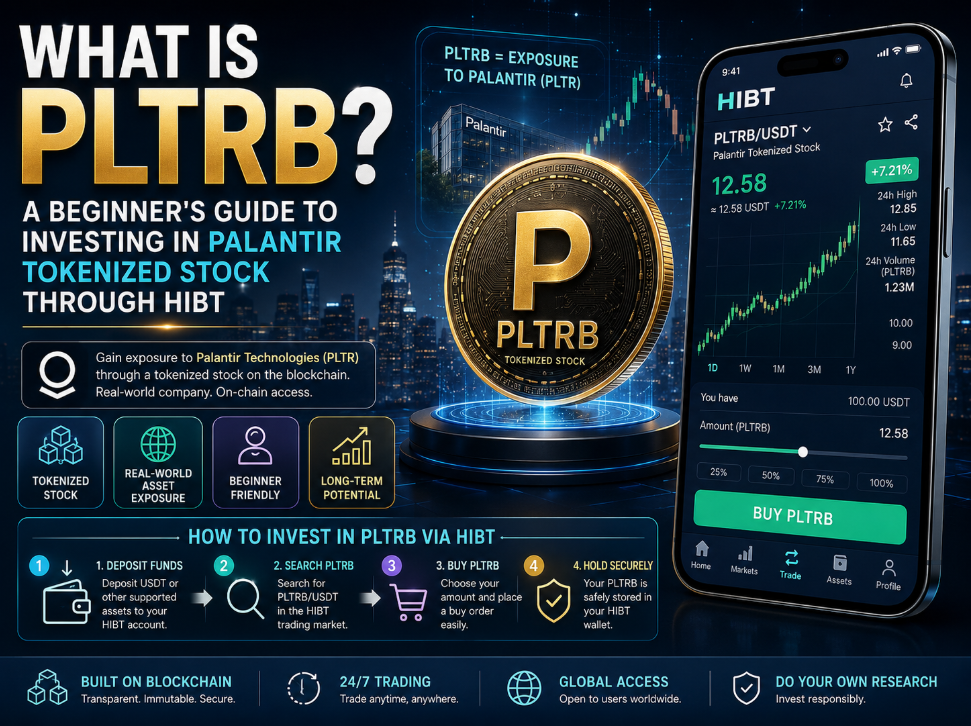
PLTRB is a tokenized security product designed around Palantir Technologies stock (PLTR), allowing users to gain economic exposure to PLTR price performance in a crypto trading environment through USDT.
There are three layers to distinguish here.
The first layer is PLTR. PLTR is the ticker for Palantir Technologies on the Nasdaq. Buying PLTR common stock means you hold shares of a listed company through a traditional securities account.
The second layer is PLTRB. PLTRB is Palantir's bStocks tokenized version. According to Binance's bStocks documentation, bStocks are issued by BTech Holdings Limited and represent an interest in the underlying securities held by the issuer, but they do not equal direct ownership of the underlying listed company's stock.
The third layer is HIBT. HIBT provides the PLTRB/USDT spot trading gateway. That means users are trading PLTRB on the HIBT platform, not buying PLTR common stock directly on the Nasdaq. The HIBT announcement states that the PLTRB listing trading pair is PLTRB/USDT, token type BSC, and provides the corresponding block explorer link.
So, newcomers must not understand PLTRB as "Palantir's official token." A more accurate description is:
- PLTRB is a tokenized security tied to Palantir stock;
- It provides exposure to PLTR price performance, not traditional stock account equity;
- Holding PLTRB does not make you a registered shareholder of Palantir;
- Its risks come not only from PLTR's stock price, but also from the issuer, custodian, platform, on-chain environment, and regulatory landscape.
2. What Is the Difference Between PLTRB and PLTR?
PLTR is a Nasdaq-listed stock. Trading occurs in traditional securities markets, typically requiring a US stock brokerage account, USD funds, and stock trading permissions.
PLTRB is a tokenized stock. Trading occurs in a crypto trading platform or on-chain environment. It is usually quoted in USDT and suits users who already hold stablecoins and are familiar with the spot trading interface.
The core difference between the two is not price—it is the rights structure.
Buying PLTR common stock means you are operating within the traditional securities system: broker, clearinghouse, stock registration, shareholder rights, voting rights, dividend rules, etc.
Buying PLTRB means you are operating within the tokenized securities system: issuer, custodian, platform matching, on-chain contracts, deposits and withdrawals, regional restrictions, compliance documents, and redemption rules.
Binance's announcement clearly states that bStocks are not stocks or shares, do not entitle holders to direct ownership of the underlying listed company's stock or shares, and trading is subject to user eligibility based on country or region.
Therefore, when evaluating PLTRB, newcomers should not only ask "does it track PLTR's price," but also ask:
- Who issued this token?
- How is the underlying stock custodied?
- Are deposits and withdrawals supported?
- Can it be redeemed or converted?
- Is trading allowed in my region?
- If the platform or issuer has problems, where are my rights?
3. How Do Tokenized Stocks Peg to Real Stocks 1:1?
The bStocks system emphasizes underlying asset backing and 1:1 conversion. The Binance announcement mentions that users can convert directly held stocks into bStocks, with a 1:1 conversion ratio between each underlying share and its corresponding bStocks, and the batch includes LITEB, METAB, MSFTB, PLTRB, and QQQB.
But "1:1" must be understood very carefully here.
"1:1 peg" is more about economic exposure and conversion mechanism; it does not mean you directly hold one share of PLTR common stock. You hold a tokenized security representing an interest in the underlying securities, not PLTR stock in a traditional securities account.
This is similar to how stablecoin USDT pegs to the US dollar, but holding USDT does not equal holding USD deposits directly in a bank account. Tokenized stocks follow the same logic: they can track the underlying asset's price, but the holder faces a different legal and custody structure.
4. What Does Palantir Actually Do?
Palantir's core business can be understood as: helping governments, the military, and large enterprises turn scattered data into software systems for decision-making, action, and automation.
It is not ordinary SaaS, nor is it simply selling AI models. Palantir is more like building a "data operating system" for complex organizations.
Palantir's main product lines can be divided into three categories:
Gotham: Focused on government, intelligence, defense, and counter-terrorism scenarios. In Palantir's official description, Gotham is used for decision-making and asset scheduling in dynamic operational environments, emphasizing improved decision effectiveness in complex, high-pressure scenarios.
Foundry: Focused on commercial and enterprise data platforms. In Palantir's official description, Foundry is used to transform data and analytics capabilities into closed-loop operational systems, with Foundry Ontology at its core.
AIP: Artificial Intelligence Platform. Palantir official documents state that AIP supports organizations in real-time AI-driven decision-making in critical commercial and government environments, with applications ranging from public health to battery production.
To put it in terms newcomers can understand:
- Gotham is like a "data combat system for defense and intelligence agencies";
- Foundry is like a "data brain and operations platform for large enterprises";
- AIP is like an "AI control layer that integrates large models into real business workflows."
This is why Palantir differs from many AI concept tokens. AI concept tokens often talk about "future ecosystem," while Palantir emphasizes "signed contracts, deployed systems, generated revenue."
5. Does 70% of Palantir's Revenue Come From Government Contracts?
Here we need to correct a common misconception: Palantir does rely heavily on government clients, but the latest public filings do not support the claim that "70% of revenue comes from government contracts."
Palantir's 2025 annual report shows that 54% of revenue came from government clients and 46% from commercial clients.
Palantir's Q1 2026 10-Q filing shows that for the three months ended March 31, 2026, 53% of revenue came from government clients and 47% from commercial clients.
This indicates that Palantir is still a company with a high proportion of government business, but it is not simply "living off the Department of Defense." A more accurate description would be:
- Government clients remain Palantir's foundation;
- US government business is growing very rapidly;
- Commercial client revenue is also expanding quickly;
- AIP is pushing Palantir from "mysterious government contractor" toward "enterprise AI infrastructure company."
Palantir's Q1 2026 business update shows that company revenue grew 85% year-over-year to $1.63 billion, US government revenue grew 84% YoY to $687 million, and US commercial revenue grew 133% YoY to $595 million.
This data set is crucial. It shows that Palantir's AI growth is not just a story—it is already reflected in reported revenue.
II. Why Should Crypto Users Allocate to PLTRB on HIBT?
1. Gain US Stock AI Leader Exposure with USDT—Lower Barrier to Entry
Buying PLTR through a traditional broker generally requires registering for a US stock account, completing identity verification, depositing funds, foreign exchange conversion, and then placing orders during US trading hours.
For crypto users who already hold USDT, this path is not smooth. You would need to move from on-chain assets into the fiat system, then from the fiat system into the US stock market, potentially involving FX conversion, bank cards, cross-border deposits, broker restrictions, and waiting times.
HIBT's PLTRB offers another path: trade PLTRB/USDT directly with USDT.
This offers several clear advantages for crypto users:
- No need to convert USDT into USD first;
- No need to open a separate traditional US stock account;
- Operate within a familiar spot trading interface;
- Add PLTRB as an AI US stock exposure to your portfolio;
- Manage it alongside BTC, ETH, stablecoins, and other RWA assets.
According to the HIBT registration tutorial, users can click the registration button on the official website, choose phone or email registration, and complete account creation with a verification code.
2. 7×24 Trading Experience, Closer to Crypto User Habits
US stock markets have fixed trading hours. Even though some brokers support pre-market and after-hours trading, not all users can execute at ideal prices at any time.
Crypto users are accustomed to a 7×24 market: check charts anytime, place orders anytime, manage positions anytime.
One of the attractions of tokenized stocks is putting traditional stock assets into an environment closer to crypto trading habits. PLTRB allows users to view price, candlestick charts, and order book depth in HIBT's spot market. The HIBT trading page shows that PLTRB/USDT supports spot trading and provides real-time price, trading volume, charts, and market data.
But it must also be reminded here: 7×24 trading does not mean the underlying PLTR stock also trades 7×24.
When US markets are closed, PLTRB price may be influenced more by the platform's internal buy/sell orders, market maker liquidity, market expectations, news events, and premium/discount. In other words, PLTRB offers a more flexible crypto trading experience, but that does not mean the price will always precisely track the PLTR common stock.
3. Palantir's Position in the AI Arms Race Is More Than a Concept
Many AI projects talk about "future AI integration," while Palantir has already sold its AI and data platforms to government, defense, intelligence, and commercial enterprise clients.
In Q1 2026, Palantir revenue grew 85% YoY to $1.63 billion, US commercial revenue grew 133% YoY, and US government revenue grew 84% YoY. This shows that AIP and Palantir's existing platforms are jointly driving revenue growth.
Reuters also reported that Palantir raised its full-year 2026 revenue guidance, mainly driven by strong US government demand for data analytics and AI software; it mentioned defense-related applications such as Maven AI battlefield software.
This is the difference between PLTRB and ordinary AI concept tokens:
- Ordinary AI tokens rely more on crypto narratives;
- PLTRB is backed by listed company Palantir;
- Palantir's revenue, contracts, clients, and profits can be verified through financial reports;
- But PLTRB itself carries the risks of tokenized securities and platform trading.
4. Is PLTR's Current Valuation Too High?
This is a question that must be faced before buying PLTRB.
As of July 2, 2026, PLTR's latest price is approximately $125.73, with a market cap of about $323.2 billion and a P/E ratio of roughly 141x.
That valuation is absolutely not low.
A high P/E means the market has already priced in many years of future growth. Palantir must continue to deliver high growth, high margins, and strong order flow to support the current valuation. If revenue growth slows, government orders decline, or commercial client growth falls short of expectations, the stock price could correct sharply.
But why are people still willing to buy at such a high valuation?
The reason is that the market views Palantir as a composite company spanning AI infrastructure, defense technology, enterprise data operating systems, and government AI platforms. It is not a traditional software stock, nor a pure consulting firm, but is seen by some investors as an "operating-system-level" company in the AI era.
The problem is: this pricing is heavily dependent on belief and growth delivery. If growth is delivered, the valuation may continue to be accepted by the market; if growth falls short, the high P/E will amplify the downside.
So, for crypto newcomers, PLTRB is not a cheap asset—it is a high-growth, high-valuation, high-volatility asset.
5. Who Is PLTRB Not Suitable For?
PLTRB is not suitable for the following types of users:
- Those who cannot tolerate large single-stock volatility;
- Those who do not understand the rights structure of tokenized stocks;
- Those who believe "Palantir does AI, so it must go up";
- Those already heavily allocated to AI tokens and altcoins, who still want to go all-in on AI;
- Those very sensitive to US government contracts, defense budgets, or privacy controversies;
- Those in regions where trading tokenized securities is not allowed;
- Those unable to distinguish official trading portals, contract addresses, and counterfeit token risks.
If your goal is short-term speculation, PLTRB may not necessarily be better than AI memes for you. If you want to understand assets in the AI赛道 that are closer to real revenue, PLTRB is worth adding to your research list.
III. HIBT Practical Guide: The Complete Path from Registration to Holding PLTRB
1. Step 1: Register a HIBT Account
The first step for newcomers is not depositing funds or immediately buying PLTRB—it is completing account registration and security settings.
According to the HIBT web registration tutorial, users can open the HIBT official website, click the registration button in the upper right corner, choose phone or email registration, and obtain a verification code. After successful registration, if you enter a referral code, you must confirm it during registration; referral relationships cannot be changed after registration.
It is recommended to complete several things immediately after registration:
- Set a strong password;
- Bind email or phone number;
- Enable two-factor authentication (2FA);
- Check login devices;
- Never send your verification code to anyone;
- Do not click links sent by unofficial customer service.
Images are recommended for this section when published:
- HIBT official website homepage registration portal;
- Email/phone registration page;
- Verification code page;
- Account security settings page;
- 2FA setup page.
2. Step 2: Complete KYC
Trading platforms typically require users to complete KYC (Know Your Customer), which is identity verification. The goal of KYC is to confirm user identity and reduce fraud, money laundering, and compliance risks.
HIBT-related articles also prompt users to complete KYC identity verification during the trading process.
Newcomers generally need to prepare:
- Your own ID document;
- A clear photo of the document;
- Personal information consistent with the document;
- Facial recognition or liveness check;
- An email or phone number that can receive verification codes.
Do not state a fixed review time. Ordinary accounts may be completed quickly, but if the document is blurry, information is inconsistent, the network environment is abnormal, regional restrictions apply, or manual review is triggered, it may take longer.
For the published page, it is recommended to use "usually completed quickly; specific timing depends on the platform page display," and do not promise "it will definitely pass in a few minutes."
3. Step 3: Deposit USDT to HIBT
After completing account setup and KYC, you can deposit USDT.
The HIBT deposit tutorial shows that users can click Deposit on the App homepage, search for or select USDT, then choose the deposit network. Taking USDT as an example, HIBT supports multiple deposit networks: USDT-TRC20 means depositing via the TRON network, USDT-ERC20 means depositing via the Ethereum network, and USDT-OKC means depositing via the OKChain network; different networks have different speeds and fees.
Here is the place where newcomers most easily lose money: the same token does not mean the same network.
When you withdraw USDT from another platform, you must choose the network that matches the HIBT deposit page. The HIBT tutorial also clearly warns that different networks are not interoperable; if you select USDT-TRC20 on HIBT, the sending platform must also select TRC20; choosing different networks may cause deposit failure.
The safe process is:
- Select USDT deposit on HIBT;
- Confirm the supported network;
- On the withdrawal platform, select the exact same network;
- Copy the deposit address;
- Send a small test amount first;
- Confirm arrival before transferring the formal amount;
- Save the transaction hash for easy lookup.
If you are a newcomer, it is recommended to test only 10–20 USDT the first time, not a large deposit right away.
4. Step 4: Enter the PLTRB/USDT Trading Pair
After USDT arrives, you can go to the HIBT spot trading area, search for PLTRB, and find the PLTRB/USDT trading pair.
The HIBT announcement states that the PLTRB listing trading pair is PLTRB/USDT, token type BSC, and provides a direct trading link and BscScan block explorer link in the announcement.
After entering the trading page, newcomers should focus on these points:
- Confirm the trading pair is PLTRB/USDT;
- Check whether the current price deviates significantly from the PLTR common stock reference price;
- Check whether the bid-ask spread is too wide;
- Check whether the order book depth is sufficient;
- Check whether the 24-hour trading volume is stable;
- Check whether there is abnormal pump or dump.
Do not just look at "can I buy it," but also look at "can I buy it at a reasonable price."
5. Step 5: Limit Order vs. Market Order—Which to Choose?
For newcomers buying PLTRB for the first time, it is recommended to prioritize limit orders, not market orders.
The advantage of a market order is fast execution; the disadvantage is that the execution price is uncontrollable. If PLTRB order book depth is insufficient, a market order may eat through multiple price levels, causing significant slippage.
The advantage of a limit order is that you can control the execution price. You can refer to the PLTR common stock price, the current PLTRB price, and the bid-ask spread, then set a buy price you can accept.
A more newcomer-friendly approach is:
- Buy in small amounts;
- Place orders in batches;
- Prioritize limit orders;
- Do not place large market orders when the order book is thin;
- Do not place impulsive orders during major US stock earnings, policy news, or after-hours volatility.
If your goal is just to familiarize yourself with the process, you can first test a complete path with a very small amount: deposit USDT, buy PLTRB, check holdings, place a sell order, and observe fees and trade records.
6. Step 6: Leave It on the Exchange or Withdraw to a Self-Custody Wallet?
The HIBT announcement states that the PLTRB token type is BSC, deposits are open, spot trading opened at 15:30 (UTC+8) on July 1, 2026, and withdrawals opened at 15:30 (UTC+8) on July 2, 2026.
This means PLTRB has on-chain transferability, but whether it suits you to withdraw to a self-custody wallet depends on your experience.
If you are a beginner, short-term small holdings can be left on the exchange first, making trading and P&L tracking easier. The downside is that you bear platform account and custody risks.
If you are familiar with wallets, seed phrases, the BSC network, contract addresses, and counterfeit token identification, you can consider self-custody. The downside is that the operation is complex, and if you transfer to the wrong address, wrong chain, or leak your seed phrase, the assets may be unrecoverable.
Newcomer principles:
- Small amounts: leave on the platform to experience;
- Large amounts: must first learn wallet security;
- First withdrawal: must be a small test;
- Never add a PLTRB contract from a random link;
- Contract address must come from the HIBT announcement, the bStocks official website, or the official block explorer link.
IV. PLTRB Investment Strategy: When to Buy, How Much to Buy, and How to Sell?
1. Palantir Is in High Growth—and Also at a High Valuation
PLTRB is backed by the PLTR common stock, and PLTR's current core contradiction is clear:
Fundamentals are very strong, but the valuation is also very high.
From a fundamentals perspective, Palantir Q1 2026 revenue grew 85% YoY to $1.63 billion, US commercial revenue grew 133% YoY, US government revenue grew 84% YoY, and the company raised its full-year revenue guidance.
From a valuation perspective, as of July 2, 2026, PLTR price is approximately $125.73, market cap approximately $323.2 billion, P/E approximately 141x.
This means the market has already assigned Palantir a very high growth premium. Buying PLTRB is not buying a "cheap stock"—it is buying exposure to a highly recognized and highly priced AI software leader.
For investors, the key is not to ask "is it a good company," but to ask:
- Has the good company's good expectation already been priced in?
- Can future growth continue to exceed expectations?
- Can the high P/E be digested by revenue growth and profit margins?
- If a single earnings report falls short, can I withstand a 20% or greater drawdown?
2. How Do Government Budget and Policy Risks Affect PLTRB?
Palantir's advantage comes from government contracts, and its risk also comes from government contracts.
If US defense budgets continue to grow, and demand for AI militarization, intelligence automation, border security, national security, and data governance continues to rise, Palantir may continue to benefit.
But if government budgets are cut, contracts are delayed, policy shifts, or privacy controversies escalate, Palantir's stock price will also come under pressure.
Palantir's Q1 2026 10-Q shows that 53% of the company's revenue that quarter came from government clients. This indicates that government business is not marginal revenue—it is the core revenue source.
This type of company differs from ordinary consumer internet companies. Its revenue is more stable, but also more dependent on policy, budgets, compliance, national security needs, and government procurement cycles.
Therefore, buying PLTRB is not simply betting on AI—it is also betting that the US government and large institutions will continue to increase investment in AI data platforms.
3. What Proportion of a Portfolio Should PLTRB Take?
The outline mentioned 5%–15% as a "tech blue-chip" allocation. This range can serve as a reference for users with higher risk appetite, but it is not suitable for everyone.
More conservative newcomers can keep PLTRB within 1%–5% of total assets.
Users already familiar with US stocks, able to tolerate single-stock volatility, and bullish on Palantir's long-term AI platform value can consider 5%–10%.
Only those with very strong risk tolerance, who have established clear stop-loss and rebalancing rules, should consider higher proportions.
Why is it not recommended to start above 15%?
Because crypto users themselves often already hold BTC, ETH, SOL, AI tokens, and altcoins—all high-risk assets. Although PLTRB is backed by a listed company, it is still a high-volatility single-stock asset, and it carries the additional risk of tokenized securities.
A more reasonable allocation framework is:
- BTC/ETH as the crypto core position;
- USDT as liquidity and defensive position;
- QQQB as tech index exposure;
- PLTRB as an AI single-stock offensive position;
- A small amount of altcoins as high-risk opportunistic positions;
- Do not concentrate all positions on a single AI narrative.
If you are looking for more diversified allocation opportunities on HIBT, you can also follow the platform's analysis of other assets. For example, Is JST a Good Buy Right Now? can serve as a reference case for judging entry timing and understanding the platform's analysis style.
4. Dollar-Cost Averaging PLTRB or Going All-In at Once?
For newcomers, dollar-cost averaging (DCA) is more suitable than going all-in at once.
The reason is simple: PLTR is in a high valuation range, and short-term volatility can be very large. Even if you are long-term bullish on Palantir, that does not mean buying all at once today is the optimal choice.
Three approaches can be used:
First, time-based DCA. For example, buy a fixed amount every week or every month, without trying to predict short-term highs and lows.
Second, drawdown-based accumulation. For example, buy in batches when the stock price pulls back 15%, 25%, and 35% from highs—but only if fundamentals have not deteriorated.
Third, valuation discipline. Reduce buying when P/E and price-to-sales ratios are clearly too high, and consider adding when market sentiment cools.
It is not recommended for newcomers to use the approach of "chasing when it rises, buying the dip when it falls, and ending up with heavier and heavier losses." That is not DCA—it is unplanned averaging down.
5. How to Use HIBT Spot Trading for Swing Trading?
PLTRB is spot, not futures. Newcomers should prioritize spot logic, not high-leverage logic.
If you want to do swing trading, consider several rules:
- Set a maximum loss before buying;
- Take profits in batches after rises, rather than fantasizing about selling at the exact top;
- Reduce position when key support is broken or the earnings thesis changes;
- Avoid going all-in before US stock earnings;
- Do not frequently chase pumps and dump cuts just because PLTRB can trade 24 hours.
A simple position discipline could be:
- Plan to buy 1,000 USDT of PLTRB, but do not buy it all at once;
- First buy 200–300 USDT to observe;
- If the price pulls back and fundamentals remain unchanged, add in batches;
- If the price rises too fast, sell a portion first to recover principal;
- Keep a long-term position, but do not lose cash liquidity.
This kind of discipline is more important than predicting short-term prices.
V. PLTRB's "Relatives": A Look at HIBT's Tokenized Stock Ecosystem
1. How Can You Build an AI + Tech Portfolio on HIBT?
PLTRB is not an isolated asset. It is part of the tokenized stock ecosystem.
According to the Binance announcement, the same batch of newly added bStocks trading pairs includes LITEB, METAB, MSFTB, PLTRB, and QQQB. Among them, PLTRB corresponds to Palantir, MSFTB to Microsoft, METAB to Meta, QQQB to Invesco QQQ Trust, and LITEB to Lumentum.
If classified by investment logic, they can be understood as follows:
- PLTRB: AI data platform, government technology, defense software direction;
- MSFTB: Cloud computing, enterprise software, AI infrastructure direction;
- METAB: Social advertising, AI content distribution, metaverse direction;
- QQQB: Nasdaq-100 ETF, covering a basket of tech companies;
- LITEB: Optical communications, lasers, AI data center hardware chain direction.
More specifically:
- PLTRB is more like a "high-beta AI single-stock";
- QQQB is more like a "tech index base position";
- MSFTB leans more toward "mature tech giant";
- METAB leans more toward "social advertising + AI application";
- LITEB leans more toward "AI hardware infrastructure."
In HIBT's tokenized stock section, AI and big data are just one segment. If you are interested in the optical communications track, you can read further What is LITEB? to understand the fundamentals of Lumentum's tokenized stock, as a reference for intra-sector diversification within the tech space.
2. What Is the Difference Between a Tokenized ETF and a Single-Stock Tokenized Stock?
The biggest difference between QQQB and PLTRB is "diversification" versus "concentration."
QQQB corresponds to the Invesco QQQ Trust, backed by a basket of Nasdaq-100 component stocks. Its advantage is diversification; its disadvantage is that elasticity may not match a single stock.
PLTRB corresponds to Palantir as a single company. Its advantage is that if Palantir continues to exceed growth expectations, the elasticity may be greater; its disadvantage is that if Palantir misses earnings, government contracts have issues, or valuation compresses, the drawdown will also be larger.
Newcomers can pair them like this:
- Want stability: QQQB as main, PLTRB as supplementary;
- Bullish on AI but don't want single-stock risk: QQQB + MSFTB + small proportion PLTRB;
- Strongly bullish on Palantir: PLTRB can serve as an offensive position, but keep position size controlled;
- Completely unfamiliar with US stocks: first study QQQB, then consider PLTRB.
Do not start by going heavy on a single stock. Crypto newcomers are most easily attracted by labels like "AI leader," "government orders," and "mysterious company," but investing is not about how exciting the story is—it is about whether risk and reward match.
3. How Do Tokenized Stocks Pair with BTC and ETH?
PLTRB, QQQB, and other RWA assets should not replace BTC and ETH, but serve as portfolio complements.
- BTC is more like the core asset of the crypto market and a macro risk asset;
- ETH is more like smart contract ecosystem and on-chain economic infrastructure;
- PLTRB is more like an AI US stock single-stock exposure;
- QQQB is more like a tech index exposure;
- USDT is a liquidity and defensive tool.
A mature crypto portfolio should not only contain altcoins, nor should it only contain BTC. The significance of RWA assets is that they allow crypto users to access more traditional asset exposures within the same account system.
But this does not mean RWA carries no risk. Tokenized stocks are not a "low-risk version of US stocks"—they are a combination of US stock risk + tokenized structure risk + platform risk.
VI. Risk Radar: 5 Hidden Risks You Must Know Before Buying PLTRB
Risk One: Legal and Compliance Risk
Tokenized stocks have different legal definitions in different countries and regions.
Binance's bStocks announcement clearly states that bStocks are only available to eligible users, open in certain jurisdictions; bStocks are not offered, sold, distributed, or made available in the United States or to US persons, and are not registered under US securities laws.
For mainland China users, extra caution is required. The China Securities Regulatory Commission (CSRC) has reaffirmed that the domestic policy stance on virtual currency-related business activities remains prohibitive; Bitcoin, Ethereum, and Tether (USDT) do not have legal status equivalent to fiat currency, and carrying out virtual currency-related business activities within the country constitutes illegal financial activity.
In addition, the 2021 notice on preventing and dealing with risks of virtual currency trading and speculation also warned that participating in virtual currency investment and trading activities carries legal risks, and related losses are borne by the participants themselves.
Therefore, this article cannot and will not give the conclusion that "mainland China users can definitely hold PLTRB legally." Users must make their own judgment based on the laws, taxes, and platform rules of their region.
Risk Two: Issuer and Redemption Risk
PLTRB is not PLTR stock you hold directly on the Nasdaq—it is a tokenized security.
The bStocks announcement clearly states that bStocks represent an interest in the underlying securities held by the issuer, and do not constitute direct ownership of the underlying stock or shares.
This means you face a longer chain of trust:
- Are the underlying assets truly held?
- Is the issuer operating according to rules?
- Is the custody mechanism secure?
- Are the conversion and redemption mechanisms stable?
- Will trading, withdrawals, or conversion be suspended under extreme market conditions?
- Can the platform properly fulfill its matching and asset management responsibilities?
A 1:1 peg is not "no risk"—it is "a mechanism supports the price relationship." Whether the mechanism can operate normally under extreme conditions is a question investors must consider.
Risk Three: PLTRB and PLTR Price Decoupling Risk
In theory, PLTRB should follow PLTR's price performance, but in actual trading, premiums or discounts may occur.
Common reasons include:
- US stock market closed;
- Insufficient PLTRB order book liquidity;
- Abnormal market maker quotes;
- Platform deposit/withdrawal suspension;
- On-chain transfer congestion;
- Market sentiment overheated for AI or RWA assets;
- Concentrated buying or selling by users.
When retail investors see decoupling, do not immediately think about arbitrage. Arbitrage requires sufficient capital, speed, permissions, conversion channels, and risk control capabilities. A more realistic approach for ordinary users is:
- Do not chase when the premium is obvious;
- When the discount is obvious, first investigate the cause;
- Reduce trade size when the order book is thin;
- Simply abstain from trading when you cannot confirm the price is reasonable.
Risk Four: Policy Sensitivity of Palantir's Business Model
Palantir's moat comes from government and defense clients, but the risk also comes from here.
If US government budgets are cut, or policies shift in defense, intelligence, immigration, border control, or AI militarization, Palantir may be affected.
At the same time, Palantir has long faced controversies over privacy, data governance, and AI military use. For some investors, such controversies may affect the company's valuation, client expansion, and long-term brand image.
This is not saying Palantir will definitely have problems, but rather: it is not an ordinary software company. The more critical the scenarios it serves, the more policy and ethical risks cannot be ignored.
Risk Five: Newcomer Operational Errors
The three most common newcomer mistakes when buying PLTRB are as follows.
First: sending USDT to the wrong chain. The HIBT deposit tutorial clearly warns that different networks are not interoperable; deposit and withdrawal networks must match, otherwise it may lead to deposit failure or asset loss.
Second: buying fake PLTRB. If you operate on a self-custody wallet, you cannot rely solely on name and icon—you must verify the official contract address. The HIBT announcement provides the PLTRB BscScan link, which is an important basis for identifying the official asset.
Third: ignoring fees and slippage. PLTRB is not a trading pair with the depth of BTC/ETH. Market orders, thin order books, and wide bid-ask spreads will all eat into your profits.
Newcomer safety principles can be summarized as:
- Test with a small amount first, then buy formally;
- Confirm the network first, then initiate the transfer;
- Check the order book first, then decide to place an order;
- Use limit orders first, then consider market orders;
- Understand the risks first, then talk about returns.
Conclusion: Looking at the Future of RWA Through PLTRB—The Next Decade for Crypto Newcomers
What truly makes PLTRB worth attention is not just whether it can go up, but what it represents: traditional US stock assets are entering the crypto trading environment.
In the past, crypto users' main choices were BTC, ETH, stablecoins, exchange tokens, layer-1 tokens, DeFi tokens, AI tokens, and meme tokens.
In the future, as RWA develops, users may trade the following in the same crypto account:
- Tokenized US stocks;
- Tokenized ETF assets;
- Tokenized government bonds;
- Gold and commodity tokens;
- On-chain funds;
- Real-world yield assets.
PLTRB is one sample of this trend.
It allows crypto users to access an AI big-data company like Palantir with USDT, and it makes the boundary between traditional financial assets and the crypto market more blurred.
But the newer the asset form, the more caution it requires.
PLTRB is not an ordinary coin; Not PLTR common stock; Not a risk-free substitute for US stocks; Not a platform-promised yield product; Even less an AI get-rich-quick tool suitable for everyone.
After reading this article, crypto newcomers can immediately do three things:
First, understand the difference between PLTR and PLTRB. Do not treat tokenized stocks as real US stocks, and do not treat PLTRB as an official cryptocurrency issued by Palantir.
Second, test the complete process on HIBT with a small amount. First register, complete KYC, deposit a small amount of USDT, find the PLTRB/USDT trading pair, use a limit order to buy a small amount, then observe your holdings, fees, and trade records.
Third, establish position discipline. PLTRB is suitable as part of an AI US stock exposure, not suitable for going all-in. For newcomers, small proportions, buying in batches, and regular review are more important than predicting short-term price movements.
When "buying US stocks with USDT" gradually becomes reality, the boundary between crypto and traditional finance will become increasingly blurred. RWA tokenization may reshape global asset allocation methods, but in this process, the users who truly survive are not the ones who charge the hardest, but the ones who best understand asset structure, risk boundaries, and position management.
This article is for informational and educational purposes only and does not constitute investment advice, legal advice, or tax advice. PLTR, PLTRB, tokenized securities, and virtual assets all carry risks including price volatility, liquidity, compliance, custody, platform, and principal loss. Before any transaction, please make prudent decisions based on the legal requirements of your jurisdiction, your personal risk tolerance, and independent judgment.