
If you're seeing the name “METAB” for the first time, it's easy to jump to a few wrong conclusions: Is Meta launching a new coin? Is the old Libra/Diem project being revived? Has Meta officially issued some kind of cryptocurrency?
The answer to all of those is no.
METAB is not a cryptocurrency issued by Meta, nor is it the Libra or Diem stablecoin project that Meta once tried to launch. Diem/Libra was a stablecoin and payment‑network initiative that Meta helped push forward, but that project sold off its assets and wound down in 2022. Reuters reported at the time that the Meta‑backed Diem Association sold its assets to Silvergate, putting an end to Meta's attempt to launch its own digital currency.
METAB is an entirely different animal. A more accurate way to understand it is: a tokenized stock product that tracks the price performance of Meta Platforms Inc. (Nasdaq: META). In other words, it takes the price exposure of the traditional META stock and packages it into an on‑chain token available on trading platforms.
This means you cannot analyse METAB using the same framework you would for ordinary cryptocurrencies. For a typical crypto project, you'd look at the whitepaper, team, roadmap, token release schedule, on‑chain ecosystem, staking yields, governance rights, and community narrative. But the core of METAB is not “Meta launched a coin” – it's “a third‑party issuer turned META stock exposure into a tokenised security.”
As of July 1, 2026, Meta Platforms (META) trades at around $563.29 per share, with a market cap of roughly $1.44 trillion – still one of the world's most important large‑cap tech stocks. But buying METAB is not the same as buying META directly in a traditional brokerage account. The rights, risks, and trading mechanics are significantly different.
This article focuses on three key questions:
- What exactly are you getting when you buy METAB?
- What are the rights differences between METAB and the underlying META stock?
- If you're buying through a platform like HIBT, how should a beginner approach it, and what pitfalls should you avoid?
We will not turn this into a full‑blown fundamental research report on Meta. We won't dive deep into advertising valuation, AI capex models, Reality Labs loss trends, or long‑term DCF valuations. We'll stay focused on the “tokenised stock” layer: how to buy it, what rights you get, and where the risks lie.
I. First, Correct the Misconception: METAB Is Not an Official Meta Coin, Nor a Diem/Libra Revival
The biggest source of confusion is the “META” in the name.
Meta does have a historical connection to crypto. In 2019, Facebook pushed the Libra project (later renamed Diem), aiming to build a global payment stablecoin system. But that plan never truly took off under regulatory pressure. Diem officially announced the sale of its intellectual property and related assets to Silvergate, and the project wound down. Reuters reported that the deal marked the end of Meta‑backed digital‑currency ambitions.
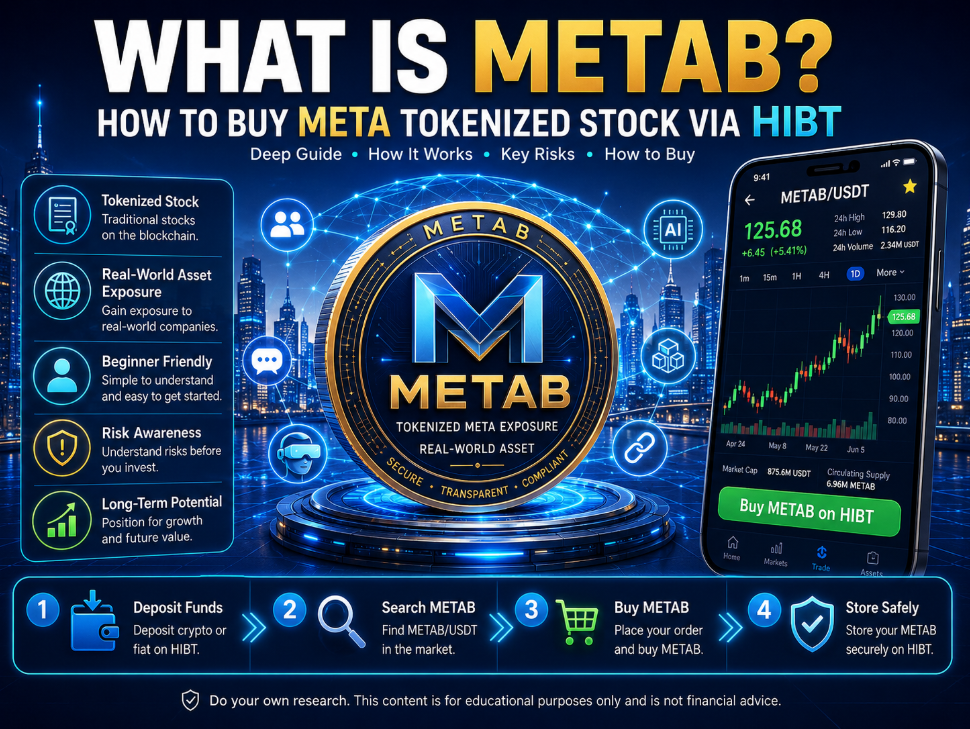
So METAB and Diem/Libra are completely unrelated.
- Diem/Libra was essentially an attempt at a stablecoin and payment network;
- METAB is essentially a tokenised expression of META stock price exposure;
- Diem/Libra was tied to Meta's payment vision;
- METAB is not an official coin issued by Meta;
- Diem/Libra is history;
- METAB falls under the category of tokenised securities / RWA (Real World Assets).
More importantly, METAB is not a stock token issued by Meta itself. According to official bStocks materials, bStocks are tokenised securities issued by BTech Holdings Limited – an affiliate of the Binance Group. These products are classified as Certificates representing certain Financial Instruments, and they represent an interest in the underlying securities held by the issuer.
That statement sets the core premise: METAB is not an “official Meta coin” nor “Meta on‑chain equity” – it is a tokenised security product issued by a third party around the META stock.
So beginners need to distinguish three concepts clearly:
- META – the actual stock of Meta Platforms Inc. listed on Nasdaq;
- METAB – the bStocks tokenised security that tracks the underlying META stock;
- Any other altcoins, meme coins, or similarly named assets on Hyperliquid or other chains – these are not the METAB we're discussing here.
When you search on HIBT or other trading platforms, the most common mistake is to glance at “Meta” or “META” and place an order without checking the full asset name and trading pair. Tokenised stock products and ordinary altcoins may use similar tickers, but the underlying assets are completely different.
II. What METAB Actually Is: It Tracks Meta Platforms Stock, Not an On‑Chain Project
METAB tracks Meta Platforms Inc. as its underlying asset, with ticker META. Meta's core business remains its Family of Apps – the advertising and social ecosystem built around Facebook, Instagram, Messenger, and WhatsApp. In its 2025 Form 10‑K, Meta reported total annual revenue of $200.966 billion, of which advertising revenue was $196.175 billion – about 97.6% of total revenue. Reality Labs generated $2.207 billion in revenue but posted an operating loss of $19.193 billion.
This shows that even though the market often talks about Meta AI, the metaverse, smart glasses, Reality Labs, and super‑intelligence labs, Meta's fundamental business is still advertising.
Therefore, METAB's long‑term price is not determined by “on‑chain ecosystem activity,” but primarily by the performance of the underlying META stock. The key variables affecting META include:
- Whether ad revenue growth remains stable;
- Whether AI recommendation and ad systems improve delivery efficiency;
- Whether Reality Labs losses continue to drag on profits;
- Whether AI capital expenditure is seen as worthwhile by the market;
- Whether macro ad budgets are affected by economic cycles;
- Whether regulatory, privacy, antitrust, and child‑safety issues weigh on valuation.
But METAB is not META stock itself.
bStocks official materials explicitly state that bStocks are not direct ownership of the underlying company's shares, but rather provide exposure to the price performance and economic benefits of the underlying stock. Each bStock is backed 1:1 by actual U.S. shares held by a regulated custodian. At the same time, the bStocks disclaimer clearly says: bStocks are not stocks or shares, do not entitle holders to directly own the stock or shares of the underlying listed company, and do not represent an affiliation with the issuer of the underlying asset.
Thus, holding METAB is more accurately understood as:
- You get tokenised exposure to the price movement of META stock;
- You are not a directly registered shareholder of Meta;
- You cannot assume you have the full voting rights of a traditional shareholder;
- You face not only META stock volatility, but also issuer, custodian, platform, on‑chain, and regulatory risks.
This is the biggest pitfall for newcomers. Seeing METAB's price track META, they think “I'm buying Meta stock.” In reality, there is an extra layer of issuer and tokenised structure in between.
III. What Role Does BTech Holdings Limited Play in METAB?
In METAB's structure, BTech Holdings Limited is the core issuer. bStocks official materials show that bStocks are issued by BTech Holdings Limited and classified as Certificates representing certain Financial Instruments. Each bStock is backed 1:1 by the corresponding U.S. stock held by a regulated custodian.
This means METAB has roughly the following layers:
- Layer 1: Meta Platforms Inc. itself – the company that issues the underlying META stock on Nasdaq.
- Layer 2: META stock – the underlying asset in the traditional securities market.
- Layer 3: BTech Holdings Limited and its custody arrangements, which support the pegging between METAB and META.
- Layer 4: The METAB token itself, circulating on trading platforms as an on‑chain token and spot trading pair.
- Layer 5: Trading platforms like HIBT, which provide the entry/exit points, account systems, order matching, and trading services.
One wording nuance: some might call this a “synthetic stock” or “depositary receipt.” But from bStocks' public materials, a more accurate description is “Certificates representing certain Financial Instruments” – a certificate‑based interest in a financial instrument, not a traditional ADR in the U.S. sense, nor direct equity.
So METAB is neither an ordinary cryptocurrency nor the traditional META stock in a brokerage account – it's a tokenised security product sitting somewhere between traditional securities and on‑chain assets.
IV. Does Holding METAB Give You Dividends and Voting Rights from META Stock?
This is the critical question for assessing METAB's value and risks.
The short answer: holding METAB does not equal holding META stock, and you cannot assume you have the full shareholder rights of META.
bStocks official materials explain that bStocks are not direct share ownership but provide exposure to the price performance and economic benefits of the underlying stock. Corporate actions like dividends and stock splits are handled automatically via a Multiplier mechanism. For dividends, the official explanation is that it's not a cash payout; instead, the net dividend value is automatically reinvested into the underlying stock, and the user's bStock balance is increased proportionally – after deducting applicable U.S. withholding tax.
This means METAB holders may receive some reflection of economic benefits, but in a different form from the traditional stock.
If you buy META stock through a traditional broker, you typically care about:
- Voting rights;
- Direct cash dividends;
- Participation in corporate actions;
- Protection under traditional securities accounts and broker custody rules;
- Clear securities account records.
But if you buy METAB, you should focus on:
- How the offering documents define holder rights;
- Whether dividends are paid in cash or reflected through reinvestment and balance adjustments;
- Whether there are any voting or governance participation rights;
- Whether the issuer and custodian are stable;
- Whether the trading platform supports deposits, withdrawals, conversion, and selling;
- Whether your jurisdiction allows trading this type of product.
Therefore, METAB is better understood as a price‑exposure tool, not a full‑shareholder‑identity tool.
If you value long‑term shareholder rights, voting, traditional broker custody, and clear tax records, then buying META stock directly is likely more suitable.
If you value stablecoin pricing, trading within a crypto account, 24/7 operability, on‑chain transferability, and portfolio‑combination possibilities, then METAB has its use case.
V. How Does METAB Differ from METAx in Kraken's xStocks System?
The market offers more than one tokenised Meta product. For example, Kraken's xStocks system has METAx, and Ondo's system has METAON. All may provide tokenised exposure to Meta Platforms stock, but their architecture, issuer, on‑chain standards, custody arrangements, and trading contexts are not the same.
Taking METAB as an example: bStocks materials show it is issued by BTech Holdings Limited, belongs to the bStocks system, is backed 1:1 by underlying U.S. stocks, and is deployed as a BEP‑20 token on BNB Smart Chain, usable for self‑custody and some DeFi scenarios.
Taking Kraken's METAx as an example: Kraken's official description states that xStocks are tokenised representations of real stocks and ETFs, each xStock is backed 1:1 by underlying equity and issued as an on‑chain SPL token. Kraken also clarifies that xStocks do not provide traditional shareholder rights like voting, but offer price exposure to the underlying asset.
You can think of them this way:
- METAB belongs to the bStocks system – key terms: BTech Holdings Limited, bStocks, BNB Smart Chain, Certificates, 1:1 backing.
- METAx belongs to the xStocks system – key terms: Kraken/Backed ecosystem, xStocks, on‑chain SPL or multi‑chain integration, 1:1 backing, non‑traditional shareholder rights.
For ordinary users, the most important factors are not which name sounds more like a stock, but:
- Which product is available in your region;
- Which platform has better liquidity;
- Which product's price stays closer to META;
- Which on‑chain network you're more comfortable with;
- Which issuer, custodian, and compliance documents are more transparent;
- Which product offers more stable deposits, withdrawals, selling, and customer support.
If you only want to trade META's short‑term volatility, prioritise trading depth and spreads.
If you want to hold long‑term, prioritise issuer, custody, regulatory treatment, corporate‑action handling, and platform stability.
VI. How Is METAB's Price Formed? It's Not Always Equal to META's Price
In theory, METAB's price should move around META's price, because its core value derives from META stock exposure.
But in practice, METAB does not necessarily equal META at every moment.
Three reasons.
1. Different trading hours.
Traditional U.S. stocks have fixed trading hours – even with pre‑market and after‑hours sessions, the main liquidity is concentrated during regular U.S. market hours. bStocks, on the other hand, can be traded 24/7 on spot markets and typically offer near‑instant settlement. When the U.S. stock market is closed but the crypto market is still trading, METAB's price may reflect market expectations for the next U.S. open.
2. Different liquidity.
META is one of the most actively traded large‑cap tech stocks globally, but METAB is a new product that only joined bStocks trading pairs on June 30, 2026. Official Binance information shows that five new bStocks pairs – Meta (METAB), Lumentum (LITEB), Microsoft (MSFTB), Palantir (PLTRB), and QQQ (QQQB) – began trading at 13:30 UTC on June 30, 2026, priced in USDT. Because it has only been listed for a short time, historical trading data, performance in extreme conditions, and long‑term spread stability are still limited.
CoinGecko data shows that Meta Platforms bStocks Tokenized Stock (METAB) has a 24‑hour trading volume of roughly $189.5K; in comparison, Meta xStock (METAx) has a 24‑hour volume of about $1.84M. This suggests that even though METAB tracks a mega‑cap stock, its own trading depth as a tokenised product may still be relatively thin.
3. Arbitrage mechanisms do not guarantee risk‑free pegging.
bStocks materials mention that eligible users can convert 1:1 between the underlying stock and the corresponding bStock, which helps maintain price anchoring. But this does not mean ordinary users can frictionlessly arbitrage at any time. Conversion eligibility, platform rules, trading hours, maintenance status, corporate‑action processing, regional restrictions, custody arrangements, and order‑book depth all affect the speed of price convergence.
So when beginners look at METAB's price, they should at least monitor four data points simultaneously:
- The real‑time price of META;
- The latest traded price of METAB;
- The bid‑ask spread of METAB;
- METAB's 24‑hour volume and order‑book depth.
If METAB shows a clear premium or discount to META, don't jump to “bargain” or “pump” conclusions. First check whether the U.S. market is closed, whether it's before/after earnings, whether major news has just broken, whether the platform has issued announcements, or whether it's a period of abnormal liquidity.
VII. Why Would Someone Buy METAB Instead of META Directly?
This is the most important decision question in this article.
Because Meta stock is not hard to buy. Many traditional brokers offer META. So why go through the extra layer of METAB?
The answer is not that “METAB is more authentic than META” – it's that METAB solves trading convenience for certain users.
First, 24/7 trading is highly attractive to users in Asia, the Middle East, and crypto‑native users.
For Asian users, regular U.S. trading hours often fall late at night. If Meta releases earnings, AI product news, or regulatory developments after the U.S. close, traditional brokerage users may have to wait for after‑hours liquidity or the next day to act more comfortably. Tokenised stocks like METAB allow crypto users to express views in a more flexible time window.
Data reportedly showed that about 47% of bStocks trading activity occurred outside traditional U.S. stock market hours. This suggests that a significant portion of users buy tokenised stocks not to replace all traditional brokers, but to gain access to trading windows outside the traditional market.
Second, it's more convenient to hold within a stablecoin account.
Many crypto users hold most of their assets in stablecoins like USDT or USDC. If they want to trade META, the traditional path is often:
- Convert stablecoins to fiat;
- Transfer to a bank account;
- Fund a U.S. brokerage account;
- Buy META;
- Sell and withdraw;
- Convert back to stablecoins.
For users in some regions, this process is costly, slow, and compliance‑heavy. METAB shortens the path to: buy and sell directly within the stablecoin account, keeping the asset within the crypto ecosystem.
Third, it can be combined with on‑chain asset allocation.
bStocks materials mention that bStocks are BEP‑20 tokens on BNB Smart Chain, can be withdrawn to compatible wallets, and can be used in certain DeFi protocols. This means METAB may in the future serve not only as a trading target but also as part of on‑chain portfolio strategies, collateral, lending, and asset management.
Of course, this doesn't mean every beginner needs this functionality.
If you simply want to hold Meta for the long term and can easily open a brokerage account in your region, buying META directly is often clearer.
If you are a crypto‑native user with assets mainly in stablecoins, wanting to manage BTC, ETH, RWA, and tokenised stocks in one account, then METAB's convenience becomes more apparent.
If you are interested in another type of asset that operates through staking, yield, or protocol design, you can also read What is CAP to compare the risk‑return structures of different asset classes. CAP leans towards on‑chain protocol and yield mechanisms, while METAB leans towards tokenised exposure to traditional U.S. stocks – their risk sources are entirely different.
VIII. Core Risks of METAB: You Must See Them Clearly Before Buying
METAB is not a typical meme coin, but it is also not a low‑risk product. Its risk comes from two layers: one is META itself, the other is the tokenised wrapper.
1. Issuer credit risk.
METAB relies on the issuer, custodian, conversion mechanisms, and platform services working together. bStocks' official risk disclosures explicitly list issuer and custodian risks: bStocks depend on the issuer and regulated custodian to maintain proper backing. If the issuer, custodian, conversion, or platform services encounter problems, the recourse available to users may differ from that for META stock in a traditional brokerage account.
This is the extra layer of risk that tokenised stocks carry compared to the underlying stock. When you buy META, your main concerns are Meta's business and market price. When you buy METAB, in addition to Meta, you also have to worry about BTech Holdings, custody arrangements, on‑chain tokens, trading platforms, and regulatory conditions.
Similar issuer‑trust structures appear in many new crypto products. Readers can cross‑reference What is RIF to build a more complete framework for assessing issuer risk.
2. Regulatory classification risk.
Tokenised stocks remain in a rapidly evolving regulatory environment. The U.S. SEC's January 2026 statement on tokenised securities noted that stocks, bonds, notes, investment contracts, securities options, etc., can all be tokenised – but tokenisation changes the technological presentation, not the securities‑law nature. Reuters reported in June 2026 that the SEC is preparing a possible “innovation exemption” that might allow crypto firms to offer tokenised stock trading, but this is still in flux.
This means tokenised stocks may see clearer regulatory frameworks in the future, but regional differences could also lead to trading restrictions, delistings, eligibility changes, or product‑structure adjustments.
Special note: bStocks materials clearly state that bStocks are not offered to U.S. persons and are not publicly offered in the U.S. Users must confirm whether their jurisdiction allows access to and trading of such products.
3. Liquidity risk.
METAB tracks the mega‑cap META, but METAB itself is still a newly listed tokenised product. In its early days, trading volume, depth, order‑book stability, and execution capacity in extreme conditions require time to prove.
- If you place a large market buy order, you may eat through multiple sell levels;
- If you want to sell quickly, you may find the buy‑side depth insufficient;
- Around earnings, regulatory news, or AI capex debates, spreads and slippage can widen quickly;
- If U.S. markets are closed but METAB is still trading, the price may carry significant expected premiums or discounts.
Don't assume that because META is a large‑cap stock, METAB has the same depth. Stock depth and token depth are two different things.
4. Additional costs and risks compared to buying META directly.
When you buy META directly, you bear brokerage fees, currency conversion costs, tax treatment, and stock volatility.
When you buy METAB, you take on extra:
- Tokenised product spreads;
- Platform trading fees;
- Issuer and custodian risks;
- On‑chain technical risks;
- Regional compliance risks;
- Deposit/withdrawal network risks;
- De‑pegging risk in extreme markets;
- Operational risk of platform trading suspensions, withdrawal halts, or conversion pauses.
This doesn't mean METAB is unbuyable – it means you must know why you're buying.
If you're only investing in Meta for the long term, a traditional broker may be simpler.
If you want to quickly gain META exposure within a crypto account, METAB makes more sense.
IX. How METAB Might Move: Not a Simple “Coin Price Prediction,” but a Two‑Variable Analysis
Many crypto articles like to write “2030 price prediction,” “2040 price prediction,” “2050 price prediction.” But for METAB, you cannot directly apply ordinary coin‑price templates.
Because METAB's price is primarily driven by the combination of two logics:
- Where the underlying META stock goes;
- How METAB's premium or discount to META changes.
In other words, predicting METAB is essentially predicting “Meta stock performance + whether the tokenised‑stock infrastructure can develop stably.”
Bear scenario
If Meta's ad growth slows, ad budgets shrink due to macro headwinds, AI capex is questioned as “too much spending, too slow returns,” and Reality Labs continues to post large losses, then META may come under pressure.
In this case, METAB could face a double hit: on one hand, META falls; on the other hand, if the tokenised‑stock market faces regulatory tightening, liquidity declines, or platform risk events, METAB may experience widening discounts and increased slippage.
Base scenario
If Meta's ad business continues to grow steadily, AI tools keep improving ad efficiency, newer businesses like WhatsApp monetisation, Meta AI, and smart glasses gradually contribute, and the market accepts the high‑capex logic, then META can maintain strong fundamental support.
In this scenario, METAB acts more like a trading tool for META exposure. As long as the issuer, custodian, exchange, and arbitrage mechanisms remain stable, METAB's spread to META should stay within a relatively manageable range.
Bull scenario
If Meta's AI products, ad automation, smart glasses, and Reality Labs direction regain market confidence, and tokenised‑stock regulations become clearer, attracting more users and institutions to RWA stock assets, then METAB could benefit from two positive layers:
- Layer 1: META stock rises;
- Layer 2: tokenised‑stock product liquidity improves, trading depth increases, and spreads narrow.
But even in a bull scenario, risks cannot be ignored. METAB's rise does not come from its own ecosystem explosion, but from the combined improvement of META stock and the tokenised‑stock sector. If either layer falters, METAB could be pressured.
So the right questions are not “how many times can METAB go up,” but:
- Is Meta's ad business still strong?
- Can AI capex translate into revenue and profit?
- Is Reality Labs' loss acceptable to the market?
- Does METAB trade at a clear premium to META?
- Is METAB's liquidity sufficient?
- Are the issuer and platform continuing to operate stably?
- Does the regulatory environment support the expansion of tokenised stocks?
That is the correct analytical framework for METAB.
X. Step‑by‑Step Example: How to Buy METAB on HIBT
Below we use HIBT as an example to provide a practical walkthrough for beginners. Note that whether METAB trading is available, the exact trading pair, minimum order size, fees, withdrawal networks, and regional restrictions should all be based on the HIBT app or official website.
HIBT is a digital asset trading service platform registered in Canada, supporting spot and derivatives trading for global users.
Step 1: Register a HIBT account.
Go to the HIBT website or app, click Sign Up, create an account using email or phone, set a login password, and complete the verification code. The registration page also supports referral codes.
After registration, complete three things immediately:
- Link your phone number;
- Enable Google Authenticator or other two‑factor authentication;
- Set a fund password or withdrawal security settings.
Tokenised stocks are high‑volatility financial assets – account security is even more important than placing orders.
Step 2: Complete KYC identity verification.
HIBT's help centre explains that new users need to complete KYC verification and link a phone number before trading. The path is to go to account info in the app and follow the prompts to complete identity verification step by step.
Typically you'll need:
- A valid government‑issued ID (e.g., national ID, passport, or driver's licence);
- Name and date of birth matching the ID;
- Clear photo of the ID;
- Facial recognition or a short selfie video;
- Some regions may require proof of address or additional documents.
Processing time varies – it depends on document clarity, information consistency, regional risk levels, and the platform's verification queue. Avoid glare, blurry photos, name mismatches, and expired documents when submitting.
Step 3: Choose a deposit method.
Two common ways: fiat on‑ramp and stablecoin deposit.
If the platform supports fiat channels in your region, you can buy USDT via bank card, third‑party payment, or P2P. This suits new users without other crypto assets, but costs may vary by payment channel, exchange rate, and merchant quotes.
If you already have USDT in another wallet or exchange, choose stablecoin deposit. On the HIBT app, go to the home page, tap Deposit, select USDT, then choose the deposit network – speeds and fees differ by network.
Network consistency is critical. For example, if you select USDT‑TRC20 on HIBT, the external platform must also send via TRC20. If you choose ERC20, BEP20, or another network, they must match. HIBT's help centre warns that mismatched networks may cause deposit failure.
For your first deposit, test with a small amount first, confirm receipt, then transfer larger sums.
Step 4: Search for the METAB trading pair on HIBT.
Go to the spot trading page and type “METAB” in the search box.
Be very careful – don't just glance at “Meta” and place an order. Check:
- Is the pair METAB/USDT?
- Does the asset name indicate Meta Platforms bStocks Tokenized Stock?
- Is it clearly a tokenised stock or bStocks product?
- Does the page show normal buy/sell orders, trade history, and asset description?
- Is it confused with unrelated altcoins, same‑name META tokens, meme coins, or other Meta‑related assets?
If multiple similar tickers appear (META, METAX, METAON, Metadium, etc.), do not click randomly. METAB is the bStocks Meta tokenised stock discussed in this article.
Step 5: Choose limit order or market order.
Beginners buying METAB should prefer limit orders.
Limit orders let you control the purchase price, avoiding paying too much due to thin order books. The downside is that if the market doesn't reach your limit, the order may not fill.
Market orders fill quickly – good when you're sure you want to enter immediately. But if METAB's liquidity is low, market orders can cause significant slippage, especially after U.S. market close, around earnings, or during volatile periods.
A safer approach:
- Check META's price first;
- Check METAB's latest price;
- Check the bid‑ask spread;
- Then test with a small limit order.
Don't use a large market order to chase a rally on your first try.
Step 6: Set price alerts after buying.
After buying METAB, don't just watch your HIBT position page. Also monitor key META events.
Set alerts for:
- METAB falling below your stop‑loss;
- METAB hitting your target;
- Abnormal premium of METAB over META;
- Meta's quarterly earnings dates;
- Major news on Meta AI, advertising, Reality Labs;
- Sharp pre‑market or after‑hours moves in META.
Meta's quarterly earnings are especially important. Because METAB effectively follows META, ad revenue, AI capex, Reality Labs losses, user growth, and next‑quarter guidance in the report can all directly affect METAB's price.
Step 7: Sell, withdraw, or convert back to fiat.
If you decide to exit, you can sell METAB on HIBT's spot market for USDT.
If you want to move funds to another platform or wallet, choose withdrawal. On‑chain withdrawals usually require selecting the coin, entering the recipient address, choosing the withdrawal network, entering the amount, and completing 2FA verification. The withdrawal network must match the network supported by the receiving platform – wrong networks may result in unrecoverable assets.
If you want to convert to fiat, you usually need to sell METAB for USDT first, then use the platform's fiat channels, P2P, or other supported methods to cash out. Arrival time depends on on‑chain network, platform review, merchant payment speed, and bank processing.
When exiting, beginners should also do so in batches – don't withdraw large amounts all at once to an unfamiliar wallet or platform.
XI. Frequently Asked Questions and Pitfall Guide for Beginners
Is METAB suitable for long‑term holding?
Yes, it can be held long‑term, but not everyone should.
Holding METAB long‑term essentially means being bullish on Meta Platforms while accepting the issuer, custody, platform, on‑chain, regulatory, and liquidity risks that come with the tokenised structure.
If you simply want to invest in Meta for the long term and can easily open a traditional U.S. brokerage account, buying META directly is likely simpler.
If you value stablecoin account management, 24/7 trading, and on‑chain composability, METAB may be more suitable for long‑term allocation.
Is METAB better for short‑term earnings trading?
For many crypto traders, METAB is indeed well‑suited for short‑term plays around earnings, AI news, regulatory events, and after‑market updates – because one of its advantages is operability outside traditional U.S. trading hours.
But earnings periods are also when slippage and spreads can widen the most. Beginners should not rush in with large market orders right before/after earnings; use limit orders and set stop‑loss levels in advance.
For long‑term holding, how to choose between METAB and META via a traditional broker?
If you value shareholder rights, traditional securities account protection, voting, cash dividends, tax records, and clear long‑term holdings, prioritise META.
If you value trading convenience, stablecoin pricing, unified crypto asset management, on‑chain transfers, and non‑U.S. trading‑hour operation, consider METAB.
The key is not which is “absolutely better,” but what your needs are.
What to do if METAB's price differs significantly from META?
Don't rush to buy or sell. Check:
- Is it currently regular U.S. trading hours?
- Has Meta just released earnings or a major announcement?
- Is METAB's order book thin?
- Is the bid‑ask spread unusually wide?
- Does the platform have any deposit, withdrawal, conversion, or maintenance announcements?
- Are other tokenised Meta products (e.g., METAx, METAON) showing similar spreads?
If only METAB is unusually deviating while other markets are not moving in sync, be extra cautious. It could be illiquidity, not an investment opportunity.
How much position should a beginner use for their first METAB purchase?
For your first METAB purchase, don't set the goal as making money – set it as testing the entire workflow.
A safer approach is to use less than 1% of your total capital, or even less, to test:
- Whether KYC goes smoothly;
- Whether USDT deposits arrive;
- Whether the METAB pair is correct;
- How fast limit orders fill;
- Whether the bid‑ask spread is acceptable;
- Whether selling is smooth;
- Whether the withdrawal process is familiar.
Only after you've run through a full cycle should you consider increasing your position.
Can METAB de‑peg?
Short‑term de‑pegging or widening spreads are possible.
Even though bStocks has 1:1 backing and conversion mechanisms, actual trading prices are still affected by market liquidity, trading hours, order‑book depth, platform status, and regulatory conditions. Especially during U.S. market holidays, weekends, major news, earnings seasons, and extreme markets, METAB may deviate from META.
So don't just look at “1:1 backing” – also look at real‑time trading depth and actual spreads.
XII. Summary: Who Is METAB For, and Who Is It Not For?
METAB is suitable for three types of users:
- Users who already understand the tokenised‑stock structure and know that METAB is not an official Meta coin, nor META stock itself.
- Users whose primary assets are in stablecoins like USDT or USDC, and who want to gain Meta stock exposure within their crypto account.
- More advanced traders who follow Meta's earnings, AI capex, ad growth, and after‑market news, and want to use more flexible trading hours to operate.
METAB is not suitable for three types of users:
- Beginners who think “Meta launched a coin” and want to buy Meta's official cryptocurrency.
- People who don't understand META's fundamentals but chase METAB just because it's newly listed.
- Conservative investors who cannot accept issuer risk, de‑pegging risk, liquidity risk, and regulatory uncertainty.
One‑sentence summary: METAB is not a coin issued by Meta – it is a tokenised security product that provides exposure to Meta Platforms stock. Its opportunity comes from META stock performance, crypto‑account trading convenience, and the development of the tokenised‑stock sector. Its risks come equally from META stock volatility, BTech Holdings' issuance structure, platform liquidity, regulatory restrictions, and on‑chain operational risks.
If you plan to buy METAB via HIBT, the correct order is not “buy when you see Meta” – instead: first confirm the trading pair, then understand the product structure, test with a small amount, and finally, based on META's movement, METAB's spread, and your own risk tolerance, decide whether to add to your position.
For beginners, the most important sentence is: before you buy METAB, make sure you are buying exposure to Meta stock price, not Meta's official cryptocurrency.