
If you have recently spotted RE on cryptocurrency exchange new listing boards, within Real World Asset (RWA) sectors, or across Binance Alpha discussions, you likely have an immediate question: What exactly is RE? Is it just another standard DeFi token, or is it a novel type of RWA asset tied to real-world business?
Simply put, RE is the governance token of the Re Protocol ecosystem. Re Protocol is positioned to bridge on-chain stablecoin capital with the traditional reinsurance market, allowing crypto funds to participate in real-world insurance risk capital markets in a more transparent and programmatic way.
However, beginners must clarify one crucial point from the outset: The RE token itself does not equal an insurance policy, it does not equal reinsurance yield rights, and it does not automatically pay dividends just by holding it. Its core role leans heavily toward governance, participation, incentives, and ecosystem coordination, rather than directly representing the revenue of a specific insurance contract.
This article will start by explaining "what reinsurance is," followed by a breakdown of Re Protocol’s business logic, the actual utility of the RE token, its safety mechanisms, launch momentum, purchasing steps, and future risks—helping crypto newcomers build a clear evaluation framework.
Disclaimer: This article is for crypto asset educational and market research purposes only and does not constitute any investment advice. RWAs, insurance, reinsurance, and crypto assets all involve complex risks. As a newly listed token, RE may experience severe price volatility. Please refer to exchanges and official real-time channels for all trading pairs, pricing, contracts, and platform support.
1. What is RE? From Traditional Reinsurance to On-Chain Capital Markets
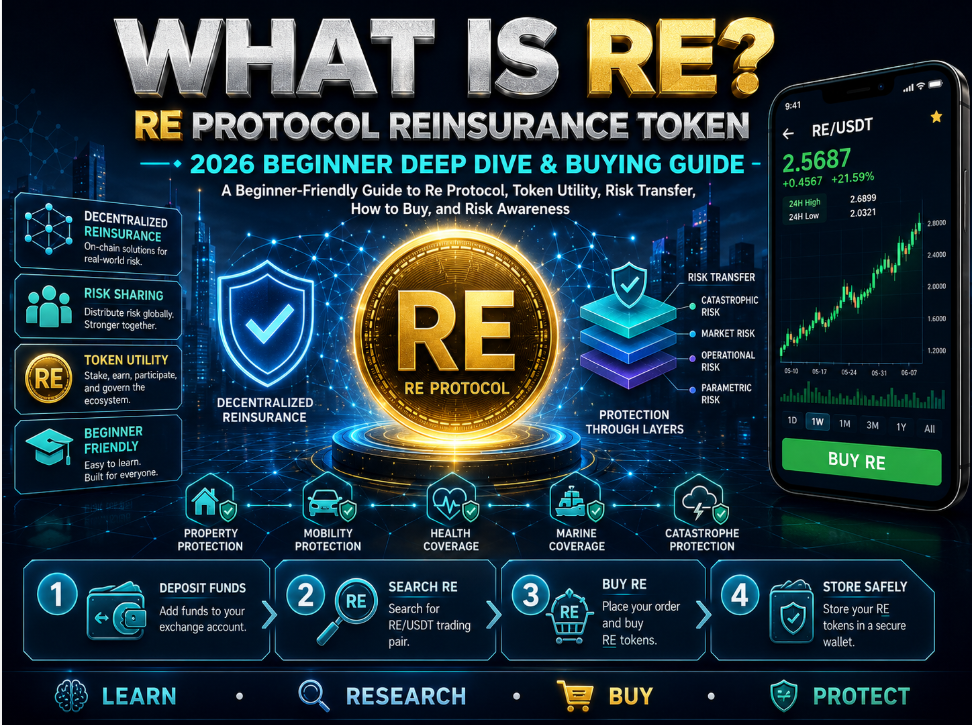
Before understanding RE, one must first grasp "reinsurance."
Standard insurance involves an insurance company providing coverage to individuals or businesses (e.g., auto, health, or property insurance). If an accident occurs, the insurance company pays out the claim.
Reinsurance is essentially "insurance for insurance companies."
For example:
An insurance company underwrites a massive volume of auto, home, or disaster policies. If claims spike simultaneously in the future, the insurance company itself could face catastrophic financial risk. To distribute this pressure, it transfers a portion of that risk to a reinsurance company. The reinsurance company collects a premium and, in return, assumes the payout risk within an agreed scope.
Therefore, the reinsurance industry is fundamentally a massive risk-capital market. It is not simple lending, nor is it standard DeFi yield farming; it operates around real policies, real risks, real payouts, and real capital efficiency.
What Problem Does Re Protocol Solve?
The traditional reinsurance industry suffers from several long-standing pain points:
- High Capital Barriers to Entry: Average investors can rarely participate directly in the reinsurance market, which has long been dominated by massive insurers, reinsurers, institutional capital, and specialized funds.
- Low Capital Efficiency: Traditional reinsurance contracts involve extensive offline processes, contract audits, lengthy settlement cycles, and intermediaries. The path from deploying capital to generating yield is long.
- Limited Transparency: It is incredibly difficult for average users to see how capital flows into reinsurance contracts in real time, or to track reserves, custody assets, and risk exposure.
- Lack of Real-World Yield for On-Chain Funds: The crypto market holds a massive pool of stablecoin capital, yet most yield sources remain concentrated in lending, trading fees, staking, arbitrage, and inflationary rewards. Re Protocol aims to channel this stablecoin capital into real-world reinsurance yield environments.
Re Protocol’s core idea: Allow users to deposit stable assets like USDC, USDe, or sUSDe into the protocol’s Insurance Capital Layers. The protocol then allocates this capital into fully collateralized reinsurance operations through licensed insurance companies and reinsurance contracts.
The capital flow can be summarized as follows:
- Users deposit stablecoins.
- The protocol channels funds into the corresponding Insurance Capital Layer.
- Capital partners with licensed insurance companies through a compliant structure.
- Funds back fully collateralized reinsurance contracts.
- Reinsurance contracts generate premium income or related yields.
- Users receive corresponding on-chain credentials and yield performance based on the specific product type they entered.
This is fundamentally different from typical DeFi lending. While standard DeFi lending relies on crypto asset collateralization, borrowing, and liquidation logic, Re Protocol taps into the risk-capital demands of real-world insurance businesses. Its underlying yield source does not derive purely from on-chain borrowing rates, but rather from reinsurance premiums, capital utilization, risk pricing, and stablecoin strategies.
What is the Role of the RE Token Itself?
RE is the governance token of Re Protocol.
Its purpose is to facilitate protocol governance, ecosystem incentives, staking/voting, parameter adjustments, and market-level capital coordination. Official governance documentation defines RE as a token for governing the market layer—not as a tool for running underwriting, claims processing, pricing, or regulated insurance operations.
This boundary is incredibly important:
- RE is not an insurance policy.
- RE is not reUSD.
- RE is not reUSDe.
- RE is not a certificate that directly represents the yield rights of any specific reinsurance contract.
Holding RE is akin to owning an entry ticket to the governance and participation rights of the Re Protocol ecosystem, rather than directly owning the underlying reinsurance assets.
What are the Protocol's reUSD and reUSDe Tokens?
Beginners often confuse RE, reUSD, and reUSDe, but they are completely distinct:
- RE: The governance token responsible for protocol governance, voting, staking participation, and ecosystem coordination.
- reUSD: A stable-yield credential tied to Re Protocol’s Insurance Capital Layers, leaning toward a low-volatility stablecoin yield product. According to official documents, reUSD is linked to delta-neutral ETH strategies, short-term T-bill yields, and protocol spreads, aiming to provide stablecoin holders with a relatively steady yield experience.
- reUSDe: A product leaning closer to "Insurance Alpha"—meaning it is more exposed to reinsurance underwriting yields. It targets a higher yield but comes with higher risk, alongside potentially more complex redemption schedules and capital lock-ups.
In short: RE is for governance and the ecosystem; reUSD is a relatively low-volatility stablecoin yield credential; reUSDe is a credential with higher exposure to insurance yields. They differ entirely in functionality, risk, yield sources, and target audiences.
Before buying RE, beginners must not mistakenly assume that "buying RE means buying into a reinsurance yield product." If you want to participate in stablecoin yields, you need to look into reUSD or reUSDe. If you are buying RE, you are primarily participating in the market price fluctuations of Re Protocol's governance token.
2. What Exactly Can the RE Token Do? The Practical Boundaries of Governance Rights
The core value of RE does not lie in passive dividend payouts, but in governance participation and ecosystem coordination.
According to its official design, RE utilizes a stake-to-vote model. Holders can influence protocol decisions through staking, delegating, and voting.
What Can RE Holders Vote On?
RE governance topics may include:
- Protocol upgrades
- Governance parameter adjustments
- Ecosystem incentive allocations
- Market access rules
- Committee member selection
- Risk frameworks and standard configurations
- Integrations, subsidies, and liquidity programs
- Arrangements regarding public resilience capital
- Future ecosystem growth proposals
These governance matters dictate the rules layer of Re Protocol as an on-chain insurance capital market. They do not directly decide how a specific policy is priced or whether a particular insurance claim gets paid out.
Why emphasize this? Because insurance and reinsurance are highly specialized, strictly regulated, and risk-sensitive real-world businesses. If any token holder could randomly dictate underwriting or claims pricing, it would introduce catastrophic compliance and operational risks. RE's governance boundaries remain at the protocol, incentive, and market-rule layers—not replacing the professional operations of insurance companies.
What Privileges Does Staking or Binding RE Grant?
The staking mechanism for RE is built to ensure that those participating in governance shoulder more responsibility, rather than offering hurdle-free passive income to all holders.
Staking or binding RE may unlock:
- Participation in governance votes
- The ability to propose or endorse initiatives
- Eligibility for committee selection
- Governance participation rewards
- Ecosystem contribution tasks
- Higher weight in future governance modules
Note: Governance rewards are not dividends in the traditional sense, nor are they risk-free yields. The team explicitly emphasizes that participation rewards are incentives for active governance and ecosystem contributions—not passive yields, dividends, profit-sharing, or protocol revenue distributions.
Critical Clarification: Can Holding RE Share Premium Income or Underwriting Profits?
This is the single most common misunderstanding among beginners.
The answer is: No, you cannot simply assume that holding RE lets you share premium income or underwriting profits.
RE is a governance token, not an insurance yield credential. It does not directly represent policy yields, underwriting profits, or on-chain insurance dividend notes. If you want yields tied to the insurance capital layer, you must look into products like reUSD or reUSDe.
This distinction is crucial for many RWA projects. While the RWA narrative sounds compelling, the rights relationship between the token and the real asset must be carefully dissected:
- Some tokens represent governance rights.
- Some tokens represent yield credentials.
- Some tokens represent debt or asset fractions.
- Some tokens are purely ecosystem incentive tools.
- Some tokens have no direct claim rights to the underlying assets.
RE falls squarely under governance tokens and should not be misinterpreted as a reinsurance profit-distribution credential.
What Do Lock-ups, Cooling-off Periods, and Slashing Mean for Holders?
If a governance token allows users to buy, vote, and dump instantly, it becomes highly vulnerable to manipulation by short-term speculators. Consequently, many protocols implement lock-ups, cooling-off periods, exit windows, and slashing mechanisms.
For RE holders, these mechanisms mean:
- You cannot withdraw immediately after staking.
- Participating in governance carries a time commitment cost.
- Exiting may require waiting out a cooling-off period.
- Malicious behavior could trigger slashing penalties.
- If governance rules are altered, staking rules may change accordingly.
- If the price drops during a lock-up period, you might not be able to sell in time.
While these designs enhance governance stability, they reduce capital liquidity. Beginners shouldn't just look at "staking to vote"; they must assess how quickly they can exit, the exit costs, and whether any slashing risks exist.
3. How Safe is RE? Audits, Custody, and Transparency Mechanisms
For RWA projects, verifiable mechanisms matter far more than catchy slogans. Re Protocol connects on-chain capital, custody systems, licensed insurance companies, reinsurance contracts, Proof of Reserves, and third-party audits. Evaluating its safety requires looking at multiple layers.
1. Smart Contract Audits
Official documentation shows that Re Protocol has undergone third-party security audits, including records from firms like Certora and Hacken. The purpose of an audit is to check for permission vulnerabilities, asset handling errors, upgrade risks, collateral management issues, and price-feed update logic flaws.
However, beginners must understand that an audit is not an absolute guarantee of safety. It reduces code risk but cannot eliminate it entirely. For an RWA protocol like Re Protocol, risks extend beyond smart contracts into custody risks, partner risks, regulatory shifts, policy underwriting underperformance, redemption bottlenecks, and broader market risks.
2. Asset Custody Mechanisms
Re Protocol's documentation notes the use of institutional-grade custody and MPC multi-sig setups to control critical operations, utilizing custody infrastructure like Fireblocks. Institutional custody helps to:
- Reduce the risk of a single point of failure via lost private keys.
- Prevent a single individual from arbitrarily moving assets.
- Enforce rigorous internal controls for fund transfers.
- Align off-chain capital management closer to institutional standards.
- Coordinate with Proof of Reserves and custody wallet verification.
Still, custody does not mean zero risk. Custody systems can still face operational hazards, permission management slip-ups, regulatory freezes, or third-party service disruptions.
3. Proof of Reserves (PoR) Mechanisms
Re Protocol documentation indicates that off-chain bank balances are verified daily by The Network Firm and published via Chainlink, alongside verification of the protocol’s custody wallet ownership and balances.
This mechanism solves a core question: How do users know the funds the protocol claims to have actually exist?
For RWA protocols, on-chain transparency cannot natively track bank accounts, insurance contracts, and off-chain capital. Therefore, Proof of Reserves, third-party attestations, and custody wallet proofs become the vital bridge linking on-chain and off-chain trust. Average users should monitor:
- Whether the official team consistently updates Proof of Reserves.
- If the attestations are provided by an independent third party.
- Whether data can be publicly verified on-chain or via open dashboards.
- Which assets the reserves actually cover (and whether they verify total liabilities, or just balances).
- Any delays, footnotes, or anomalous shifts.
4. Access Control & Upgrade Mechanisms
Official security documents show that Re Protocol utilizes multi-sig controls for critical permissions alongside upgrade delay mechanisms. Critical privileges cover oracle configurations, redemption parameters, access management, and custody controls.
This ensures that no single account can unilaterally control the protocol, gives users time to observe upgrade risks, allows certain functions to be paused in emergencies, and mitigates internal malicious acts. However, it also means the protocol retains administrative control. Beginners should note that many RWA protocols are not completely immutable, "permissionless protocols," but rather hybrid systems featuring multi-sig overrides and compliance controls.
Cross-Reference: As another token designed to "link real-world assets or businesses," you might also explore what HOME (Defi App) is . While HOME leans closer to a DeFi application portal and on-chain user experience, RE focuses more on the real-world insurance risk capital market. Both touch upon the macro theme of "on-chain capital efficiency," but their transparency mechanisms, underlying businesses, and regulatory complexities differ significantly.
4. Why Did RE Launch Simultaneously on Multiple Exchanges in June 2026?
RE garnered concentrated attention in June 2026 largely due to its sudden listings across multiple trading platforms within a tight window, compounding with Binance Alpha exposure, spot listing momentum, and the general RWA narrative hype.
From a market perspective, a coordinated multi-exchange debut generally indicates a few things:
- The project team or foundation prepared heavily prior to listing.
- Exchanges see strong narrative appeal in RWAs, insurance, and reinsurance.
- The project possesses notable backing, community size, or institutional resources.
- Early liquidity setups were heavily concentrated.
- The launch window easily attracts market attention and short-term trading volume.
Binance listed RE on June 18, 2026, opening trading pairs for RE/USDT, RE/USDC, and RE/TRY, while applying a Seed Tag to RE. The Seed Tag serves as an explicit reminder: This is an innovative project that may carry higher volatility and risk compared to mature assets.
This is an important signal for beginners. An exchange listing does not equate to low risk. On the contrary, the initial launch phase is typically when a token is most volatile. Many beginners buy blindly simply because a token hits a major exchange, ignoring that day-one listing windows are often when early participants, airdrop hunters, point farmers, and liquidity providers are most likely to take profits.
What Does Early Price Volatility Mean?
At launch, new token prices are usually driven by a mix of forces:
- Early users cashing out low-cost tokens.
- Believers in the narrative buying in.
- Short-term traders chasing volatility.
- Market makers providing depth.
- Arbitrageurs moving capital between platforms.
- The market re-pricing based on FDV (Fully Diluted Valuation) and circulating market cap.
Thus, a massive initial pump for RE doesn't necessarily mean its long-term fundamentals have crystallized immediately; conversely, a rapid retracement doesn't automatically mean the project has failed. The initial phase is purely about market price discovery.
How Did Early Supporters Participate?
Early avenues for RE included points systems, community quests, governance events, Binance Alpha, or related pre-release campaigns. The cost basis for RE acquired through different channels varies wildly.
This presents a real-world challenge: The cost basis for early users could be vastly lower than that of secondary market buyers. If a large volume of low-cost tokens unlocks at launch, it can create intense short-term selling pressure—especially if the price spikes quickly and early participants opt to lock in profits.
Beginners should keep a close eye on:
- Day-one circulating supply vs. total max supply.
- The initial circulating percentage at TGE (Token Generation Event).
- The upcoming unlock schedule.
- Whether large ecosystem incentive emissions are imminent.
- Whether early points allocations are fully claimable.
- Any exchange campaigns yielding additional token dilution.
Distinguishing "Listing Hype" from "Long-Term Fundamentals"
Listing Hype Indicators
Long-Term Fundamental Indicators
Number of exchange listings
Growth of underlying reinsurance business scale
Day-one trading volume
Expanding roster of partner insurance companies
Social media discussion volume
Inflow scale of capital into reUSD and reUSDe
Short-term percentage gains/losses
Consistency and transparency of Proof of Reserves
Key Opinion Leader (KOL) mentions
Actual efficacy and impact of governance voting
"Top Gainers" board placement
Controllable token unlock pacing and utility sinks
Beginners are easily swayed by listing hype, but the ultimate factor deciding RE's long-term value is whether Re Protocol can successfully run its reinsurance business, stablecoin capital pipelines, and on-chain governance smoothly over time.
5. Three Core Risks to Understand Before Investing in RE
While RE’s narrative is fresh and imaginative, its risks are equally concrete. You should understand at least three major risks before investing.
Risk 1: Token Unlock and Dilution Risk
RE has a fixed total supply of 1 billion tokens. According to official governance disclosures, a portion circulates at TGE, while the remaining supply unlocks gradually across various allocation categories.
For secondary market buyers, unlocks are critical. When more tokens enter circulation, the market requires increasing buy pressure just to sustain the current price. If buying tapers off, the expanding circulating supply can suppress the price. Be mindful of the Fully Diluted Valuation (FDV). If the FDV is sky-high while the actual business is in its infancy, exercise extreme caution.
Risk 2: Industry and Jurisdictional Regulatory Risk
RE is not a generic meme coin or a pure, insulated DeFi lending token; it hooks directly into real-world insurance and reinsurance. Reinsurance globally is a heavily regulated sector. Compliance constraints include:
- Licensing requirements for partner insurance firms.
- The legality of reinsurance contract structures.
- Strict KYC (Know Your Customer) and AML (Anti-Money Laundering) mandates.
- Restricted user access across specific jurisdictions.
- Cross-border capital flows and yield distribution compliance.
Re Protocol documentation explicitly notes that capital is deployed through regulated frameworks alongside licensed entities, requiring KYC/AML compliance, and certain regions may face strict geoblocking. RE's future depends entirely on whether real-world regulators permit these on-chain capital models to scale.
Risk 3: Protocol Dependencies and Underwriting Risks
Even if RE isn't a direct insurance-payout token, its valuation heavily reflects the health of the Re Protocol business.
- If a partner insurance company encounters compliance or liquidity issues, market confidence drops.
- If an catastrophic real-world event triggers massive insurance payouts, the capital layer's performance suffers.
- If Proof of Reserves encounters an error or delay, trust evaporates.
- If reUSD or reUSDe experience heavy redemption cascades, protocol reputation takes a hit.
The market will naturally reflect the protocol’s overarching health directly into the price of RE. Do not just look at chart candles; track the protocol’s operational data.
How Should Average Investors Size Their Positions?
RE is a hybrid asset combining RWAs, reinsurance narratives, and a newly listed governance token. It holds higher volatility than established blue-chip cryptos and follows a entirely different logic than meme coins.
- Conservative Investors: Observe from the sidelines. Wait for protocol operational metrics, unlock distributions, and market stability to become clearer before reassessing.
- Balanced Investors: Consider a minor observer position—perhaps 1% to 3% of your portfolio—focusing on whether the price stabilizes within a reasonable valuation range.
- Aggressive Investors: If you are highly bullish on the RWA insurance narrative, keep position sizes controlled (e.g., capped at 5% to 8% of total trading capital) with clear stop-losses and profit-taking targets.
6. How to Buy RE: A Practical Step-by-Step Guide for Spot Trading on HiBT
If HiBT has opened spot trading for the RE/USDT pair, beginners can utilize the following workflow. Note: Please check the live HiBT platform for exact trading pairs, listing times, deposit/withdrawal statuses, and regional restrictions.
Step 1: Register a HiBT Account and Complete Basic Identity Verification (KYC)
Head to the HiBT official website or download the App to register using your email or mobile number. Completing your basic KYC helps to upgrade account security, unlock full trading features, expand deposit/withdrawal limits, and smooth out future risk-control checks.
Simultaneously turn on advanced security options: Google Authenticator (2FA), Email verification, SMS verification, a Funding Password, and an Anti-Phishing Code.
Step 2: Deposit or Fund Your Account with USDT
If you do not hold USDT, you can use HiBT's "Fiat-to-Crypto" / Quick Buy features to purchase USDT using local fiat methods. If you already hold USDT in an external wallet or another exchange, you can deposit it directly to your HiBT deposit address.
⚠️ Important: Double-check that you select the correct network (e.g., TRC-20, ERC-20). The sending network must exactly match HiBT’s receiving network address. For initial deposits, consider sending a small test amount first to confirm receipt before transferring larger sums.
Step 3: Navigate to the RE/USDT Pair and Place an Order
Head to the HiBT Spot Trading interface and type RE into the asset search bar. Select the RE/USDT pair. Before executing an order, verify:
- The token name is exactly Re Protocol (RE) (avoiding lookalikes).
- The price isn't experiencing anomalous, disconnected spreads compared to other platforms.
- The 24-hour volume and order book depth are healthy.
For volatile new listings, beginners should favor Limit Orders (where you set your maximum buy price and wait for execution) over Market Orders (which execute instantly at the current market rate but can suffer from severe slippage during high volatility).
Step 4: Post-Purchase Asset Management
Once your purchase fills, you generally face two choices:
- Keep it in your HiBT Spot Account: Ideal for short-term traders looking for instant liquidity without managing private keys. Ensure your account security features remain fully active.
- Withdraw to a Self-Custodial Wallet: If RE is an ERC-20 token, ensure your wallet (e.g., MetaMask) supports the Ethereum network, and maintain native ETH to cover future gas fees. This gives you complete ownership of your assets, but requires you to securely guard your seed phrase and stay vigilant against phishing links or malicious smart contract approvals.
7. What is RE's Future Outlook? A Multi-Scenario Price Trajectory Analysis
RE’s future trajectory depends on two core questions: Can Re Protocol scale its underlying business, and can the RE token maintain healthy market supply-demand dynamics? Rather than assuming "RWAs are the future, so RE will inevitably skyrocket," it is wiser to map out a multi-scenario analysis.
🚀 Optimistic Scenario: Reinsurance Partners & Underwriting Volume Scale Up
If Re Protocol successfully onboard a growing roster of licensed insurance partners, expands the size of its reinsurance contracts, and attracts stablecoin inflows into reUSD and reUSDe, RE’s market attention will naturally strengthen.
- Drivers: RWA insurance narratives gain massive traction; protocol premium volumes shoot upward; more top-tier exchanges list RE; governance participation expands; and Proof of Reserves remain completely flawless.
- Result: RE moves away from short-term speculative pricing and transitions into a fundamentally backed RWA governance asset.
↔️ Neutral Scenario: Steady Business, Cooling Speculative Hype
The protocol operates successfully, but experiences steady, incremental growth rather than viral scaling.
- Drivers: Initial launch hype fades, and daily trading volumes settle down into a predictable baseline range.
- Result: The price enters an extended consolidation or accumulation range. Short-term speculative money rotates out to newer trends, leaving long-term holders to evaluate the token based on actual, realized protocol metrics.
📉 Pessimistic Scenario: Unlock Pressure Meets a Cool Market Phase
RE hits major token unlock dates right as the broader RWA narrative cools off, or the protocol's business growth falls short of lofty initial expectations.
- Drivers: Continuous selling pressure from early backers; trading volume drops; the market down-sizes the project's Fully Diluted Valuation (FDV); or unexpected regulatory roadblocks emerge for off-chain partners.
- Result: The token price faces downward pressure, testing lower support levels. Community engagement drops, and the market begins to question the value-capture efficiency of pure governance tokens.
8. How Does RE Compare to Similar Tokens, and Who is It For?
RE is fundamentally distinct from pure DeFi lending tokens and meme coins. Let's compare it directly to understand its risk profile.
RE vs. Standard DeFi Lending Tokens

Alternative Reference: If you are primarily interested in alternative stablecoin capital optimization pathways rather than insurance specific models, you might look into what $O coin is . While $O addresses capital efficiency through alternate designs, RE zeroes in directly on channeling stablecoins to tap the massive real-world reinsurance market.
Is RE Right For You?
- RE might be suitable for you if: You thoroughly understand the RWA narrative, are willing to read complex protocol documentations, can easily distinguish a governance token from a yield-bearing asset, accept the high volatility of new listings, and track circulating market caps closely.
- RE is likely NOT suitable for you if: You are searching for risk-free passive yields, confuse RE with stablecoin yield tokens like reUSD, do not understand how reinsurance functions, lack a strict stop-loss plan, or FOMO into projects solely because they hit major exchange boards.
9. Frequently Asked Questions (FAQ)
Q: Can the RE token be infinitely minted? What is the maximum supply?
A: According to official governance layouts, RE has a fixed total supply of 1,000,000,000 (1 billion) tokens. It utilizes a fixed-supply design with no ongoing permanent inflation or infinite mint functions. The focus for investors should be on the unlock schedule of already allocated but uncirculated tokens rather than arbitrary minting.
Q: Can average individuals participate directly in Re Protocol’s reinsurance yields, or can they only buy the token?
A: Access to the actual underwriting layer depends on product types, regional regulations, and KYC compliance. Users can deposit stable assets into the Insurance Capital Layers to receive reUSD or reUSDe credentials provided they clear KYC/AML guidelines and do not reside in restricted countries. Buying the RE token itself is simply participating in the governance token market—it does not automatically grant direct insurance yields.
Q: Are RE, reUSD, and reUSDe the same thing?
A: No. RE is the governance token for ecosystem voting and coordination. reUSD is a lower-volatility, stablecoin-focused yield credential. reUSDe is a product credential offering higher exposure to underlying insurance underwriting performance.
Q: Does holding RE grant premium dividend payouts?
A: No, it cannot be interpreted that way. RE is strictly positioned as a governance token. Governance participation rewards are designed to incentivize active ecosystem contributions—they are not structured as passive dividends, stock corporate payouts, or direct premium profit-sharing.
Q: Is RE safer than standard DeFi tokens?
A: Not necessarily. While RE hooks into tangible real-world business models—giving it a concrete narrative foundation compared to speculative assets—it introduces unique off-chain dependencies. These include custody bank risks, insurance claim spikes, and stringent regulatory oversight. It is an asset with a more complex risk matrix rather than a "low-risk" one.
Summary
The launch of RE introduces a highly distinct narrative to the crypto market: connecting on-chain stablecoin capital with the multi-billion-dollar real-world reinsurance sector.
For beginners, the healthiest way to evaluate RE is to strip away listing emotions and look directly at its structural framework: Do you understand its utility? Is your position size structured to survive high volatility? Are you keeping track of upcoming unlocks? By building a clear understanding of its governance boundaries versus its underlying capital layers, RE can become an insightful asset to study rather than a reactive trade.