
CLO is the native token of the Yei Finance / Clovis ecosystem, built around cross-chain lending, swaps, bridging, governance, staking, and ecosystem incentives — not a meme coin riding on community hype.
One thing needs to be clear up front: the CLO discussed in this article is the CLO from Yei Finance / Clovis, not the CLO from Callisto Network. The two projects share a ticker but are completely different in terms of chain, contract, ecosystem, use case, and investment logic. Before buying, readers must verify the project name, official channels, exchange listing page, contract address, and network to avoid buying the wrong token.
This article is not investment advice. CLO is a highly volatile crypto asset, and its price can swing sharply due to liquidity, airdrops, unlocks, cross-chain security, protocol revenue, market sentiment, and exchange support. All data here was compiled from publicly available sources at the time of writing and may change. Before buying, check official announcements, exchange pages, CoinGecko, CoinMarketCap, and on-chain explorers for real-time information.
Chapter 1 | What Kind of Token Is CLO, Exactly? Separating "DeFi Governance Token" from "Meme Coin"
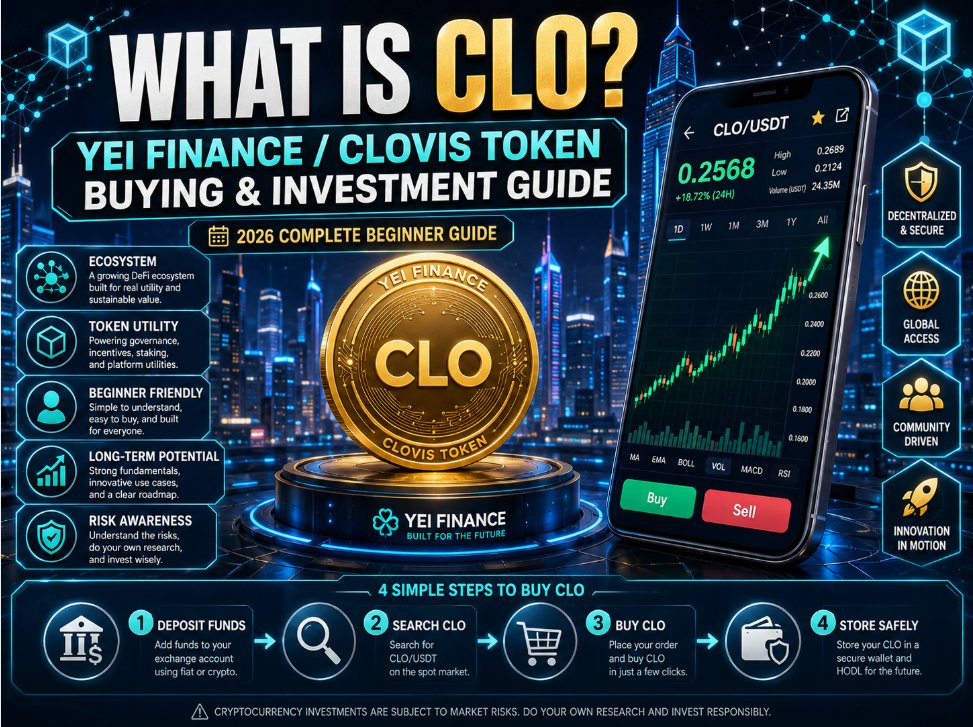
When newcomers see a small-cap token like CLO, their first instinct might be:
- Is this just another altcoin?
- Is it driven by community hype like DOGE, WIF, or PEPE?
- Should I be buying based on buzz and candlestick charts?
- Is this the same CLO as Callisto Network?
Thinking this way makes it easy to misjudge CLO's actual value proposition.
CLO is not an ordinary meme coin — it's the DeFi token at the center of the Yei Finance / Clovis ecosystem. Its core narrative isn't community memes, mascot avatars, or sentiment-driven virality; it revolves around the Sei ecosystem, cross-chain liquidity, lending markets, swaps, bridging, and protocol revenue.
On-chain, CLO originated as a Sei-ecosystem asset and was later expanded to BNB Chain and other networks via Wormhole NTT.
Three names need to be kept distinct here:
- Yei Finance
- Clovis
- CLO
Yei Finance is the protocol brand — think of it as a DeFi infrastructure project within the Sei ecosystem, with lending markets (YeiLend) as its early focus.
Clovis is the cross-chain liquidity layer launched by Yei Finance, designed to address the problem of DeFi capital being scattered across different chains, protocols, and pools. It aims to unify lending, swaps, bridging, and yield stacking into a more cohesive cross-chain liquidity network.
CLO is the native token of this ecosystem, used for governance, incentives, staking, liquidity rewards, and potentially protocol revenue distribution.
This is quite different from a meme coin.
Meme coin value typically comes from:
- Community spread
- Sentiment-driven consensus
- Social media buzz
- Whale-driven momentum
- Exchange listings
- Short-term speculative capital
- Attention generated by "meme culture"
CLO's value, on the other hand, depends more on:
- The real scale of deposits in Yei Finance
- Whether the lending market is active
- Whether YeiSwap has trading volume
- Whether YeiBridge sees cross-chain demand
- Whether Clovis can unify multi-chain liquidity
- Whether the protocol generates real revenue
- Whether CLO can capture that protocol value
- Whether staking and governance reflect genuine demand
This doesn't mean CLO is necessarily safer than a meme coin. DeFi tokens can crash too — due to unlocks, protocol exploits, declining TVL, or insufficient liquidity.
But the analytical framework is different.
To analyze a meme coin, focus on:
- Community heat
- Speed of spread
- Number of holders
- Exchange support
- Social narrative
- Market sentiment
To analyze CLO, focus on:
- TVL
- Lending volume
- Protocol revenue
- Active users
- Cross-chain transaction volume
- Contract security
- Token unlock schedule
- Governance and staking design
- Whether CLO is actually being used by the protocol
If you want to compare a "sentiment-driven token" against a "fundamentals-driven DeFi token," see What Is WIF. WIF is a more typical meme coin, propelled by community culture and market sentiment, while CLO leans toward being a DeFi protocol token, where the key question is whether the protocol has real usage and revenue.
In short: CLO is the DeFi ecosystem token of Yei Finance / Clovis, with value rooted in cross-chain lending, swaps, bridging, governance, and protocol revenue — not meme sentiment alone.
Chapter 2 | What Real Problem Does Clovis Solve? Why "Liquidity Fragmentation" Deserves Its Own Layer
One increasingly obvious problem in DeFi today is that liquidity has become fragmented.
A user's assets might be scattered across:
- Ethereum
- BNB Chain
- Base
- Arbitrum
- Optimism
- Solana
- Sei
- the Cosmos ecosystem
- various app-chains
- various DEXs
- various lending protocols
- various cross-chain bridges
On the surface, more chains mean more choices and more opportunities.
But for users, this also means growing complexity:
- Funds spread across many wallets and chains
- Idle assets on one chain that can't easily serve another chain
- Fragmented lending rates across chains
- Scattered swap liquidity
- Cumbersome cross-chain bridging
- Cross-chain transfers that involve waiting, fees, and bridge risk
- Many yield opportunities requiring constant protocol-switching
- Difficulty knowing which chain or pool offers the best capital efficiency
This is "liquidity fragmentation" in DeFi.
The consequences are direct:
- Low capital utilization for users
- Redundant protocol infrastructure
- Inconsistent lending rates
- Higher trading slippage
- Increased cross-chain costs
- New chains struggling to attract deep liquidity
- Inefficient capital migration between chains
This is the problem Clovis is trying to solve.
Yei's "Deposit Once, Earn Everywhere" Model
The core idea behind Clovis can be summarized as: users shouldn't have to shuttle funds back and forth across chains just to access yield and liquidity. Instead, users deposit assets into one unified system, and that system connects liquidity to multiple chains, protocols, and yield sources behind the scenes.
This is the so-called "deposit once, earn everywhere" model.
Roughly, it works like this:
- Sei serves as the central hub, handling global logic and settlement coordination
- Lightweight vaults are deployed on each connected chain
- Users deposit assets on various chains
- The system folds these assets into a unified cross-chain liquidity network
- Capital can serve lending, swaps, bridging, and other use cases
- Users have a chance to earn from multiple yield sources
- CLO handles governance, incentives, and ecosystem coordination
This architecture is often called a "hub-and-spoke" model.
In simple terms:
- The hub is Sei
- The spokes are the lightweight vaults on each chain
- The connective tissue is the cross-chain messaging and settlement layer
- The ultimate goal is to stop liquidity from being siloed by chain
What YeiLend, YeiSwap, and YeiBridge Each Do
The products of Yei Finance / Clovis fall into three categories.
First, YeiLend. YeiLend is the lending module, similar to a decentralized money market. Users can:
- Deposit assets to earn interest
- Borrow against collateral
- Use over-collateralized loans
- Supply assets
- Manage risk and return across different assets
The value of a lending market is that it lets idle assets generate yield while giving borrowers access to liquidity.
Second, YeiSwap. YeiSwap is the DEX / swap module, handling asset exchange and liquidity trading. Its purpose:
- Provide on-chain swaps for users
- Provide yield for liquidity providers
- Support pricing and conversion for lending and bridging
- Make assets easier to move within the ecosystem
If YeiSwap's trading volume grows, protocol fees and liquidity demand grow alongside it.
Third, YeiBridge. YeiBridge is the cross-chain bridge or cross-chain liquidity module, mainly addressing how assets move between chains.
The value of a bridge:
- Lets users move assets from one chain to another
- Connects liquidity across different chains
- Helps new chains gain capital faster
- Gives users more flexibility to capture yield opportunities
But bridges are also among the riskiest pieces of DeFi infrastructure. Historically, many of the largest hacks have happened at cross-chain bridges. So even with audits, Clovis cannot fully eliminate cross-chain risk.
Why the Backers Matter
Yei Finance isn't a fully anonymous project with no track record. Public information indicates Yei Finance completed a seed round, with investors including Manifold, DWF Ventures, Kronos Research, Outlier Ventures, Side Door Ventures, and WOO Network.
This backing doesn't guarantee success, but it offers a few reference points:
- The project has passed some degree of institutional vetting
- The team has resources to pursue ecosystem partnerships
- The project is more likely to attract exchanges, market makers, and ecosystem partners
- Public fundraising information helps reduce the risk of pure scam projects
- Investor backgrounds can serve as a supporting signal of "authoritativeness" within an E-E-A-T framework
That said, keep in mind:
VC backing doesn't guarantee the token will rise. Funding doesn't mean the project is risk-free. Institutional endorsement doesn't mean retail investors are buying at a safe price.
Investors still need to come back to fundamentals: TVL, revenue, users, volume, unlocks, and contract security.
How to Think About the Security Audits
Yei Finance's official materials disclose multiple security audits, involving firms like Zellic and PeckShield.
This matters for a DeFi protocol because Yei Finance touches on:
- Lending contracts
- Collateral management
- Liquidation mechanisms
- Swap contracts
- Cross-chain bridges
- Price oracles
- Vaults
- User asset deposits and withdrawals
A vulnerability in any one of these modules could cause serious losses.
What audits accomplish:
- Help uncover contract vulnerabilities
- Review critical permissions
- Assess liquidation and pricing logic
- Increase protocol transparency
- Reduce some technical risk
But an audit is not insurance.
Users need to understand:
- An audit does not mean 100% safety
- New features can introduce new vulnerabilities after launch
- Cross-chain bridge risk is hard to fully eliminate
- Oracles, permissions, multisigs, and vaults can all become points of failure
- If a DeFi protocol is exploited, user assets may be unrecoverable
So a security audit is a plus, not a guarantee.
Chapter 3 | What Gives CLO Its Value? Breaking Down Use Cases and Token Economics
Whether CLO has long-term value comes down to two questions:
- Does it have real utility within the protocol?
- Is its tokenomics design sound?
If a token only serves a rewards function — with no governance, staking, revenue capture, or genuine fee-driven demand — it might pump fast at launch but will struggle to absorb unlocks and sell pressure over time.
CLO's main utilities fall into three categories.
Utility One: Governance Voting
CLO can function as the governance token for the Yei Finance / Clovis ecosystem.
Governance may cover:
- Listing new assets
- Adjusting lending market parameters
- Setting collateral ratios
- Liquidation thresholds
- Risk parameters
- Fee structure
- Incentive allocation
- Use of the ecosystem fund
- Cross-chain deployment plans
- Protocol upgrade direction
The value of a governance token isn't the act of voting itself — it's whether voting actually influences how protocol resources are allocated.
If Yei Finance's future TVL is high, protocol revenue is stable, and the ecosystem fund is well-resourced, then governance rights become more valuable, since CLO holders can influence how revenue, incentives, and risk get distributed.
But if governance is highly centralized, or major decisions are mainly controlled by the team and a multisig, then holding CLO for governance purposes becomes less meaningful.
So when assessing governance value, look at:
- Whether on-chain governance actually exists
- Who can submit proposals
- Whether voting power is overly concentrated
- The team's and investors' share of token holdings
- Whether major parameters are genuinely decided by the community
- Whether governance outcomes actually get implemented
Utility Two: Staking and Protocol Revenue
CLO's second potential source of value is the link between staking and protocol revenue.
If the protocol generates revenue, common value-capture mechanisms include:
- Distributing a portion of fees to stakers
- Buybacks
- Using revenue to subsidize liquidity
- Using revenue to support ecosystem incentives
- Allocating fees to a DAO treasury
- Letting governance decide how revenue is used
For CLO, if the staking mechanism is tied to protocol revenue, that strengthens the case for holding the token.
For example:
- Users stake CLO to earn protocol revenue
- Stakers participate in governance
- Staking locks reduce circulating supply
- Higher protocol revenue makes staking more attractive
- Long-term users are more inclined to hold rather than sell short-term
But there's an important risk to flag here: protocol revenue is not the same as stable yield.
DeFi protocol revenue is affected by many factors:
- Rising or falling TVL
- Changes in lending rates
- Market leverage demand
- Trading volume changes
- Liquidation volume changes
- Cross-chain bridge usage
- Strength of incentive subsidies
- Competitor fee rates
- Hacks and system failures
If protocol revenue falls, staking yield can fall too.
Utility Three: Liquidity Mining Rewards
CLO can also be used for liquidity incentives.
In DeFi, projects often use token rewards early on to attract:
- Depositors
- Borrowers
- Liquidity providers
- Cross-chain bridge users
- Traders
- Partner protocols
The benefits of this kind of incentive:
- Quickly boosts TVL
- Attracts early users
- Improves trading depth
- Helps new chains and pools cold-start faster
- Strengthens protocol metrics
But token incentives also have downsides:
- Incentivized users may not be loyal users
- TVL can drop once rewards stop
- Mining participants may continuously sell CLO
- The protocol can look busy while real revenue stays limited
- Persistent unlock pressure builds over time
So judging whether CLO's liquidity mining is healthy means looking at:
- Whether the TVL brought in by incentives is retained
- Whether users are genuinely lending and trading
- Whether protocol revenue covers the cost of incentives
- Whether CLO sell pressure is being absorbed by real demand
- Whether incentives are gradually shifting from subsidy-driven to revenue-driven
Tokenomics: Total Supply, Circulating Supply, and Distribution
CLO has a maximum supply of 1 billion tokens. At the time of writing, major market-data platforms showed a circulating supply of roughly 129.1 million tokens — about 12.9% of maximum supply.
This means CLO is currently in a low-float stage.
A low-float stage typically has two characteristics:
First, high price elasticity. Because the tradable supply is limited, even modest buying or selling pressure can move the price significantly.
Second, a large gap between FDV and current market cap. With only about 12.9% of supply circulating, the current market cap may look modest, but calculated against the 1-billion-token maximum supply, fully diluted valuation (FDV) could be far higher than the current circulating market cap.
As for token distribution, public sources differ in their breakdowns; before investing, defer to the official whitepaper, TGE announcement, exchange disclosures, and on-chain data.
Common disclosure categories typically include:
- Ecosystem incentives
- Community airdrop
- Team
- Investors
- Treasury
- Liquidity
- Marketing and growth
- Advisors or strategic partners
Based on some market materials and project communications, CLO's allocation is reported to broadly follow these lines:
- Ecosystem incentives: for liquidity, protocol growth, partnerships, and multi-chain expansion
- Community airdrop: rewarding early users, active participants, and ecosystem contributors
- Team: incentivizing core development and long-term operations
- Investors: corresponding to early-round backing
- Treasury: for DAO operations, marketing, strategic reserves, and long-term ecosystem building
- Liquidity: for CEX/DEX listings and initial market depth
Readers should pay particular attention to two questions:
- When do team and investor tokens unlock?
- Will ongoing ecosystem incentive emissions keep creating sell pressure?
If future unlock pace is fast while protocol revenue and TVL fail to grow in step, CLO's price could come under pressure.
Airdrop Design: Claim Immediately vs. Lock for 90 Days for a 2.5x Bonus
One distinctive feature of CLO's airdrop design is that users can choose to claim immediately or lock their tokens for 90 days in exchange for a 2.5x bonus.
This design serves two purposes.
First, reducing initial sell pressure. If every airdrop recipient claims and sells on TGE day, the price can get hammered quickly. Offering a 2.5x bonus for a 90-day lock encourages users to delay claiming, easing that initial wave of selling.
Second, filtering for long-term participants. Users willing to lock for 90 days are generally more confident in the project, or at least willing to bear longer-term price volatility. This lets the project distinguish short-term farmers from long-term participants.
But this mechanism carries its own risk.
New supply hits the market after 90 days. If a large share of users choose the 2.5x locked bonus, that could create concentrated unlock pressure at a single future point in time.
For price, this can create two distinct phases:
- Reduced sell pressure during the initial TGE period
- Increased potential sell pressure 90 days later
So investors shouldn't just look at "low pressure now" — they also need to watch "future unlock timing."
What a Much Higher FDV Than Market Cap Means
If a token only has 12.9% circulating, there will be a substantial gap between circulating market cap and FDV.
For retail holders, this means:
- The current price may be driven by a small circulating float
- Supply will increase as more tokens enter the market
- If new demand doesn't keep pace, the price could get diluted
- Team, investor, ecosystem incentive, and airdrop unlocks can all affect price
- Buying because market cap "looks low" isn't enough — FDV reasonableness matters too
In short: a low-float new token can easily create the illusion of "the market cap looks cheap, but the FDV really isn't."
For CLO, investors need to weigh protocol fundamentals against FDV together:
- If Clovis becomes a cross-chain liquidity hub, the FDV may be justified
- If TVL and protocol revenue stagnate, a high FDV could become a valuation headwind
- If supply concentration is high, whale selling will amplify volatility
- If staking and revenue-sharing mechanisms lock up tokens, sell pressure could be partially eased
Chapter 4 | Can You Buy It Now, Where, and How to Avoid Fakes or the Wrong CLO
One of the biggest risks in buying CLO isn't price volatility — it's buying the wrong token.
Multiple tokens share the CLO ticker in the market.
The two most commonly confused are:
- Yei Finance / Clovis's CLO
- Callisto Network's CLO
These are not the same project.
Callisto Network is a separate, older blockchain project that also uses CLO as its ticker. Yei Finance's CLO belongs to the Yei Finance / Clovis cross-chain DeFi ecosystem.
So before buying, always confirm:
- Whether the project name is Yei Finance
- Whether the exchange page explicitly states Clovis or Yei Finance
- Whether the contract address matches the official one
- Whether the network is an officially supported one (Sei, BNB Chain, etc.)
- Whether the information comes from an official announcement
- Whether it cross-checks against the corresponding CoinGecko / CoinMarketCap page
Where Is CLO Currently Tradable
At the time of writing, Yei Finance's CLO is trading on several centralized exchanges and decentralized channels.
Commonly referenced platforms include:
- HiBT
- KuCoin
- MEXC
- BingX
- Binance Alpha
- PancakeSwap
- Other platforms supporting CLO/USDT or related CLO trading pairs
Network and trading status can differ between platforms.
For example, some platforms display CLO as a BSC / BNB Chain asset, while others show more Sei-native information; some platforms only offer price data without supporting deposits or withdrawals.
Before buying, verify:
- Whether it's spot trading
- Whether the pair is CLO/USDT
- Whether the token page explicitly states Yei Finance
- Whether the deposit network matches your wallet's network
- Whether withdrawals are enabled
- Whether there are regional restrictions
- Whether order book depth is sufficient
- Whether there's an abnormal price spread
- Whether risk warnings are present
How to Verify the Official Contract Address
The most common mistake new users make is copying a contract address shared by someone in a community group.
The correct verification process should be:
- Open Yei Finance's official website or documentation
- Check official X / Telegram / Discord announcements
- Open the Yei Finance (CLO) page on CoinGecko
- Open the Yei Finance (CLO) page on CoinMarketCap
- Check the Token Contract listed in an exchange's announcement
- Check the corresponding block explorer for Sei or BNB Chain
- Compare the contract address, token name, symbol, total supply, holder addresses, and transaction history
If any key detail doesn't match, pause the purchase.
During verification, pay particular attention to:
- Whether the name is Yei Finance
- Whether the symbol is CLO
- Whether maximum supply is close to 1 billion
- Whether the contract is verified
- Whether there's any unusual minting activity
- Whether the top ten addresses hold a disproportionate share
- Whether there are transfer restrictions
- Whether there's a blacklist function
- Whether there's a pause-trading function
- Whether it's the official bridged asset
If buying CLO on a DEX, also check:
- Whether the pool is the official liquidity pool
- Whether pool volume is genuine
- Whether liquidity is sufficient
- Whether a fake pool with the same name exists
- Whether buy/sell tax rates are unusual
- Whether the contract allows normal selling
- Whether there's rug-pull risk
How to Think About the 0.05–0.90 Price Swings
CLO's historical price has shown large swings, with a wide gap between lows and highs — a sign that this is a highly volatile asset, not one suited to a stablecoin or large-cap mindset.
Sharp price swings typically come from:
- Small circulating float at launch
- Sentiment around exchange listings
- Airdrop recipients selling
- DEX liquidity fluctuations
- Shifts in social media attention
- Whale address activity
- Overall market risk appetite
- Capital rotation within the DeFi sector
- FDV being re-priced
New users shouldn't assume continued upside just because the price went from $0.05 to $0.90, nor assume the project is dead just because it pulled back from a high.
A more sensible approach:
- Look at whether the current price relative to FDV is reasonable
- Look at whether protocol TVL is growing
- Look at whether protocol revenue is growing
- Look at whether trading volume is genuine
- Look at airdrop and unlock pressure
- Look at whether holder addresses are well distributed
- Look at whether multi-chain expansion is materializing
- Look at whether CLO has staking and revenue-capture mechanisms
If you're trading short-term, watch the order book and volatility. If you're holding mid- to long-term, watch protocol fundamentals and unlock schedules.
Chapter 5 | A Complete Walkthrough for Buying CLO on HiBT
Below is a walkthrough of the basic process for buying CLO on HiBT.
According to HiBT's announcement, CLO (Yei Finance) has launched a CLO/USDT trading pair, with the token type listed as BSC; deposits, trading, and withdrawals open according to the announced schedule. Always check HiBT's current page before acting.
Step One: Register on HiBT and Complete KYC
Start by going to the official HiBT website or app and registering an account with your email or phone number.
After registering, it's worth setting up security first:
- Use a strong password
- Enable Google Authenticator or another two-factor method
- Set a funds password
- Enable an anti-phishing code
- Never share verification codes with anyone
- Never click links from unsolicited "customer service"
- Never download unofficial apps
- Never share your seed phrase, private key, or password with anyone
Then go to the identity verification page to complete KYC.
Why do compliant exchanges require KYC?
Main reasons include:
- Meeting anti-money-laundering requirements
- Reducing account takeover and fraud risk
- Complying with regional regulatory rules
- Supporting fiat deposits and withdrawals
- Applying trading thresholds for certain higher-risk assets
- Strengthening overall platform security
HiBT can be described as a globally oriented, compliance-focused digital asset exchange. Public materials indicate it has a Canadian registration background and discloses US and Canada MSB-related compliance status, while headquartered in Dubai. Before publishing, editors should double-check HiBT's latest licensing page, terms of service, and regional restrictions to ensure all statements match the platform's current disclosures.
Step Two: Fund Your Account — Fiat or Stablecoin
After registering and completing KYC, you'll need funds to buy.
There are generally two routes.
The first is a fiat deposit. If HiBT supports bank cards, third-party payment methods, or P2P in your region, you can use local currency to buy USDT or USDC.
This route suits beginners since the process is relatively intuitive.
But note:
- Deposit methods vary by country
- Fiat channels may carry fees
- P2P trading carries counterparty risk
- Settlement times can vary
- Some payment methods may not support crypto transactions
The second is depositing a stablecoin. If you already hold USDT/USDC on another exchange or wallet, you can deposit it into HiBT and use it to buy CLO.
When depositing, pay close attention to:
- Selecting the correct coin
- Selecting the correct network
- Copying the correct address
- Testing with a small amount before depositing a large sum
- Not confusing networks like BSC, ERC-20, TRC-20, Arbitrum, and Base
- Confirming HiBT supports the network you intend to deposit on
For the CLO/USDT pair, the most common path is to acquire USDT first, then use it to buy CLO.
Step Three: Find the CLO Trading Pair on the Spot Market
Once funds arrive, go to HiBT's spot trading page.
Search for:
- CLO
- CLO/USDT
- Yei Finance
After landing on the trading page, don't place an order right away — confirm first:
- That the project name shown is Yei Finance
- That it's the CLO/USDT spot pair
- That the listed token type matches the official announcement
- That it's not Callisto Network
- That the current price is roughly in line with CoinGecko / CoinMarketCap
- That 24-hour volume looks reasonable
- That the order book has sufficient depth
- That deposits and withdrawals are open
If the exchange page doesn't clearly state the project name, or the price diverges significantly from mainstream platforms, it's best to pause.
Step Four: Market Order vs. Limit Order — What Should Beginners Choose
Order type matters a lot when buying a volatile asset like CLO.
Market orders:
- Execute immediately
- Simple to use
- Suited to highly liquid tokens
- But can produce serious slippage in low-liquidity conditions
Limit orders:
- Let you set your own buy price
- Only execute once the market reaches that price
- Better suited to new, volatile tokens
- Help avoid getting hit by order-book slippage
- May not execute immediately
For a volatile asset like CLO, beginners are generally better off using limit orders.
A more cautious buying approach:
- Start with a small test order
- Check the fill price and fees
- Observe order book depth
- Buy in batches
- Don't chase a sudden green candle
- Don't go all-in during extreme volatility
- Set a maximum acceptable loss
- Only commit funds you can afford to lose
Don't assume any price is worth paying just because CLO has rallied quickly before. The most common way new traders lose money is chasing a token at its hottest, steepest moment.
Step Five: After Buying — Keep It on the Exchange or Move It to a Wallet
After buying CLO, there are two ways to hold it.
Option one: keep it on HiBT.
Suited for:
- Beginners
- Short-term traders
- People unfamiliar with self-custody wallets
- Anyone who might sell on short notice
- Anyone who doesn't want to manage private keys
Advantages:
- Convenient trading
- No wallet management needed
- Quick to sell
- Low barrier to operate
Disadvantages:
- Assets are custodied by the exchange
- You bear platform risk
- Account security depends on the exchange's and your own settings
- Maintenance, risk controls, or regional restrictions could affect your ability to act
Option two: move it to a self-custody wallet.
Suited for:
- DeFi-savvy users
- Those wanting to participate in the Yei / Clovis ecosystem
- Those wanting to use DEXs, bridges, staking, or liquidity mining
- Those capable of safely managing private keys and seed phrases
Because CLO spans Sei-native and BNB Chain (and other) environments, before withdrawing confirm:
- Which CLO network HiBT currently supports
- Whether your wallet supports that network
- Whether the address format is correct
- Whether the destination chain has gas available
- Whether you need to bridge through an official bridge
- Whether the contract address is the official one
If it's the BNB Chain network, you can add BNB Smart Chain in MetaMask and import the CLO contract.
If it's the Sei network, you'll need a Sei-compatible wallet or tool, sourcing network and contract details from official channels.
Regardless of the chain, it's recommended to:
- Test withdrawals with a small amount first
- Confirm receipt before transferring larger amounts
- Avoid connecting to unfamiliar websites
- Avoid clicking fake airdrop links
- Avoid approving unknown contracts
- Periodically revoke suspicious approvals
- Keep your private key and seed phrase secure
The process of buying a newly listed token like CLO on a compliant exchange shares similarities with other projects entering the market through Alpha listings, airdrops, or new-token launches. What Is BLESS covers similar logic for buying new tokens, which can also help readers understand the approach: verify the project first, confirm the trading pair, test with a small order, and then size your position based on your risk tolerance.
Chapter 6 | What's CLO Actually Worth? Multi-Scenario Price Projections
CLO's price can't be judged with a simple "bullish" or "bearish" call.
Its valuation depends simultaneously on:
- Yei Finance's TVL
- Clovis's multi-chain expansion progress
- Lending revenue
- Swap trading volume
- Cross-chain bridge usage
- CLO staking scale
- How protocol revenue flows back to the token
- Exchange liquidity
- The gap between FDV and current market cap
- The unlock schedule
- Holder concentration
- The overall DeFi market cycle
The projections below are not predictions or investment advice — they're meant to help readers build an analytical framework.
For convenience, let P0 represent the current market reference price, or your average buy-in cost.
Bearish Scenario
Core assumptions:
- Clovis's cross-chain expansion underperforms
- Multi-chain vault usage stays low
- YeiLend's active loan volume stagnates
- YeiSwap trading volume declines
- YeiBridge usage remains limited
- Protocol revenue fails to support staking expectations
- Airdrop and subsequent unlocks create sustained sell pressure
- Holdings are concentrated among top addresses, and whale selling hits the price
- The broader DeFi market weakens
Possible performance over 6–12 months:
- Price may trade in a 0.3P0–0.8P0 range
- If sentiment worsens further, it could break below prior lows
- Declining volume would widen bid-ask slippage
- FDV pressure could keep new capital on the sidelines
- Selling from airdrop and incentive recipients could cap any rebound
Possible performance over 1–3 years:
- Without revenue growth, CLO could stay below P0 long-term
- Failed multi-chain expansion would weaken the Clovis narrative
- Unclear staking yield would erode the case for holding
- The unlock period could continue generating sell pressure
- The project might keep running, but valuation would struggle to improve
Key triggers to watch:
- Stagnant or declining TVL
- Falling active loan volume
- Weak DEX trading volume
- Insufficient cross-chain bridge usage
- Top addresses transferring to exchanges
- Unlock volume outpacing new demand
- Protocol revenue failing to cover incentive costs
- Cooling overall interest in the Sei ecosystem
Suitable strategy:
- Don't chase rallies
- Manage position size
- Wait for airdrop and unlock pressure to play out
- Focus on TVL and revenue
- Avoid large buys during thin liquidity
Neutral Scenario
Core assumptions:
- Clovis's multi-chain expansion proceeds steadily
- YeiLend maintains a baseline of lending demand
- YeiSwap and YeiBridge see stable usage
- Protocol revenue grows moderately
- CLO's staking mechanism gradually matures
- Airdrop and unlock pressure is absorbed by the market over time
- The Sei ecosystem maintains stable development
- CEX and DEX liquidity improve
Possible performance over 6–12 months:
- Price may trade around 0.8P0–2P0
- If TVL and revenue improve, the market may grant some valuation recovery
- Staking locks could reduce part of the circulating float
- New exchange support could spark short-term rallies
- Volatility would still be substantial
Possible performance over 1–3 years:
- If protocol revenue and multi-chain usage data keep improving, price could reach 2P0–4P0
- CLO could gradually shift from "newly listed DeFi token" toward "cross-chain liquidity protocol token"
- The market would start re-pricing it based on protocol revenue, TVL, and FDV
- But ongoing unlocks would still cap the upside
Key triggers to watch:
- Steady TVL growth
- Expanding active loan volume
- Recovering YeiSwap trading volume
- Genuine cross-chain demand on YeiBridge
- Growing CLO staking scale
- Transparent disclosure of protocol revenue
- Multi-chain vaults running smoothly
- No significant whale selling
Suitable strategy:
- Buy in batches
- Track protocol data
- Don't chase rallies during spikes
- Adjust position size in line with the unlock schedule
- Keep staking yield expectations realistic
Bullish Scenario
Core assumptions:
- Clovis becomes one of the mainstream cross-chain liquidity hubs
- The Sei ecosystem keeps expanding
- YeiLend, YeiSwap, and YeiBridge form genuine synergy
- Multi-chain vaults attract substantial assets
- Protocol revenue grows meaningfully
- CLO stakers earn sustainable yield
- Supply concentration gradually decreases
- Major exchanges and the broader DeFi ecosystem continue supporting it
- The market enters a new DeFi upcycle
Possible performance over 6–12 months:
- Price could reach 2P0–5P0
- Major-exchange spot listings or significant ecosystem partnerships could drive larger short-term gains
- Staking expectations and revenue feedback would strengthen the case for holding
- Even in this scenario, drawdowns of 30%–60% are still possible
Possible performance over 1–3 years:
- If Clovis genuinely becomes cross-chain liquidity infrastructure, price could reach 5P0–10P0 or higher
- CLO's valuation logic could shift from an incentive token toward a protocol-revenue token
- The market would price it comprehensively using revenue, TVL, cross-chain volume, and staking ratio
- If revenue growth absorbs the FDV, long-term upside could be larger
Key triggers to watch:
- Successful multi-chain deployment for Clovis
- Rapid TVL growth
- Protocol revenue repeatedly hitting new highs
- Staking yield genuinely materializing
- Substantial growth in YeiBridge usage
- Stable trading depth forming on YeiSwap
- Gradual decentralization of top-address holdings
- Unlocks not causing significant dumping
- The Sei ecosystem becoming a DeFi growth hotspot
Suitable strategy:
- Still build positions gradually
- Take partial profits during extreme rallies
- Don't treat the bullish scenario as a guaranteed outcome
- Keep tracking on-chain data
- Focus on whether revenue can support the valuation
Why FDV, the Market Cap Gap, and Supply Concentration Deserve Special Attention
CLO's circulating supply is currently low, leaving a notable gap between FDV and current market cap.
This means:
- The current price is largely determined by a small circulating float
- Future unlocks will add to supply
- If demand growth doesn't keep up, the price could be diluted
- Whale selling could meaningfully move the price
- Retail investors risk buying in at a high-FDV stage
For CLO, the key question isn't simply "will it go up" but rather:
- Can protocol revenue grow enough to support the FDV?
- Is there enough buy-side demand to absorb unlocked tokens?
- Can staking reduce circulating supply?
- Is multi-chain expansion bringing in real capital?
- Are holder addresses becoming more distributed?
- Is the protocol building a durable moat?
If the answers to these questions keep trending positive, CLO may earn a sustained re-rating. If the answers stay unclear, price gains are more likely just short-term sentiment-driven moves.
Chapter 7 | Risks to Know Before Buying CLO
CLO has a genuine DeFi product behind it, but the risks are equally real. For YMYL-category crypto content, the risks need to be spelled out clearly, or readers can be misled.
Supply Concentration Risk
A key risk for CLO is supply concentration.
If top addresses hold a large share of tokens, several issues follow:
- Whale selling could crash the price
- Insufficient market depth would amplify volatility
- Retail holders struggle to gauge true circulating supply
- A small number of addresses could sway governance
- Large transfers to exchanges can trigger panic
- The actions of the project team, market makers, and investors can move the price
Concentration alone doesn't mean a project has problems, but it does mean ordinary investors are at an information and capital disadvantage.
Before buying, check:
- The top ten addresses' share
- Team and treasury addresses
- Investor unlock addresses
- Market-maker addresses
- Exchange hot wallets
- Recent large transfers
- Whether whales are consistently moving funds to CEXs
Value Capture Risk
CLO's value logic rests on governance, incentives, staking, and potential protocol revenue.
But here's the issue: a protocol generating revenue doesn't guarantee the token captures that revenue.
Investors need to clarify:
- Whether protocol revenue is distributed to CLO stakers
- What the distribution ratio is
- Whether locking is required
- Whether regional restrictions apply
- Whether the revenue is stable or cyclical
- Whether it's purely subject to governance votes
- Whether the team can change the rules
- Whether incentives exceed actual revenue
A common problem with many DeFi tokens: the protocol itself gets used, but the token fails to capture that value. People can use a protocol without buying its token, and growing protocol revenue doesn't automatically flow to token holders.
So whether CLO has long-term value depends on how clear the path from "protocol revenue" to "CLO holder" actually is.
Unlock and FDV Dilution Risk
Low float plus high FDV is a common risk pattern for new tokens.
With only about 12.9% currently circulating, a large amount of CLO could still enter the market.
Potential sources of future supply include:
- Ecosystem incentives
- Community airdrop
- The 90-day locked airdrop bonus
- Team unlocks
- Investor unlocks
- Treasury spending
- Liquidity incentives
- Market-making arrangements
If unlocks come faster than protocol growth, price pressure follows.
New users should remember: gains during a low-float stage don't necessarily reflect long-term value appreciation — they may simply be short-term price elasticity caused by limited supply.
Cross-Chain Bridge and Smart Contract Risk
Clovis is built around cross-chain liquidity, and cross-chain infrastructure itself is a high-risk area.
Risks include:
- Bridge contract vulnerabilities
- Message-passing errors
- Oracle anomalies
- Vault permission risk
- Multisig management risk
- Cross-chain delays
- Duplicate asset minting
- Lightweight vaults being attacked
- Abnormal liquidation mechanics
- Manipulated DEX pools
- New vulnerabilities introduced by contract upgrades
Even an audited project can't fully eliminate these risks.
Historically, many audited DeFi protocols have still been exploited, so users shouldn't assume zero risk just because names like PeckShield or Zellic appear in the audit history.
Wrong-Token Risk
The CLO ticker isn't unique.
Before buying, always confirm you're buying:
- Yei Finance
- Clovis
- CLO
- on an officially supported network
- at the official contract address
- through an official trading pair
Don't accidentally buy:
- Callisto Network's CLO
- a fake CLO with the same name
- a fake airdrop CLO
- a fake DEX pool
- a token recommended by a fake "customer service" agent
- a scam token with a similar-looking but different contract address
The consequences of buying the wrong token can be severe:
- Unable to sell after buying
- Ending up with an entirely different project
- Buying an illiquid fake token
- A phished wallet approval
- Stolen assets
Liquidity Risk
Although CLO already trades on multiple platforms, liquidity varies significantly between exchanges and DEXs.
Pay attention to:
- 24-hour trading volume
- Order book depth
- Bid-ask spread
- DEX pool TVL
- Slippage on large single trades
- The price gap between CEX and DEX
- Any signs of abnormal wash trading
Don't judge by "volume looks high" alone — check real depth too.
Some small-cap tokens show:
- Data that looks active
- But thin actual order books
- Massive slippage on large sell orders
- Buy-side liquidity that vanishes quickly once the market turns
A Scam-Prevention Checklist
Before buying or claiming CLO, go through this checklist:
- Only access links through Yei Finance's official channels
- Don't click unfamiliar airdrop websites
- Don't believe in "supplementary airdrop claims," "insider whitelists," or "customer service claiming on your behalf"
- Never enter your seed phrase on any website
- Never send a verification code to anyone
- Never install unfamiliar wallet extensions
- Never copy a contract address from a group chat
- Never grant unlimited approval to an unknown contract
- Test with a small amount before large transactions
- Confirm the exchange page explicitly states Yei Finance
- Cross-check against CoinGecko, CoinMarketCap, and block explorers
- Periodically revoke suspicious approvals
- Stop immediately if a contract address doesn't match
The simplest rule: if you can't confirm the project name, contract address, chain, trading platform, and liquidity — all five — don't buy.
Conclusion: CLO Is Worth Watching, But Don't Judge It on Price Swings Alone
CLO is a DeFi token worth researching, because behind it isn't pure sentiment narrative but a real problem Yei Finance / Clovis is trying to solve: fragmented cross-chain DeFi liquidity.
If Clovis can truly unify lending, swaps, bridging, and multi-chain vaults, CLO could have a clearer set of use cases:
- Governance
- Staking
- Protocol revenue
- Liquidity incentives
- Cross-chain ecosystem expansion
- Multi-chain capital coordination
But investors also need to see the risks:
- Low circulating float
- FDV higher than current market cap
- Supply concentration
- Airdrop and unlock sell pressure
- Cross-chain bridge risk
- Smart contract risk
- Uncertain protocol revenue
- Wrong-token risk
- Intense competition within DeFi
So the right way to approach CLO isn't asking "should I buy now," but continuously tracking:
- Whether TVL is growing
- Whether active lending is growing
- Whether YeiSwap has genuine trading volume
- Whether YeiBridge is being used frequently
- Whether Clovis's multi-chain deployment is going smoothly
- Whether protocol revenue is rising
- Whether CLO staking is delivering real value
- Whether holder addresses are becoming more distributed
- Whether unlocks are being absorbed by the market
- Whether exchange liquidity is improving
If these indicators keep improving, CLO could gradually evolve from a highly volatile new token into a DeFi token with genuine fundamental support. Conversely, if TVL, revenue, and usage fail to keep pace with the narrative, the price will eventually settle back into supply, demand, and unlock pressure.
FAQ
Is Yei Finance's CLO the same as Callisto Network's CLO?
No. This article covers Yei Finance / Clovis's CLO, related to cross-chain DeFi, lending, swaps, and bridging. Callisto Network's CLO is a separate project. Before buying, always verify the project name, official channels, contract address, and chain to avoid buying the wrong token.
Where can I buy CLO right now?
At the time of writing, Yei Finance's CLO trades or has listing information on platforms/channels including HiBT, KuCoin, MEXC, BingX, Binance Alpha, and PancakeSwap. Whether your region is supported, whether deposits/withdrawals are open, and whether the trading pair is available should be confirmed on the exchange's live page.
Is CLO a Sei token or a BNB Chain token?
CLO is closely tied to the Sei ecosystem and has been expanded to BNB Chain and other networks via Wormhole NTT. Different exchanges may support different networks — for example, some platforms list it as a BSC / BNB Chain asset. Before depositing or withdrawing, always confirm which network the platform supports to avoid sending to the wrong chain.
Does staking CLO really earn a share of protocol revenue?
CLO's design includes logic linking staking to protocol revenue, but the actual yield mechanism, distribution ratio, lock-up conditions, and eligibility requirements should follow the official, finalized rules. It shouldn't be assumed that simply holding CLO guarantees a payout. Protocol revenue also fluctuates with TVL, lending demand, swap volume, and cross-chain usage.
How is CLO different from a meme coin like WIF?
WIF is driven more by community sentiment and meme culture, with value rooted in spread, buzz, and market consensus. CLO is more fundamentals-driven, with the focus on Yei Finance / Clovis's TVL, protocol revenue, cross-chain usage, lending demand, and token value capture. Both are high-risk, but the analytical frameworks differ.
What's the biggest risk with CLO?
CLO's biggest risks include supply concentration, low circulating float, FDV dilution, airdrop and unlock sell pressure, uncertain protocol revenue, cross-chain bridge vulnerabilities, smart contract risk, insufficient liquidity, and the risk of confusing it with Callisto Network or a fake CLO.
Is CLO suitable for long-term holding?
Whether it's suitable for long-term holding depends on whether Clovis can genuinely become a cross-chain liquidity hub. If TVL, protocol revenue, cross-chain transaction volume, staking scale, and user retention keep growing, CLO may have a reasonable case for long-term holding. If these indicators stagnate, the risk of holding long-term increases significantly.
How should beginners go about buying CLO?
Beginners shouldn't go all-in on a single purchase. A more cautious approach is to first verify the exchange and contract address, then test with a small order to confirm it's Yei Finance's CLO and not Callisto Network or a fake token. When placing orders, lean toward limit orders, and size positions in batches based on your own risk tolerance.
Author info card
Author: HiBT Research Institute Content Team Editor: HiBT Risk Education Editorial Team Research focus: DeFi lending, cross-chain liquidity, the Sei ecosystem, new exchange listings, crypto asset risk education Article type: Project explainer, buying guide, investment risk analysis Last updated: June 18, 2026
Sources
This article drew on the following types of publicly available material:
- Yei Finance's official website and documentation
- Publicly available materials on Yei Finance / Clovis
- Wormhole's documentation on CLO's NTT multi-chain expansion
- CoinGecko's Yei Finance (CLO) market page
- CoinMarketCap's Yei Finance (CLO) market page
- KuCoin's CLO/USDT listing announcement
- HiBT's CLO/USDT listing announcement
- Binance Alpha / Binance Futures related announcements
- DefiLlama's TVL, revenue, and protocol data for Yei Finance
- Yei Finance audit materials, including reports from Zellic and PeckShield
- On-chain data and the CLO contract, as viewed on block explorers
Risk disclaimer
This article is for information-sharing and crypto education purposes only and does not constitute investment advice, legal advice, tax advice, or a recommendation to buy or sell. CLO is a highly volatile crypto asset that may rise or fall sharply, including the possibility of significant losses. DeFi protocols also carry risks related to smart contract vulnerabilities, cross-chain bridge attacks, liquidation, oracle failures, governance, and regulatory uncertainty. Before buying, independently verify official information, the contract address, exchange support, liquidity, the unlock schedule, and your own region's compliance requirements, and make decisions carefully based on your personal risk tolerance.