
Risk Disclaimer: This article is for educational and informational purposes only and does not constitute investment advice. Privacy coins, payment cryptocurrencies, and altcoins are highly volatile. Always conduct your own research into the project’s technology, liquidity, regulatory environment, and your personal risk tolerance before investing.
If this is your first time searching “what is XVG” or “what is XVG coin,” you could easily mistake it for just another old-school altcoin. But more accurately, XVG is the native cryptocurrency of the Verge Currency network, and Verge’s core mission is to serve as a privacy-focused digital currency for everyday payments.
Verge’s official FAQ describes it as a digital currency designed for people and daily use, aiming to provide fast, efficient, decentralized, and direct peer-to-peer transactions. Verge was originally created in 2014 under the name DogeCoinDark and rebranded to Verge Currency in 2016.
That means XVG is not a meme coin, nor a DeFi governance token. It’s a crypto project built around private digital payments. Its focus isn’t complex financial protocols or AI model training — it’s answering a fundamental question: in an era where blockchain transactions are becoming increasingly traceable, do everyday users still need a low-cost, fast, privacy-preserving digital payment tool?
This article systematically covers: what XVG is, why Verge chose the privacy-payment route, how XVG differs from Bitcoin, Monero, and Zcash, where XVG’s token value comes from, what drives its price, and how beginners can check XVG live price and buy XVG.
1. What Is XVG? Why Did Verge Choose the Privacy-Payment Direction?
Many newcomers to crypto ask the same core question when they first encounter XVG: “What exactly is XVG? Is it just another ordinary altcoin?”
Simply put, XVG is the native token of the Verge Currency network. Verge is a decentralized digital payment project focused on enabling faster, lower-cost peer-to-peer transactions while enhancing privacy at the network level.
1.1 XVG Basics: What Is the Verge Project?
Verge’s core positioning can be summed up as: a privacy-focused cryptocurrency for everyday use.
It is not a meme coin, not a pure speculation token, and not a DeFi governance coin. It’s closer to a hybrid of a privacy coin and a digital payment network.
Verge’s official tech pages emphasize that Verge is a digital currency built for daily use, improving upon the original Bitcoin blockchain to offer individuals and businesses fast, efficient, and decentralized direct transactions. The project also highlights low fees, fast transaction speeds, high circulating supply, and multi-platform support.
From this perspective, XVG was never intended to be “the next BTC.” Instead, it explores a different path: a digital currency better suited for everyday payments with a layer of privacy protection.
1.2 Verge’s Origins: Why Do We Need Privacy Payments?
Bitcoin pioneered decentralized digital currency, but it is not a fully anonymous system.
Bitcoin transactions are recorded publicly on the blockchain. Wallet addresses, transfer amounts, timestamps, and fund flows are all visible to anyone. While an address isn’t directly tied to a real-world identity, once it’s linked to exchange accounts, KYC data, social media, merchant payment addresses, or on-chain behavior, a user’s financial activity can be analyzed.
For some use cases, this transparency is an advantage — it enhances accountability. But for payments, it creates privacy concerns.
Examples:
- Users may not want others to see their wallet balance.
- Merchants may not want competitors to track their revenue flows.
- Individuals may not want all their payment history permanently exposed.
- Businesses may not want suppliers, clients, and payment routes fully visible.
Verge was created to address this demand: digital currency shouldn’t just transfer value — it should also protect users’ privacy during the payment process.
1.3 How Does XVG Differ from Bitcoin?
Bitcoin’s core narrative leans toward store of value and a decentralized monetary base layer. It’s often called “digital gold” and serves as a foundational asset for the entire crypto market.
XVG, by contrast, is positioned more toward everyday payments and privacy.
This doesn’t mean XVG aims to replace Bitcoin. Rather, XVG explores an alternative direction: how to make cryptocurrency more suitable for small transactions, daily use, and privacy needs.
Bitcoin solves the problem of “a decentralized digital scarce asset.” Verge attempts to solve “a faster, cheaper, more privacy-aware digital payment experience.”
They have different goals — and different investment theses.
2. How Does Verge Achieve Private Transactions? XVG Technical Mechanism Explained
Before investing in XVG, you need to understand one key question: what exactly makes XVG private?
Many newcomers assume all privacy coins work the same way, but the technical approaches vary significantly.
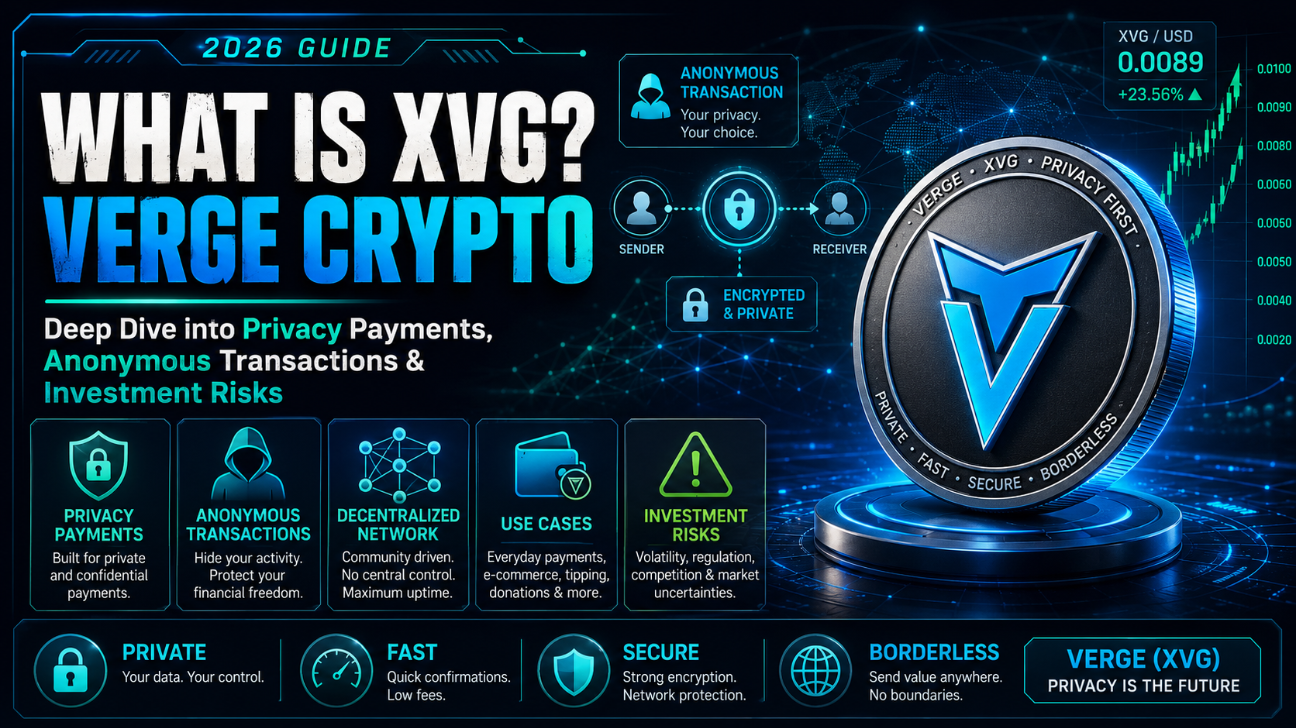
2.1 What Privacy Technologies Does Verge Use?
Verge’s privacy capabilities focus primarily on network-layer privacy and address privacy.
Verge’s official tech pages mention that Verge integrates Tor into its wallet to hide communication sources and destinations, reducing the possibility of identifying transaction parties through network monitoring.
This means Verge’s emphasis is not on fully hiding on-chain transaction amounts and structures like some privacy coins, but rather on protecting users’ network identities — such as IP addresses and communication paths.
Additionally, Verge’s official site references Dual-Key Stealth Addressing, which allows senders to generate one-time destination addresses for recipients. Multiple transactions sent to the same stealth address appear on-chain as going to different addresses, further enhancing recipient privacy.
So Verge’s privacy logic can be summarized as:
- Enhancing network-layer privacy via Tor.
- Enhancing recipient address privacy via stealth addresses.
- Optimizing payment experience through low fees and fast confirmations.
It’s important to note that Verge is not a project where “all transaction information is completely invisible.” Verge’s official FAQ explicitly states that it retains a public blockchain, because a public ledger allows users to view coin distribution and network usage.
This is one of the biggest differences between XVG and coins like Monero.
2.2 How Does XVG Privacy Compare to Monero?
Monero is one of the most representative projects in the privacy-coin space. Monero’s official FAQ explains that it uses three different privacy technologies: ring signatures, Ring Confidential Transactions (RingCT), and stealth addresses. Monero’s official introduction also states that senders, receivers, and transaction amounts are all hidden by these technologies.
In other words, Monero offers deeper, default, stronger transaction-level privacy.
Verge’s privacy approach is different.
Verge emphasizes network-layer privacy, fast payments, low fees, and everyday usability. It uses Tor to hide communication paths and stealth addresses to enhance recipient privacy, but it doesn’t offer Monero’s default hiding of sender, receiver, and amount.
Think of it this way:
- Monero is more like a default-private transaction system.
- Verge is more like a payment-oriented digital currency with network-layer privacy enhancements.
Neither is inherently “better” — they serve different use cases. If your top priority is strong anonymous transactions, Monero takes a more aggressive technical stance. If you care more about lightweight payments, low fees, and network-layer privacy, Verge aligns more with daily payment tools.
2.3 How Does XVG Differ from Zcash?
Zcash is another major player in the privacy-coin space. Zcash’s official introduction states that it was one of the first cryptocurrencies to use zero-knowledge cryptography for private peer-to-peer payments. Zcash’s learning resources explain that it uses zk-SNARKs to encrypt shielded transactions on-chain while still allowing network consensus to validate them.
Zcash’s core strength lies in zero-knowledge proofs, especially shielded transactions.
Verge, however, does not use the zk-SNARK route. It focuses more on network-layer privacy, stealth addresses, and payment experience.
Therefore:
- Zcash emphasizes zero-knowledge proofs and optional shielded transactions.
- Monero emphasizes default strong privacy for all transactions.
- Verge emphasizes fast payments and network-layer privacy enhancements.
All three fall under the privacy umbrella, but their technical paths and user scenarios are quite different.
2.4 What Are XVG’s Speed and Fee Advantages?
Payment-focused projects must deliver on speed and cost.
If transfers are slow, fees are high, or confirmations take too long, it’s hard to function as a daily payment tool.
Verge’s official FAQ states that the transaction fee is 0.1 XVG per KB, and most transactions are under 1 KB. Transaction speeds vary with network load but typically range between 5 to 10 seconds. The FAQ also lists a processing capacity of 100 TPS.
These figures show that Verge was indeed designed with small-value payments in mind. It aims for users to transfer funds quickly without long confirmation times or high fees.
Of course, official parameters only reflect design goals. Investors should also monitor real-world network usage, wallet experience, merchant adoption, exchange liquidity, and ecosystem activity.
3. What Value Does XVG Token Have? Where Is the Investment Thesis?
When users search “Is XVG worth buying,” what they really want to know is: what is XVG’s actual utility, and does it still have room for growth?
3.1 What Are the Main Uses of XVG Token?
XVG’s primary use is payment.
Users can send XVG in peer-to-peer transfers, and it can also be used with merchants, wallets, or payment scenarios that support XVG. Verge’s official FAQ indicates that businesses can accept XVG payments through integrated partners or APIs.
XVG is also used for on-chain transaction fees — users pay a small network fee when transferring.
Additionally, XVG serves as the value carrier for the Verge ecosystem. If Verge’s payment ecosystem, wallet usage, merchant adoption, and community activity grow, XVG’s demand may gain more support.
But it’s important to clarify: XVG is not a smart-contract governance token or a DeFi yield token. Its value logic comes more from payment usage, privacy demand, community network effects, and market liquidity.
3.2 Where Does XVG’s Value Growth Come From?
XVG’s potential value growth stems from three main directions.
First, growing demand for privacy.
As on-chain analytics tools become more powerful, users may become more concerned about wallet balances, fund flows, and transaction behavior privacy. The more people realize that “public addresses don’t equal true privacy,” the more privacy-payment projects may regain market attention.
Second, expansion of crypto payments.
If digital currency payments become more mainstream in the future, users will need not only stablecoins but also low-fee, fast, privacy-protected payment tools. XVG’s payment positioning could then gain renewed discussion.
Third, emerging automated payment scenarios (AI Agents).
In the era of AI agents, automated programs may represent users in executing tasks, calling services, paying fees, subscribing to tools, or completing on-chain operations. If AI-agent payment demand grows, privacy, security, and low-cost payment capabilities could become even more important.
That’s why XVG — despite being an older privacy-payment project — can still be discussed within the framework of “future payment infrastructure.”
4. XVG Ecosystem and Real-World Use Cases
To judge whether XVG still holds value, you can’t just look at historical price charts — you also need to examine whether it still has practical use cases.
4.1 Verge Payment Ecosystem
Verge’s core ecosystem remains payments.
The payment ecosystem includes user transfers, merchant acceptance, wallet support, third-party payment integrations, exchange liquidity, and community promotion.
Verge’s advantage is that it was designed for daily use from the ground up: fast transactions, low fees, and a relatively large total supply that makes it easier to work with whole-number amounts for small purchases. Verge’s official FAQ explains that its higher total supply is partly intended to facilitate everyday payment amounts, avoiding the need for very small decimal units like BTC.
But the key to a payment ecosystem isn’t technical specs — it’s adoption.
Without enough merchants accepting it, enough users actively using it, and enough wallets supporting it, a payment coin risks remaining “usable for payments” rather than “actually used frequently.”
So investors should track Verge’s actual merchant count, wallet activity, community development, exchange support, and payment-scenario updates.
4.2 Future Application Scenarios for Privacy Payments
Privacy payments are not synonymous with illegal transactions. Legitimate users also have privacy needs.
Examples:
- Cross-border freelancers who don’t want all their income addresses publicly traceable.
- Merchants who don’t want competitors tracking their revenue.
- Web3 users who don’t want all their wallet activities flagged by on-chain analytics.
- Individuals who don’t want every single payment permanently public.
As digital payments become more widespread, privacy may re-emerge as a critical need. Traditional cash itself offers a degree of privacy, while fully transparent blockchain payments strip away some financial privacy.
XVG’s value proposition lies in offering a payment-oriented privacy solution for this very problem.
4.3 AI Agent Payment Scenarios
In the future, AI agents may execute more and more operations on behalf of users.
For example, an AI agent might automatically subscribe to tools, purchase data, call APIs, pay for compute, settle transfers, manage wallets, or complete micro-payment tasks.
When AI agents start handling payments, privacy and security become very important. Users don’t want their agent’s entire payment paths, service calls, transaction counterparts, and fund balances to be fully exposed.
If you want to understand the relationship between AI agents and payment infrastructure, you can read What Is AEON Crypto? AI Agent Payment Infrastructure Explained. AEON leans more toward AI-agent economies and payment networks, while XVG leans more toward private digital payments. Both can be understood within the broader “future automated payment infrastructure” context.
5. How Does XVG Relate to AI, DePIN, and Web3 Infrastructure Trends?
XVG is not an AI project, nor is it a DePIN project. But from a broader Web3 infrastructure perspective, it does have indirect connections to these trends.
5.1 What’s the Connection Between Privacy Coins and the AI Era?
The AI era will involve massive data processing.
AI systems may handle user identities, transaction records, preference data, account permissions, subscription information, payment behavior, and commercial data. If all of this is exposed on public blockchains, privacy risks increase significantly.
Privacy coins and privacy-payment projects offer a different kind of infrastructure: ways to reduce unnecessary information exposure during digital asset transfers.
Of course, XVG does not address AI model privacy, data training privacy, or encrypted computation — it addresses payment and network-layer privacy. That distinction is important.
5.2 How Does XVG Differ from DePIN Projects?
DePIN projects focus on organizing real-world physical resources — such as geospatial data, wireless networks, GPUs, storage, sensors, bandwidth, etc. — through blockchain incentive mechanisms.
XVG is not a DePIN project. It solves digital payment privacy, not real-world resource networking.
If you want to understand the DePIN space, you can read What Is GEOD? Geodnet DePIN Project Explained. GEOD focuses on high-precision geographic data and real-world infrastructure, while XVG focuses on privacy payments and digital transfers. They belong to different infrastructure layers.
What they share is that both attempt to solve foundational issues in traditional internet or traditional finance: GEOD tackles real-world data infrastructure, and XVG tackles digital payment privacy.
5.3 XVG and the Future of Financial Infrastructure
Future financial infrastructure may simultaneously involve privacy, computation, security, payments, asset tokenization, and cross-chain settlement.
XVG covers only one layer — privacy payments. It is not an all-in-one financial protocol, but it touches on a long-standing issue in finance: must transactions be completely public?
If you’re interested in a wider view of future financial infrastructure, you can read What Is QNTB?. QNTB leans more toward quantum computing, fintech, and future compute infrastructure, while XVG leans more toward payment privacy. Different projects solve different layers of the stack.
6. Factors Affecting XVG Price
When users search “XVG price prediction,” what they really care about is: can XVG still go up in the future?
Any price prediction shouldn’t rely solely on charts. XVG’s price is influenced by the overall crypto market cycle, sentiment in the privacy-coin sector, project activity, exchange liquidity, and the regulatory environment.
6.1 What Conditions Are Needed for XVG Price to Rise?
First, the overall crypto market cycle.
As an altcoin, XVG’s price is typically influenced by BTC cycles. When BTC rallies, risk appetite improves, and altcoin liquidity increases, XVG is more likely to attract capital attention.
Second, renewed interest in the privacy sector.
If on-chain privacy, payment privacy, data security, and anti-tracking demand become market hotspots again, privacy coins may get a repricing opportunity.
Third, Verge project development.
Investors should watch for technical updates, wallet upgrades, merchant partnerships, community activity, exchange support, and real payment adoption.
Fourth, growth in payment use cases.
If crypto payments shift from speculation to real-world usage, low-fee, fast, privacy-enhanced payment coins may re-enter the discussion.
6.2 ETH Ecosystem and Broader Market Impact
Although XVG is not an Ethereum ecosystem project, the overall crypto market’s liquidity is influenced by the ETH ecosystem.
When ETH rallies, Layer 2 networks thrive, and DeFi and Web3 applications recover, overall risk appetite improves, and capital may flow into smaller-cap assets.
You can track ETH Price Prediction to gauge broader market cycles. XVG doesn’t rely on ETH technology, but its price is still affected by overall crypto sentiment.
6.3 Regulatory Sentiment Around Privacy Coins
Privacy-coin prices are also affected by the regulatory environment.
In recent years, some exchanges have taken a more cautious approach to listing or trading privacy coins. For example, Kraken announced that due to regulatory changes, it would stop XMR trading and deposits for European Economic Area customers as of October 31, 2024, and eventually delist related markets.
Such events don’t necessarily mean XVG will face the same treatment, but they show that the privacy-coin sector faces compliance pressures. When investing in XVG, you should consider not just privacy demand but also exchange support, regional regulations, and liquidity conditions.
7. XVG Price Prediction: Upside Potential and Risk Analysis
Whether XVG can rise in the future depends on two factors: whether privacy-payment demand re-accelerates, and whether Verge can prove it still has real use value.
7.1 Short-Term Price Factors
In the short term, XVG price is mainly driven by market sentiment, trading volume, exchange depth, project news, privacy-sector heat, BTC trends, and altcoin capital rotation.
If the market enters a bull phase and capital starts hunting for low-cap, older privacy-payment projects, XVG could see a short-term rally due to thematic interest.
But if market liquidity drops, or if privacy coins are shunned due to regulatory pressure, XVG could correct sharply.
Short-term price is largely a game of sentiment and capital flows — and it carries high risk.
7.2 Long-Term Value Model
XVG’s long-term bull case can be framed as follows:
If on-chain privacy demand rises, users become more concerned about payment privacy, crypto payments resume growth, and Verge continues to update its wallet, merchant network, community, and technology, XVG as an established privacy-payment coin may regain market attention.
But the bear case is equally clear:
If regulatory pressure on privacy coins intensifies, centralized exchanges reduce support, Verge’s user growth stalls, merchant adoption remains limited, and its technology falls behind Monero, Zcash, or newer privacy protocols, XVG’s long-term value could erode.
So a reasonable XVG price prediction shouldn’t be written as “will definitely reach X price.” Instead, it’s more sensible to monitor several variables:
- Is privacy-payment demand growing?
- Are Verge’s technology and wallet being updated?
- Is exchange liquidity stable?
- Is the community active?
- Does the regulatory environment allow privacy coins to continue circulating?
You can check XVG Price Prediction and combine it with price data, market cycles, and project progress to form your own view.
8. How to Buy XVG? A Beginner’s Step-by-Step Guide
Once you understand XVG’s fundamentals, the next question is: “how to buy XVG?”
Beginners should not go all-in based on community hype or short-term pumps. A better approach is to first check live prices, then test the trading process with a small amount.
8.1 What Do You Need Before Buying XVG?
Before buying XVG, you’ll need three things.
First, a digital asset account.
Choose a platform that supports the XVG/USDT trading pair, complete account registration, set up security, and finish any required identity verification.
Second, USDT funds.
Most crypto trading pairs are quoted in USDT. Beginners typically need to acquire USDT first, then use it to buy XVG.
Third, risk awareness.
XVG is a privacy-payment altcoin, and its volatility can be significantly higher than BTC or ETH. You must set a position size limit in advance and avoid treating short-term speculation as a long-term sure thing.
8.2 How to Check XVG Real-Time Price?
Before buying, always check the live price — don’t rely solely on community discussions.
You can view the latest price, candlestick trends, trading volume, percentage change, and market trends via the XVG/USDT Live Price.
When checking the chart, pay attention to at least three things:
- Is the price at a short-term peak?
- Is volume increasing?
- Is the rise backed by real project progress, or is it just hype?
If you don’t understand the chart, it’s not advisable to buy heavily.
8.3 Steps to Buy XVG
For beginners, the purchase process can be understood as follows:
- Register a digital asset account.
- Complete account security settings.
- Deposit USDT.
- Search for the XVG/USDT trading pair.
- Choose a market order or limit order.
- Confirm the purchase amount.
- After the purchase, continue monitoring the price and project updates.
Market orders execute quickly but may have slippage. Limit orders let you control the buy price but aren’t guaranteed to fill immediately. For beginners, a small limit order is a good way to practice.
8.4 How to Manage XVG After Buying?
After buying XVG, don’t just stare at the price.
You need to track project development — wallet updates, tech upgrades, community activity, merchant support, and payment ecosystem progress.
You also need to monitor market trends — whether the privacy-coin sector regains attention, whether payment cryptos recover momentum, and whether regulatory policies change.
Finally, maintain risk control — position sizing, stop-loss plans, long-term observation cycles, and avoiding over-concentration.
Investing in XVG isn’t a one-and-done transaction; it requires ongoing judgment of whether the project still holds value.
9. XVG Investment Risk Analysis
While XVG has a clear privacy-payment positioning, its investment risks are not trivial. The privacy-coin sector, in particular, faces more regulatory and liquidity pressure than many other crypto assets.
9.1 Privacy Regulatory Risk
One of the biggest risks for privacy coins is regulatory uncertainty.
Regulators typically focus on anti-money laundering (AML), counter-terrorism financing (CFT), transaction traceability, and exchange compliance. Because privacy coins can reduce on-chain traceability, some exchanges and jurisdictions adopt more cautious policies toward them.
This affects trading depth, user accessibility, listing scope, and market sentiment.
If more regions tighten rules on privacy-coin trading, XVG could face reduced liquidity or restricted access.
9.2 Technology Competition Risk
XVG faces competition from Monero, Zcash, Dash, and newer privacy protocols.
- Monero is more representative in strong privacy transactions.
- Zcash has a stronger technical brand around zero-knowledge proofs.
- Newer projects may combine ZK, MPC, FHE, privacy smart contracts, or compliant privacy tech to offer more modern privacy infrastructure.
If XVG fails to continuously update its tech and ecosystem, its competitive edge may weaken.
9.3 Adoption Risk
Technology existence doesn’t equal user adoption.
The most critical metric for a payment coin isn’t “can it transfer value” — it’s “do people actually use it regularly.”
Investors should monitor merchant count, active addresses, wallet usage, transfer frequency, community activity, and ecosystem integrations.
If XVG lacks genuine payment demand, its price becomes more dependent on market speculation than on fundamentals.
9.4 Market Volatility Risk
As an altcoin, XVG’s price can swing wildly.
In a bull market, it may surge quickly due to privacy narratives and low market cap. In a bear market, it may plummet due to falling liquidity and risk-off sentiment.
Therefore, beginners should never borrow to invest in XVG, nor treat it as a guaranteed long-term income asset.
10. What Other Emerging Crypto Infrastructure Should XVG Investors Watch?
XVG represents the privacy-payment direction, but crypto infrastructure is rapidly expanding into AI, semiconductors, data, payments, RWA, DePIN, and more.
10.1 AI Compute and Semiconductor-Related Assets
Future investment opportunities may concentrate in several infrastructure layers:
- Compute resources
- Semiconductor chips
- Data infrastructure
- Payment networks
- Privacy protection
If you’re interested in the AI supply chain and tokenized traditional assets entering crypto, you can read What Are FWDI/AEHR/FLY USDT?. Those assets lean more toward AI compute, semiconductors, and tokenized real-world assets.
XVG is different from these. It doesn’t solve AI compute or represent semiconductor assets — it represents privacy payments.
But from a broader view, AI agents, Web3 wallets, on-chain payments, RWA assets, and digital identities all need payment infrastructure. Privacy payments could become one complementary module.
11. Is XVG Worth Investing In? Final Analysis
Whether XVG is worth investing in depends on how you see the future of the privacy-payment sector.
On the positive side, XVG has several strengths:
- It’s an established crypto project that has survived multiple market cycles.
- It has a clear positioning: privacy payments and everyday digital currency use.
- It offers fast transactions and low fees, which align with payment-asset needs.
- It has a community base and historical recognition.
But the risks are equally evident:
- Privacy coins face regulatory headwinds.
- XVG’s technological competitiveness requires ongoing validation.
- Payment adoption remains a critical open question.
- Competition from Monero, Zcash, and newer privacy protocols is strong.
- Price is heavily influenced by market cycles.
Therefore, XVG is more suitable for three types of investors:
- Those who are bullish on the privacy-payment trend.
- Those who follow established crypto infrastructure projects.
- Those who can tolerate high volatility and are willing to track project progress over the long term.
If you’re just chasing short-term pumps, XVG is not for heavy positioning. But if you want to research the long-term question — “do digital payments need privacy protection?” — Verge is worth putting on your watchlist.
The ultimate judgment of XVG’s value isn’t how high it has rallied in the past, but whether it can continue to answer one question:
In an era where all transactions are becoming more transparent and on-chain analytics more powerful, do everyday users still need a fast, low-cost, privacy-preserving digital payment tool?
If the answer is yes, XVG still has research value. But whether that translates into long-term investment returns depends on Verge’s tech updates, user adoption, exchange liquidity, and the regulatory environment.