
Data Verification Date: July 10, 2026 (UTC+8)
Risk Disclaimer: This article is for informational research and investor education only. It does not constitute any investment advice, legal advice, tax advice, or return guarantee. GOOGLB is a tokenized stock / Tokenized bStock asset that involves risks related to US stock price volatility, tokenization structure, price decoupling, liquidity, platform counterparty, regulation, taxation, on-chain operations, and principal loss.
I. Why Should Crypto Newcomers Care About "Tech Giant Tokenization" Assets Like GOOGLB?
When crypto newcomers first explore AI investments, they typically think of AI concept tokens, AI Agent tokens, decentralized computing, AI data protocols, and AI meme coins.
These assets are highly volatile and have strong narratives, but they share one obvious problem:
The valuation of many AI concept tokens is primarily driven by narrative and liquidity, not stable cash flow.
The logic behind GOOGLB is completely different.
The underlying asset behind GOOGLB is Alphabet Inc. Class A stock, i.e., the NASDAQ-listed shares of Google's parent company. Alphabet is not a single AI project; it is a global tech giant with core businesses spanning search, YouTube, Android, Google Cloud, Gemini, TPU, proprietary models, the ad network, and Waymo autonomous driving.
For crypto newcomers, the significance of GOOGLB is:
It is not just about chasing AI narratives, but about gaining exposure to the AI cash flow, cloud infrastructure, and long-term growth of global tech giants through tokenized stocks.
1. What's the Difference Between GOOGL and GOOGLB?
Let's start with the most common point of confusion.
GOOGL is the NASDAQ ticker for Alphabet Inc. Class A stock.
GOOGLB is the Alphabet Tokenized bStock, a tokenized mapping asset of Alphabet stock.
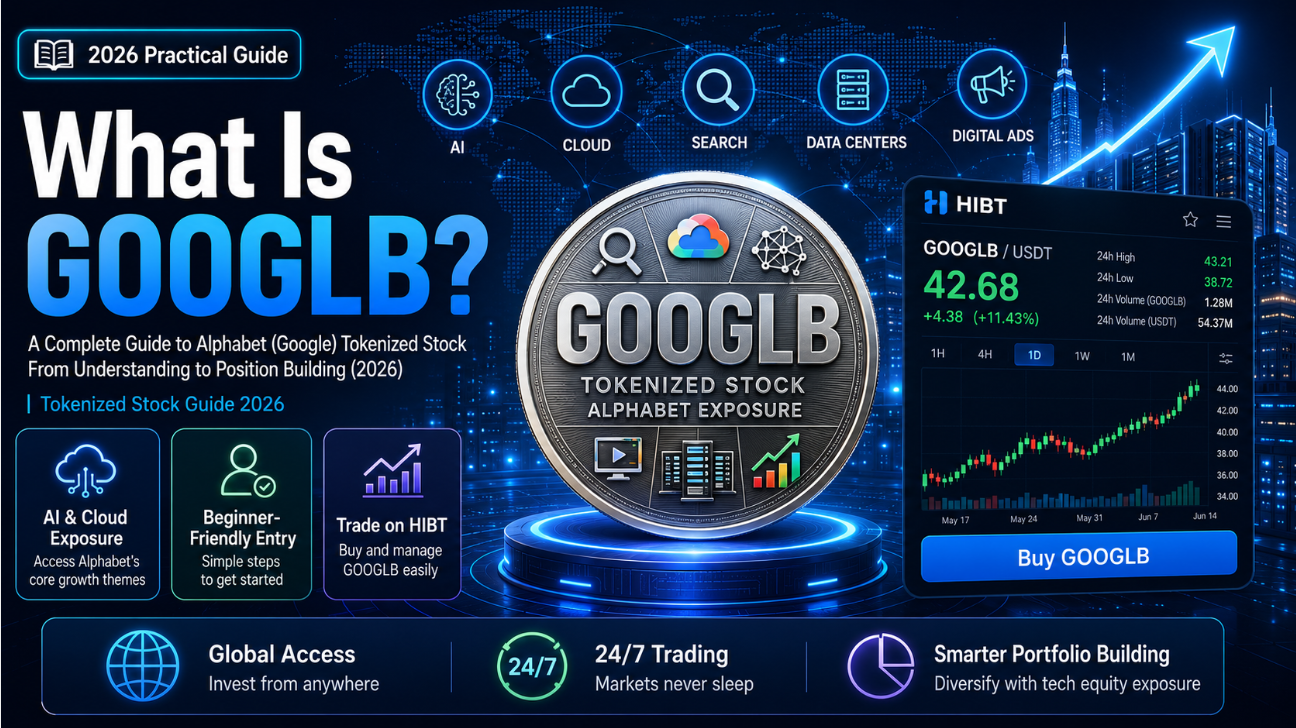
According to HIBT's official announcement, the GOOGLB trading pair is GOOGLB/USDT, on the BSC network. Trading commenced at 07:30 UTC on July 9, 2026, and withdrawals opened at 07:30 UTC on July 10, 2026. The project description states: "GOOGLB is a tokenized bStocks that gives you economic exposure to Alphabet Tokenized bStocks."
Therefore, the correct understanding is:
- GOOGL is a traditional US stock;
- GOOGLB is a tokenized stock asset;
- GOOGLB is not an independent cryptocurrency;
- GOOGLB's price is highly correlated with the GOOGL stock;
- Holding GOOGLB is not the same as holding Alphabet stock directly in a traditional brokerage account.
As of recent public market data, Alphabet's market cap fluctuates in the range of approximately $4.3 to $4.5 trillion. The 52-week price range for GOOGL is approximately 172.77–408.61. The specific stock price should be verified against the real-time market on the day of publication.
2. How Do Tokenized bStocks Work?
bStocks are a type of tokenized security product. Binance Academy's explanation of bStocks is: bStocks allow users to gain exposure to US stocks via blockchain technology. Each bStock is typically backed 1:1 by the corresponding US stock and held by a regulated custodian.
But newcomers must understand one key point:
bStocks are not the stocks themselves.
The bStocks official page explicitly states that bStocks are not stocks or shares, and do not allow holders to directly own the stock of the underlying listed company.
Therefore, a more accurate understanding of GOOGLB is:
It allows users to gain economic exposure to Alphabet stock through a crypto trading platform, rather than making them direct Alphabet shareholders.
3. Three Reasons for Crypto Newcomers to Allocate to GOOGLB
First, Alphabet is a full-stack AI company.
It does not just build models or clouds; it owns:
- Search traffic entry points;
- YouTube content ecosystem;
- Google Cloud infrastructure;
- Gemini model;
- TPU proprietary chips;
- Android and mobile ecosystem;
- Waymo autonomous driving;
- Enterprise AI tools.
Second, Alphabet has real cash flow.
Compared to many AI concept tokens still in the narrative stage, Alphabet's AI investments are materializing in search, cloud services, subscriptions, enterprise AI products, and infrastructure demand. In Q1 2026, Alphabet's total revenue reached $109.9 billion, a year-over-year increase of 22%; Google Services revenue was $89.6 billion, up 16% year-over-year; Google Cloud revenue was $20 billion, up 63% year-over-year.
Third, GOOGLB allows crypto users to participate in the growth of global tech giants without a traditional US stock account.
Traditionally, buying GOOGL stock requires a US brokerage account, USD deposit, US trading hours, and compliance with securities account rules. Through HIBT's GOOGLB/USDT trading pair, users can gain exposure to Alphabet's economic performance using USDT. HIBT's GOOGLB market page also provides the GOOGLB/USDT trading entry.
4. The Essential Difference Between "Buying AI Concept Tokens" and "Buying GOOGLB"
When buying AI concept tokens, the common valuation logic includes:
- Narrative strength;
- Community heat;
- Tokenomics;
- On-chain activity;
- Exchange liquidity;
- KOL promotion;
- Short-term capital rotation.
When buying GOOGLB, the core logic shifts to:
- Alphabet earnings reports;
- Google Cloud growth;
- Search advertising revenue;
- Gemini monetization;
- TPU proprietary chip efficiency;
- Waymo autonomous driving progress;
- AI capital expenditure ROI;
- US stock valuation and regulatory risks.
The price drivers of these two asset types are completely different.
Therefore, GOOGLB should not be treated as a "100x coin." It is more appropriately understood as:
A tokenized stock exposure to the world's top tech companies, accessed via crypto trading methods.
II. What Is GOOGLB, Exactly? Breaking Down Alphabet's Business Map and Price Mechanism
To understand GOOGLB, you cannot just look at the candlestick chart on HIBT; you must understand how Alphabet actually makes money.
1. Alphabet's Three Major Business Segments
Alphabet's earnings reports divide its business into three main segments:
First, Google Services.
This segment includes Google Search, YouTube, Google Network, Android, Chrome, Google Play, hardware devices, subscription services, etc. In Q1 2026, Google Services revenue was $89.6 billion, with an operating profit of $40.6 billion.
Second, Google Cloud.
This segment includes Google Cloud Platform, Google Workspace, enterprise AI infrastructure, and enterprise AI solutions. In Q1 2026, Google Cloud revenue was $20 billion, up 63% year-over-year; operating profit rose from $2.18 billion in the same period last year to $6.6 billion.
Third, Other Bets.
This segment includes long-term projects such as Waymo. In Q1 2026, Alphabet disclosed that Waymo had already surpassed 500,000 fully autonomous rides per week.
For GOOGLB investors, these three segments represent:
- Search advertising cash cow;
- Cloud and AI growth engine;
- Long-term options like autonomous driving.
2. How Is Gemini AI Reshaping Google's Business?
In the Q1 2026 earnings report, Alphabet CEO Sundar Pichai stated that the company's AI investments and full-stack approach are lighting up every part of the business; Search queries reached a new all-time high, AI experiences are driving usage, and the Google Cloud backlog nearly doubled quarter-over-quarter to over $460 billion.
This shows that Gemini and AI are not a single product but affect Alphabet on multiple levels:
- Search: AI Overviews and AI Mode enhance the query experience;
- Cloud: Enterprise AI infrastructure and AI solutions drive revenue;
- Developers: Gemini API and Vertex AI form an ecosystem;
- Subscriptions: Google One, YouTube, and AI plans increase paid users;
- Enterprise clients: Gemini Enterprise paid monthly active users are growing;
- Internal efficiency: AI is transforming advertising, recommendations, coding, customer service, and infrastructure.
The earnings report also showed that Gemini API customers are directly calling over 160 billion tokens per minute, a 60% quarter-over-quarter increase; Alphabet's paid subscriptions reached 350 million.
3. Google Cloud: The Core Growth Engine of GOOGLB
Google Cloud is one of the most important variables in the GOOGLB investment thesis.
In Q1 2026, Google Cloud revenue grew 63% year-over-year to $20 billion, driven mainly by enterprise AI solutions, enterprise AI infrastructure, and core GCP services growth.
More critical is the backlog.
Alphabet's earnings report showed that the Google Cloud backlog nearly doubled quarter-over-quarter to over $460 billion.
What does this mean?
Simply put:
Many enterprise clients have already signed future cloud service contracts, but Alphabet has not yet fully converted these contracts into current revenue.
This provides a key indicator for medium- to long-term investors:
- Backlog growth means strong demand;
- Backlog conversion to revenue means strong delivery capability;
- If backlog is high but delivery is constrained, computing power or data centers may be the bottleneck;
- If backlog growth slows, it may signal a cooling in enterprise AI demand.
4. The Strategic Significance of TPU Proprietary Chips
Alphabet does not just buy NVIDIA GPUs; it also has proprietary TPUs.
In 2026, Google Cloud released its eighth-generation TPU, including the TPU 8t and TPU 8i. According to the official introduction, the TPU 8t is designed for large-scale training, with a single superpod containing 9,600 chips, providing 121 exaflops of computing power and 2 PB of shared memory; the TPU 8i is more focused on low-latency inference and Agentic AI scenarios.
The significance of TPU for GOOGLB is:
- Reducing reliance on a single GPU supply chain;
- Improving AI inference and training costs;
- Enhancing Google Cloud's appeal to enterprise clients;
- Supporting Gemini's proprietary model;
- Potentially forming a differentiated advantage in cloud business.
Meanwhile, Reuters reported that Broadcom and Google signed a long-term agreement to jointly develop and supply Google's next-generation AI racks and TPUs, extending the partnership to 2031; Broadcom will also provide AI computing capacity based on Google chips for Anthropic.
This shows that Alphabet's AI strategy is not a single bet on the model, but a full-stack layout spanning chips, cloud, models, search, subscriptions, and enterprise tools.
5. How to Understand GOOGLB's Issuance and Custody Mechanism?
HIBT's announcement shows that GOOGLB runs on the BSC network, providing economic exposure to Alphabet Tokenized bStocks, and provides the bStocks official website and BscScan contract address.
From the bStocks mechanism perspective, each bStock is typically backed 1:1 by the corresponding US stock, but bStocks themselves are not stocks and do not grant users traditional shareholder status in the underlying company.
Regarding dividends, users must pay special attention:
Alphabet announced in Q1 2026 that it would raise its quarterly cash dividend from $0.21 per share to $0.22 per share.
However, GOOGLB holders should not simply assume that "they will receive cash dividends directly like in a US stock account." The dividend handling for tokenized stocks usually depends on the bStocks multiplier mechanism, NAV adjustment, withholding tax rules, and HIBT announcements. The final determination should be based on official disclosures.
6. Price Linkage and Deviation Risk
In the long run, GOOGLB should fluctuate around the economic value of the GOOGL stock, but short-term premiums or discounts may occur.
Reasons include:
- US stock market is closed, but GOOGLB may still trade;
- AI news breaks on weekends or after hours;
- Limited order book depth for GOOGLB on HIBT;
- Widened bid-ask spreads;
- Different prices for tokenized versions across platforms;
- Exchange rate, USDT premium, and market sentiment affecting prices.
Therefore, newcomers should not simply assume:
"The current price of GOOGLB must equal the real-time price of GOOGL."
A more accurate understanding is:
GOOGLB provides economic exposure to Alphabet stock, but short-term prices may be affected by trading hours, liquidity, platform depth, and market sentiment.
III. GOOGLB Investment Logic: Valuing GOOGLB Under the 2026 AI Supercycle
Investing in GOOGLB essentially means answering one question:
Is Alphabet one of the most complete full-stack platforms in the AI era?
1. Supply-Demand Imbalance Behind Google Cloud's High Growth
Google Cloud's Q1 2026 revenue grew 63% year-over-year, with backlog exceeding $460 billion, indicating very strong enterprise AI demand.
But strong demand does not mean revenue can grow indefinitely.
Cloud business growth depends on:
- Data center capacity;
- TPU / GPU supply;
- Electricity;
- Network;
- Storage;
- Enterprise client budgets;
- Delivery capability;
- Gross margin control.
If Alphabet is constrained by "computing supply," short-term revenue may fall below potential demand; if massive CapEx is too aggressive, future depreciation pressure and margin compression may also arise.
2. $180–190 Billion Capital Expenditure: Bubble or Infrastructure?
Alphabet's 2026 capital expenditure is one of the most important risk variables in the GOOGLB investment thesis.
Alphabet stated in its June 2026 investor presentation that full-year 2026 CapEx is expected to be $180 to $190 billion, and 2027 CapEx is expected to increase significantly compared to 2026.
Meanwhile, the Q1 2026 earnings report showed that Alphabet's cash expenditure on property and equipment for the quarter was $35.674 billion.
This shows that Alphabet is making extremely large-scale AI infrastructure investments.
Optimistic interpretation:
- AI demand is strong;
- Google Cloud backlog supports future revenue;
- TPU proprietary chips reduce costs;
- Search, cloud, subscriptions, and enterprise AI are synergizing;
- Long-term infrastructure investment may form a moat.
Cautious interpretation:
- Capital expenditure is too high;
- Free cash flow is being compressed;
- Future depreciation will affect profits;
- If AI revenue growth falls short of expectations, the market may re-rate downward;
- If hyperscalers collectively expand capacity, future price wars or oversupply may occur.
3. Will AI Disrupt Search Advertising?
Many people worry that AI will impact Google search advertising.
But Q1 2026 data shows that Google Search & other revenue was $60.4 billion, up 19% year-over-year; management also stated that AI experiences are driving usage, and search query volume reached a new all-time high.
This shows that at least in Q1 2026, AI did not significantly erode Google's search business model; on the contrary, it may have increased some query volume and usage frequency.
But risks remain:
- AI answers may reduce user clicks;
- Ad display formats may need to be redesigned;
- Users may shift to AI search entry points like ChatGPT, Perplexity, and Claude;
- Regulators may restrict Google's default search distribution advantage;
- AI Overviews may trigger publisher and content ecosystem disputes.
Therefore, the search logic for GOOGLB is not "risk-free," but rather:
Current earnings prove search remains strong, but AI search competition and regulatory pressure will persist long-term.
4. Waymo: The Most Important Long-Term Option in Other Bets
Waymo is Alphabet's autonomous driving business.
In the Q1 2026 earnings report, management disclosed that Waymo's weekly fully autonomous ride count had exceeded 500,000.
This is significant for GOOGLB because:
- Waymo is no longer just a lab project;
- Autonomous ride-hailing has a commercialization path;
- If it independently raises funds or goes public in the future, it may unlock valuation;
- But it may continue to consume capital in the short term.
For newcomers, Waymo should not be treated as a short-term reason to buy GOOGLB, but rather as a long-term option.
5. How to Use GOOGLB Price Prediction Tools?
HIBT's GOOGLB price prediction page shows that related predictions are generated based on user feedback, providing short-term and long-term forecasts, ROI calculations, and a price prediction calculator. The page also explicitly states "for reference only, not investment advice."
Correct usage:
- Use it for target price simulation;
- Use it to plan take-profit ranges;
- Use it to understand how returns change under different growth rates;
- Combine it with GOOGL stock, Alphabet earnings reports, Google Cloud backlog, and technical analysis.
Incorrect usage:
- Treating predictions as return guarantees;
- Going all-in just because you see 2030 or 2050 predicted prices;
- Ignoring liquidity and risks;
- Not setting stop-losses;
- Ignoring US stock valuation and regulatory risks.
IV. Step-by-Step Guide: The Complete Path to Buying GOOGLB on HIBT
This section is designed for complete beginners, focusing on explaining each step clearly to avoid buying the wrong trading pair, sending to the wrong network, or accidentally entering the futures page.
1. Register a HIBT Account
After entering the HIBT official website or app, you can register an account using email or phone number.
After registration, it is recommended to immediately complete three things:
- Set a strong password;
- Enable Google Authenticator or another 2FA;
- Set an anti-phishing code.
Do not send login passwords, verification codes, fund passwords, private keys, or seed phrases to any "customer service." Real official customer service will never ask you to transfer funds privately or send verification codes.
2. Complete KYC Verification
KYC serves to confirm identity, reduce fraud and money laundering risks, and also affects account functionality, deposit and withdrawal permissions, and limits.
Common reasons for KYC failure among newcomers include:
- Blurry ID photos;
- Expired ID documents;
- Facial recognition failure;
- Name and ID information mismatch;
- Unsupported ID type uploaded;
- Using a VPN causing abnormal region detection;
- Multiple accounts with duplicate verification;
- Region does not support the relevant product.
Users in different regions may have differences in ID, address proof, source of funds, and trading restrictions. The actual requirements are subject to the HIBT page prompts and local laws and regulations.
3. Prepare USDT: On-Chain Deposit or P2P?
To buy GOOGLB/USDT, you usually need to prepare USDT first. HIBT trading tutorials explain that users can obtain USDT through deposit or buy-crypto, and transfer USDT to the trading account for trading.
There are two common deposit methods.
First, on-chain USDT deposit.
Suitable for users who already hold USDT on other exchanges or in wallets. HIBT's deposit and withdrawal network instructions remind users that the deposit and withdrawal networks must be consistent; for example, if you choose the USDT-ERC20 deposit network, the withdrawal side must also choose USDT-ERC20, otherwise assets may be lost.
Second, P2P or express buy-crypto.
Suitable for newcomers who do not yet have USDT. The advantage is a low barrier to entry; the disadvantages are potential exchange rate premiums, varying merchant credibility, and possible local regulatory and payment risk controls affecting fiat on- and off-ramps.
For pure newcomers, it is not recommended to make a large deposit the first time. You can start with 50–100 USDT to run through the process.
4. Enter the GOOGLB/USDT Trading Page
HIBT's announcement shows that the GOOGLB listing trading pair is GOOGLB/USDT.
The operational path can be understood as:
- Log in to HIBT;
- Confirm that USDT is already in your account;
- Enter the spot trading page;
- Search for GOOGLB;
- Select GOOGLB/USDT;
- Confirm it is not the futures page;
- Check the K-line chart, order book, and trading volume;
- Choose limit order or market order;
- Enter the purchase amount;
- After placing the order, check the transaction history and position.
5. How to Choose Between Limit Orders and Market Orders?
For newly listed tokenized stocks like GOOGLB, newcomers should prioritize limit orders.
Limit orders are suitable for:
- Not wanting to chase highs;
- Wanting to control costs;
- Limited order book depth;
- Larger trading amounts;
- Wanting to scale in (DCA);
- Worried about premiums during US stock market closures.
Market orders are suitable for:
- Very small amounts;
- Needing quick execution;
- Sufficient order book depth;
- Accepting slippage.
The most common mistake newcomers make is market-order chasing after seeing GOOGLB rise quickly. Because the early liquidity of tokenized stocks may not be as deep as BTC or ETH, market orders may cause significant slippage.
6. How to Manage Your Position After Buying?
After buying GOOGLB, do not just look at the unrealized P&L in your HIBT account; also track:
- GOOGL stock price movements;
- GOOGLB/USDT order book depth;
- Alphabet quarterly earnings reports;
- Google Cloud revenue and backlog;
- Gemini user and API usage;
- TPU and AI infrastructure progress;
- Waymo commercialization data;
- AI capital expenditure;
- HIBT announcements;
- bStocks Proof of Collateral;
- Dividend or corporate action processing rules.
Regarding trading fees, special attention is needed: HIBT's spot fee schedule shows that the base spot maker and taker fee is 0.2%; while the maker 0.03% / taker 0.05% belongs to the futures fee structure and should not be directly applied to GOOGLB spot trading. Actual fees are subject to the trading page, account level, and real-time rules.
7. Selling and Withdrawal Path
The typical liquidation path for GOOGLB is:
- Sell GOOGLB in the GOOGLB/USDT trading pair;
- Receive USDT;
- Keep USDT on HIBT for continued trading, or withdraw to a personal wallet;
- If fiat currency is needed, choose a compliant off-ramp path;
- Record transactions and tax information as required by local laws.
When withdrawing, confirm:
- Withdrawal currency;
- Withdrawal network;
- Receiving address;
- Fees;
- Minimum withdrawal amount;
- Arrival time;
- Whether additional risk control review is required.
V. Cross-Comparison of Similar Tokenized Assets: How to Choose Between GOOGLB, CBRSB, and WDCB?
HIBT has more than one tokenized stock. What newcomers really need to learn is not "which one went up more today," but understanding their positions in the AI industry chain.
1. GOOGLB vs CBRSB: AI Cloud Infrastructure Giant vs AI Chip Designer
GOOGLB corresponds to Alphabet. The core logic is:
- Google Cloud;
- Gemini;
- TPU;
- Search advertising;
- YouTube;
- Waymo;
- Global tech giant cash flow.
CBRSB corresponds to Cerebras Tokenized bStocks. The core logic is more oriented toward:
- AI chip design;
- Wafer-scale processor;
- Non-NVIDIA architecture breakthrough;
- High-elasticity AI computing narrative.
The biggest difference between the two is maturity.
GOOGLB is backed by a multi-trillion-dollar mature tech giant with diversified business, strong cash flow, but also significant regulatory pressure.
CBRSB is backed by a more concentrated, more aggressive AI chip narrative, with potentially higher elasticity but also more concentrated individual company risk.
If you are a newcomer, the more prudent understanding is:
- Want to allocate to an AI full-stack giant: GOOGLB is more suitable;
- Want to pursue high elasticity in AI chips: CBRSB is more aggressive;
- Want to balance risk and growth: can use GOOGLB as the main position and CBRSB as a supplement.
2. GOOGLB vs WDCB: Cloud Infrastructure vs Physical Storage
WDCB corresponds to Western Digital Tokenized bStocks. The logic is more oriented toward:
- HDD;
- SSD;
- NAND;
- Enterprise storage;
- Data center storage cycle.
GOOGLB is more oriented toward data processing and cloud platforms; WDCB is more oriented toward data storage hardware.
The two are not substitutes but upstream and downstream relationships:
- Google Cloud needs massive data centers, computing power, and storage;
- Companies like Western Digital provide part of the physical storage infrastructure;
- AI data center expansion may simultaneously benefit cloud platforms and storage hardware;
- But the profit structures of cloud platforms and storage hardware are completely different.
3. Full AI Industry Chain Allocation Strategy
The following is for educational example only and does not constitute investment advice.
Conservative:
- GOOGLB: 60%;
- BTC / ETH: 20%;
- USDT: 20%.
Suitable for newcomers who want to participate in AI tech giants but do not want to bear too much volatility from single small-cap stocks.
Growth-oriented:
- GOOGLB: 45%;
- CBRSB: 25%;
- BTC / ETH: 20%;
- USDT: 10%.
Suitable for users who are bullish on both cloud platforms and AI chips, but still want to maintain positions in major assets.
Cyclical:
- GOOGLB: 40%;
- WDCB: 25%;
- BTC / ETH: 20%;
- USDT: 15%.
Suitable for investors who are bullish on AI data center expansion and are willing to bet on a storage cycle reversal.
4. Cross-Platform Price Comparison: Look at Actual Execution, Not Just Displayed Prices
The same Alphabet underlying may appear in different tokenized versions on different chains and platforms, such as GOOGLX, GOOGLON, GOOGLB, etc. When comparing across platforms, newcomers should not only look at the displayed price but also at:
- Bid-ask spread;
- Actual execution slippage;
- Whether withdrawal is supported;
- On-chain contract address;
- Underlying asset disclosure;
- Platform order book depth;
- Fees;
- Deposit and withdrawal costs;
- Platform compliance restrictions.
The core of GOOGLB is not "which platform has the lowest price," but confirming that you are buying the correct asset, the correct trading pair, the correct network, and the correct page.
VI. Risk Panorama: 6 Pits You Must Know Before Investing in GOOGLB
Alphabet is a global tech giant, but GOOGLB is still not a low-risk asset. It contains underlying US stock risk, tokenization structure risk, and trading platform risk simultaneously.
1. AI Capital Expenditure Bubble Risk
Alphabet's 2026 capital expenditure is expected to be as high as $180–190 billion.
This is both a moat and a risk.
If AI demand continues to grow, massive CapEx can be converted into cloud revenue, model capabilities, and platform barriers.
But if enterprise AI demand slows after 2027, or if AI product commercialization falls short of expectations, massive data center and chip investments will bring depreciation pressure, compressing free cash flow and profit margins.
GOOGLB investors cannot just look at "AI growth"; they must also look at:
- CapEx ROI;
- Google Cloud profit margins;
- Backlog conversion speed;
- Enterprise AI willingness to pay;
- Whether AI infrastructure is oversupplied.
2. Antitrust and Regulatory Risk
One of Alphabet's biggest long-term risks is regulation.
In the US, the Google search antitrust case is still in the appeals stage. Reuters reported that the US government and multiple states are appealing, seeking stricter remedies; Google is also appealing the monopoly finding.
In Europe, the European Commission issued a preliminary opinion on DMA compliance to Google in 2026, requiring Google to take measures to meet the Digital Markets Act requirements.
For GOOGLB, regulatory risk may manifest as:
- Search distribution advantage being weakened;
- Default search agreements being restricted;
- Advertising business rules being adjusted;
- AI product deployment being restricted;
- Fines or structural breakup risk;
- Increased data usage and privacy requirements.
3. Tokenized Securities Regulatory Risk
GOOGLB is not a regular cryptocurrency, but a tokenized stock exposure.
The SEC's 2026 statement on Tokenized Securities stated that tokenized securities typically include securities tokenized by issuers or third parties, and market participants still need to comply with US federal securities laws.
This means:
- Users in certain regions may not be able to trade;
- Platforms may restrict service scope;
- Products may be suspended due to regulatory changes;
- Users need to confirm the laws of their location;
- Tokenized securities may face stricter disclosure requirements.
4. Price Decoupling and Liquidity Risk
In theory, GOOGLB is strongly correlated with the GOOGL stock, but short-term premiums or discounts may occur.
A typical scenario is:
During US stock market closures, Google releases major AI news, and GOOGLB is first bid up on HIBT. When the US stock market opens, the GOOGL stock does not rise synchronously, and the GOOGLB premium falls back, causing newcomers who chased highs to lose money in a short time.
Another scenario is:
During market panic, the GOOGLB order book thins out, and sell orders push the price down, causing a temporary discount. If you market sell during very poor liquidity, the actual execution price may be significantly lower than the theoretical value.
Countermeasures:
- Do not chase highs during US stock market closures;
- Compare with the GOOGL stock price;
- Look at HIBT order book depth;
- Prioritize limit orders;
- Scale in (dollar-cost averaging);
- Do not use leverage;
- Do not equate displayed price with the real executable price.
5. Platform Counterparty Risk
By trading GOOGLB through HIBT, you are taking on centralized exchange risk, including:
- Account security;
- Deposit and withdrawal delays;
- System maintenance;
- Risk control review;
- Trading suspension;
- Customer service response;
- Platform reserve transparency;
- Tokenized stock custody chain transparency.
Recommendations:
- Do not keep all funds on a single platform;
- Enable 2FA;
- Set withdrawal whitelist;
- Diversify large assets;
- Regularly check HIBT and bStocks official announcements.
6. Leverage and Futures Misoperation Risk
The most dangerous mistake for newcomers is accidentally entering the futures page when they meant to buy GOOGLB spot.
HIBT's introductory materials show that the platform supports derivatives trading with up to 125x leverage.
The maximum risk of spot buying is losses from price declines.
If you add leverage in futures trading, you may be liquidated due to short-term volatility.
Before operating, you must confirm:
- The current page is spot;
- The trading pair is GOOGLB/USDT;
- Leverage is not enabled;
- It is not a perpetual contract;
- It is not a fake token;
- You can afford the maximum loss.
VII. GOOGLB Action Strategies for Different Investors
Different users are suited to different strategies. Don't copy someone else's position just because they posted gains.
1. Short-Term Traders: 1–30 Days
Short-term traders focus on volatility and events.
Suitable for observing:
- GOOGL US stock pre-market and after-hours;
- GOOGLB/USDT order book depth;
- Alphabet earnings dates;
- Google Cloud related news;
- Gemini product launches;
- TPU and Broadcom news;
- Regulatory developments;
- RSI;
- MACD;
- Trading volume.
Short-term discipline:
- Do not chase highs after a single-day surge;
- Do not make heavy purchases during US stock market closures;
- Do not use large market orders;
- Keep single-trade losses within 1%–3% of the account;
- Take profits in batches after gaining;
- Do not go all-in to bet on direction before earnings.
2. Medium-Term Holders: 1–6 Months
Medium-term investors are suitable for trading around events.
Key events include:
- Alphabet quarterly earnings;
- Google Cloud revenue growth rate;
- Cloud backlog conversion;
- Gemini user growth;
- TPU launch progress;
- Waymo ride count;
- AI capital expenditure adjustments;
- Antitrust litigation progress;
- HIBT / bStocks announcements.
Medium-term strategies can be:
- Small position observation before earnings;
- Add positions after earnings confirm growth;
- Buy in batches when hitting key support levels;
- Take profits in batches when approaching analyst target prices or 52-week highs;
- Avoid chasing highs after good news is realized.
3. Long-Term Allocators: 6+ Months
Long-term investors buy GOOGLB with the core logic of:
AI full-stack platform + search cash cow + cloud growth + TPU proprietary chips + Waymo long-term option.
Suitable for tracking:
- Whether Google Services maintains advertising growth;
- Whether Google Cloud continues high growth;
- Whether Cloud backlog converts to revenue;
- Whether TPU reduces AI costs;
- Whether Gemini forms a paid ecosystem;
- Whether Waymo improves commercialization efficiency;
- Whether CapEx brings reasonable returns;
- Whether regulatory risks are controllable.
Long-term buying is not recommended to go all-in at once.
You can adopt:
- First purchase 25% of the planned position;
- Buy another 25% after a 10%–15% pullback;
- Buy another 25% after earnings confirm growth;
- Reserve the remaining 25% for extreme pullbacks.
Take-profit discipline:
- Take profits in batches when the price approaches historical highs;
- Reduce position when AI infrastructure sentiment is overheated;
- Trim when valuation is clearly overextended relative to future revenue;
- Reassess when Cloud growth slows or CapEx returns are insufficient.
4. Pure Beginner's Minimalist Path: Start with 100 USDT
For complete beginners, the most important thing is not how much money you make the first time, but learning the complete process first.
Minimalist operation checklist:
- Register on HIBT;
- Complete KYC;
- Enable 2FA;
- Prepare 100 USDT;
- Enter GOOGLB/USDT;
- Confirm it is the spot page;
- Check the GOOGL stock price;
- Use a limit order to buy a small amount of GOOGLB;
- Record the purchase price;
- Observe for 7 days without frequent trading.
Beginner mindset management:
- Do not stare at the 1-minute K-line;
- Do not chase highs and sell lows;
- Do not use futures;
- Do not go all-in;
- Do not borrow money;
- Do not believe "guaranteed profit";
- Do not mistake a tech giant for a low-risk asset.
VIII. Conclusion: GOOGLB Is a Bridge to "AI Full-Stack Dominance," Not the Destination
The significance of GOOGLB is not just about having another trading pair on HIBT.
Its more important value is helping crypto newcomers understand a deeper trend:
The end of AI is not a single model or a single chip, but the comprehensive competition of computing power, data, distribution, cloud infrastructure, advertising monetization, and ecosystem entry points.
Alphabet's advantages lie in:
- Search distribution;
- YouTube content ecosystem;
- Google Cloud;
- Gemini model;
- TPU proprietary chips;
- Android entry point;
- Enterprise AI products;
- Waymo autonomous driving;
- Global advertising network.
GOOGLB puts this global tech giant exposure into the crypto trading scenario.
This is a typical case of TradFi and Crypto convergence:
- Traditional listed companies;
- Tokenized stocks;
- BSC on-chain contracts;
- HIBT trading entry;
- USDT pricing;
- Global crypto user participation.
But GOOGLB is a bridge, not the destination.
What really matters is that through GOOGLB, users learn:
- How to distinguish between the underlying stock and the tokenized stock;
- How to understand tech giant earnings reports;
- How to judge whether AI capital expenditure is reasonable;
- How to read Cloud backlog;
- How to identify premiums and discounts;
- How to manage platform risk;
- How to control position sizing.
Information Sources to Track Continuously
GOOGLB holders are advised to pay long-term attention to:
- Alphabet investor relations page;
- Alphabet quarterly earnings reports;
- Google Cloud updates;
- Google AI / Gemini blog;
- TPU and Broadcom cooperation developments;
- Waymo commercialization data;
- US and EU antitrust progress;
- HIBT announcement board;
- bStocks Proof of Collateral;
- GOOGLB/USDT real-time market page.
Pre-Investment Self-Check Checklist
Before buying GOOGLB, ask yourself:
- Do I know that GOOGLB is not an independent cryptocurrency?
- Do I know that GOOGLB is Alphabet Tokenized bStocks?
- Do I know that holding GOOGLB is not the same as holding GOOGL stock directly?
- Have I completed KYC?
- Is my USDT deposit path secure?
- Have I confirmed that the trading pair is GOOGLB/USDT?
- Have I confirmed that the current page is the spot page, not the futures page?
- Do I understand Alphabet's high capital expenditure risk?
- Do I understand antitrust regulatory risk?
- Can I accept losses?
- Have I set a stop-loss?
- Am I not putting all funds into a single asset?
If the answer to any of these questions is no, you should not rush to place an order.
GOOGLB is suitable for learning about RWA, tokenized stocks, and global tech giant investment logic, but it is not suitable to be treated as a guaranteed profit tool.
IX. FAQ: Common Questions About GOOGLB
1. What is GOOGLB?
GOOGLB is Alphabet Tokenized bStocks, a tokenized stock asset that provides economic exposure to Alphabet Class A stock. It is not an independent cryptocurrency, nor is it a regular token officially issued by Google.
2. Are GOOGL and GOOGLB the same thing?
No. GOOGL is the Class A stock ticker of Alphabet on NASDAQ; GOOGLB is a tokenized stock exposure. GOOGLB's price is strongly correlated with the GOOGL stock, but in the short term may be affected by liquidity, premium/discount, US stock market closures, and platform order book depth.
3. Does holding GOOGLB equal holding Alphabet stock?
No. The bStocks official explanation explicitly states that bStocks are not stocks or shares, and holders do not directly own the stock of the underlying listed company. GOOGLB provides economic exposure, not traditional shareholder identity.
4. Why is GOOGLB related to AI?
Alphabet is a global full-stack AI company, owning Gemini, Google Cloud, TPU, proprietary models, search distribution, and enterprise AI products. In Q1 2026, Google Cloud revenue grew 63% year-over-year, with backlog exceeding $460 billion, indicating strong enterprise AI infrastructure demand.
5. Does GOOGLB have dividends?
Alphabet has announced quarterly cash dividends, but whether, when, and how dividends are reflected for GOOGLB holders should be based on bStocks official disclosures and HIBT announcements. Tokenized stocks are usually not equivalent to the cash dividend experience in a traditional brokerage account.
6. Is GOOGLB suitable for long-term holding?
If you are long-term bullish on Alphabet's search advertising, Google Cloud, Gemini, TPU, Waymo, and AI full-stack ecosystem, GOOGLB can be used as an observation asset. But long-term holding still requires regular review of earnings, regulation, valuation, capital expenditure, and platform risk.
7. Which is better for the AI narrative, GOOGLB or CBRSB?
GOOGLB is more oriented toward AI cloud infrastructure and global tech giant exposure; CBRSB is more oriented toward AI chip design and high-elasticity single-company narrative. The two are not substitutes but different links in the AI industry chain.
8. What is the difference between GOOGLB and WDCB?
GOOGLB represents cloud platforms, AI models, search, and computing infrastructure; WDCB is more oriented toward data center physical storage and the HDD / SSD cycle. Both are related to AI data centers, but their business models and risk sources are different.
9. How much is suitable for a newcomer's first purchase?
Pure newcomers are not recommended to make large purchases. You can start with 50–100 USDT to test the complete process, confirm that you can complete deposit, place orders, check positions, sell, and withdraw, and then consider whether to increase the position.
10. What is the biggest risk of GOOGLB?
The main risks include Alphabet's AI capital expenditure returns falling short of expectations, search advertising being diverted by AI entry points, antitrust regulation, price decoupling, insufficient liquidity, platform counterparty risk, tax compliance, and misuse of futures leverage.
About the Author
The author of this article has long been following crypto trading platforms, RWA tokenized assets, AI infrastructure, global tech giant financial analysis, and novice investment education. They are adept at breaking down complex financial products from four dimensions: product operations, industry logic, platform data, and risk disclosure. The focus of the article is not to encourage readers to blindly buy, but to help newcomers establish correct awareness: understand the asset first, then decide whether to participate; control risk first, then consider returns.
Disclaimer
This article is for informational sharing, market research, and investor education only. It does not constitute any investment advice, trading advice, legal advice, tax advice, or financial planning advice. Information involving GOOGLB, GOOGL, HIBT, bStocks, Alphabet, Google Cloud, Gemini, TPU, CBRSB, WDCB, etc. may change with market conditions, platform announcements, regulatory policies, product rules, company earnings, and trading status. Readers should refer to the HIBT official page, bStocks official disclosures, Alphabet investor relations page, regulatory public information, and the laws and regulations of their location.
Tokenized stocks are high-risk financial products and may involve risks of significant price volatility, insufficient liquidity, underlying asset decoupling, platform trading suspension, deposit and withdrawal delays, opaque custody mechanisms, complex tax filing, regulatory restrictions, on-chain operation errors, and principal loss. Any investment decision should be made independently by the reader based on their own risk tolerance. Do not borrow money to invest. Do not go all-in on a single asset. Do not use high-leverage trading. Do not believe in any guaranteed return promises.