
In the second half of 2025, the BNB Chain ecosystem saw a fresh wave of projects built around GameFi, NFTFi, Meme token launches, and DeFi composability. ANOME is one of the more representative examples.
It is neither a pure Meme coin nor a traditional chain-game token in the conventional sense. More accurately, ANOME is a BSC ecosystem project attempting to bundle GameFi, NFTFi, DeFi, on-chain asset issuance, and community growth tools into one package.
But for newcomers, the real questions that matter are not "how many concepts does it have?" but rather:
Does ANOME have a real contract?
Is it an official Binance project?
With only 3% of supply in circulation, is this an opportunity or a trap?
Can you still buy it now, and can you sell it after you buy?
How do you complete a purchase and sale on Hibt step by step?
This article systematically breaks down ANOME from the angles of on-chain contracts, Binance Alpha, tokenomics, trading depth, Hibt walkthrough, and risk control. This article does not constitute investment advice. ANOME is a highly volatile, small-cap GameFi / NFTFi token. It carries specific risks including low float, high FDV, future unlock pressure, and product delivery uncertainty. Newcomers should exercise caution and manage position sizes carefully.
1. What Exactly Is ANOME? A Legit Project or Vaporware?
The first step in judging whether a new token is "vaporware" is not looking at promotional graphics or what KOLs say — it is checking the contract.
ANOME’s contract address on BNB Chain is:
0x6bc3855827fa6ee1229c937a26bb9fca1a0ffbf0
BscScan shows the corresponding token name as Anome (Anome), with a max total supply of 1,000,000,000 Anome, 22,294 holders, and verified source code. The page also notes that no contract security audit has been submitted for this contract.
To verify the ANOME contract, follow this process:
Step 1: Open BscScan.
Step 2: Paste the full contract address into the search box:
0x6bc3855827fa6ee1229c937a26bb9fca1a0ffbf0
Step 3: Confirm the token name is Anome and the chain is BNB Chain / BSC.
Step 4: Check the Holders, Transfers, Contract, and Analytics tabs to confirm real holders, transfer records, and verified source code.
Step 5: Cross-check the contract information against what is displayed on Hibt, CoinGecko, CoinMarketCap, KuCoin, XT, and PancakeSwap to avoid buying a fake token with the same name.
From a positioning standpoint, ANOME is not a single chain game, nor is it a pure DeFi protocol. BNB Chain DappBay describes ANOME as aiming to build a closed-loop ecosystem that helps users unlock NFT liquidity and value by integrating DeFi, NFTFi, and GameFi; core components include NFT issuance, NFT lending, and gaming.
In simple terms, ANOME does three main things:
First, attract users through NFTs and on-chain card games.
Second, improve NFT asset liquidity through NFTFi and lending mechanisms.
Third, connect users, creators, NFTs, and tokens through GameFi, DeFi, and asset issuance tools.
By category, ANOME can be classified as a GameFi + NFTFi + DeFi + BNB Chain ecosystem token. CoinGecko also categorizes ANOME under BNB Chain Ecosystem, DeFi, Gaming, NFT, NFTFi, Card Games, and Binance Alpha Spotlight.
If we understand it through the five pillars you outlined, ANOME’s ecosystem logic breaks down as follows:
Plaza Airdrop Hub
Primarily addresses early user acquisition and project cold-start. Users enter the ecosystem through tasks, events, airdrops, or community engagement, while the project gains exposure and user growth.
NFT Marketplace
Primarily addresses NFT issuance and trading. Users can buy, sell, and trade around game assets, cards, blind boxes, or other on-chain assets.
Studio
More like a Web3 game and asset issuance factory. It targets creators, game developers, and community projects, helping them issue gameplay, cards, NFTs, or asset modules.
DeFi
Primarily addresses capital efficiency. Users can engage in NFT collateral, lending, yield, and liquidity operations rather than treating NFTs as static collectibles only.
Land
Can be understood as ANOME’s overall wrapper for virtual space, social interaction, gaming, and asset display. It serves as the "ecosystem entry point" and "user retention space."
It is important to note that these modules do not mean every feature is already mature and live. Newcomers should distinguish between "features already launched and usable" and "items on the roadmap" when evaluating ANOME.
ANOME’s relationship with Binance Alpha is one of the important reasons it has attracted market attention. The official Binance News verified account posted on Binance Square that Binance Alpha would debut support for ANOME and SubHub airdrops on October 17, 2025, and eligible users could claim airdrops using Alpha Points after trading opens.
But this must be made clear: Binance Alpha is not the same as a Binance spot listing.
Binance Alpha is more like a new-project discovery and early trading gateway within the Binance ecosystem. A project entering Binance Alpha means it has received early exposure and a liquidity entry point, but it does not mean it will definitely move to Binance main spot trading, nor does it mean Binance is endorsing future prices.
On social and ecosystem activity, ANOME has public community entry points. The CoinGecko page lists ANOME’s Twitter, Telegram, Medium, and YouTube links. Additionally, Decrypt reported that ANOME held a global launch event during Token2049 Singapore at Capella Singapore on Sentosa, with the theme "Redefining the Value of GameFi." GlobeNewswire later published an ANOME ecosystem expansion release mentioning its integration with CyberCharge’s Charge-to-Earn model, where users earn CBS through real-world behaviors like phone charging and can convert it into the ANOME ecosystem.
This information shows ANOME is not a completely anonymous vapor token with no public footprint, but it remains an early-stage, high-volatility, high-delivery-pressure project. For investors, "having project materials" does not equal "investment is safe"; what really matters is product data, on-chain activity, revenue models, token unlocks, and secondary market liquidity.
2. Why Does ANOME Tokenomics Deserve Attention? Is 3% Circulation an Opportunity or a Trap?
The most notable aspect of ANOME is not its concepts, but its tokenomics.
BscScan shows ANOME’s max total supply is 1 billion tokens. CoinGecko and CoinMarketCap both show ANOME’s current circulating supply at approximately 30 million tokens, with a max supply of 1 billion tokens. This means the current circulation ratio is roughly 3%.
This is a classic low float, high FDV structure.
What does low float mean?
First, short-term prices are more easily pushed by small amounts of capital.
When only 3% of the supply is actually tradable in the market, an exchange listing, KOL discussion, Binance Alpha hype, or short-term capital inflow can cause rapid price appreciation.
Second, short-term volatility will be more extreme.
Because the float is small, buy orders can push the price up quickly, and sell orders can push it down just as fast. It can rise fast, and it can fall fast.
Third, future unlock pressure is critical.
If the remaining 97% of tokens is released gradually over time, and the project does not have enough real users, revenue, and buy-side support, then unlocks could create sustained sell pressure.
Fourth, the gap between market cap and FDV can mislead newcomers on valuation.
Using CoinGecko data as an example, ANOME was priced at approximately 0.01683** at the time of query, with a circulating market cap of roughly **513,700 and an FDV of approximately $17.12 million. If you only look at the circulating market cap, it seems tiny; but if you calculate based on all 1 billion tokens, its fully diluted valuation is an entirely different magnitude.
This is the trap newcomers most easily fall into: a low float creates the illusion of "cheap."
The core issue with ANOME tokenomics is not "whether the current market cap is low," but rather:
When does the remaining 97% of tokens unlock?
What are the allocations to team, ecosystem, marketing, investors, airdrops, market makers, and community respectively?
Is the unlock linear, or is there a concentrated release at a specific point in time?
Do exchanges and market makers hold large undisclosed positions?
Can project revenue offset future unlock sell pressure?
If these questions do not have clear answers, newcomers cannot treat ANOME as a stable asset; they can only view it as a high-risk growth-oriented position.
Another ANOME mechanism that easily sparks debate is the NFT-related mechanics mentioned in project materials, such as "refundable NFTs," "NFT collateral lending," "non-liquidated lending," and "NFT asset issuance." DappBay’s description of ANOME mentions it provides never-liquidated NFT collateral lending services and emphasizes higher LTV and non-liquidation lending services.
From the user perspective, this design is very attractive. The most painful problems in traditional NFT lending are price volatility, liquidation, insufficient liquidity, and opaque valuation. If ANOME can provide a more user-friendly collateral lending experience, it could genuinely lower the barrier to NFTFi.
But from an economics perspective, promises like "NFTs only go up," "buyback at original price," and "non-liquidated lending" must be viewed with caution.
The reason is simple:
If NFT secondary market prices fall, who bears the buyback cost?
If a large number of users exit simultaneously, is the treasury sufficient?
If NFT valuation models become distorted, how is collateral risk handled?
If project revenue is insufficient, can buybacks and rewards only rely on new user inflows?
Without a liquidation mechanism, how are bad debts absorbed?
These kinds of mechanisms are not impossible to work, but they require very strong treasury reserves, risk control models, real revenue, and transparent audits to support them. Otherwise, they can easily shift from "user-friendly" to "systemic risk."
Compared to GameFi predecessors like Axie Infinity and StepN, ANOME’s differentiation is not in a single blockbuster game, but in its attempt to integrate gaming, NFT asset issuance, NFTFi lending, and DeFi yields into a closed loop. The advantage of this direction is more diverse gameplay and more complex asset circulation; the disadvantage is that the system is harder to sustain, and once user growth slows, the economic model comes under pressure.
So, ANOME’s 3% float is not purely bullish, nor is it absolutely bearish.
It may bring explosive short-term momentum.
It may also bring long-term unlock sell pressure.
The real key is whether the project has built up enough users, revenue, and liquidity by the time the remaining 97% of tokens is released.
3. ANOME’s Current Market Performance and Ecosystem Data: Is It Expensive Now, and Can You Sell?
As of the query on July 6, 2026, CoinGecko showed ANOME at approximately 0.01683**, with a 24-hour trading volume of roughly **4.8438 million, circulating supply of 30 million tokens, circulating market cap of approximately 513,700**, and FDV of roughly **17.12 million. CoinMarketCap showed ANOME at approximately 0.016822** around the same time, with a 24-hour trading volume of about **2.3061 million, circulating market cap of roughly $504,700, circulating supply of 30 million tokens, and max supply of 1 billion tokens.
The two platforms show discrepancies, especially in 24-hour volume figures. This is normal, because different platforms aggregate different exchanges, trading pairs, update times, and outlier filtering methods. For newcomers, it is best not to rely on a single platform but to compare multiple sources including CoinGecko, CoinMarketCap, Hibt, KuCoin, XT, and PancakeSwap.
From a price history perspective, CoinGecko shows ANOME’s all-time high at 0.1983**, reached on **October 28, 2025**; its all-time low at **0.007344, reached on July 3, 2026. At the time of query, the price was still significantly below its all-time high.
This shows ANOME has already gone through a typical new-token trajectory: driven up quickly after launch by Alpha, airdrops, CEX listings, community hype, and a low-float structure, followed by a clear pullback. For newcomers, this trajectory should not be simplistically interpreted as "it fell a lot, so it must be cheap," but rather as:
The market has already gone through one round of hype release.
Early buyers may be sitting on underwater positions.
The low-float structure still implies high volatility.
Without new ecosystem catalysts, the price may continue to oscillate.
If new features go live or exchange liquidity improves, a rapid rebound is also possible.
On exchanges, CoinGecko shows ANOME is tradable on multiple centralized exchanges and DEXs. Among them, Hibt’s ANOME/USDT pair showed a price of approximately 0.02000**, with a spread of about **0.97%**, +2% depth of roughly **1,052.82, -2% depth of about 976.52**, 24-hour volume of approximately **3.2819 million, representing about 60.78% of total volume; PancakeSwap Infinity CLMM also showed significant volume.
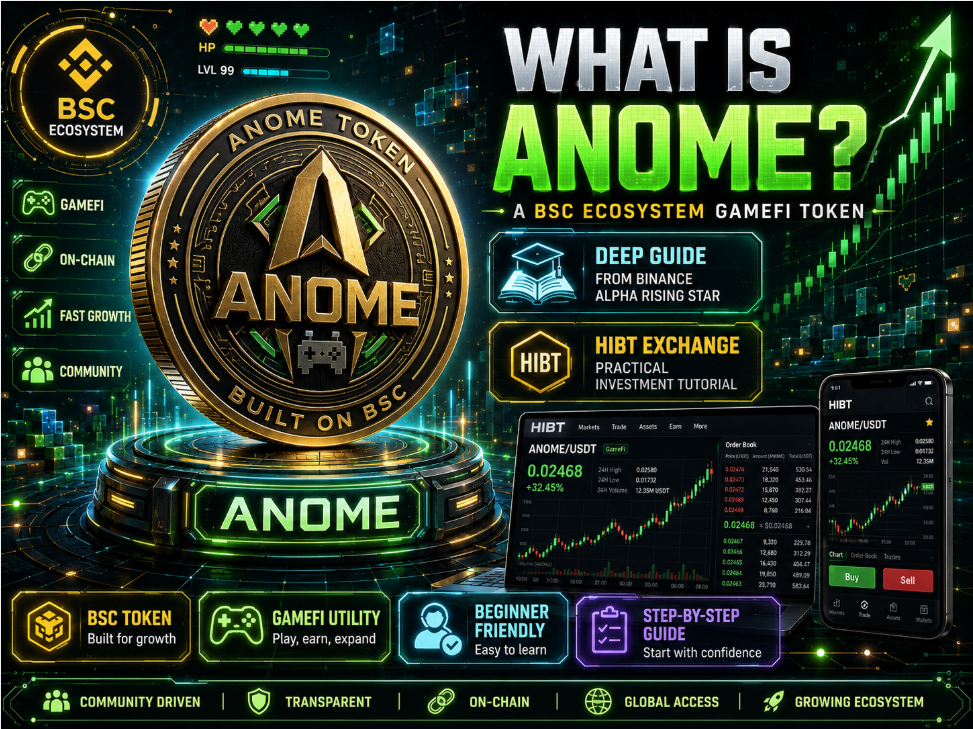
For readers who want to view real-time charts and order book depth directly, you can browse the ANOME/USDT trading pair real-time data. Note that Hibt’s unauthenticated static pages may not fully display the real order book; the page snapshot showed 24h high, 24h low, 24h vol, and 24h turnover as 0, so before formal trading you should rely on the authenticated real-time depth, best bid/ask, trade history, and trading page display.
On ecosystem data, the claim of "200,000 registered users and 21,000 DAU" needs to be treated with caution. A ChainCatcher analysis article stated that ANOME’s public beta had over 200,000 total users, roughly 21,500 DAU, with users mainly distributed across Vietnam, the Philippines, Indonesia, Germany, and Japan, and that it had already airdropped over 30,000 in-game NFTs. An ANOME Deck on Scribd also showed similar figures, mentioning approximately 203,100 total registered users and roughly 21,500 DAU as of September 26, 2024.
But such data mainly comes from project materials or media reprints and cannot fully equate to on-chain verifiable users. BNB Chain DappBay’s ANOME page showed no available data for Users, TXN, and other metrics under the opBNB network.
Therefore, the correct framing is:
The project or media materials claim ANOME once had over 200,000 registered users and approximately 21,000 DAU, but on-chain explorers and Dapp data pages cannot fully verify these off-chain user figures. Investors should treat this as project operations reference, not as definitive investment evidence.
User distribution in Southeast Asian markets like Vietnam, the Philippines, and Indonesia has two-sided implications for ANOME.
On the positive side, Southeast Asia has historically been a key user base for GameFi, P2E, and lightweight chain games. Projects like Axie Infinity and StepN benefited from user participation in emerging markets. If ANOME can attract these users with low-barrier NFTs, cards, quests, and yield mechanics, it could indeed achieve community growth.
On the negative side, Southeast Asian users are yield-sensitive, and retention often depends on whether they can make money. Once rewards decrease, token prices drop, or the gaming experience is insufficient, user churn can also be very fast. So ANOME’s real challenge is not "user acquisition," but "retention" and "monetization."
4. Complete Walkthrough: Buying ANOME on Hibt
If you decide to research ANOME and want to purchase ANOME/USDT through Hibt, follow the steps below.
Step 1: Register a Hibt account.
Open the Hibt website or app and go to the registration page. It is recommended to use a long-term stable email or phone number; do not use temporary emails. Hibt’s help center states that HIBT is a digital asset trading service platform registered in Canada in 2021, offering spot and derivatives trading.
After registration, immediately complete security setup:
Set a strong password.
Bind your email and phone number.
Enable Google Authenticator or another 2FA.
Set a fund password.
Enable an anti-phishing code.
Only log in through the official website, official app, or official channels.
If your region requires KYC, follow the Hibt page prompts to submit identity information. KYC typically involves ID photos, facial recognition, name, date of birth, and residential address. Review time varies by region, document quality, and platform workload, ranging from minutes to several hours. Do not submit identity information through Telegram DMs, unfamiliar customer service links, or third-party forms.
Step 2: Deposit USDT.
Before buying ANOME/USDT, you need USDT in your account. There are two common methods.
Method 1: On-chain transfer deposit.
If you already hold USDT on another exchange or in a wallet, you can choose Hibt’s USDT deposit address. Here you must pay close attention to the network type. ANOME is a BNB Chain ecosystem token, but when depositing USDT you are not limited to BSC; Hibt usually supports different networks by coin, such as TRC20, BEP20, ERC20, etc. What you need to do is ensure the network selected on the withdrawal platform matches the network shown on the Hibt deposit page exactly.
If you deposit USDT from an external wallet via the BSC chain, you generally select the BEP20 network. Never send ERC20 USDT to a BEP20 address, and never treat TRC20 USDT as a BSC chain deposit. If you select the wrong network, assets may be unrecoverable.
Method 2: Third-party or express buy-crypto.
This method is simpler for newcomers, but watch out for payment fees, exchange rate spreads, arrival times, and channel restrictions. Do not only look at the payment amount; look at how much USDT actually arrives.
For a first-time deposit, it is not recommended to transfer a large amount directly. You can test with 10 USDT or 20 USDT to confirm arrival, then deposit the formal amount after verification.
Step 3: Go to the ANOME/USDT trading page.
After logging into Hibt, search for ANOME in the markets or spot section, find the ANOME/USDT trading pair, or go directly to the ANOME/USDT real-time trading page.
After entering the page, first check:
Whether the current price is close to CoinGecko, CoinMarketCap, KuCoin, XT, and other platforms.
Whether 24h volume is normal.
Whether the best bid/ask spread is too wide.
Whether the order book depth is sufficient.
Whether recent trades are continuous.
Whether it just experienced a sudden pump or dump.
Whether there are abnormal long wicks.
Step 4: Choose limit order or market order.
The advantage of a market order is fast execution; the disadvantage is you cannot control the final fill price. For a volatile, small-cap token like ANOME, if the order book is thin, a market order may sweep through multiple price levels, causing the actual fill price to deviate significantly from the price you saw.
The advantage of a limit order is price control; the disadvantage is it may not execute immediately. For a first-time ANOME purchase, newcomers are recommended to use a limit order.
For example, if the current ask price is 0.020 USDT, you can place your order at 0.019, 0.018, or lower based on your plan and wait for execution. Missing one opportunity is not terrible; chasing a pump and being unable to stop-loss is dangerous.
Step 5: Control your first position size.
If you only have 100 USDT, the general recommendation is to observe first, or at most use 1 USDT to 5 USDT as an experience position.
If you have 1,000 USDT, consider a 10 USDT to 30 USDT observation position, with a maximum recommendation of 50 USDT.
If you have 10,000 USDT, do not go heavy on ANOME just because you have more capital. A more reasonable approach is to first test liquidity and trading plans with 100 USDT to 300 USDT in batches, and unless you thoroughly understand the unlock schedule, order book, and stop-loss rules, do not exceed 3%-5% of total assets.
Step 6: Check positions, P&L, and trade history.
After buying, you can view your ANOME position quantity, available balance, frozen balance, and estimated value on the Hibt assets page. In trade history, you can check each fill price, fill quantity, fee, and time.
Hibt’s spot fee page shows both Maker and Taker fees at 0.2%, with a minimum order size of approximately 5 USDT; refer to the actual page display.
It is recommended to record for every trade:
Entry time.
Entry price.
Entry amount.
Entry rationale.
Stop-loss level.
Take-profit target.
Exit conditions.
Post-trade review.
This helps prevent you from shifting from "planned trading" to "emotional holding."
Step 7: Set take-profit and stop-loss.
If Hibt currently supports trigger orders, conditional orders, or take-profit/stop-loss functions, you can set risk controls in advance. For a low-float, high-volatility token like ANOME, relying entirely on on-the-spot reactions is not suitable because when the market moves fast, the order book can thin out and prices can gap instantly.
Three strategies for reference:
Conservative: Sell the principal portion after a 30%-50% rise, keep the remaining position to observe.
Swing trading: Take profit in batches at resistance levels, for example 25%, 25%, 50% across three sells.
Defensive: Stop-loss when the price falls 20%-30% below entry with expanding volume; do not average down indefinitely.
Step 8: Sell ANOME and convert back to USDT.
If you want to exit in the future, you can select sell on Hibt’s ANOME/USDT page and convert ANOME back to USDT. When selling, limit orders are also recommended as the preferred method, especially when the order book is thin — avoid dumping large market orders directly onto the book.
After converting back to USDT, you can leave it on Hibt or withdraw to a personal wallet or another platform. When withdrawing, confirm:
The withdrawal coin is USDT.
The withdrawal network matches the receiving address.
If you select BEP20, ensure the receiving wallet supports BNB Chain USDT.
The address has no copy-paste errors.
Whether a Memo or Tag is needed.
Whether the fee and minimum withdrawal amount are reasonable.
Test with a small amount first, then withdraw the larger amount.
5. ANOME Price Trend and Outlook: When to Buy, When to Sell?
ANOME’s price action shows distinct new-token characteristics: the first wave of hype from Binance Alpha and multi-platform listings, followed by a pullback from highs, then entering a phase of low-level consolidation and event-driven moves.
CoinGecko shows ANOME’s all-time high at 0.1983** on **October 28, 2025**; its all-time low at **0.007344 on July 3, 2026. This means ANOME experienced a clear hype peak after launch, but the subsequent drawdown was very significant.
From a technical analysis perspective, newcomers should not draw ANOME’s support and resistance levels too precisely. Because for this kind of low-float, high-volatility asset, a single candle can slice through multiple levels.
A "zone-based" approach is more suitable:
First support zone: near the recent lows, i.e., the historical low area around $0.0073.
Second support zone: the pullback area after a volume bounce; if the price pulls back but volume shrinks, watch for absorption.
First resistance zone: the dense trading area after a recent volume-driven rally.
Second resistance zone: the prior high and historical trapped supply zone, especially the high area above $0.1.
If the price rebounds but volume cannot sustain expansion, it suggests insufficient buy-side interest.
If the price rises while exchange depth improves, holder count increases, and social media sentiment rebounds, short-term sentiment may strengthen.
If the price falls while volume expands and on-chain large transfers move to exchanges, be alert for distribution or a stop-loss cascade.
For more detailed technical indicators and algorithmic predictions, you can refer to Hibt’s ANOME price prediction tool, combining signals across multiple timeframes for decision-making. Hibt’s ANOME price prediction page displays current price, short-term forecast, long-term forecast, and ROI calculation modules, while explicitly stating that "all price predictions are generated based on user feedback" and labeling it "for reference only, not investment advice."
Four core variables will affect ANOME’s future price.
First, whether Binance Alpha and exchange hype can sustain.
Binance Alpha gave ANOME early exposure, but Alpha does not equal a Binance main spot listing. If ANOME can gain support from more exchanges in the future, liquidity will improve; if exchange hype fades, prices may continue to come under pressure.
Second, whether AnoMEME can genuinely create new demand.
Marketing materials mention that AnoMEME will turn Meme culture into playable, tokenizable on-chain assets deployed on BSC. If AnoMEME remains just a concept, the impact is limited; if it can actually attract projects and users to issue tradable game assets, it could bring new use cases for ANOME.
Third, whether DePIN partnerships like CyberCharge can deliver.
A GlobeNewswire project release mentioned that ANOME integrates with CyberCharge’s Charge-to-Earn model, where users earn CBS through real-world charging behavior and enter the ANOME ecosystem. This narrative is imaginative, but what truly affects token value is not the press release — it is hardware coverage, real users, conversion paths, capital, and retention data.
Fourth, how the remaining 97% of tokens unlock.
This is the most important variable. As long as the float is only 3%, future unlocks will always be potential overhead pressure. In the short term, a low float can create elasticity; in the long term, unlocks will test the project’s ability to absorb supply.
Therefore, ANOME price prediction cannot rely on candlesticks alone; you must simultaneously look at:
Unlock schedule.
Exchange trading volume.
Hibt order book depth.
On-chain holder changes.
NFT trading data.
Game DAU and retention.
Real social media engagement.
Whether ecosystem partnerships deliver.
6. Real Risks of Investing in ANOME and Risk Control Strategies
ANOME’s biggest risk is not that it lacks a story, but that it has too many stories and too much difficulty delivering.
First, future sell pressure risk from the low float.
ANOME’s current circulating supply is approximately 30 million tokens out of a total supply of 1 billion tokens, or 3%. This means how the remaining 97% of tokens unlock in the future will directly affect price. If team, ecosystem, marketing, investor, or market maker portions see concentrated releases while secondary market absorption is insufficient, prices could come under pressure.
Second, high FDV risk.
ANOME’s circulating market cap looks low, but its FDV is significantly higher. CoinGecko showed a circulating market cap of approximately $513,700 and an FDV of roughly $17.12 million at the time of query. If users only look at market cap and ignore FDV, they can easily underestimate future dilution risk.
Third, uncertainty around NFT "only go up" or "non-liquidated" mechanics.
DappBay’s description of ANOME emphasizes never-liquidated NFT collateral lending services. But in extreme market conditions, NFT prices will fall, users may exit in clusters, and the treasury may come under pressure. Without sufficiently transparent reserves, risk control models, buyback mechanisms, and audit reports, this kind of mechanism carries non-negligible uncertainty.
Fourth, insufficient product data verification.
Project or media materials mention ANOME has over 200,000 registered users and approximately 21,000 DAU, but BNB Chain DappBay’s ANOME statistics area has not yet displayed verifiable on-chain Users and TXN data. This shows investors cannot directly equate off-chain registration data with real on-chain activity.
Fifth, smart contract and audit risk.
BscScan shows ANOME’s contract source code is verified, but also notes no submitted contract security audit. For early-stage projects, source verification is a baseline, not a complete security guarantee. Users also need to pay attention to whether there is a third-party audit, permission management, contract upgrade authority, blacklist mechanisms, minting authority, treasury permissions, and other issues.
Sixth, exchange liquidity change risk.
CoinGecko shows ANOME has trading data on Hibt, PancakeSwap, XT, LBank, and other markets. But support for small-cap tokens on exchanges can change quickly; for example, LBank announced in February 2026 that it was suspending ANOME trading services at the project’s request. So newcomers should not assume all trading entry points will remain available; before buying, confirm whether the current platform supports trading, deposits, and withdrawals.
Seventh, platform account security risk.
Trading ANOME on Hibt reduces the operational complexity of on-chain approvals, gas fees, DEX slippage, etc., but the platform account itself also needs security protection. CoinMarketCap’s Hibt page shows Hibt claims 90% of user funds are stored in multi-sig cold wallets, with firewalls, intrusion detection, security audits, and a 24/7 risk control team safeguarding funds. Users should still enable 2FA, fund passwords, and anti-phishing codes themselves, and avoid clicking unofficial links.
For different risk tolerance levels, position sizes can be controlled as follows:
Conservative users: Do not buy ANOME; only observe data.
Light participation users: Within 1% of total assets.
Moderate risk users: 1%-3% of total assets.
High risk users: Maximum 5% of total assets.
Under any circumstances, it is not recommended to borrow money to buy ANOME, not recommended to use living expenses to buy ANOME, and not recommended to chase pumps because of Binance Alpha, community shilling, or short-term parabolic moves.
7. Summary and Action Plan: How Much Should I Invest, and What Should I Do Next?
ANOME is a BNB Chain ecosystem GameFi / NFTFi project worth researching, but it is not a low-risk asset.
Its strengths are:
It has a real BSC contract.
It has entered Binance Alpha’s radar.
It carries multiple narratives including GameFi, NFTFi, DeFi, AnoMEME, and CyberCharge.
The float is very low, creating large short-term price elasticity.
There is an ANOME/USDT trading entry on Hibt and other platforms.
Its risks are:
Circulating supply is only approximately 3%.
FDV is significantly higher than circulating market cap.
The remaining 97% of token releases carry potential future sell pressure.
NFT buybacks, non-liquidated lending, and other mechanisms need long-term validation.
Project real user data is not fully equivalent to on-chain verifiable data.
Exchange liquidity and listing status can change.
If you only have 100 USDT, it is recommended to not buy yet, or at most use 1 USDT to 5 USDT as an experience position. Your focus should be on learning how to read the ANOME/USDT order book, how to place limit orders, how to set stop-losses, and how to sell.
If you have 1,000 USDT, consider a 10 USDT to 30 USDT observation position, with a maximum recommendation of 50 USDT. This position is mainly for validating a trading plan, not for betting on a moonshot.
If you have 10,000 USDT, it is still not recommended to go heavy on ANOME. A more reasonable approach is 100 USDT to 300 USDT in batches, with a maximum of 3%-5% of total assets. The majority of funds should still be in more liquid, more transparent mainstream assets.
Short-term swing trading is suitable for people who can watch the screen, read the order book, and enforce strict stop-losses. The timeframe is typically hours to days, with the core being to follow Binance Alpha, exchange volume, and ecosystem news.
Long-term holding of ANOME is suitable for those who truly understand GameFi, NFTFi, and the BNB Chain ecosystem, and are willing to track project product progress, unlock schedules, and community retention. Long-term holding cannot rely on stories alone; it must rely on data.
After buying ANOME, check at least once a week:
Whether ANOME/USDT price has fallen below key zones.
Whether Hibt order book depth has deteriorated.
Whether 24h volume is consistently shrinking.
Whether BscScan holder count is increasing.
Whether large wallets show transfers or exchange inflows.
Whether NFT trading volume is growing.
Whether game users and community activity are genuinely active.
Whether new projects are using AnoMEME.
Whether the CyberCharge partnership has real hardware and user data.
Whether there are new unlock or exchange announcements.
If ANOME does not fit your risk profile, you can research higher-liquidity BNB Chain ecosystem assets on Hibt, such as BNB, CAKE, or other GameFi / NFTFi-related assets. Their explosive potential may be less than early small-cap tokens, but their information transparency and trading depth are usually more suitable for newcomers.
Ultimately, the right way to approach ANOME is not "see Alpha and apes in," but rather:
First verify the contract.
Then check float and FDV.
Then check Hibt order book depth.
Then assess unlock risk.
Finally, validate your trading plan with a minimal position size.
If you cannot accept a drawdown of more than 50%, do not go heavy on ANOME.
If you do not understand unlocks and FDV, do not go heavy on ANOME.
If you are chasing a pump just because of short-term gains, that is not investing — it is emotional trading.
Truly mature investors are not the ones most willing to buy, but the ones who best understand how to control losses.