
Opening: AI Tokens Are Everywhere—Why Does ALLO Deserve a Second Look?
In 2026, when people talk about AI concept tokens, beginners tend to fall into two extremes: one side says, “ChatGPT is so hot, AI coins must still have a chance”; the other side says, “AI + Crypto sounds like pure hype, and it always ends in bag-holding.” ALLO (Allora) sits right between these two views.
Allora is not a stock of OpenAI, ChatGPT, or any large-model company, nor is it an empty token that simply writes “AI” into its whitepaper. Its core positioning is a decentralized intelligence network: different machine learning models submit predictions within the same network, compete with each other, mutually calibrate, and the more accurate models are retained through on-chain incentive mechanisms.
This is why ALLO deserves standalone research. It is not building “another chatbot,” but trying to solve a fundamental problem in the AI industry: there are more and more intelligent models, yet they are isolated from each other, and users have a hard time judging which model is more reliable on a specific task.
Allora mainnet and the ALLO token officially launched on November 11, 2025. The official description frames it as a decentralized intelligence layer that combines multiple AI models into a stronger adaptive system. Subsequently, Binance listed Allora as the 58th HODLer Airdrops project and opened ALLO/USDT, ALLO/USDC, ALLO/BNB, and ALLO/TRY trading pairs.
But ALLO’s debut was not smooth. After listing, it suffered significant drawdowns due to airdrop selling pressure, low float / high FDV, and AI-sector sentiment swings. Yahoo Finance reported that ALLO dropped over 50% rapidly after going live on Coinbase and Binance; Bitget’s project analysis also noted that ALLO fell more than 70% in a short period shortly after listing.
So this article will not simply tell you “ALLO will definitely go up” or “ALLO is untouchable.” What we will solve are the five questions beginners actually care about:
- What exactly is ALLO?
- Does Allora’s tech have real substance?
- Could ALLO’s tokenomics leave retail as the bag-holder?
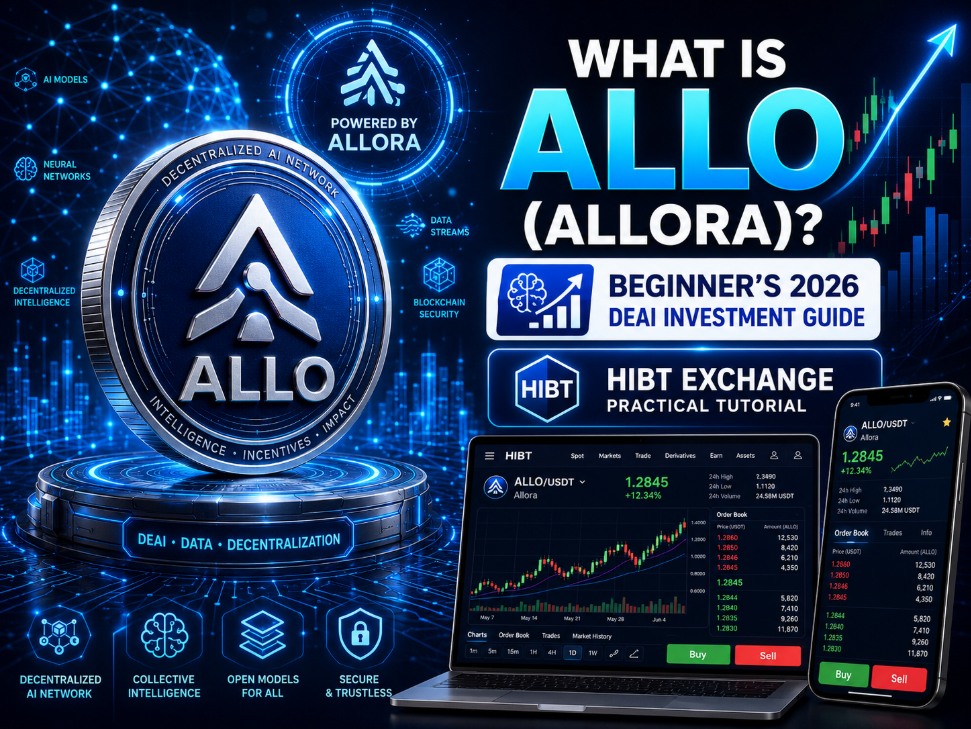
- How do I buy ALLO/USDT on HIBT?
- After buying, how do I manage risk and position sizing?
If this is your first time exploring the DeAI, remember one thing: Allora is not trying to become a centralized AI company, but an open network where AI models collaborate, compete, and are priced by the market.
1. What Is the Relationship Between ALLO, ChatGPT, and OpenAI?
1.1 What Is the Difference Between the Allora Network and OpenAI? What Problem Is “Decentralized AI” Actually Solving?
Many beginners, upon seeing ALLO, immediately ask: what is its relationship with ChatGPT? Is it a token issued by OpenAI?
The answer is clear: ALLO is not OpenAI’s token, nor is it an on-chain version of ChatGPT.
OpenAI’s typical model is a centralized large-model platform. Users send questions to a powerful closed-source model, which completes inference inside the platform. Users usually do not know how decisions are made, where training data comes from, how model weights are updated, and cannot participate in model revenue distribution.
Allora takes a different approach. It tries to build an open, collaborative AI network where different model providers contribute predictions or inference results. The network dynamically assembles more reliable outcomes based on historical performance, current tasks, and feedback from other participants. Allora’s official website defines it as a self-improving decentralized AI network that generates high-precision, context-aware predictions through community-built machine learning models.
The problem Allora aims to solve is officially called Siloed Machine Intelligence, which can also be understood as “model islands.” Today, a large amount of high-quality AI models, data, algorithms, and computing power are locked inside big companies or independent teams. Users have a hard time connecting these intelligence capabilities for use. Allora’s goal is to break such islands and allow different models, data, and compute resources to collaborate through a unified network.
More importantly, Allora does not ask users to choose a model themselves, but to define a goal. Binance Research’s explanation of Allora is: users do not need to select and manage models; they only need to state their objective, and the network will automatically coordinate multiple models to produce a better result.
This is Allora’s core difference:
- OpenAI is a centralized platform; users call one powerful model.
- Allora is a decentralized network; multiple models collaborate around the same goal.
- OpenAI is more like “one super-brain.”
- Allora is more like “an intelligence market composed of many models.”
Therefore, the investment logic for ALLO is not “ChatGPT is hot, so ALLO will be hot too,” but rather: if future AI applications need a more open, verifiable, and composable intelligence layer, DeAI networks like Allora may have a chance to become underlying infrastructure.
1.2 Is the ALLO Token Essential to the Allora Network? Could the Network Run Without It?
A key test of whether an AI token is pure hype is whether the token is genuinely embedded in network operations. If a project can run normally without its token, the token’s value can easily become pure speculation.
Allora’s ALLO token mainly serves four functions.
First, paying for inference. Binance Research notes that ALLO can be used to purchase inferences generated by the network—that is, inference or prediction results. Allora adopts a Pay-What-You-Want model, allowing consumers to pay based on their own assessment of service value.
Second, participating in Topic creation and network tasks. In the Allora network, a Topic can be understood as a specific task market, such as “predict ETH’s future price,” “assess the risk of a certain DeFi strategy,” or “generate a certain type of financial signal.” Participants need ALLO to enter the corresponding task system.
Third, staking and delegation. Reputers and Validators need to stake ALLO, and ordinary holders can also delegate ALLO to a Reputer or Validator to participate in network security and reward distribution.
Fourth, serving as a reward settlement medium. The contributions of Workers, Reputers, and Validators are rewarded with ALLO according to network rules. The official mainnet launch announcement also clarifies that ALLO is the native asset of the Allora network, used for coordination, governance, and incentives; model workers, Reputers, validators, and other contributors receive rewards based on their measurable impact on inference quality.
Why does the official team call ALLO an Intelligence-backed asset rather than an ordinary utility token? Because ALLO’s value narrative is not just “used to pay gas.” It is more like an economic index of the AI/ML model collaboration capability within the network. If more models, more applications, and more developers connect to Allora, ALLO’s demand and staking value could grow.
But beginners should note: this is only the token design logic, not a guarantee of price appreciation. What truly determines ALLO’s long-term value is whether Allora can generate real inference demand, not how many use cases are written in the whitepaper.
1.3 692M+ Inferences, 288K+ Workers, 55+ Topics—Are These Real Ecosystem Metrics or Inflated?
Allora’s official website displays network data including: 692M+ inferences generated, 288K+ Workers, 55+ Topics.
These numbers look impressive, but beginners cannot take them at face value. Because in DeAI projects, network activity may come from real developers and model contributors, or it may include testnet activity, incentive tasks, low-cost botting, and early airdrop farming.
To judge whether such data is meaningful, look at three dimensions:
First, is the data from mainnet or testnet? Testnet data can prove that people are participating, but it does not necessarily represent real paid demand. Allora mainnet launched on November 11, 2025, so paid calls, real Topic usage, and actual application integration after mainnet launch are what really demonstrate commercial value.
Second, do the inferences correspond to real applications? Simply generating a large number of predictions is not difficult; what is hard is whether these predictions are actually used by DeFi, AI agents, trading strategies, risk management, gaming, advertising, or other applications.
Third, is there continuous external application integration? Allora’s official website lists use cases including prediction price feeds, automated liquidity management, intelligent yield strategies, and AI agents, and also mentions ecosystem entry points such as PancakeSwap, Coinbase CDP AgentKit, and Drift.
So, these metrics cannot be simply interpreted as “all real revenue,” nor can they be dismissed as “all fake volume.” A more reasonable attitude is: they show that Allora already has a certain degree of network participation, but investors still need to continue tracking real call fees after mainnet, active Topics, effective Worker retention, and application revenue.
2. Where Is Allora’s Tech Actually Hardcore? Or Is It Just Whitepaper Concept?
2.1 What Is “Inference Synthesis”? Why Might Multiple Models Combined Be More Accurate Than a Single Model?
One of the most core concepts in Allora’s tech is Inference Synthesis.
You can think of it as: instead of trusting only one model, multiple models give answers to the same question. Then the network dynamically assigns weights to different models based on each model’s past performance, the current market environment, other models’ predictions, and Reputers’ evaluations, and finally synthesizes a more reliable result.
This corresponds to Ensemble Learning in machine learning. In reality, in tasks such as financial market prediction, weather forecasting, and risk assessment, a combination of multiple models is often more stable than a single model. The reason is that every model has biases: some are good at trending markets, some at choppy markets, some sensitive to short-term fluctuations, and some better suited to long-term signals. The value of combining models is to reduce the impact of a single model’s mistake on the overall result.
Allora’s official website describes the network mechanism as: a Topic coordinator sets the task, Worker models generate inferences, Reputers evaluate these inferences against real outcomes, and the final output is a more stable and accurate inference result than any single participant could produce.
This also involves Regret Minimization. Simply put, the network constantly observes: if we had trusted a certain model more in the past, would the result have been better? If a model has consistently lower error, its future weight should increase; if a model performs worse in certain scenarios, its weight should decrease. BingX’s explanation of Allora’s mechanism also mentions that the network assigns weights to models based on historical performance and real-time predictions through Regret Minimization, ultimately forming a weighted result more reliable than any single model.
For investors, you do not need to understand all the math formulas, but you need to understand one criterion: Allora’s technical value does not lie in “training the most powerful model itself,” but in “continuously finding more reliable model combinations for different tasks.”
2.2 How Do the Three Roles—Workers, Reputers, and Topics—Actually Collaborate?
The most important roles in the Allora network include Workers, Reputers, Validators, and Consumers. Ordinary investors do not need to become developers, but must understand the economic relationships between these roles, because this determines whether the ALLO token has real demand.
Workers are model contributors. They submit AI/ML inference results, such as a price prediction, risk score, or strategy signal. Allora Docs state that Workers provide AI/ML-powered inferences and receive rewards based on inference quality.
Reputers are evaluators. They compare Workers’ inference results with real outcomes and assess the quality of different models’ contributions. Reputers’ rewards are tied to their stake and evaluation accuracy.
Topics are task markets. Each Topic represents a specific objective, such as “predict BTC’s price tomorrow,” “assess an asset’s volatility,” or “optimize a certain liquidity strategy.” Allora’s official website shows that the network currently has 55+ Topics.
Validators are chain validators. Allora runs on Cosmos SDK and CometBFT Proof of Stake; Validators are responsible for maintaining chain security and consensus. Binance Research also notes that Allora is a chain built using Cosmos SDK and adopts CometBFT’s PoS/DPoS mechanism.
Consumers are the demand side. They can be DeFi protocols, AI agents, trading platforms, developers, or enterprise applications. They request inferences from the network and pay fees in ALLO. Allora Docs explicitly state that Consumers use the network’s native token to pay for inference requests.
The basic flow of this system can be understood as:
- Topic defines the task objective;
- Worker submits predictions or inferences;
- Reputer evaluates which Worker is more accurate;
- Validator maintains on-chain security and settlement;
- Consumer pays ALLO to obtain results;
- The network distributes fees and emission rewards to contributors.
If this cycle can run, ALLO has a true economic. If only Workers farm for rewards without real Consumers paying, ALLO can easily become a subsidy-driven token.
2.3 What Is zkML? How Does It Protect AI Model Intellectual Property from Being Copied?
Another noteworthy technical direction for Allora is zkML, or zero-knowledge machine learning.
Many professional machine learning teams are unwilling to open-source their models to a public network, for a simple reason: the model, training methods, and data processing logic are core competitive advantages. If connecting to the network means exposing model structure and parameters, professional teams have no incentive to participate.
Allora’s collaboration with Polyhedra is designed to solve this problem. Allora’s official blog announced in February 2025 a partnership with Polyhedra to enhance machine learning model verifiability through zkML technology. The official introduction states that Workers can generate a unique fingerprint for their ML models, store the hash on Polyhedra’s EXPchain, and thereby verify model authenticity and integrity without exposing data or model logic.
This matters to Allora because a DeAI network needs to attract not just retail and airdrop hunters, but real ML engineers, quant teams, DeFi strategy teams, and AI application developers capable of deploying models.
zkML’s significance for Allora is mainly threefold:
- Protect model intellectual property, preventing excellent models from being directly copied;
- Improve the credibility of inference results, reducing the room for “randomly submitting fake results”;
- Help high-value AI applications gain verifiability in on-chain scenarios.
Of course, zkML itself is still in rapid development and is not a silver bullet. It can improve verification capability, but it cannot guarantee that a model is accurate, nor can it replace real market demand. Investors should view zkML as one of Allora’s technical moats, not as a guarantee of price increase.
2.4 Allora Is Built on Cosmos SDK—What Are the Pros and Cons Compared to Ethereum-Based AI Projects?
Allora is a sovereign chain built on Cosmos SDK, not a simple ERC-20 project deployed on Ethereum. Binance Research explicitly states that Allora operates as a chain built using the Cosmos SDK and uses CometBFT’s Proof of Stake mechanism.
This has several advantages.
First, a sovereign chain can design incentive mechanisms more flexibly. Allora is not an ordinary DeFi contract; it needs to handle complex relationships among Workers, Reputers, Validators, Topics, Consumers, inference requests, and reward distribution. A sovereign chain makes it easier to customize the underlying layer for these mechanisms.
Second, performance and fees are more controllable. An AI inference network may require high-frequency requests, frequent settlement, and extensive participant scoring. If fully reliant on Ethereum mainnet, cost and throughput would be constrained.
Third, governance and parameter adjustments are more flexible. For example, reward distribution, Topic weights, inference request frequency, and Reputer staking mechanisms can all be designed at the chain level.
But the disadvantages are also obvious.
First, native EVM liquidity is inferior to the Ethereum ecosystem. Many users and funds naturally stay on EVM networks such as Ethereum, Base, BNB Chain, and Arbitrum.
Second, wallet and developer usability barriers are higher. Ordinary users are more familiar with MetaMask, while the Cosmos ecosystem often requires wallets such as Keplr.
**Third, cross-chain bridge security and liquidity become critical risk points.
To address this, Allora emphasized multichain from day one at mainnet launch, and announced official ALLO contract addresses on EVM, Base, BSC, and other networks, while supporting cross-chain access through routes such as Eureka Bridge, LayerZero OFT, and Stargate.
So, Allora’s strategy is: use Cosmos SDK at the base layer to maintain sovereignty and customization capability, and deploy the asset layer across multiple chains to access larger liquidity markets.
3. ALLO Tokenomics—Am I an Early Participant or the Bag-Holder?
3.1 In the Token Allocation Structure, Which Parts Could Dump in the Short Term?
ALLO’s maximum supply is 1 billion tokens. Allora’s official tokenomics shows the initial allocation includes: Network Emissions 21.45%, Foundation 9.35%, Community 9.30%, Ecosystem & Partnerships 8.85%, Allora Prime Staking Rewards 2.50%, Backers 31.05%, Core Contributors 17.50%.
What beginners need to watch most closely are two parts:
- Early Backers: 31.05%
- Core Contributors: 17.50%
These two items combined equal 48.55%, nearly half of the total supply. The official disclosure states that both portions have a 3-year lockup schedule: the first 12 months are locked, at which point 33% is unlocked, and the remainder is linearly released over the following 24 months.
Since ALLO mainnet launch and TGE occurred around November 11, 2025, the first major unlock window will likely fall around November 2026. In other words, from late 2026 to early 2027, the market will closely watch the first large unlock pressure from Early Backers and Core Contributors.
This does not mean that VCs and the team will definitely dump, but it does mean:
- The market will trade the unlock expectation in advance;
- When prices rise, early investors have stronger potential selling motivation;
- Low-float, high-FDV projects usually experience more volatility around unlocks;
- Retail cannot look only at current circulating market cap; they must also look at future supply release.
ALLO’s token structure is not uninvestable, but the unlock schedule cannot be ignored. If you only see “AI赛道,” “Binance listing,” and “strong tech,” but overlook the unlock pressure at the end of 2026, you can easily end up bag-holding in the middle-to-late stage of the cycle.
3.2 With Current Circulation of 200M and Market Cap of $100M, Where Does This Valuation Stand in the DeAI Sector?
Binance’s HODLer Airdrops announcement shows that ALLO’s circulating supply at Binance listing was 200,500,000 tokens, representing 20.05% of max supply; the maximum supply is 1,000,000,000 tokens.
This means ALLO was a classic low-float, high-FDV structure at launch. Current market data pages show the ALLO price roughly in the 0.30–0.35 range; real-time market cap and trading volume will change with market conditions. Binance’s market page shows ALLO/USDT at around $0.3433 and a fully diluted valuation of about $345 million; CoinGecko data also shows ALLO/USDT price around $0.33.
Compared with top AI projects, ALLO is still not a mega-cap asset. For example, CoinGecko shows Bittensor (TAO) at a market cap of about $2 billion, and Artificial Superintelligence Alliance (FET) at about $400 million.
This shows ALLO is in an awkward but also elastic range:
- Relative to TAO, it is not yet a top-tier AI valuation;
- Relative to small AI, it is no longer a pure low-cap early project;
- If Allora’s real adoption grows, there may be room for valuation upward revision;
- If demand falls short of expectations, FDV and unlock pressure will suppress price.
Beginners should not only look at “the market cap is not too high,” but also at “how many tokens are still unreleased in the future.” Low circulating market cap does not mean cheap, and high FDV does not mean uninvestable; the key is whether future released tokens have real demand to absorb them.
3.3 Can the Pay-What-You-Want Model Create Real ALLO Demand?
Allora’s Pay-What-You-Want model is quite interesting. It allows consumers to pay fees based on their own assessment of the inference service’s value. Binance Research explicitly mentions that ALLO can be used to purchase inferences generated by the network, and consumers can choose the fee they are willing to pay.
The advantage of this model is lowering the barrier to entry. Early applications can test Allora’s prediction capability at a lower cost without being blocked by a fixed high fee.
But it also has a hidden risk: if users can pay very little, can the network generate enough revenue to support Workers, Reputers, and Validators? If real usage fees are insufficient, network rewards will rely more on Network Emissions, i.e., token emissions.
Allora’s official tokenomics also states that Network Emissions, transaction fees, and inference request fees are the main reward sources for Workers, Reputers, and Validators.
So, ALLO’s long-term value depends on one key question:
Early stage relies on emissions to attract models and nodes; can real inference demand take over later?
If Allora’s prediction results are truly adopted by DeFi protocols, AI agents, trading strategies, and enterprise applications, then inference fees become a real demand source. Conversely, if most calls are only for farming rewards or botting data, ALLO will face pressure from “emissions > real revenue.”
3.4 What Does Allora’s “Bitcoin-Style Halving” in Network Emissions Mean for Long-Term Holders?
Allora’s Network Emissions design aims to attract Workers, Reputers, and Validators to join the network through token incentives in the early stage. Official tokenomics discloses that 21.45% of ALLO is allocated to Network Emissions to compensate Workers, Reputers, and Validators.
Logically, this is similar to the early subsidy model of many blockchain networks:
- Early stage has insufficient real revenue, so token rewards attract the supply side;
- After network scale expands, gradually rely on real usage fees and transaction fees;
- If adoption grows fast enough, emission pressure can be absorbed by demand;
- If adoption grows too slowly, emissions will create sustained selling pressure.
What beginners should focus on is not the single word “halving,” but three types of indicators:
- Inflation rate changes. How much new ALLO is added each year? Is the release speed declining?
- Usage fee growth. Are inference request fees growing?
- Staking ratio. Are more tokens being staked, or are more tokens flowing into exchanges?
If ALLO’s emissions decline while real revenue and staking demand rise, long-term holders are more likely to benefit. Conversely, if emissions continue, revenue is insufficient, and unlocks increase, price will be under pressure.
4. Why Did ALLO Crash Right After Listing? Is Now a Buying Opportunity or a Death Trap?
4.1 Is the Airdrop Crash an ALLO-Specific Problem, or a Common Disease of All VC Coins?
ALLO’s post-listing crash is not an isolated case, but a problem shared by many airdrop tokens, VC coins, and new narrative tokens in recent years.
Binance’s announcement shows that ALLO HODLer Airdrops allocated 15 million tokens, representing 1.5% of max supply, with another 20 million tokens allocated to future marketing campaigns; the circulating supply at listing was 200,500,000 tokens.
Airdrop users’ cost is usually very low, even close to zero. After listing, they naturally have a motive to sell for profit. Combined with low early float, limited market depth, and concentrated project hype, it is easy to see “listing = instant selling pressure.”
This type of issue has occurred in many projects. Airdrop projects such as GRASS, ZRO, STRK, and W have all experienced varying degrees of post-listing selling pressure and sentiment correction. ALLO’s special feature is that it AI, high FDV, Binance listing, Coinbase listing, multichain contracts, and VC background, so initial expectations were very high. Once selling pressure appeared, the drawdown was also magnified.
So, beginners should not simply interpret “post-listing crash” as project death, nor should they interpret “dropped 60%” as cheap. What really matters is:
- Has airdrop selling pressure been fully released?
- Does the project still have real development progress?
- Is on-chain activity sustained?
- Is exchange liquidity improving?
- Has the market already priced in the unlock expectation at the end of 2026?
If there are no answers to these questions, so-called “bottom-fishing” is more like gambling.
4.2 At the Current Price of ~$0.30, Where Does It Stand Technically?
As of early July 2026, public market data shows ALLO roughly fluctuating in the 0.30–0.35 range; real-time prices will change with the market. TradingView and Binance market pages show ALLO/USDT recently fluctuating around $0.33.
From a technical analysis perspective, a new token’s candlestick chart has limited reference value. Because ALLO’s listing time is short, the historical cycle is incomplete. Support and resistance levels come more from the early post-listing, psychological price levels, and volume, rather than multi-year market structure.
Beginners can focus on a few zones:
- ~$0.75: If this was an important post-listing trading zone or support zone, after breaking down it tends to become a resistance level.
- 0.30–0.35 range: The current active trading zone, suitable for observing long-short turnover.
- ~$0.25: Psychological support and short-term sentiment dividing line.
- 0.15–0.20 range: If the market goes into extreme panic, this could become a deeper defense zone.
But note: technical levels are not ironclad. New token prices can easily break so-called support, and can also be rapidly pumped by an exchange campaign, ecosystem partnership, or market rebound. Assets like ALLO are more suited to batch planning, not “all-in at one price.”
4.3 What Catalysts Are Needed for Community Sentiment to Shift from Neutral to Positive?
ALLO’s biggest current problem is not the lack of a story, but that the market needs to see the story turn into data.
Potential catalysts that could push sentiment higher include:
- New high-quality Topics going live;
- More DeFi protocols integrating Allora prediction signals;
- AI agent projects calling Allora inference capabilities;
- Growth in Allora Prime Staking data;
- Growth in mainnet real inference fees;
- More exchanges or wallets supporting ALLO;
- zkML verification capability going live;
- Substantive partnerships with ecosystem applications on Base, BNB Chain, Solana, Monad, etc.;
- The market completing sufficient turnover before the end-of-2026 unlock.
Allora’s official website already lists application directions such as prediction price feeds, automated liquidity management, and intelligent yield strategies, and mentions some ecosystem partnership entry points. But investors need to continuously judge whether these partnerships are “brand exposure” or “real usage.”
Compared with AI/DeAI projects such as Kite, Bittensor, Fetch.ai, and Virtuals, Allora’s differentiator lies in model coordination and predictive intelligence, not general-purpose large models, AI agent launch platforms, or compute networks. It must prove itself on “more accurate, more stable, and easier to integrate prediction results.”
4.4 As a New Token That Launched in November 2025, ALLO’s Price History Is Too Short. How Should I Assess Risk?
ALLO is a new token; this itself is a risk.
New token investments have several typical problems:
- Price history is too short, so technical analysis reliability is low;
- Liquidity may be concentrated on a few exchanges;
- Large orders can easily move the price;
- Early holder cost bases vary enormously;
- Airdrops, market making, marketing, and unlocks all cause volatility;
- Every project announcement can trigger emotional swings.
So, ALLO cannot be allocated like a mature asset such as BTC or ETH. For beginners, a more reasonable principle is:
- Only participate with small capital that you can afford to lose entirely;
- Do not borrow money to buy ALLO;
- Do not use living expenses to buy ALLO;
- Do not go all-in just because of the words “AI赛道”;
- Do not chase after a single-day pump;
- Do not ignore the unlock window at the end of 2026.
If you are genuinely bullish on Allora, you can participate with a small position, batch entries, and long-term observation, rather than treating it as a get-rich-quick tool.
5. Complete Practical Guide to Buying ALLO on HIBT Exchange
5.1 Why Choose HIBT to Buy ALLO? What Do Compliance and Security Mean for Beginners?
HIBT has issued a “New Token Listing: ALLO (Allora)” announcement. The announcement shows the listing trading pair is ALLO/USDT, the token type is BSC, deposits are already open, trading opened at 13:00 on December 2, 2025 (UTC+8), and withdrawals opened at 16:00 on December 3, 2025 (UTC+8).
For beginners, the advantage of buying ALLO on HIBT is that the process is relatively straightforward: first deposit USDT, then enter the ALLO/USDT spot trading pair and place an order. No need to cross-chain yourself, find a DEX, or verify contract authenticity.
Regarding the platform itself, third-party review materials state that HIBT was founded in 2021, registered in Canada, holds US and Canadian MSB-related licenses and Australian AFS-related compliance endorsements, and covers spot, derivatives, wealth management, and quantitative strategy functions. CoinGecko’s exchange page shows HIBT as a centralized exchange registered in Canada, listing hundreds of tokens and trading pairs.
On the security side, third-party review materials mention that HIBT supports 2FA, multisig, cold storage, and Proof of Reserves mechanisms. But no centralized exchange equals zero risk. For beginners, the meaning of compliance and security mechanisms is not “guaranteed profit,” but reducing account risk, deposit/withdrawal risk, and platform custody risk.
In addition, HIBT covers not only the DeAI but also Layer 2 scaling concept tokens. If you want to learn about representative projects in the Layer 2, you can first read What Is OP to compare the difference in ecosystem infrastructure positioning between Optimism, which solves Ethereum scaling, and Allora, which solves AI model collaboration.
5.2 HIBT Registration and KYC: What If My ID Photo Keeps Failing?
Before buying ALLO, it is recommended to complete HIBT registration, KYC, and security settings first.
Step 1: Register an account. You can register using email or mobile number. Do not reuse passwords from other websites; it is best to use a password manager to generate a strong password.
Step 2: Complete verification code verification. The verification code is only for your own login or registration confirmation. Do not tell it to anyone. Anyone claiming to be customer service, a project team member, or an airdrop assistant who asks for your verification code is likely a scammer.
Step 3: Enter the identity verification page. Upload your ID, passport, or other supported document as required by the page, and complete facial recognition.
If your ID photo keeps failing, common reasons include:
- Photo is reflective;
- Document corners are not fully captured;
- Text is blurry;
- Document is expired;
- Name or document information does not match the entered information;
- Facial recognition environment is too dark;
- Wearing a hat, sunglasses, or mask;
- Network interruption caused upload failure.
The solutions are simple:
- Take photos in a place with even lighting;
- Make sure all four corners of the document are complete;
- Do not use beauty filters or filters;
- Document information must match registration details;
- Keep a frontal face, no obstruction, during facial recognition;
- If you fail multiple times, switch phones or browsers and try again.
Review times may range from a few minutes to 24 hours, depending on HIBT’s current system, the user’s region, and document completeness. After completing KYC, it is recommended to immediately do four security settings: bind Google Authenticator, set a fund password, enable an anti-phishing code, and enable a withdrawal address whitelist.
5.3 Depositing USDT to HIBT: Should I Choose ERC20 or TRC20?
The most common path for beginners to buy ALLO is to first deposit USDT to HIBT, then use USDT to buy ALLO.
When depositing USDT, the most critical thing is to choose the correct network. Common networks include ERC20, TRC20, BEP20, etc. HIBT’s official ALLO announcement states the ALLO token type is BSC, but this does not mean you must use BSC when depositing USDT. For USDT deposits, you should follow the networks displayed on HIBT’s deposit page.
Generally:
- ERC20 is the Ethereum network, with strong security and compatibility, but fees are usually higher.
- TRC20 is the Tron network, with faster arrival and usually lower fees, suitable for small USDT transfers.
- BEP20 is the BNB Chain network, with lower fees too, but you must confirm whether HIBT supports USDT deposits on this network.
The most important principle is: the network selected on the withdrawal platform must exactly match the network of the HIBT deposit address.
For example, if you select a USDT-TRC20 deposit address on HIBT, then when withdrawing from another exchange, you must also choose TRC20. You cannot send ERC20 USDT to a TRC20 address, nor can you send BSC assets to an unsupported network. If the chain is wrong, assets may be unrecoverable.
Before depositing, it is recommended to operate as follows:
- First confirm the token is USDT;
- Then confirm the network;
- After copying the address, verify the first and last 6 characters;
- Do a small test deposit first;
- After arrival, transfer a larger amount;
- Do not use screenshots to recognize addresses; prioritize copy-paste;
- Do not click “deposit links” sent by strangers.
5.4 Finding the ALLO/USDT Trading Pair on HIBT: Should Beginners Use Market Orders or Limit Orders?
After USDT arrives, you can enter HIBT’s spot trading page.
The basic flow is as follows:
- Open the HIBT App or web interface, and enter the “Spot” or “Trade” page.
- Enter “ALLO” in the trading pair search box.
- Select the ALLO/USDT trading pair.
- Confirm that the current page is “Buy ALLO,” not “Sell ALLO.”
- Choose the order type: Market Order or Limit Order.
- Enter the purchase amount or quantity.
- Confirm the price, quantity, fee, and slippage, then submit the order.
- After execution, check your ALLO holdings in the spot account or assets page.
What beginners most easily struggle with is market orders vs. limit orders.
Market orders have the advantage of immediate execution, suitable for small test amounts and quick buys. The disadvantage is that during sharp market fluctuations, slippage may occur; the actual execution price may not exactly match the price you see.
Limit orders have the advantage of letting you control the buy price. For example, if you are only willing to buy ALLO at 0.30 USDT, you can place a limit buy at 0.30. The disadvantage is that if the price does not reach your level, it will not execute.
If you are buying ALLO for the first time, it is recommended to first use a small market order to familiarize yourself with the process. After you understand volatility and the order book, then use limit orders for batch buying. Do not place a large order on your first attempt, and certainly do not use a large market order to chase a sudden pump.
5.5 After Buying, How Do I Set Stop-Loss and Take-Profit? Does HIBT Support Stop-Loss in Spot Trading?
After buying ALLO, the most important thing is not to stare at the price, but to first write down your exit rules.
If HIBT’s current spot page supports stop-loss/take-profit, conditional orders, or scheduled orders, you can select the corresponding function on the spot trading page and set the trigger price and order price. Specific function names may vary by version; follow the actual HIBT page.
Beginners can refer to three simple rules:
- Conservative: After buying, reduce position or stop loss if the price drops 10%–15%.
- Standard: After buying, stop loss if the price drops 15%–20%.
- Long-term observation: Only invest a very small position, no short-term stop-loss, but set a maximum loss amount.
For a high-volatility new token like ALLO, trailing stop-loss is not necessarily suitable for all beginners. The advantage of trailing stop-loss is that it can lock in some profits as the price rises; the downside is that during violent volatility, you may be stopped out by a short-term wick. If you are not familiar with the feature, ordinary limit take-profit and fixed stop-loss are more stable.
It is recommended to set at least three prices after buying:
- Stop-loss price: At what drop does it mean my judgment was wrong?
- First take-profit price: At what rise should I sell part of my principal?
- Observation price: At what breakout does it suggest the trend may be changing?
If you do not have these prices and just “buy first, think later,” it is easy to panic when the price falls and become greedy when the price rises.
5.6 Should Large ALLO Holdings Stay on HIBT or Be Moved to a Self-Custody Wallet?
Asset custody can be divided into two types: exchange custody and self-custody wallet.
Keeping it on HIBT has the advantage of convenience for trading, fast buying and selling, and direct use of platform features. The disadvantage is that you need to trust the platform’s custody system, and account security depends on your login protection, 2FA, anti-phishing awareness, and platform risk control.
Moving to a self-custody wallet has the advantage that private keys are in your own hands. ALLO is a multichain asset; the official mainnet launch announcement disclosed its EVM, Base, and BSC contract addresses, and also supports Allora Chain and cross-chain bridges. If you use the Cosmos ecosystem, you can pay attention to wallets such as Keplr; if you use EVM networks, you can manage ALLO on the corresponding chain through MetaMask. Before any operation, you must confirm that the contract address comes from an official source; do not copy unfamiliar contracts from community groups.
General recommendations:
- Small short-term trading funds can stay on HIBT;
- Large long-term positions can be gradually moved to a self-custody wallet;
- Do a small test withdrawal first;
- Do not screenshot your seed phrase, upload it to cloud storage, or send it to anyone;
- Do not connect to unfamiliar DApps;
- Do not authorize unknown contracts;
- Regularly check wallet approvals and revoke unnecessary permissions.
For beginners, the safest principle is not “all on exchange” or “all in wallet,” but layered management based on amount, purpose, and operational ability.
6. After Buying ALLO, What Can You Do Besides Waiting for the Price to Rise?
6.1 Can ALLO Be Staked? How Do I Participate in the Allora Prime Staking 2.5% Reward Pool?
Allora tokenomics shows that Allora Prime Staking Rewards account for 2.50% of max supply, used to support network security and incentivize early contributors.
Ordinary users can participate in the Allora network through two main staking-related paths:
First, delegate to a Reputer. Allora Docs mention that users can delegate stake to a Reputer, thereby participating in network health and performance.
Second, delegate to a Validator. Validators are responsible for maintaining consensus and security of Allora Chain, and users can participate in security yield through staking or delegation, depending on the official wallet, staking portal, and current network rules.
But staking is not risk-free yield. You need to pay attention to:
- Is there a lock-up period?
- Is there a redemption waiting period?
- Is there slashing risk?
- Does the yield come from real fees or token emissions?
- Is the staking page an official portal?
- Is the wallet authorization secure?
If you are a beginner, it is recommended to first try with a small amount. Do not immediately stake all your ALLO, because staking may reduce liquidity, and if the market drops rapidly, you may not be able to sell in time.
6.2 Does HIBT Have ALLO Wealth Management Products or Flexible Mining?
If HIBT subsequently supports ALLO wealth management, flexible, fixed, or staking products, you can look in the App or web interface under Earn, Wealth Management, Staking, or Activity Center sections.
When checking, focus on a few pieces of information:
- Product type: flexible or fixed;
- Yield source: platform subsidy, on-chain staking, market-making income, or campaign reward;
- APY: is it floating?
- Redemption rules: T+1, T+3, or locked until maturity;
- Risk disclosure: is principal protected, is loss possible?
- Quota limits: is there a minimum or maximum?
- Does it support early redemption?
If the yield is significantly higher than the market average, you must be more cautious. High yields usually correspond to high risks; do not treat wealth management products as bank deposits.
6.3 Do You Need to Write Code to Become a Worker? Can Ordinary Investors Get a Share of Technical Participation?
Becoming an Allora Worker usually requires certain technical skills. Allora Docs’ Worker tutorials include using Docker, building inference Workers, deploying price prediction Workers, and configuring models. The official tutorial even provides an example of building an ETH price prediction node.
This shows that Worker is not something you can participate in with a single click. It is more suitable for:
- Machine learning engineers;
- Quantitative trading teams;
- DeFi data teams;
- Developers who can deploy servers;
- Technical users capable of maintaining models and data sources.
Ordinary investors without a technical background also have several participation paths:
- Hold ALLO and observe ecosystem growth;
- Participate in the network through official staking or delegation mechanisms;
- Participate in community governance voting;
- Track the growth of high-quality Topics;
- Use applications that integrate Allora;
- Configure spot positions through exchanges such as HIBT.
Do not, for the sake of “earning Worker rewards,” casually download unfamiliar scripts, run unknown node programs, or import your wallet private key into unidentified tools. Technical participation can indeed yield rewards, but the security risks are also higher.
7. ALLO Investment Strategy and Position Management
7.1 DeAI Sector Allocation Advice: What Percentage of My Crypto Portfolio Should ALLO Be?
ALLO is a high-risk emerging-sector asset and is not suitable as a core position.
For ordinary beginners, ALLO accounting for 3%–5% of total crypto assets is already not low. If your risk tolerance is weak, you can control it to 1%–3%. Only when you deeply understand Allora’s technology, token unlocks, ecosystem progress, and can withstand large drawdowns should you consider raising it above 5%.
A more稳健 portfolio could be:
- BTC / ETH: Core position, used to reduce portfolio volatility;
- Stablecoins: Retain liquidity, wait for opportunities;
- Platform tokens or mainstream: Medium-risk allocation;
- ALLO / DeAI new tokens: Small proportion, high-risk position;
- Meme or ultra-low-cap tokens: Very low proportion or no participation.
ALLO’s opportunity comes from the DeAI narrative, model coordination network, mainnet application growth, and the long-term AI + Crypto trend. Its risks come from unlock selling pressure, low float / high FDV, uncertain real demand, sector competition, and new token liquidity volatility.
The core principle of position management is: even if ALLO goes to zero, it cannot affect your life and core strategy.
7.2 DCA vs. Lump-Sum Bottom-Fishing: Which Suits ALLO’s Current Price Level?
ALLO has a short listing time, large price volatility, and an important unlock window at the end of 2026. Therefore, for most beginners, batch dollar-cost averaging (DCA) is more suitable than a one-time lump-sum buy.
A simple plan is:
- Buy a fixed small amount every week or every month;
- Total investment does not exceed the planned position limit;
- Do not chase on a big pump;
- On a big dump, only add according to plan, not emotionally double down;
- Reduce adding frequency around unlocks;
- If it breaks below your own risk line, resolutely execute stop-loss.
One-time lump-sum buying is only suitable for three situations:
- You have fully researched the project;
- You see the price complete a clear pullback and show rebound confirmation;
- You have a clear stop-loss point and are willing to accept failure.
The most dangerous thing for beginners is not buying wrong, but having no plan. For an asset like ALLO, the worst scenario is: “it dropped, I think it’s cheap, so I add; it dropped again, I think it’s even cheaper, so I add again; in the end, my position gets heavier and heavier, and my mindset gets worse and worse.”
7.3 The Five Most Common Mistakes Beginners Make When Investing in ALLO
Mistake 1: All-in on ALLO, ignoring the unlock schedule. ALLO’s Backers and Core Contributors combined account for nearly half, with a 33% unlock arrangement after 12 months. If you only look at the AI narrative and not the unlocks, it is easy to overlook future supply pressure.
Mistake 2: Treating the airdrop crash as the “absolute bottom.” A post-listing crash only shows that early selling pressure was released; it does not mean there is no room for further decline. Low-float, high-FDV projects can drop a lot and still not be cheap.
Mistake 3: Chasing pumps and panic-selling, trading on emotion. ALLO can pump quickly on a single partnership announcement, and can also drop quickly on unlocks, market corrections, or AI-sector cooling. People without a plan are most likely to buy at the peak of hype and sell at the bottom of panic.
Mistake 4: Confusing Allora with other AI projects. Allora is not OpenAI, not Bittensor, and not Kite. Its core is model coordination, inference synthesis, predictive intelligence, and the Topic mechanism. Before buying, confirm that you are buying ALLO/USDT, not another AI token with a similar name.
Mistake 5: Keeping large assets on an exchange long-term without security backups. If you are only short-term trading, you can leave it on the exchange; if it is a medium-to-long-term large position, consider self-custody, splitting positions, and security backups. Do not put all assets in one account.
For investors uncertain about the risk of a single AI token, you can also consider diversifying through an index approach to reduce single-project black swan risk. For example, learn about What Is QQQB to see how crypto index assets can help you participate in industry growth without betting on a single sector.
Conclusion: Is ALLO Right for You? A Decision Checklist to Help You Decide
ALLO is not an ordinary AI concept token. Behind it are a mainnet, a token economic model, a Workers/Reputers/Topics architecture, a Cosmos SDK sovereign chain, listings on platforms such as Binance, and a clear DeAI narrative.
But ALLO is by no means a low-risk asset. It faces new token volatility, airdrop selling pressure, unlock pressure, FDV valuation, real demand verification, DeAI sector competition, and technical落地 uncertainty.
Before deciding whether to buy, you can use the self-test checklist below to judge:
- Do I understand that ALLO is not an OpenAI stock, nor a ChatGPT token?
- Do I know that Allora’s core is model coordination and inference synthesis?
- Do I understand the basic mechanisms of Workers, Reputers, and Topics?
- Can I withstand ALLO dropping another 30%–50%?
- Do I know that important unlock pressure may appear at the end of 2026?
- Am I willing to track Allora’s Topic growth, Worker count, and real inference demand?
- Is my ALLO position controlled within 3%–5% of my total crypto assets?
- Do I have a clear stop-loss, take-profit, and batch plan?
If most answers are “Yes,” you can treat ALLO as a small-proportion observation position in the DeAI sector.
If most answers are “No,” or if you only want to rush in because “AI is hot,” “Binance listed it,” or “it dropped a lot,” then the better choice is to observe first and not rush to buy.
ALLO’s long-term opportunity lies in: it may become the infrastructure for AI model collaboration and on-chain predictive intelligence.
ALLO’s core risk lies in: real demand still needs verification, token unlock pressure is clear, and new token volatility is extreme.
Final reminder: This article is for informational reference only and does not constitute investment advice. Cryptocurrency investment carries high risk and may result in total loss of principal. ALLO is a newly listed asset with extreme price volatility. Past performance does not indicate future returns. Mentioned exchange functions, trading pairs, wealth management products, staking rules, and token information are subject to the latest official version. Please be sure to DYOR before investing and make independent judgments based on your own risk tolerance.