
Risk Disclosure: This article is compiled from public information and market materials for educational and research purposes only. It does not constitute investment advice. MSTRB belongs to a category of tokenized securities / stock-mirroring assets — it is not equivalent to an ordinary cryptocurrency, nor is it the same as directly holding US stock. Related products may carry multiple layers of risk involving the issuer, custodian, regulatory jurisdiction, liquidity, and de-pegging. Always independently verify platform rules and applicable law before investing.
Many beginners who first see the ticker "MSTRB" instinctively treat it like a newly listed altcoin — checking the chart, the percentage gain, community hype, and whether market makers are pumping it. That instinct is wrong from the start.
MSTRB isn't a native crypto asset like NES, SOL, or ETH. It isn't the gas token of some blockchain, and it isn't the governance token of an independent Web3 project. The more accurate way to understand it is as an on-chain mirrored product tracking MSTR stock — essentially, "a shadow of a stock."
Breaking down the letters isn't complicated:
- MSTR: the US stock ticker for Strategy (formerly MicroStrategy)
- B: generally understood as a suffix used by bStocks-type products, indicating it belongs to an exchange's tokenized stock series
- MSTRB: an on-chain tradable asset whose price is tied to the performance of MSTR stock
So the first question to ask about MSTRB isn't "does this token have an ecosystem" — it's:
- What exactly is the company behind MSTR?
- How does a tokenized stock's price actually track the real stock?
- When you buy MSTRB, are you getting stock ownership, or just price exposure?
- If Bitcoin drops, how does that affect MSTR and MSTRB?
- If something goes wrong with the issuer or the exchange, how is your asset protected?
This article walks through these questions to help beginners understand MSTRB's underlying logic, investment case, buying process, and core risks.
I. Clearing Up a Common Misconception: MSTRB Isn't a New Token — It's "A Stock's Shadow"
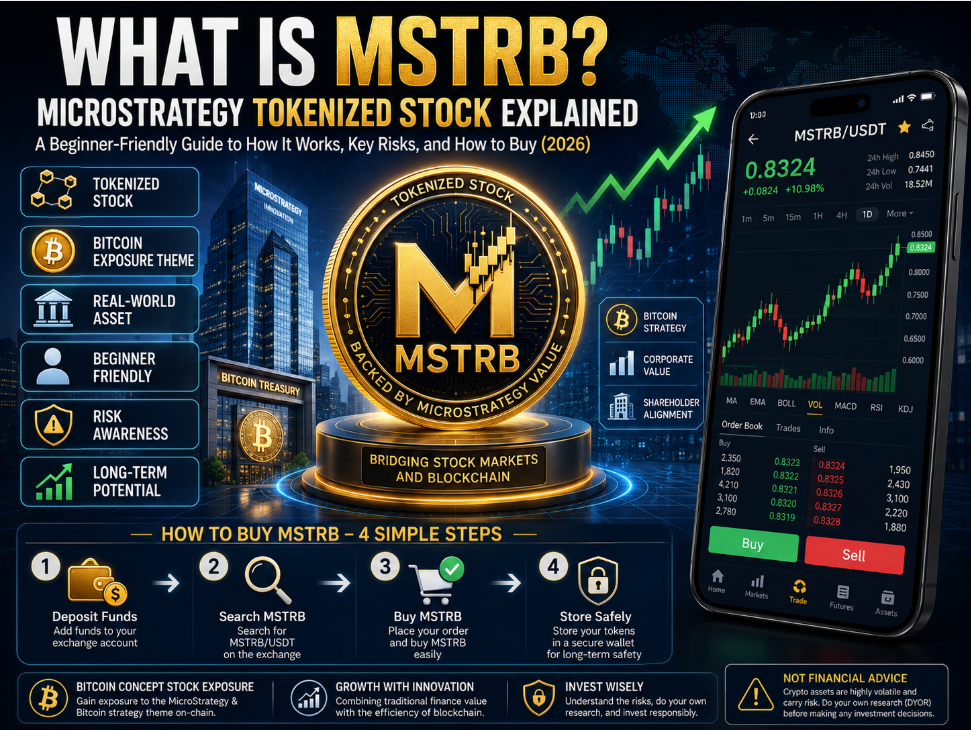
In crypto markets, most people default to thinking about every asset through a "coin" lens.
See SOL, and you think blockchain ecosystem, gas fees, validators, staking, developer activity. See NES, and you think AI blockchain, tokenomics, node incentives, unlock pressure. See a memecoin, and you think community sentiment, trading hype, short-term speculative flows.
MSTRB doesn't follow that logic.
MSTRB's core value isn't "native on-chain value" — it's "a price mirror of an off-chain stock asset." What matters here isn't whether some blockchain has an ecosystem, but how the publicly traded company Strategy is performing.
This creates at least three fundamental differences between MSTRB and an ordinary cryptocurrency.
First, the price source is different.
A typical blockchain token's price is generally driven by on-chain ecosystem activity, market sentiment, liquidity, project progress, and macro cycles. MSTRB's core anchor, by contrast, is MSTR stock. In other words, what MSTRB is actually tracking is the market price of a publicly listed US company — not the intrinsic economics of some on-chain protocol.
Second, the nature of the rights involved is different.
When you buy SOL, you hold a native asset of the Solana network. When you buy ETH, you hold a native asset of the Ethereum network. When you buy MSTRB, you generally do not become a registered shareholder of Strategy, and you likely don't get voting rights, the ability to participate in shareholder meetings, or full dividend rights. What you're more likely getting is economic exposure to the price of MSTR stock.
Third, the risk structure is different.
A typical cryptocurrency mainly carries smart contract risk, project risk, exchange risk, on-chain liquidity risk, and market volatility risk. MSTRB stacks additional layers on top of that: equity market risk, tokenization-issuer risk, custody risk, regulatory risk, and peg-mechanism risk.
So why would an exchange tokenize stocks on-chain instead of just letting you buy US equities directly?
There are three main reasons.
First, lowering the barrier to entry. Many users don't have a US brokerage account, or trading US stocks is cumbersome in their region. Tokenized stocks let them get exposure to US equity prices using assets like USDT, within an exchange interface they're already familiar with.
Second, extending trading hours. Traditional US equities trade only during fixed market hours, while crypto markets run 24/7. Tokenized stock products attempt to move US equity price exposure on-chain and onto exchanges, letting users trade across a much wider time window.
Third, meeting crypto users' portfolio needs. Many crypto users already hold USDT, BTC, ETH, and similar assets, and want exposure to stocks like Tesla, Nvidia, Apple, or Strategy without leaving the exchange. Tokenized stocks meet exactly that demand.
But this raises a core issue: convenience doesn't mean risk-free. The more a product looks like a stock while trading like a crypto asset, the more important it is for beginners to understand exactly what it is.
II. What Company Is Actually Behind MSTRB?
To understand MSTRB, you first need to understand the company behind MSTR: Strategy.
Strategy was formerly known as MicroStrategy, a long-established enterprise business intelligence and data analytics software company. It wasn't originally a crypto company at all — it was a traditional tech company built around enterprise BI, data analytics, and software services.
What truly changed how the market perceived the company was its decision, starting in 2020, to aggressively accumulate Bitcoin and gradually shift its corporate strategy toward becoming a "Bitcoin treasury company."
Later, MicroStrategy formally rebranded as Strategy, emphasizing its position as one of the earliest and largest Bitcoin treasury companies in the world. In other words, when the market discusses MSTR today, many no longer view it as an ordinary software stock — they view it as a "leveraged Bitcoin proxy stock."
As of late May 2026, Strategy's publicly disclosed Bitcoin holdings exceeded 840,000 BTC. That's an enormous position, meaning the company's sensitivity to Bitcoin's price is far higher than that of a typical listed company.
So does buying MSTRB indirectly amount to holding Bitcoin?
The answer is: partially true, but not a complete equivalence.
Why partially true?
Because Strategy's core asset is Bitcoin, and the company's market cap and MSTR's stock price are heavily influenced by BTC's price. When Bitcoin rallies sharply, the market typically re-rates the value of Strategy's holdings, and MSTR's stock price can be amplified upward. If MSTRB tracks MSTR stock effectively, it benefits accordingly.
Why not a complete equivalence?
Because MSTR isn't spot Bitcoin. It's a publicly listed company, and beyond its BTC holdings, it also includes:
- Its software business
- Debt structure
- Convertible bonds
- Preferred stock
- Equity financing
- Management strategy
- The market's pricing of a net-asset-value premium or discount
- Overall risk appetite in the US equity market
- The effects of regulatory and accounting treatment
In other words: buying spot BTC exposes you primarily to the price of BTC itself. Buying MSTR stock exposes you to "BTC price + the company's capital structure + market valuation premium + management's financing strategy." Buying MSTRB adds yet another layer on top of that — the risk of the tokenized-securities issuance and pegging mechanism itself.
So MSTRB is neither Bitcoin nor an ordinary US stock — it's "on-chain price exposure to a Bitcoin-proxy stock."
III. How Tokenized Stocks Actually Work: Where Does the Money Really Go?
The question beginners most often overlook with tokenized stocks is: is what you're buying actually a "real share"?
Many people see "MSTRB tracks MSTR" and simply assume they've bought a share of Strategy stock. That assumption isn't rigorous.
Generally speaking, tokenized stocks tend to follow a few common models:
The first is a physical share-custody model. The issuer or its custodial partner holds the corresponding shares off-chain, and issues a corresponding token on-chain. In theory, each token is backed by a proportional share of the underlying stock asset. What the user trades is the on-chain token — not a share registered directly in their own name.
The second is a contract-based price-mirroring model. Some products don't necessarily grant the user full shareholder rights at all — instead, the user simply gets economic exposure to the stock's price movements. This functions more like a structured product or derivative, where the focus is price tracking rather than equity ownership.
The third is a compliant security-token model. Under specific jurisdictions and regulatory frameworks, a token may represent some form of securities interest. But these products typically come with stricter requirements around user eligibility, region, KYC, transfer restrictions, and compliance review.
What an ordinary user really needs to look at isn't which model sounds nicer — it's the following questions:
- Who is the issuer?
- Is there third-party custody?
- Is there disclosed proof of reserves or an asset-backing mechanism?
- Does the user have voting rights?
- Does the user have dividend rights?
- Can the token be redeemed for actual shares?
- Is trading limited to within the platform only?
- Is on-chain withdrawal supported?
- Who is responsible if de-pegging occurs?
- What happens to user assets if the platform stops operating?
For a product like MSTRB, the single most important distinction is this: "price exposure" is not the same as "equity ownership."
If you buy MSTRB, you're most likely getting economic exposure to changes in MSTR's stock price — not directly becoming a registered shareholder of Strategy. This means you likely cannot participate in shareholder meetings, vote, or directly receive company-level entitlements the way a traditional shareholder would.
Of course, rules vary across issuers. Tokenized stock products like Binance bStocks, xStocks, and Ondo may differ in their issuance structure, custody arrangements, applicable regions, user rights, withdrawal methods, and compliance approach. As an ordinary user, don't assume one platform's rules apply to another.
What you should actually do is open the relevant platform's product disclosure page before buying, and carefully read sections like "Legal Terms," "Risk Disclosure," "Tokenized Stocks," "Custody," "Redemption," and "Trading Rules."
If a platform only tells you it "tracks the stock" without clearly disclosing the issuer, custodian, user rights, and risk-handling mechanisms, that's a reason to be especially cautious.
IV. The Question Beginners Care About Most: Is Buying MSTRB Worth It Right Now?
Judging whether MSTRB is worth buying can't be done by looking at MSTRB's own chart alone — it needs to be evaluated against two separate frameworks:
The first framework is the Bitcoin cycle. The second framework is Strategy's corporate fundamentals and capital structure.
From a Bitcoin-cycle perspective, MSTRB is highly dependent on BTC's trajectory.
If Bitcoin enters an uptrend, the market will typically re-rate the value of Strategy's large BTC holdings, giving a meaningful boost to MSTR's stock price. Because the market tends to view Strategy as a "leveraged BTC exposure" vehicle, MSTR's gains can, in certain phases, outpace Bitcoin itself.
But the reverse is also true: if Bitcoin drops sharply, MSTR's decline can be amplified as well. The market won't just mark down the value of its BTC holdings — it will also reassess the company's financing capacity, debt pressure, preferred-stock costs, and future accumulation strategy.
From a fundamentals perspective, Strategy is no longer valued using traditional software-company logic.
Its software business still exists, but the market is far more focused on:
- How much BTC the company holds
- Its average acquisition cost
- BTC held per share
- Whether it continues accumulating
- Whether new purchases are funded by issuing stock, issuing debt, or issuing preferred shares
- Whether its cost of capital is rising
- Whether it would be forced to sell BTC during a downturn
- How much premium the market is willing to assign to its BTC net asset value
This explains why MSTRB isn't simply "buying US stock" — it's closer to "gaining an amplified version of BTC exposure through a corporate equity structure."
This logic of "gaining indirect Bitcoin exposure through a stock wrapper" carries a completely different risk structure compared to directly holding a major blockchain's native token. If you want to understand how to evaluate direct holdings, our earlier analysis on whether now is a good time to buy SOL at lays out the risk-premium differences between these two asset categories more clearly.
So compared to buying BTC directly, what additional variables does MSTRB introduce?
First, a corporate-financing variable. Strategy's continued BTC accumulation typically requires financing through stock issuance, convertible bonds, or preferred shares. In a bull market, this kind of financing may be viewed by the market as aggressive and opportunistic; in a bear market, it may instead be viewed as dilutive and debt-burdening.
Second, a valuation-premium variable. MSTR's stock price doesn't necessarily equal the company's BTC net asset value. The market may assign it a premium, or a discount. When the premium expands, MSTR's gains can exceed BTC's; when the premium contracts, MSTR can fall even if BTC doesn't.
Third, a US equity-market variable. MSTR is a Nasdaq-listed company, subject to overall US equity liquidity, the interest-rate environment, institutional positioning, and risk appetite. Since MSTRB tracks MSTR, it can't fully escape these influences either.
Fourth, a tokenized-product variable. Even if MSTR's stock performs normally, MSTRB itself can still see price deviation due to insufficient liquidity, issuer mechanics, exchange risk controls, or regulatory changes.
So judging whether MSTRB is worth buying isn't as simple as asking "will BTC go up?" — it's really asking: Is BTC rising? Is MSTR continuing to maintain its premium? Is the company's capital structure sustainable? Can MSTRB reliably track MSTR?
V. Multi-Scenario Price Projections: Where Might MSTRB Go?
The following is a scenario-based projection drawn from public information, BTC's price cycle, MSTR's historical volatility characteristics, and tokenized-stock mechanics. It does not constitute investment advice. MSTRB's price ultimately depends on MSTR stock's performance, which in turn is highly dependent on Bitcoin's price, the company's financing capacity, and market risk appetite.
1. Bear Case: Bitcoin Sees a Sharp Pullback, MSTRB's Decline Gets Amplified
If the following conditions play out:
- BTC continues falling sharply from current levels
- Crypto market liquidity contracts
- Strategy's unrealized gains on its holdings shrink or turn into unrealized losses
- The market grows concerned about the company's debt, preferred-stock dividends, and refinancing pressure
- MSTR's premium relative to BTC net asset value contracts significantly
- MSTRB's trading depth deteriorates and bid-ask spreads widen
Then MSTRB may not just follow BTC downward — it could see even larger downside volatility.
Hypothetically, if BTC drops 30%, MSTR could see a 40–60% drawdown due to its leveraged exposure and a contracting valuation premium; if MSTRB's liquidity is thin, its short-term decline could be even more exaggerated.
In this scenario, MSTRB isn't "BTC on sale" — it's "amplified BTC risk."
2. Base Case: BTC Trades Sideways, MSTRB Follows MSTR's Range-Bound Movement
If the following conditions play out:
- BTC trades within a wide sideways range
- Strategy continues to make modest additional purchases or maintains its current holdings
- The company's financing channels remain accessible
- The market doesn't develop extreme concerns about its debt structure
- MSTR's valuation premium stays within a reasonable range
- MSTRB's peg to MSTR remains relatively stable
Then MSTRB may trade in a range similar to MSTR's own consolidation.
In this scenario, MSTRB's investment logic isn't about capturing major bull-market gains — it's about accepting fairly high volatility in exchange for convenient trading exposure to MSTR stock.
For beginners, the base case is most useful for evaluating two questions:
- Can I tolerate a 30% drawdown, or more?
- Am I buying MSTRB for short-term trading, or for long-term BTC-related equity exposure?
If you can't clearly answer both of these, buying without a clear plan isn't advisable.
3. Bull Case: BTC Breaks to New Highs, MSTRB Enjoys Leveraged Upside
If the following conditions play out:
- BTC breaks through to new all-time highs
- Institutional capital continues flowing into Bitcoin-related assets
- Strategy continues accumulating BTC
- MSTR's premium over BTC net asset value widens
- The market re-embraces the "Bitcoin treasury company" narrative
- MSTRB's liquidity improves and trading depth increases
Then MSTRB could benefit significantly.
In a bull market, MSTR's upside logic typically isn't simply equal to BTC's gain — it can stack across three layers:
- BTC itself rising
- The value of the company's holdings increasing
- The market assigning MSTR a higher valuation premium, as investors become willing to pay extra for "leveraged BTC exposure"
So if BTC rises 50%, MSTR could rise by more than 50% during a strong bull phase; and if MSTRB tracks it well, it could follow suit. But this isn't guaranteed — it depends on rising market risk appetite and continued market acceptance of the company's financing model.
This approach — breaking down a correlated asset into bear/base/bull paths — applies equally well to other tokens tightly bound to a single narrative. Our earlier 2030 price prediction for LFI coin at used a similar framework, with the same underlying goal: avoiding a falsely precise single number.
VI. How Beginners Can Actually Buy MSTRB, Using HiBT as an Example
If you understand MSTRB's underlying nature and risks and still want to participate, you can use a platform that supports the MSTRB/USDT trading pair. Below, we use an exchange like HiBT as a case study to walk through the general process from signup to purchase. Whether this specific trading pair is listed, which regions are supported, and whether withdrawals and custody are permitted should always be confirmed on the platform's actual pages.
Step 1: Why Does Buying a Tokenized Security Require Even More Scrutiny of Platform Credentials?
When buying an ordinary altcoin, users mainly worry about the project team disappearing, the token going to zero, or exchange security. Buying a tokenized security like MSTRB involves a more complex layer of risk.
You need to care not just about whether the exchange itself is secure, but also about:
- Who the issuer is
- Whether the token is backed by actual share custody
- Who the custodian is
- Whether you're eligible to purchase
- Whether the platform clearly discloses risk
- Whether there's KYC and compliance restrictions
- Whether users from different countries can trade
- How assets would be handled in the event of a regulatory change
So when choosing a platform, it's not enough to look at low fees or a clean interface — you also need to check whether the platform publicly discloses registration information, compliance information, risk-control mechanisms, and user terms.
For example, if a platform's official materials cite Canadian registration, US/Canada MSB status, or a Dubai headquarters, beginners shouldn't simply take the marketing at face value — they should independently verify the platform's latest disclosures, license numbers, service restrictions, and risk statements on the official site.
Step 2: Register an Account and Complete KYC
The typical process includes:
- Accessing the platform's website or app
- Registering with an email or phone number
- Setting a strong password
- Verifying via an email or SMS code
- Enabling Google Authenticator
- Going to the identity verification page
- Uploading an ID card, passport, or other supported document
- Completing facial verification as required
- Waiting for review
Tokenized securities products generally require more rigorous KYC than ordinary tokens, since they may involve securities-type assets and regional restrictions. Beginners should never use someone else's identity information, never buy a pre-made account, and never send a verification code, private key, seed phrase, or funds password to anyone.
Review time generally depends on platform efficiency and how clear the submitted documents are — it can take anywhere from a few minutes to several hours, sometimes longer. If a review fails, it's usually due to blurry documents, inconsistent information, an unsupported region, or a risk-control request for additional materials.
Step 3: Choose a Deposit Method
There are two common deposit methods.
Fiat channels are suited for beginners who don't yet hold any USDT. You can purchase USDT through platform-supported bank cards, third-party payment services, or fiat-to-crypto purchase services, then use that USDT to trade MSTRB. The upside is simplicity; the downside is that fees, exchange rates, payment success rates, and processing times can be inconsistent.
On-chain USDT transfer works if you already hold USDT on another exchange or wallet — you can deposit it directly into your HiBT account. When doing so, you must confirm:
- The deposit currency is actually USDT
- The network matches (e.g., TRC20, ERC20, BEP20)
- The address has been copied in full
- Whether a Memo or Tag is required
- Whether a small test transfer arrives successfully
- The network is double-checked again before sending a larger amount
The most common cause of asset loss for beginners isn't picking the wrong direction in the market — it's transferring to the wrong chain or the wrong address.
Step 4: Search for the MSTRB/USDT Trading Pair
Once your USDT arrives, go to the spot trading page and search for "MSTRB" or "MSTRB/USDT."
If the platform has listed this pair, you'll see the trading interface, including:
- The current price
- The bid and ask order book
- The 24-hour change
- Trading volume
- The price chart
- Order options like limit and market orders
Beginners are generally advised to prioritize limit orders.
Market orders fill quickly, but for a product like MSTRB — newly listed or with unstable trading depth — slippage can occur. When the order book is thin, the price you see and the price you actually pay can diverge.
Limit orders give you control over price. For example, if you're only willing to buy at a certain price, you can place that order and wait for it to fill. The downside is it may not execute immediately.
If you're just learning or experimenting with a small position, use a small limit order first to get familiar with the process, rather than chasing a rally with a large market order right away.
Step 5: After Buying, Keep It on the Exchange or Move It to a Wallet?
For ordinary cryptocurrencies, beginners typically choose to keep short-term positions on the exchange and move long-term holdings to a self-custody wallet.
But MSTRB is a tokenized security, and custody questions here are more complex. You first need to confirm whether the platform even supports MSTRB withdrawal, which chain it supports, whether the corresponding rights are preserved after withdrawal, and whether the issuer imposes additional restrictions based on the on-chain address, KYC status, or region.
If the platform doesn't support withdrawal, MSTRB can only be traded and held within the platform itself.
If withdrawal is supported, you should also confirm:
- The withdrawal network
- The contract address
- Whether there's a whitelist restriction
- Whether your wallet supports displaying this asset
- Whether it can still be traded after being withdrawn
- Whether withdrawal affects redemption or rights handling
For beginners, if you're only trading short-term or experimenting with a small position, keeping it on the exchange with all security features enabled may be more convenient. But if you're considering long-term holding, you need to thoroughly research the issuer, custody structure, withdrawal rules, and platform risk.
VII. Risks You Must Think Through Before Buying MSTRB
MSTRB carries a strong narrative: a Bitcoin-proxy stock, Strategy, Michael Saylor, on-chain stock tokenization, USDT trading, US equity exposure. But the stronger a narrative, the more clearly the risks need to be spelled out.
1. De-Pegging Risk
De-pegging risk means MSTRB's price doesn't accurately track MSTR's actual stock price.
Possible causes include:
- Insufficient trading depth
- Market makers not updating quotes promptly
- US equities being closed while crypto markets keep trading
- An imbalanced order book during extreme conditions
- The issuer or exchange suspending deposits/withdrawals
- User panic causing a short-term discount
- Platform rules preventing arbitrage from functioning smoothly
In traditional equity markets, ETFs, depositary receipts, and closed-end funds can all trade at a premium or discount to their underlying value. Tokenized stocks can experience the same kind of price deviation — especially early in a new product's life, during extreme volatility, or when liquidity is thin.
2. Corporate-Level High-Leverage Risk
Strategy's core strategy is continuous Bitcoin accumulation. This strategy is highly appealing during a bull market, but the risk gets amplified during a bear market.
The risk isn't just "BTC falls, so the company's assets shrink" — it also includes:
- The company financing purchases through debt, convertible bonds, preferred shares, or additional stock issuance
- If BTC stays depressed for a long period, the market may question its refinancing ability
- If preferred-dividend obligations and debt pressure rise, the company's cash flow could come under strain
- If the market stops assigning MSTR a high valuation premium, its stock could fall faster than BTC itself
- If forced to sell BTC under extreme conditions, that could further damage market confidence
So MSTRB isn't a simple BTC substitute — it's a BTC-related asset carrying corporate capital-structure risk on top.
3. Regulatory Risk
Tokenized stocks carry securities-like characteristics, and regulatory attitudes vary widely across countries and regions.
Potential issues include:
- Users in certain regions being unable to trade
- Platforms requiring stricter KYC
- The product being restricted, delisted, or suspended
- Withdrawal and transfer being restricted
- The issuer adjusting the product's structure
- User rights being affected by the platform's jurisdiction
For ordinary users, the most important thing is to confirm whether your own region permits trading this type of product — don't try to bypass platform restrictions or use false identity information.
4. Liquidity Risk
MSTR is a Nasdaq-listed stock with relatively ample liquidity. But as a tokenized product, MSTRB's trading depth may not compare to the real equity market.
Insufficient liquidity carries several hidden costs:
- Higher slippage when buying
- Insufficient buy-side depth when selling
- Wider bid-ask spreads
- Price deviation from the underlying stock during extreme conditions
- Large trades moving the price significantly
Beginners shouldn't just look at the percentage gain or loss — they also need to check order book depth and trading volume. If a product's order book is thin, even a correct directional call can lose money to slippage and spread.
5. Issuer and Custody Risk
The core trust point for a tokenized stock isn't just the underlying stock itself — it's the issuer and custody structure behind it.
You need to ask:
- Are the underlying shares actually held?
- Is the custodian trustworthy?
- Is there an audit or proof of reserves?
- Can users redeem the token for shares?
- How would assets be segregated if the platform went bankrupt?
- Are there contract or operational risks?
If this information isn't transparent, then MSTRB isn't just exposed to market risk — it carries credit risk as well.
6. Misunderstanding Risk
Many people buy MSTRB simply because they've heard something like: "It's basically the on-chain version of MSTR, and MSTR is basically leveraged BTC."
That statement has some truth to it, but it's an oversimplification.
A more accurate way to put it: MSTRB may provide on-chain price exposure related to MSTR stock, and MSTR stock is itself heavily dependent on Strategy's Bitcoin holdings, capital structure, market premium, and financing capacity.
That's a lot more layered than "buying it is the same as buying BTC."
VIII. Conclusion: A Reusable Decision Framework for Beginners
When facing a tokenized stock product like MSTRB, beginners shouldn't just ask "can I buy it right now" — they should work through five things in order.
First, check the underlying company's fundamentals.
MSTRB tracks MSTR, and MSTR is Strategy. You need to first understand:
- What the company's main assets are
- Whether it's profitable
- What its debt structure looks like
- How much BTC it holds
- Its average cost basis
- Whether it's continuing to accumulate
- Whether the market has historically assigned it an excessive premium
If you don't understand Strategy, you shouldn't be rushing to buy MSTRB.
Second, check the pegging mechanism.
You need to know:
- How MSTRB tracks MSTR
- Whether it's backed by real shares
- Who's responsible for custody
- Whether redemption is supported
- Whether there's an arbitrage mechanism
- How de-pegging events would be handled
If the pegging mechanism isn't clear, you shouldn't feel reassured just because the name resembles a stock.
Third, check the issuer and platform credentials.
Focus on:
- Who the issuer is
- Whether the platform discloses compliance information
- Whether KYC is required
- Whether risk disclosures exist
- Whether your region is supported
- Whether the user terms are clearly written
Tokenized securities rely on platform and issuer credibility far more heavily than ordinary tokens do.
Fourth, check liquidity.
Look at the order book before buying — not just the chart. Pay attention to:
- 24-hour trading volume
- Bid-ask spread
- Buy-side depth
- Sell-side depth
- How easily large slippage can occur
- Whether the price stays stable when US markets open and close
Fifth, check the regulatory environment.
If your region imposes strict restrictions on tokenized stocks, or the platform doesn't support users in your location, don't try to participate by circumventing the rules. It may look convenient in the short term, but it can lead to withdrawal problems, account freezes, or compliance risk down the line.
So where does MSTRB fit in a portfolio?
For most beginners, it's better suited as a satellite position rather than a core holding.
A core position should generally be the asset you understand best, with the strongest liquidity and the clearest risk structure. While MSTRB offers an interesting form of BTC-related equity exposure, it stacks an unusual number of risk layers on top of each other: BTC's price, MSTR's stock price, the company's financing, the valuation premium, the tokenization mechanism, the issuer, the exchange, regulation, and liquidity.
If you're strongly bullish on Bitcoin, understand Strategy's leveraged BTC strategy, and are willing to take on the additional risks of a tokenized security, MSTRB can work as a small allocation tool. But if you've only heard that "it's related to Bitcoin" without understanding the relationships between BTC, MSTR, US equities, and the issuer, then chasing it blindly isn't advisable.
The bottom line: MSTRB isn't a new token, and it isn't an ordinary altcoin — it's an on-chain price-exposure product tracking MSTR stock. It makes it easier for crypto users to participate in the ups and downs of a Bitcoin-proxy stock like Strategy, but it also brings incomplete equity rights, pegging-mechanism risk, liquidity risk, issuer risk, regulatory risk, and corporate leverage risk.
What beginners really need to learn isn't how to predict tomorrow's price move — it's understanding the underlying structure of this kind of asset:
You're not buying BTC. You're also not necessarily buying real MSTR stock in the full sense. What you're buying is an on-chain asset whose value is tied to MSTR's price, wrapped and packaged through an exchange and an issuer.
As long as that distinction is clear in your mind, you won't mistake MSTRB for an ordinary new token to chase blindly, and you won't overlook the layered risks hiding behind the "Bitcoin-proxy stock goes on-chain" narrative.