
I. Why Understanding "Is OP Worth It" Is Absolutely Critical
Many people get stuck when they first encounter OP (Optimism):
- What is Layer 2 (L2)? Why does it make Gas fees so much cheaper?
- Who is truly stronger among OP, Arbitrum, and Polygon?
- Why are major players like Coinbase and a16z betting heavily on this specific direction?
- Is OP a "technical token" or a "narrative-driven token"?
More importantly, there is a very real question to answer:
- Why is it that under the exact same banner of "Ethereum scaling," some projects surge dozens of times over while others are left entirely ignored?
🧠 Core Questions This Article Solves For You
You will gain a systematic understanding of:
- The real positioning of OP (it is not a simple altcoin)
- Why L2 serves as the core scaling layer for Ethereum
- The exact problem that Optimistic Rollups are solving
- The structural differences in the OP vs. ARB vs. ZK landscape
- The fundamental growth logic for OP moving through 2025–2030
- How to participate in OP investing safely
💡 Before determining the value of an L2 token, you must first understand the macro market cycle:
👉 Is it a good time to buy Bitcoin now?
This is because L2 is, by its very nature, a "leveraged narrative" play on ETH.
II. Prerequisite Knowledge: Why Does Ethereum Need L2?
2.1 Why Is Ethereum So Expensive?
Ethereum's core challenges boil down to three main pain points:
- High Gas fees (often ranging from tens to hundreds of dollars)
- Network congestion (long transaction queues)
- Limited throughput (low Transactions Per Second, or TPS)
The Root Cause:
This is due to the blockchain "Blockchain Trilemma":
- Decentralization
- Security
- Scalability (Scaling)
- 👉 Ethereum structurally chose to prioritize the first two, sacrificing native scalability.
2.2 What Is L2?
Layer 2 (L2) can be understood as:
- "Building a high-speed processing system right on top of Ethereum."
A Simple Analogy:
- ETH: The main lanes of a heavily jammed highway.
- L2: A dedicated city express lane running alongside it.
- Users process transactions on the L2 express lane first, which then packages and submits them in batches to the ETH highway.
2.3 What Is an Optimistic Rollup?
OP belongs to the Optimistic Rollup category.
- The Core Logic: It assumes all transactions are "valid by default."
- Verification Execution: It only executes formal verifications if a transaction is actively challenged by someone.
Why is it called "Optimistic"?
- Because it fundamentally operates under the assumption that the majority of network participants are honest.
⚖️ Comparison with ZK Rollups:
- Optimistic Rollups: Low operational costs, native EVM compatibility, but feature a slower withdrawal window (typically 7 days).
- ZK Rollups: Offer stronger cryptographic security, but are technically complex and possess a much younger ecosystem.
2.4 OP’s Position in the L2 Arena
The current competitive landscape of L2 stands as follows:
- Arbitrum: The leader in terms of Total Value Locked (TVL).
- OP: Features exceptional ecosystem strength and massive institutional backing.
- Base: Powered by the Coinbase ecosystem.
- zkSync / StarkNet: Leading the ZK track.
👉 The core competitive edge of OP is not merely its technology, but rather its ecosystem standards + the systematic expansion capabilities of the OP Stack.
III. Deep Dive Into the Optimism Project
3.1 Team and Financing Background
- The Optimism Foundation: Operates under a non-traditional corporate structure, functioning much more like a "public protocol organization."
- Financing Background: Backed by multi-round investments from top-tier institutions including a16z and Paradigm.
- Key Characteristics: Boasts strong institutional endorsements and a rigid commitment to long-termism, refusing to focus on short-term profits.
3.2 OP Stack: The True Moat
The OP Stack is the absolute core of Optimism:
- It is a comprehensive, open-source "L2 Development Operating System."
Why It Matters:
- It allows anyone to rapidly deploy new, custom L2 blockchains.
- It standardizes the architecture of Rollups.
- It dramatically lowers development overhead costs.
🚀 The Ultimate Catalyst:
Coinbase built its own L2 network, Base, entirely on top of the OP Stack.
- 👉 This proved that OP is no longer just a "blockchain," but rather a "production system for generating blockchains."
The Superchain Vision:
If successful, this vision will enable:
- Multiple distinct blockchains sharing the same OP Stack architecture.
- Seamlessly shared, cross-chain liquidity.
- Unified technical and operational standards.
- 👉 OP effectively transforms into the universal "L2 Operating System."
Ecosystem Highlights:
Prominent projects natively integrated into the ecosystem include:
- Uniswap
- Synthetix
- Velodrome
3.3 Governance Structure (The Optimism Collective)
Optimism employs a unique, two-tier governance framework:
- Token House: Governed directly by OP token holders.
- Citizens’ House: Focused on soulbound citizen governance.
The Major Innovation:
- 👉 RetroPGF (Retroactive Public Goods Funding):
- The Philosophy: Rewarding developers and creators after they have successfully contributed value to the network, rather than handing out funding prior to execution.
💡 The long-term value of OP is inherently tethered to Ethereum:
👉 Ethereum Price Prediction 2030
IV. OP Tokenomics (Core Investment Logic)
4.1 Basic Structure
- Total Supply: Hard-capped max supply.
- Current Circulating Ratio: Moderate.
- Annual Inflation Rate: Approximately 2%.
4.2 Allocation Structure
- Ecosystem Fund (the largest portion)
- Institutional Investors
- Core Development Team
- Community Airdrop Users
- RetroPGF Incentives
4.3 Unlocking Pressures
- The Core Issue: A heavy concentration of token unlocks is scheduled between 2025 and 2027.
- The release of tokens allocated to early investors and the core team represents the primary source of structural selling pressure during this period.
4.4 Real Utility of the OP Token
- ✔ Governance Voting: Deciding the future directional path of the ecosystem.
- ✔ Incentive Allocation: Voting on how ecosystem funds are deployed.
❗ The Crucial Caveat:
- As it stands, the OP token has no direct mechanism tying it to protocol cash flows, and it offers no transaction fee dividend distribution.
- 👉 It remains, at its core, a pure "governance asset."
4.5 Airdrop History
- OP has already completed multiple rounds of highly targeted airdrops based on on-chain user behavior.
- Future rewards are expected to continue rolling out via RetroPGF incentives.
V. OP Price Trends & 2025–2030 Predictions
5.1 Historical Price Action Drivers
The price of OP is fundamentally driven by:
- The broader upward cycles of Ethereum (ETH)
- The structural breakout of the Layer 2 sector
- Ecosystem airdrop milestones
- The entry and accumulation cycles of institutional capital
5.2 Key Influencing Variables
Ranked in order of critical importance:
- The organic growth of the broader Ethereum ecosystem
- The global adoption rate of the OP Stack/Superchain architecture
- Direct competitive pressure from Arbitrum (ARB)
- The progression of its token unlock schedules
- Macro crypto bull/bear cycles
💡 The theoretical ceiling for any L2 is ultimately bound to the ultimate ceiling of Ethereum:
👉 Ethereum Price Prediction 2030
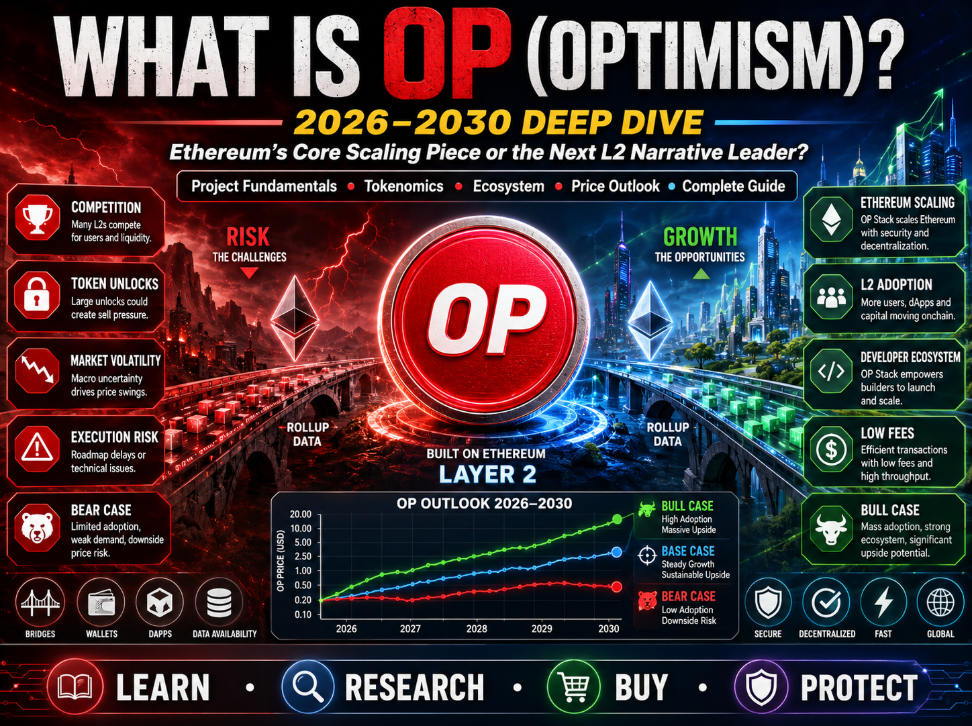
5.3 Multi-Scenario Price Predictions (2025–2030)
- Year 2025
- Bear Market Scenario: $0.80
- Baseline Scenario: $2.20
- Bull Market Scenario: $4.50
- Assumption: Steady ETH consolidation alongside baseline L2 expansion.
- Year 2026
- Bear Market Scenario: $0.60
- Baseline Scenario: $2.80
- Bull Market Scenario: $6.00
- Assumption: Capital inflows driven heavily by post-BTC halving cycles.
- Year 2027
- Bear Market Scenario: $0.50
- Baseline Scenario: $2.00
- Bull Market Scenario: $5.00
- Assumption: Stabilization of the primary L2 market share landscape.
- Year 2028
- Bear Market Scenario: $0.40
- Baseline Scenario: $2.50
- Bull Market Scenario: $7.00
- Assumption: Revenue captured by the protocol begins to reflect in the token.
- Year 2030
- Bear Market Scenario: $0.30
- Baseline Scenario: $4.00
- Bull Market Scenario: $12.00
- Assumption: L2 positions itself as the default, irreplaceable infrastructure layer of ETH.
⚠️ All predictions are based on model projections and do not constitute investment advice.
VI. How to Buy OP on HiBT
6.1 Why Choose HiBT?
- A fully compliant exchange framework utilizing global licenses
- Robust security via cold wallet storage architectures
- Native, deep liquidity for the OP/USDT trading pair
- An intuitive, beginner-friendly trading interface
6.2 Registration Process
- Register an account on the official platform.
- Complete the Identity Verification (KYC) requirements.
- Activate your spot trading permissions.
6.3 Step-by-Step Guide to Buying OP
- Search for the OP/USDT pair on the trading terminal.
- Select either a Market Order (for instant execution) or a Limit Order (to specify your entry price).
- Execute the trade while strictly maintaining your pre-planned position sizing.
6.4 Asset Management
- Consider withdrawing long-term holdings to a self-custody wallet like MetaMask.
- Always configure take-profit and stop-loss parameters.
- Monitor on-chain developer and network activity over time.
VII. Comprehensive Evaluation of OP Investment Risks
7.1 Technical Risks
- Unforeseen smart contract bugs or vulnerabilities within the complex Rollup architecture.
- Future base-layer Ethereum upgrades that significantly lower mainnet fees, potentially decreasing the structural demand for L2 networks.
7.2 Competitive Risks
- Arbitrum maintaining its firm lead in ecosystem TVL.
- Long-term technical threats posed by the mature deployment of ZK Rollups.
- The potential for individual ecosystems built on the stack (like Base) to overshadow the native Optimism mainnet.
7.3 Token-Specific Risks
- Heavy selling pressure stemming from structural token unlock cycles.
- The ongoing lack of direct protocol cash flow redirection to token holders.
- Governance rights do not inherently equate to direct financial yield.
7.4 Macro Risks
- Extended bear markets can easily slash L2 valuations by more than half.
- Evolving global regulatory landscapes and ongoing discussions surrounding token securitization.
VIII. Conclusion: Who is OP Best Suited For?
✔ It is highly suited for:
- Investors with a firm, long-term conviction in the future of the Ethereum ecosystem.
- Individuals who clearly understand the underlying logic and value proposition of Layer 2 scaling.
- Traders capable of comfortably handling high-beta market volatility.
❌ It is NOT suited for:
- Hyper-short-term scalpers or momentum chasers.
- Extremely conservative, risk-averse investors.
- Anyone who does not yet grasp the basic underlying concepts of blockchain infrastructure.