
In the crypto market, many tokens skyrocket during bull runs, but few projects truly survive multiple cycles. Moonriver (MOVR) is one such highly controversial case.
It once surged from under $7 to nearly $500, only to subsequently experience a drawdown of over 99%. Some consider it just a "Kusama ecosystem relic coin," while others believe it could explode again in the next cross-chain narrative.
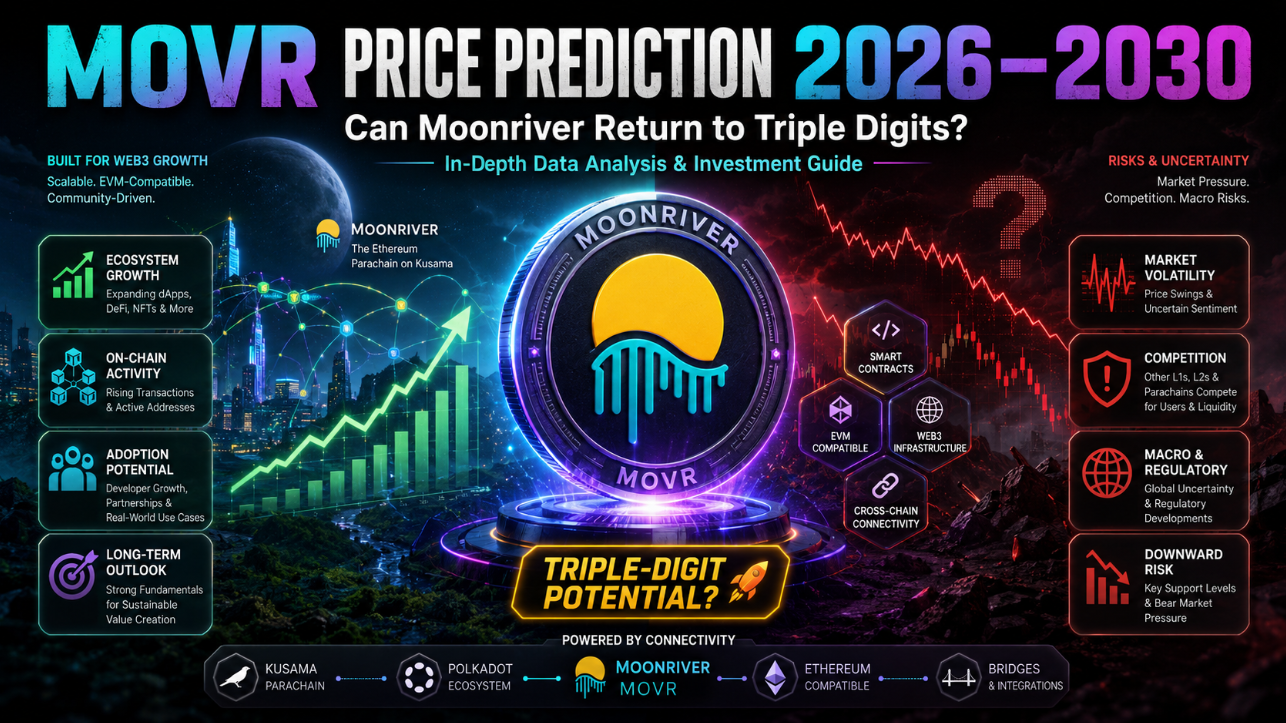
So the questions are:
- Does MOVR still have long-term value?
- Will it have a chance to return to highs between 2026 and 2030?
- Is MOVR currently a value zone or the beginning of a long-term decline?
This article won't give you "1000x get-rich-quick fantasies." Instead, it builds a complete MOVR analysis framework through:
- Kusama / Polkadot ecosystem logic
- On-chain data
- Technical indicators
- Historical cycles
- Capital behavior
- Market sentiment
If you're also following cross-chain, Layer2, and AI tracks, you can further read:
Like MOVR, these projects are representative assets with "strong narrative + high volatility."
Chapter 1: What is MOVR and Why is It Different from Ordinary Altcoins?
Many people, upon first seeing MOVR, simply understand it as "an EVM chain in the Polkadot ecosystem."
But what truly makes MOVR special is its positioning.
What exactly is Moonriver?
Moonriver is the "Canary Network" for Moonbeam on the Kusama network.
Simply put:
- Moonbeam is the stable version for the Polkadot mainnet.
- Moonriver is the experimental version running on Kusama.
Kusama's own positioning is "Polkadot's experimental field."
Thus:

This means that many features, governance upgrades, and cross-chain mechanisms in the MOVR ecosystem are often tested on Moonriver first.
This is also why many developers still pay attention to MOVR.
Chapter 2: What are MOVR's Core Utilities?
Many coins eventually die because they have "no real utility."
MOVR, at least for now, is not one of them.
It has three core functions:
- Gas Fee Payment – Similar to ETH. Users need to pay MOVR for transactions, smart contract calls, DeFi operations, and NFT trading on the Moonriver chain.
- Staking and Network Security – MOVR supports the network's validation mechanism. Users can delegate stake, earn on-chain rewards, and participate in the Collator node ecosystem. Currently, becoming a Collator has a very high threshold, requiring about 50,000 MOVR. Regular users can participate in delegated staking on a smaller scale.
- Governance Rights – MOVR holders can participate in protocol upgrades, parameter adjustments, and proposal voting. This determines it is not "pure air."
Chapter 3: MOVR Tokenomics – Why is It Noteworthy?
MOVR's model is actually healthier than many imagine.
Initial Supply and Inflation
- Initial supply: 10 million tokens
- Annual inflation rate: ~5%
Seeing inflation scares many people. But the key point comes next.
80% Transaction Fee Burn Mechanism – Moonriver adopts a mechanism similar to EIP-1559. Of the on-chain transaction fees:
- 80% is burned
- 20% goes to the treasury
This means that if on-chain activity is high enough, MOVR could even become net deflationary. This is why many long-term investors continuously monitor MOVR. Because deflation + small market cap + high beta characteristics inherently possess strong speculative elasticity.
Chapter 4: MOVR Historical Price Review – Why Could It Rise from $7 to $480?
This is the most critical part to understanding MOVR.
The Crazy Bull Market of 2021 – After its launch in 2021, MOVR quickly became a Kusama ecosystem star, a popular EVM-compatible project, and a core asset of the cross-chain narrative. At that time, the market featured extreme liquidity easing, an explosion of Web3 concepts, the lingering warmth of the DeFi Summer, and extremely high ETH gas fees. Consequently, a lot of capital began searching for "Ethereum alternatives." MOVR became one of the beneficiaries.
Why Could It Rise to Nearly $500? There are five fundamental reasons:
- Extremely Small Circulating Supply – Early circulating supply was very limited. Small capital could drive huge increases.
- Extremely High Kusama Ecosystem Hype – At the time, parachain auctions, DOT lock-ups, and Kusama slots were core market narratives.
- Explosion of EVM Compatibility Concept – Developers could migrate ETH applications at low cost. This was one of Moonriver's biggest advantages.
- Retail FOMO – Many viewed MOVR as "the next SOL."
- High Leverage Capital Drive – A large amount of contract funds entered, and high volatility further attracted speculators.
Chapter 5: Why Did It Drop 99% Later?
This is a problem newcomers most often overlook.
- Macro Liquidity Collapse – After 2022, the Fed raised rates, risk assets fell, and the crypto market entered a bear market. High-beta assets were hit first, and a small-cap token like MOVR naturally saw an extremely exaggerated drop.
- Kusama Ecosystem Cooling – As Polkadot's popularity waned, the parachain narrative receded, and capital shifted to Layer2, Kusama's ecosystem activity significantly declined.
- Intense Layer2 Competition – The market is different now. Competitors include Arbitrum, Optimism, Base, zkSync, Starknet, and MOVR's "EVM compatibility" advantage is no longer unique.
Chapter 6: Where Are MOVR's Biggest Opportunities?
Despite many problems, MOVR still has several potential opportunities.
- Small-Cap Elasticity – MOVR's market cap is now very small. This means that with a new narrative, capital rotation, or a Kusama ecosystem revival, MOVR could see huge percentage gains.
- Cross-Chain Narrative May Return – If Web3 re-emphasizes cross-chain, multi-chain interoperability becomes a hot topic again, and the XCM ecosystem upgrades successfully, MOVR could re-enter the market's spotlight.
- Developer Ecosystem Isn't Completely Dead – Moonriver still retains a certain developer base. Compared to completely "ghost chain" projects, it still has a real ecosystem. This is an important distinction from many dead altcoins.
Chapter 7: 5 Core Variables Affecting MOVR's Price
Whether MOVR will rise in the future depends on the following five things.
- Technical Indicator Cycles – Watch for MA50 crossing above MA200 and RSI leaving long-term low levels, which often indicates improving medium-to-long-term trends.
- On-Chain Data – Truly important data includes TVL, active addresses, daily transactions, and developer activity. Often, on-chain data recovers before prices rise.
- Kusama / Polkadot Ecosystem Cycle – MOVR essentially depends on Kusama's popularity, DOT ecosystem development, parachain auctions, and XCM cross-chain activity.
- Bitcoin Cycle – MOVR is a typical high-beta asset. A Bitcoin bull market greatly impacts it. The typical pattern is BTC rises first, then ETH, then altcoin rotation, with small caps exploding last.
- Whale Capital Influence – A small amount of capital can create huge volatility. MOVR's price action can often deviate from fundamentals. Newcomers must understand this.
Chapter 8: MOVR vs. GLMR – Which is Worth Holding?
Moonbeam (GLMR) and MOVR come from the same team but have different positioning.

MOVR suits those who like high volatility, short-to-medium term trading, and pursuing high elasticity. GLMR suits those with long-term ecosystem observation, lower risk tolerance, and who prioritize stability.
Chapter 9: MOVR vs. Arbitrum / Optimism
This is MOVR's real challenge. The market mainstream has shifted to Ethereum Layer2, Rollup ecosystems, and modular blockchains. In comparison, the Kusama ecosystem is no longer the market's core. Therefore, MOVR's future success largely depends on "whether the cross-chain narrative regains market centrality."
Chapter 10: MOVR Price Prediction 2026–2030
Note: These are not deterministic predictions but probability intervals based on historical cycles, market cap models, ecosystem development, and macro environment.
MOVR 2026 Prediction
- Bearish Scenario ($1.2): Kusama ecosystem continues declining, Bitcoin enters a bear market, liquidity worsens.
- Neutral Scenario ($3.5 – $5): Normal market rotation, Kusama ecosystem remains active, BTC stays strong.
- Bullish Scenario ($9 – $11): New altcoin season, cross-chain narrative returns, XCM upgrade succeeds, capital flows back into small caps.
MOVR 2027 Prediction
- Bearish ($2): No significant ecological improvement.
- Neutral ($7 – $13): Market enters a recovery phase.
- Bullish ($16 – $20): DeFi re-explodes, Kusama ecosystem recovers, MOVR on-chain activity grows.
MOVR 2028 Prediction
- Bearish ($5)
- Neutral ($18 – $24): A reasonable long-term recovery range.
- Bullish (Over $30): Requires Polkadot ecosystem resurgence, cross-chain DeFi explosion, significant capital re-entering small caps.
MOVR 2029 Prediction
- Bearish ($8): Project gradually marginalized.
- Neutral ($28 – $35): TVL continues to grow, stable developer ecosystem, increased staking demand.
- Bullish (Over $45): Requires enterprise-grade DApp adoption, growth in long-term staking users, market re-acknowledgment of cross-chain infrastructure.
MOVR 2030 Prediction
Can MOVR return to three digits? Theoretically possible, but conditions are extremely harsh: new highs in total crypto market cap, Kusama becoming a core ecosystem again, widespread Web3 adoption, cross-chain becoming essential.
- Bearish ($5 – $10): Ecosystem decline.
- Neutral ($38 – $55): A reasonable long-term range.
- Bullish ($80 – $120): An extremely optimistic scenario. Still far below the historical peak near $500.
Chapter 11: MOVR Investment Strategy
- DCA Strategy – Suitable for long-term investors. Combine with RSI below 30 or significant deviation from MA200. Buy in stages, not one lump sum.
- Stop-Loss Strategy – MOVR is extremely high risk. Suggested first stop-loss: -20%. Ultimate stop-loss: -35%.
- Take-Profit in Batches – A reasonable method: Sell 30% at +100%, another 30% at +200%, hold the rest long-term.
- Position Management – MOVR is not suitable for heavy positions. For most investors, a single-coin position should ideally be below 5%, and even for high-risk portfolios, not exceed 10%.
Chapter 12: 5 Risks Beginners Must Know
- Extremely Wide Prediction Gaps – Predictions for small-cap coins are inherently highly uncertain.
- Low Market Cap ≠ Safety – Low market cap means prone to sharp rises and sharp falls. A double-edged sword.
- Experimental Risks of Kusama Ecosystem – Frequent upgrades, higher risk, potential ecological instability.
- Liquidity Risk – In extreme market conditions, you may not be able to sell at your desired price.
- Information Asymmetry – KOL shilling, project PR, community sentiment all affect price movements. Must learn independent judgment.
Conclusion: Is MOVR Worth Long-Term Investment?
The final answer is simple: MOVR is not a "stable investment." It is more like a high-risk, high-elasticity cyclical speculative asset.
It suits those who can handle high volatility, are willing to track the ecosystem long-term, and understand Kusama's logic.
It does not suit those wanting stable returns, unable to accept 90% drawdowns, or lacking position management skills.
Whether MOVR can rise again depends not just on the project itself, but on whether the Polkadot ecosystem recovers, the cross-chain narrative returns, and Web3 truly enters its next phase.
Therefore, don't treat price predictions as destiny. What truly matters is always on-chain data, ecosystem activity, capital flows, and cycle positioning. These are the true compass determining MOVR's future.