
Introduction: Why Is FET/ASI One of the Most Worthwhile Targets for In-Depth Research in the AI + Blockchain Track?
If the keywords for the crypto market in 2021 were DeFi, NFT, and public chain wars, then one of the most unavoidable narratives from 2024 to 2026 is AI + Crypto.
But the problem is equally obvious: after the AI concept became overheated, a large number of projects "wearing an AI coat" appeared on the market. Many projects simply rewrote their whitepapers into AI versions, changed a few keywords on their official websites, and started telling stories about "decentralized artificial intelligence."
FET is different.
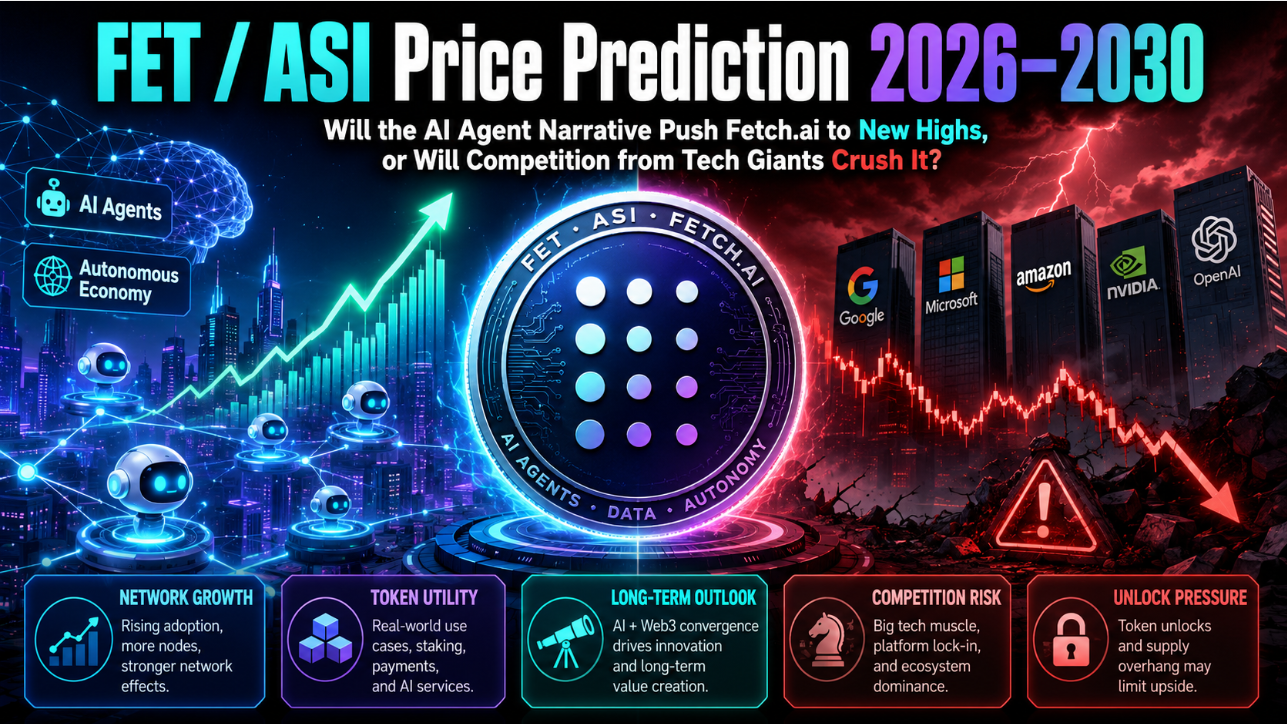
Fetch.ai is not a concept coin that simply rides the AI hype. Long before the AI Agent concept became massively popular, it was already exploring autonomous AI agents, machine economies, and decentralized intelligent service networks.
More importantly, Fetch.ai later partnered with SingularityNET and Ocean Protocol to drive the ASI Alliance merger narrative, gradually transforming FET from a single-project token into a larger decentralized AI alliance asset.
This is why many investors ask:
Is FET/ASI a core target for the next AI bull market, or is it already an overhyped, high-risk altcoin?
This article analyzes from four dimensions:
- Technical Fundamentals: What problem does Fetch.ai actually solve?
- Token Economics: Is the supply-demand structure of FET/ASI healthy?
- Macro Cycles: How will the 2026–2030 crypto cycle affect prices?
- Competitive Landscape: Will TAO, RNDR, AKT, NEAR, or traditional AI giants steal its market share?
A necessary disclaimer: all price predictions in this article are scenario-based extrapolations derived from public information, historical patterns, and reasonable assumptions. They do not constitute investment advice. The crypto market is highly volatile, and any prediction may fail due to regulatory, technological, liquidity, or black swan events.
What is truly valuable is not memorizing a specific target price, but learning to judge:
- Why would FET rise?
- Under what conditions would the prediction fail?
- Which data can tell you in advance whether the project is improving or deteriorating?
- When should you continue holding, and when should you admit your judgment was wrong?
Chapter 1: The Underlying Logic of FET/ASI — Without Understanding These, You Cannot Judge the Price Drivers
1.1 What Is Fetch.ai Actually Building? "Autonomous AI Agents" Is Not Just a Gimmick
Many people buy FET simply because they see keywords like "AI token," "AI Agent," and "decentralized AI."
But if you don't even understand what Fetch.ai actually does, it is very difficult to judge its future price logic.
The core concept of Fetch.ai can be simply understood as:
Letting AI Agents automatically complete tasks on behalf of users, devices, enterprises, or services within a decentralized network.
What is an AI Agent?
It is not a simple chatbot, nor is it a ChatGPT-style tool that only answers questions. An AI Agent is closer to an intelligent agent capable of autonomously executing tasks.
For example:
- Finding the cheapest travel itinerary for users;
- Automatically matching logistics resources for enterprises;
- Automatically negotiating prices between devices;
- Helping users make optimal choices between different services;
- Helping developers create tradable, callable, and composable intelligent services.
If traditional AI is more about "answering questions," then AI Agents emphasize:
Automatically understanding goals, breaking down tasks, calling tools, and completing actions.
This is the long-term imaginative space of Fetch.ai.
Within the Fetch.ai framework, a large number of autonomous agents may emerge in the future. They can represent different users, enterprises, devices, and applications to complete transactions, communication, and collaboration within the network.
The value of FET/ASI comes from whether this network is actually being used.
If AI Agents remain merely a concept, token prices can only be driven by sentiment. If AI Agents truly achieve large-scale application, FET/ASI has the opportunity to transform from an "AI concept coin" into an "AI infrastructure asset."
1.2 The uAgents Framework: The Key Entry Point for FET Demand
Fetch.ai's uAgents framework is an important entry point for understanding the project's fundamentals.
Simply put, uAgents is a developer tool framework for creating autonomous agents.
Such agents can be used for:
- Data queries;
- Automated trading;
- Supply chain scheduling;
- IoT device coordination;
- AI service calls;
- Enterprise process automation;
- Personalized user services.
Why does this affect the FET/ASI price?
Because if more and more developers use uAgents to build applications, the number of agents, call frequency, and service demand within the network may grow.
Once these interactions require FET/ASI as payment, staking, service call, or network incentive assets, the token will gain real demand.
The key point here is:
The long-term rise of FET/ASI cannot rely solely on the AI narrative; it must rely on the growth of network usage.
The problem with many projects is "a good story, but no real consumption scenarios." Whether FET/ASI can succeed in the future depends on whether it can convert AI Agent usage demand into token demand.
1.3 The DeltaV Search Engine: How Can Natural Language Call AI Services?
Another direction within the Fetch.ai ecosystem worth paying attention to is DeltaV.
It can be understood as a search and calling entry point for AI Agent services.
Ordinary users do not need to understand complex blockchain operations; they only need to express their needs in natural language, and the system can help users discover and call the corresponding agent services.
If this model works, it could be analogous to:
A service search engine for the AI Agent era.
This is important.
Because one of the biggest problems with blockchain applications is the excessively high user threshold.
If every operation requires the user to:
- Connect a wallet;
- Switch networks;
- Select contracts;
- Understand gas fees;
- Judge transaction paths;
Then mass adoption is difficult to achieve.
But if users can call backend AI Agents through natural language, with the blockchain only completing settlement, verification, and incentives at the underlying layer, the user experience will improve dramatically.
This is also one of the core potentials of FET/ASI:
It is not simply selling an "AI concept," but attempting to build an AI Agent service network.
Of course, potential does not equal success.
What truly determines the price is whether DeltaV, uAgents, and the ASI ecosystem can generate real users, real calls, and real revenue.
1.4 The Great ASI Alliance Merger: What Changed When FET + AGIX + OCEAN Became One?
FET price predictions cannot avoid the ASI Alliance.
The merger narrative of Fetch.ai, SingularityNET, and Ocean Protocol attempts to build a larger decentralized AI alliance.
From a storytelling perspective, this merger is very attractive.
Because the three projects represent different directions:
- Fetch.ai: AI Agents and intelligent agent networks;
- SingularityNET: Decentralized AI service marketplace;
- Ocean Protocol: Data assets and data marketplace.
If these three directions truly connect, the ASI Alliance narrative becomes very strong:
AI Agents + AI Services + Data Marketplace = A closed loop of decentralized AI infrastructure.
This is also why the market is willing to give FET/ASI a higher imaginative space.
But investors must calmly view one issue:
A merger does not equal success.
After a project merger, the most important thing is to see whether synergies truly occur.
For example:
- Do Fetch.ai's agents actually call SingularityNET's AI services?
- Does Ocean's data marketplace truly provide data support for AI Agents?
- Have the three communities completed integration?
- Are developers more willing to enter the ASI ecosystem?
- After token unification, does it bring stronger liquidity and value capture?
If the answer is yes, the ASI merger becomes a long-term positive. If it is merely a brand and narrative merger with no actual ecosystem integration, it may just be a phased marketing campaign.
Therefore, judging the future of FET/ASI cannot rely solely on "merger news," but must look at the real data after the merger.
1.5 FET/ASI Token Economics: Which Numbers Determine the Price Ceiling?
Any token price prediction must ultimately return to the relationship between supply and demand.
The long-term price of FET/ASI depends on four core questions:
- How do total supply and circulating supply change?
- Do unlocks and inflation create selling pressure?
- Can staking mechanisms reduce circulating chips?
- Can AI service calls create real token demand?
Many newcomers only look at the price, not the token structure. This is very dangerous.
Especially for AI track projects, the market can easily drive valuations to crazy heights because of the narrative, but if token release speed is too fast, the price will still be suppressed.
Circulating Supply: Determines Short-Term Price Elasticity
If the current circulating supply is low, the price is more easily pushed by capital.
But low circulation is not necessarily a good thing.
Because the uncirculated portion will be gradually released in the future. Once the release speed exceeds market demand growth, the price will be suppressed.
Therefore, FET/ASI investors must pay attention to:
- The current circulation ratio;
- Subsequent release plans;
- The speed of ecosystem incentive releases;
- Changes in team and foundation holdings.
Staking Mechanism: Affects Actual Circulating Chips
If a large amount of FET/ASI is staked, the actual circulating chips in the market will decrease.
This is favorable for the price.
But staking yield needs to be distinguished by source:
If the yield comes from real network revenue, it indicates the ecosystem has value. If the yield mainly comes from new token issuance, it is essentially still inflationary subsidies.
A truly healthy staking mechanism should be:
Network usage grows → service fees increase → staking yield becomes more real → users are willing to lock in long-term → circulating pressure decreases.
If it merely uses high yields to attract short-term capital, once rewards decline, capital may leave rapidly.
Token Consumption Scenarios: Determines Long-Term Demand
The most critical question for FET/ASI is:
Does the token have real consumption scenarios?
Ideally, FET/ASI can be used for:
- AI Agent service calls;
- Network gas fees;
- Agent registration;
- Service marketplace payments;
- Staking and security mechanisms;
- Data and AI service transactions;
- Ecosystem incentives.
If these scenarios continue to grow, token demand will strengthen.
But if users are only trading FET/ASI on exchanges rather than using it within the ecosystem, then the price is still mainly determined by market sentiment.
1.6 Historical Price Review: The Real Drivers Behind Every Major FET Rally
The historical price trend of FET can be roughly divided into several stages.
Stage 1: Early AI Narrative Germination
In the early stage, FET's core story was machine economy, autonomous agents, and intelligent networks.
At that time, AI had not yet become the global technology mainline as it is today, so FET was more of a niche technology project with limited market attention.
Price during this stage was mainly influenced by:
- The crypto macro market;
- Project progress;
- Small-scale AI narratives;
- Exchange liquidity.
Stage 2: 2021 Bull Market Rally
In 2021, the entire crypto market entered a high risk-preference phase.
DeFi, NFT, public chains, the metaverse, AI, and other narratives rose in turn, and FET also benefited from bull market liquidity.
But the rally at that time was largely driven by overall market risk preference rather than AI Agents having already achieved large-scale adoption.
This illustrates a problem:
A bull market amplifies narratives, but a bear market re-examines fundamentals.
Stage 3: 2022 Bear Market Drawdown
In 2022, the market entered a deep bear market, and most altcoins fell sharply.
FET could not rise independently of the macro market.
This shows:
Even if a project's direction is correct, prices can still fall sharply during liquidity contraction phases.
Many newcomers mistakenly believe that "good fundamentals mean it won't fall." This is a misconception.
In the crypto market:
Good projects also fall; it's just that good projects are more likely to survive after a bear market.
Stage 4: 2024 AI Concept Explosion
In 2024, the AI narrative exploded comprehensively. Traditional tech markets saw continuous heating of NVIDIA, OpenAI, AI Agents, generative AI, and other concepts, and the crypto market also began chasing AI tokens.
FET gained massive attention during this stage.
The rally logic mainly came from:
- AI becoming a global technology mainline;
- Fetch.ai possessing a real AI Agent narrative;
- The ASI Alliance merger enhancing imaginative space;
- Improved exchange liquidity;
- The market seeking AI Crypto leading targets.
But this also brings a question:
In the price rise, how much was supported by fundamentals, and how much was emotional premium?
This is critical for 2026–2030 predictions.
If future ecosystem data can catch up with the price, FET/ASI still has room to grow. If the price has already advanced too many expectations, it may subsequently enter a valuation digestion phase.
Chapter 2: Six Core Variables Affecting FET/ASI Prices
2.1 Macro Narrative of the AI Track: Will AI Heat Continue to Explode, or Gradually Cool?
The biggest external variable for FET/ASI is the AI track itself.
If AI Agents, automated workflows, and enterprise AI services continue to grow rapidly in the coming years, FET/ASI will benefit from the expansion of the entire AI narrative.
But if the AI narrative cools, or the market begins to believe that "AI + Crypto" lacks real commercial value, the valuation of FET/ASI will also be compressed.
Here, two levels need to be distinguished:
Level 1: Will AI itself continue to grow?
The answer is most likely yes.
AI has become the mainline of global technology competition and will continue to influence:
- Search;
- Office work;
- Programming;
- Finance;
- Healthcare;
- Manufacturing;
- Automated services;
- Data analysis.
Level 2: Does blockchain really need AI?
This is the more critical question.
Traditional AI can continue to develop without relying on blockchain. Centralized giants can also provide powerful AI services. So why would users use a decentralized AI network?
FET/ASI must prove:
- Decentralized AI can reduce data monopolies;
- AI Agents need open markets;
- Multi-party data collaboration requires trusted settlement;
- Automatic transactions between machines require blockchain;
- Developers need permissionless AI service networks.
If these logics are recognized by the market, the long-term valuation of FET/ASI will strengthen.
If the market believes AI Crypto is just conceptual hype, then the price will return to ordinary altcoin logic.
2.2 Bitcoin Halving Cycle and Altcoin Season Transmission
The crypto market still cannot escape the BTC cycle.
The typical capital rotation path is:
BTC rises first, attracting market liquidity; ETH and mainstream public chains follow up; Then capital enters narrative sectors such as AI, RWA, DePIN, GameFi, and Layer 2; Finally, small and mid-cap altcoins rotate comprehensively.
FET/ASI belongs to a high-attention asset in the AI track and theoretically may gain capital attention earlier than ordinary small coins.
Because the AI narrative has one advantage:
It is not just an internal crypto circle narrative; it is also a global technology mainline narrative.
This differs from many pure on-chain concepts.
For example, decentralized storage, game metaverses, and energy blockchain all have real-world application backgrounds, but their heat often depends on阶段性 market preferences. Related tracks can be referenced:
- SC (Siacoin) Price Prediction 2026–2030
- SUPER (SuperVerse) Price Prediction 2026–2030
- POWR Price Prediction 2026–2030
Like these projects, the long-term performance of FET/ASI cannot rely solely on narrative; it depends on whether real demand grows.
2.3 ASI Alliance Ecosystem Actual Adoption Rate: On-Chain Data Does Not Lie
The most important factor in judging whether FET/ASI is worth holding long-term is not Twitter heat, but ecosystem adoption rate.
Focus on several key indicators.
First: AI Agent Registration Quantity
This is one of the most core fundamental indicators.
If more and more developers create Agents, it indicates the ecosystem is growing.
But you must also look further:
- Whether these Agents are truly active;
- Whether there are call counts;
- Whether they generate fees;
- Whether they are just tests or wash volume;
- Whether there are enterprise-level users.
Quantity growth does not equal real adoption; activity is more critical.
Second: Developer Numbers
For long-term infrastructure projects, developers are the lifeline.
If developers continue to increase, it indicates the ecosystem is attractive. If developers leave, even if the short-term price rises, it may only be a sentiment-driven rally.
You can observe:
- GitHub commit frequency;
- SDK download volume;
- Hackathon project numbers;
- Developer community activity;
- Documentation update speed.
Third: DeltaV Usage
If DeltaV can become the AI Agent service entry point, then its daily active users, search requests, and service call counts are very important.
If DeltaV data grows, it indicates users are truly using the ASI ecosystem. If data remains depressed long-term, the narrative will be questioned.
Fourth: Enterprise Cooperation Landing
Fetch.ai has had cooperation narratives with some traditional enterprises and institutions.
But investors cannot just look at "cooperation announcements."
What is truly important is:
- Whether it has entered the commercialization phase;
- Whether it generates real revenue;
- Whether it brings token usage;
- Whether it forms replicable cases.
Many crypto projects have "partners," but that does not mean business has truly landed.
Therefore, future FET/ASI enterprise cooperation must shift from "news-type cooperation" to "revenue-type cooperation."
2.4 Competitive Landscape: How Deep Is FET/ASI's Moat?
The AI + Crypto track competition is extremely fierce.
The main competitors of FET/ASI include:
- Bittensor (TAO)
- Render (RNDR)
- Akash (AKT)
- NEAR AI Ecosystem
- io.net and other decentralized computing power networks
- And new AI chain projects that may emerge in the future
These projects are not completely identical competitive relationships, but they will all compete for AI Crypto capital.
TAO: Strong Decentralized AI Network Narrative
Bittensor is more oriented toward decentralized machine learning networks, and the market has a high degree of recognition for its "AI infrastructure" narrative.
If TAO continues to become the AI Crypto leader, FET/ASI may need to prove that it is not a follower, but has different value.
RNDR: Computing Power and Rendering Network
Render is more oriented toward GPU computing power and rendering resource networks.
Its advantage is that application scenarios are easier to understand.
AI needs computing power; this is intuitive demand.
In comparison, the FET/ASI AI Agent narrative is more complex and requires stronger user education.
AKT: Decentralized Cloud Computing
Akash is more oriented toward decentralized cloud services and computing power markets.
If future AI projects massively need decentralized computing power, AKT may benefit.
Traditional AI Giants: The Truly Huge Threat
The biggest competitors for FET/ASI may not be crypto projects, but:
- OpenAI
- Microsoft
- Anthropic
- Amazon
- Meta
These companies possess:
- Stronger model capabilities;
- Larger user scale;
- Stronger enterprise channels;
- More abundant capital;
- More complete cloud infrastructure.
So FET/ASI must answer one question:
Why would enterprises and developers not use centralized AI services, but instead use a decentralized AI network?
If it can provide more open, more composable, more anti-monopoly, and more machine-economy-suitable services, it has the opportunity to occupy a market. If it cannot, it may remain at the crypto narrative level long-term.
2.5 Institutional Capital and Market Maker Behavior
FET/ASI prices are not only affected by fundamentals, but also by institutional capital and market maker behavior.
Especially high-heat AI assets, which often attract large amounts of short-term capital and leveraged trading.
Need to pay attention to:
- Exchange net inflows/outflows;
- Large holder address持仓 changes;
- Contract funding rates;
- Spot trading volume;
- Market maker wallet anomalies;
- Whether unlocked tokens are transferred to exchanges.
If prices rise while exchanges see continuous net inflows, it indicates potential selling pressure is increasing. If prices fall but large holders continue to accumulate, it may indicate medium-to-long-term capital is positioning.
However, on-chain data cannot be interpreted in isolation.
Large holder transfers are not necessarily sales; they may also be custody, market making, or internal rebalancing.
But it can at least remind you:
Don't just look at news and candlesticks; combine capital flow directions to judge.
2.6 Dual Regulatory Risk of AI + Blockchain
FET/ASI faces two layers of regulatory risk.
The first layer is crypto asset regulation. The second layer is AI regulation.
Crypto asset regulation mainly focuses on:
- Whether the token is a security;
- Whether exchanges are compliant;
- Whether staking involves investment contracts;
- Whether the project conducted unregistered issuance.
AI regulation focuses on:
- Data privacy;
- Model transparency;
- Training data compliance;
- Automated decision-making liability;
- Enterprise AI deployment risks.
If future regulation tightens, FET/ASI may be affected.
But there are also reverse opportunities.
If regulation gradually becomes clear, compliant decentralized AI infrastructure may instead gain institutional recognition.
The key is:
Whether the ASI Alliance can establish a clear compliance path, rather than remaining in the simple narrative of "decentralized so no regulation needed."
Chapter 3: FET/ASI Price Prediction for 2026
3.1 Macro Market Environment Forecast for 2026
2026 may be a very critical year in this crypto cycle.
If we follow the historical four-year cycle, the second year after the halving is usually one of the stages where market risk preference is strongest.
Of course, history does not repeat exactly.
But if 2026 sees a bull market peak, FET/ASI may simultaneously receive triple catalysis:
- Market liquidity brought by the BTC cycle;
- Narrative heat brought by the AI technology mainline;
- Fundamental validation brought by ASI Alliance ecosystem landing.
If all three appear simultaneously, FET/ASI has the opportunity to challenge historical highs.
But if the AI narrative cools, or market capital rotates to other sectors such as RWA, Meme, DePIN, gaming, and Layer 2, the performance of FET/ASI may be below expectations.
3.2 Key Events for 2026: Unlocks, Roadmaps, and Product Landing
In 2026, three directions need the most attention.
First: Token Unlock Pressure
If there is large-scale unlocking in 2026, we need to judge whether the market can absorb it.
Unlocking itself is not absolutely bearish.
If project fundamentals are strong and buying power is sufficient, unlocking may be absorbed by the market.
But if unlocking occurs during a market weakening phase, it may amplify the decline.
Second: ASI Alliance Roadmap Execution
Investors need to look at:
- Whether the three ecosystems truly integrate;
- Whether the AI Agent network grows;
- Whether DeltaV usage improves;
- Whether enterprise cooperation is commercialized;
- Whether the token has more practical uses.
If the roadmap merely remains at the vision level, the market may gradually lose patience.
Third: Whether AI Agents Become a Mainstream Narrative
If AI Agents continue to explode in 2026, FET/ASI will benefit.
Especially when traditional tech markets continue to hype Agentic AI, automated workflows, and enterprise AI agents, the crypto market is very likely to seek corresponding targets.
FET/ASI is one of the assets most easily noticed by capital.
3.3 FET/ASI 2026 Three-Scenario Price Prediction
Scenario
Core Assumption
Predicted Price Range
Corresponding Logic
Optimistic
Bull market peak + AI Agent explosion + ASI ecosystem integration success
$5.50 – $12.00
FET/ASI becomes a core AI Crypto target, market cap revaluation
Neutral
Follows bull market rally + ecosystem steadily advances
$2.80 – $5.50
AI narrative remains strong, but fundamentals have not fully exploded
Pessimistic
Market peaks early + AI narrative cools + unlock selling pressure
$0.80 – $2.50
Project still has value, but valuation is compressed
Optimistic Scenario: 5.50–12.00
This scenario requires multiple conditions to be met simultaneously:
- BTC and ETH remain strong;
- The AI Agent narrative becomes a crypto market mainline;
- ASI Alliance integration effects are obvious;
- Enterprise cooperation enters a substantive phase;
- Token usage scenarios increase;
- Unlock pressure is absorbed by the market;
- FET/ASI is regarded by the market as one of the AI Crypto leading assets.
If these conditions are met, FET/ASI has the opportunity to enter a strong revaluation phase in 2026.
Neutral Scenario: 2.80–5.50
This is a relatively scenario.
In this case, FET/ASI will benefit from the bull market and AI narrative, but ecosystem growth does not reach an explosive state.
The price may rise, but more as a sector follower rather than becoming an absolute leader.
Pessimistic Scenario: 0.80–2.50
In the pessimistic scenario, several problems may occur:
- AI Crypto heat cools;
- The market enters a callback early;
- Unlock selling pressure increases;
- ASI merger synergy is not obvious;
- Traditional AI giants absorb market attention.
In this case, FET/ASI may still maintain project value, but the price will find it difficult to break through previous highs.
3.4 Three Catalysts Most Worth Watching in 2026
Catalyst 1: AI Agent Registration Volume Explosion
If the number and activity of AI Agents in the ASI ecosystem grow massively, this is the strongest fundamental signal.
Catalyst 2: Enterprise-Level Cooperation Commercialization
If enterprise cooperations of the Bosch, Airbus, Deutsche Telekom type can generate real revenue or actual deployment, market confidence will be enhanced.
Catalyst 3: ASI Ecosystem Token Demand Strengthening
If FET/ASI is truly used in service calls, staking, payments, and data transactions, the price logic will be significantly stronger than ordinary concept coins.
Chapter 4: FET/ASI Price Prediction for 2027
4.1 If 2026 Is the Bull Market Peak, What Happens in 2027?
If the market reaches a high point in 2026, then 2027 will most likely enter a cooling phase.
At this time, FET/ASI will face a real stress test.
In a bull market, all projects can tell stories. In a bear market, only projects with real users, real revenue, and real developers can survive.
The performance of FET/ASI in 2027 depends on one question:
Have AI Agents already transformed from narrative into real demand?
If the answer is yes, it may be more resilient than ordinary altcoins. If the answer is no, it may fall sharply like most high-elasticity assets.
4.2 How Resilient Is the AI Track in a Bear Market?
Many people assume that AI is a strong narrative, so it won't fall even in a bear market.
This is wrong.
Even the best tech stocks fall when macro liquidity contracts. Crypto AI tokens will only be more volatile.
Therefore, in 2027, we cannot simply say "AI is bullish long-term, so FET won't fall."
A more reasonable judgment is:
If AI Agents have already formed real adoption by 2026, then the decline in 2027 may be smaller than pure concept coins. If AI Agents are still just a vision, 2027 may see a massive valuation regression.
4.3 FET/ASI 2027 Three-Scenario Prediction
Scenario
Predicted Price Range
Trigger Conditions
Optimistic
$4.00 – $8.00
Post-bull market callback, but ASI ecosystem data remains strong, AI Agent adoption continues to grow
Neutral
$1.50 – $4.00
Market enters bear market, FET follows overall altcoin callback
Pessimistic
$0.40 – $1.50
AI narrative cools, ecosystem adoption insufficient, unlock and liquidity pressure
4.4 Five Risk Signals Holders Must Monitor in 2027
First: AI Agent Active Quantity Declines
If registration numbers remain but active calls decline, it indicates the ecosystem may have "data bloat."
Second: Developer Drain
Developers are the core assets of infrastructure projects.
If GitHub updates decrease, hackathons become, and ecosystem projects decrease, vigilance is required.
Third: Enterprise Cooperation Has No Follow-Up
If there are many cooperation announcements but no commercialized revenue or real deployment, the market will lower expectations.
Fourth: Tokens Continuously Enter Exchanges
This may indicate large holders or early holders are selling.
Fifth: ASI Merger Synergy Fails
If the FET, AGIX, and OCEAN ecosystems do not truly integrate after the merger, the long-term narrative will be weakened.
Chapter 5: FET/ASI Price Prediction for 2028
5.1 In the Bear Market Bottom Area, How to Judge Whether FET/ASI Has Bottomed?
2028 may be a critical year around the next halving.
At this time, two emotions will appear in the market:
One is extreme pessimism, believing altcoins have no hope. The other is early positioning, waiting for the next cycle.
For FET/ASI, judging whether it has bottomed cannot rely solely on how much the price has fallen, but must look at five hard indicators.
First: Whether Active Addresses Have Stabilized
If the price falls but active addresses no longer decline, it indicates users may still be there.
Second: Whether Developers Continue Building
Projects that continue developing during a bear market are the ones that have the opportunity to re-explode in the next bull market.
Third: Whether the FET/BTC Trading Pair Has Stopped Falling
Looking only at USD prices is prone to misjudgment.
If FET no longer continues to weaken relative to BTC, it indicates it may be starting to regain capital attention.
Fourth: Whether Unlock Pressure Has Been Mostly Digested
If most of the selling pressure has already been released, future price repair resistance will be smaller.
Fifth: Whether the AI Agent Narrative Is Still Heating Up in the Tech Market
If the traditional AI industry continues to promote Agent applications, FET/ASI still has the opportunity to be rediscovered by the market.
5.2 Impact of the 2028 Bitcoin Halving Expectation on FET/ASI
If 2028 approaches the next Bitcoin halving, the market may begin positioning early.
But capital usually does not enter high-risk AI altcoins from the start.
The general path is:
BTC recovers first; ETH and mainstream assets subsequently strengthen; Then sectors such as AI, DePIN, RWA, and Layer 2 rotate; Finally, high-elasticity assets explode.
If FET/ASI wants to start early, it needs to satisfy:
- The AI track remains a mainstream tech narrative;
- The ASI ecosystem has not been replaced by new projects;
- On-chain data shows recovery;
- Large holders begin re-accumulating;
- Trading volume gradually.
5.3 FET/ASI 2028 Three-Scenario Prediction
Scenario
Predicted Price Range
Corresponding Logic
Optimistic
$3.00 – $7.00
Market positions early for new cycle, AI Agent ecosystem real growth
Neutral
$1.00 – $3.00
Project survives and slowly recovers, but has not yet returned to strength
Pessimistic
$0.25 – $1.00
Ecosystem growth stagnates, AI Crypto narrative is replaced by new projects
The most important thing in 2028 is not "whether the price is cheap," but:
Does FET/ASI still have the ability to enter the next bull market mainline?
Chapter 6: Long-Term Outlook for FET/ASI 2029–2030
6.1 2029: Valuation Reconstruction in a New Round of Bull Market
If FET/ASI successfully survives the market trough of 2027–2028, then 2029 may welcome a revaluation.
But this will not happen automatically.
By 2029, the market will re-examine:
- Whether ASI has truly become AI Agent infrastructure;
- Whether decentralized AI has real commercial value;
- Whether enterprises are willing to use the ASI ecosystem;
- Whether the token has value capture capability;
- Whether stronger competitors have replaced it.
If these questions have positive answers, FET/ASI has the opportunity to re-challenge and even break through the previous cycle's highs.
6.2 2030: The Ultimate Bull vs. Bear Debate
Strongest Bull Arguments
The bull logic for FET/ASI is very clear.
First, AI Agents may become one of the most important technology trends of the next decade.
If large amounts of software, devices, and enterprise processes are automatically executed by AI Agents, then an open agent network is needed.
Second, decentralized AI can counter data and model monopolies.
If future AI becomes overly concentrated in the hands of a few tech giants, the market may need open, transparent, and composable alternatives.
Third, the ASI Alliance may form a trinity ecosystem of data, models, and agents.
If the synergy between Fetch.ai, SingularityNET, and Ocean Protocol truly occurs, ASI will be more imaginative than a single AI project.
Fourth, token demand may strengthen as network usage grows.
If AI Agent calls, service payments, staking, and data transactions all require FET/ASI, the token will have stronger long-term demand.
Strongest Bear Arguments
The bear logic for FET/ASI is equally unignorable.
First, centralized AI giants are too strong.
OpenAI, Google, Microsoft, Amazon, and Meta possess capital, models, users, cloud resources, and enterprise channels. It is difficult for FET/ASI to compete head-on.
Second, blockchain may not be necessary infrastructure for AI Agents.
Many AI Agent applications can be completed entirely on Web2 cloud platforms; they do not necessarily need to be on-chain.
Third, the ASI merger may have insufficient synergy.
If the merger is only brand integration rather than technology and user integration, long-term value will be overestimated.
Fourth, new projects may replace FET/ASI.
The AI Crypto track changes quickly, and by 2030, stronger new protocols may emerge.
6.3 FET/ASI 2030 Target Price Prediction
Scenario
Predicted Price Range
Corresponding Market Position
Extremely Optimistic
$18.00 – $35.00
Becomes the leading decentralized AI Agent infrastructure, with massive enterprise and developer adoption
Moderately Optimistic
$8.00 – $18.00
Becomes an important AI Crypto project with steady ecosystem growth
Neutral
$3.00 – $8.00
Project survives and has users, but has not become an industry core
Pessimistic
$0.30 – $3.00
Narrative recedes, ecosystem marginalized or replaced by new projects
This prediction has very high uncertainty.
The 2030 price depends not only on the crypto market, but also on global AI development, the regulatory environment, competition from traditional tech giants, and ASI's own execution capability.
Therefore, long-term predictions can only serve as scenario references, not as definite targets.
6.4 Six Milestones FET/ASI Must Complete Before 2030
If FET/ASI wants to achieve a long-term optimistic scenario, it must complete at least six milestones.
First: AI Agent registration and active numbers must grow continuously.
Cannot just look at registration numbers; must look at real call volume.
Second: Developer ecosystem maturity.
Needs to form enough developers, tools, SDKs, documentation, and community activities.
Third: Enterprise cooperation commercialization.
Not issuing announcements, but generating revenue, usage volume, and long-term cooperation.
Fourth: True ASI Alliance integration.
Fetch.ai, SingularityNET, and Ocean Protocol must form synergy, rather than each telling their own story.
Fifth: Clear token value capture.
Network growth must be able to FET/ASI demand.
Sixth: Clear compliance path.
Both AI and crypto regulation will become increasingly strict, and compliance capability will become a long-term competitive advantage.
Chapter 7: FET/ASI Investment Decision Guide for Crypto Beginners
7.1 Position Planning: What Percentage Should FET/ASI Occupy in Your Portfolio?
FET/ASI is a high-volatility asset.
Even if you are very bullish on the AI track, you should not go all-in on a single bet.
A reasonable approach is to treat it as a growth-oriented satellite position, not a core defensive position.
Reference:
Investor Type
Recommended FET/ASI Position
Suitable Situation
Conservative
0%–3%
Mainly holds BTC, ETH, and stablecoins
Balanced
3%–8%
Bullish on AI track, but controls risk
Aggressive
8%–15%
Can withstand large drawdowns and continuously track data
It is not recommended for ordinary newcomers to make FET/ASI their largest position.
Because no matter how strong the AI narrative is, it cannot eliminate:
- Market cycle risk;
- Unlock risk;
- Regulatory risk;
- Technology landing risk;
- Competitive failure risk.
7.2 Portfolio Logic with BTC, ETH, and Stablecoins
A more robust portfolio should be:
BTC as the cyclical core asset; ETH as the smart contract ecosystem core asset; Stablecoins as defense and funds; FET/ASI as the AI high-elasticity allocation.
The benefit of this approach is:
Even if the FET/ASI judgment is wrong, the overall portfolio will not be completely dragged down.
The greatest value of altcoins is not replacing BTC and ETH, but improving portfolio elasticity during bull markets.
7.3 Three-Dimensional Judgment System for Buy Signals
Buying FET/ASI should not be based solely on "it has fallen a lot."
Falling a lot does not mean it is undervalued.
Instead, you should see whether three dimensions are improving simultaneously.
On-Chain Signals
Can pay attention to:
- Whether large holders are net accumulating;
- Whether exchanges are seeing net outflows;
- Whether staking volume is rising;
- Whether active addresses are growing;
- Whether network call volume is increasing.
If the price falls but large holders accumulate, exchanges see outflows, and the ecosystem is active, this may be a positive signal.
Fundamental Signals
Focus on:
- AI Agent registration and active numbers;
- DeltaV usage;
- Whether enterprise cooperation has landed;
- GitHub development activity;
- ASI ecosystem integration progress;
- Whether token usage scenarios are increasing.
Fundamental improvement is more important than short-term price rebounds.
Technical Signals
Can pay attention to:
- Weekly-level support levels;
- Whether it has broken through a long-term downtrend;
- Whether the FET/BTC ratio has stabilized;
- Whether trading volume is;
- Whether the rebound is accompanied by macro market coordination.
Technical analysis cannot alone determine investment, but it can help judge entry timing.
7.4 Stop-Loss and Exit Logic: When Should You Admit Your Judgment Was Wrong?
Many people lose money not because they bought wrong, but because they are unwilling to admit they were wrong.
For high-volatility assets like FET/ASI, exit rules must be set in advance.
Technical Level
If the price falls below long-term key support and repeatedly fails to rebound, the position needs to be reduced.
Fundamental Level
If the following situations occur, a reassessment is needed:
- AI Agent activity declines long-term;
- Developer ecosystem;
- Enterprise cooperation makes no actual progress;
- ASI merger synergy fails;
- Token unlocks continuously suppress the price;
- Regulation forms a major blow to AI tokens;
- The project is clearly replaced by stronger competitors.
Time Level
If by a certain key year, such as the 2026 bull market window, FET/ASI still has no ecosystem breakthrough and no relatively strong price performance, the original judgment needs to be re-examined.
Investment is not a faith competition.
Correcting mistakes in a timely manner is more important than stubbornly holding on long-term.
7.5 Six Cognitive Traps Retail Investors Are Most Likely to Fall Into
Trap 1: Equating "AI is important" with "FET will definitely rise"
AI being important does not mean all AI tokens will rise.
Between technology trends and token prices lie users, revenue, token value capture, and market cycles.
Trap 2: Only looking at the most optimistic predictions
Many people reading prediction articles only remember the highest target price.
But truly mature investors will simultaneously look at:
- Optimistic scenarios;
- Neutral scenarios;
- Pessimistic scenarios;
- The trigger conditions for each scenario.
Trap 3: Ignoring the unlock timetable
Technical benefits encountering large-scale unlocks may not necessarily lead to price increases.
Supply pressure is the most easily overlooked factor in altcoin investment.
Trap 4: Liquidity traps
If your capital size is large, you must consider market depth.
Not all prices can be smoothly traded.
Trap 5: Survivorship bias
What you see are the AI tokens that have risen, but many more AI concept projects in the market may have already gone to zero or been forgotten.
Trap 6: Merger narrative
The ASI Alliance merger is an important positive, but if the market has already fully priced it in advance, subsequent real data is needed to.
Otherwise, after the is realized, the price may fall back.
Chapter 8: FET/ASI Price Prediction 2026–2030 FAQ
1. What is the relationship between FET and ASI?
FET was originally the native token of Fetch.ai. As Fetch.ai, SingularityNET, and Ocean Protocol promoted the ASI Alliance merger, FET gradually assumed a larger role as an ASI ecosystem asset.
Simply understood, FET is no longer just the token of the single Fetch.ai project, but is bound more deeply to the decentralized AI alliance narrative.
2. Why is FET/ASI considered one of the leading AI coins?
Because Fetch.ai laid out AI Agents, autonomous agents, and machine economy directions very early, and the ASI Alliance further integrated the narratives of AI services, data markets, and agent networks.
Compared to many projects that only talk about AI concepts, FET/ASI at least possesses a relatively clear technical roadmap and ecosystem framework.
3. How high can FET/ASI rise in 2026?
In an optimistic scenario, if the bull market peaks, the AI Agent narrative explodes, and ASI ecosystem landing goes smoothly, FET/ASI in 2026 may enter the 5.50–12.00 range.
In a neutral scenario, it may be 2.80–5.50. In a pessimistic scenario, if the market peaks early or the AI narrative cools, it may fall back to 0.80–2.50.
4. Can FET/ASI rise above $30 by 2030?
Theoretically possible, but requires very strong prerequisites.
FET/ASI needs to become the leading decentralized AI Agent infrastructure and achieve real enterprise adoption, developer growth, token value capture, and ecosystem revenue.
If these conditions are met, in an extremely optimistic scenario it may reach 18.00–35.00. But if the project merely maintains survival, the price may be far below this range.
5. Is FET/ASI suitable for long-term holding?
FET/ASI is suitable for investors who are bullish on the AI Crypto track and can withstand high volatility, allocated in small proportions.
But it is not suitable for newcomers who completely do not understand the AI track and token unlocks to hold heavily long-term.
Long-term holding must continuously track:
- AI Agent active numbers;
- ASI ecosystem integration;
- Developer activity;
- Token unlocks;
- Large holder positions;
- Enterprise cooperation landing.
6. What is the biggest upside catalyst for FET/ASI?
The most important catalysts include:
- AI Agents becoming a technology mainline;
- Successful ASI Alliance integration;
- Enterprise cooperation commercialization;
- Massive growth in AI Agent registration and call volume;
- Increasing real token usage scenarios;
- Bull market liquidity driving AI sector revaluation.
Among these, the most critical is ecosystem usage volume, not pure news.
7. What is the biggest risk for FET/ASI?
Main risks include:
- AI narrative cooling;
- Insufficient ASI merger synergy;
- Competition from traditional AI giants;
- Token unlock selling pressure;
- Regulatory pressure;
- Insufficient token value capture;
- Replacement by new AI blockchain projects.
If these risks appear simultaneously, FET/ASI prices may be suppressed long-term.
8. What is the difference between FET/ASI and TAO, RNDR, and AKT?
TAO is more oriented toward decentralized machine learning networks. RNDR is more oriented toward GPU computing power and rendering resources. AKT is more oriented toward decentralized cloud computing. FET/ASI is more oriented toward AI Agents, autonomous agent networks, and decentralized AI service coordination.
They all belong to the AI Crypto track, but their entry points differ.
9. Is FET/ASI suitable for beginners to buy?
Newcomers can pay attention, but it is not recommended to hold heavily.
Because FET/ASI involves AI Agents, token mergers, ecosystem data, unlocks, regulation, and competitive landscape, the understanding threshold is relatively high.
A more reasonable approach is to first observe with a small position while learning how to track project data.
10. What should you look at most when buying FET/ASI now?
You should look at four types of data:
- AI Agent active numbers;
- Token unlock progress;
- Large holder and exchange capital flows;
- Actual ASI ecosystem usage.
If these data improve, price rises have more foundation. If news heat is high but data has not changed, be cautious.
Conclusion: Five-Year Predictions Will Become Outdated, but the Analytical Framework Remains Valid Forever
FET/ASI is one of the most worthwhile assets for long-term tracking in the AI Crypto track.
Its core value comes from:
AI Agent × Decentralized AI Services × Data Marketplace × Token Economic Network.
But it is equally not a low-risk asset.
Whether FET/ASI can truly succeed in the next five years depends on six questions:
- Have AI Agents truly entered large-scale application?
- Can the ASI Alliance complete real ecosystem integration?
- Can enterprise cooperation move from announcements to revenue?
- Can the token capture network value?
- Can decentralized AI compete with centralized giants?
- Does the crypto market cycle provide sufficient liquidity?
If the answers to these questions become increasingly positive, FET/ASI may become an important winner in the AI Crypto track from 2026 to 2030.
If the answers continue to deteriorate, it may also just be a hotspot in the previous round of AI narratives.
Final Reminder: All price predictions in this article are based on public information, historical patterns, and reasonable assumption extrapolations, and do not constitute any form of investment advice. The cryptocurrency market is extremely volatile, and actual prices may deviate significantly from predictions. Please conduct independent research before investing, control your position size, and only invest funds you can afford to lose.