
If you’ve come across AIRH on a trading platform, a price ticker, or social media for the first time, the most common questions are usually: What exactly is AIRH? Is it an AI coin? How does it relate to the robotics industry? Can it be traded like a regular cryptocurrency?
Simply put, AIRH is best understood as an AI Robotics‑related Tokenized Asset – a tokenised representation of exposure to AI robotics, the broader artificial intelligence industry, or related corporate assets. It is not an AI chatbot token in the traditional sense, nor a typical meme coin, and it is not a crypto‑native asset like BTC or ETH. AIRH’s core positioning is closer to RWA (Real World Assets) and Tokenized Stocks: it allows users to gain economic exposure to traditional companies, AI industries, or related asset price movements through crypto market trading.
For newcomers to crypto, the first step in understanding AIRH is not to immediately guess “will it go up?”, but rather to figure out: What type of asset is AIRH? How is it different from ordinary AI tokens? Why does its price fluctuate? Is it driven by the same logic as ETH, PHA, STORJ, or other crypto assets? How can beginners buy AIRH? What are the risks of investing in AIRH?
Users can start by checking AIRH real‑time quotes, trading info, and market data on Hibt, and then explore the AIRH price prediction page to observe market trends and forecast references.
1. What Is AIRH, and Why Would AI Robotics Assets Appear in Crypto Markets?
When users search “what is AIRH”, the biggest misconception is to treat it directly as an “AI coin”.
Because the name AIRH evokes AI associations, many newcomers naturally think of AI crypto projects like FET, TAO, or PHA, and even mistakenly believe that AIRH is a native token issued by some AI chatbot, AI Agent, or robotics project.
But from an asset classification perspective, AIRH should be understood within the RWA and Tokenized Stock framework.
RWA stands for Real World Assets – it refers to bringing real‑world assets such as stocks, bonds, funds, gold, real estate, commodities, or corporate equity exposure onto the blockchain and into crypto trading environments through tokenisation.
Tokenized Stock is a major subset of RWA: it expresses traditional stocks or stock‑related economic rights in token form, allowing crypto users to trade them using USDT or other stablecoins on supported platforms.
Therefore, AIRH is not any of the following:
- An AI chatbot token
- A generic AI‑themed coin
- A meme coin
- A governance token for an Ethereum‑based application
Instead, it is closer to a tokenised expression of AI Robotics‑related assets. When users buy AIRH, the core focus is not “does this token have a public chain ecosystem?” but rather the underlying AI industry assets, stock price exposure, RWA structure, platform liquidity, and market demand.
It is important to note that different platforms may use different naming conventions, underlying assets, holder rights, and redemption mechanisms for Tokenized Stocks or RWA assets. Public data sources also list similar‑named assets – for example, rwa.xyz shows “AIrh” as representing Robinhood C3.AI with an asset class of “Stock”, indicating that AI‑related stock exposure has already appeared in tokenised asset data systems. However, for AIRH specifically on Hibt, users should always refer to the Hibt quote page and product descriptions.
2. What’s the Difference Between AIRH and Ordinary AI Tokens?
Many users see AIRH and ask: “Is it similar to FET, TAO, or PHA – those AI crypto projects?”
The answer is: not exactly.
AI‑oriented crypto assets can be roughly divided into three categories.
First: AI infrastructure tokens
These typically revolve around AI compute, data markets, decentralised model networks, distributed inference, on‑chain verification, model training resources, and similar infrastructure. Their value logic usually comes from network usage, token incentives, protocol revenue, ecosystem development, and developer activity.
Second: AI application tokens
These are closer to AI tools, AI Agents, AI content generation, AI social platforms, AI search, AI automation services, and other application‑layer use cases. Their prices are often influenced by product usage, user growth, application revenue, narrative heat, and market sentiment.
Third: AI‑related RWA assets
AIRH falls closer to this third category. It does not directly provide AI computing services, nor is it a governance token for an AI chatbot project. Instead, it uses tokenisation to give users exposure to price movements in AI robotics or AI‑related corporate assets.
The core logic for this type of asset is not “will the on‑chain protocol grow?” but rather “does the underlying AI industry have value? How are the related companies performing? Is the RWA market developing? Is trading liquidity sufficient?”
So when evaluating AIRH, you cannot simply use the same analytical framework as for ordinary AI tokens. You need to simultaneously consider the AI robotics industry, the Tokenized Stock structure, RWA compliance, trading depth, and crypto market capital flows.
3. What Is a Tokenized Stock, and Why Can Traditional Stocks Enter Crypto Markets?
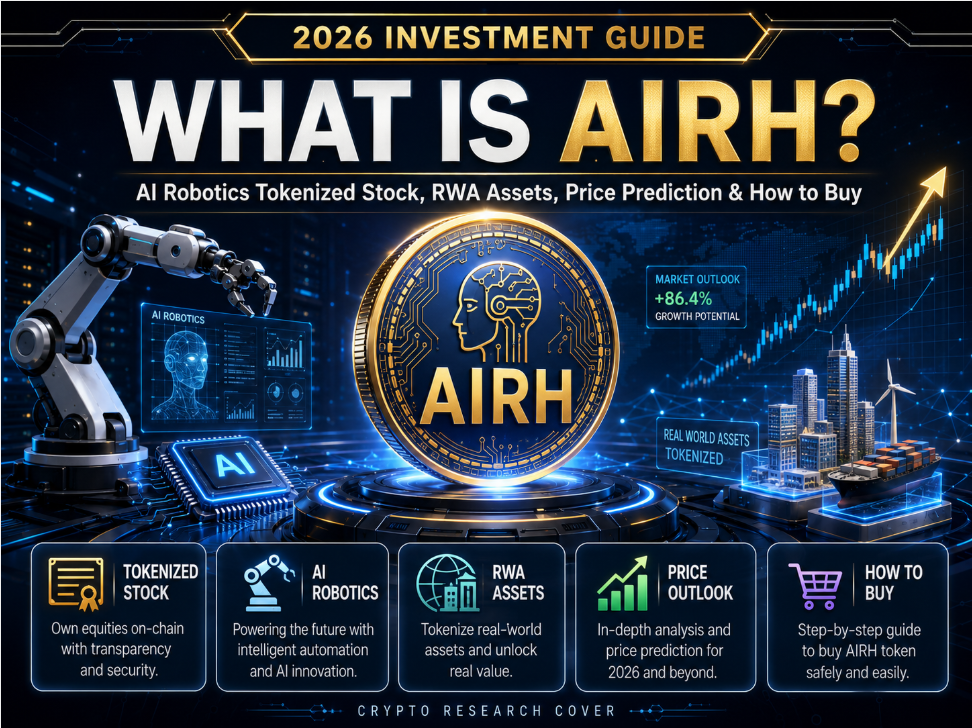
Tokenized Stock, as the name suggests, is a stock that has been tokenised. The basic idea is to take traditional stocks or stock‑related economic rights and express them as tokens via blockchain technology, enabling users to trade them in crypto markets.
Traditional stock investing usually requires a securities account, a broker, a stock exchange, and clearing systems. Trading hours are limited, and there are often geographical restrictions, account opening hurdles, deposit issues, tax considerations, settlement cycles, and trading permissions.
Tokenized Stocks attempt to bring traditional stock assets into the crypto trading environment. Users can trade with USDT, view prices, place orders, hold, and transfer on supported platforms more conveniently.
For example, xStocks’ website states that its tokenised US stocks and ETFs are backed 1:1 by underlying assets, can be traded 24/7, and support cross‑chain usage. Similarly, OKX’s introduction to Unified Tokenized Stocks mentions that these products allow users to hold and trade price exposure to underlying stocks or ETFs, with USDT‑denominated trading pairs and 24/7 trading.
This highlights three core attractions of tokenised stocks.
First, more flexible trading hours.
Traditional stock markets have fixed trading hours, while crypto users are accustomed to round‑the‑clock trading. Bringing stock price exposure into crypto aligns better with global user habits.
Second, potentially lower barriers to entry.
Many crypto users do not have a traditional brokerage account but are already familiar with USDT, exchanges, and Web3 wallets. Tokenized Stocks lower the cost of accessing traditional assets.
Third, bringing traditional assets into the Web3 ecosystem.
In the future, Tokenized Stocks could be used not only for spot trading but also in on‑chain asset management, DeFi collateral, RWA index products, automated portfolios, and cross‑chain liquidity scenarios.
However, Tokenized Stocks are not a simple copy of the actual stock. As Crypto.com explains in its help centre, tokenised stocks do not confer direct ownership of the underlying stock; voting rights, dividend rights, and other shareholder rights depend on the specific product terms.
This is the most critical point when understanding AIRH: while AIRH provides exposure to AI‑related assets, whether it is equivalent to a traditional stock, whether it carries voting rights, dividend rights, redemption rights, or actual stock ownership, must be verified against the specific issuance structure and platform rules.
4. The Investment Logic Behind AIRH: Why Is the AI Robotics Sector Gaining Attention?
AIRH is particularly relevant as a topic for AI assets and RWA because it is closely tied to the AI Robotics narrative.
AI Robotics – the field of AI‑driven robots – is becoming a very important segment of the AI industry. In the past, AI was mostly focused on language models, image generation, code generation, and digital applications. But as model capabilities improve, AI is expanding into the physical world, and robotics is a key vehicle for bringing AI into industrial, warehousing, healthcare, service, home, and manufacturing environments.
The AI robotics industry chain can be understood as follows:
- AI models are responsible for understanding and decision‑making.
- Robot control systems execute actions.
- Sensors perceive the environment.
- Mechanical structures perform physical tasks.
- Automation equipment enables real‑world deployment in factories or warehouses.
- Commercial applications turn robots into real productivity.
This chain connects industrial automation, humanoid robots, enterprise efficiency, labour force changes, and advances in AI model capabilities.
According to the International Federation of Robotics (IFR) World Robotics 2025 report, global industrial robot installations reached approximately 542,000 units in 2024 – more than double the figure from a decade ago. The IFR also projects that global robot installations will grow to about 575,000 units in 2025. This shows that the robotics industry is not just a conceptual hype; it has a solid foundation in industrial applications.
At the same time, developments in generative AI, large language models, multimodal models, and robot control algorithms are drawing renewed market attention to humanoid robots, smart manufacturing, automated logistics, AI machine vision, and robotics software platforms. The IFR also lists artificial intelligence and machine learning as important trends in robotics, noting that generative AI interfaces are making robot programming more intuitive.
Thus, the investment logic for AIRH can be framed as:
It is not a pure bet on any single AI chat application, but rather a combination of the AI robotics industry, tokenisation of traditional assets, and a crypto trading on‑ramp.
5. Does Investing in AIRH Equal Investing in AI Robotics?
This point needs careful clarification.
Buying AIRH does not mean you are directly investing in a specific robotics product.
It does not mean you directly own traditional stock in any AI robotics company.
Nor does it mean you are directly participating in AI technology development.
AIRH is better understood as: gaining an investment exposure to price changes in AI robotics or AI‑related underlying assets through a Tokenized Asset.
This means AIRH’s price logic may be influenced simultaneously by three factors.
First, whether the AI robotics industry continues to grow.
If industrial automation, humanoid robots, smart manufacturing, AI machine vision, enterprise automation, and robot control systems continue to advance, market attention to AI Robotics‑related assets may increase.
Second, how the underlying assets perform.
If AIRH corresponds to certain AI‑related corporate stocks, asset portfolios, or price exposures, the performance of those underlying assets will directly affect AIRH’s price.
Third, whether the RWA market is gaining traction.
If the Tokenized Stock and RWA sectors warm up overall, and users become more willing to participate in traditional assets through crypto markets, AIRH may also see increased trading demand.
Therefore, AIRH is not “buying AI technology itself”, but rather “buying a tokenised expression of AI‑related assets in the crypto market.”
6. Why Are AI and RWA Converging?
The convergence of AI and RWA stems from the intersection of two major trends.
First, AI industry assets are attracting growing investor interest.
Whether it is AI chips, cloud computing, data centres, industrial automation, robotics, machine vision, smart manufacturing, or enterprise AI applications, capital markets are looking for assets that can benefit from long‑term AI growth.
Second, traditional assets are entering crypto markets.
In the past, crypto users mainly bought BTC, ETH, DeFi tokens, meme coins, and on‑chain application tokens. Now, more platforms are attempting to bring traditional assets such as stocks, ETFs, bonds, gold, and funds onto the blockchain or into exchange environments.
As Reuters has noted, the industry sees tokenised stocks as enabling 24/7 trading and instant settlement, potentially improving liquidity and lowering transaction costs. At the same time, different tokenised stock products vary in terms of rights, disclosures, regulatory applicability, and investor protection.
AIRH emerges precisely in this context: AI robotics is a hot industry sector, RWA is the direction of asset on‑boarding, and Tokenized Stock is the specific form in which traditional stocks enter crypto markets.
So AIRH’s positioning is not a single AI coin, but a hybrid asset combining “AI Robotics + RWA + Tokenized Asset.”
7. How Does AIRH Work? What Are the Underlying Assets and Price Mechanisms?
To understand why AIRH has value, you cannot just look at the price chart; you also need to understand its asset structure.
A typical RWA or Tokenized Stock structure works like this:
- A real‑world asset is identified and verified.
- A custodian or issuance structure holds, manages, or maps the underlying asset.
- The issuing platform converts the corresponding asset rights or price exposure into a token.
- AIRH (the token) enters a trading platform or on‑chain environment.
- Users trade AIRH through their crypto accounts.
- The price fluctuates based on underlying asset performance, market supply/demand, and trading liquidity.
In this structure, AIRH’s core value does not come from “having its own public chain,” but rather from the underlying asset value, AI industry expectations, RWA issuance structure, platform support, and user demand.
This is why AIRH cannot be analysed like an ordinary altcoin. Typical crypto tokens require looking at tokenomics, on‑chain activity, ecosystem projects, TVL, protocol revenue, and community growth. AIRH, by contrast, demands examination of whether the underlying asset is clear, whether the issuance mechanism is transparent, whether custody arrangements are reliable, whether trading depth is adequate, and whether there are regulatory restrictions.
Crypto.com also warns in its Tokenized Stocks research that investors need to be aware of counterparty risk from centralised custodians, as well as the lack of direct legal ownership or voting rights.
Therefore, analysing AIRH must cover both the “AI industry” and the “RWA product structure.”
8. How Does AIRH’s Price Relate to the AI Industry?
There is likely a strong emotional and fundamental correlation between AIRH’s price and the AI industry.
When the AI sector is in an upcycle, the market tends to pay more attention to AI robotics assets. For example, improvements in large language models, breakthroughs in robot control systems, growing enterprise demand for automation, and commercialisation of humanoid robots can all boost investor interest in AI Robotics.
When the AI sector cools down, AIRH may also be affected. For instance, disappointing AI investment returns, slow robot commercialisation, difficult technology deployment, corporate budget cuts for automation, or valuation corrections can put pressure on AIRH.
Positive factors include:
- Expanding AI robotics market size
- Continued industrial automation
- Corporate willingness to invest in robotics and automation
- Improved robot control and interaction enabled by stronger LLMs
- Institutional capital flows into AI Robotics
Negative factors include:
- Declining AI investment sentiment
- Overly long commercialisation cycles for robot products
- Stubbornly high hardware costs
- Intense industry competition
- Correction after overvaluation of underlying assets
Thus, AIRH is not simply about “is AI hot?” but rather whether the AI robotics industry can move from concept to real commercial revenue.
9. What’s the Difference Between AIRH and Traditional AI Stocks?
AIRH and traditional AI stocks have similarities, but also clear differences.
Similarities: both are influenced by AI industry trends, underlying company performance, market valuations, and investor sentiment.
Differences: traditional AI stocks are typically bought through a brokerage account, traded on stock exchanges, and subject to exchange rules and trading hours. AIRH appears as a token in crypto markets, often traded with USDT, and offers a trading experience closer to digital assets.
Traditional stocks usually have clearer rights, such as shareholder rights, voting rights, dividend rights, corporate announcements, and regulatory disclosures. Whether AIRH (as a tokenised asset) carries these rights depends on the specific issuance mechanism.
This is why AIRH cannot be simply equated with a traditional stock.
A more accurate understanding is:
- Traditional AI stocks are AI assets in the stock market.
- AIRH is an AI‑related Tokenized Asset in the crypto market.
The former is more TradFi, the latter is more RWA combined with crypto.
For users, AIRH’s advantage is a trading on‑ramp that is closer to the crypto world; the risk is that the product structure is more complex and may lack some of the rights that traditional stockholders enjoy.
10. What’s the Difference Between AIRH and ETH?
AIRH and ETH are not the same type of asset.
ETH is the native asset of the Ethereum network. Its value comes from the Ethereum ecosystem, gas demand, Layer‑2 development, DeFi, stablecoins, NFTs, RWA on‑boarding, and developer activity. ETH is more like a foundational infrastructure asset in the crypto world.
AIRH, on the other hand, is an AI Robotics‑related RWA or Tokenized Asset. Its value depends more on the performance of underlying AI assets, the AI robotics industry cycle, RWA market demand, and platform trading liquidity.
ETH’s key question is: will the Ethereum network continue to be used, will its ecosystem thrive, and will on‑chain applications grow?
AIRH’s key questions are: do AI robotics‑related assets have value? How are the underlying assets performing? Is the RWA structure reliable? Is the market willing to trade this type of asset?
So ETH and AIRH are not competitors; they are different asset classes. Users can check the ETH price prediction to understand long‑term trends in foundational public‑chain assets, and then compare that with the investment logic for RWA assets like AIRH.
11. How Does AIRH Differ From Other Web3 Assets?
To help newcomers build an asset classification framework, we can place AIRH alongside other crypto assets.
- EDU is more of a Web3 education ecosystem token, with value logic tied to education applications, ecosystem partnerships, user adoption, and Web3 education scenarios. To understand application‑oriented tokens, read What Is EDU.
- STORJ is more of a decentralised storage infrastructure token, with value logic derived from storage network demand and decentralised cloud storage ecosystems. See What Is STORJ.
- PHA leans towards AI/Web3 infrastructure, useful for understanding AI‑blockchain integration assets. Read What Is PHA.
- BANK is more of a DeFi financial ecosystem token, with value logic from financial protocols, trading, liquidity, and DeFi narratives. Check What Is BANK.
AIRH is different. It is not a pure Web3 application token, nor a typical DeFi token, but rather a tokenised expression of AI Robotics‑related assets. It bridges the AI robotics industry, traditional financial assets, and crypto trading markets.
That is precisely AIRH’s unique positioning: it is not simply an “AI coin”, but an AI‑related RWA asset.
12. Why Does AIRH’s Price Rise or Fall?
When users search “what is the future price trend of AIRH”, the most important thing is to focus on the price drivers, not just look at the short‑term chart.
AIRH’s price is mainly influenced by three categories of factors.
First: developments in the underlying AI industry.
If the AI robotics market continues to grow, industrial automation demand strengthens, humanoid robot commercialisation advances, and AI model capabilities improve, the market may revalue AI Robotics assets higher. Conversely, if commercialisation is slower than expected, enterprise budgets shrink, hardware costs remain high, or technological breakthroughs stall, AIRH’s price may come under pressure.
Second: developments in the RWA market.
If Tokenized Stocks and RWA assets receive more platform support, and users become more willing to trade traditional asset exposures via crypto accounts, AIRH could gain more attention and liquidity. If RWA market heat cools, regulatory restrictions tighten, or platform support diminishes, AIRH may face reduced trading demand.
Third: the crypto market cycle.
Although AIRH is not a typical crypto project token, it still trades within crypto market environments. BTC and ETH trends, USDT liquidity, market risk appetite, and capital flows into AI and RWA sectors all affect AIRH’s short‑term price. When risk appetite is high, capital may be more willing to experiment with new assets like AI, RWA, and Tokenized Stocks. When markets turn risk‑off, funds may flow back to BTC, ETH, or stablecoins, potentially reducing liquidity for newer assets like AIRH.
13. AIRH Price Prediction 2026: Which Indicators Should You Watch?
An AIRH price prediction for 2026 cannot rely solely on historical price movements. For an asset like AIRH, forecasts should incorporate at least three dimensions.
First: AI industry fundamentals.
Watch for commercialisation progress in AI robotics, industrial automation demand, humanoid robot applications, enterprise spending, robot control system breakthroughs, AI model capability improvements, and cost reductions across the supply chain. If AI Robotics moves from concept to scaled deployment, market attention to AIRH may rise.
Second: underlying asset performance.
If AIRH corresponds to a particular AI‑related stock, asset portfolio, or RWA price exposure, then the underlying asset’s revenue, profit, valuation, business growth, and market expectations will all affect AIRH’s price.
Third: token trading data.
Monitor AIRH trading volume, liquidity, bid‑ask spread, order book depth, holder changes, and platform support. If trading volume is low, the short‑term price may be more easily moved by small amounts of capital, and slippage may be higher.
Fourth: RWA sector developments.
Keep an eye on Tokenized Stock market size, regulatory changes, institutional participation, custody transparency, redemption mechanisms, and more asset on‑boarding cases.
Users can refer to the AIRH price prediction page for trend references and market forecasts. However, it is important to understand that predictions are not guarantees of returns and cannot substitute for your own research and risk assessment.
A more rational approach is:
- First, understand what AIRH is.
- Then assess whether the AI robotics industry is worth long‑term attention.
- Then observe AIRH’s trading depth and RWA market heat.
- Finally, decide whether to participate based on your own risk tolerance.
14. How to Buy AIRH: A Beginner’s Investment Process
Users searching “How to buy AIRH” or “AIRH purchase guide” can follow these steps.
Step 1: Find a platform that supports AIRH trading.
Start by visiting Hibt’s AIRH/USDT quote page to check real‑time prices, trading information, and market data.
Step 2: Prepare a crypto trading account.
If the platform supports AIRH trading, you need to complete account registration, security settings, and any required identity verification. Different regions may have different trading restrictions, so always refer to the platform’s rules.
Step 3: Prepare USDT funds.
AIRH is typically traded as the AIRH/USDT pair. Beginners should not jump in with a large position; instead, determine an investment amount and risk tolerance first.
Step 4: Search for AIRH/USDT.
Go to the trading page, search for AIRH, and confirm the trading pair name, price, volume, and depth to avoid buying a similarly named asset by mistake.
Step 5: Choose your buy order type.
Market orders are suitable for users who want quick execution, but if market liquidity is insufficient, slippage may occur.
Limit orders are suitable for users who want to control costs. For a newer RWA asset like AIRH, beginners are better off using limit orders to avoid unfavourable execution due to shallow order books.
Step 6: Manage your position.
Before buying AIRH, decide on a position size. Do not ignore the asset’s inherent volatility and liquidity risks just because AI and robotics are hot topics.
Step 7: Set an exit plan.
Think through before buying: at what level would you take partial profits? At what level would you reduce your position? What if trading volume drops? What if platform rules change? What if the AI Robotics narrative cools?
Investing in AIRH is not “buy and forget” – it requires continuous tracking and dynamic management.
15. What Are the Risks of Investing in AIRH?
AIRH’s opportunities come from the combination of AI Robotics, RWA, and crypto markets, but its risks come from these same three areas.
First: AI industry risk.
Although the AI robotics industry has great potential, commercialisation is not easy. Robotics involves hardware, software, control systems, sensors, supply chains, costs, reliability, safety, and scenario adaptation. Even if AI model capabilities improve, that does not mean robots can be deployed at scale immediately.
Second: technology deployment risk.
Many AI robotics projects show impressive demos, but when it comes to real‑world factories, warehouses, hospitals, homes, or commercial settings, they must cope with complex environments, continuous stable operation, maintenance costs, and liability issues.
Third: valuation risk.
AI and robotics are hot sectors, and hot sectors often become overvalued. Once the market realises that commercial revenue is not keeping up with expectations, related assets may correct sharply.
Fourth: RWA asset authenticity risk.
As an RWA or Tokenized Asset, investors need to confirm whether there is a real underlying asset, how it is custodied, how the issuer proves asset backing, and whether the platform discloses sufficient information.
Fifth: custody and issuer risk.
If the underlying asset is held by a third‑party custodian, users bear counterparty and issuer risks. If the issuer is opaque, lacks compliance, or mismanages the asset, AIRH’s price and user interests may be affected.
Sixth: liquidity risk.
If AIRH’s trading volume is insufficient, the bid‑ask spread may widen. In extreme cases, users may not be able to buy or sell at a reasonable price.
Seventh: regulatory risk.
Tokenized Stocks and RWA assets involve traditional financial assets and securities regulation. Different countries and regions may have varying definitions, sales restrictions, investor eligibility rules, and disclosure requirements. Reuters has noted that tokenised stocks have already attracted regulatory attention regarding investor protection, rights disclosure, and applicable regulations.
Eighth: price deviation risk.
AIRH’s price may be influenced by crypto market supply/demand, liquidity, trading hours, platform depth, and market sentiment, and may deviate from underlying asset value in the short term.
For these reasons, AIRH is not suitable for complete beginners who do not understand RWA mechanisms, cannot tolerate high volatility, have no risk management plan, and are looking to allocate a large position.
16. Is AIRH Worth Investing In? How to Build Your Own Judgment?
“Is AIRH worth investing in?” cannot be answered with a simple “yes” or “no.” A more sensible approach is to build a decision framework.
Those who are bullish on AIRH typically focus on three directions.
First, they are optimistic about AI’s long‑term development.
If you believe AI model capabilities will continue to improve and will expand from the digital world into the physical world, then the AI robotics industry may offer long‑term investment value.
Second, they are optimistic about robotics industry growth.
If you believe industrial automation, humanoid robots, logistics robots, service robots, and smart manufacturing will continue to develop, then AIRH as an AI Robotics asset is worth researching.
Third, they are optimistic about RWA financial innovation.
If you believe that traditional assets such as stocks, funds, bonds, and commodities will increasingly enter crypto markets, then AIRH serves as an interesting entry point for AI‑related RWA assets.
However, AIRH is not for everyone.
- If you only want to invest in BTC and ETH and have no interest in traditional asset exposures, AIRH may not be for you.
- If you do not understand RWA mechanisms, or are unclear about the differences between Tokenized Stocks and traditional stocks, you should not buy blindly.
- If you cannot tolerate high volatility, low liquidity, wide spreads, and regulatory changes, AIRH is not suitable for a heavy allocation.
- If you are tempted to chase price spikes simply because “AI robotics is hot”, you should also proceed with caution.
For beginners, AIRH is better viewed as a learning entry point into AI assets, RWA assets, and Tokenized Stock mechanisms, rather than a speculative target for large upfront investments.
17. What Indicators Should You Track for AIRH’s Future Development?
If you plan to follow AIRH over the long term, you can observe it from three levels.
First: AI industry indicators.
Watch commercialisation progress in AI robotics, industrial robot installations, humanoid robot production volumes, enterprise automation spending, control system breakthroughs, AI model capability improvements, and hardware cost trends.
Second: token indicators.
Monitor AIRH trading volume, circulating supply, market depth, bid‑ask spread, price volatility, holder changes, and platform support. Stable trading volume suggests stronger market participation, and tighter spreads indicate better liquidity.
Third: RWA industry indicators.
Follow regulatory policies for Tokenized Stocks, custody transparency, issuer disclosures, new cases of stock tokenisation, institutional involvement, and support from traditional finance platforms for RWA.
Fourth: crypto market indicators.
Watch BTC and ETH trends, USDT liquidity, the AI sector’s heat, RWA capital inflows, and overall market risk appetite.
Fifth: Hibt platform data.
Users can continuously check AIRH real‑time quotes and the AIRH price prediction to combine price, volume, and forecast trends for dynamic assessment.
18. AIRH FAQ: Common Questions for Beginners
What is AIRH?
AIRH is an AI Robotics‑related RWA tokenised asset – better understood as a Tokenized Asset or Tokenized Stock‑type product. It is not an AI chatbot token or a meme coin, but a product that expresses price exposure to AI‑related underlying assets through crypto markets.
What is the AIRH coin?
Many users search “what is the AIRH coin”, but strictly speaking, AIRH should not be treated as a simple coin. Although it trades in token form, its core logic is closer to an AI‑related RWA asset or a tokenised stock asset.
Is AIRH an AI coin?
AIRH is not an AI application token in the traditional sense. Unlike some AI crypto projects that rely on on‑chain model networks, AI Agent ecosystems, or protocol tokenomics, AIRH is closer to a tokenised expression of AI‑related assets, with emphasis on underlying asset exposure and RWA structure.
How is AIRH different from ordinary AI tokens?
Ordinary AI tokens typically depend on on‑chain ecosystems, protocol functionality, compute networks, data markets, or AI application revenue. AIRH, on the other hand, leans towards AI Robotics asset exposure, falling into the RWA or Tokenized Asset category, with value logic more closely tied to underlying asset performance, RWA market demand, and trading liquidity.
How do I buy AIRH?
You can buy AIRH on platforms that support it. Beginners can start by visiting the AIRH/USDT quote page, prepare USDT funds, search for the AIRH/USDT trading pair, and then choose between limit or market orders based on their risk tolerance.
What factors affect AIRH’s price?
AIRH’s price is mainly influenced by AI robotics industry trends, underlying asset performance, RWA market developments, crypto market liquidity, trading volume, bid‑ask spreads, platform rules, and the regulatory environment.
How should I interpret AIRH price predictions?
AIRH price predictions should not be based solely on historical charts. Investors need to combine AI industry growth, robot commercialisation progress, underlying asset performance, trading volume, liquidity, and RWA market heat. You can refer to the AIRH price prediction page, but remember that predictions are not guarantees of returns.
What’s the difference between AIRH and ETH?
ETH is the native asset of the Ethereum public chain, with value derived from the Ethereum network ecosystem, gas demand, Layer‑2, DeFi, and on‑chain applications. AIRH is an AI Robotics‑related RWA asset, with value more dependent on the AI industry, underlying assets, and tokenised trading demand. They are not the same asset class.
Is AIRH worth investing in?
Whether AIRH is worth investing in depends on whether you are bullish on the AI robotics industry, whether you understand RWA mechanisms, whether you can accept Tokenized Asset risks, and whether you have position management skills. For newcomers, it is better to study first, observe with a small position, and avoid heavy allocations blindly.
Conclusion: AIRH Is Not an Ordinary AI Coin – It’s an Entry Point for AI Robotics Assets Into Crypto Markets
AIRH’s core value does not lie in whether it is a short‑term hot AI coin, but in the fact that it represents a new way of connecting assets: AI robotics‑related assets are entering crypto markets through RWA and Tokenized Stock structures.
It connects the AI Robotics industry trend. It connects the tokenisation of traditional assets. It connects the trading needs of crypto users. And it connects the expansive imagination of future RWA asset growth.
So, understanding AIRH requires more than just a “crypto hype” lens, and more than just a “traditional stock” lens. A more accurate perspective is to view it as a hybrid asset combining “AI Robotics + RWA + Tokenized Asset.”
For newcomers, before investing in AIRH, at least answer these five questions:
- What exactly is AIRH?
- Is it an ordinary AI token?
- How does it relate to traditional stocks or AI corporate assets?
- What factors determine its price?
- What are its risks?
Once you can answer these questions, combine them with research from AIRH real‑time quotes, AIRH price prediction, ETH price prediction, What Is PHA, What Is STORJ, What Is EDU, and What Is BANK – that will be a more prudent path to investment.
AIRH is not an asset for everyone, but it is an excellent entry asset for understanding the trends of AI Robotics, RWA, and Tokenized Stocks.